We use necessary cookies and the Meta Pixel to measure campaigns and improve our offers. You can change your optional-cookie preferences at any time. Read our Terms and conditions.
Lash extensions vs. lash lift: results, cost, and upkeep
Silvana DebiasiSeptember 1, 2026Updated on October 21, 2026 13 min read
A lash lift curls your natural lashes so their tips show more clearly. Lash extensions add fibers for extra length or fullness. The difference affects both the result and your schedule: a lift gradually grows out, while extensions need fills to keep the set even. Choosing between them means matching the look you want with your own lashes, daily care, and the cost of repeat visits.
At a glance: consider a lash lift if your lashes are straight and you want more curl with fewer appointments. Choose extensions if you want added length or fullness and can manage daily cleaning and fills, often every 2 to 3 weeks. A lift commonly lasts about 6 to 8 weeks, but neither service has a guaranteed timeline. Current irritation or a previous reaction needs attention before you book.
Lash extensions vs. lash lift: the main differences
What matters
Lash lift
Lash extensions
What changes
The curve and direction of existing lashes
Length and fullness from added fibers
Added material
No fibers; an optional tint adds color
Artificial fibers and professional adhesive
Realistic result
Uses the length and number of lashes you already have
Classic, hybrid, or volume styling within what your lashes can support
Repeat visits
Reassess around 6 to 8 weeks, depending on the system and regrowth
Fills often every 2 to 3 weeks; fewer usable extensions may mean a new set
Daily care
Gentle cleansing after the system’s initial care period
Clean the lash line and set daily, then brush gently when dry
Stopping the service
Allow the treated lashes to grow out; do not try to reverse the lift at home
Arrange professional removal if you no longer want the set
How a lift and extensions change a lash
Natural lash and added fiber
What each service changes
Lash lift
Reshapes your natural lash
The curve changes. The lash stays the same length.
Classic extension
Adds one fiber
1. Natural lash
2. Added fiber
3. Attachment along the lash
Side-view schematic, not to scale. A classic extension attaches along one natural lash and stays clear of the skin. Its length and weight must suit the natural lash.
For a lift, the professional positions your lashes on a silicone shield or rod and uses a chemical system to change their curve. It does not make the lash physically longer, create new lashes, or fill a bare patch. Straight or downward-pointing lashes can look longer from the front because more of their length becomes visible.
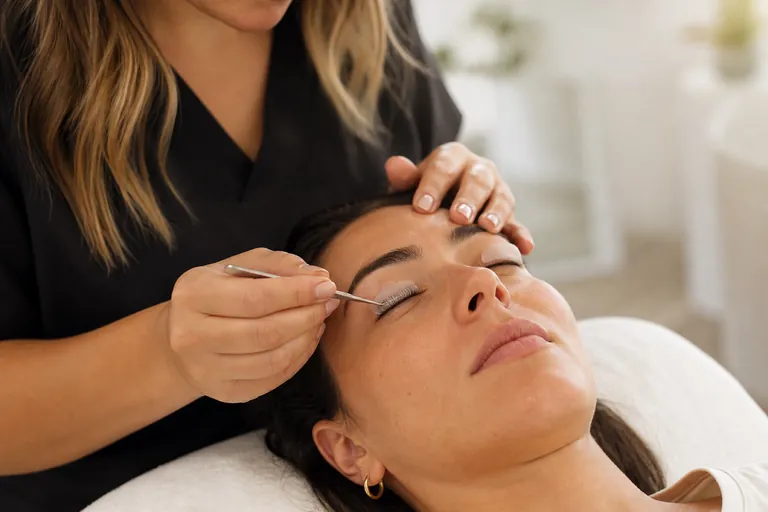
A classic extension set attaches one artificial fiber along one isolated natural lash, clear of the skin. Volume sets use fans of fine fibers; hybrid sets combine classic lashes and fans. The professional chooses the length, weight, and placement to suit the natural lashes. Adding fibers can make the lash line look fuller, but it does not treat lash loss or stimulate growth.
Which result suits your natural lashes?
A lift can make a noticeable difference on long, straight lashes. If the tips are pale, a suitable tint can make them easier to see. On short or sparse lashes, the available length and gaps still limit the result. Tint changes color; it does not add the thickness of mascara or the fibers of an extension set.
Extensions offer more control over length, curl, and how fullness is distributed across the eye. A light classic set can look subtle, while a fuller volume set creates a stronger outline. Bring a front-facing reference photo with the eyes open, then ask which parts of that look are realistic on your lashes.
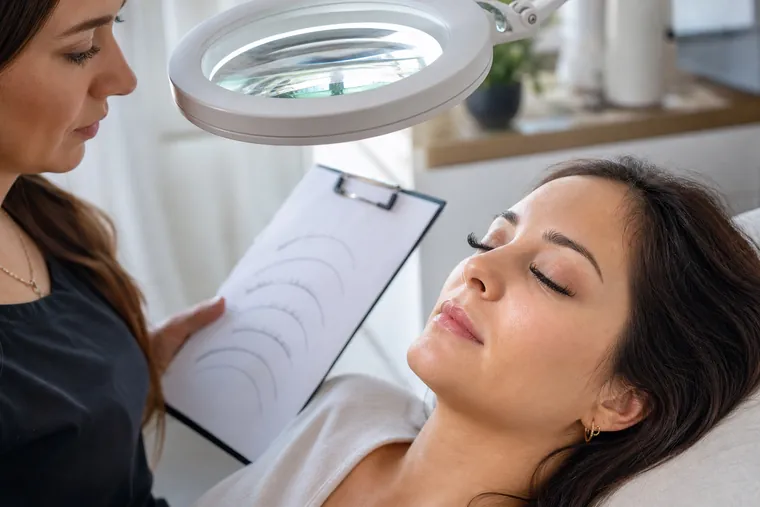
Fragile lashes cannot safely support a heavier set just to hide gaps. Tell the provider about recent lifting, previous reactions, and any pulling or breakage. Sudden lash loss, bare patches, or inflamed eyelids need a healthcare assessment before a cosmetic service. The pre-treatment consultation guide explains what to discuss.
How long do lash lifts and extensions last?
Elleebana USA describes a typical lift result of 6 to 8 weeks and recommends assessing the lashes before another treatment. As treated lashes shed and new lashes grow in their natural direction, the overall curl becomes less uniform. Tint can fade before the curl has fully grown out.
Extensions usually need maintenance sooner than a lift. The salon menus below offer fills at 2 to 3 weeks. A fill, also called an infill or refill, includes checking growth, removing extensions that are no longer positioned well, and replacing missing fibers on suitable lashes. The appointment interval is a starting point: retention, growth, and the salon’s eligibility rules determine whether you need a fill or a new set.
A few remaining extensions do not mean the set still has its original shape. Natural lashes grow and shed at different times, so both services change gradually rather than ending on a fixed expiration date.
Daily cleaning and the first few days
Get written instructions naming the lift system or extension adhesive used and when to resume washing, makeup, swimming, and steam. Waiting periods differ between systems. Elleebana’s lift aftercare says water will not undo its lift, but advises avoiding heat, steam, and rich products for the first 24 to 48 hours. Its named makeup remover and Elleevate mascara are exceptions to that product restriction.
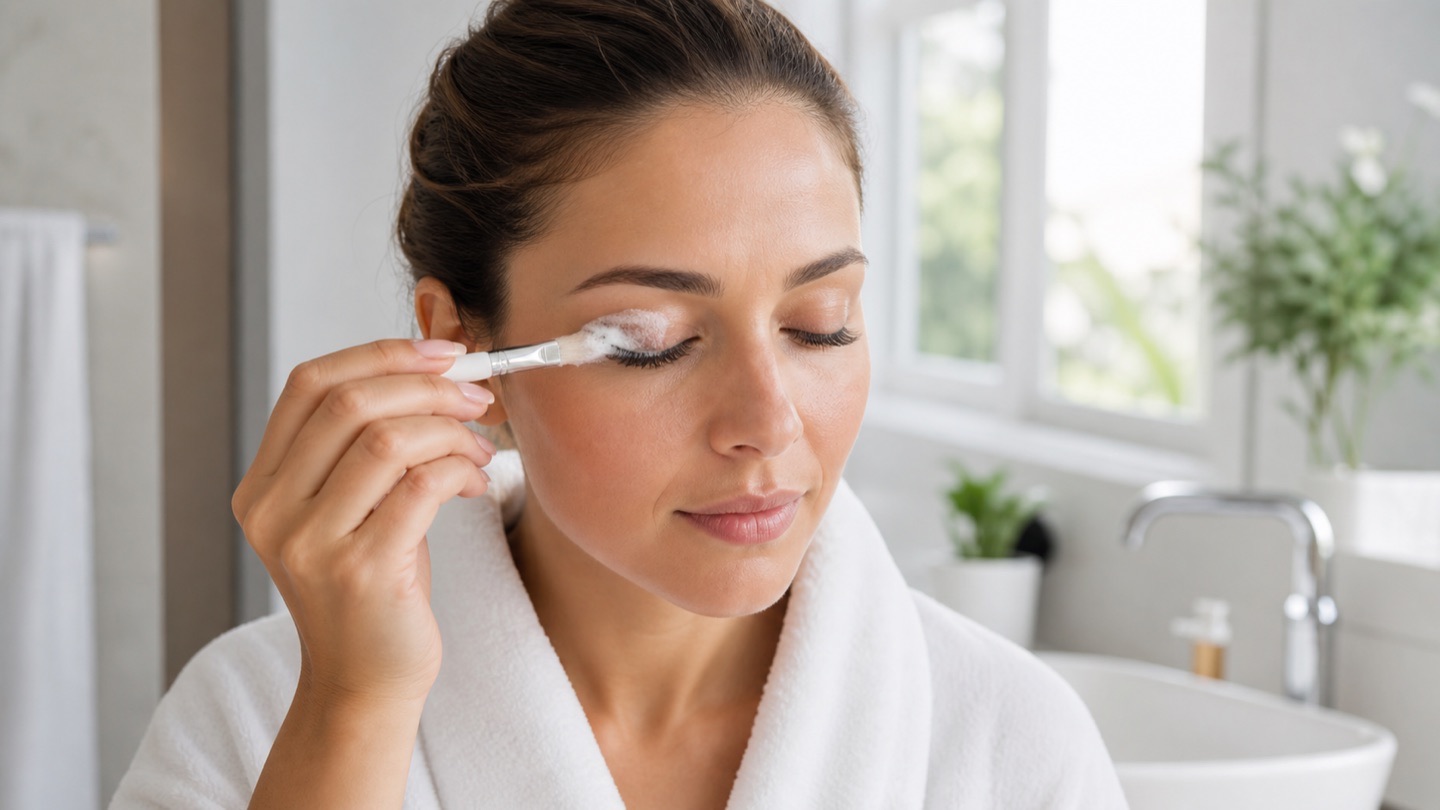
For extensions, clean the lash line and fibers daily once the initial care period allows it. One example is Borboleta Lash Bath: the manufacturer directs users to lather a dime-sized amount with its damp Clean Swoop Brush, gently cleanse over and under the lashes, rinse with water, and pat dry. Keep your eyes closed and use a cleanser compatible with your set.
Leaving makeup, oil, and debris at the roots makes the area harder to clean. After drying, brush lightly with a clean spoolie without pulling through a snag. Contact the salon if an extension pulls or the set hurts; do not pick it off.
Before a fill, the professional checks growth, direction, and which extensions can remain.
Appointments over eight weeks
Example with fills every three weeks
Appointments in the first eight weeks
Extensions
Lash lift
The extension example includes one full set and two fills. For the lift, weeks 6 to 8 are a time to assess regrowth before scheduling another treatment, not an automatic repeat appointment.
Tiana Lash Pro in Fremont lists 90 minutes for a classic full set and 80 minutes for its 15-to-21-day fill. Beauty Power Studio in Santa Clara lists 60 minutes for a lift with tint. These are appointment lengths from those salons, not chemical processing times or universal estimates.
At a lift reassessment, remaining curl, new growth, and lash condition may call for waiting longer. A long trip without access to fills can therefore make a lift easier to maintain.
US price examples and the cost of repeat visits
These two California salon menus were checked on October 21, 2026. They show local examples, not a national average. Confirm the current total and the exact service before booking.
$135 standard classic set; $70 fill at 1 to 14 days or $85 at 15 to 21 days. Lift $100; lift with tint $120.
A classic set needs replacement after 21 days or with 40% or fewer extensions remaining. Outside-salon classic fill $95; removal and wash $35. The menu also lists a $115 new-client set.
$195 classic set; $150 refill at 2 to 3 weeks or $170 at 3 to 4 weeks. Lift with tint $160.
After 4 weeks, a full set is required. Removal $50; colored lashes from $30. Confirm suitability for a refill and any additional work.
Using Tiana’s standard prices, a first set plus two three-week fills costs $135 + $85 + $85 = $305 over eight weeks. This assumes both fills take place within 21 days of the previous visit and enough extensions remain. One lift without tint costs $100; two would cost $200 if a second treatment is assessed as suitable and performed within that period. With tint, the corresponding totals are $120 and $240.
These examples exclude home-care products, removal, travel, any applicable tax, and optional gratuity. Ask whether a different style, an outside-salon set, or lower retention changes the quote. A second lift is a separate decision, not a necessary expense at week 6.
Mascara, eyeliner, swimming, and sleep
After a lift, use mascara when the system permits it. Elleebana’s USA guidance allows its Elleevate mascara immediately, while regular mascara has a 24-to-48-hour wait. An easy-to-remove formula reduces the need to rub. Let your eye makeup remover loosen the product before wiping gently.
For extensions, Xtreme Lashes’ aftercare guide advises against mascara on hybrid or volume sets because it can make the fans clump. For its classic sets, it permits its own extension-compatible mascara used as directed. It also advises avoiding waterproof makeup and mechanical or heated lash curlers. Those instructions belong to that system; ask your provider about the set you wear.
Xtreme Lashes specifies a three-hour initial restriction on excessive water, sweat, and humidity, including swimming, exercise, and sauna, and on reinserting contact lenses. This differs from many familiar 24-hour rules. Schedule activities around your actual aftercare instructions. Once washing is allowed, gently clean away sweat and pool residue. If you regularly wake with flattened lashes on one side, reduce pressure from sleeping face-down.
For a single occasion, removable strip lashes may fit your plans. They come off after use and have no fill schedule, though their adhesive can still cause a reaction. Avoid trying any unfamiliar lash service for the first time the day before an important event.
Sensitive eyes and when to stop
When to stop
Symptoms to report and urgent warning signs
Before
Report reactions and symptoms; remove contacts
During
Pain or burning: tell the provider immediately
Chemical splash
Rinse for 15 to 20 minutes, then call Poison Control
Urgent
Severe pain or vision changes: emergency care
Stop for pain or burning. After a chemical splash, rinse first and seek guidance. Do not force eyelids open if adhesive has sealed them.
Describe what “sensitive” means for you: itching, burning, watering, or a previous reaction to adhesive, tint, or pads. Mention eye conditions, medications, and recent treatments. Remove contact lenses before the appointment and bring glasses. The FDA advises avoiding eye cosmetics while an eye is infected or the surrounding skin is inflamed.
A lift uses chemical products near the eye, and extension adhesives can cause irritation or allergic reactions. A negative patch test cannot rule out every eye-area reaction. Follow the exact product’s testing instructions and discuss any previous reaction before another exposure. Do not try a different glue or chemical treatment at home to see whether it feels better.
Tell the professional immediately if you feel pain or burning, and stop the service. If a chemical splashes into the eye, Poison Control advises immediate rinsing with plenty of room-temperature water for at least 15 to 20 minutes, removing contact lenses. Then call US Poison Control at 1-800-222-1222 for guidance. Severe symptoms, including significant pain or vision changes, need emergency care after rinsing. Symptoms that persist an hour after rinsing began need an urgent eye examination.
If adhesive has sealed the eyelids, do not force them open. Do not put household solvents or lash remover into the eye. For irritation without a splash, stop the offending product and contact a healthcare professional if symptoms persist; marked swelling or changes in vision warrant prompt assessment.
Tint, professional licensing, and what to check
A lift and a tint are separate services. In the United States, a dye must be permitted for its intended use on lashes. The FDA’s color-additive guidance identifies silver nitrate as the only approved color additive for eyebrow or eyelash dyeing, under restricted professional-use conditions. Approval for another cosmetic use does not make a color additive suitable for lash tinting.
Licensing is a separate question. California includes lash and brow perming within the scope of estheticians, cosmetologists, and barbers, while paid extension services require a cosmetology or esthetician license. Those California rules do not establish permission in another state. Verify the provider’s license and the exact service with your state board; a salon menu alone does not establish product compliance or professional scope.
Removal, switching services, and combining them
Have extensions removed professionally when you want to stop or switch services. Pulling them off, picking with tweezers, or trying household oils and solvents can injure lashes or expose the eye to products not intended for it. The provider should assess the natural lashes after removal before agreeing to a lift.
There is no fixed seven-day or fourteen-day wait that makes every switch safe. Elleebana’s guidance on removal before lifting calls for an individual assessment because adhesives, removers, and lash condition differ. If lashes are broken, brittle, or uncomfortable, postpone the next service. Do not cover damage with more fibers or attempt to reverse an overprocessed lift yourself.
When switching from a lift to extensions, give the provider the treatment date and system name. A strong remaining curl may make isolation and attachment harder, so you may need to wait for it to grow out. Combining the two services requires a compatible professional protocol; for a first appointment, choose the one that best matches your desired result.
Choose for your routine
Your priority
Option to consider
What to plan for
More curl on long, straight lashes
Lash lift
Existing length and gaps remain
Added length or fullness
Extensions
Daily cleaning and repeat fills
Fewer salon visits
Lash lift
Gradual change as the lift grows out
A defined lash shape maintained over time
Extensions
Time and cost for maintenance and eventual removal
Current irritation or unexplained lash loss
Postpone both
Healthcare assessment before another cosmetic service
A consultation connects the desired look with your natural lashes and the care you can maintain.
Questions to ask before booking
Which parts of my reference photo are realistic on my lashes without overloading them?
How long are the first appointment and fills, and when should I return?
Which products will you use, and how will you record previous reactions?
Can you show me how to clean my lashes and give me written aftercare?
What will the next eight weeks cost, including fills, products, and removal?
Who should I contact if something feels wrong, and which symptoms need medical care?
If you want to learn the technique, the BeautyLearn lash lift course describes its curriculum and support. A private course certificate does not itself grant a US professional license.
Before your appointment: a checklist
Frequently asked questions
Which looks more natural: a lift or classic extensions?
A lift keeps your own lash length and density. Classic extensions can also look subtle if the length and placement are restrained. Compare photos taken with the eyes open in similar lighting so you can judge the curl and fullness you would see day to day.
Can either service let me skip mascara?
Extensions add visible fullness and definition, so many people do not need mascara with them. A lift, with an optional suitable tint, may be enough if you already have fairly full lashes. Sparse lashes will still have gaps after a lift.
Why did the salon charge for a new set instead of a fill?
A fill depends on how many usable extensions remain and how far they have grown out. Salons also set time limits. For example, Tiana’s classic fill applies through day 21 and requires more than 40% of the extensions to remain. Ask for the cutoff before booking, especially when changing salons.
Will my lashes look shorter after removing extensions?
Your natural lashes may look less noticeable after you have become used to added length and fullness. Compare them with a clear photo taken before your first set. Broken lashes, new gaps, pain, or unusual shedding should be assessed rather than dismissed as a change in perception.
Can I choose a lift because extension glue made me react?
A lift uses different products, but that does not establish that you will tolerate it. Tell the provider and your healthcare professional what happened and which adhesive was used. Wait until any irritation has resolved and the reaction has been assessed before considering another service.
Should I book a fill or lift right before a vacation?
Leave enough time to follow the initial aftercare and address any problem before traveling. If you will be away for several weeks without access to fills, consider how an extension set will grow out or plan professional removal. A lift involves fewer maintenance appointments, but its initial water, heat, and makeup instructions still matter.
A cautious consultation protocol before lash extensions or a lash lift: questions, descriptive observation, product instructions, consent, postponement, stopping and traceability.
A complete eyelash extension aftercare guide: cleansing, rinsing, drying, brushes, make-up, skincare, sleep, exercise, swimming, travel and signs that need professional or medical review.