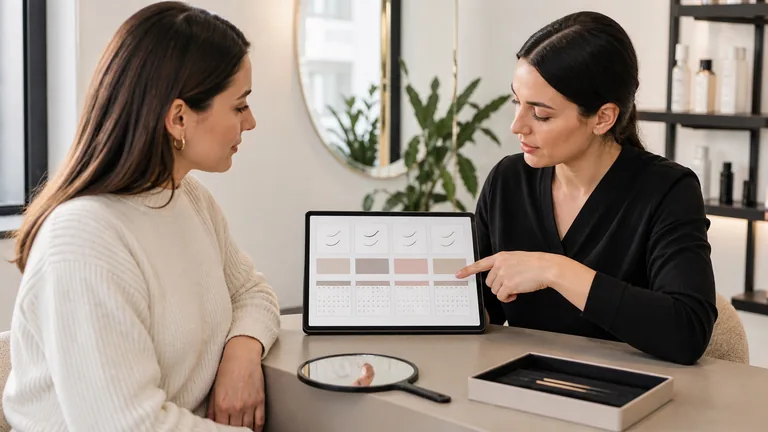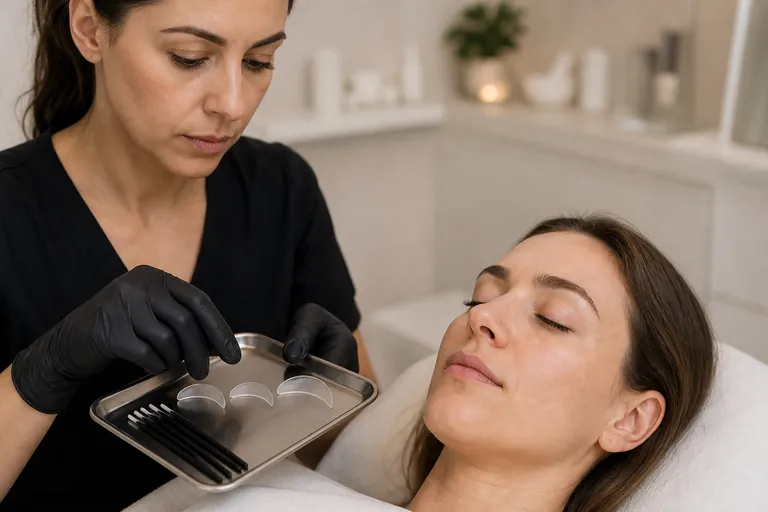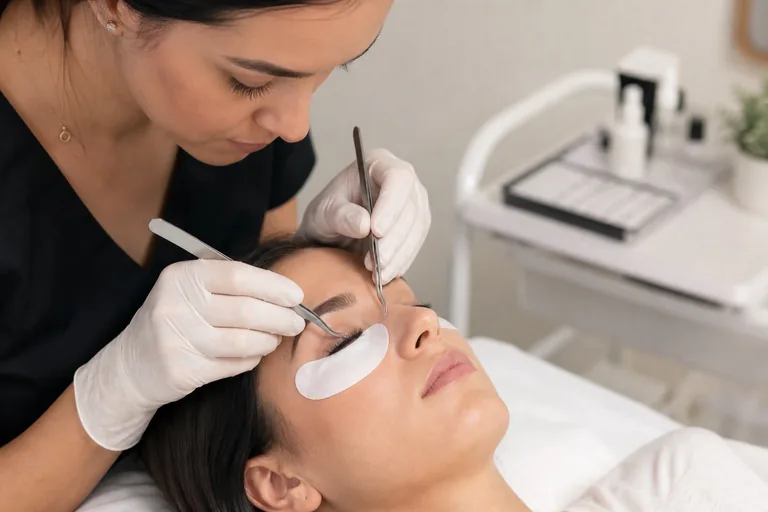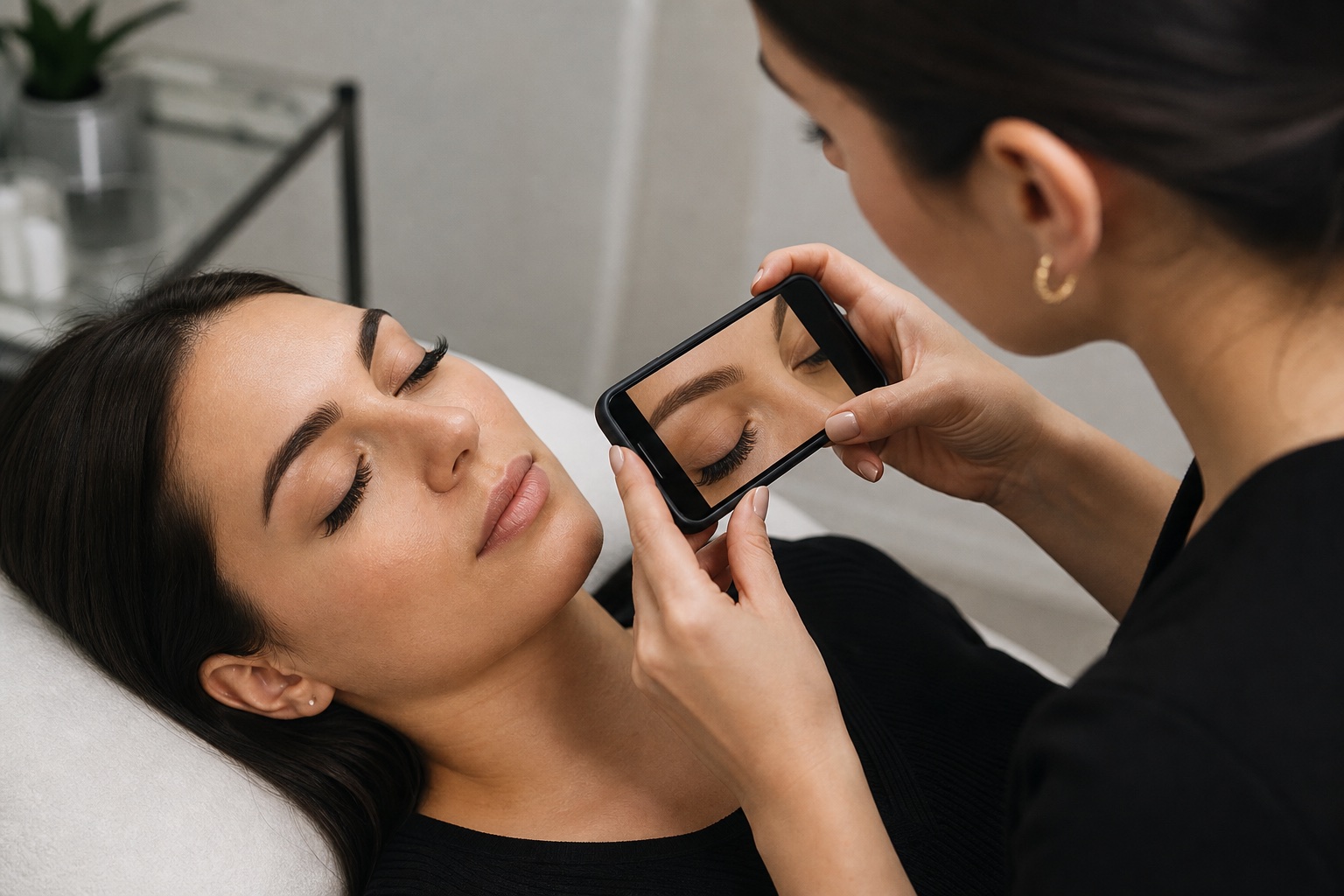

A consultation before lash extensions or a lash lift decides whether the requested service is appropriate today, requires an adaptation, should be postponed or must not begin. It is not a form to sign quickly and it is not a medical examination. It connects what the client reports, what the practitioner can describe externally, the technical needs of the service and the exact product instructions. A reasoned no or not today can be the most professional result.
Ask about the goal, current eye-area comfort, recent procedures, previous lash services and reported reactions. Observe visible features without naming a disease. Check the current label and manufacturer instructions for every product and system. Explain realistic outcomes, maintenance, alternatives and known limitations, then record the decision and consent. Eye pain, a change in vision, marked light sensitivity or a very red eye requires prompt healthcare assessment rather than a cosmetic service.
This guide owns the pre-treatment consultation intent. It does not diagnose blepharitis, allergy, conjunctivitis, dermatitis or another eye or skin condition, prescribe treatment or replace an optometrist, ophthalmologist, pharmacist, doctor or other qualified healthcare professional. The professional lash-lift procedure and the comparison of extensions and lash lifts remain separate. Here we build the decision that precedes either service.
What a lash consultation can and cannot establish
Describe enough to decide—do not diagnose
Cosmetic observation has a clear boundary
Ask
Symptoms, history and current comfort
Describe
Visible features in neutral language
Decide
Proceed, postpone or stop
Do not diagnose
Cause, condition or prognosis
A consultation can test whether the goal fits the visible natural base, collect relevant history, identify a reported symptom or visible change that makes proceeding unwise, apply product exclusions and agree a realistic plan. It can record the client reports itching since yesterday or diffuse redness is visible along the upper lid margin. It cannot conclude this is an allergy, this is blepharitis or this cannot be infectious.
One sign can have several causes, and the absence of a sign does not certify eye health or exclude sensitisation. A lash practitioner does not examine the ocular surface with diagnostic equipment, alter prescribed treatment or reassure someone about an urgent symptom. Language creates an operational boundary: accurate description supports a conservative decision; a diagnostic label creates false certainty and exceeds cosmetic scope.
The consultation can | The consultation cannot |
|---|---|
Record symptoms, previous reactions and products as reported by the client | Diagnose the cause or classify a reaction |
Describe external appearance, distribution, direction and visible integrity | Assess the cornea, conjunctiva, glands, follicle or exact growth phase |
Apply manufacturer warnings, exclusions and instructed preliminary checks | Invent a safety test or declare a product allergy-free |
Postpone and direct the client towards appropriate assessment | Determine diagnosis, treatment, recovery or medical suitability |
Three possible outcomes: proceed, postpone or stop
Three outcomes are all professional
The correct decision can be yes, not today or stop now
Proceed
Compatible plan and continued checks
Postpone
Wait for clarification or resolution
Stop
End exposure and follow incident steps
Record
Reason, product and next action
Proceed means that the available information, professional scope and current product instructions do not reveal a reason to withhold the planned service, and that client and practitioner agree the aim and limits. It is not a guarantee of result or absence of an adverse event. The plan still records products, service, adaptations, aftercare and conditions that would cause an interruption.
Postpone means do not begin today. A temporary issue needs to resolve, a manufacturer interval has not elapsed, a recent procedure needs clarification, a healthcare professional's advice is awaited or essential information is missing. Record postponed pending appropriate assessment rather than unsuitable as a permanent personal label.
Stop means end the process immediately when significant symptoms appear, product reaches an unintended area, discomfort increases or the service cannot remain controlled. Follow the exact incident and eye-contact instructions, preserve product identification and help the client access appropriate care. Do not finish a processing time simply because most of it has elapsed.
A deposit, discount, fully booked diary or opened kit must never influence the outcome. A clear postponement policy reduces commercial pressure before it occurs. Consent does not make a contraindication acceptable, and a waiver does not transfer technical responsibility to the client.
Prepare the consultation before the appointment
Send concise preparation information. Ask the client to arrive without eye make-up where possible, not to conceal symptoms with cosmetics and to bring details of a previous service or product linked to a reported reaction. Never ask them to stop medicines, prescribed eye drops or a medical device. If contact lenses affect your service protocol, explain the practical requirement in advance and do not improvise at the appointment.
Prepare a current consultation record, privacy information, readable product labels and instructions, identifiable batch or lot, suitable light and a reasonably private conversation area. Consult before opening single-use items or preparing reactive products. If you cannot identify the product, expiry or period after opening, batch, warnings, system compatibility or eye-contact instructions, you do not have enough information to start.
Decide in advance how urgent symptoms, language or communication needs, a minor client, impaired capacity, a late arrival or an unexpected product substitution are handled under local law and your insurer's requirements. A procedure written before the diary is full is easier to follow than a decision invented under pressure.
Essential questions without suggesting a diagnosis
Ask for facts, not a preferred answer
Current state, history, materials and goal
Today
Comfort, redness, pain and vision
History
Services, procedures and reactions
Materials
Products, tape, pads and latex
Goal
Result and sustainable maintenance
Start openly: how do your eyes and eyelids feel today? Then ask about pain, burning, itching, a foreign-body sensation, unusual watering, discharge, swelling, redness, light sensitivity and any change in vision. Record side, onset, change and the client's own words. If an important signal appears, do not keep asking questions as though enough favourable answers could cancel it.
Reconstruct previous extensions, lifts, tints, removals and reported reactions. Capture approximate date, service, known product, area, onset, duration and action taken. Write reported reaction after an unidentified adhesive when that is all that is known; do not upgrade it to diagnosed cyanoacrylate allergy. A useful record preserves uncertainty instead of filling it with a label.
Ask about recent eye or periocular procedures, trauma, surgery, ongoing treatment and relevant advice already given. You do not need a full medical history. If the answer requires clinical interpretation, postpone and ask the client to consult the professional managing their care. Also ask about contact lenses and reported sensitivity to tape, pads, latex or cosmetics because materials beyond the main product can matter.
Area | Useful wording | How to record it |
|---|---|---|
Current state | Do you have discomfort, pain, itching or any change in vision today? | Client's words, side, onset and pattern |
Previous services | Which service did you have, when, and what happened afterwards? | Timeline and product only when genuinely known |
Procedures and care | Have you received recent advice or treatment relevant to the eye area? | Only necessary information and resulting decision |
Materials | Have you reported reactions to cosmetics, adhesive, tape, pads or latex? | Confirmed substance or a neutral description |
Goal | What result do you want and what maintenance can you sustain? | Priority, expectation and explained limit |
External observation: describe without clinical interpretation
Observe under even light without manipulating a painful area. Describe visible distribution, direction, lengths, residue, apparent lash integrity, external skin appearance and whether comfortable eye closure is possible. Do not assign a follicle phase, judge follicle health or determine the cause of redness, thinning or breakage from appearance. The guide to natural-eyelash anatomy and the growth cycle explains this boundary.
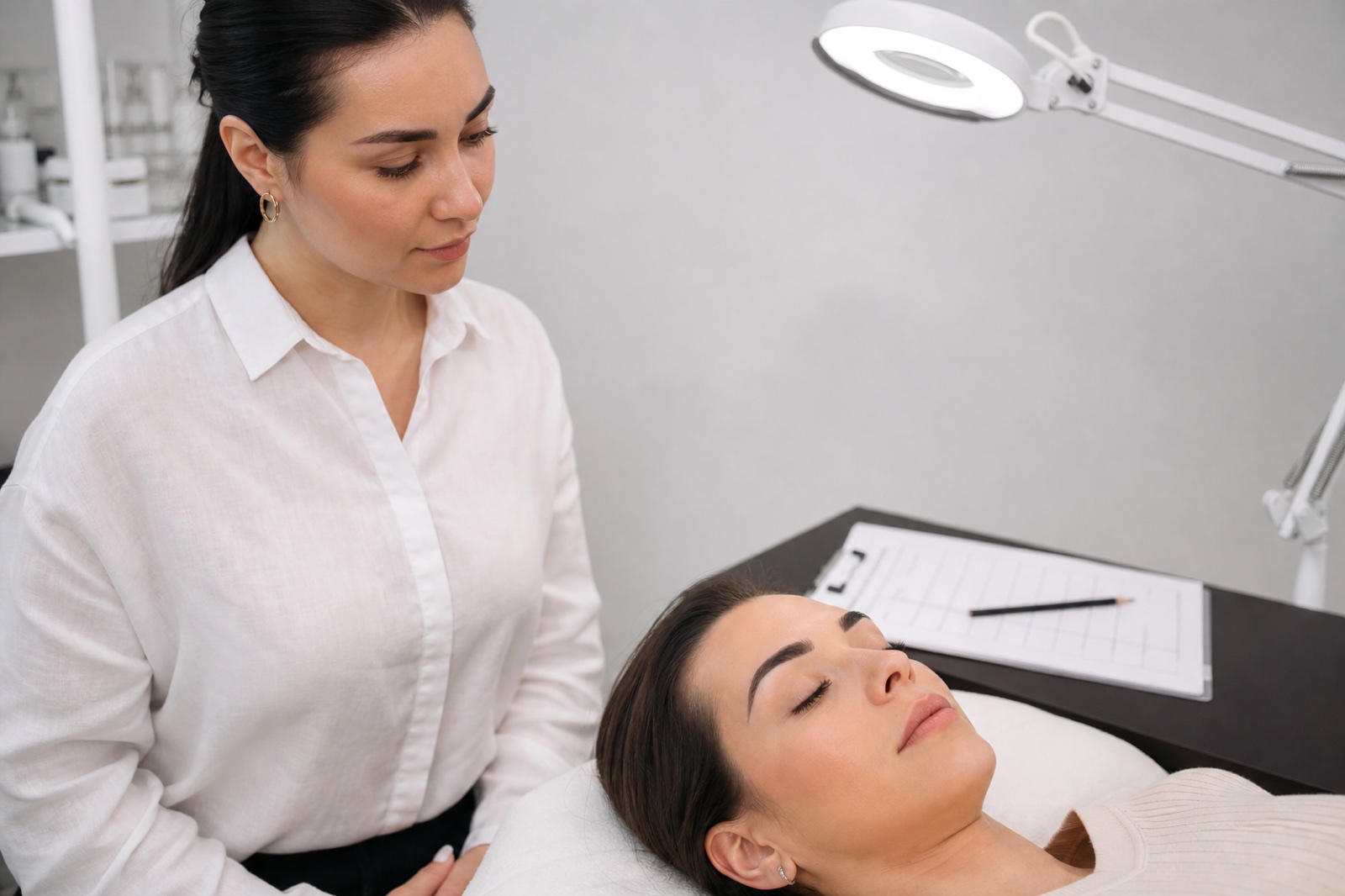
Use a repeatable structure: area, side, distribution, visible appearance, extent and a standardised photograph when necessary and permitted. Small pale flakes are visible at several points on both upper lash lines is a description; blepharitis is a diagnosis. The right upper eyelid appears more swollen than the left describes; allergic reaction interprets. A neutral description is enough to justify not proceeding and recommending appropriate assessment.
Do not remove or scrape material to investigate, pull lashes to test strength or use magnification as if it were a diagnostic instrument. The purpose is to identify a safe service boundary and a design-compatible base, not to prove why an appearance exists.
Technical assessment of the natural lashes
After no immediate reason to stop is found, assess what the cosmetic design needs: visible population, present lengths, directions, curvature, gaps, asymmetry and apparent external condition. For extensions, those observations inform mapping, curl, length, diameter, weight and coverage. A requested effect does not justify load that is incompatible with the available natural support.
For a lash lift, assess length, direction, crossings, eyelid relationship, previous-service result and visible fibre condition. Shield fit, wrap, tension and layout depend on this starting point and on the exact system. Never infer processing time from appearance alone. Timing, zones, quantity and sequence remain governed by current manufacturer instructions.
When a previous service cannot be reconstructed or the fibres appear significantly kinked, crossed or compromised, postponement can be a sound technical decision. The lash-lift troubleshooting guide explains why an immediate second chemical process is not an automatic correction.
Contraindications come from three different sources
Do not merge every limitation into one list
Product, technique and health signals require different actions
Product
Warnings, exclusions and instructed checks
Technique
Control, comfort and practitioner scope
Health signal
No diagnosis; stop and refer
Uncertainty
Document and postpone
Contraindication is often presented as a universal copied list. A safer method separates manufacturer exclusions and warnings; technical or professional limitations; and reported symptoms or health circumstances that require healthcare assessment. The first is product and system specific, the second depends on the service and your competence, and the third must not be interpreted as a diagnosis by the lash practitioner.
Source | Example | Action |
|---|---|---|
Manufacturer | Professional-use restriction, eye-contact warning, instructed test or minimum interval | Follow the complete current directions for the exact product |
Technique and scope | Eye cannot remain comfortably closed or safe isolation and protection are impossible | Adapt only within training and instructions; otherwise postpone |
Health signal | Pain, visual change, light sensitivity, marked redness, discharge or trauma | Stop and support prompt assessment without diagnosing |
Uncertainty | Unknown previous product, unexplained reaction or contradictory information | Document the gap and postpone rather than improvise |
Pregnancy, breastfeeding, contact-lens use and self-described sensitive skin should not be converted into a universal yes or no. Check the exact product instructions, service conditions, relevant advice already provided by a healthcare professional, professional scope, insurance and local requirements. If safe action depends on medical interpretation, do not interpret; postpone.
Patch tests and preliminary checks: what they can document
The term patch test is used loosely across the beauty industry. Follow only the exact preliminary test specified by the product manufacturer, using the stated material, site, amount, timing, observation period and exclusion criteria. Do not invent a small exposure for convenience, change products between test and service or present one brand's instructions as a universal protocol.
A result with no observed or reported reaction documents only what happened under those limited conditions and time. It does not prove no allergy, predict every future exposure or make a currently symptomatic eye suitable. Sensitisation and irritation are different mechanisms, while a cosmetic practitioner cannot diagnose either. A previous tolerance likewise does not guarantee the next appointment.
Medical patch testing is a diagnostic procedure planned and interpreted by qualified healthcare professionals; it is not the same as a manufacturer-instructed preliminary cosmetic check. Keep the language separate in records and client information. If a product supplies no such test instruction, do not create one and advertise it as medical reassurance.
A traffic-light system for postponement and stopping
A decision aid, not medical triage
Green plans, amber pauses and red stops
Green
Plan, document and monitor
Amber
Postpone and define what is missing
Red
Stop and support prompt assessment
Always
Use the exact product instructions
Level | Examples | Decision |
|---|---|---|
Green: proceed with a plan | No relevant current symptom, compatible instructions, suitable base and agreed expectations | Document products, design, adaptations, checks and aftercare |
Amber: postpone | Recent procedure, unclear previous reaction, unresolved mild symptom, damaged-looking fibre or missing product information | State what information or change is needed before reassessment |
Red: stop and seek prompt help | Eye pain, visual change, marked light sensitivity, very red eye, trauma, significant swelling or product in the eye | No cosmetic service; follow incident instructions and support appropriate care |
The colours organise decisions; they are not a medical triage scale and do not grade disease. If symptoms are severe, sudden or worsening, use the urgent-health guidance for the country rather than waiting for a beauty appointment. A practitioner should know the local emergency and non-emergency routes before an incident.
Explain result, maintenance and alternatives before consent
Show what the natural starting point can realistically support. Explain that extensions add fibres but depend on the existing base and natural shedding; a lash lift changes visible direction but does not add lashes or guarantee one curve on every person. Describe useful wear rather than a promised fixed duration, and separate routine maintenance from correction of an unwanted or symptomatic outcome.
Discuss the expected appointment, eye closure, products, aftercare, infill or regrowth, removal and the point at which the result is reassessed. Offer a lighter design, a different service, postponement or no treatment where appropriate. The client needs time to ask questions without a sales countdown. If the agreed result changes after assessment, obtain agreement before beginning.
Informed consent supports a decision; it does not waive responsibility
Consent is a process of understandable information, voluntary choice and ongoing communication. It should identify the service, intended result, material limitations, relevant risks, maintenance, alternatives, price and the right to stop. A signed form does not authorise the practitioner to ignore instructions, work outside competence or continue through pain.
Check language and accessibility needs and give the client a way to ask questions. Do not bundle service consent, marketing photography, data sharing and future promotional messages into one compulsory tick. Photograph publication needs separate, specific permission. Consent can be withdrawn during the service; explain how this is handled without pressure or punishment.
Client record, privacy and product traceability
Reconstruct the decision, not a medical record
Reported, observed, decided, used and reviewed
Report
Client's own words and timeline
Observe
Neutral external description
Trace
Product, batch and parameters
Review
Aftercare, follow-up and incident
The record should reconstruct the decision and service: date, practitioner, goal, relevant client reports, neutral observations, result of any instructed preliminary check, proceed or postpone decision, products and batches, opening or expiry information, technical parameters, aftercare, consent and follow-up. For a lift, record shield, arrangement and product timing according to the system; for extensions, record design, fibres, adhesive and relevant environment.
Collect only information necessary for the stated purposes, explain how it is used, restrict access, secure storage and define retention under the law that applies to the business. Health-related information and identifiable close-up images may require particular care. Do not store a full medical narrative merely because a template has empty boxes.
Update changeable facts at every appointment: current symptoms, recent services or procedures, products, reported reactions and the new goal. A previous signed form does not freeze the situation. The date, practitioner, product and decision must remain attributable to the specific visit.
What to do if discomfort or an incident occurs
Stop immediately for unexpected burning, pain, increasing discomfort, sudden watering, product migration, significant redness or any visual complaint. Follow the exact product instructions and safety data available for accidental exposure, including irrigation guidance where specified, and contact appropriate emergency or poison-information services if required. Do not add another cosmetic to neutralise the first unless the manufacturer explicitly instructs that step.
Record the timeline, product, batch, service step, reported symptoms, visible observations and action taken without deciding causation. Preserve packaging and instructions. Support appropriate healthcare assessment and follow the incident-reporting, insurer and cosmetic-vigilance routes in the jurisdiction. Serious or persistent eye symptoms take priority over completing internal paperwork.
Do not prescribe medicines, suggest home remedies or tell someone to continue exposure to test whether it improves. Follow up without interpreting clinical results. If a healthcare professional later provides information relevant to future services, record only what is necessary and repeat the full consultation rather than assuming permanent suitability.
A repeatable consultation sequence
Confirm identity, communication needs, service requested and the purpose of the record.
Ask about current symptoms before discussing design or sales options.
Reconstruct relevant services, procedures, products and reported reactions neutrally.
Observe the external area and natural lashes without diagnosing.
Check manufacturer exclusions, instructions, compatibility and preliminary tests.
Choose proceed, adapt, postpone or stop and record the reason.
Explain realistic result, maintenance, alternatives, price and aftercare.
Obtain service consent and separate permissions for optional image use.
Record product traceability and technical parameters during the service.
Complete checks, aftercare, follow-up and incident reporting when needed.
Learn the wider professional system in how to become a lash artist, and use the independent guide on choosing an online lash course to audit how consultation and stop decisions are taught. Explore all topics in the English lash guide hub or compare current training in the lash-course collection and online lash-lift course.
Frequently asked questions about lash consultations
Is a consultation required before every lash appointment?
Use a complete first consultation and update all facts that can change at every visit: current comfort, new procedures or products, reported reactions, desired result and service decision. Local law, insurer terms and product instructions may set additional requirements. A previous signature does not confirm today's condition.
Can a lash artist diagnose blepharitis or an allergy?
No. They can record what the client reports, describe visible features and postpone or stop. Blepharitis, allergy, conjunctivitis and other conditions require appropriate clinical assessment. Use neutral language and never recommend a cosmetic service as a test of whether a suspected condition is present.
Which symptoms should stop a lash service?
Eye pain, a visual change, marked light sensitivity, a very red eye, significant swelling, discharge, trauma or sudden severe symptoms require no cosmetic service and prompt appropriate assessment. Burning, worsening discomfort or unintended product contact during treatment also requires immediate stopping and the product-specific incident process.
Does a negative patch test prove there is no allergy?
No. A manufacturer-instructed preliminary check records only what happened with that material, method and observation window. It does not diagnose allergy or guarantee future tolerance. Medical patch testing is a separate clinical process. Current symptoms or product exclusions still override a previous uneventful check.
Can I create my own patch-test method?
Do not present an improvised exposure as a safety or diagnostic test. Follow the exact current manufacturer instruction where one exists, including product, location, amount and timing. If directions are absent or unclear, contact the responsible supplier and postpone rather than inventing a method.
Are contact lenses an automatic contraindication?
Not as a universal rule. Follow product instructions, your trained protocol, insurer conditions and any relevant advice already given to the client. Communicate practical requirements before arrival. A contact-lens question does not replace assessment of current symptoms or comfortable eye closure.
Can lash services be performed during pregnancy or breastfeeding?
Do not issue a universal yes or no. Check the exact product instructions, current comfort, ability to maintain the service position, professional scope and local or insurer requirements. When suitability depends on medical history or advice, the practitioner should not interpret it and should postpone for appropriate guidance.
What should I write instead of suspected allergy?
Record facts: the client reports itching and swelling beginning several hours after a previous service using an unidentified adhesive. Add dates, side, product only if known, action and today's decision. Do not name the mechanism or causative substance without appropriate professional confirmation.
Does signing consent remove the practitioner's responsibility?
No. Consent records information and voluntary agreement; it does not permit work outside competence, disregard of product instructions or continuation through a stop signal. The practitioner remains responsible for technical and organisational decisions. Service consent should also be separate from optional marketing-image permission.
What should be observed in the natural lashes?
Record visible distribution, present lengths, direction, curvature, gaps, asymmetry, residue and apparent external condition as relevant to design. Do not assign exact growth phases, examine the follicle or diagnose why loss or breakage occurred. Sudden or concerning change calls for postponement.
What if the client had a recent eye procedure?
Do not invent a universal waiting period. Record the procedure and date, check product instructions and ask the client to obtain guidance from the professional managing their care when needed. Reassess at the new appointment; an elapsed calendar interval alone does not prove suitability.
What should happen if a lash lift burns?
Stop immediately and follow the exact product directions for removal and unintended exposure. Do not finish the processing time or add an improvised neutraliser. Eye pain, significant redness, vision change or persistent symptoms require appropriate prompt healthcare assessment and documented incident handling.
When can an appointment be rescheduled after postponement?
Only when the reason is resolved or clarified through the relevant source: current manufacturer directions, a technical interval or appropriate healthcare advice. Do not set one waiting period for all symptoms and procedures. Repeat the consultation and record what changed before making a new decision.
Does one previous reaction rule out every lash service forever?
A cosmetic practitioner should neither make that diagnosis nor trial random alternatives. Record what is known, identify all products and ancillary materials where possible and seek appropriate guidance. Extensions, tape, pads, tint and lift systems involve different exposures, but that difference does not prove an option is safe.
What must the client record include?
Include the relevant report, neutral observations, decision, consent, service, product and batch traceability, technical parameters, aftercare, follow-up and any incident. Apply the privacy, security and retention rules of the jurisdiction and insurer. Collect only information required for defined purposes.
Where should consultation skills be taught?
A serious lash course should demonstrate questions, neutral language, visible observation, product-instruction checks, record keeping, privacy, scenarios, stop decisions and feedback. Use the independent online-course guide to compare evidence, then verify the current programme and assessor rather than assuming the certificate proves these skills.
Official sources and editorial criteria
Eye-area cosmetic precautions are supported by the US Food and Drug Administration's Eye Cosmetic Safety, its guidance on allergens in cosmetics and information on latex in cosmetics. These pages support label awareness, stopping for irritation and cautious product handling; they do not make a beauty professional a diagnostician.
For public guidance on red-eye warning signs and blepharitis symptoms, consult the UK National Health Service pages on red eye and blepharitis. They are used to support referral and urgent-assessment language, not to train cosmetic diagnosis. For the EU context, consult the European Commission Scientific Committee opinion on thioglycolic acid and its salts and the consolidated Cosmetics Regulation.
Editorial review: 5 September 2026. This independent guide is not sponsored and contains no competitor links. Product instructions, professional scope, incident reporting and cosmetic-vigilance systems vary by market and must be checked for the actual service. The article requires technical review by an experienced extension and lash-lift educator and clinical review of symptom and referral language by an appropriately qualified eye-care professional.
Use the lash workstation hygiene protocol to separate hand hygiene, clean stock, reusable tweezers, single-use supplies, product dosing, surface treatment and between-client turnover without shortcuts.
Record the service with the lash client record for extensions and lifts: it separates consultation outcomes, technical delivery, product batches, permissions, privacy, aftercare, incidents and follow-up into an auditable lifecycle.
For colour-specific service planning, use the professional eyelash-tinting guide: it separates legal product suitability, colour, system compatibility, ratio, timing, closed-eye control, removal and follow-up from lash-lift reshaping.
Plan tools and stock by function with the professional lash artist kit guide: it connects tested tweezers, lighting, consumables, traceable products, measured adhesive conditions, inventory and staged purchasing without brand rankings.
For the complete client-level overview, read the eyelash extensions guide: it connects classic, volume and hybrid principles with design, the appointment, realistic duration, infills, preparation, aftercare, removal and safety boundaries.
Study the classic technique in the one-to-one eyelash extensions guide: it makes natural-lash selection, isolation, off-skin distance, direction, contact, adhesive dose and sticky checks separately verifiable.
Compare every volume-family construction in the volume, hybrid and mega-volume guide: it keeps D labels, total load, fan anatomy, hybrid design, mega-volume prerequisites and troubleshooting inside one non-cannibalising technical intent.
For a complete specification and mapping framework, continue with the guide to extension curls, lengths, diameters and total load. It explains product-label limits, leverage, zone adaptations, grow-out and sustainable set design without splitting every curl or diameter into a competing page.
Connect eye references, visible balance and texture with the complete lash mapping guide. Cat eye, doll/open eye, squirrel and wispy stay together as one non-cannibalising design intent, with no universal map assigned to an eye-shape label.
For product identity, environmental control, storage, exposure and reaction boundaries, use the complete eyelash extension adhesive guide. It also owns irritation, sensitisation and patch-test limits, so no separate competing page is needed for glue allergy.
For duration, natural shedding, early-loss troubleshooting and the choice between maintenance and replacement, use the complete lash retention and infill guide. It also owns the search intent “why eyelash extensions fall out”, avoiding a second competing page.
For product choice, a no-pull sequence, residue inspection, incident response and stop criteria, use the professional eyelash extension removal guide. It also owns DIY removal and cream-versus-gel search intent, avoiding thin competing pages.
For cleanser choice, a complete wash-and-dry method, make-up, sleep, exercise, swimming and stop signs, use the complete eyelash extension aftercare guide. It also owns “when can lashes get wet” and sleeping-with-extensions intent, avoiding thin competing pages.
For natural-lash protection, load, stickies, tension, breakage and warning signs, use the complete eyelash extension safety guide. It owns “do extensions damage natural lashes?” intent without creating a competing fear-based page.
For customer-facing costs, inclusions, maintenance budgets and quote comparison, use the eyelash extension and lash lift cost guide. It avoids misleading international averages and remains separate from professional rate-card calculation.
Before taking paying clients, use the lash artist certificate and licensing guide to verify practitioner, premises, business and insurance requirements in the exact jurisdiction. It keeps legal-entry intent separate from technique and career development.
For a currency-neutral model of paid appointments, full service time, occupancy, costs and operating profit, use the lash artist earnings guide. It keeps professional earnings separate from client price comparison and future rate-card construction.
To build a traceable unit price from complete time, real product use, overhead, labour, fees and margin, use the professional lash service pricing guide. It keeps the rate card distinct from client quote comparison and monthly earnings analysis.
For a repeatable capture workflow covering permission, lighting, focus, honest before-and-after comparison, colour and editing limits, use the professional lash photography guide. It documents completed work without replacing live technical or safety checks.
To turn real work into a coherent path through evidence, authentic reviews, enquiry, booking, follow-up and appropriate return, use the lash portfolio and client acquisition guide. It measures qualified appointments without promising demand or income.
To adjust the complete lash workstation and plan static-load interruption, reach, light, tools and recovery without prescribing treatment, use the lash artist ergonomics guide. It complements technical and hygiene controls without replacing individual assessment.
For a cautious framework on apparent lash breakage or thinning, serum limits, treatment pauses and clinical referral, read the fragile or thinning eyelashes guide. It supports a stop-or-proceed decision without diagnosing the cause or promising regrowth.