We use necessary cookies and the Meta Pixel to measure campaigns and improve our offers. You can change your optional-cookie preferences at any time. Read our Terms and conditions.
Lash lift: how it works, results, duration, and cost
Silvana DebiasiSeptember 1, 2026Updated on October 21, 2026 12 min read
A lash lift curls your natural lashes so more of their existing length is visible. It can make straight or downward-pointing lashes easier to see, while an optional tint darkens pale lashes and tips. The result depends on the lashes you start with. Knowing what happens during the appointment, how the effect grows out, and what care it needs helps you decide whether to book.
At a glance: a lash lift reshapes existing lashes without adding extensions or making them grow longer. Allow roughly 45 to 90 minutes for the appointment; visible results commonly last about 4 to 8 weeks. The two US salon menus below list lifts from $95 to $120 and lift-and-tint options from $125 to $160. Confirm the exact service, products, and aftercare before booking.
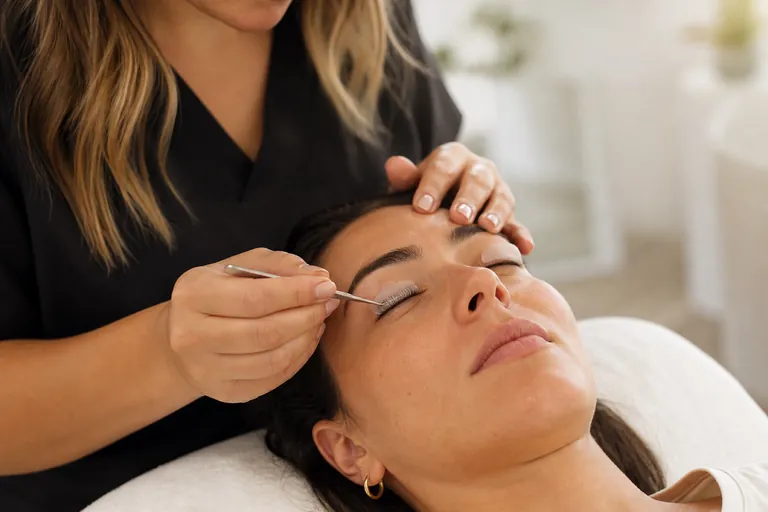
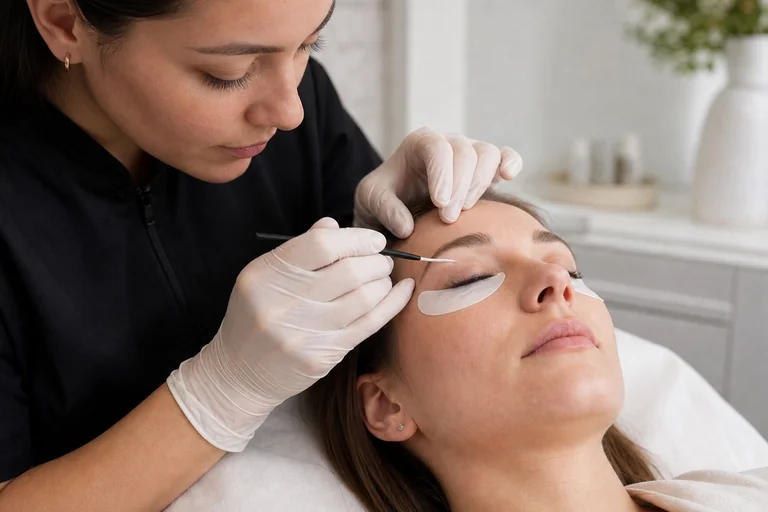
Your lashes are separated and arranged on a curved silicone support, usually called a shield or pad. A lifting lotion makes the hair easier to reshape, and a setting or neutralizing step stabilizes the new curve. The professional then removes the products and checks the result. A tint and conditioning finish may be included, depending on the system and the service you book.
Lash lift, eyelash lift, and eyelash lamination usually describe this same core treatment. Some salons use “lamination” for a package with tint and a conditioning product. Ask what the price includes: the service name alone does not tell you.
Terms such as keratin, filler, or lash botox describe different cosmetic services or formulas. A conditioner can affect the feel and appearance of the lash shaft. Those names do not establish that a treatment grows new lashes or repairs a follicle.
What changes in your lashes
Lash lift · side view
The same lash with a different curve
Before the lift
Straight lash
After the lift
Lifted, curved lash
The lash stays the same length.
Lifting the lash makes more of its length visible from the front. Both simplified views use the same scale and lash length; no fiber is added.
A straight lash can hide some of its length when you look directly at the eye. Curving it upward makes that same hair more visible. Tint can make pale tips stand out, but neither step adds the fibers that an extension service would attach. New lashes will still grow in their own natural direction.
Why the result changes as lashes grow
Lash renewal · illustrated example
Why the curl becomes less uniform
After the appointment
As new lashes grow
Treated lashes, still curved
New lashes, natural direction
New lashes grow beside lashes that still hold their lift. Blue marks new growth in this example; its shape and timing vary from person to person.
Lashes grow and shed at different times, so the same eyelid contains hairs at several stages. In Thibaut and colleagues’ study, four volunteers were followed weekly for nine months to study their lash cycle. That small sample helps explain renewal; it cannot predict how long your lift will last.
The lift affects the exposed hairs present during treatment. As treated lashes shed, new lashes appear beside those that still hold a curve. The result becomes less uniform over time. The blue lashes in the diagram are shorter and straighter to make the example easy to read; new growth follows each person’s natural shape and is not always straight.
How a lash lift works
Chemical bonds help the lash shaft hold its shape. Lift systems alter some of those bonds so the hair can take the shape of the support, then stabilize it. Products differ in ingredients, application areas, and processing times. The professional needs the instructions for the actual system, including any documented compatibility between its products.
Leaving a lotion on longer can overprocess the hair instead of producing a better curl. Hair-perming products are not substitutes for lash-lift products. A salon appointment includes close control of placement and timing near closed eyes; an online sequence is not a safe do-it-yourself chemical recipe.
Assessment before the appointment
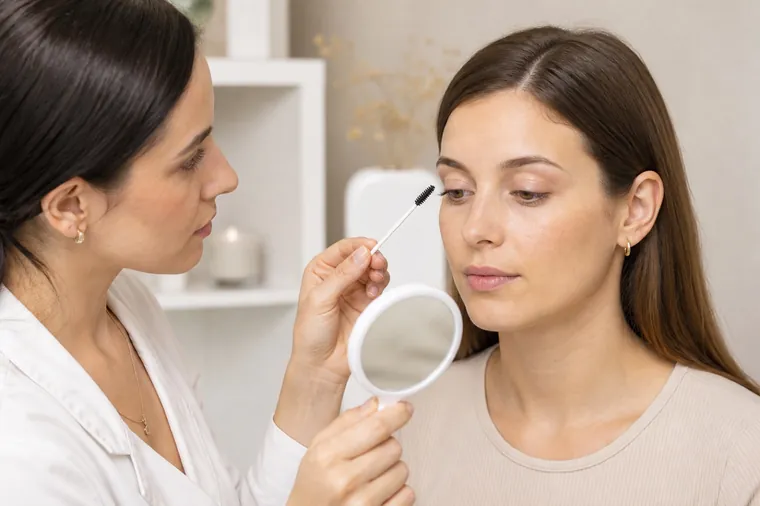
Tell the salon about previous lifts or extensions, reactions to cosmetics, eye symptoms, recent eye procedures, and products or medications used around your eyes. Bring the date of your last treatment and the product name if you know it. The professional checks lash length, direction, condition, and how a shield fits your eyelid. Redness, pain, swelling, or discharge calls for postponement and appropriate medical advice.
Lash length, direction, and condition help determine whether a lift is suitable.
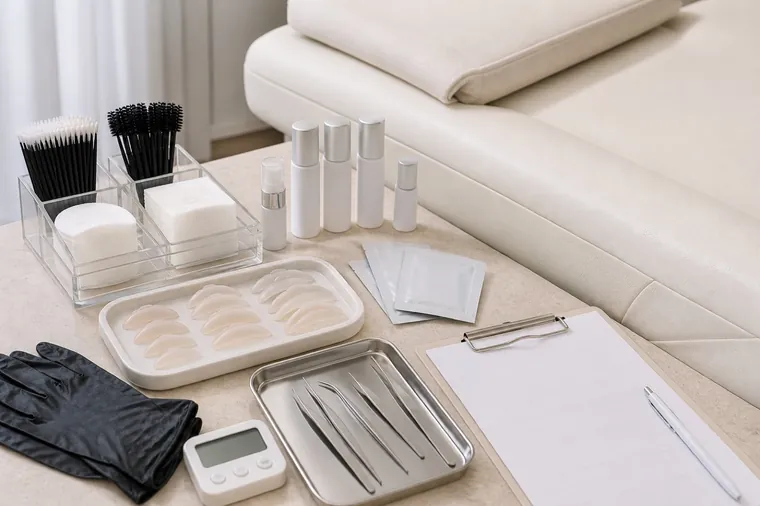
Shield sizes are not interchangeable across brands. The support must fit the eyelid and allow the lashes to follow the intended curve without folded tips. Very short lashes may not reach the useful part of a pad, even when the smallest size is used.
The system’s instructions determine products and processing times. Assessment and a final check are part of the appointment.
Arrive without eye makeup and allow enough time for preparation and final checks. The professional follows the system’s instructions for product quantities and processing times. During the appointment, you can expect the following sequence:
The professional discusses the result you want, your treatment history, and reasons to postpone, then obtains your consent.
They prepare clean tools and materials, cleanse the eye area, and protect the lower lashes as directed.
They fit the shield and separate the upper lashes over it. Your eyes remain closed, and you should tell them if the positioning feels uncomfortable.
They apply and remove the lifting lotion, then use the setting or neutralizing step according to that system’s instructions.
If tint is part of your booking, they use an appropriate product at the point in the sequence specified for the compatible system.
They remove residue, check lash direction and symmetry, and apply any specified finish. They record the products and timing and give you written aftercare.
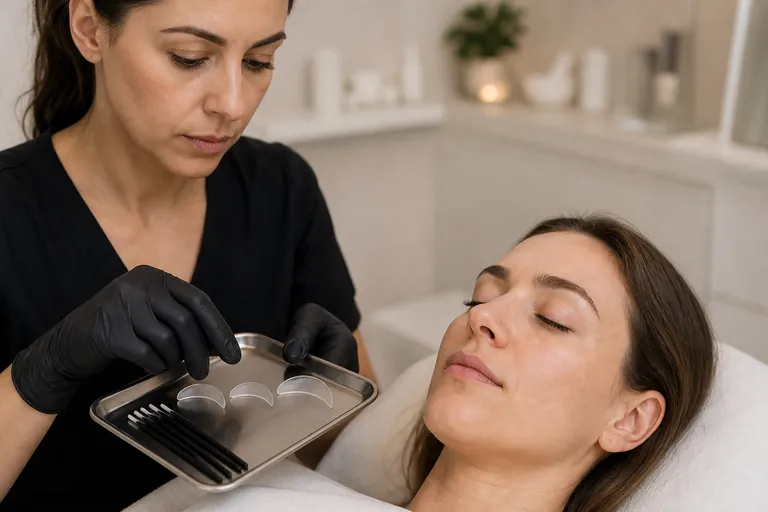
Different shield shapes and a timer support preparation; the service record keeps track of products and processing times.
Allow roughly 45 to 90 minutes, then confirm the time for your booking. For example, Ina in Chicago lists 60 minutes for a lift and 75 minutes for a lift with tint. Cleansing, arranging each lash, and checking the finished result take time beyond the lotion’s processing period.
If you have another appointment afterward, mention it when booking. The salon should confirm that it can finish the full service within that window.
What a lash lift costs in the US
These October 2026 salon prices illustrate the difference between a lift and a lift with tint. They are examples from two cities, not a national average. Compare the included tint and any take-home products before choosing between quotes.
$120 keratin lift; $150 with upper-lash tint; $160 with upper- and lower-lash tint.
The $150 option tints upper lashes only. Including lower lashes adds $10.
At Ina, the listed lift-and-tint package is $125, rather than the $135 you would get by adding the standalone prices. At Salon de Beaute, decide whether you want upper lashes tinted or both upper and lower lashes. Ask for a final quote that identifies any tax, optional gratuity, and home-care products separately.
How long a lash lift lasts
About 4 to 8 weeks is a useful planning range for visible results, with gradual changes as lashes grow out. RefectoCil Classic describes results lasting up to six weeks; Elleebana’s US guidance gives six to eight weeks. These are product references, not a personal guarantee.
The starting direction of your lashes, the curve created, and natural shedding all affect how long the result looks consistent. Tint may fade while the curve is still visible. To compare changes, take photos without mascara using the same light, head position, and distance.
What realistic results look like
Long, downward-pointing lashes can show a noticeable change from the front. On short or sparse lashes, the improvement may be mainly in direction and curl. A lift cannot fill a gap where there are no lashes, and an overly tight curl can fold the tips back so the lashes look shorter.
Starting lashes
Possible result
Limit
Long and straight
More of the existing length becomes visible.
The number of lashes does not increase.
Pale lashes or tips
Tint can make the lashes more visible.
Color can fade before the curl changes.
Short or sparse
More curl or a more even direction, if a shield fits.
No added extension length or volume.
Already curved
A change in direction where it is useful.
An excessive curl can fold the tips back.
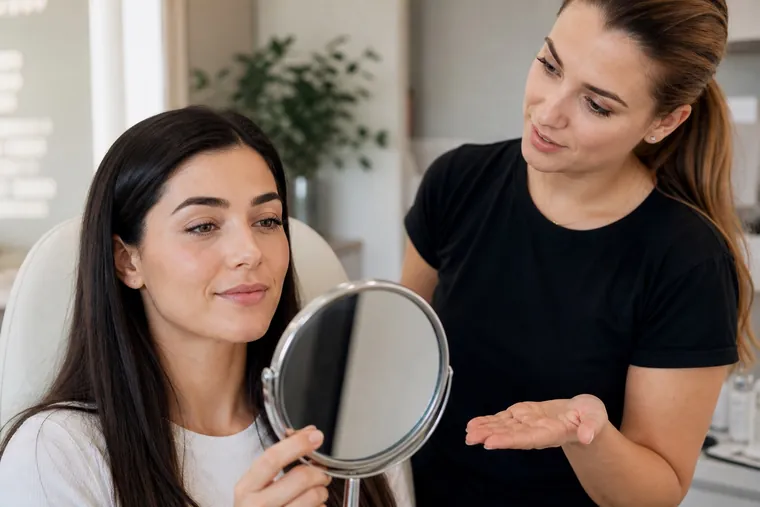
At the final check, look at lash direction and symmetry, and mention any discomfort.
When looking at a salon’s before-and-after photos, compare lighting and eye position, and check whether tint or mascara was used. A different camera angle can make a lift look much stronger.
Lash lift, mascara, false lashes, or extensions?
Comparing lash options
Curl, coat, or add fibers
Lash lift
Reshapes natural lashes
Curler
Creates a temporary bend
Mascara
Adds a removable coating
False lashes and extensions
Add fibers
A lift reshapes existing lashes. A curler creates a temporary bend, mascara adds a removable coating, and false lashes or extensions add material.
A lash lift suits someone who wants to make their existing lashes more visible for several weeks. An eyelash curler bends the hairs temporarily, while mascara adds a removable coating. Strip lashes add material for a makeup look; extensions attach individual fibers or fans to natural lashes and need their own maintenance schedule.
If you want added length or a fuller design, compare lash extensions and lash lifts. A lift stays within the length and density you already have.
Aftercare: water, mascara, and daily care
Get the name of the lift system and written instructions before leaving. The time you should wait before washing your lashes or applying makeup differs by product. The salon’s removal of residue at the end of treatment is a separate step from your routine at home.
System
Water, heat, and steam
Mascara
RefectoCil Eyelash Lift Classic
The Academy’s aftercare FAQ says to avoid water, steam, swimming, and saunas for 24 hours.
Wait 24 hours. The manufacturer advises against waterproof mascara because removal can require heavy cleansing.
Elleebana
The manufacturer permits water contact. Its detailed aftercare guidance says to avoid heat and steam for the first 24 to 48 hours.
The same guidance limits rich cosmetics during that period, with exceptions for Elleevate Mascara and Elleebana Makeup Remover.
Gently brush the lashes with a clean spoolie and remove makeup without pulling. If the professional recommends a conditioner, use one intended for lashes. For example, Elleeplex Advanced Aftercare can be used before mascara, allowing it to dry fully, or as a nighttime coating. Use a conditioner only for cosmetic care, not to treat eye irritation.
Lash tint and US product rules
Tint is a separate coloring step. In the US, a color additive must be permitted for the intended use, and a product sold for scalp hair is not suitable for eyelashes. The FDA’s color-additive fact sheet identifies silver nitrate as the only approved color additive for dyeing lashes and brows, under specific professional-use conditions.
Those conditions include a viscous gel containing no more than 4% silver nitrate, use on people age 16 or older, and application for no longer than one minute. That one-minute limit applies to this tint, not the lift lotion. Such products are not for direct sale to consumers. This permission does not mean every lash tint is FDA-approved or that any provider may offer the service in every state. Product rules and state professional licensing are separate checks.
Ask which product will be used, whether it is intended for lash tinting in the US, and how the provider meets your state’s service requirements. The professional eyelash-tinting guide explains why color, compatibility, and the tint’s own directions matter.
When to postpone or stop
When to stop
Report pain or burning immediately
Check
Lashes, eyelids, and comfort
Postpone
Irritation or damaged lashes
Stop
Pain or burning during treatment
Get urgent care
Severe symptoms or vision problems
If a product enters the eye, start rinsing immediately as described below. Severe pain or vision problems need emergency care after rinsing.
Postpone if your eyes or eyelids are irritated, swollen, injured, painful, or producing discharge. Broken or very fragile lashes also need assessment before another chemical service. Tell the professional about ongoing eye care or recent procedures; your eye-care clinician can advise on medical suitability. A lash professional should not diagnose an eye condition.
During treatment, report burning or pain immediately so the service can stop. If product enters your eye, start rinsing right away with plenty of room-temperature water for at least 15 to 20 minutes, removing contact lenses. Do not delay rinsing to make a call. Follow the product’s emergency directions as well.
US Poison Control advises contacting Poison Control after irrigation at 1-800-222-1222 or through webPOISONCONTROL. Severe pain or vision problems need emergency care after rinsing; do not wait to see whether they improve. If irritation, pain, redness, swelling, tearing, or vision problems persist one hour after rinsing began, get an urgent eye examination. Keep the product container or label available.
When to book another lift
Arrange a reassessment around the interval given for your system. Elleebana’s US guidance recommends waiting at least six to eight weeks and checking lash condition before another lift. For an October 21 appointment, six and eight weeks fall on December 2 and December 16. That is an example for scheduling a check, not an instruction to repeat treatment on either date.
Some treated lashes may still hold a strong curve when the overall effect looks weaker. If lashes are dry, breaking, or sharply bent, another lift may need to be delayed. The professional should compare regrowth and remaining curl with the previous treatment record instead of repeating the service automatically.
Choosing a professional and training
Ask for a clear price and an explanation of the likely result on your own lashes, including whether tint is included.
Check that the provider uses identifiable products, clean tools, and fresh single-use materials, and can explain the system’s precautions.
Confirm that the provider is permitted to offer the service where you live. A course certificate and a state license are different documents.
Leave with written aftercare and a contact for reporting a problem or arranging a reassessment.
If you want to learn the technique, the BeautyLearn lash lift course lists its curriculum, instructor, access, and support. Check those details alongside your state’s training and licensing requirements. Completing a private course does not itself grant a US professional license.
Frequently asked questions
What if I wear contact lenses?
Tell the salon when booking and bring your glasses. RefectoCil’s Classic instructions require contact lenses to be removed before treatment. If you have dry eyes, redness, pain, or ongoing eye treatment, ask your eye-care clinician whether a cosmetic lash service is appropriate.
Can I have a lift immediately after removing extensions?
Do not assume both services can happen at the same appointment. Elleebana’s US FAQ calls for a case-by-case assessment because extension products, removers, and the condition of the natural lashes vary. Tell the salon about the removal before booking the lift.
Will several lifts make my lashes grow longer?
Repeated lifts reshape the hairs present at each appointment. There is no established growth benefit from repeating the lift itself. If a service promises longer or thicker growth, ask for evidence for that specific product and outcome rather than relying on its name or before-and-after curl photos.
What should I do if the lift looks uneven?
Contact the salon before applying another chemical treatment. Send clear photos and explain when the lift was performed and whether you have any discomfort. Sharp bends, crossed lashes, and breakage need assessment; eye symptoms take priority over correcting the appearance.
A cautious consultation protocol before lash extensions or a lash lift: questions, descriptive observation, product instructions, consent, postponement, stopping and traceability.