Opening a nail salon in Italy begins with classification, not décor. “Nail salon” or “nail centre” is a commercial description rather than one national authorisation category. The treatments actually supplied, the region and municipality, the professional requirements, the premises and the business structure determine what must be in place. A written service menu and an early exchange with the competent SUAP should come before a lease, fit-out or launch date.
Quick answer: describe every proposed service and tool in writing, ask the local SUAP how the activity is classified and which professional and premises requirements apply, verify the answer with the Chamber of Commerce and qualified advisers, condition any lease on technical and administrative feasibility, then complete the business, SCIA, safety, privacy, insurance and operating systems before taking bookings. A private course certificate does not by itself replace a qualification required by regional law.
This English-language guide is specifically about opening in Italy and was legally reviewed against official sources on 5 September 2026. It cannot authorise a particular business or replace the SUAP, Chamber of Commerce, accountant, employment adviser, lawyer or qualified building professional. For technique foundations, use the BeautyLearn nail guide library and compare the separate English-market online nail courses. English courses, teachers and commercial records remain isolated from the Italian market.
Define the service menu before the business plan
The menu determines the route
A commercial name cannot classify the activity
Services
Treatments, tools and client contact
People
Qualifications and technical manager
Place
Address, plan and systems
Business
Legal, tax and staffing model
Write an operational list rather than “nails”. State whether you intend to perform aesthetic manicure, cuticle work, polish and gel-polish application or removal, overlays, gel, acrylic or acrygel extensions, infills, repairs, electric-file work, nail art, hand treatments, pedicure, toenail enhancement, retail and training. Identify devices, products, client contact, treatment areas and whether employees or independent professionals will work on site.
Administrative classification follows the real activity. A studio offering surface decoration may not be assessed in the same way as one preparing the natural nail, applying artificial structures and using powered tools. Do not reduce the description in the hope of obtaining a simpler answer: an authorisation based on an incomplete menu may not cover the service later advertised.
Decision | Evidence to prepare | Who must confirm it |
|---|---|---|
Service classification | Detailed menu, methods, tools and products | Municipal SUAP and competent authorities |
Professional requirement | Qualifications and technical-manager arrangement | SUAP, region and Chamber of Commerce |
Premises | Address, floor plan, intended use, systems and proposed works | Qualified technician, SUAP and health authority where applicable |
Business and tax | Owners, activities, staffing, turnover and cost model | Accountant, Chamber of Commerce and advisers |
National framework and local rules
Italy’s national framework is Law 4 January 1990, no. 1, which defines beautician activity as treatments on the human body intended to maintain, improve or protect aesthetic appearance using manual techniques, specified equipment and cosmetics, while excluding treatments with a specifically therapeutic purpose. The law does not create a single nationwide “nail technician” licence that resolves every service configuration.
Regions implement professional training and qualification rules, while municipalities and their SUAP offices apply opening procedures and premises requirements. Artificial-nail application and reconstruction are commonly treated within beautician activity, but a result from another municipality is not binding on yours. Ask the SUAP for a written response tied to the address, service menu and operating model.
If a beautician qualification or technical manager is required, a private attendance certificate does not automatically substitute for it. The owner and technical manager may be different people in some lawful structures, but presence, employment relationship, registration and responsibility conditions must be verified before contracts are signed. A nominal appointment that does not match real supervision is not a safe business plan.
The ten-step opening sequence
Verify before you commit
Classification and feasibility precede fit-out and launch
Define scope and ask SUAP
Verify people and premises
Model costs and contracts
File, fit out and control
Pass the launch gate
Define services, products, equipment, staffing and whether you will work on hands, feet or both.
Send the competent SUAP the written menu and request classification, professional requirements, premises rules and required filings.
Verify qualifications and any technical-manager arrangement before committing to a fixed opening date.
Build a conservative business model using full working time, realistic capacity, start-up capital and cash reserve.
Have a qualified technician inspect the exact premises before signing an unconditional lease or buying the unit.
Choose legal form, tax treatment, registrations and ATECO code with qualified advice and the Chamber of Commerce.
Complete fit-out, systems, accessibility, hygiene, ventilation and workstation design against confirmed requirements.
Submit the correct SCIA and linked business notifications through the competent channels with accurate attachments.
Activate insurance, safety, employment, privacy, payments, records, complaints and product traceability procedures.
Accept bookings only when the filings and declared conditions actually allow the activity to start.
SUAP, SCIA and starting the business
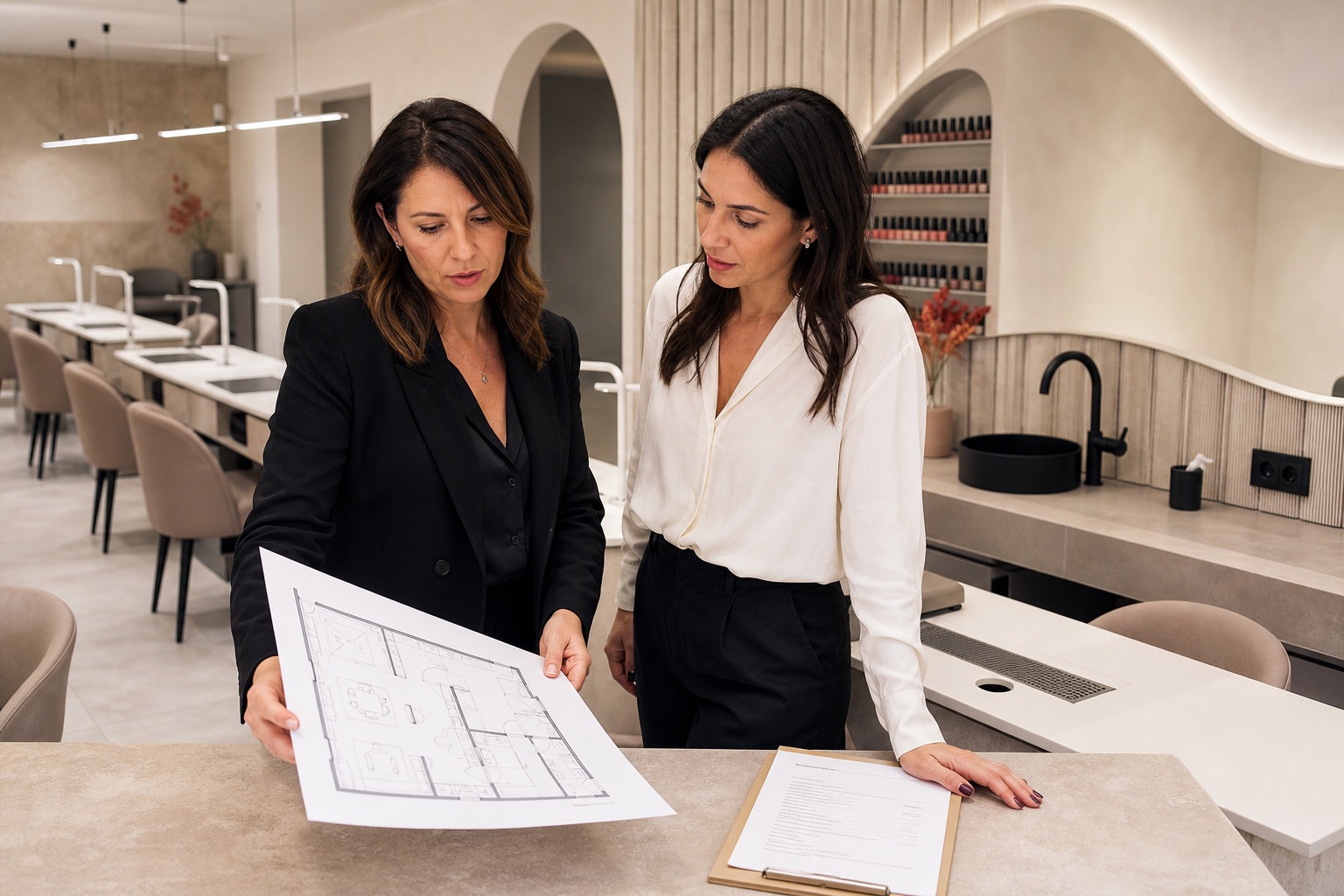
The SUAP is the single contact point for productive activities in the municipality. The official Impresa in un giorno startup portal explains the role of the telematic SCIA receipt, but the actual form, attachments, fees and prerequisite checks must be confirmed for the competent office. A SCIA is a declaration made under the business’s responsibility; it does not cure a missing qualification, unsuitable premises or inaccurate plan.
Business registration, tax number, social-security and insurance notifications may be coordinated through Italy’s business-start procedures, but they do not replace municipal, health, building or professional requirements. Map every filing, responsible adviser, prerequisite, submission date, receipt and dependency in one launch register. “Submitted” and “permitted to operate” are not always the same status.
ATECO 2025: use the current classification
The official ATECO 2025 structure and explanatory notes place manicure and pedicure services under code 96.22.01. Older pages may show a different code because the classification changed. Treat 96.22.01 as the current starting reference, not a self-service answer: retail, teaching, ecommerce or other beauty activities may require additional or different coding, and classification does not decide professional authorisation on its own.
Ask the accountant and Chamber of Commerce to record the real main and secondary activities. Preserve the written rationale and recheck it when the service menu changes. Adding feet, retail, training, room rental or another beauty treatment can alter more than the marketing copy.
Choose the premises before you choose the finishes
A low rent or attractive window cannot compensate for incompatible permitted use, building irregularities or an impossible ventilation route. Before accepting the premises, have a qualified professional examine urban-planning and cadastral consistency, occupancy status where relevant, accessibility, electrical and water systems, toilets, washing facilities, ventilation, lighting, washable surfaces, storage, waste route, fire obligations and local dimensional requirements.
Use a lease condition or other legally reviewed protection linked to the necessary feasibility and permissions. Estimate design, professional fees, works, utility upgrades and approval time before agreeing the handover date. If the salon will operate inside a home, building, condominium, access, hygiene and municipal rules still apply; working from home is not an exemption.
Design a controllable nail workstation
Design the workflow at scale
Clean flow and source control need physical space
Work zone
Posture, lighting and power
Clean flow
Prepared and used items separated
Exposure
Dust capture and ventilation
Support
Sink, storage and waste route
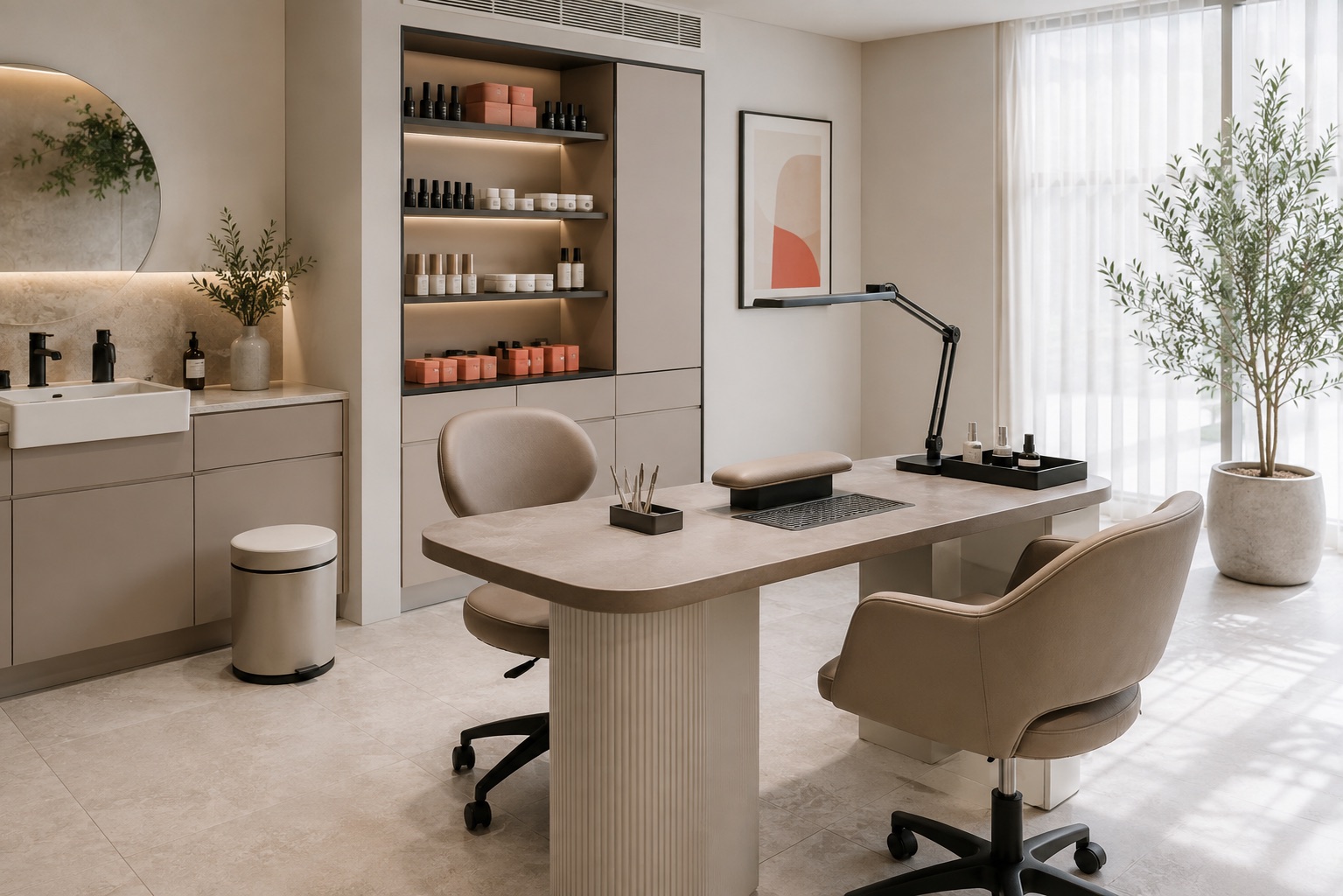
Plan client and technician posture, task lighting, electrical load, hand washing, clean storage, used-item flow, laundry, spills and emergency access. Place local dust extraction where filing occurs and size general ventilation for the products and room. The electric nail file guide explains tool and dust control; the acrylic-extension guide adds liquid, vapour and batch controls.
Separate clean, prepared, in-use and contaminated items so the procedure remains possible during a full day, not only in a staged photograph. Buy furniture after the workflow is drawn at scale. A table that is beautiful but too deep, unstable, unextractable or impossible to disinfect becomes an operating cost.
Chemical exposure, hygiene and worker safety
The Italian workplace-safety institute INAIL advises beauty businesses to purchase compliant products, define their use, limit exposure, ensure good ventilation, read labels and composition, adopt appropriate hygiene and use task-specific protective equipment according to the risk assessment. Its official guidance on hazardous substances for beauticians and hairdressers is a starting point, not the salon’s completed risk assessment.
Create written procedures for hand hygiene, surfaces, reusable tools, single-use items, laundry, product spills, dust collectors, chemical storage, waste and incidents. Disinfection and sterilisation are not synonyms; the required route depends on the item, use and applicable local health rules. Keep manufacturer instructions and safety data where required, train workers and record maintenance.
Employees, chair rental and external professionals
Staffing changes professional supervision, workplace safety, payroll, training, equipment, insurance and privacy obligations. Calling someone self-employed or renting a table does not decide their legal work status, and it does not transfer every duty away from the salon. Have the real relationship reviewed before advertising a position or collecting rent.
Define who buys and controls products, owns client records, handles payments, books appointments, maintains premises, responds to incidents and verifies qualifications. Shared branding can make responsibility unclear to clients even when contracts are separate. Public terms and internal agreements must reflect the actual service journey.
Build the opening budget from evidence
Equipment is only one budget block
Opening capital must cover delay as well as fit-out
Professional
Advice, plans, filings, insurance
Premises
Deposit, works, systems, utilities
Operations
Stations, products, software
Reserve
Fixed costs and owner pay
Budget block | Include | Common omission |
|---|---|---|
Professional and filing | Advisers, plans, registrations, SCIA, fees and insurance | Corrections and resubmissions |
Premises | Deposit, rent, works, systems, signage and utilities | Unproductive fit-out months |
Operating equipment | Stations, extraction, lighting, tools, IT and maintenance | Replacement and calibration |
Working capital | Products, wages, taxes, marketing and months of fixed costs | Owner pay and slow launch |
Do not publish prices by copying a neighbouring salon. Use the free beauty pricing calculator to structure labour, direct materials, overhead, capacity and margin, then have tax assumptions reviewed locally. Model break-even with realistic sellable hours and cancellations. The number of chairs is not the number of simultaneously billable hours unless demand, staff and technical supervision support it.
Before launch: operational readiness gate
Written confirmation of classification, professional requirements and premises route for the exact service menu.
Business, SCIA and linked registrations submitted correctly, with receipts and start conditions checked.
Premises, systems, access, ventilation and workstations completed against the approved design.
Insurance wording matched to treatments, staff, products, premises and complaints process.
Hygiene, incident, stop, product-batch, privacy, payment, cancellation and refund procedures tested.
Opening cash reserve and price list checked against measured time, costs and realistic appointment capacity.
Frequently asked questions about opening a nail salon in Italy
Is “nail salon” a separate national licence in Italy?
No single commercial label determines the authorisation. Actual treatments, regional professional rules and municipal procedure control the classification.
Do I need a beautician qualification?
It is commonly required when nail reconstruction or artificial-nail application is classified as beautician activity, but the competent SUAP and regional rules must confirm your exact menu.
Is a private nail-course certificate enough to open?
Not automatically. It can document education but does not replace a statutory professional qualification where one is required.
Can the owner appoint a qualified technical manager?
Some structures allow this, but eligibility, presence, work relationship, registration and responsibility must be confirmed locally before contracting.
What ATECO 2025 code covers manicure and pedicure?
The current starting reference is 96.22.01. Confirm main and secondary activities with the accountant and Chamber of Commerce; ATECO coding does not grant professional permission.
Should I sign the salon lease before contacting SUAP?
No unconditional commitment is prudent before classification and technical feasibility are checked. Use qualified legal and technical advice for any protective condition.
Can I run a nail salon from home?
Only if municipal, regional, building, condominium, access, hygiene and professional requirements allow the exact activity at that address. Home working is not an exemption.
Does submitting a SCIA solve missing premises requirements?
No. A SCIA is a responsible declaration and does not regularise unsuitable premises, missing qualifications or inaccurate documents.
How much does it cost to open a nail salon?
There is no defensible national total. Location, premises condition, works, stations, staffing, advisers, insurance and working capital change the amount. Build it from written quotes.
Can I rent tables to self-employed nail technicians?
A table-rental label does not determine employment status or remove salon duties. Have the real working relationship, qualifications, insurance and responsibilities reviewed.
Do I need local dust extraction?
Source capture is a core exposure-control measure for filing dust. The final design must follow the risk assessment, product use, premises and applicable safety rules.
Can an online nail course prepare me for the business?
It can support technique and theory, but opening requires legal qualification where applicable, local checks, supervised competence, safety systems and professional business advice.
Editorial review: 5 September 2026. Official classifications and territorial procedures can change; verify the current position for the exact municipality, premises and service menu before relying on any step. This guide owns the Italy salon-opening intent. Qualification, technique, pricing, client acquisition, insurance and complaints remain separate topics.