Becoming a nail technician is not simply learning to apply gel or polish. Professional preparation combines nail-unit knowledge, hygiene, product control, natural-nail preparation, structure, filing, maintenance, removal, communication and the judgement to stop when a service is unsuitable. It also requires a route that is lawful for the exact services and location where you intend to work.
Short answer: define the services and country or region first; ask the relevant licensing or business authority which training, examination, registration and premises rules apply; choose a course with a transparent curriculum and assessed practice; build skill through recorded repetition and feedback; then start paid work only when both competence and local requirements are in place.
This guide owns the complete career pathway. The guide to nail technician certificates, qualifications and licences owns the legal distinction between course documents and permission to practise. The learning-timeline guide owns how long skill development may take. Here those pieces become one sequence from first research to a responsible career decision.
The seven-stage route to becoming a nail technician
A career pathway, not a certificate shortcut
Scope and local requirements come before course selection
Define
Services, location and working model
Verify
Current local entry requirements
Develop
Training, practice and feedback
Begin
Paid work only when ready
Define your destination: personal skill, salon employment, room rental, mobile work, a home studio or a future salon. Each creates different duties and checks.
List the exact services you intend to perform. Manicure, gel polish, cuticle work, extensions, e-file use, pedicure and retail are not automatically treated alike in every jurisdiction.
Verify local entry requirements before buying training. Identify the government, licensing board, municipality or other competent body and keep its written answer.
Choose foundational training that teaches anatomy, hygiene, preparation, product systems, structure, maintenance, removal and stop criteria in a logical order.
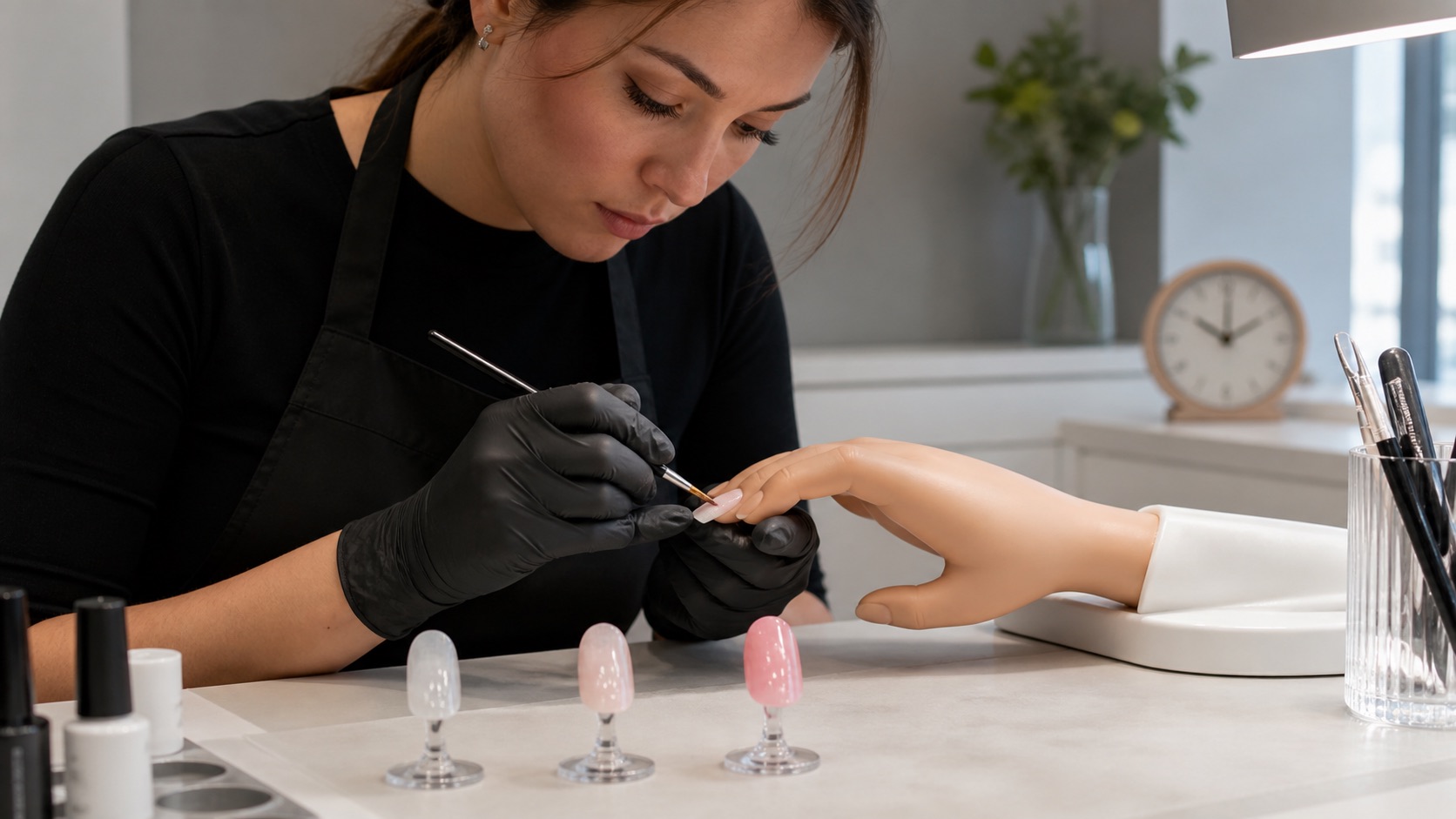
Practise on training supports, then suitable informed models. Increase difficulty only when the preceding control is repeatable, and obtain corrective feedback.
Document outcomes at completion, wear and removal. Build a truthful portfolio that explains your role, system, challenge and learning rather than displaying only edited close-ups.
Prepare for paid work: permissions, insurance, records, client terms, hygiene workflow, prices, bookings, complaints and referral boundaries must exist before the first transaction.
The stages overlap, but their order matters. Watching theory without deliberate practice cannot build manual control; performing services without theory makes failures and limits harder to recognise. A productive cycle alternates explanation, complete demonstration, focused exercise, evidence, feedback and corrected repetition.
Start with jurisdiction, service scope and working model
English-language advice crosses many legal systems. In the United States, the Bureau of Labor Statistics explains that manicurists and pedicurists generally complete a state-approved programme and state examination, while exact licensing conditions vary by state. The UK National Careers Service describes several possible training and entry routes. These official examples demonstrate variation; neither is a worldwide rule.
Write one page containing every intended service and where it will take place. Send that factual description to the authority named by the jurisdiction, not to a course seller alone. Ask which occupation or licence category applies, which programme providers are approved, whether an examination is required, whether mobile or home work is permitted, and which premises, supervision and insurance conditions apply.
Do not assume that a certificate accepted by one salon, school, insurer or country transfers elsewhere. If you move, expand into pedicure or change from employee to independent work, repeat the check. Save source URLs, dates, names and written answers. The dedicated requirements guide provides a reusable verification checklist.
Competencies to build before paid services
Technique is only one part of professional readiness
Every service links judgement, control and communication
Assess
Suitability, scope and stop criteria
Control
Hygiene, product and structure
Maintain
Wear, infill and removal
Communicate
Consent, limits and aftercare
Competency | What competent practice includes | Observable evidence |
|---|---|---|
Assessment and scope | Observe nail and surrounding skin, gather relevant information, select a suitable service and recognise stop criteria without diagnosing. | You can explain why you proceed, adapt, postpone or refer. |
Hygiene | Organise hands, surfaces, single-use items and reusable-tool processing through a documented one-way workflow. | The protocol remains complete when time pressure increases. |
Preparation and product | Prepare without pain or avoidable thinning; prevent skin contact; use a compatible product-lamp system and follow manufacturer instructions. | A clean application with traceable products, no flooding and controlled cure. |
Structure and refinement | Build axis, sidewalls, apex, curve and thickness for the intended length and shape, then refine artificial material predictably. | Top, side and front views agree and the natural plate remains protected. |
Maintenance and removal | Read regrowth and retention, remove lifting, rebalance or remove according to material and condition. | Return appointments inform the next decision rather than hiding failure. |
Client communication | Set expectations, explain aftercare, record consent and products, communicate limits and manage concerns. | The client understands service, maintenance, risks, price and next steps. |
Nail technology connects living anatomy to cosmetic materials. Begin with the nail matrix and nail-unit guide and the professional nail filing guide before treating extensions or e-file speed as the foundation.
How to choose nail technician training
Make course claims testable before enrolling
A clear curriculum matters more than a certificate count
Curriculum
Foundations through maintenance
Evidence
Tutor, demos and assessment
Practice
Progression and feedback route
Claims
No automatic licence or income
A strong course makes its promises testable. Read the full syllabus, declared level, prerequisites, tutor identity and experience, demonstration format, practice tasks, feedback method, access period, materials, completion rules and exact nature of the certificate before paying. A gallery and the word ‘accredited’ are not a substitute for those details.
Check | Useful evidence | Warning sign |
|---|---|---|
Curriculum | Anatomy, hygiene, prep, complete applications, structure, maintenance, removal and troubleshooting. | Only finished looks or vague module names. |
Level | Clear prerequisites and a genuine route from fundamentals to complexity. | Advanced shapes or e-file work sold as the first lesson. |
Demonstration | Close, legible, complete sequences with errors and multi-view checks. | Edited speed videos that omit preparation, cure or refinement. |
Practice | Progressive briefs, assessment criteria and a defined feedback route. | Course completion presented as sufficient proof of work-ready skill. |
Claims | Certificate, regulator recognition and career support described precisely. | Guaranteed licence, clients, job or income without jurisdictional evidence. |
Compare the current BeautyLearn online nail courses by level and curriculum. Choose a broad foundation when you need the whole sequence; choose a specialist module only when its prerequisites match skills you can already demonstrate.
Online, in-person or blended training
Online education can make close demonstrations repeatable and lets practice follow a personal schedule. It still requires real materials, a safe workstation, deliberate exercises and feedback. In-person training can provide immediate correction of pressure, quantity, posture and angles, but a single classroom day does not remove the need for later repetition.
Blended learning can combine repeated theory with observed practical assessment. Format alone does not establish quality. Ask how the tutor sees your work, which views are required, whether regrowth is reviewed and what happens when criteria are not met. The separate guide comparing learning time and practice milestones helps turn course access into an actual schedule.
A progressive practice ladder
Do not measure progress only in hours or completed sets. Use exit criteria for each stage. First practise brush control, product quantity, filing planes and colour application on suitable supports. Next add short, repeatable structures. Then work with informed suitable models, beginning with straightforward anatomy and one known system.
Record date, system, batch where appropriate, lamp, complete service time, top/side/front photographs, immediate defects, wear at the agreed return and condition after removal. Select one priority correction for the next attempt. Changing brand, technique, length and form simultaneously prevents you from learning which variable caused the outcome.
The nail prep guide, architecture guide and infill guide provide separate criteria for the stages that a final photograph cannot prove.
Build a coherent beginner kit and workstation
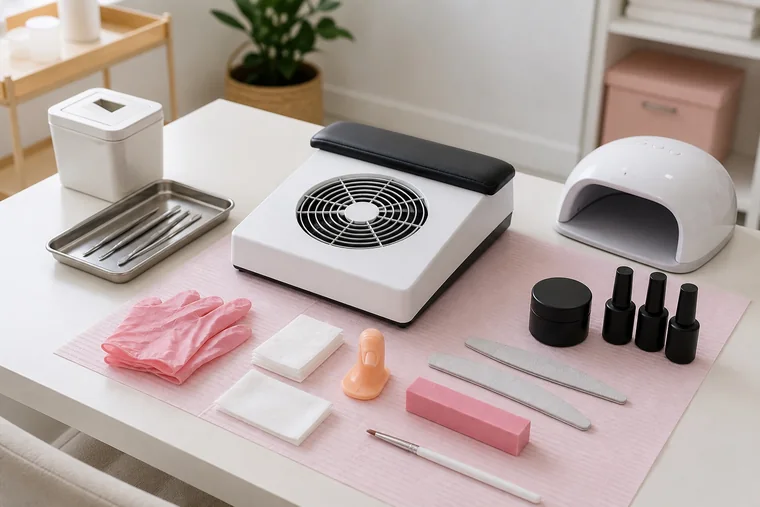
Begin with one documented product system, its compatible lamp or stated curing conditions, essential application and removal tools, clear task lighting, dust control appropriate to the work and a hygiene workflow. Keep instructions, safety information, labels and purchase records. More colours and techniques do not compensate for an incomplete core system.
Use the beginner nail kit checklist to separate essentials from premature variety, and the tool hygiene guide to classify single-use and reusable items before writing the workstation protocol. Follow manufacturer labels: FDA nail-product guidance, for example, stresses labelled directions, warnings, ventilation and avoidance of skin contact, but local product law must come from the market where you work.
When are you ready for paying clients?
Readiness is demonstrated across the whole service
A fixed number of sets cannot replace observable criteria
Repeat
Stable process on suitable cases
Review
Wear, return and removal evidence
Prepare
Records, terms and insurance
Verify
Permission for exact paid work
A fixed number of practice sets cannot answer this alone. You should be able to repeat an appropriate service while maintaining assessment, hygiene, product control, structure and communication when the nail is not identical to the demonstration. You must also manage maintenance and safe removal—not only the first application.
You operate the full workstation protocol without shortcuts or cross-contamination.
You recognise visible stop criteria, remain outside diagnosis and know the referral route.
Preparation causes no avoidable pain or thinning and uncured product does not contact skin.
Appropriate work remains structurally coherent through its planned wear and return.
Records, consent, aftercare, maintenance, pricing and complaint handling are ready.
The local training, licensing, business, premises and insurance requirements have been verified.
Build a truthful record with the nail technician portfolio guide. Before committing to self-employment, separate salary, business revenue and operating profit in the guide to nail technician earnings. Training cannot guarantee employment, clients or income.
Learning mistakes that slow down professional development
The first common mistake is collecting advanced courses before foundational controls are stable. A long shape, fast e-file routine or detailed design adds variables to preparation, product and structure. If the short salon structure is not repeatable, complexity hides the cause of failure instead of developing skill. Return to one measurable control and repeat it across several suitable nails.
The second is changing brand, lamp, primer, technique and preparation together after one poor result. Products are systems, not interchangeable labels. Document the manufacturer’s instructions, keep the tested variables stable and investigate the location and timing of failure with the nail lifting troubleshooting guide. A popular online fix is not evidence that your actual cause has been identified.
The third is judging a set only at completion. A glossy top view can conceal an unbalanced profile, unsupported sidewall, excessive free-edge thickness or product touching skin. Photograph top, side and front views consistently, then review comfort, retention, growth and condition at maintenance. The return appointment is part of the learning evidence, not an inconvenience after the portfolio image.
The fourth is treating removal as a low-skill step. Peeling, scraping or filing without a readable boundary can damage the natural plate and destroy evidence about adhesion. Learn the material-specific professional removal process before offering the application. A technician must be able to close a service safely as well as begin it.
The fifth is buying variety instead of solving a defined need. Compare the behaviour and limits of gel, acrylic and acrygel before purchasing several unrelated systems. One coherent range used according to its instructions creates cleaner learning data than a drawer of products selected by trend.
Finally, do not make speed the entry test for paid work. Record full service time and identify searching, poor workstation layout or repeated corrections, but never shorten assessment, hygiene, cure or breaks to imitate an experienced technician. Precision becomes efficient through organised repetition. If pain, heat, skin contact or uncertainty appears, stop and solve the safety problem rather than protecting the timer.
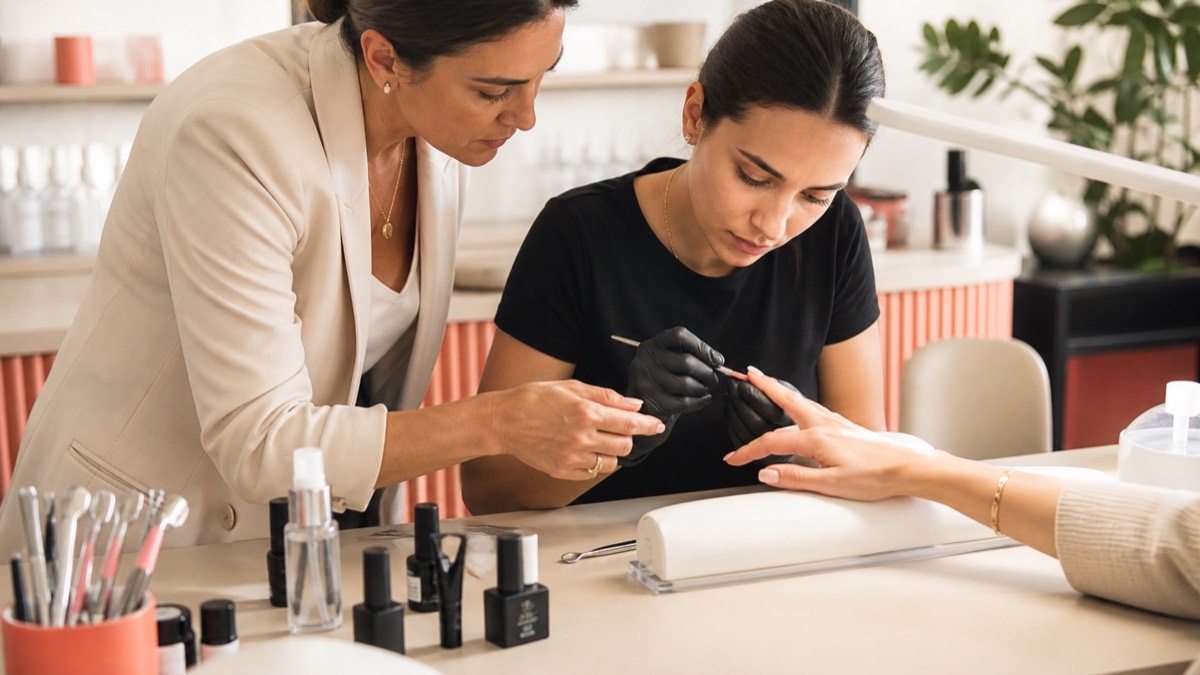
Review progress with a tutor or experienced professional who can explain the correction, not simply approve the photograph. Useful feedback names the observable defect, likely process stage, priority change and evidence required next time. Save that feedback beside the practice record so improvement can be traced rather than remembered selectively.
Career settings and progression
A nail technician may work as an employee, trainee, renter, mobile provider or salon owner where permitted. With experience, possible directions include advanced salon services, team supervision, editorial or event work, product education, retail, content or teaching. Each changes the evidence, insurance, tax, premises and contractual questions.
Do not rush into teaching because a course title calls you a master. A responsible educator needs durable technical evidence, the ability to diagnose a learner’s process error without exceeding professional scope, a complete safety framework and transparent claims about what the training document means. Career progression should deepen accountability as well as technique.
Frequently asked questions
Do I need a licence to become a nail technician?
Requirements depend on jurisdiction, exact services and working model. Some places require an approved programme and examination; others use different qualification or business routes. Ask the competent local authority with a written service list before enrolling or trading.
Is a private course certificate enough to work?
Not automatically. It documents whatever training and assessment the issuer defines. It does not by itself prove work-ready skill or replace a government licence, regulated qualification, premises approval, insurance condition or other local requirement.
Can I learn nail technology online?
Online teaching can provide repeatable close demonstrations and flexible study, but manual competence requires physical practice and useful feedback. Check whether your jurisdiction or intended employer requires approved in-person hours or a practical examination.
Which technique should a beginner learn first?
Start with assessment, hygiene, natural-nail preparation, controlled application, filing and removal inside one coherent system. Gel polish can teach thin application; builder systems introduce structure. The course sequence and prerequisites matter more than collecting several techniques at once.
How long does it take to become work-ready?
There is no universal duration. Prior skill, course design, practice frequency, feedback, service range and assessment criteria change the timeline. Use demonstrated milestones, wear and removal evidence rather than elapsed weeks or video hours alone.
How much practice is needed before models?
Move from training supports when product quantity, basic shape and tool control are repeatable, then select suitable informed models and straightforward services under the learning plan. Never use a person to test a technique you cannot manage safely.
How can I find suitable practice models?
Explain your learner status, service, expected time, products, limitations, photographs and follow-up clearly. Obtain informed agreement, choose uncomplicated suitable cases and arrange a return check. Do not disguise training as a fully established paid service.
Do I need professional insurance?
Insurance requirements and useful cover depend on country, employment status, location and services. Ask a qualified broker or insurer using your complete service list, equipment and premises. Confirm whether training, mobile work, teaching or retail changes cover.
Can I work from home or travel to clients?
Only if local planning, licensing, hygiene, property, insurance and business rules allow it. Home and mobile work are not automatically simpler; they create storage, transport, ventilation, waste, privacy and workstation-control questions.
What belongs in a beginner portfolio?
Show a small selection of truthful, consistent cases with top, side and front views, your exact role and technique, colour-faithful images, wear or return evidence where relevant, and permission to publish. Remove duplicates and heavy retouching.
When should I specialise?
Specialise after foundational assessment, hygiene, preparation, product, filing, maintenance and removal are stable. Choose the next course from a documented gap or target service, not from trend pressure or the number of certificates available.
Can a nail course guarantee a job or income?
No. Training can develop knowledge and skill, but eligibility, assessment, practice, local demand, portfolio, employment terms, capacity and costs determine outcomes. A responsible course describes support and criteria without promising employment, clients or earnings.
Official sources and scope
Career and US entry-route example: US Bureau of Labor Statistics, Manicurists and Pedicurists. UK career-route example: National Careers Service, Nail technician. Product-safety example: US FDA, Nail Care Products. These sources apply only within their stated jurisdictions and purposes; they do not create a global training or licensing rule.
Editorial boundary: this guide organises career preparation but is not legal, regulatory, insurance, employment or business advice. Verify the current written rules for your service list, location and working model with the competent local bodies.