We use necessary cookies and the Meta Pixel to measure campaigns and improve our offers. You can change your optional-cookie preferences at any time. Read our Terms and conditions.
Eyelash extension adhesives: humidity, storage, and safety
Silvana DebiasiSeptember 1, 2026Updated on October 21, 2026 14 min read
Professional eyelash extension adhesive bonds an artificial fiber to a natural lash through a chemical reaction. Temperature, humidity, and the time you take to place the fiber affect how that bond forms. Glue that sets too quickly can start hardening before contact; glue that sets too slowly can let the base shift after you align it.
Choosing an adhesive means matching its instructions to your working pace and the conditions at your station. The age of the drop and the way you close and store the bottle matter too. These instructions concern a trained professional working on another person with closed eyes and appropriate protection. Professional extension glue is unsuitable for self-application.
At a glance: measure temperature and relative humidity near the adhesive drop, then choose a product whose stated range covers both readings and whose setting time suits your placement speed. Keep drops fresh, record when you open each bottle, and follow its storage limits. Burning, pain, swelling, or other eye symptoms require you to stop the service, not adjust the glue and continue.
Choose an adhesive for your room and working speed
Before buying, record your station readings at different times of day. On a practice mannequin, observe how long you take to move from dipping the extension to placing it. If you are still finding the natural lash or making lengthy direction adjustments after pickup, a one-second formula leaves little room for correction. Finish isolation before dipping, and review your sequence with your trainer.
64.4 to 71.6°F (18 to 22°C); 40 to 70% RH; stated setting time 1 second. For classic and volume.
Who it is intended for
Advanced professionals with fast, controlled placement. The product page excludes beginner and intermediate use.
The Fahrenheit values above are exact conversions of the stated Celsius limits; Flexie’s US page rounds them to 64 to 72°F. Use the exact range when comparing readings near a boundary. These are specifications for two individual products, not a universal temperature or humidity prescription.
Consider a hypothetical station at 68°F (20°C) and 55% RH. Both products fit those conditions. If you need a little more time to align the fiber, Lady Bond is the slower option to evaluate. A comfortable working pace still needs a clean, stable attachment; being inside the environmental range does not guarantee retention.
At the same temperature but 45% RH, only Flexie is within its stated range. That does not make it suitable for someone who cannot yet place an extension in time. You could instead adjust the room humidity for Lady Bond, wait for stable readings, and recheck your technique on a practice mannequin.
Measure temperature and humidity at the station
Place a thermometer-hygrometer near the adhesive palette at a similar height. Keep it on a dry surface away from direct sunlight, lamp heat, and air blowing from an AC vent or humidifier. A thermostat across the room may describe different conditions from those around your drop.
Read the temperature and relative humidity together. Relative humidity describes moisture relative to saturation at that temperature, so changing the heat or air conditioning can change both readings. Allow the sensor to stabilize for the time its manual specifies. If readings conflict, check placement, battery condition, and the instrument’s verification instructions before changing adhesives.
Record the readings before the appointment and check again after opening a window, adjusting climate control, or noticing a change in the drop. In another hypothetical example, a station moves from 68°F (20°C), 55% RH at 9 a.m. to 75.2°F (24°C), 55% RH at 11 a.m. Humidity still fits both products, but temperature exceeds both limits. Pause application and restore the specified conditions; switching between these two glues would not solve that problem.
Stated working ranges
Same temperature, different humidity ranges
Lady Bond
64.4 to 71.6°F (18 to 22°C) · 50 to 65% RH
Flexie
64.4 to 71.6°F (18 to 22°C) · 40 to 70% RH
A: 68°F (20°C), 55% RH, inside both ranges. B: 68°F (20°C), 45% RH, inside only Flexie’s range.
The shaded areas show London Lash’s stated ranges. Points A and B are hypothetical examples, not measured appointments. The ranges do not measure setting speed or guarantee retention or tolerance; your placement pace must also suit the adhesive.
Use a humidifier or dehumidifier to adjust the room, keeping its output away from the drop and the client’s face. Do not wet the eye area to speed up adhesive. London Lash’s hygrometer guidance explains how monitoring the room supports product selection.
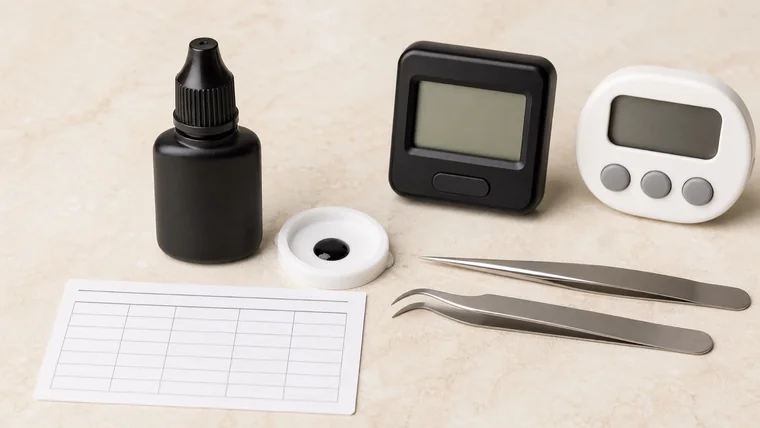
Keep the adhesive palette and sensor in the same working area. The displays in this photo do not provide usable readings.
Setting time, polymerization, and aftercare
Many extension adhesives contain cyanoacrylates, a family of substances whose molecules join into a solid polymer when exposed to small amounts of moisture. Formulas differ in their cyanoacrylates, pigments, stabilizers, and other ingredients. A listing for the isolated ingredient ethyl cyanoacrylate cannot establish the composition of a finished lash adhesive.
Setting time describes the initial attachment. Polymerization continues as the adhesive reacts. A one-second setting claim does not tell you when every part of the adhesive has finished reacting or when the client can wash the set. Do not test a newly placed bond by touching or moving it.
London Lash’s showering instructions specify a 24-hour wait before wetting extensions when a bonder is not used. Treat this as the brand’s aftercare protocol, not a measured time to complete chemical conversion. Its bonder protocol has separate instructions. Give the client aftercare for the actual products and sequence you used; one brand’s sealant instructions do not establish compatibility with every adhesive.
Traditional adhesives, UV/LED adhesives, and activators are not interchangeable. The Lady Bond and Flexie specifications here do not establish UV/LED compatibility. Do not mix adhesives, add water to the drop, or use hot air to accelerate setting.
Prepare a fresh drop and keep the nozzle clean
London Lash’s adhesive FAQs call for 1 to 2 minutes of manual shaking before use and shaking again whenever you open the bottle for a fresh drop. For manual shaking, the brand instructs you to remove the cap and cover the nozzle with a dedicated glue nozzle wipe. With a compatible shaker, keep the bottle upright with its cap at the top and follow the device’s timing and attachment instructions.
Dispense onto a clean, stable support intended for lash adhesive. Place the new drop separately instead of adding it over an old one, and never return residue to the bottle. For Lady Bond and Flexie, the product pages specify a fresh drop every 10 to 20 minutes; Lady Bond may need more frequent replacement in hot conditions. Replace it sooner if it forms strings, develops a skin, or becomes thick during pickup.
After dispensing, wipe the nozzle with a dry, adhesive-compatible wipe and close the bottle promptly. Keep thickened residue out of the bottle. Do not use cotton balls, cotton swabs, wool, or an improvised cloth on fresh cyanoacrylate: contact with cotton or wool can generate enough heat to burn, as Poison Control explains. Follow the product’s spill instructions rather than wiping a spill with whatever is nearby.
There is no drop diameter that suits every support and formula. Watch for smooth, repeatable pickup without dragging threads of thickened glue. The amount on the extension base also depends on the attachment technique. The classic extension application guide explains contact and isolation; adding glue to compensate for poor contact can create bulky bases and stickies.
If the nozzle blocks, stop using the bottle until you can restore controlled dispensing and a sound closure. London Lash supplies replacement nozzles and a dedicated removal tool. Do not squeeze against a blockage toward someone’s face or push an improvised needle through it. A new nozzle will not restore adhesive that has thickened inside the bottle.
Store opened bottles and sealed stock separately
For the 5 mL Lady Bond and Flexie bottles, the product pages specify six months unopened from the production date and four weeks after opening. Buying the bottle does not restart its shelf life. The listed sample limits are shorter: one month unopened and 3 to 5 days after opening. Use the instructions for the exact size you have.
Bottle condition
Where and how to store it
Before it returns to service
Sealed stock
The US product pages allow refrigeration before opening, with the original packaging sealed.
Let the bottle reach room temperature while still sealed before opening it, to avoid condensation. Follow any specified acclimation time; do not open reserve stock just to inspect the liquid.
Opened bottle
Upright, tightly capped, at room temperature in a dry airtight container, away from heat and sunlight. Do not refrigerate it after opening.
Clean the nozzle before closing. An airtight storage container cannot compensate for a poorly sealed bottle.
Changed or unidentified bottle
Keep it separate from products ready for use, retaining its packaging and batch information.
Do not use it if it leaks, has unexplained thickening, or lacks a traceable opening date or expiration date. Never test a questionable bottle on a client.
Sealed stock
Where and how to store it
The US product pages allow refrigeration before opening, with the original packaging sealed.
Before it returns to service
Let the bottle reach room temperature while still sealed before opening it, to avoid condensation. Follow any specified acclimation time; do not open reserve stock just to inspect the liquid.
Opened bottle
Where and how to store it
Upright, tightly capped, at room temperature in a dry airtight container, away from heat and sunlight. Do not refrigerate it after opening.
Before it returns to service
Clean the nozzle before closing. An airtight storage container cannot compensate for a poorly sealed bottle.
Changed or unidentified bottle
Where and how to store it
Keep it separate from products ready for use, retaining its packaging and batch information.
Before it returns to service
Do not use it if it leaks, has unexplained thickening, or lacks a traceable opening date or expiration date. Never test a questionable bottle on a client.
For an illustrative calendar, a 5 mL bottle opened on October 21, 2026 reaches four weeks on November 18, 2026. Write the opening date and replacement deadline on the bottle, and check whether the printed expiration date comes sooner. If the adhesive becomes stringy on November 3 despite correct conditions and mixing, take it out of service then. A date on the label does not override a change in the product.
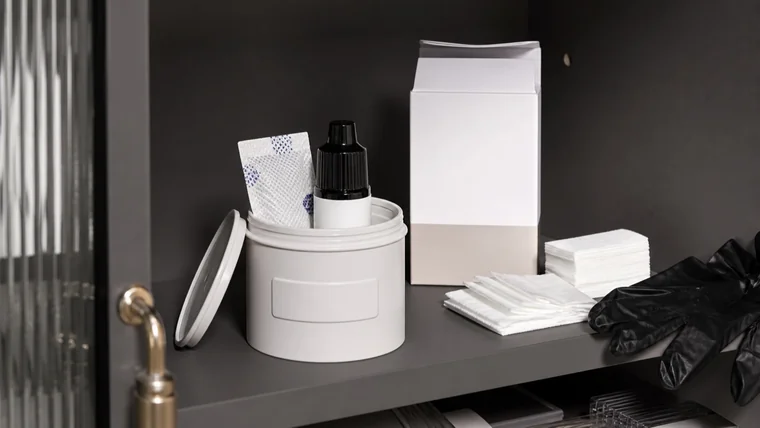
Close each bottle before storing it upright, then close the container. Keep any desiccant outside the bottles.
Buy quantities you can use within the after-opening period and leave backups sealed. A larger bottle can become wasteful if you perform few appointments. Protect stock during transport from heat and large temperature changes. Use the supplier’s disposal instructions and applicable local waste rules for liquid residue and contaminated materials; do not pour them down a drain.
Troubleshoot attachment problems without eye symptoms
What you observe
What to check
What to do next
The fiber detaches easily during placement.
Delay between pickup and contact, an aging drop, preparation, and the attachment surface.
Refresh the drop and check both room readings. Review your movement on a practice mannequin; correct the identified cause instead of loading the base with more glue.
The base slides or its direction changes after placement.
Setting that is too slow for your sequence, excess adhesive, or unstable contact.
Check pickup amount and support, then compare the setting time and room conditions. Humidity alone cannot explain every shift.
Glue forms strings or comes out of the bottle unusually thick.
Whether the change affects only the exposed drop or also freshly dispensed adhesive; opening date, cap, and storage.
If a fresh drop has the same problem under correct conditions, remove the bottle from service and contact the supplier with its batch number.
The fiber detaches easily during placement.
What to check
Delay between pickup and contact, an aging drop, preparation, and the attachment surface.
What to do next
Refresh the drop and check both room readings. Review your movement on a practice mannequin; correct the identified cause instead of loading the base with more glue.
The base slides or its direction changes after placement.
What to check
Setting that is too slow for your sequence, excess adhesive, or unstable contact.
What to do next
Check pickup amount and support, then compare the setting time and room conditions. Humidity alone cannot explain every shift.
Glue forms strings or comes out of the bottle unusually thick.
What to check
Whether the change affects only the exposed drop or also freshly dispensed adhesive; opening date, cap, and storage.
What to do next
If a fresh drop has the same problem under correct conditions, remove the bottle from service and contact the supplier with its batch number.
Loss several days later needs a broader review. Note whether the fallen extension has a natural lash attached, when the loss began, and which areas are affected. Natural shedding, attachment, growth, and maintenance can all contribute. The retention and fill guide explains that assessment.
Burning, swelling, or glue in the eye: stop the service
Burning, tearing, pain, redness, and swelling concern the person’s health. Stop applying product. The FDA’s eye cosmetic guidance advises stopping products that cause irritation and seeking medical care if it persists. Avoid treatment when the eye or surrounding skin is infected or inflamed.
Symptoms can overlap between irritation, allergy, mechanical contact, infection, and other eye conditions. Their timing or a photo cannot establish the cause. The American Academy of Ophthalmology advises seeing an ophthalmologist for an extension-related reaction or infection. Eye pain or a change in vision needs urgent medical assessment.
If adhesive gets into an eye, Poison Control advises immediate rinsing with water for 15 minutes. Do not force glued eyelids open or rub the eye. Call US Poison Control at 1-800-222-1222 for exposure-specific guidance. Keep the bottle available. Do not put acetone, lash remover, or other solvents in the eye. Call 911 for difficulty breathing, collapse, or other signs of a severe reaction.
Record the time, stage of the appointment, reported symptoms, products, batches, and actions taken. Set the bottle aside while the incident is reviewed. Do not prescribe eye drops or medication, or add remover to an irritated eye area as a routine first response. After a suspected reaction, refer for medical assessment rather than arranging small trial applications of another glue.
Sensitive claims, clear glue, and patch testing
Clear glue may avoid a pigment while still containing cyanoacrylates. Low odor, “sensitive,” and “latex free” do not establish that a person will tolerate every ingredient. The FDA explains that terms such as “hypoallergenic” and “for sensitive skin” have no federal standard or definition in US cosmetics. A different color or product name is not evidence that re-exposure is safe.
An ingredient claim and a release test answer different questions. A study of 37 eyelash glues detected formaldehyde release in some products that did not declare it. That study does not establish the composition, emissions, or measured risk of Lady Bond or Flexie. Such conclusions need evidence for the specific product.
Diagnostic patch testing is selected and interpreted by a healthcare professional. The American Academy of Dermatology describes a process with controlled allergens and follow-up readings. A commercial salon screening test does not identify an allergen or guarantee that a later service will be tolerated. Do not improvise a test by putting professional extension glue on skin behind the ear or near the eye, and do not repeat an exposure to investigate a reaction.
Protect the professional and keep usable product records
Repeated exposure over a working day differs from one client’s appointment. Keep the bottle open only as long as needed and arrange ventilation and, where appropriate, local extraction based on the products and workspace. A fan that pushes vapor toward a face does not remove it. Recurring cough, wheezing, or eye, nose, or skin irritation warrants stopping exposure and seeking medical or occupational health assessment. Describe the work and provide the product details.
Request the safety data sheet (SDS) for the exact adhesive and variant you purchase. Sections 4, 7, and 8 cover first aid, handling and storage, and exposure controls and personal protection; section 13 addresses disposal considerations. OSHA’s SDS guide explains these sections. A sheet for a similarly named glue or for pure cyanoacrylate does not describe the mixture in your bottle. Have the supplier resolve missing identity or safety instructions before use.
Under OSHA’s Hazard Communication Standard, employers with hazardous workplace chemicals must provide exposed workers with labels, accessible safety data sheets, and appropriate training. Choose protective equipment through the product’s SDS and workplace assessment. A generic face covering is not a substitute for a vapor-control plan.
In the client record, identify the full adhesive name, size, batch, opening date, temperature, humidity, and any lash prep product or bonder used. For example: “Lady Bond 5 mL; batch copied from bottle; opened October 21, 2026; 68°F (20°C), 55% RH; no bonder.” This is an illustrative entry, not a client result. Keep photos and health information in the appropriate confidential record.
Look for extension training that includes supervised isolation, adhesive pickup, attachment, and feedback. A lash lift course teaches a different treatment, and a course certificate does not itself establish permission to practice. Check your state board’s requirements before accepting paying clients. For example, Texas has a specific eyelash extension specialist licensing path; requirements in other states may differ.
Frequently asked questions
My black glue has a clear streak. Can I use it?
For these black London Lash adhesives, the dispensed drop should be uniform after the specified mixing. If a fresh drop still separates, strings, or behaves unusually, set the bottle aside and contact the supplier. A formula designed to be clear is a different case.
Can I use Lady Bond at 45% humidity?
That reading is below its specified range. Adjust the room and wait for stable readings before using it. Flexie includes 45% RH, but its faster setting time and advanced-skill requirement make it an unsuitable automatic substitute for a slower working pace.
Why does an extension detach when the room readings are correct?
The readings cover only the environment. Check the drop’s condition, the delay after pickup, preparation, and contact along the base. Review one variable at a time on a practice mannequin. More adhesive does not repair an attachment that has poor contact.
Does the four-week opening limit apply to a sample?
No. The Lady Bond and Flexie pages list 3 to 5 days after opening for samples. Use the period printed for your exact sample, record the date, and discard it when due even if product remains.
Can I use professional extension glue for DIY clusters?
These products are intended for trained professionals applying extensions to another person. Self-application requires open eyes and does not reproduce those conditions. For temporary lashes, use a product explicitly intended for that use, never a professional extension adhesive or household super glue.
Sources and product instructions
Product details: Lady Bond, Flexie, and London Lash FAQs. The instructions supplied with the exact product take priority if a formula or package changes.