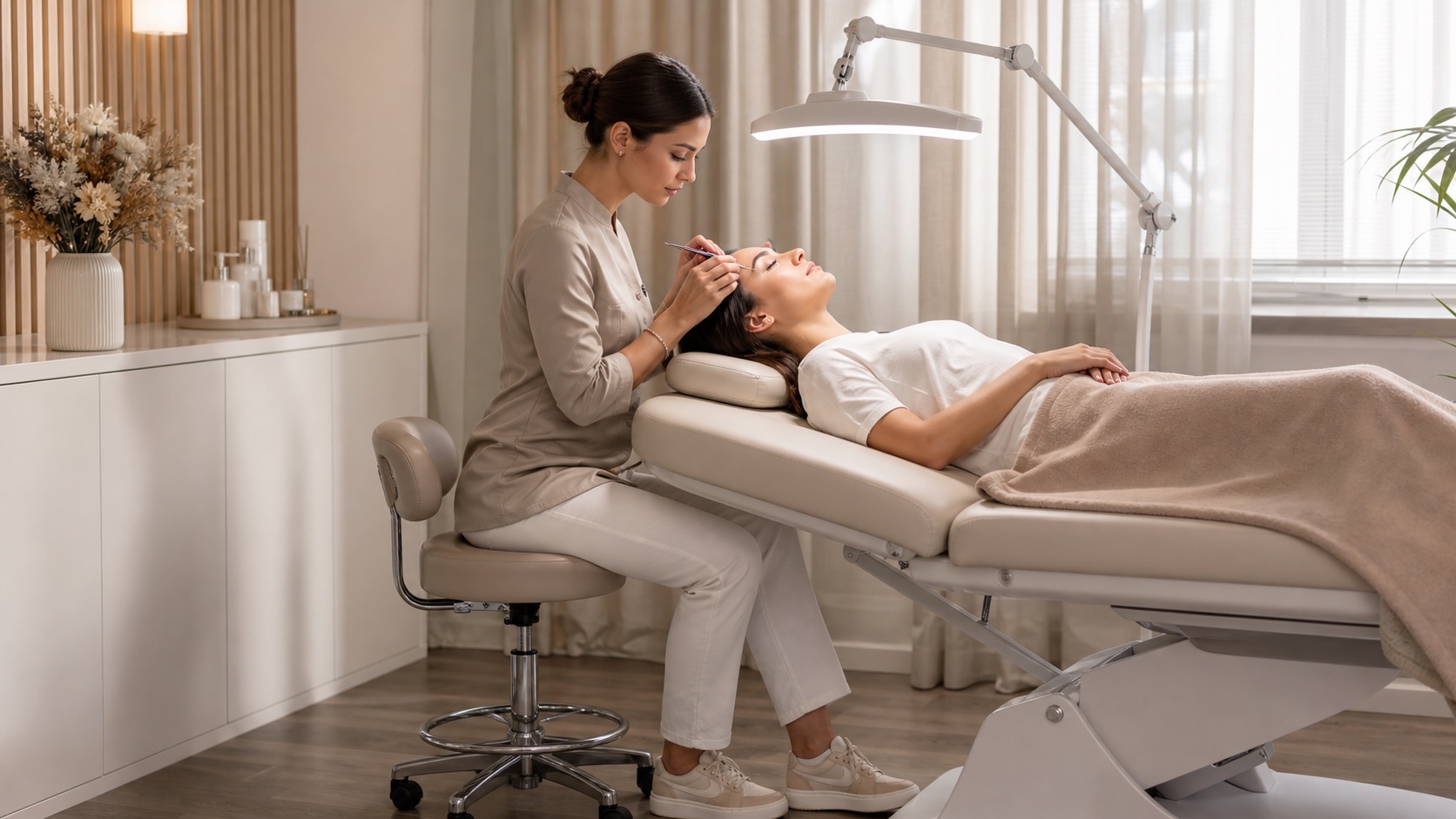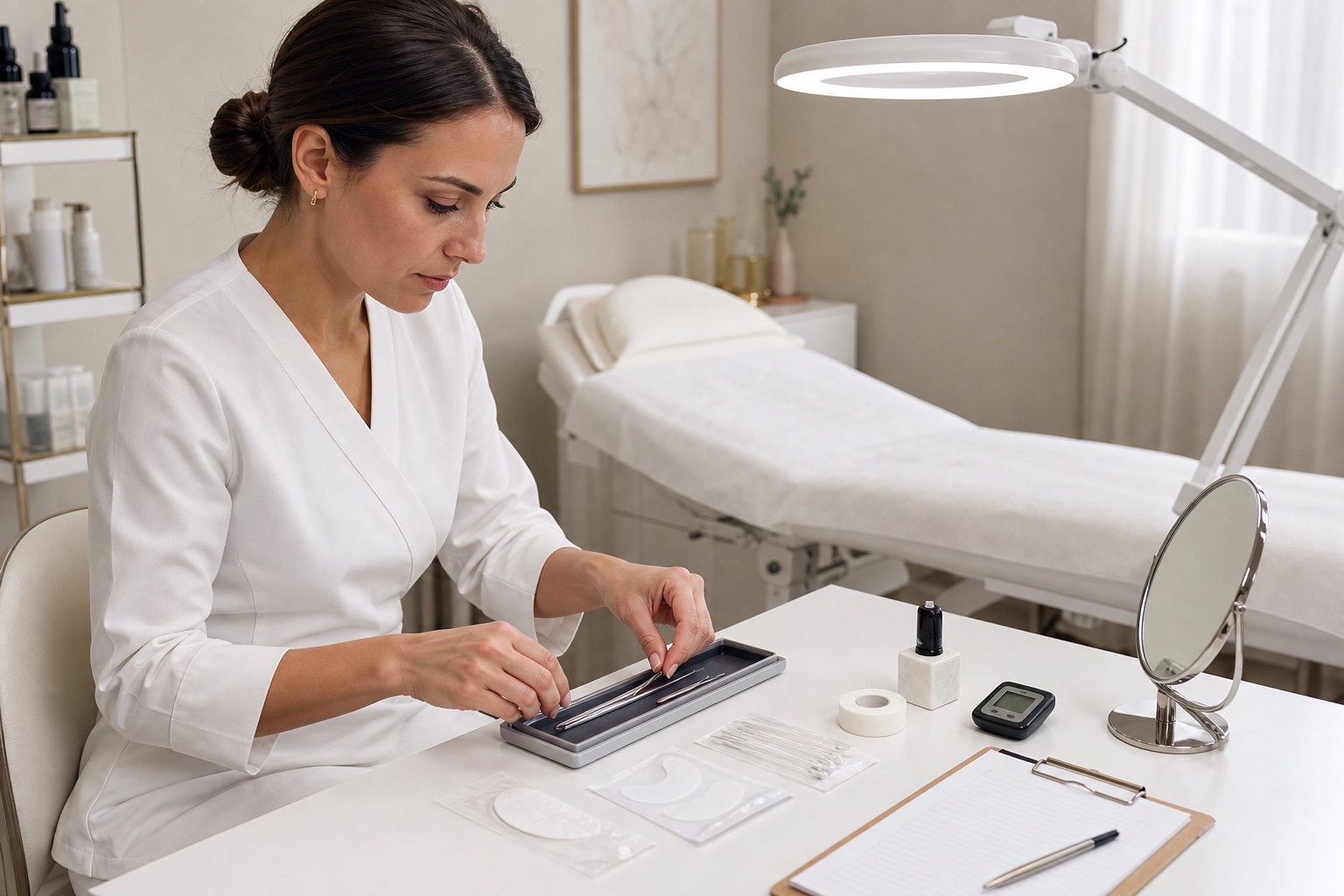
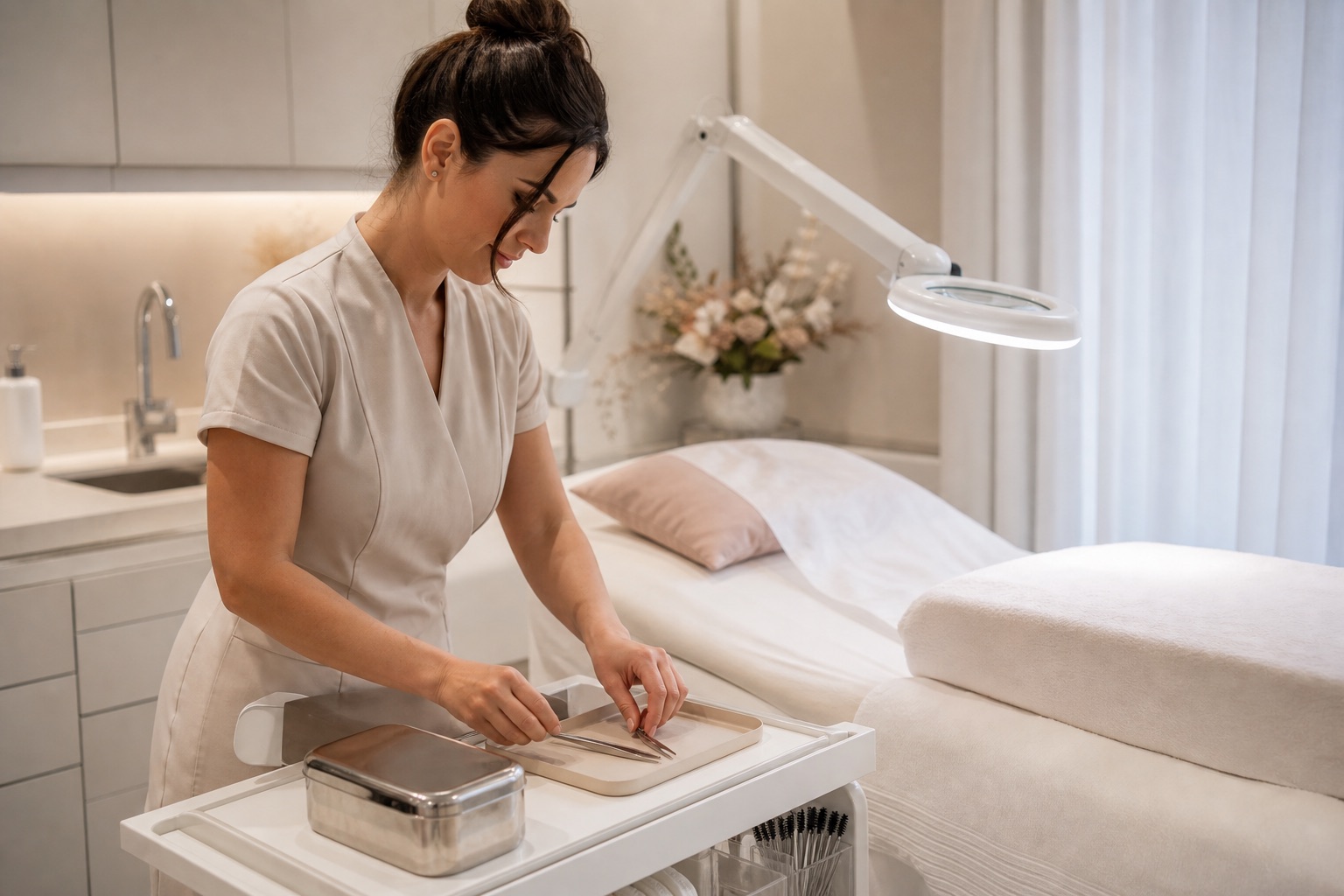
Lash workstation hygiene is a controlled flow, not a spotless-looking trolley or the smell of disinfectant. Hands, tweezers, applicators, surfaces, textiles and product containers can connect one client with the next unless clean supplies, the active service and used items move through clearly separated stages. A reliable protocol says what happens before, during and after every appointment, which products and contact times apply, and what must be discarded, reprocessed or removed from service.
Prepare only what one client needs. Perform hand hygiene at the right moments. Keep clean stock protected. Dispense products without returning an applicator or leftover dose to the original container. Discard single-use items after use. Move used tweezers into a dedicated closed route. Clean before any required disinfection, follow the labelled use and full contact time, dry and inspect reusable tools, then rebuild the station only after the previous service is completely closed.
This guide owns the lash-workstation hygiene intent. It does not teach isolation, mapping or chemical processing. Those belong to the professional lash-lift procedure and other technical guides. It also does not replace the pre-treatment lash consultation, local infection-control rules, workplace risk assessment, product labels, safety data sheets, insurer requirements or manufacturer instructions.
Rules for personal services differ by country, region and service scope. The principles below support a defensible workflow, but they do not certify a salon or prescribe one universal chemical. Check the authorised use of every cleaner or disinfectant where you work. If a process, material or product cannot be identified and verified, do not improvise a stronger concentration, a shorter time or an unlabelled substitute.
A clean-looking station is not enough: design a one-way flow
Three zones, one direction
Protected clean, one-client field, used exit
Clean
Protected stock and dry tools
Service
Only this client's working set
Used
Exit without return
Reset
Close before rebuilding
During a lash service, hands move between lamp controls, tweezers, tape, pads, brushes, timer, trolley, phone and product packaging. An item can look pristine after being touched with a used glove, while a simple tray can be managed safely when every object has a defined status. The useful questions are where did this come from, what has it touched and what must happen before it can return to service?
Create three zones: protected clean storage, the working field for one client and the exit route for used items. The clean zone contains dry reprocessed tweezers, unopened or protected stock and clean textiles. The working field contains only the amounts and implements needed for the current appointment. Used tools, disposables and textiles leave without crossing clean stock. In a small room, separation can be temporal and supported by closed containers, but it cannot be a pile whose status changes by assumption.
Zone | What belongs there | Failure to prevent |
|---|---|---|
Protected clean | Dry tools, closed stock and clean textiles | Opening everything early or placing a phone on top |
One-client field | Measured dose, tools and applicators for this service | Returning to bulk stock with a used hand or tool |
Used exit | Used tweezers, textiles and single-use waste | Leaving used items on the active or clean tray |
Cleaning, disinfection, antisepsis and sterilisation are different processes
Every term describes a different process
Use only the claim your real workflow supports
Cleaning
Removes soil and residue
Disinfection
Labelled use on inanimate items
Antisepsis
Product intended for skin
Sterilisation
Separately validated cycle
Cleaning physically removes soil, adhesive and cosmetic residue that may obstruct the next process. Disinfection is a defined treatment for inanimate objects or surfaces using a product authorised or registered for that purpose. Antisepsis concerns living tissue and a product intended for skin. Sterilisation is a separately validated process designed to eliminate all viable microorganisms, including spores; a spray, quick dip, UV storage box or bead container must not be described as sterilisation unless the entire system is validated for that claim and use.
Cleaning normally comes before disinfection because visible soil and organic material may shield the surface or interfere with the active chemistry. A surface disinfectant does not belong on skin, and a cosmetic cleansing product is not automatically a tool disinfectant. Read the full label: intended surface or device, dilution, application method, spectrum where relevant, wet contact time, rinsing, drying, ventilation, personal protection and material compatibility all matter.
There is no universal liquid for stainless-steel tweezers, vinyl beds, painted lamp arms, screens and hands. A concentration copied from social media does not prove approval, compatibility or effectiveness. More product cannot repair skipped cleaning, and mixing cleaners or disinfectants can create hazardous chemistry. Keep products in labelled containers, do not top up partly empty bottles and never transfer a working solution into an anonymous decorative bottle.
Hand hygiene: timing, technique and recontamination
Clean hands remain clean only until the next contact
Before, between, after—and after interruptions
Before
Set-up and client contact
Change
After a different surface or task
Gloves
Never replace hand hygiene
After
Used items, waste and reset
Perform hand hygiene before setting out clean items, before contact with the client or prepared eye-area field, after touching used materials or uncontrolled surfaces, after glove removal, after touching your phone, face or hair, and during the final reset when the workflow requires it. Wash with soap and water when hands are visibly soiled. Use an alcohol-based hand rub only according to its label, with enough product and enough rubbing time to cover all surfaces; it is not a shortcut over visible residue.
Long nails, rings, bracelets, sleeves and damaged skin can obstruct coverage, catch materials or compromise gloves. Build a workplace policy appropriate to the service and local requirements. A freshly cleaned hand becomes recontaminated after opening a used drawer, adjusting a phone or touching the waste bin. Good station design reduces these returns by placing controls, spare tools and waste where status remains obvious.
Gloves do not make everything they touch clean and do not replace hand hygiene. Wear them where required by risk assessment, product directions, local rules or an incident procedure, and change them between incompatible tasks. Never wash or disinfect disposable gloves to extend their use. One pair used across client, phone, drawers, bottle and waste simply joins those points into one contaminated chain.
High-touch surfaces around a lash treatment
The between-client reset includes the bed and covering, pillow or head support, trolley, trays, lamp arms and controls, handles, stool, timer, fan, dispensers and every point touched during the appointment. Remove waste and residue first, clean using a compatible method, then apply any required disinfectant so the surface remains visibly wet for the labelled contact time. Complete rinsing or drying exactly as directed. A wipe that evaporates immediately may not deliver the process described on the label.
Set frequencies by contact, soil, service risk and product instructions. Between-client turnover and scheduled room cleaning are related but not interchangeable. A compatible single-use barrier can protect a difficult control, but it must be removed without contaminating the surface and does not eliminate inspection. Replace cracked, porous or degraded furniture and containers that can no longer be cleaned reliably; disinfectant cannot repair the material.
Give phones and cameras their own rule. Keep them outside the treatment field where possible, prepare framing before the service and follow the device maker's cleaning and protection instructions. After touching the device, do not return directly to tweezers, eyelid or product packaging. Image consent and data protection are separate obligations from hygiene, even when the same phone is involved.
Reusable tweezers: from the used container to protected storage
A tweezer returns only after a complete cycle
Collect, clean, treat, dry and inspect
Safe collection
Accessible cleaning
Required treatment
Dry, inspect and protect
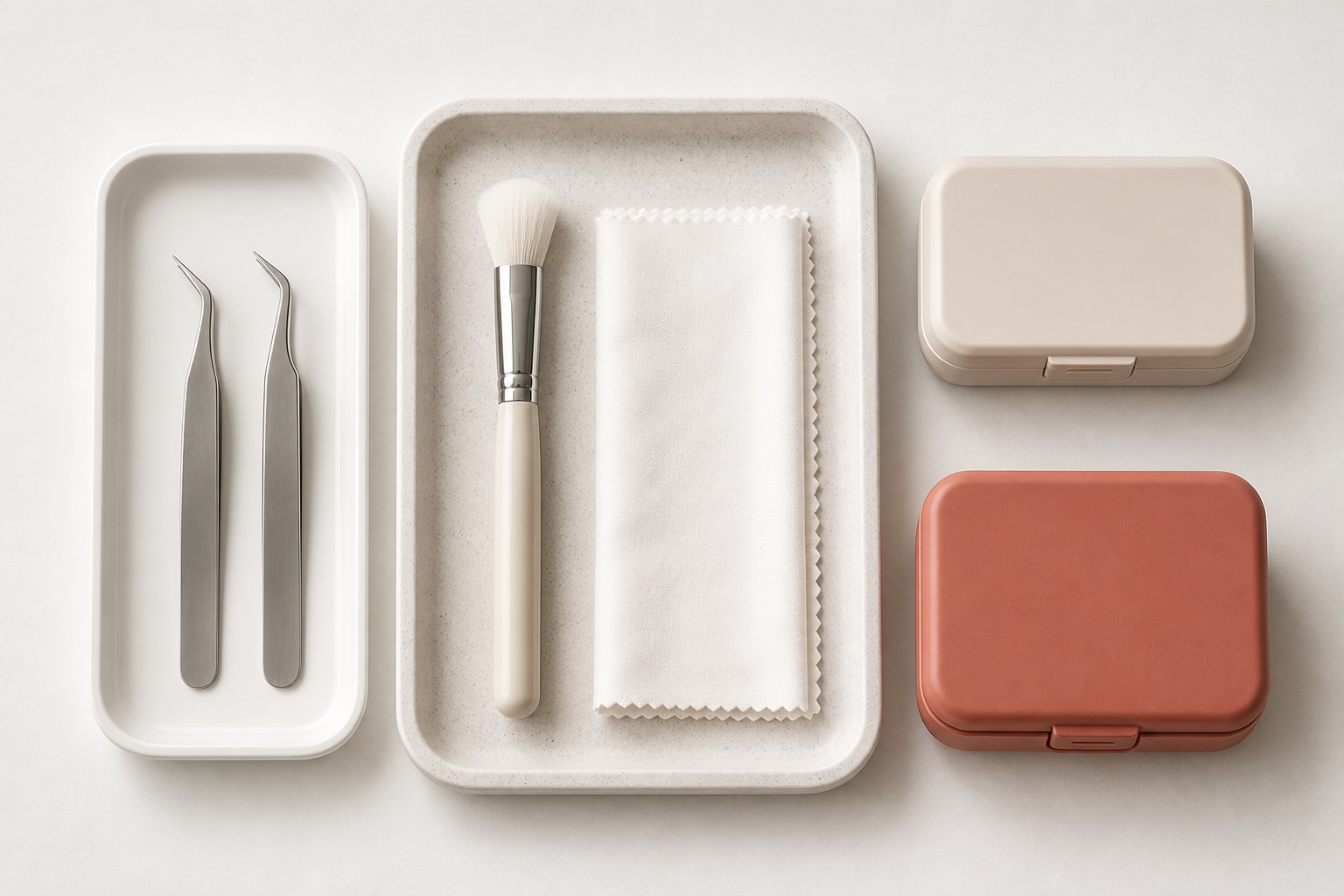
Reusable lash tweezers need a written route: safe collection, residue removal, cleaning, any required subsequent treatment, rinsing when specified, complete drying, inspection and protected storage. Move them after the service without leaving them loose in a sink or returning them to the clean tray. A dedicated puncture-resistant or otherwise suitable container reduces accidental injury, tip damage and contact while tools travel to the reprocessing area.
Remove cured adhesive with the method approved for the tool and remover, without scraping in a way that damages alignment or surface finish. Cleaning must reach tips, sides, grip and closure points. The later process depends on intended use, material, contamination, manufacturer directions and local requirements. Do not call a tweezer sterile because it was sprayed, briefly immersed or stored under a light.
Dry completely and inspect under strong light. Persistent residue, corrosion, pitting, deep scratches, distorted tips, poor alignment or irregular closure are reasons to remove the tool from service. Store reprocessed tweezers dry, protected and separate from used instruments. Keep enough complete sets for the appointment pattern; insufficient stock is an inventory problem, not permission to shorten contact time or skip drying.
Single-use supplies: one client, one service, one disposal route
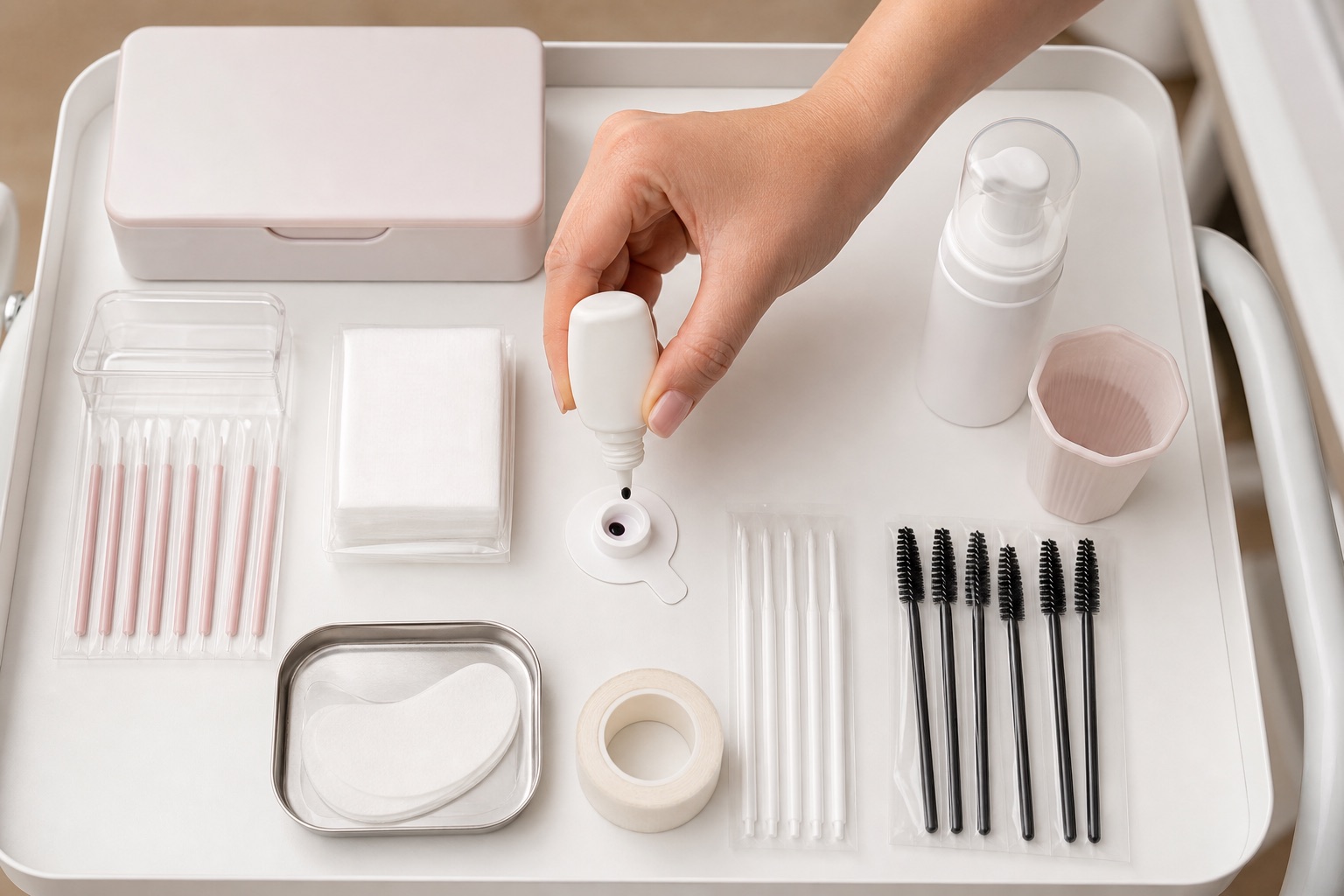
Microbrushes, lint-free applicators, spoolies, cotton-tipped applicators, glue wells or rings, pads, tapes and other supplies are single use when the manufacturer says so or when no validated reprocessing route exists. They do not become reusable because they look intact, are stored in a named client's bag or have been sprayed. Set out a sensible quantity and remove extras from protected stock without touching the pieces left behind.
Treat the tape roll as stock, not as an object that repeatedly approaches the client's face. Precut reasonable lengths with clean hands and a dedicated tool, protect the roll and interrupt the workflow cleanly if more is needed. Never place a used brush or micro-applicator on the trolley for later and never re-enter a product or packet with it. Removed tape and pads are discarded rather than repositioned after touching a used surface or glove.
Single use does not mean every item in a studio must be disposable. It means respecting the declared purpose and selecting reusable items only when they can actually be cleaned, treated, dried, inspected and stored. Neither option compensates for recontaminated hands, an unfinished surface reset or poorly protected bulk supplies.
Cosmetics, adhesives and lift systems: dose, batch and original container
The session dose leaves and never returns
Identify, dispense, close and record
Identify
Label, batch and opening
Dispense
Amount for one client
Close
Protect nozzle and cap
Discard
No session remainder returns
Keep cosmetics in their original packaging with the product identity, batch or lot reference, period after opening or expiry where applicable, warnings and storage conditions. Record opening date where it supports the system. Permanent decanting into an anonymous bottle removes traceability and may introduce packaging incompatibility. Requirements differ by market, but the working principle is stable: you should be able to identify exactly what was used and retrieve its current instructions.
Dispense a small extension-adhesive drop into an intended single-client holder without letting the nozzle touch a surface, tweezer or applicator. Maintain the nozzle as instructed, close the bottle promptly and never return the remainder. Temperature, humidity, agitation, storage, life after opening and disposal are product-specific. Do not add another substance or transfer a failing adhesive in an attempt to restore performance.
For lift lotions, tint, developer, primer, cleanser and remover, use the exact system, container and dose described by the manufacturer. Decant only the session amount into a clean or single-use holder without double dipping. Do not combine leftovers, swap caps, mix systems for convenience or proceed when identity, batch, integrity or directions cannot be verified. The guide to a lash lift gone wrong explains why more chemical exposure is not a universal correction.
Maintain the clean-used boundary during the service
Arrange objects in order of use and reduce trips into drawers. A dropped tweezer, an applicator that touches an uncontrolled surface or a hand that moves to the phone cannot be recovered by looking at it. Replace the single-use item, isolate the reusable instrument and repeat hand hygiene where required. A prepared reserve set allows the practitioner to break the chain without improvisation.
Do not blow on adhesive or cosmetics, rest bottles on the treatment bed or keep used applicators upright in an open cup. Plan how the lamp, pillow and timer will be adjusted without returning directly to the eye area. If a client coughs, sneezes, waters heavily or needs a pause, stop the precise work, protect materials and reassess what was exposed rather than continuing automatically.
Hygiene never authorises continuation through increasing burning, pain, chemical contact or another stop criterion. Stop, follow the product incident instructions and preserve product identification without diagnosing or inventing a neutralisation step. The consultation guide sets postponement and stopping boundaries; hygiene limits avoidable transfer and preserves useful information about the event.
Between-client turnover is a fixed part of the appointment
Turnover belongs inside the booking time
Close, clean, treat, reprocess and rebuild
Close
Remove used items and leftovers
Clean
Remove every visible residue
Treat
Observe the full label time
Rebuild
Only clean, dry items return
Close the service first: discard single-use waste through the correct route, move used textiles and tweezers, close and remove cosmetics, and perform hand hygiene when indicated. Clear surfaces and remove residue before cleaning and any required disinfection. Keep the surface wet for the full label time; do not dry it early to recover diary minutes. Reusable tools follow their own separated cycle at the same time.
Rebuild only after processes, drying and inspection are complete. The next client should not arrive while the previous client's used items remain on the trolley. Include real turnover time in pricing and scheduling and keep enough stock and tweezer sets. Closely packed appointments are a commercial planning issue, not a reason to reuse disposables or compress a validated step.
Textiles, waste, incidents and mobile services
Use a clean covering and textiles for each client. Place used items directly into a dedicated container without shaking them or laying them on clean stock. Define transport, washing, complete drying and protected storage according to material, contamination and local rules. A damp or dropped towel does not return to the bed. Reusable coverings must tolerate the real repeated process, while single-use coverings are discarded after the appointment.
If a sharp tool causes an injury or an item contacts blood or another body fluid, stop, make the area safe and follow your written exposure, waste and assessment procedure. Do not clean hurriedly to conceal the event. Record the facts and product or tool involved, and do not reuse anything whose safe handling route is unclear. Occupational-health and reporting duties depend on jurisdiction and must be established before an incident.
For a mobile appointment, carry separate closed containers for clean and used items, a cleanable work surface or compatible barriers, adequate stock, a waste route, original labelled products and a practical hand-hygiene plan. Assess the room before setup. If you cannot protect clean supplies, restore the surface or transport used tools safely, postpone rather than recreate only the visible parts of the studio protocol.
Records, responsibility and protocol audits
A useful reprocessing record identifies the tool or set, method, product where relevant, dilution if required, contact time, date, person responsible, exception and decision. Record equipment maintenance, replaced containers, expired or quarantined products and contamination incidents. Keep client data separate and proportionate; process traceability does not justify collecting unrelated personal details.
Audit whether the written protocol matches a complete real appointment, including phone use, drawer opening and turnover. Check labels, registrations or authorisations, expiry, safety data sheets, tweezer condition and reserves. A checklist that is always ticked proves little if deviations are never recorded. The purpose of an audit is to repair the system before a shortcut becomes routine.
To develop organisation, manual control and manufacturer-instruction literacy, explore the BeautyLearn lash courses and the online lash-lift course. Use the guide on choosing an online lash course to assess demonstrations, supervised practice and feedback. A private certificate never replaces local licences, qualifications or legal permission to provide a service.
Lash workstation checklist
Before the client: previous cycle closed; hands ready for effective hygiene; clean stock protected; bed and high-touch points reset; tweezers dry and inspected; adequate single-use supplies; tape roll protected; packaging intact and readable; batch and opening status checked; product can be dispensed without return; used-tool container and waste route ready; phone outside the flow; current instructions and emergency steps accessible.
After the client: single-use items discarded; tweezers transferred safely; textiles separated; cosmetics closed; leftovers not returned; all touched surfaces treated as required; full contact times observed; tools dried and inspected; exceptions recorded; stock replenished without exposure; no used item remains in the clean area. If one status cannot be verified, the station is not ready.
Frequently asked questions about lash workstation hygiene
Is spraying tweezers between clients enough?
No. A quick spray does not replace residue removal, cleaning, any required subsequent treatment, full contact time, drying and inspection. The correct route depends on the tool material, intended use, contamination, manufacturer instructions and local rules. Keep enough prepared sets to complete every step without shortening it, and do not return a tweezer to the clean tray until the result is dry, intact and verifiable.
Does a UV box sterilise lash tweezers?
Not automatically. Sterilisation is a validated process with specified equipment, cycle parameters, load configuration and monitoring. A storage box with a light or a commercial hygiene claim does not remove adhesive or soil and does not by itself support the word sterile. Check the exact intended use and evidence for the device, while retaining the cleaning and reprocessing route required for the tool and your jurisdiction.
Is 70% alcohol suitable for every surface and tool?
No. A percentage alone does not establish authorised use, spectrum, contact time or compatibility. Some finishes, plastics, coatings and adhesives can be damaged, and visible residue still requires cleaning. Select a product approved or registered for the intended surface in your market and follow the label. Use only a skin antiseptic or hand rub formulated and labelled for living skin, never the trolley product on hands.
Do gloves remove the need for hand hygiene?
No. Gloves can become contaminated, can tear and can transfer material between every object touched. Perform hand hygiene before putting them on and after removal according to the applicable protocol, and change them between incompatible tasks. Do not wash or disinfect disposable gloves. If the same pair touches the client, phone, drawer and product bottle, the glove has connected those points rather than protected them.
Can a spoolie be saved for the same client?
A single-use spoolie that entered the professional service should be discarded. Sending it home and bringing it back gives the studio no control over storage, handling or contamination, while its return can contaminate packaging and surfaces. If aftercare requires a brush, provide a new one intended for the client to keep. Do not reintroduce a previously used applicator into professional stock or product.
Can a glue ring be reused after the adhesive peels away?
No when it is supplied as single use. Removing the visible drop does not restore the initial surface, and scratches or invisible residue make reprocessing unverifiable. Discard it after the client and do not place fresh adhesive over an old dose. Dispense smaller amounts and refresh the drop only as the adhesive manufacturer's instructions require; waste reduction must not depend on reuse of a disposable holder.
Can tape be cut from the same roll during the service?
Precut reasonable lengths before contact, using clean hands and a dedicated tool, and keep the roll protected. If more tape is necessary, interrupt the treatment flow so used hands, gloves or tools do not return to the stock. Any length that has touched the client, working field or a used glove is discarded and never wound back onto the roll or retained for another appointment.
How long must disinfectant remain on the trolley?
For the full contact time stated on the authorised product label and required by your applicable protocol. There is no universal number. Remove soil first, then apply enough product by the specified method to keep the target surface wet for the whole interval. Respect ventilation, rinsing and compatibility directions. Drying it immediately because the next client has arrived changes the evaluated process.
Can leftover extension adhesive go back into the bottle?
No. The session drop has been exposed to the room, holder, tools and service and must not return to the original container. Dispense a small amount, prevent nozzle contact, close and store the bottle as instructed, and discard the remainder through the appropriate route. Do not combine old and new drops or dilute adhesive when viscosity, curing behaviour or other performance changes.
May lift lotions or cleansers be kept in matching decanted bottles?
Permanent decanting can remove product identity, batch, warnings, expiry or opening information and may place the formula in incompatible packaging. Keep the original container unless the manufacturer provides and documents a professional dispensing system. For one appointment, place only the required amount in a clean or single-use holder, identify it throughout the service, and never save or return the remainder.
What should happen when a tweezer falls on the floor?
Remove it from the service immediately, place it in the used-tool route and replace it with an already reprocessed set. Do not wipe only the tip and continue. After the full cleaning and treatment cycle, inspect alignment and damage from the fall before returning it to stock. A suitable reserve lets the appointment continue safely without turning an accident into a shortcut.
How should a phone used for photographs be managed?
Keep it outside the working field where possible and follow the manufacturer's cleaning and compatible-cover instructions. Plan photographs at defined points, avoid touching the device with hands or gloves engaged in the service, and perform hand hygiene before returning to tools or products. Obtain image consent and protect client data separately; a hygienically managed device can still create a privacy breach.
Are synthetic lash extensions on a strip single use?
Fibres removed from protected stock and placed in the one-client working field should not return to bulk storage after being touched or exposed during the session. Prepare a dedicated palette with a sensible quantity and protect reserve strips. Follow supplier instructions and never wash leftover fibres or transfer them to the next client. Good stock planning reduces waste without reversing the clean-to-used direction.
Does clean also mean sterile?
No. Clean describes the removal of soil and residue. Disinfected and sterile refer to different outcomes produced by defined processes. Use only the term supported by what was actually completed and recorded. Professional communication does not need the strongest-sounding word; it needs an accurate process, suitable products, real contact times, inspection and a clear storage status.
Does excellent hygiene prevent every allergy or irritation?
No. Hygiene controls avoidable contamination routes, but it cannot prevent every sensitisation, irritant exposure, technical error or individual response. Consultation, compliant products, manufacturer directions, careful technique, monitoring and stop criteria remain necessary. Never describe a service as allergy-free or use a clean workstation as a reason to dismiss increasing discomfort, redness or another unexpected response.
How often should the treatment-bed covering be changed?
Use a clean covering for every client and replace it whenever it becomes wet, soiled or damaged, in line with its material and your local protocol. Discard a single-use covering. Send reusable textile through its dedicated collection, washing, complete drying and protected-storage cycle. Turning over a used cover or laying a fresh one over residue does not reset the underlying bed.
When should a lash tweezer be replaced?
Remove it from service when corrosion, pitting, deep scratches, distortion, misaligned tips, irregular closure or persistent residue prevents reliable cleaning or precise use. Also confirm that its material continues to tolerate the repeated process. Disinfection cannot repair mechanical damage, and an unstable grip can compromise separation, direction and safe control near the eye.
Can a mobile lash station be as hygienic as a studio station?
Only when it can achieve the same essential outcomes: effective hand hygiene, a cleanable field, protected clean stock, intact labelled products, separated used tools and waste, safe transport and enough time for turnover. Assess the site before unpacking and use closed containers. If one essential condition cannot be provided, postponing is more professional than performing a reduced imitation of the protocol.
What should be recorded if a product container is contaminated?
Quarantine the container and record date, product, batch or lot, what touched it, people informed, decision and closure. Do not remove only the visible portion and use the rest on another client. Consult the manufacturer's instructions and workplace procedure, assess any relevant adverse-event reporting route and examine the system failure that allowed the contact. Traceability should lead to a decision, not just a note.
Official sources and further reading
For hand hygiene and environmental processes, consult the WHO Guidelines on Hand Hygiene in Health Care, the CDC definitions of cleaning, disinfection and sterilisation and the CDC guidance on cleaning and disinfecting facilities. These healthcare sources define processes; they do not turn a lash service into a medical procedure.
For chemical products and eye-area context, see the ECHA guidance for users of biocidal products, the EU Cosmetics Regulation, FDA Eye Cosmetic Safety and the OSHA bloodborne-pathogens overview. Apply only the rules and product authorisations relevant to your jurisdiction and workplace.
Continue with all lash guides, review natural-eyelash anatomy and the growth cycle or map the training path for becoming a lash artist. BeautyLearn does not link to competing academies in this guide.
Record the service with the lash client record for extensions and lifts: it separates consultation outcomes, technical delivery, product batches, permissions, privacy, aftercare, incidents and follow-up into an auditable lifecycle.
For colour-specific service planning, use the professional eyelash-tinting guide: it separates legal product suitability, colour, system compatibility, ratio, timing, closed-eye control, removal and follow-up from lash-lift reshaping.
Plan tools and stock by function with the professional lash artist kit guide: it connects tested tweezers, lighting, consumables, traceable products, measured adhesive conditions, inventory and staged purchasing without brand rankings.
For the complete client-level overview, read the eyelash extensions guide: it connects classic, volume and hybrid principles with design, the appointment, realistic duration, infills, preparation, aftercare, removal and safety boundaries.
Study the classic technique in the one-to-one eyelash extensions guide: it makes natural-lash selection, isolation, off-skin distance, direction, contact, adhesive dose and sticky checks separately verifiable.
Compare every volume-family construction in the volume, hybrid and mega-volume guide: it keeps D labels, total load, fan anatomy, hybrid design, mega-volume prerequisites and troubleshooting inside one non-cannibalising technical intent.
For a complete specification and mapping framework, continue with the guide to extension curls, lengths, diameters and total load. It explains product-label limits, leverage, zone adaptations, grow-out and sustainable set design without splitting every curl or diameter into a competing page.
Connect eye references, visible balance and texture with the complete lash mapping guide. Cat eye, doll/open eye, squirrel and wispy stay together as one non-cannibalising design intent, with no universal map assigned to an eye-shape label.
For product identity, environmental control, storage, exposure and reaction boundaries, use the complete eyelash extension adhesive guide. It also owns irritation, sensitisation and patch-test limits, so no separate competing page is needed for glue allergy.
For duration, natural shedding, early-loss troubleshooting and the choice between maintenance and replacement, use the complete lash retention and infill guide. It also owns the search intent “why eyelash extensions fall out”, avoiding a second competing page.
For product choice, a no-pull sequence, residue inspection, incident response and stop criteria, use the professional eyelash extension removal guide. It also owns DIY removal and cream-versus-gel search intent, avoiding thin competing pages.
For cleanser choice, a complete wash-and-dry method, make-up, sleep, exercise, swimming and stop signs, use the complete eyelash extension aftercare guide. It also owns “when can lashes get wet” and sleeping-with-extensions intent, avoiding thin competing pages.
For natural-lash protection, load, stickies, tension, breakage and warning signs, use the complete eyelash extension safety guide. It owns “do extensions damage natural lashes?” intent without creating a competing fear-based page.
For customer-facing costs, inclusions, maintenance budgets and quote comparison, use the eyelash extension and lash lift cost guide. It avoids misleading international averages and remains separate from professional rate-card calculation.
Before taking paying clients, use the lash artist certificate and licensing guide to verify practitioner, premises, business and insurance requirements in the exact jurisdiction. It keeps legal-entry intent separate from technique and career development.
For a currency-neutral model of paid appointments, full service time, occupancy, costs and operating profit, use the lash artist earnings guide. It keeps professional earnings separate from client price comparison and future rate-card construction.
To build a traceable unit price from complete time, real product use, overhead, labour, fees and margin, use the professional lash service pricing guide. It keeps the rate card distinct from client quote comparison and monthly earnings analysis.
For a repeatable capture workflow covering permission, lighting, focus, honest before-and-after comparison, colour and editing limits, use the professional lash photography guide. It documents completed work without replacing live technical or safety checks.
To turn real work into a coherent path through evidence, authentic reviews, enquiry, booking, follow-up and appropriate return, use the lash portfolio and client acquisition guide. It measures qualified appointments without promising demand or income.
To adjust the complete lash workstation and plan static-load interruption, reach, light, tools and recovery without prescribing treatment, use the lash artist ergonomics guide. It complements technical and hygiene controls without replacing individual assessment.
For a cautious framework on apparent lash breakage or thinning, serum limits, treatment pauses and clinical referral, read the fragile or thinning eyelashes guide. It supports a stop-or-proceed decision without diagnosing the cause or promising regrowth.