We use necessary cookies and the Meta Pixel to measure campaigns and improve our offers. You can change your optional-cookie preferences at any time. Read our Terms and conditions.
One-to-one eyelash extensions: isolation, placement, and adhesive
Silvana DebiasiSeptember 1, 2026Updated on October 21, 2026 14 min read
One-to-one eyelash extensions, also called classic extensions, attach one artificial fiber to one natural lash. Depending on the fibers and the available lashes, the result can be subtle or defined. Each attachment must let that natural lash move and grow without pulling on its neighbors, so a neat line of tips is only part of the quality check.
For students and working lash professionals, the checks below explain how to assess isolation, distance from the skin, contact, direction, and adhesive control. They support practical instruction and supervised work near the eye. Professional extension adhesive is not suitable for applying extensions to your own eyes.
At a glance: attach one fiber to one suitable, fully isolated natural lash. Keep a clear gap from the skin and continuous contact along the lash, without a lifted base or a crossed attachment. Hold the isolation until the fiber is stable, then check that neighboring lashes remain separate. Correct a faulty attachment after the adhesive has set with professional removal; do not bend it into place or add glue over it.
Inspect each natural lash for length, thickness, condition, and direction. A short or fine lash may need a shorter, lighter extension than the lash next to it. Leave a lash untreated if it looks damaged or you cannot isolate it reliably. Where a natural lash is missing, there is no attachment point for an extension.
London Lash’s fiber selection guide gives a general reference of no more than 2 mm beyond the natural lash length. In that example, a 10 mm fiber on an 8 mm lash is already at the stated limit. The arithmetic does not establish a safe load: a shorter fiber may be more appropriate for a thin or downward-growing lash.
Compare diameter, base shape, and curl within the product line you use. With the same material and construction, increasing diameter or length adds weight. Flat and round fibers with the same labeled diameter need not have the same mass. Choose a base that can lie alongside the natural lash for a continuous stretch; if the curl pulls away immediately, change the fiber geometry instead of filling the gap with adhesive.
Visible lashes are at different points in their growth and shedding cycle. You cannot reliably identify a biological stage by looking at one lash, but you can recognize a base that is too short, fragile, or inaccessible for the planned attachment.
Prepare the workstation and protect the eye
Adjust the bed, chair, and light until you can see the bases without bending your wrist toward the eye. Use clean hands, properly cleaned and disinfected tweezers, fresh disposable supplies, and identifiable products. Record the adhesive name, batch, and opening date, and keep its instructions and safety data sheet available. Do not work from an unlabeled or decanted bottle.
Have the client remove contact lenses before the service. Cleanse and dry the lashes using the preparation system specified for the adhesive. Lower-lash pads or tape must protect the lower lashes without touching the eye surface. The eyelids should stay fully closed and relaxed; reposition any tape that pulls them open.
Postpone treatment for an eye infection, inflamed or broken skin, discharge, or unexplained eye symptoms. The FDA’s eye cosmetic safety guidance advises stopping an irritating eye cosmetic immediately and seeing a doctor if irritation persists.
Stop application if the client reports burning, stinging, pain, or increasing tearing. Check eye closure and pad or tape position without adding product. Marked redness, swelling, light sensitivity, or a vision change needs prompt medical assessment. Cosmetic removal is not treatment for an eye reaction.
If adhesive or remover enters the eye, stop and begin rinsing immediately with plenty of clean running water at a comfortable temperature. Poison Control recommends at least 15 to 20 minutes of irrigation, followed by a call to 1-800-222-1222 for specific guidance. Do not delay rinsing to find paperwork. Keep the product container available, and seek urgent eye care for pain, vision changes, or persistent symptoms.
If the eyelids are glued shut, do not force them apart. Do not rub the eye, pick at the glue, or use acetone, household solvents, or lash remover to free the lids. Poison Control’s lash adhesive guidance explains these exposure risks. A suspected exposure ends the service.
Isolate one natural lash from base to tip
Use the isolation tweezers to move neighboring lashes aside until you can follow one lash from near the skin through the attachment area. Hold that opening while the other hand works. If a fine lash slips back into the contact zone, stop and reestablish isolation before picking up adhesive.
A front view can hide a fine lash behind the selected one. Change your viewing angle or lighting enough to distinguish both roots while keeping the client’s eye closed and protected. The tweezer tips should separate hairs without pinching skin or moving the lower-lash pad.
Use only enough pressure to keep the opening steady. If you lose sight of the base or your hand starts to shake, adjust your grip, seat, or light before continuing. Hold isolation through placement and initial setting. When you release, watch for a neighboring lash that follows the new extension; a wide opening alone does not prove that a second hair stayed out.
Isolation
Follow each lash to its root
One isolated lash
The opening contains one lash. The tweezer tips keep neighboring hairs outside.
A hidden second hair
Follow the roots: a fine hair enters the opening behind the chosen lash. Reestablish isolation.
Schematic top view. In the second example, a fine hair remains inside the opening. Space between the tweezer tips alone does not prove isolation. Proportions are illustrative.
Check skin clearance and attachment length separately
Skin clearance is the free space between the eyelid and the start of the attachment. Contact length is the stretch where the fiber and natural lash lie together. Moving a fiber farther from the skin cannot repair a lifted base, and moving it closer does not create better adhesion.
One London Lash set-assessment method uses 0.5 mm of clearance at the inner and outer corners and 1 mm elsewhere. These are references for that method, to be calibrated during training on the lashes in front of you. Adhesive belongs on the lash shaft, and the base must not touch or prick the skin.
For the attachment itself, London Lash trainer Karolina Swiderska recommends at least 2 mm of contact. Inspect whether the base lies continuously along the lash. That contact length is separate from skin clearance and from how far you dip a fiber into adhesive; it is not a universal dipping depth.
Attachment from the side
Continuous contact with space above the skin
Continuous contact
The bond follows a length of the natural lash. A clear gap remains between the attachment and the skin.
Touching the skin
The fiber and adhesive reach the skin. This attachment needs correction.
Lifted base
The lower end sticks out. Adhesive higher up does not close the gap beneath the base.
X-shaped attachment
The fiber crosses the natural lash, leaving only a meeting point instead of continuous contact.
Brown: natural lash. Teal: extension fiber. Amber: adhesive at the attachment.
Enlarged diagrams, not to scale. Check skin clearance and contact length separately. The text explains the measurements used in specific training methods.
Look from the side. A gap under the lower end of the fiber reveals a lifted base. An X-shaped crossing creates a meeting point instead of a continuous attachment. If the adhesive has already set, remove the faulty extension professionally and replace it with a compatible fiber and approach angle. Do not bridge the gap with another drop.
Top, side, or underneath placement can be appropriate within the technique you have learned. Choose an approach that keeps the attachment visible, preserves skin clearance, and gives continuous contact. Identical curl letters from different product lines do not guarantee identical base shapes.
Set the direction before making contact
Approach with the fiber already oriented. Its base should follow the part of the natural lash receiving it, while the tip fits the design without crossing neighboring extensions. A straight-looking tip can hide a rotated base, so alternate your top and side views.
At the inner corner, choose lengths suited to the shorter lashes and an angle that keeps the base visible. At the outer corner, a long fiber on a downward-growing lash can rotate or pull the outline down. Shorten the fiber or change its curl when the planned direction would require forcing the natural lash. Use the lash mapping guide to plan length distribution and compare both eyes.
Adjust placement only while the adhesive still allows it. Once the bond has set, pushing or twisting the extension can weaken the attachment or pull the natural lash. A crossed or protruding base needs professional correction.
Control adhesive amount, setting time, and room conditions
Pick up adhesive on the portion of the base that will attach. After placement, look for a continuous bond without a hanging drop, a rigid lump, or a bridge to another hair. If the pickup is excessive, discard that fiber and start with a clean one. Do not wipe the excess onto the client’s lashes.
LashBase Extreme Lash Adhesive, sold on the brand’s US site, is one example: a black cyanoacrylate adhesive with medium viscosity and a listed 2 to 3 second setting time. Its specified environment is 64 to 76°F, about 18 to 24°C, with 40 to 70% relative humidity. These values apply to this product.
Measure temperature and humidity at the workstation. Moisture affects cyanoacrylate setting, so judge your pace in the actual room conditions. If the product starts setting before you reach the lash, prepare the isolation and fiber direction before dipping. If the fiber stays mobile unexpectedly, keep it isolated and review the amount, room readings, and bottle condition. Do not test an unfamiliar adhesive on a client.
For Extreme, LashBase instructs users to shake the bottle before use, dispense a small drop, refresh it regularly, and recap immediately. Store it upright in an airtight container at room temperature. The stated shelf life is nine months unopened when stored correctly, and up to six weeks after opening. Date the bottle and follow the current instructions supplied with it.
A drop that develops strings, a skin, or an obvious consistency change should be replaced; do not mix it into a fresh drop. Recurring changes call for a check of the environment and storage. Add primers or accelerators only when the system specifies compatibility. The lash adhesive guide covers product handling and reaction risks in more detail.
The short setting time describes initial attachment during placement. It does not establish complete curing or tell you when washing, steam, or other aftercare is appropriate. Follow the adhesive system’s finishing and aftercare directions, and give the client those instructions without promising a fixed wear time.
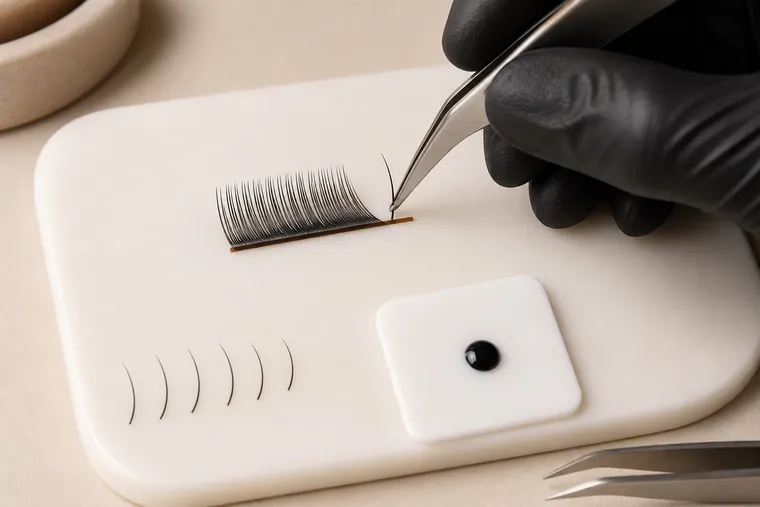
Use a practice strip to compare adhesive pickup and base contact before supervised work on a person.
Follow a controlled placement sequence
Select a suitable natural lash and isolate it. You must be able to see the intended contact area before picking up adhesive.
Pick up the extension and orient it in the tweezers. Check that its base is intact and its shape can lie alongside the natural lash.
Load the base with a controlled amount of adhesive. Approach without searching again for the opening or touching skin, pads, or other hairs.
Create continuous contact and hold the position until the fiber is stable. Check skin clearance and look for a lifted base.
Release in a controlled movement. Watch for rotation or a neighboring lash moving with the extension.
Move to a separate area or the other eye according to your training sequence. Recheck the completed area before new extensions hide its bases.
A marked map helps you compare both eyes and keep track of completed areas. If errors increase late in the appointment, pause to adjust your lighting, posture, or grip. A fatigued hand or an out-of-focus base makes reliable inspection difficult.
Find stickies at the bases, including hidden lashes
A sticky is an unintended adhesive bond between lashes that should remain separate. It can join two extensions or capture a fine natural lash that has no extension. Look close to the bases: separated tips can still belong to hairs that are glued together lower down.
Once the adhesive has set enough for the taught check, work through the area with gentle, controlled separation and inspect the different layers. Each natural lash should be distinguishable from its neighbors. If two bases move together or a fine lash stays caught, stop at that point. Brushing the tips alone cannot rule out a sticky.
Check during placement and across the entire lash line before finishing, including the lower lashes. Never tug on a hair to test retention or pull two bonded lashes apart. If you cannot separate an unwanted bond within your training method without traction, the affected extension needs professional removal.
Checking for stickies
Inspect the bases even when the tips are separate
Independent lashes
Each extension follows its own natural lash. The fine hair between them stays free.
A sticky to resolve
The amber bridge catches the neighboring hair. Separate tips do not rule out a sticky.
Brown: natural lash. Teal: extension fiber. Amber: adhesive at the attachment.
A sticky joins natural lashes that should remain independent. Check fine lashes without extensions too, and never pull hairs apart. These diagrams show relationships, not working measurements.
What you see
What to correct
A neighboring lash follows the extension when you release it.
Recheck isolation, adhesive pickup, and release timing. Resolve the bond before covering the area.
A lifted base or X-shaped contact.
Change the approach angle or fiber geometry. If the bond has set, remove the extension professionally and replace it.
A fiber or adhesive touches the skin.
Stop placing extensions in that area and remove the faulty attachment with a professional method. Do not slide it along the lash or wait for it to grow out.
A clump traps several hairs.
Stop adding extensions to the area. Assess professional removal of the affected attachments and reduce adhesive pickup before resuming.
A neighboring lash follows the extension when you release it.
What to correct
Recheck isolation, adhesive pickup, and release timing. Resolve the bond before covering the area.
A lifted base or X-shaped contact.
What to correct
Change the approach angle or fiber geometry. If the bond has set, remove the extension professionally and replace it.
A fiber or adhesive touches the skin.
What to correct
Stop placing extensions in that area and remove the faulty attachment with a professional method. Do not slide it along the lash or wait for it to grow out.
A clump traps several hairs.
What to correct
Stop adding extensions to the area. Assess professional removal of the affected attachments and reduce adhesive pickup before resuming.
Assess early loss and grown-out attachments at a fill
An extension found without a natural lash suggests bond release, but it does not identify one cause. Check when and where loss occurred, visible residue, preparation, contact length, and the time from pickup to placement. If many fibers release early, compare those findings with the adhesive batch, opening date, room conditions, airflow, and aftercare record. Avoid changing every product at once.
An extension attached to a shed natural lash may be part of normal turnover. Pain, breakage, or bonded neighbors still need assessment; do not automatically attribute them to the growth cycle. At a fill, review grown-out, rotated, or unstable bases before adding new fibers. The retention and fill guide explains how those findings affect maintenance.
Removal requires a professional product and a technique that protects the eye. Do not cut natural lashes, pull on extensions, or recommend household solvents. For an eye reaction, the American Academy of Ophthalmology advises medical assessment and warns against trying to treat the reaction or remove extensions yourself.
Practice with results your instructor can inspect
A mannequin or practice strip lets you separate the movements and photograph the attachments. This sample plan uses four sessions of 25 to 30 minutes across a week. It organizes practice; it does not establish readiness to work on a person. Have your instructor check each exercise before progressing to supervised model work.
Session
Exercise on a practice support
What to show your instructor
1: isolation
Select 10 hairs in different areas, hold each opening for 5 seconds, then release and find the same hair again.
One hair visible in each selection, with no hidden hair caught underneath. Repeat unsuccessful selections.
2: contact
Position 10 fibers without adhesive, then repeat with the course’s adhesive system. Photograph the bases from above and the side.
Continuous contact, a visible gap from the simulated skin line, and no lifted or X-shaped base.
3: direction
Build two small matching sections using a simple map.
Tips follow the map while bases remain well attached. Identify and replace rotated attachments.
4: full sequence
Repeat isolation, pickup, contact, setting, and release. Check every attachment through the layers.
No bonded neighbors left on the support. Record errors and total time, including corrections.
1: isolation
Exercise on a practice support
Select 10 hairs in different areas, hold each opening for 5 seconds, then release and find the same hair again.
What to show your instructor
One hair visible in each selection, with no hidden hair caught underneath. Repeat unsuccessful selections.
2: contact
Exercise on a practice support
Position 10 fibers without adhesive, then repeat with the course’s adhesive system. Photograph the bases from above and the side.
What to show your instructor
Continuous contact, a visible gap from the simulated skin line, and no lifted or X-shaped base.
3: direction
Exercise on a practice support
Build two small matching sections using a simple map.
What to show your instructor
Tips follow the map while bases remain well attached. Identify and replace rotated attachments.
4: full sequence
Exercise on a practice support
Repeat isolation, pickup, contact, setting, and release. Check every attachment through the layers.
What to show your instructor
No bonded neighbors left on the support. Record errors and total time, including corrections.
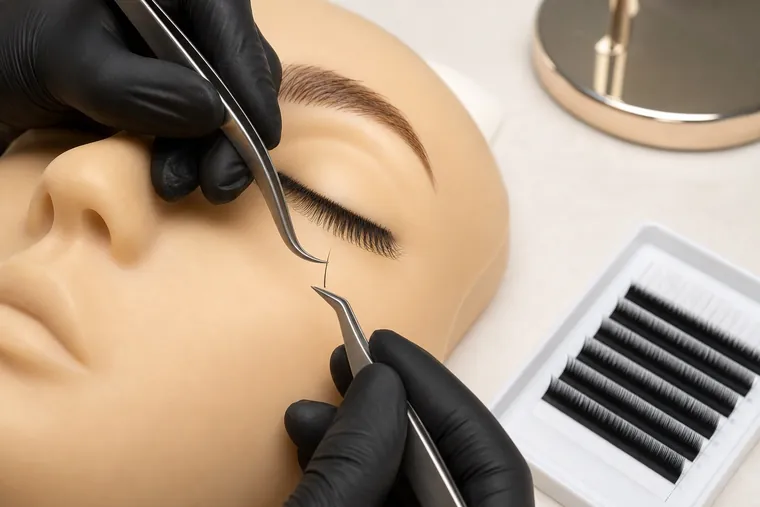
The mannequin exercise shown practices picking up and passing a fiber. Check isolation separately among the hairs on a practice strip.
Practice lashes do not reproduce skin, tears, movement, or every natural growth direction. Your instructor also needs to assess eye protection, communication, and how you respond when something goes wrong. Use the same lighting and angles for progress photos, keeping corrected examples alongside attachments you needed to redo.
Complete the final check before the client opens their eyes
Every fiber is attached to only one natural lash. Hidden fine hairs and lower lashes have been checked for unintended bonds.
Bases stay clear of the skin with continuous contact, no lifted ends, and no adhesive clumps.
Lengths and direction follow the agreed design without crossed attachments or fibers pulling on their neighbors.
The adhesive system’s finishing steps are complete and the protective pads are removed carefully. Opening the eyes should not cause pain, stinging, or burning; symptoms require a stop and appropriate assessment.
The service record includes products, batches, opening dates, room readings, fiber choices, and corrections. The client has clear cleaning and maintenance instructions and knows which symptoms require medical help.
Questions about classic lash application
Are flat lashes always easier to attach than round lashes?
A flat base offers a different contact shape, but it still has to fit the natural lash. Compare the product’s stated weight, curl, and base profile, then check side contact on a practice support. A flat label does not make a lifted attachment acceptable.
Does a negative patch test rule out a reaction?
No. LashBase’s extension patch-test guidance explains that a client can still react to a full set after a negative test or previous uneventful treatments. Follow the exact product and insurer requirements without treating a test as medical clearance. Do not improvise by putting professional extension adhesive on skin.
Can I turn a fiber after the adhesive has set?
A sideways push can weaken the bond or pull the natural lash. If the direction is wrong after setting, remove that extension professionally and apply a new one. The client should not try to straighten it at home.
Does lash lift training qualify me to offer extensions?