We use necessary cookies and the Meta Pixel to measure campaigns and improve our offers. You can change your optional-cookie preferences at any time. Read our Terms and conditions.
Eyelash extension retention: fills, shedding, and new sets
Silvana DebiasiSeptember 1, 2026Updated on October 21, 2026 11 min read
Eyelash extensions can remain attached after a set has started to look sparse or uneven. Natural lashes grow and shed at different times, and some extensions lose their bond before the natural lash falls. A fill, also called an infill or refill, restores the shape by keeping suitable attachments, replacing grown-out extensions, and filling gaps. The next appointment depends on both the condition of the set and the salon’s booking policy.
At a glance: plan the first fill or check around 2 to 3 weeks, then adjust the interval with your lash artist. The US menu examples below allow 60 to 75 minutes for classic fills and 75 to 105 minutes for volume fills. Individual extensions may remain longer than the set looks full. Contact the salon sooner if substantial gaps appear in the first few days; pain, swelling, or vision changes need medical attention.
To keep the set looking full, a 2-to-3-week return is a useful starting point. Art of Lash in Washington, DC, recommends that first follow-up for new clients. The artist can then adjust the schedule after seeing your growth, shedding, and aftercare.
Nouveau Lashes says its semipermanent extensions can last up to eight weeks while still recommending fills at 2 to 3 weeks for its Extend, SVS, and Russian Volume services. That upper limit describes the brand’s system; it does not promise eight weeks of first-day fullness or define the natural lash cycle.
Retention means how well extensions remain attached. An attached fiber can still be too grown out, twisted, or uncomfortable to keep. When comparing wear claims, ask whether the artist means some extensions remain, the set still looks balanced, or it is ready for maintenance.
Fill prices and appointment times in the US
These are published service examples from Lash’d Out in Austin, Texas, and Art of Lash in Washington, DC, checked October 21, 2026. They show how technique, return window, and stylist level change a booking. They are not national averages.
Service and salon
Return window and appointment time
Listed price
Lash’d Out: classic fill
2 to 3 weeks; 75 minutes
$55 Talent / $65 Elite / $70 Master
Lash’d Out: volume fill
2 to 3 weeks; 75 minutes
$90 Talent / $95 Elite / $105 Master
Art of Lash: classic fill
Within 14 days; 60 minutes
$160
Art of Lash: classic fill
Within 21 days; 75 minutes
$190
Art of Lash: volume fill
Within 14 days; 90 minutes
$200
Art of Lash: volume fill
Within 21 days; 105 minutes
$230
Lash’d Out: classic fill
Return window and appointment time
2 to 3 weeks; 75 minutes
Listed price
$55 Talent / $65 Elite / $70 Master
Lash’d Out: volume fill
Return window and appointment time
2 to 3 weeks; 75 minutes
Listed price
$90 Talent / $95 Elite / $105 Master
Art of Lash: classic fill
Return window and appointment time
Within 14 days; 60 minutes
Listed price
$160
Art of Lash: classic fill
Return window and appointment time
Within 21 days; 75 minutes
Listed price
$190
Art of Lash: volume fill
Return window and appointment time
Within 14 days; 90 minutes
Listed price
$200
Art of Lash: volume fill
Return window and appointment time
Within 21 days; 105 minutes
Listed price
$230
Lash’d Out lists an extended fill at 3 to 4 weeks or a foreign fill over another artist’s work as a 90-minute service with $35 added to the refill price. For example, its Talent classic refill plus the foreign-fill surcharge is $55 + $35 = $90. That covers a fill on accepted existing work, not removal and a full replacement set.
Art of Lash requires at least 50% of extensions to remain for its fill service and classifies returns after 28 days as a new set. Its classic full set is $300 for two hours; complete removal is listed separately at $60 for 30 minutes. Consultation is included with a scheduled appointment. Ask which service applies before booking.
The quoted menus do not specify whether these prices include tax or gratuity. Confirm the final charge, any correction time, and whether complete removal is extra. For a budget across several appointments, see the extension and lash lift cost guide.
A first-month calendar you can adapt
Suppose you get a new set on November 6, 2026. This hypothetical schedule helps you plan what to observe and discuss; it does not predict how many extensions will remain on any date.
Example date
What to look for
What to arrange
November 6: application
Starting fullness, direction, and comfort
Keep a clear photo of both eyes. Get written care instructions and book a check between November 20 and 27.
November 9: if early loss appears
Substantial gaps or a marked difference between the eyes
Send photos and the date the change began. Ask for an earlier assessment instead of waiting for the planned fill.
November 20 to 27: 2-to-3-week check
Grown-out, twisted, or unstable attachments and the position of gaps
The artist assesses which extensions can stay, which need removal, and whether a fill can restore the design.
December 4: four weeks after application, if the check was missed
How much usable work remains
Tell the salon how long it has been before booking. A longer service or new set may be needed.
November 6: application
What to look for
Starting fullness, direction, and comfort
What to arrange
Keep a clear photo of both eyes. Get written care instructions and book a check between November 20 and 27.
November 9: if early loss appears
What to look for
Substantial gaps or a marked difference between the eyes
What to arrange
Send photos and the date the change began. Ask for an earlier assessment instead of waiting for the planned fill.
November 20 to 27: 2-to-3-week check
What to look for
Grown-out, twisted, or unstable attachments and the position of gaps
What to arrange
The artist assesses which extensions can stay, which need removal, and whether a fill can restore the design.
December 4: four weeks after application, if the check was missed
What to look for
How much usable work remains
What to arrange
Tell the salon how long it has been before booking. A longer service or new set may be needed.
At the check, ask the artist to note the next interval and why it suits this set. A repeated gap in one area, widespread growth, or a set that is still orderly helps the artist decide whether to shorten or extend the interval.
Shedding or attachment loss: what fell out?
A fine natural lash attached to an extension can be consistent with natural shedding. An artificial fiber found alone may have separated at the bond. These findings raise different questions, but neither identifies the cause on its own. A natural lash can be hard to see, broken, or hidden by residue.
Even when a natural lash is present, you cannot tell from that one piece whether it shed normally or was pulled out. Note when the loss happened and whether it affected one area or both eyes. Photograph what you find without pulling off more extensions to compare them.
A closer look
Two different findings after an extension falls
Natural lash + extension
This can be consistent with natural shedding. Timing, the pattern of loss, and any pulling still need consideration.
Extension alone
The bond may have separated. A natural lash could also be hard to see or broken; one fiber is not enough to establish the cause.
Schematic examples, not a diagnosis. A visible natural lash does not prove normal shedding; a fiber alone does not prove faulty adhesive.
Why an attached extension may need replacing
Natural lashes are at different stages of growth when extensions are applied. Some will shed sooner than others. The natural eyelash growth-cycle guide explains these stages; a maintenance appointment is based on the set you have now, rather than the length of an entire biological cycle.
As the natural lash grows, it carries the same bond and extension farther from the eyelid. The section of natural lash before the bond becomes longer; the artificial fiber does not lengthen. Direction can change and the extension may rotate. A professional checks whether it is still suitable to keep and removes it selectively when needed.
Growth and attachment
The bond moves as the natural lash grows
After application
The amber area marks the bond on the natural lash. The extension is not attached to the skin.
As the lash grows
More natural lash is exposed before the bond. The artist checks for changed direction or rotation.
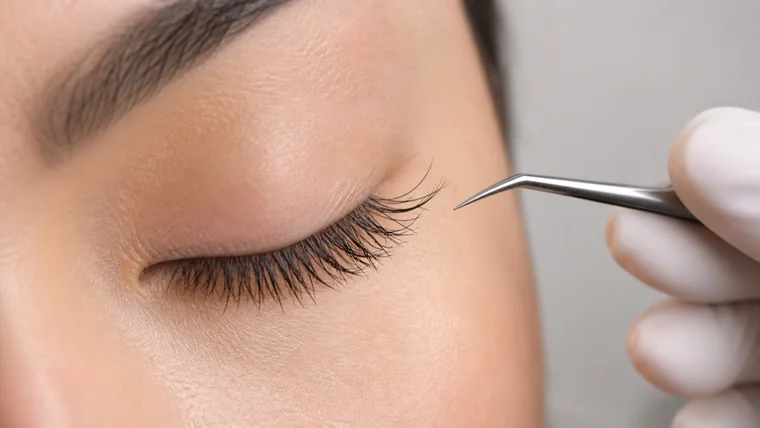
The same extension and bond move away from the eyelid as new natural lash grows behind them. These drawings are not to scale and do not define a safe gap or a removal deadline.A close inspection helps the artist assess attachments and direction. This photograph cannot establish why an extension came off.
The position of a gap also changes what you see. A missing group near the longest part of the design may stand out more than the same loss spread across the lash line. Classic and volume sets have different visual density, so counting fibers alone will not tell you how much work a fill requires.
What to do if extensions fall out in the first few days
If the set becomes noticeably sparse after only a few days, contact the salon and ask for a check. Early loss should prompt a review of the application as well as home care. It should not automatically be attributed to your sleeping position, a cosmetic, or normal shedding.
Record the application date and when you first noticed the change. Say whether loss started immediately or increased later.
Identify the area: one eye, both eyes, the outer corners, or scattered gaps.
Take unfiltered photos of both eyes in similar light, at the same distance and angle as your first-day photos.
Describe any discomfort and the products or habits that changed, such as makeup remover, eye cream, mascara, or rubbing. Include how you used the product.
The artist can compare your report with the session record: lash preparation and rinsing, contact at the bond, fiber weight and direction, adhesive working speed, room temperature and humidity, and bottle opening and storage. London Lash’s retention guidance discusses preparation, attachment, and glue handling. More loss on one side is a clue for this review, not proof of a single cause.
When a correction is justified, record it and review the result at the next appointment. Changing cleanser, primer, adhesive, and design together makes the outcome hard to interpret. The eyelash adhesive guide explains how room conditions and working speed affect product choice.
Pause cosmetic treatment for eye pain, swelling, persistent redness, or ongoing irritation, and contact a healthcare professional. Seek urgent eye care for severe pain, light sensitivity, blurred vision, or other vision changes; use an emergency department if urgent eye care is unavailable. Do not reapply extensions to test whether a reaction returns. FDA advises stopping irritating eye cosmetics; the National Eye Institute and MedlinePlus describe symptoms that need medical attention.
What happens during a professional fill
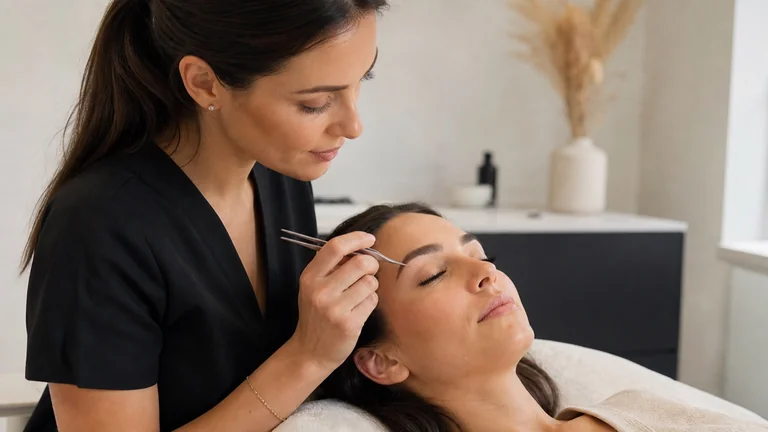
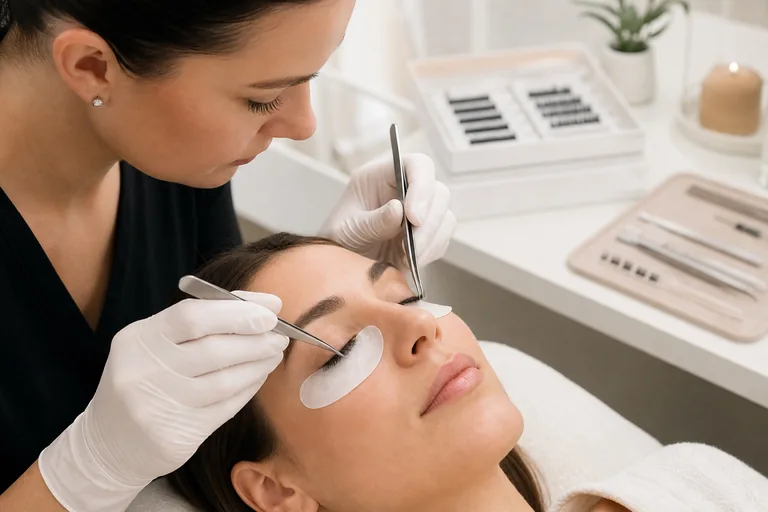
A fill includes assessment and correction of the work that remains. London Lash’s fill guidance describes removing grown-out extensions and replacing gaps. The artist applies new fibers to suitable natural lashes after addressing compromised attachments.
The artist asks about comfort, wear, and any changes since the last visit, then examines gaps, growth, direction, and cleanliness.
They clean and dry the lashes according to the system and check that individual natural lashes are isolated.
They keep stable, well-directed extensions and professionally remove attachments that are too grown out, rotated, lifting, or unsuitable for the design.
They rebuild the shape on suitable isolated lashes, adapting lengths and distribution to the natural lashes available at this visit.
They check attachments, independent lash movement, direction, and symmetry, then document the result and agree on the next visit.
Lashes stuck together, often called stickies, can pull against each other as they grow. A snagging brush or a fiber that pulls is a reason to contact the artist. Do not try to separate attachments with tweezers, scissors, or pulling at home. The professional removal guide explains how the artist protects the eye area and checks for residue.
Comparable photos and notes about the design, products, and appointment date help locate when and where the set changed.
When is a new set a better choice?
A fill is practical when enough stable, well-distributed attachments remain after unsuitable extensions are removed. If little useful work is left, or most of the design needs changing, removal and a new set may be the more appropriate booking.
What the artist finds
What to discuss
Stable, orderly attachments with gaps
A fill, including selective replacement of grown-out or unstable extensions.
Many twisted or grown-out extensions, or few usable attachments
Removal and a new set, with time and price agreed before work begins.
Lashes bonded together or an unsuitable weight or direction
Professional correction or removal before considering new application. Adding fibers will not repair the existing attachments.
A substantial change in length, curl, or overall effect
How much of the old design can be kept. A new set may give the artist enough time to rebuild it.
Stable, orderly attachments with gaps
What to discuss
A fill, including selective replacement of grown-out or unstable extensions.
Many twisted or grown-out extensions, or few usable attachments
What to discuss
Removal and a new set, with time and price agreed before work begins.
Lashes bonded together or an unsuitable weight or direction
What to discuss
Professional correction or removal before considering new application. Adding fibers will not repair the existing attachments.
A substantial change in length, curl, or overall effect
What to discuss
How much of the old design can be kept. A new set may give the artist enough time to rebuild it.
Nouveau Lashes suggests considering a new set as you approach week four because correction can take as long as starting again. This is the brand’s service guidance. A salon’s week limit or minimum remaining percentage also defines its booking and pricing policy; it is not a biological threshold for every lash.
Before proceeding, ask what will stay, what will be removed, and whether a new application is suitable that day. Symptoms or compromised natural lashes may require postponement.
How to care for the set between appointments
Regular gentle cleaning removes makeup and residue from the lash line. London Lash’s cleansing advice includes a compatible lash shampoo, gentle rinsing, and drying without rubbing. Ask your artist to demonstrate the method and specify when to start after this treatment.
Use an eye-area cleanser confirmed compatible with the extension system. With eyes closed, clean gently as directed, rinse off products that require rinsing, and pat dry without pulling the fibers.
Once dry, brush lightly with a clean spoolie. If it catches, stop and arrange a check instead of forcing it through.
Avoid picking, pulling, lash curlers, and repeated pressure against a pillow. Tell the artist about uneven wear without assuming that a sleeping habit explains it.
The first wash and any restrictions on water, steam, or cosmetics depend on the adhesive and finishing products used. Get a specific instruction before leaving the salon. A quick initial bond does not by itself set the aftercare waiting time. Aftercare supports hygiene and reduces avoidable mechanical stress, but it cannot correct a weak attachment, excessive weight, or incomplete isolation.
Frequently asked questions
Can I get a fill at a different salon?
Contact the new salon before booking. Give the date and technique of your existing set and send unfiltered photos. Ask whether it accepts foreign fills, what extra time or fee applies, and when it requires removal and a new set. Photos help plan the visit; the artist still needs to inspect the attachments in person.
Should I count every extension that falls out?
A daily count is not a reliable test of normal shedding. You may miss fallen fibers, and one volume fan is different from one classic extension. Dates, affected areas, and comparable photos are more useful for a follow-up. Report an abrupt increase or any symptoms instead of trying to match a daily quota.
Can I stop getting fills and let the extensions shed?
You can stop maintenance, but remaining extensions still need attention if they twist, snag, or pull. Arrange professional removal if you want them off sooner or they are uncomfortable. Do not trim them with scissors, pull them off, or use improvised solvents near your eyes.
Will a fill look as full as the first set?
The aim is an orderly result that suits the natural lashes available at that visit. If some lashes cannot support the planned extensions, adding more weight to hide gaps is not an appropriate fix. Agree on a lighter result or a change in the design when needed.