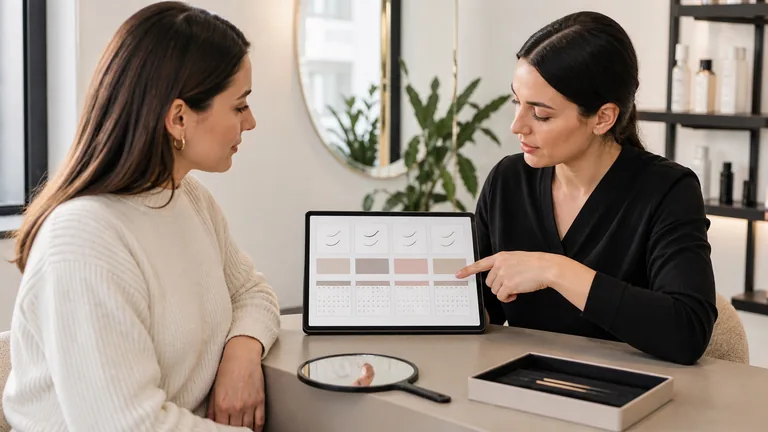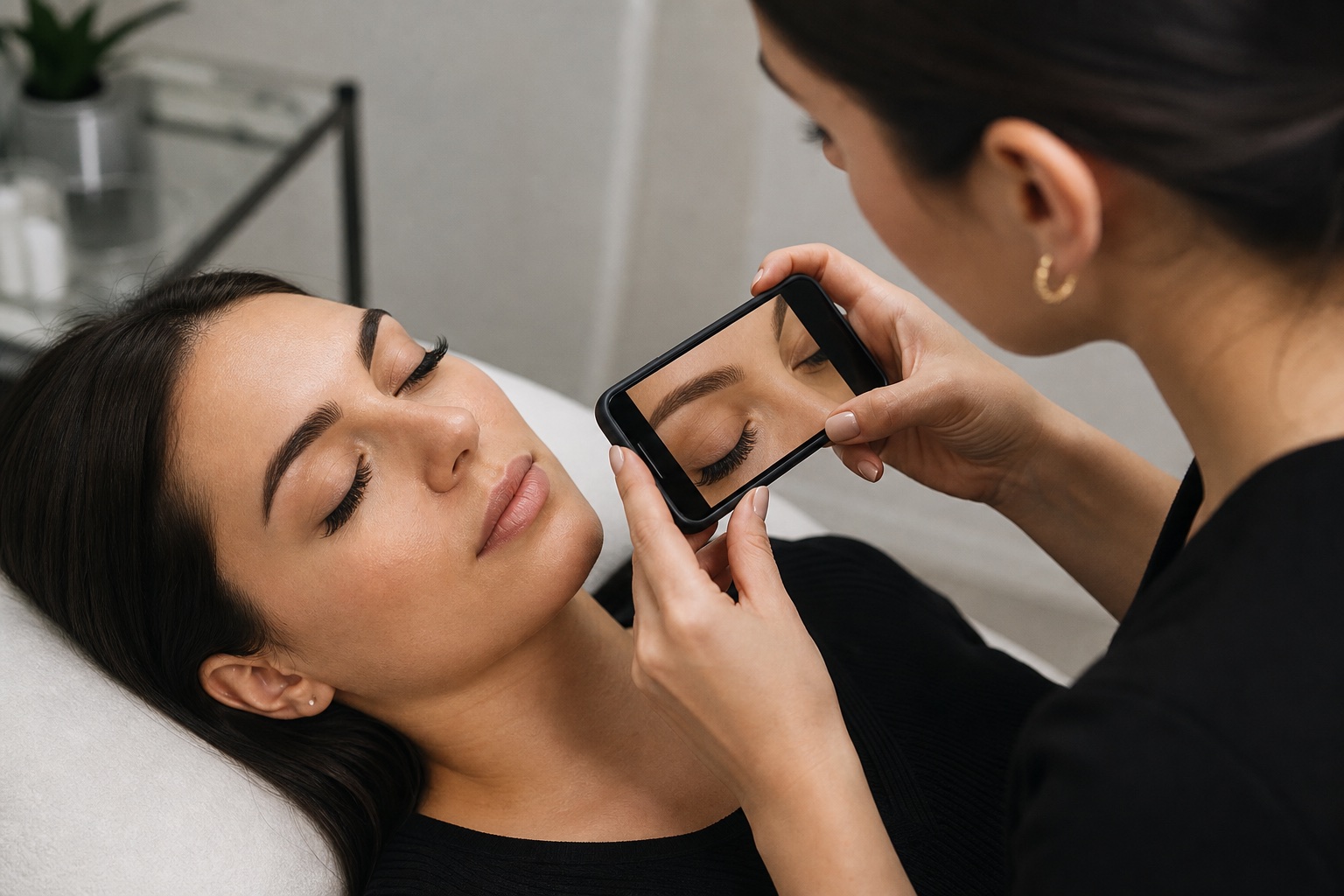

A lash client record is not a waiver to sign hurriedly before an extension or lift appointment. It is the controlled memory of the service: the client's request, the consultation decision, the technical design, the products actually used, available batch references, instructions delivered and what happened afterwards. When every field has a defined purpose, another authorised practitioner can reconstruct the work without relying on memory, scattered photographs or a private-message thread.
More fields do not automatically create more protection. A strong record collects the minimum information needed for a real decision, separates technical, administrative and promotional purposes, identifies who changed what and preserves uncertainty. It does not request a general medical history, diagnose eye conditions or use one signature to transfer every risk to the client. The useful question is always what decision this item changed.
For every appointment, link the client and practitioner to the current consultation outcome, planned and delivered service, exact products and batch or lot references, deviations, aftercare version and follow-up decision. Label information as reported by the client, observed externally by the practitioner or required by product instructions. Keep service consent, privacy information, photography choices and marketing permissions separate.
This guide owns documentation and governance for lash client records. The pre-treatment consultation owns questions, observation and the decision to proceed, postpone or stop. The lash workstation hygiene protocol governs hands, tools, single-use items, products and turnover. Here the focus is recording, protecting and retrieving necessary evidence. This is educational guidance, not a ready-to-use legal form; your actual process requires technical, privacy, insurance and jurisdiction-specific review.
What a lash client record is—and what it must not become
The record links an identifiable person to one consultation or appointment. It should identify its form version, who collected the information, when it was updated, which service was agreed and what facts shaped the plan. Client reports eyelid swelling the evening after a previous service; product and clinical cause unknown is more useful than allergic to glue. It separates source, timing and uncertainty instead of upgrading an account into a diagnosis.
It is not a medical record. Diagnosis, allergy testing, prescriptions, clinical reports and assessment of ocular disease belong to qualified healthcare professionals. When health-related information is genuinely necessary for a safety decision, record only the relevant fact as reported and protect access appropriately. Asking for every illness and medicine by habit exposes sensitive information without proving that a cosmetic practitioner can interpret it.
It is not an unlimited release of liability. Agreement to the cosmetic service, notice about data processing, permission for an internal photograph, permission to publish a before-and-after image and marketing contact are different actions. A signature does not make a product compliant, remove a stop criterion or erase statutory rights. Good wording explains the service and makes questions possible; it does not intimidate the client.
Six layers: identity, consultation, design, products, permissions and follow-up
Six layers, one readable record
From minimum identity to documented closure
Minimum identity and contact
Consultation outcome
Design and delivery
Products and batches
Permissions and instructions
Follow-up and closure
A readable record has six layers. The first holds minimum identity and operational contact. The second references the relevant consultation outcome. The third records the planned and delivered service. The fourth identifies products, batches and consumables. The fifth documents information supplied, choices and instructions. The sixth records outcome, incident, follow-up, amendments and closure. Separating the layers also allows staff access to be limited by role.
Mark fields as essential, conditional or optional. Date, client identifier, practitioner, service and products are normally central. A photograph is conditional: capture it only for a defined purpose with appropriate handling. A social-media preference is optional and must never become a condition of treatment. Restrict free-text boxes because unlimited notes invite irrelevant health details, personal opinions and inconsistent language.
Design from the actual workflow. Who enters the information? Who can read it? Where are images stored? How is an error corrected? Which system sends follow-up? When does deletion occur? A polished cloud platform open to all staff may be riskier than a simple record with roles, locks and retention rules. Privacy by design means deciding purpose, fields, permissions, storage and disposal before collection.
Collect the minimum and separate technical from administrative data
Collect what is necessary—not everything possible
Technical, administrative and optional data stay separate
Technical
Changes a service decision
Administrative
Billing or contract system
Conditional
Appears only when needed
Avoid
Detail without a purpose
A name or client code, authorised contact, date, location and practitioner may be enough to link an appointment. Full address, government identifier, tax number and complete date of birth are not automatically necessary in the technical record. They may belong in invoicing, a contract or an age-verification process, but should be collected once in the appropriate system. Separation reduces duplication and access.
Record the channel authorised for booking and service follow-up without turning it into promotional permission. A message agreed to check comfort or retention supports the service; recurring offers have another purpose. If a phone or inbox is shared, tell the client what may be visible. Services involving minors or a representative require checks on identity, authority and legal suitability that vary by jurisdiction; a standard signature cannot solve them.
Avoid labels such as difficult client, uncooperative or anxious. Record relevant facts: client requested two pauses because the position was uncomfortable; comfortable eye closure could not be maintained; client declined photography and the service proceeded without images. Neutral language can be understood by another practitioner and does not turn a moment into a permanent character judgement.
Import the consultation decision without duplicating the interview
Do not copy the whole consultation questionnaire into every appointment. Reference its date and version, record changes reported today, relevant external observations and the decision: proceed, adapt, postpone or stop. Keep reported by client, observed by practitioner and required by manufacturer as separate evidence types. That grammar prevents an assumption from becoming a fact after repeated copying.
Before a later appointment, ask whether eye-area comfort, relevant products, recent procedures, medicines or professional advice have changed, without requesting unnecessary detail. No change reported since consultation review on a stated date is more defensible than a pre-ticked box. Pain, marked swelling, discharge, strong redness, visual change or another stop signal requires action, not merely a new note.
Consent never replaces reassessment. The plan may change after inspecting the available natural lashes, safe closure, position tolerance or current system directions. Record the amendment and explanation. The client may accept or decline the revised scope, but cannot authorise a technique that conflicts with product instructions, law or the practitioner's professional limits.
Extension fields: mapping, fibres, adhesive and maintenance
For extensions, record the technique actually used, fan type where relevant, curls, diameters, lengths by zone, intended density, direction, map, attachment distance, differences between eyes and reason for adaptations. Volume alone cannot reconstruct the design. Link choices to the externally observable natural base described in the guide to eyelash anatomy and the growth cycle without diagnosing follicles or assigning exact growth phases.
Record adhesive, primer, cleanser, remover and other products by full identifiable name and available reference. Log environmental conditions only when measured with a reasonable instrument and useful to the product system. Temperature and humidity may help interpret adhesive behaviour, but they do not prove the cause of retention. Add batch, opening and expiry information where relevant and record any change during the appointment.
For maintenance, preserve initial-set date, elapsed time, observed growth and directions, detachments, removals and additions. A percentage retained is useful only when estimated consistently. Do not use the record to blame home care, hormones or a cosmetic automatically. Record observable facts and change one variable at a time. The comparison of extensions and lash lifts explains service choice; the record documents this client's delivered work.
Lash-lift fields: shield, direction, system and real timings
For a lift, record the complete system, each step, shield for each eye, placement, wrap direction, distance from the eyelid margin, applied zones, excluded zones, actual processing time for every phase, removal method and finishing products. Timings belong to the exact product instructions. A record must not imply one universal time or use a previous result as the sole instruction for the next appointment.
When tint is included, identify tint, shade, developer or instructed component, ratio, batch, placement and time. Also record omitted steps. The professional lash-lift guide explains sequence and control; the client record shows which variation was actually applied rather than which protocol was intended in theory.
Document deviations as they occur: shield changed before product, lashes rewrapped, direction corrected, phase removed early according to incident instructions or service stopped. Never rewrite the initial plan as though it was delivered unchanged. If a result needs troubleshooting, the lash-lift correction guide shows why plan, execution and follow-up are more informative than one photograph.
Product and batch ledger: identify what was actually used
The batch must lead back to the real product
Identify, link, record change, preserve history
Identify
Name, function and variant
Link
Batch, lot or equivalent
Separate
Opening, PAO and expiry
Version
Never overwrite history
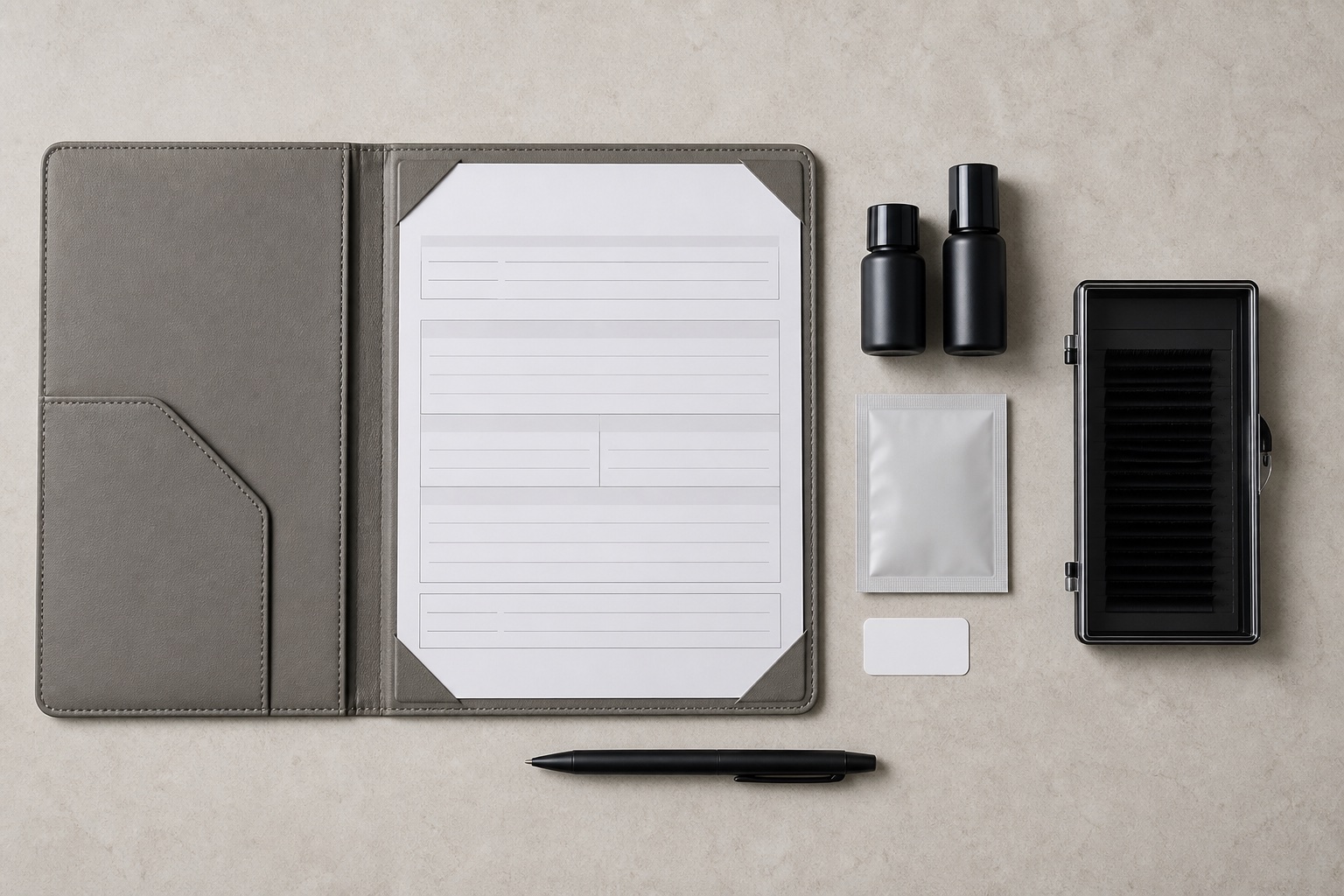
For each product, record full name, function, variant or shade, manufacturer or brand needed for identification, batch or lot number or equivalent label reference, opening date where relevant and package status. Black glue and step one are not traceable. If the batch appears only on outer packaging, capture it before disposal in a shared product register that does not unnecessarily expose client data.
A batch identifies a production run; it is not the same as expiry, period after opening or opening date. Store each in its correct field and never invent a missing value. A label photograph may belong once in the common product register, while the client record points to its internal code. This avoids copying large images into every client file and makes product updates manageable.
If a new batch is opened or a product is substituted during the service, record when and why without deleting the first reference. During an unwanted event, the sequence helps reconstruct exposure, location and context without proving causation. Keep products in original labelled packaging and follow the hygiene protocol for dispensing. Traceability means preserving accurate information, not retaining a contaminated session remainder.
Service agreement, acknowledgement and privacy notice are not synonyms
One signature cannot authorise everything
Service, data, photographs and marketing have distinct purposes
Service
Goal, limits and stopping
Privacy
Purpose, basis, retention and rights
Images
Internal, teaching or public
Marketing
Optional and separate
Informed agreement to a cosmetic service records that its aim, meaningful steps, limits, alternatives, aftercare and right to stop were explained. An acknowledgement can record that a named instruction or version was supplied; it does not by itself prove understanding, correct technique or error-free performance. Neither document automatically provides the legal basis for every use of personal data.
A privacy notice explains who controls the data, purposes, lawful bases, recipients or processors, transfers, retention criteria, rights and contact routes. It should be available before collection. Avoid a blanket phrase such as I consent to privacy: privacy is not one activity to accept. The organisation must map an appropriate basis and safeguards for each actual purpose under the laws that apply.
Where consent is the selected legal basis, it must meet the applicable standard. Under the EU and UK GDPR model, for example, valid consent must be freely given, specific, informed, unambiguous, demonstrable and as easy to withdraw as to give. Preselected boxes and one signature covering service, health information, public photographs and marketing are not granular choices. Data necessary to perform a booking may use another lawful basis; sensitive health information needs an additional condition and stronger protection.
Photography: internal evidence, restricted teaching and public promotion are different purposes
Define purpose before taking a photograph. A technical macro stored inside the client record may document direction or follow-up. Sending it to an educator introduces another recipient. Publishing a before-and-after image on a site or social platform is promotion. Do not reuse an image created for one purpose automatically. Each route needs its own necessity, lawful basis, notice, access, retention and withdrawal handling.
Showing only the eyes does not guarantee anonymity. Brows, tattoos, facial features, room, date, filename and account linkage can identify a person. Crop and remove unnecessary metadata where appropriate, use a code and separate the identity key from the image archive. Do not promise anonymous treatment when the client or people around them could reasonably recognise the image.
Declining publication must not reduce service quality or affect price unless a separate, transparent arrangement is lawful and genuinely voluntary. Record internal documentation, limited educational sharing and public promotion as separate choices. Define what happens to posts, website copies, backups and materials already printed if permission is withdrawn; never promise instant deletion from third-party systems you cannot control.
Health-related information: relevance, neutral wording and higher protection
Information about symptoms, diagnoses, medicines or professional advice may constitute health data or similarly sensitive information depending on jurisdiction. Collect it only when necessary for a defined decision. Rather than copying a diagnosis, the record may state client reports current treatment near the eye and has been advised to postpone cosmetic services, where that is enough to decide. Never ask a lash artist to interpret a prescription or advise stopping medicine.
Separate the client's report, the practitioner's external observation and the operational decision. Do not write allergic when the evidence is a reported reaction to an unknown product. Do not convert redness into a disease label. Restrict access, avoid exporting sensitive notes into general booking calendars and do not place the reason for postponement in a message visible to unrelated staff.
Explicit consent is not a shortcut around necessity, professional scope, security or local conditions for processing sensitive data. Determine whether the information is genuinely required, which legal condition applies, how long it remains useful and who needs it. If a service can be made safe by recording only postpone pending appropriate assessment, do not archive a clinical report by default.
Retention, access and security across the record lifecycle
Protection lasts for the entire lifecycle
Collect, limit, use, retain and delete
Collect with clear information
Limit access and copies
Retain by stated criterion
Delete or anonymise
Set a retention period or review criterion for each purpose before launch. Technical service records, invoices, incident evidence, internal photographs, public media permissions and marketing lists may have different legal and operational lifecycles. Keeping everything forever because storage is cheap conflicts with minimisation. Deletion must cover exports, staff devices, chat attachments and governed backups where the policy requires it.
Grant access by role and remove it promptly when a person changes role or leaves. Use individual accounts, appropriate authentication, device controls, encryption where suitable, tested backups and a breach-response route. Shared passwords and a common camera roll defeat an otherwise excellent form. Paper records need locked storage, controlled copying, a clear check-out route and secure destruction.
Document vendors that host forms, bookings, messages, files or backups. Map where data is stored and transferred, contractual role, security, subprocessors and deletion options. Free software is not automatically unsafe and paid software is not automatically compliant. The organisation remains responsible for selecting, configuring and using it lawfully.
Appointment log: record delivery, deviations and incidents
A useful chronology states start and finish, practitioner, service and design, products and batches, measured conditions where relevant, actual timings, checks made, changes, client-reported comfort and completion status. Record events when they happen rather than reconstructing everything at closing time. Use a timestamp and author for later additions.
For a deviation, preserve the original plan, event, reason, action and observed result. For example: right shield changed before lotion because edge lifted; lashes rewrapped; no chemical contact occurred. Do not erase the first entry. For a stop, identify the exact step, product, batch, symptom or visible sign as reported or observed, immediate instructions followed and referral or contact route offered.
Avoid unsupported conclusions such as retention failed because client used oil or reaction caused by adhesive. Record evidence: client reports using a named cleanser; detachments are concentrated on the outer third; adhesive and batch identified; environment readings available; no cause assigned. The difference makes the record useful for quality review rather than blame.
Aftercare: version, understanding and contact channel
Record the aftercare document or digital version supplied, date, language and delivery route. The advice must match the actual service and product instructions. A checkbox marked aftercare given is weak when nobody can retrieve what it contained. Do not add generic rules from another adhesive or lift system simply because they are common online.
Use teach-back for essential points: ask the client to explain in their own words what they will do and when they will contact the practitioner or seek healthcare. This checks clarity without testing or shaming them. Record the clarification provided, not a judgement about intelligence. Offer an accessible format and translated or supported communication where reasonably required.
Define a service contact route, hours and urgent limitations. A salon inbox is not emergency care. Increasing pain, visual change, marked light sensitivity or a very red eye needs prompt healthcare assessment. The record can show that this boundary was explained, but must not diagnose the cause or delay access to appropriate care.
Follow-up: compare, decide and close the case
Follow-up ends with a decision
Compare the same signal, record the outcome, close
Compare
Same indicator and context
Separate
Reported, observed and decided
Act
Review, stop or referral
Close
Date, owner and reason

Choose timing based on the service, product directions, an event and what was promised. Ask focused questions about comfort, visible result, maintenance and the agreed indicator rather than requesting an unstructured update. Compare the same angle, lighting or retention method when photographs are justified and permitted. Do not diagnose from a phone image.
Every contact should end in a documented decision: close with no issue reported, clarify an instruction, arrange an in-person technical check, stop future cosmetic work pending appropriate assessment, or activate an incident process. Record source, date, author and reasoning. No reply is no reply—not evidence that everything is fine. Limit reminders to the agreed and lawful contact pattern.
If the client attends elsewhere, provide a proportionate copy or summary when legally appropriate without disclosing staff-only credentials or another person's data. Portability, access and record-transfer duties vary. Build a request process before the first request arrives, including identity checks and an audit of copies.
Unwanted effects: document without assigning the cause
When a client reports an unwanted effect, record their words, onset, location, progression, products and batches, service sequence, photographs only when necessary and permitted, actions already taken and advice or referral provided. Preserve relevant packaging information and quarantine a suspect product when your procedure requires it. Do not offer another exposure as a test and do not state causation without competent evidence.
Separate immediate assistance from root-cause review. Urgent health needs come first. Later, audit consultation, product status, instructions, application, hygiene, environment, timing, aftercare and other known exposures. A quality review can identify a process improvement while leaving medical diagnosis and formal causality assessment to the appropriate professionals.
Check reporting duties in the market where the service and product are supplied. The EU Cosmetics Regulation, US FDA and other authorities provide different serious-adverse-event or vigilance routes and responsible parties. Insurer, manufacturer, distributor and local authority notifications may also apply. Record who decided, which route was used and reference numbers without assuming one global process.
Corrections, versions and audits: never erase the history
Correct an inaccurate entry without silently replacing it. Preserve the original where required, add the corrected information, date, author and reason, and ensure exports show the current state. A client request for rectification does not automatically mean deleting the documented chronology of an event; assess rights and legal obligations through the relevant privacy process.
Version forms, privacy notices, aftercare and consent language. A signature attached to version 2 cannot prove that version 4 was supplied. Audit missing batch numbers, copied notes, blanket consents, unresolved follow-ups, excessive access and data beyond retention. Sample full records across practitioners rather than checking only whether fields are populated.
Train staff on why each field exists and give them an escalation path. Completion targets can reward careless copying. Better measures include identifiable products, neutral descriptions, timely incident records, documented deviations, closed follow-ups and access reviews. A client record is part of the service system, not administrative decoration.
Operational template: essential, conditional and avoid
Layer | Useful fields | Avoid |
|---|---|---|
Identity and appointment | Client code or name, authorised contact, date, practitioner, location | Duplicated identifiers and unrelated personal detail |
Consultation outcome | Version, change reported, external observation, decision | Diagnosis or copied medical history |
Technical delivery | Map or shield, actual products, batches, timing, deviations | Generic service name with no reconstructable detail |
Permissions and information | Separate versions and choices for service, data, images and marketing | One mandatory blanket signature |
Follow-up | Date, report, observation, action, owner and closure | Open chat thread with no decision |
Quality checklist before the form goes live
Confirm that every field maps to a decision or obligation; consultation and record do not duplicate one another; extensions and lifts have appropriate technical fields; products and batches are identifiable; service agreement, privacy, images and marketing are separate; sensitive data is minimised; roles and access are tested; retention and deletion cover exports and images; corrections preserve an audit trail; aftercare has a version; follow-up has an owner and closure; incident and rights-request routes exist.
Test the form with fictional scenarios before real data: a straightforward lift, an adapted extension set, a product substitution, a declined photograph, a next-day report and a deletion or access request. Check mobile usability, keyboard navigation, readable language and export. A form that works only when nothing changes is not ready.
Use the BeautyLearn lash course collection and online lash-lift course to build technical understanding, then evaluate curriculum and feedback with the guide to choosing an online lash course. Training does not replace jurisdiction-specific privacy, insurance or licensing advice.
Frequently asked questions about lash client records
Is a lash client record legally required?
There is no single worldwide answer. Requirements may arise from local personal-service rules, consumer law, product vigilance, insurance, professional standards, tax or contract obligations. Even when a named form is not mandated, accurate records can support continuity and quality. Map the exact service and location with qualified advice; do not market a downloadable template as universally compliant.
Does the client need to sign at every appointment?
Not necessarily, and a signature alone is not the goal. Determine which agreement, acknowledgement or permission needs proof, how material changes are communicated and what local rules require. A later appointment should confirm relevant changes and the current plan. Obtain a new choice when purpose, risk information, service or optional data use changes, rather than collecting identical signatures without explanation.
Can one signature cover service, privacy, photographs and marketing?
It should not be treated as one bundled choice. The service agreement explains the cosmetic procedure. The privacy notice explains data processing and may rely on several lawful bases. Internal images, teaching use, public posting and marketing contact are separate purposes. Offer granular controls and allow optional choices to be refused without reducing the core service, subject to the law that applies.
What exactly should be recorded for a product batch?
Record the full product identity, variant or shade and the batch, lot or equivalent reference printed on the packaging. Keep expiry, period after opening and opening date in separate fields. If the product changes during the appointment, preserve both entries and timing. Never invent a missing number or use a catalogue code as though it were a manufacturing batch.
Should extension fibres also be documented?
Yes, to the level needed to reconstruct the design and stock used: supplier or product line, curl, diameter, length ranges, fibre type and relevant batch reference when available. Also record fan or application technique and mapping. Do not infer that the fibre caused a later problem merely because it appears in the record; traceability identifies exposure and supports review, not automatic causation.
Must temperature and humidity always be recorded?
Record them when the adhesive or system instructions make them relevant and when your instrument gives a useful measurement. Note device or location when consistency matters. Values may help interpret curing and handling, but do not prove why retention changed. A copied number recorded after the appointment is worse than a clear statement that no reliable measurement was available.
Can I store an eye photograph if the full face is not visible?
Only after defining a necessary purpose, lawful basis, notice, access, security and retention. An eye-area image can still identify a person through brows, tattoos, context, metadata or linkage to the record. Minimise the frame and metadata, separate identifiers where possible and do not claim anonymity unless re-identification is not reasonably possible in the real context.
Can WhatsApp or another messenger be used for follow-up?
A messaging service may be usable only after assessing purpose, client expectation, business configuration, recipients, device access, backups, transfers, retention and local requirements. Keep content proportionate and move essential facts into the governed record. Do not leave the only incident history in a practitioner's personal account, and never add service contacts to marketing groups without a separate lawful process.
How do I document a change made during a lash lift?
Preserve the initial plan, time, reason, new choice and observed outcome: for example, shield replaced before product application, direction corrected, phase removed early under instructions or service stopped. Retain actual products, batches and processing times. Do not rewrite the initial plan to match the final execution; the difference is valuable technical evidence for follow-up and training.
How should a reaction reported the next day be recorded?
Record the client's words, date and time, location, symptoms or visible signs, onset, change, products and batches, known other exposures, necessary photographs and actions already taken. Do not assign the cause or propose another exposure as a test. Give the appropriate healthcare or emergency boundary and assess manufacturer, insurer and regulatory reporting routes in the relevant jurisdiction.
How long should a lash client record be kept?
Do not copy a universal number. Set a period or review criterion for every purpose after considering local obligations, contract, claims, insurance, vigilance and minimisation with qualified advice. Technical records, invoices, promotional photographs and marketing permissions may differ. Communicate the relevant criteria and apply deletion or anonymisation to exports and governed copies, not only the main screen.
Is a digital record safer than paper?
Not automatically. Digital systems can provide permissions, logs, encryption and backups but add vendors, remote access, exports and configuration risk. Paper avoids some cyber risks but can be viewed, misplaced, copied or destroyed. Compare identity controls, staff roles, incidents, retention, availability and secure disposal. Safety depends on governance and use, not the format label.
Can I ask for a complete list of diseases and medicines?
Not as a routine precaution. Ask only for information relevant to an identified professional decision, and establish the local legal condition, notice, access and retention for health-related data. Often it is enough to know that an instruction requires postponement or clarification without storing a diagnosis or report. A lash practitioner must not interpret treatment or advise stopping prescribed medicine.
Should a patch test be recorded as proof that allergy is impossible?
No. Record only the preliminary check specified by the exact manufacturer: product, batch, method, location, date, observation period and what was observed or reported. Do not call it medical allergy testing or promise that it excludes sensitisation or a future response. A previous uneventful check does not override current symptoms, product warnings or stop criteria.
Can a client request access or correction?
Privacy laws such as the EU and UK GDPR provide access and rectification rights subject to conditions and limits. Create a request channel, verify identity proportionately and search governed copies. Correction does not always mean deleting the history of an incident; mark inaccurate data and preserve an audit trail where justified. Do not expose another person's data or internal credentials in the response.
Can I use a client-record template downloaded online?
Use it only as a prompt, not as compliance evidence. It may come from another country, service or business model, use invalid wording and collect excessive data. Map your own workflow, remove fields with no decision attached, separate purposes and have the language, lawful bases, retention, vendors and incident routes reviewed. A signed form cannot repair uncontrolled camera rolls or shared accounts.
How should withdrawal of photograph consent be handled?
Record the verified request date, permission and channels involved, stop future consent-based use and follow the communicated removal or restriction procedure. Withdrawal does not retrospectively invalidate earlier lawful use, but must be as easy as granting permission. Internal technical evidence and public promotion may have different bases and lifecycles, so do not delete or retain every copy automatically.
What should I write when the client does not answer follow-up?
Record date, channel, minimal purpose of the contact and no response. Do not write no problem and do not multiply messages beyond what was agreed or lawful. If follow-up concerns a possible incident, apply the procedure and decide what can be done with the available facts. Close or escalate the follow-up under a stated criterion rather than leaving an endless chat thread.
May I upload the record to an AI tool for a summary?
Do not upload names, images or eye-related information to a general tool for convenience. First assess purpose, lawful basis, notice, provider role and contract, training use, location, security, retention, accuracy and human oversight. Summaries can omit or invent details. Use fictional data for testing and adopt only a governed system after privacy, security and technical assessment.
Does a signature protect the practitioner from every complaint?
No. It may evidence that a particular version was presented or a choice recorded, but it does not prove product compliance, correct technique, hygiene, understanding or absence of error. It does not remove client rights or professional responsibility. Real protection comes from competence, current instructions, proportionate records, appropriate insurance, secure data handling and a prompt incident response.
Official sources and further reading
For privacy principles, rights and consent, see the EU General Data Protection Regulation, the European Data Protection Board consent guidelines and the UK ICO guide to the data-protection principles. They apply in their jurisdictions and are not a universal legal template.
For product identity and adverse-event context, consult the EU Cosmetics Regulation, FDA guidance on mandatory serious-adverse-event reporting for cosmetics and FDA Eye Cosmetic Safety. Identify the competent authority and responsible party for the market involved.
Explore all BeautyLearn lash guides or plan the professional pathway with how to become a lash artist. This guide contains no links to competing academies.
For colour-specific service planning, use the professional eyelash-tinting guide: it separates legal product suitability, colour, system compatibility, ratio, timing, closed-eye control, removal and follow-up from lash-lift reshaping.
Plan tools and stock by function with the professional lash artist kit guide: it connects tested tweezers, lighting, consumables, traceable products, measured adhesive conditions, inventory and staged purchasing without brand rankings.
For the complete client-level overview, read the eyelash extensions guide: it connects classic, volume and hybrid principles with design, the appointment, realistic duration, infills, preparation, aftercare, removal and safety boundaries.
Study the classic technique in the one-to-one eyelash extensions guide: it makes natural-lash selection, isolation, off-skin distance, direction, contact, adhesive dose and sticky checks separately verifiable.
Compare every volume-family construction in the volume, hybrid and mega-volume guide: it keeps D labels, total load, fan anatomy, hybrid design, mega-volume prerequisites and troubleshooting inside one non-cannibalising technical intent.
For a complete specification and mapping framework, continue with the guide to extension curls, lengths, diameters and total load. It explains product-label limits, leverage, zone adaptations, grow-out and sustainable set design without splitting every curl or diameter into a competing page.
Connect eye references, visible balance and texture with the complete lash mapping guide. Cat eye, doll/open eye, squirrel and wispy stay together as one non-cannibalising design intent, with no universal map assigned to an eye-shape label.
For product identity, environmental control, storage, exposure and reaction boundaries, use the complete eyelash extension adhesive guide. It also owns irritation, sensitisation and patch-test limits, so no separate competing page is needed for glue allergy.
For duration, natural shedding, early-loss troubleshooting and the choice between maintenance and replacement, use the complete lash retention and infill guide. It also owns the search intent “why eyelash extensions fall out”, avoiding a second competing page.
For product choice, a no-pull sequence, residue inspection, incident response and stop criteria, use the professional eyelash extension removal guide. It also owns DIY removal and cream-versus-gel search intent, avoiding thin competing pages.
For cleanser choice, a complete wash-and-dry method, make-up, sleep, exercise, swimming and stop signs, use the complete eyelash extension aftercare guide. It also owns “when can lashes get wet” and sleeping-with-extensions intent, avoiding thin competing pages.
For natural-lash protection, load, stickies, tension, breakage and warning signs, use the complete eyelash extension safety guide. It owns “do extensions damage natural lashes?” intent without creating a competing fear-based page.
For customer-facing costs, inclusions, maintenance budgets and quote comparison, use the eyelash extension and lash lift cost guide. It avoids misleading international averages and remains separate from professional rate-card calculation.
Before taking paying clients, use the lash artist certificate and licensing guide to verify practitioner, premises, business and insurance requirements in the exact jurisdiction. It keeps legal-entry intent separate from technique and career development.
For a currency-neutral model of paid appointments, full service time, occupancy, costs and operating profit, use the lash artist earnings guide. It keeps professional earnings separate from client price comparison and future rate-card construction.
To build a traceable unit price from complete time, real product use, overhead, labour, fees and margin, use the professional lash service pricing guide. It keeps the rate card distinct from client quote comparison and monthly earnings analysis.
For a repeatable capture workflow covering permission, lighting, focus, honest before-and-after comparison, colour and editing limits, use the professional lash photography guide. It documents completed work without replacing live technical or safety checks.
To turn real work into a coherent path through evidence, authentic reviews, enquiry, booking, follow-up and appropriate return, use the lash portfolio and client acquisition guide. It measures qualified appointments without promising demand or income.
To adjust the complete lash workstation and plan static-load interruption, reach, light, tools and recovery without prescribing treatment, use the lash artist ergonomics guide. It complements technical and hygiene controls without replacing individual assessment.
For a cautious framework on apparent lash breakage or thinning, serum limits, treatment pauses and clinical referral, read the fragile or thinning eyelashes guide. It supports a stop-or-proceed decision without diagnosing the cause or promising regrowth.