We use necessary cookies and the Meta Pixel to measure campaigns and improve our offers. You can change your optional-cookie preferences at any time. Read our Terms and conditions.
Eyelash extension curls, lengths, diameters, and weight
Silvana DebiasiSeptember 1, 2026Updated on October 21, 2026 13 min read
Eyelash extension curls, lengths, and diameters affect where the tips sit, how defined the lash line looks, and how much load each natural lash carries. A stronger curl can lift the tip while leaving too little contact at the base. Extra length can extend the outline but become difficult to control at the outer corner.
A sustainable set adapts those choices to the natural lashes in each zone and allows for growth and maintenance. Here, sustainable describes the design and its ongoing care; it is not an environmental claim about the fibers. The comparisons below help lash professionals and students read product labels, compare profiles, and recognize when a planned specification needs to change.
At a glance: assess natural-lash direction and condition first. Choose a curl that allows continuous base contact, then compare lengths by the position of the tips. On finer, shorter, or poorly directed lashes, consider less length, a smaller diameter, fewer fibers in a fan, or leaving the lash bare. Record the changes by zone. A tray label or weight calculation cannot establish that a natural lash can carry the proposed extension.
C · 0.15 · 10 mm contains three separate specifications: C names the curl, 0.15 mm is the nominal diameter, and 10 mm is the stated length. Keep these measurements in millimeters when choosing trays. In a label such as 3D, the number means three fibers in a fan. It is neither a length nor the D curl; a 3D fan can itself have a C curl.
Specification
Comparison setup
What to observe
Curl
Product line, nominal diameter, and stated length.
Where the curve begins, how the base lies, and where the tip points.
Length in mm
Product line, curl, nominal diameter, and practice-lash direction.
Tip projection and whether base contact stays continuous.
Nominal diameter in mm
Material, cross-sectional shape, length, and curl.
Visual thickness; the number alone does not give mass.
Fiber count
Identify the actual fibers, their dimensions, and the fan base.
Total construction, including fibers and adhesive.
Curl
Comparison setup
Product line, nominal diameter, and stated length.
What to observe
Where the curve begins, how the base lies, and where the tip points.
Length in mm
Comparison setup
Product line, curl, nominal diameter, and practice-lash direction.
What to observe
Tip projection and whether base contact stays continuous.
Nominal diameter in mm
Comparison setup
Material, cross-sectional shape, length, and curl.
What to observe
Visual thickness; the number alone does not give mass.
Fiber count
Comparison setup
Identify the actual fibers, their dimensions, and the fan base.
What to observe
Total construction, including fibers and adhesive.
Assess both eyes before drawing the map
Look at the inner corner, center, planned high point, and outer corner of each eye. Adjacent lashes can differ in length, direction, and flexibility. Apparent thickness is only one clue: also inspect the shaft available for attachment, visible damage, and whether the lash can be fully isolated. A close-up photo can help compare results over time, but it cannot replace assessment in person or diagnose a lash condition.
Agree on an observable result before selecting measurements: more lift at the tips, lateral elongation, a darker lash line, or a textured outline with separate spikes. Ask about glasses and protective eyewear. Tips that hit the lenses during blinking need a change in length or projection. A reference photo communicates style; it does not reveal the products, natural lashes, or load behind that result.
At the inner corner, compare short lashes with their neighbors and prepare shorter extensions for the transition. Leave lashes bare when they are too fine, inaccessible, or difficult to isolate reliably.
At the outer corner, look for lashes that point down or sideways. A long tail may need shorter end sections or a high point placed farther inward.
In a sparse zone, keep natural lashes independent. Joining two natural lashes to support an extension prevents them from moving and growing separately.
B, C, CC, D, L, and M curls: compare the profiles
In London Lash’s curl guide, B has a gentle curve, C a more noticeable arc, CC more curl than C, and D a pronounced curl. L starts with a straight base before turning sharply upward. These descriptions identify profiles within that brand’s range; they do not define universal angles.
Align sample bases on a light surface and turn each fiber to the same side view. Look at where the curve begins as well as the tip height. A straight starting section and a continuous arc can place the tips differently even when both are intended to create lift.
The BL Lashes chart labels D as also known as CC, while London Lash lists CC and D separately. BL describes M as a short flat base followed by a strong upward curve. When changing brands, compare the old fiber with a new sample before transferring a map. There is no automatic letter-for-letter conversion.
Side profiles
Find the base, curve, and tip
B: gentle curve
The profile has a gradual bend.
C: visible arc
The arc raises the tip.
D: stronger curve
The tip turns farther back toward the base.
L: straight base
The upward turn follows a straight section.
Qualitative profiles based on London Lash descriptions, not product outlines drawn to scale. The drawn paths do not compare the lengths printed on trays.
Natural-lash direction changes the extension’s starting angle. The same fiber begins higher on an upward-pointing lash and lower on a downward-pointing one. Assess tip clearance with the eyes open before treatment and again after application is complete and the client can open their eyes. A strong curl on already upward-pointing lashes can bring the tips too close to the eyelid.
You can mix curls when the transition serves the design. Check how the change works with length and natural direction so that it does not create a step, crossed tips, or uneven shadows. Substituting a curl because one tray length has run out can alter both the attachment and the outline.
Check contact along the base
From the side, the extension base should lie alongside a continuous section of the natural lash, with the skin clearance taught for that system. If it rises away immediately and touches only at one point, reconsider the profile or the placement method. Twisting a natural lash to redirect the tip leaves the mismatch at the base unresolved.
A visible gap, a lifted base, or an extension that rotates calls for a technical check before proceeding. Extra adhesive can make the base bulkier or join neighboring lashes without correcting the geometry. Adjust the fiber choice or application within your training, without pulling on the natural lash.
The fibers lie alongside each other in the highlighted section.
Curve rises too soon
Limited contact calls for a review of the profile and placement.
Black shows the extension, green the natural lash, and amber the contact. This schematic does not specify attachment length or adhesive quantity.
Length in millimeters and visible tip projection
The tray number identifies a product length; projection describes where its tip reaches after placement. A tighter curl can appear shorter from the front at the same nominal length. Choosing a longer fiber to compensate also changes the load and requires a fresh assessment.
The Chelsea and Matt Flat product pages below list lengths in millimeters without specifying a measurement method. Do not interpret a 10 mm label as 10 mm of straight-line projection. With the bases aligned, compare the fiber’s path, how far its tip reaches forward, and how high it rises.
With material and cross-section unchanged, a physically longer fiber contains more material. Leverage also depends on how far that mass sits from its support and on the fiber’s curve and orientation. Reducing diameter does not automatically make extra length suitable.
Practice exercise: compare 10 mm and 12 mm
Use two fibers from the same line, curl, and nominal diameter on a practice lash strip. For example, the US Classic Chelsea 0.15 C mixed tray lists lengths from 8 through 13 mm, so its 10 mm and 12 mm rows provide a matched comparison. Keep the practice-lash type and direction, base position, and application method the same.
Place one sample of each length on a light surface with their bases aligned. Compare their side profiles before attaching them.
Apply them to equivalent practice lashes using the method taught in your training. Inspect the attachment for a gap or lifted base.
View the strip from the front, above, and the side. Note where each tip sits, whether the longer fiber crosses a neighbor, and whether it breaks the planned outline.
Repeat with only one variable changed. If you change curl and diameter at the same time, you cannot attribute the difference to length alone.
This exercise tests your observation and control on a practice surface. It cannot measure the load capacity of a living lash or qualify you to work on a person. Client services require the relevant training, supervised practical competence, and authorization for your state.
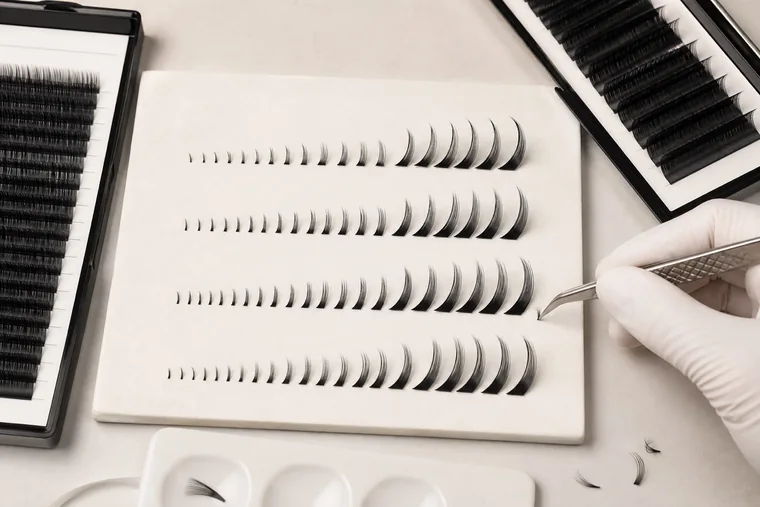
Side-by-side samples make differences in profile and fan opening easier to see. The photo does not establish a brand, curl, diameter, or length.
Round and flat lashes with the same nominal diameter
In lash terminology, thickness usually means nominal fiber diameter. Material, cross-sectional shape, taper, and manufacturing tolerances also affect mass and behavior. A round section has a diameter; a flat section has different width and height. One commercial number cannot describe the entire shape of a flat fiber.
London Lash’s US Classic Chelsea 0.15 is a synthetic classic lash with a rounded base and semi-matte finish. Its C mixed tray covers 8 through 13 mm. Use the 10 mm row for a comparison with a C 10 mm flat lash, keeping the stated curl, diameter, and length the same.
The US Matt Flat (Ellipse / Cashmere) Ultra Soft 0.15 has a concave flat base, matte finish, and tapered split tip. The C 10 mm variant is listed as a single length. London Lash describes this product as lighter than a traditional round classic lash. That is a manufacturer claim about the line, not a measured mass for the sample in your tweezers or evidence that it suits every natural lash.
Cross-sections
A diameter cannot describe every shape
Round
A circle can be described by its diameter.
Concave flat
More than one dimension is needed to describe this section.
Qualitative shapes, not measurements of the cited products. The drawing does not establish a weight equivalence or the load a natural lash can carry.
Compare a fiber of each type from the front and side: the flat shape can appear wider in one view while being thinner in the other. Then compare how the bases sit on equivalent practice lashes. The cited flat line is intended for classic application; do not treat it as a round volume fiber when building fans.
What diameter can tell you about weight
The added load includes the fibers and adhesive. In volume work, the number of fibers also matters, along with their lengths, taper, and base construction. A 2D or 3D label counts fibers; it does not weigh the fan.
A simple geometry model explains why small diameter changes matter. Two solid, uniform cylinders with equal length, material, and density have a mass ratio of 2.25 when their diameters are 0.15 mm and 0.10 mm: (0.15 ÷ 0.10)² = 2.25. Real extensions have tapered tips and may have flat or concave sections; adhesive adds another variable. This calculation is neither an actual extension weight nor a safe-load threshold.
A smaller diameter reduces mass in that model only while the other inputs stay fixed. Increasing length or fiber count can offset the reduction. Use product-specific mass data when supplied, within the variants and assumptions it covers. If those data are absent, a generic weight calculator cannot establish a reliable mass in grams or authorize a particular fan size.
A map gives the main length sequence, with adjustments for individual lashes. A lifted base or forced direction needs correction, even without a weight measurement. The absence of a visible problem does not, by itself, prove that the load is appropriate. When a shorter length is needed, choose a shorter manufactured fiber; do not trim an attached extension.
Observation
Change to consider
Check afterward
Outer tips drop or rotate
Choose shorter fibers at the end; consider placing the longest zone farther inward.
Does the tail keep its direction without twisting the natural lashes?
A natural lash is very fine or flexible
Reduce length and, within the product and technique, diameter or fiber count. Leave it bare if unsuitable.
Does it keep its own direction and remain separate from its neighbors?
The extension touches at only one point
Choose a more compatible starting profile or reassess the placement method.
Is there continuous contact without a gap or lifted base?
A step appears between zones
Adjust the length transition and check where the curl changes.
Do the tips form the intended outline from the front and side?
Tips touch glasses
Reduce length or forward projection in that area.
Do the tips clear the lenses during normal blinking?
Outer tips drop or rotate
Change to consider
Choose shorter fibers at the end; consider placing the longest zone farther inward.
Check afterward
Does the tail keep its direction without twisting the natural lashes?
A natural lash is very fine or flexible
Change to consider
Reduce length and, within the product and technique, diameter or fiber count. Leave it bare if unsuitable.
Check afterward
Does it keep its own direction and remain separate from its neighbors?
The extension touches at only one point
Change to consider
Choose a more compatible starting profile or reassess the placement method.
Check afterward
Is there continuous contact without a gap or lifted base?
A step appears between zones
Change to consider
Adjust the length transition and check where the curl changes.
Check afterward
Do the tips form the intended outline from the front and side?
Tips touch glasses
Change to consider
Reduce length or forward projection in that area.
Check afterward
Do the tips clear the lenses during normal blinking?
Check from the front, above, and the side. The front view shows the outline and visible balance; the top view shows spacing and direction; the side view shows curl, projection, and steps. Different natural directions or eyelid shapes may need different measurements on the two eyes to create a balanced result.
Record the map and reassess at a fill
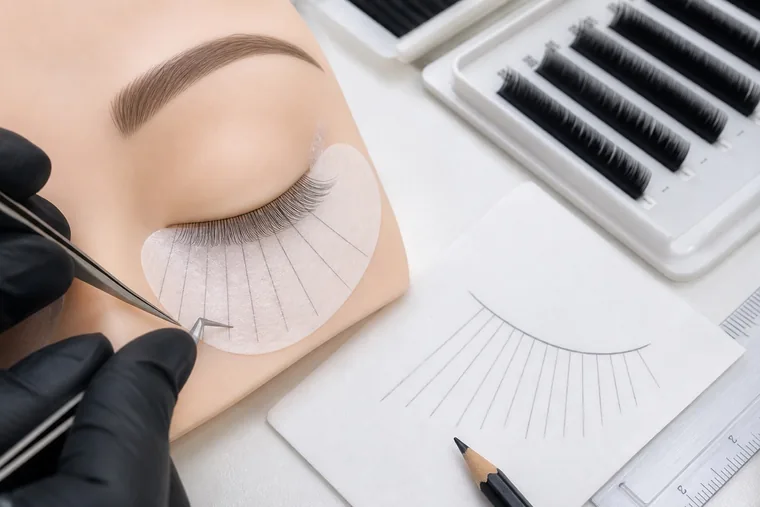
Zone boundaries connect the observed lashes with the planned measurements. Record curl, diameter, and length separately.
Record the fiber brand and line, curl, nominal diameter, length by zone, and fan count where used. Add the adhesive and batch, relevant room conditions, adjustments, and lashes left bare. With consent, photos taken at consistent angles and lighting help compare growth and direction at the next appointment.
A practice note might read: “Chelsea C, 0.15 mm, 10/12 mm comparison on matching practice lashes. The 12 mm sample breaks the tip line at the end; use 10 mm there and recheck contact.” Write this only if it describes what you actually observed. A client record also needs the eye and zone, actual specification, and reason for the choice.
As the natural lash grows, the attachment moves farther from the eyelid and its behavior can change. At a fill, distinguish stable attachments from grown-out work that needs professional removal, changed directions, and newly available lashes. Repeated rotation in one zone is a reason to review length, curl, load, and attachment before repeating the original map.
Keep the map, products, and follow-up observations together in the lash client record.
When to stop and seek care
Postpone treatment for redness, swelling, pain, discharge, or inflamed skin around the eye and refer the client for healthcare assessment. The FDA advises avoiding eye cosmetics during infection or inflammation and stopping a product if it causes irritation. Stop application if burning or pain begins; do not try to solve symptoms by changing curl or diameter.
If adhesive or another chemical gets in the eye, begin rinsing immediately with plenty of room-temperature running water for 15 to 20 minutes, following Poison Control’s eye-exposure guidance. Remove contact lenses if they come out easily. Do not delay rinsing to look up the product.
If glue seals the eyelids, do not force them apart. Call US Poison Control at 1-800-222-1222 for product-specific help; its eyelash-glue guidance also covers this situation. Keep remover, acetone, and tools out of the eye. Severe pain or a change in vision needs urgent medical evaluation; persistent irritation also needs a clinician’s assessment.
Final design checklist
I assessed both eyes by zone and noted lashes that need a smaller specification or no extension.
The chosen curl allows continuous attachment without forcing the natural lash.
I checked tip projection, transitions, eyelid clearance, and any glasses.
Each attachment stays clear of the skin and separate from neighboring lashes.
The front, top, and side views support the intended outline.
The map, products, and changes are recorded for the next fill, and the client knows to report pain, irritation, or visual changes.
Frequently asked questions
Do C and D curls look equally long at the same millimeter length?
They can look different because curl changes tip projection. Compare fibers from the same line and diameter with their bases aligned. Check both height and forward reach, then inspect contact on a practice lash before compensating with a longer fiber.
Can I shorten an extension by cutting it?
Choose a fiber manufactured in the shorter length. Cutting removes the tapered or split tip and changes its appearance; it is not equivalent to choosing a 10 mm version instead of a 12 mm one. Do not cut extensions while they are attached to a client.
Is a 0.15 flat lash equivalent to a 0.15 round lash?
The nominal number matches, but the cross-sections differ. Chelsea has a rounded base and Matt Flat a concave flat base. The manufacturer’s lighter-weight description for Matt Flat does not establish an equivalence for every 0.15 fiber or determine which natural lash can carry either product.
How much longer can an extension be than the natural lash?
There is no universal extra-millimeter allowance that accounts for diameter, fan count, direction, and attachment. Work within the product system covered by your training and the natural lash you assessed. Prepare shorter options for finer or less stable lashes, and leave unsuitable lashes bare. More adhesive or a second natural lash cannot make up for inadequate support.
Do both eyes need the same lash map?
Start with the agreed design, then adjust corresponding zones for differences in natural direction, density, or eyelid shape. Write down each eye separately. Compare the visible balance from the front and check the attachment and projection on each side.