We use necessary cookies and the Meta Pixel to measure campaigns and improve our offers. You can change your optional-cookie preferences at any time. Read our Terms and conditions.
Volume, hybrid, and mega volume lashes: fans, weight, and cost
Silvana DebiasiSeptember 1, 2026Updated on October 21, 2026 14 min read
Volume, hybrid, and mega volume lash extensions change how artificial fibers are arranged on natural lashes. Volume uses several fine fibers in a fan; hybrid combines fans with classic single fibers; mega volume uses higher-count fans made from very fine fibers. These constructions can create soft fullness, distinct tips, or a darker lash line.
Choosing between them means looking at both the result and the work behind it. A photo can show texture, but comparing two sets also requires their lengths, diameters, fan openings, and bases. For students and working lash artists, fan construction adds a skill to the isolation and attachment checks already needed for classic lashes.
At a glance: classic extensions attach one fiber to one natural lash; volume attaches one fan to that same single, isolated lash. Hybrid combines the two constructions and does not require a 50/50 split. D counts the fibers in a fan, not its weight. Choose the construction for the natural lashes in each area, and leave an unsuitable lash untreated.
In classic, or one-to-one, application, an artificial fiber lies alongside one isolated natural lash. In volume, several fibers meet at a common base. Their tips spread above the attachment while neighboring natural lashes remain separate.
Construction
Visible result
Work involved
Classic
Separate tips and definition along the existing lash line.
Select and position one fiber on each lash being treated.
Volume
Several tips per attachment; the opening can create a soft or compact texture.
Make or select a fan, preserve its shape, and attach its base to one lash.
Hybrid
Classic tips stand out among areas filled with fans.
Distribute both constructions without accidental clumps or abrupt length changes.
Mega volume
Many very fine fibers per fan, often used for a denser lash line.
Control fiber count, base, and transfer, then inspect attachments hidden by dense tips.
Classic
Visible result
Separate tips and definition along the existing lash line.
Work involved
Select and position one fiber on each lash being treated.
Volume
Visible result
Several tips per attachment; the opening can create a soft or compact texture.
Work involved
Make or select a fan, preserve its shape, and attach its base to one lash.
Hybrid
Visible result
Classic tips stand out among areas filled with fans.
Work involved
Distribute both constructions without accidental clumps or abrupt length changes.
Mega volume
Visible result
Many very fine fibers per fan, often used for a denser lash line.
Work involved
Control fiber count, base, and transfer, then inspect attachments hidden by dense tips.
A hybrid set can look bold, and a volume set can be subtle. Fullness also depends on the number of usable natural lashes, length, curl, color, and distribution. Where a suitable natural lash is missing, there is no attachment point. A nearby fan may soften the appearance of a gap, but it cannot create a new natural lash.
One natural lash per attachment
A single fiber or a fan
Classic: one fiber
The artificial fiber follows part of a single natural lash.
Volume: a 3D example
Three fibers meet at a common base. They attach to one natural lash.
Green: natural lash. Black: artificial fiber. Amber: adhesive along the contact area.
Schematic detail, not to scale. The highlighted contact area shows attachment to one natural lash. Separate natural lashes must remain free of each other.
What 2D, 3D, and other D labels mean
D states how many artificial fibers form one fan: two in 2D, three in 3D, four in 4D, and so on. A 7D fan has seven fibers joined at the base and still attaches to one natural lash. The number does not describe how many natural lashes are glued together or give the weight in grams.
Two 4D fans can look different. With the same fibers, a narrow fan concentrates the tips; a wider fan spreads them across more space. That changes visible coverage while the fiber count stays at four. Changing diameter, length, or material also changes the weight comparison.
There is no universal numerical boundary between volume and mega volume. To describe a proposed set, ask for details such as “4D, 0.07 mm, lengths from 8 to 11 mm, narrow fans,” plus the areas where those fans will be used. This is an example of a specification, not a combination suitable for every client.
Fan bases, opening, and direction
The base is the section where the fibers come together and contact the natural lash. Check it before pickup and after dipping into adhesive. It should stay together, without a loose strand sticking sideways or separating from the group. Remake a handmade fan with a split base, or discard a damaged premade fan.
Opening describes the spread of the tips. A wide fan can have a narrow base; spreading the tips does not require a wider attachment. A longer stem keeps the fibers together farther up the fan, while a shorter stem lets them open sooner. The base still needs enough usable contact to sit securely alongside the selected lash.
Approach the lash with the base already aligned. If the fan rotates, tilts, or loses its opening during transfer, correct it before attachment. Pulling on the tips after the adhesive has set can distort or weaken the bond.
The same fiber count
Different openings, compact bases
Narrow fan
The tips are concentrated in a smaller space.
Wide fan
The tips cover more space; the base stays narrow.
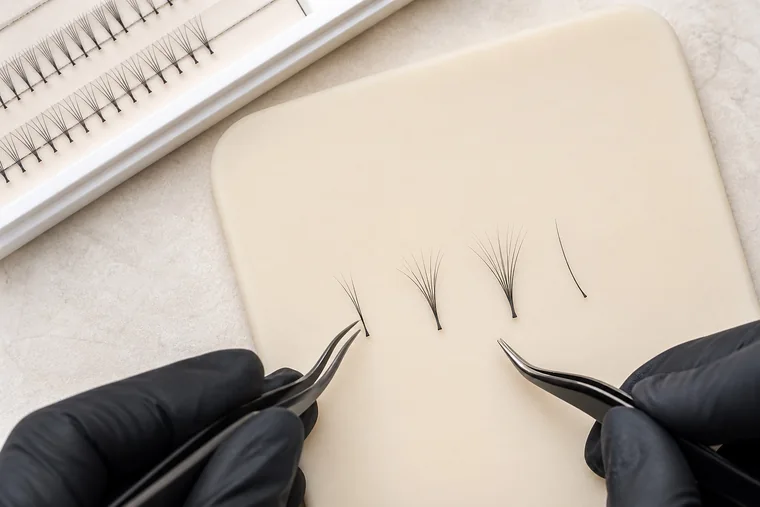
Both examples have four fibers and the same base length. These qualitative shapes do not measure diameter or weight and do not prescribe application dimensions.Compare how the fibers spread and converge at the base. The photograph does not measure the fans’ weight.
Handmade, premade, and promade fans
With handmade fans, the artist picks up fibers from a strip and opens them using a taught method, such as fanning on the strip or pinching the base. Fiber count and opening can be adjusted during construction. The next challenge is keeping that shape through pickup, adhesive, and placement.
Premade fans arrive formed and joined, which removes the fan-making step from the appointment. Natural-lash selection, isolation, adhesive control, and final separation checks still take time. Premade and promade are not standardized categories: London Lash uses both terms for fans made by hand in advance.
US product example
Fiber and base specifications
What to inspect
London Lash Narrow Mayfair 5D
Five synthetic fibers, 0.06 mm; narrow opening and a slim, pinched base joined with a small amount of glue. Box of 600 fans, mixed lengths from 7 to 13 mm.
Check that the base stays together after pickup. Follow the application instructions for the fan and extension adhesive.
Lash Affair Dirty Little Secrets 4D
Four PBT fibers, 0.07 mm, CC curl, pointed base. Mixed trays contain 400 fans; the 4D options group lengths as 7 to 9, 10 to 12, or 13 to 15 mm.
Choose the length group you need and inspect the pointed base and spacing. The product name alone does not identify the bonding method.
London Lash Narrow Mayfair 5D
Fiber and base specifications
Five synthetic fibers, 0.06 mm; narrow opening and a slim, pinched base joined with a small amount of glue. Box of 600 fans, mixed lengths from 7 to 13 mm.
What to inspect
Check that the base stays together after pickup. Follow the application instructions for the fan and extension adhesive.
Lash Affair Dirty Little Secrets 4D
Fiber and base specifications
Four PBT fibers, 0.07 mm, CC curl, pointed base. Mixed trays contain 400 fans; the 4D options group lengths as 7 to 9, 10 to 12, or 13 to 15 mm.
What to inspect
Choose the length group you need and inspect the pointed base and spacing. The product name alone does not identify the bonding method.
Before buying a large supply, practice pickup with a small sample. The fibers should stay joined and retain the intended opening. For handmade fans, check that the tweezer grips every fiber without crossing them. Lash Affair’s fan-making guide describes construction methods to practice with an instructor.
Weight and length: adjust the choice by area
The applied load includes every fiber, the joined base, and the adhesive. Nominal diameter is only one detail: length, material, cross-sectional shape, and taper also matter. Taper describes how the fiber narrows toward its tip. A flat fiber and a round fiber with the same labeled diameter need not have the same mass. Curl and direction also affect how the extension projects from its attachment.
With the same material, length, and shape, adding fibers adds mass. A smaller diameter can reduce mass, but a 4D or 7D label alone cannot tell you which fan is lighter. A manufacturer’s weight chart applies to the products and assumptions it names; do not transfer it automatically to longer fibers, flat fibers, or a different base.
Suppose a design uses the same fan line through the center and outer corner, but the outer lashes are finer and point downward. Reassess that area before applying the planned fans. A shorter length, fewer fibers, or a finer diameter may be appropriate under the method you have learned. Leave a lash untreated if it cannot support the planned application or cannot be isolated. Record the adjustment so the next fill does not restore the original size by habit.
On a practice strip, you can hold product line, diameter, and count constant and compare 12 mm with 10 mm fans. Observe the difference in projection. This shows what changing length does; it does not establish a safe weight limit for a person.
Extra adhesive cannot compensate for an unsuitable fan. If a bead forms at the base or glue travels up between the fibers, correct the pickup before placement. The guide to eyelash extension adhesives explains working conditions, storage, and product control.
Hybrid design: place classic fibers and fans
Classic fibers can create distinct tips, while fans add fullness between them. A 50/50 ratio is one option. Placement matters as much as the ratio: grouping all classic fibers on one side and all fans on the other produces a different result from distributing the same numbers along the lash line.
For a supervised mannequin exercise, compare three single fibers alternating with three fans against six fans, using comparable lengths. Photograph both rows from the same position, then remove one attachment from each and compare the gaps. This demonstrates distribution and how it changes with loss; it is not a map to copy onto every eye.
For more visible spikes, a design may use longer classic tips where the natural lashes can support them. For a softer line, keep length changes gradual and avoid crowding fans into one area. Lash mapping explains how the longest point and fiber direction change the result.
Six natural lashes in each row
Compare hybrid and volume tip distribution
Hybrid
Three single fibers and three fans. The classic tips stand out between the groups.
Volume
Six fans on the same six natural lashes put more tips along the row.
Green: natural lash. Black: artificial fiber. Each attachment has its own natural lash.
Practice examples with comparable lengths. Three single fibers plus three fans show one possible hybrid arrangement, not a required ratio or a map for every eye.
The extra control mega volume requires
A higher-count fan means controlling more fibers through each movement. You need to pick up the intended count, keep the base together, collect adhesive without closing the fan, and place it in the intended direction. A tweezer that drops a fiber or a base that splits has already changed the construction before attachment.
Dense tips can hide a fine neighboring lash or an adhesive bridge between layers. Check separation during the service and again at the end; do not pull against a resistant bond. A sparse natural lash line may require a less full result or untreated areas. Increasing fan size on the few remaining lashes does not solve the lack of suitable attachment points.
Skills and safety checks before volume practice
Begin with reliable classic control: keep one lash isolated throughout attachment, maintain clearance from the skin, recognize a lifted base, and find neighboring lashes stuck together, called stickies. The classic isolation and attachment diagrams show those checks before fan construction adds another movement.
On practice material, check whether you can complete pickup and placement within the adhesive’s working time under the stated conditions. If the glue sets before contact, choosing a faster adhesive gives you even less time. If bases stay mobile, review temperature, humidity, quantity, and timing with your instructor before continuing.
Working on people requires appropriate training, supervision during learning, and compliance with the rules where you work. For example, Texas’s eyelash extension specialist route requires 320 hours at a licensed school and written and practical exams. That is a Texas licensing route, not a nationwide course standard. A BeautyLearn completion certificate is not a state license, and a lash lift course does not teach extension application unless that training is explicitly included.
Professional extension adhesive is not for applying extensions to your own eyes. During a service, the eyes must stay closed, lower-lash protection must remain stable, and tools must be clean. Tell the practitioner about previous reactions or current eye problems. FDA guidance advises avoiding eye cosmetics when there is an eye infection or inflammation around the eye.
A negative patch test or a previously comfortable set does not guarantee that the next application will be tolerated. London Lash’s US guidance on reactions explains that a small test exposure can still be followed by a reaction to a full set. Report a previous reaction before booking; do not test a new adhesive on an already irritated eye area.
Stop the service if burning, pain, or marked tearing occurs. Persistent irritation needs medical assessment; severe pain or a change in vision needs urgent care. If adhesive enters the eye, Poison Control advises immediate irrigation with water for 15 minutes. If the lids are stuck, do not force them apart. Call 1-800-222-1222 for exposure guidance. Do not use household solvents near the eye, pull out extensions, or continue the appointment to cover up symptoms.
Keep the adhesive’s safety data sheet (SDS) accessible for first aid, ventilation, handling, and protective measures. In workplaces covered by OSHA’s Hazard Communication Standard, employers must make required SDSs readily accessible to employees and provide training on hazardous chemicals. An SDS is product safety information; it does not certify a fan’s suitability for an individual lash.
Practice exercises with results you can check
Use short supervised practice sessions to isolate one skill. For example, spend 20 to 30 minutes on one exercise and save a close-up photograph for feedback. These are illustrative drills, not a test that qualifies someone to work on clients.
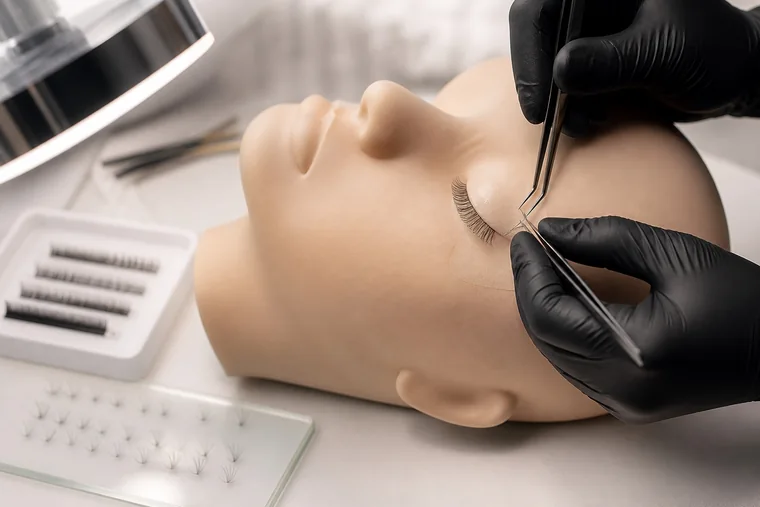
Use the mannequin to observe transfer and direction. An artificial support does not reproduce a living lash’s strength or growth cycle.
Practice task
What to record
Make 20 fans with the same fiber count and length.
Count those with joined bases, consistent openings, and uncrossed fibers. Describe the defect in the others before repeating.
Transfer 10 fans from the strip to practice material using the intended adhesive.
Compare the shape before and after. Note the stage at which a fan closes, loses a fiber, or collects excess glue.
Build the hybrid and volume examples on six artificial supports.
Compare tips and gaps from the same camera position, then remove one attachment to observe the change.
Review the samples with your instructor.
Ask for checks of base shape, contact, isolation, and separation. Repeat unstable steps before supervised practice on a person.
Make 20 fans with the same fiber count and length.
What to record
Count those with joined bases, consistent openings, and uncrossed fibers. Describe the defect in the others before repeating.
Transfer 10 fans from the strip to practice material using the intended adhesive.
What to record
Compare the shape before and after. Note the stage at which a fan closes, loses a fiber, or collects excess glue.
Build the hybrid and volume examples on six artificial supports.
What to record
Compare tips and gaps from the same camera position, then remove one attachment to observe the change.
Review the samples with your instructor.
What to record
Ask for checks of base shape, contact, isolation, and separation. Repeat unstable steps before supervised practice on a person.
Fans that close, bulky bases, and early loss
What you see
What to check and change
The fan closes during pickup.
Check tweezer grip, pressure, release from the strip, and fiber alignment. Repeat the pickup without adhesive on practice material.
The shape changes after dipping into adhesive.
Compare dipping depth and the amount collected. Remake a base with an obvious glue bead; do not pull a fan open on the client’s lash.
The base splits or a fiber sticks out.
Remake the handmade fan or discard the premade one. Do not hide the defect among neighboring attachments.
A fan rotates as the attachment grows out.
At the fill, assess length, contact, and the grown-out position. Remove unstable attachments professionally before adding new work.
Fans fall off without a natural lash attached.
Record timing and affected areas, then inspect residue and the remaining attachments. One fallen fan or photo cannot identify the cause; change one variable at a time.
The fan closes during pickup.
What to check and change
Check tweezer grip, pressure, release from the strip, and fiber alignment. Repeat the pickup without adhesive on practice material.
The shape changes after dipping into adhesive.
What to check and change
Compare dipping depth and the amount collected. Remake a base with an obvious glue bead; do not pull a fan open on the client’s lash.
The base splits or a fiber sticks out.
What to check and change
Remake the handmade fan or discard the premade one. Do not hide the defect among neighboring attachments.
A fan rotates as the attachment grows out.
What to check and change
At the fill, assess length, contact, and the grown-out position. Remove unstable attachments professionally before adding new work.
Fans fall off without a natural lash attached.
What to check and change
Record timing and affected areas, then inspect residue and the remaining attachments. One fallen fan or photo cannot identify the cause; change one variable at a time.
US appointment times, prices, and fills
Fan-making is only part of an appointment. Consultation, preparation, isolation, and separation checks also take time. Published US menus give useful comparisons, but their durations describe each salon’s services. They are not training speed targets or national averages.
Its regular and mega volume fills require at least 40% of extensions remaining, and it does not fill another artist’s work. Removal is listed separately at $30 for 30 minutes. A regular volume set plus two qualifying fills totals $160 + $75 + $75 = $310; adding that removal brings the service subtotal to $340. Tax, gratuity, and home-care purchases are outside this calculation.
For comparison, Iris Lash Studio in Midtown Manhattan lists hybrid at $100 for 60 minutes, volume at $110 for 60 minutes, and mega volume at $120 for 75 minutes on the same date. Their two-week fills are $70, $75, and $80 respectively. New-client full sets include consultation and custom mapping. Its fill policy defines two weeks as 9 to 15 days, three weeks as 16 to 22 days, and requires a new set from day 23. Those are this salon’s booking rules.
Before paying a deposit, ask how the salon handles low retention, a set from another artist, a change of style, and removal. Agree on the next assessment using that policy and your actual lashes. At a fill, the artist checks growth, stability, direction, and cleanliness even when the tips still look full.
For daily care, use the cleanser and washing method recommended for the system, rinse, dry gently, and brush without tugging. Mascara can close fans and leave residue between fibers. Report pulling, poking, or burning promptly instead of waiting for the scheduled fill.
How to compare two proposed sets
Compare photos with eyes open and closed. Look at how distinct the tips are, how dark the lash line looks, and where the longest section falls.
Ask which fibers and fans will be used in each area, and how the design will change for finer lashes. Hybrid or mega volume alone does not describe the construction.
Confirm the first appointment’s duration, fill price, and conditions that require a new set. Include removal and any separate aftercare products when comparing the total cost.
Frequently asked questions about volume and hybrid lashes
Can I switch from hybrid to volume at a fill?
Sometimes. The remaining work must fit the new design, and the natural lashes must be suitable. The artist checks lengths, curls, and attachments. If most of the existing set needs removal, the appointment may need to be booked as a new set. Agree on that before confirming the price and time.
Does a heat-bonded fan need extension adhesive?
Yes. Heat bonding holds the fan’s fibers together; professional extension adhesive attaches the fan to the natural lash. The bond within the fan and the attachment to the lash do different jobs. Follow the fan and adhesive instructions for application.
Can volume make two very different lash lines look identical?
Fan distribution can balance the appearance of fullness, but major differences in natural density or direction may remain visible. Each eye needs its own assessment and map. Do not put larger fans on sparse areas just to force an equal count or identical outline.
Further reading
MedlinePlus: eye emergencies explains when eye symptoms need emergency medical attention and what to avoid after an eye injury.