
How do you find nail clients without depending on random posts, viral luck or a permanent introductory discount? Build one connected path: be discoverable when a local client is searching, show evidence that matches the service she wants, make contact and pricing clear, confirm the appointment professionally, deliver a consistent experience and make appropriate maintenance easy to book. Google Business Profile, Instagram, a portfolio, reviews, referrals and partnerships are not competing tactics; each removes a different reason for a suitable client to stop.
The useful outcome is not a larger follower count. It is a steady flow of relevant enquiries, confirmed appointments that fit your offer and clients who return because the service and communication match the promise.
This guide owns client acquisition and retention. Build the evidence in your nail technician portfolio, price the service with the professional nail price-list guide and separate revenue from take-home income in the guide to nail technician earnings. If the plan includes premises in Italy, the separate nail salon opening guide explains why marketing cannot come before the applicable business and professional requirements.
The seven-stage nail client journey
A client system is a connected journey
More reach cannot repair a broken booking or return stage
Discover
Local search, Maps and trusted networks
Verify
Portfolio, reviews and clear scope
Book
Quote, fit and written confirmation
Return
Maintenance and appropriate rebooking
A local client may find you in Google Maps, open Instagram to understand your style, compare recent work and reviews, ask for a quote, book, attend and then decide whether to return. Publishing more cannot repair every weak point. If your local listing is inaccurate, search demand is lost. If the portfolio lacks comparable services, interest does not become trust. If replies are slow or vague, an enquiry does not become an appointment. If there is no maintenance explanation, every month begins with an empty future diary.
Positioning: define the client, area, primary services and price level you can serve well.
Discovery: appear in relevant local search, Maps, social channels and trusted local networks.
Evidence: show representative work, growth, hygiene, reviews and verifiable service information.
Contact: provide one obvious route to enquire or book without searching through old posts.
Qualification: collect the desired service, existing material, location, availability and useful photographs.
Appointment: confirm scope, estimated time, complete price, location, preparation and cancellation terms.
Return: explain suitable maintenance, invite honest feedback and record how the client found you.
Define the clients and nail services you want to attract
‘All nails for everyone’ is difficult to remember and impossible to prove in a small portfolio. Begin with a clear service promise: clean short salon extensions; structured overlays for natural length; reliable infills and corrections; hand-painted nail art; or a mobile service across a defined area. Communicating a focus does not forbid other suitable work. It gives the client a reason to recognise that your evidence is relevant to her request.
Write a positioning sentence with four components: main service, intended client, real service area and evidence. For example: ‘Short gel extensions and structural infills for clients in Bristol, with documented rebalance cases and appointments by booking.’ Use the business name as it exists in the real world. Do not add a string of cities and keywords to the listing name or claim to be the best without verifiable support.
Price is part of positioning, but repeated discounting is not a substitute for it. Before advertising a number, account for complete appointment time, materials, overhead, payment fees, training, tax and margin. The free BeautyLearn pricing calculator helps model service economics. A price that only works while your own labour is unpaid attracts demand the business cannot sustainably keep.
Google Business Profile for local nail clients
Local visibility depends on accurate real-world information
Relevance, distance and prominence are different signals
Relevance
Category, services and complete details
Distance
Searcher and real service location
Prominence
Known business, links and reviews
Accuracy
Hours, contact, address and imagery
Google Business Profile can display the business category, hours, phone, website, service area, photographs and reviews in Search and Maps. Google says local results are mainly based on relevance, distance and prominence. You cannot request or pay Google for better organic local ranking. You can verify the profile, keep information complete and accurate, select appropriate categories, respond constructively to reviews and publish photographs that represent the real service.
Use the real-world business name rather than adding services and locations as keywords.
Choose the most specific eligible primary category and accurately complete services, contact details and normal and special hours.
Link to a fast mobile page that explains area, services, evidence, price information and the next booking step.
Add recent, truthful photographs of the workspace and representative work without filters that alter skin, colour or nail shape.
Review edits, messages, hours, reviews and links regularly so a client does not meet obsolete information.
The address choice must match the actual operating model and local eligibility. Google states that a business which does not serve customers at its address should remove that public address and use a service area. A storefront or hybrid business that displays an address must meet Google’s real-location conditions. Do not use a virtual office, create duplicate profiles for every town or show a residential address merely to rank. Local rules may also limit whether a home can receive clients, so platform eligibility does not replace legal checks.
Instagram should create confidence, not just reach
Four content families answer four client questions
A useful profile proves fit, process, trust and the next step
Portfolio
Can you create the service I want?
Process
What happens and what is included?
Trust
Are the standards and limits credible?
Conversion
How do I enquire or book correctly?
A professional Instagram account is useful only when a person who sees one post can understand who you are, where you work, what you specialise in and how to proceed. Put the service area and booking route in visible profile information. Use highlights for representative work, maintenance, price guidance, reviews, availability and essential policies. Aesthetic consistency helps recognition; accuracy and relevance do more for conversion than a perfect grid.
Build four content families. Portfolio posts prove results and include well-documented regrowth. Process content explains preparation, architecture and maintenance without making diagnoses. Trust content shows the workstation, hygiene, training and thoughtful answers. Conversion content communicates availability and the exact enquiry route. Rotate these families so the profile does not become ten nearly identical finished hands or an uninterrupted sale.
Content type | Client question | Useful next action |
|---|---|---|
Result and regrowth | Does this match my style and service? | See a comparable case or request an assessment |
Process and maintenance | What is included and what happens next? | Read the scope, timing and return plan |
Workstation and method | Can I trust the service? | Check hygiene, boundaries and reviews |
Availability and booking | How do I book the correct appointment? | Send service, date and requested photographs |
Measure relevant enquiries and attended appointments, not personal worth through likes. A local post with modest reach and two suitable requests may outperform a reel watched widely outside your service area. Ask every new client how she found you, record the source consistently and avoid assigning a booking to the last click when a client used both Google and Instagram.
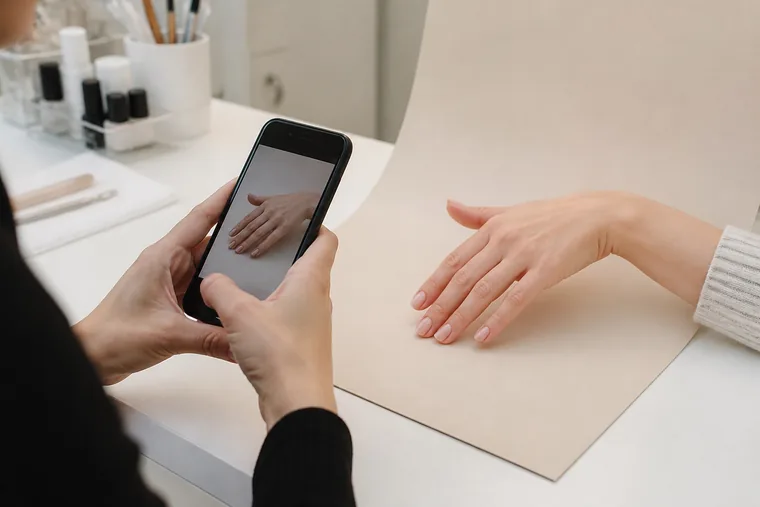
Build a nail portfolio that attracts suitable enquiries
A converting portfolio is an edited body of evidence, not an archive of every appointment. Select work that represents the services you want to sell and show useful angles: top, side, front and regrowth when appropriate. Keep light, background, distance and colour processing consistent. State technique, length and elapsed time without promising that every client will achieve identical wear.
Before-and-after pairs need comparable camera position and light. Do not smooth skin, sharpen the free edge or remove technical defects. A believable photograph may be less dramatic, but it protects expectation and makes progress assessable. The detailed portfolio guide covers shot lists, case selection and file organisation; the later English photography guide will own camera setup in greater depth.
Treat client images as personal data. A hand can identify someone through tattoos, jewellery or context. Explain the intended channels, obtain and document the permission or other lawful basis required in the relevant jurisdiction, limit access and honour applicable withdrawal rights. Permission to document a service internally is not blanket permission for advertising, training or indefinite public use. Refusing optional portfolio publication should not reduce service quality.
Ask for genuine Google reviews without incentives
You may ask for an honest review and share Google’s review link or QR code. Google’s current policy says contributions should reflect a genuine experience and prohibits free or discounted goods or services in exchange for posting, changing or removing a review. It also prohibits selectively soliciting positive reviews while discouraging negative ones. Keep referral rewards separate from public-review requests.
Ask after the client has had a fair opportunity to evaluate the service, not while she is still seated and feels watched. A proportionate message is: ‘If you would like to share your experience, the optional review link is here. Your feedback helps me understand the service.’ Do not write the review, prescribe five stars or ask a dissatisfied client to contact you privately while only satisfied clients receive the public link.
Respond briefly and professionally. Thank a positive reviewer without turning the reply into an advert. For criticism, acknowledge the verifiable concern, protect privacy and offer an appropriate private contact route. Never publish health information, appointment records or a client’s private messages to win an argument. If content violates platform policy, use the reporting tools rather than attacking the reviewer.
Referrals and local partnerships that can be measured
Word of mouth is strongest when the experience is repeatable: the result matches the consultation, price and boundaries are clear, time is respected, maintenance is explained and early concerns are handled professionally. Make sharing easy with one current page or contact card. ‘If someone you know wants this type of short structured set, you can send her this link’ is more useful than asking a client to promote a vague business.
A refer-a-friend benefit can be transparent and economically sustainable, but it is not payment for a Google review. Define who receives it, when it is earned, expiry, exclusions and maximum use. Check consumer, tax and marketing rules in the jurisdiction. If the incentive removes all margin or attracts only one discounted visit, it has created activity rather than a valuable client relationship.
Hairdressers, makeup artists, bridal professionals, photographers, fashion retailers and other beauty practitioners may share an audience without duplicating the nail service. Start with a concrete project: a bridal trial day, a portfolio shoot, an educational event or a trackable referral arrangement. Put responsibilities, dates, payment, image permissions, cancellations and the client journey in writing. Do not exchange client databases or send promotional messages merely because two businesses collaborate.
Turn enquiries into confirmed appointments
A beautiful feed still loses business when the enquiry process is slow or ambiguous. Create a short response flow that asks for the requested service, current product, desired length and design, preferred dates and clear photographs when necessary. State when replies are handled. Use saved prompts for consistency, but read the actual message and never automate a technical promise from an image.
Stage | Information to confirm | Common leak |
|---|---|---|
Enquiry | Service, existing material, length, art and area | Generic ‘prices?’ receives no guided answer |
Quote | Complete total, inclusions, time and in-person limits | Starting price hides predictable extras |
Booking | Date, deposit, location, preparation and policy | No single written confirmation |
Follow-up | Aftercare, concern route and review window | Only promotional messages are sent |
A quote from photographs remains conditional where product identity, lifting, damage or symptoms cannot be assessed remotely. Explain what could legitimately change and obtain agreement before additional work. The guide to Italian nail salon prices shows how clients compare complete scope rather than a headline; the same clarity improves conversion for the business.
Retention and rebooking fill the future diary
Acquiring a first visit and never discussing the appropriate return forces the business to replace every client repeatedly. At the end of the service, explain aftercare, signs that justify earlier contact and the indicative maintenance window based on the system and nail condition. Offer rebooking without pressure. A client may decline, but she should understand why growth, balance and product condition—not a sales target—shape the review date.
Distinguish operational contact from marketing. An agreed appointment confirmation or change is not automatically permission for recurring promotions. Collect only necessary data, secure it, state retention and follow the laws that apply to electronic marketing and personal data in your location. The English client-record guide later in this nail cluster will own detailed documentation; until then, obtain competent local advice instead of copying a generic consent box.
Send one complete confirmation with date, service, estimated duration, address and essential terms.
Use a proportionate reminder and a simple route for genuine changes.
Record relevant material, colour, shape, reported sensitivities and preferences without collecting unrelated personal details.
Explain the maintenance decision and offer an appropriate future slot.
Provide a clear channel for an early concern rather than leaving the client to post publicly for help.
Measure the point where suitable clients are lost
Count decisions, not vanity totals
A small monthly dashboard reveals the weakest stage
Enquiries
Source and suitability
Bookings
Confirmed ÷ relevant enquiries
Attendance
Completed ÷ confirmed
Rebooking
Returns booked ÷ clients served
Choose a small monthly dashboard. Count enquiries by source, enquiries that fit the service, quotes sent, appointments confirmed, appointments attended, first visits, rebookings and average service value. A follower count does not reveal capacity or margin. Record definitions so ‘client from Instagram’ means the same thing each month, and let a person have an assisted path when she discovered you on Maps and verified you on Instagram.
Metric | Simple calculation | What it helps diagnose |
|---|---|---|
Booking rate | Confirmed bookings ÷ relevant enquiries | Offer, evidence, response and price clarity |
Attendance | Appointments attended ÷ confirmed | Confirmation, reminder and cancellation process |
Rebooking | Return appointments booked ÷ clients served | Experience and maintenance conversation |
Average service value | Service revenue ÷ appointments | Service mix—not net profit |
Client source | Attended appointments by discovery and assist channel | Channels that produce real local work |
Average service value is not earnings. Materials, non-billable time, rent, payment fees, insurance, training, tax and other costs remain. Use the nail technician earnings guide to separate revenue, operating result and personal income. A diary can be full while cash flow and take-home pay remain weak.
A 30-day plan for finding your first nail clients
Period | Focus | Verifiable output |
|---|---|---|
Days 1–7 | Positioning and foundations | Offer sentence, costed prices, terms, eligible Google profile and current contact page |
Days 8–14 | Evidence and content | Twelve consistent images, three growth cases and four useful explanatory posts |
Days 15–21 | Local network | Five tailored approaches and one written collaboration test |
Days 22–30 | Conversion and return | Tested enquiry script, honest-review link, rebooking process and source report |
If you do not yet have enough representative work, practise on tips and suitable models under transparent conditions. Do not describe training work as an established paid-service record. Continue building the technique you plan to sell through online nail courses and use the guide on practising after a nail course to turn repetition into evidence rather than content pressure.
Mistakes that damage trust and margin
Copying another professional’s photographs, service names or claims instead of building your own evidence.
Buying followers or reviews, incentivising public ratings or filtering review requests by expected sentiment.
Posting clients, conversations or appointment details without an appropriate permission and privacy process.
Promising universal wear, zero allergy risk or an identical result from a reference photograph.
Hiding predictable supplements until payment or using a low starting price for a different service.
Filling every gap with discounts without measuring margin, attendance or repeat behaviour.
Treating one busy week as proof of a stable and profitable client base.
Frequently asked questions about finding nail clients
How can I find my first nail clients without followers?
Create a small, consistent portfolio; make the service, area and enquiry route explicit; complete an eligible Google Business Profile; and approach relevant local networks with a defined offer. Twelve credible examples can be more useful than a large audience outside your area.
Can a home-based nail technician use Google Business Profile?
Eligibility depends on how clients are served and Google’s current rules. If clients are not served at the address, Google says to remove it publicly and use a service area. If clients visit, real-location requirements and local business rules still apply.
Does Google or Instagram bring more nail clients?
Google often captures active local intent; Instagram can make style, proof and method easier to evaluate. Track relevant enquiries, attended appointments and assisted journeys for several weeks. There is no universal winner.
What should a nail technician post on Instagram?
Rotate representative results and regrowth, process, hygiene and professional boundaries, answers to genuine questions, availability and clear booking information. Use accurate images and avoid diagnoses or universal durability claims.
Can I offer a discount for a Google review?
No. Google prohibits incentives such as free or discounted goods or services in exchange for posting, editing or removing a review. Ask for optional feedback from genuine clients without specifying the rating.
How do I ask for reviews without pressuring clients?
Send the official link after the service and state that feedback is optional. Ask all suitable clients consistently rather than only those expected to leave five stars, and do not watch them complete it at the desk.
Do I need permission to publish photographs of hands?
A hand may identify someone through tattoos, jewellery or context. Define internal documentation and public marketing separately, provide the information required locally and record an appropriate permission or lawful process. Seek jurisdiction-specific advice.
Should I lower nail prices to fill the diary?
A limited promotion can test a defined objective, but a chronically undercosted service cannot fund labour, products, overhead, training and tax. Calculate the complete cost and measure whether acquired clients return at a sustainable price.
How do local partnerships work for nail technicians?
Choose complementary businesses with compatible clients and standards. Propose a specific test, define duties, payment, image use and tracking in writing, then evaluate attended appointments rather than social reach alone.
How can I turn a first nail client into a regular?
Deliver the agreed service, explain maintenance, make concerns easy to report and offer the next appropriate review without pressure. Clear confirmation, reliable timing and consistent results matter more than frequent promotional messages.
Which nail-business numbers should I review monthly?
Track relevant enquiries by source, booking rate, attendance, first visits, rebooking and average service value. Connect them to time and cost: more appointments do not automatically create more take-home income.
How long does it take to build a nail client base?
There is no reliable universal deadline. Area, skill, offer, capacity, price, reputation and consistency change the result. Review the journey every 30 days, improve one weak stage and never present a commercial forecast as guaranteed income.
Sources, platform rules and scope
Google Business Profile Help — tips to improve local ranking: verification, complete information, reviews, photographs and relevance, distance and prominence.
Google Business Profile Help — guidelines for representing a business: real-world name, address, service-area and virtual-office rules.
Google Business Profile Help — tips to get more reviews: genuine experience, links and QR codes, and the prohibition on incentives.
UK Information Commissioner’s Office — data protection guidance: principles and guidance for organisations subject to UK GDPR. Other jurisdictions require their own review.
Substantively reviewed on 5 September 2026. This is operational and marketing education, not a promise of clients or earnings and not legal, tax, privacy or platform-account advice. Confirm the current platform policies and the rules that apply to the country, premises and services in which the business operates.