Natural eyelash anatomy and growth cycle: shedding, renewal and professional limits

A clear guide to the eyelash shaft, root, follicle, eyelid margin, anagen, catagen, telogen, exogen, asynchronous growth, cosmetic observation and referral boundaries.

Silvana DebiasiSilvana Debiasi1 September 2026 18 min read
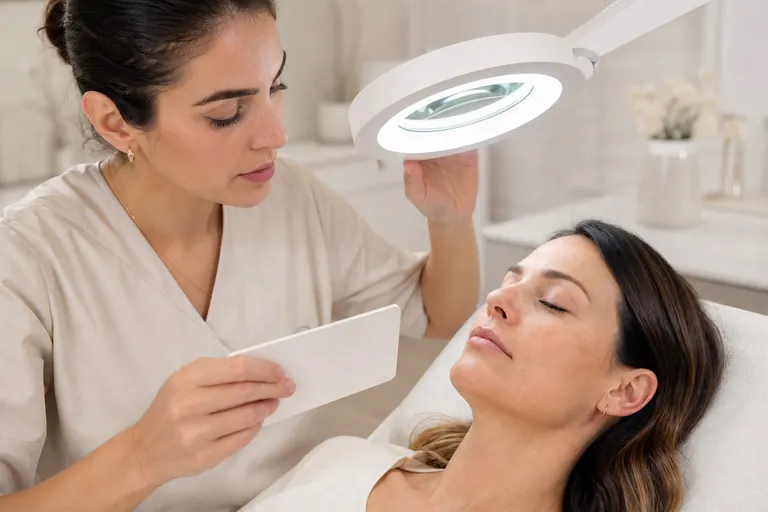
Lash professional observes untreated natural eyelashes with a magnifying lamp and records visible features before any service
On this page
  1. 1 Eyelash anatomy: what is visible and what is not
  2. 2 The eyelash shaft: cuticle, cortex and keratinised fibre
  3. 3 The follicle: where a new eyelash is produced
  4. 4 The eyelid margin and the protective role of eyelashes
  5. 5 Why eyelashes do not grow like scalp hair
  6. 6 The eyelash cycle: anagen, catagen, telogen and exogen
  7. 7 Anagen: active production and growth
  8. 8 Catagen: transition, not a second growth period
  9. 9 Telogen and exogen: rest and release
  10. 10 Asynchronous growth: why different lengths coexist
  11. 11 Growth rate and cycle duration: how to read the numbers
  12. 12 What a lash professional can observe
  13. 13 What visible lashes cannot establish
  14. 14 Natural cycle and lash extensions
  15. 15 Natural cycle and lash lifts
  16. 16 Professional limits: useful theory, diagnosis excluded
  17. 17 Frequently asked questions
  18. 17.1 What are the four phases of the eyelash cycle?
  19. 17.2 How long is the natural eyelash cycle?
  20. 17.3 How fast do eyelashes grow?
  21. 17.4 Is every short lash in anagen?
  22. 17.5 Does a shed lash include the follicle?
  23. 17.6 Does trimming make eyelashes grow thicker?
  24. 17.7 Why do natural lashes have different lengths?
  25. 17.8 Is it normal to lose lashes with extensions attached?
  26. 17.9 Do lash extensions stop natural growth?
  27. 17.10 Does a lash lift change the growth cycle?
  28. 17.11 Why does a lash lift look uneven after a few weeks?
  29. 17.12 Can a lash artist identify each growth phase?
  30. 17.13 Can a cosmetic serum guarantee eyelash growth?
  31. 17.14 Can sparse areas be covered with extensions?
  32. 17.15 When should a lash service be postponed?
  33. 17.16 Can photographs diagnose lash damage or loss?
  34. 18 Sources and editorial criteria

Understanding natural-eyelash anatomy and the growth cycle helps explain what changes between appointments. The visible lash is not the whole follicle; a short fibre does not automatically identify a growth phase; one shed lash does not prove damage, and a newly sparse area cannot be dismissed as normal renewal without context. Theory becomes professionally useful when it improves observation, records and cautious decisions.

Each follicle produces a lash through periods of active growth, transition, rest and release. Follicles are not synchronised, so fibres of different lengths and ages coexist on one eyelid. Extensions and lash lifts do not stop natural renewal, while unsuitable load, traction, rubbing or an uncontrolled chemical process can add stress. A lash professional observes the visible fibre and client comfort; they cannot date each phase, diagnose shedding or treat a medical cause.

This guide owns the anatomy and growth-cycle intent. It does not teach the professional lash-lift procedure or extension application. Use lash extensions vs lash lift to compare services and the lash-lift troubleshooting guide for unwanted outcomes. Here we build the shared biological foundation without turning visible signs into diagnoses.

Eyelash anatomy: what is visible and what is not

One fibre, several anatomical levels

Observe the shaft without inventing the follicle

Shaft

Visible keratinised fibre

Root

Part of the fibre inside the follicle

Follicle

Tissue unit that produces and cycles

Margin

Eye-area tissue to respect and observe

The shaft emerges from the lid; root and follicle remain in tissue. A beauty photograph describes the surface, not deep biology.

In everyday language, eyelash means the fibre emerging from the lid. Anatomically it is useful to distinguish the visible shaft above the skin from the root inside the follicle. The follicle is a living tissue unit within the eyelid. It is not pulled out during ordinary shedding and cannot be assessed directly from a beauty photograph.

Structure

What it is

What a lash professional can observe

Shaft

Keratinised fibre visible above the skin

Visible length, apparent diameter, curve, direction, surface and breaks

Root

Part of the fibre inside the follicle

Not directly visible during a cosmetic service

Follicle

Tissue unit that cycles and produces the shaft

Cannot be diagnosed from fibre length or a shed lash

Eyelid margin

Area where lashes emerge among nearby glandular structures

Cleanliness, residue, visible integrity and reported symptoms

The eyelash shaft: cuticle, cortex and keratinised fibre

The shaft is not the follicle

Three concepts for describing the fibre

Cuticle

Overlapping outer layer

Cortex

Structure and pigmentation

Medulla

Internal region described in research

Limit

No layer is diagnosed by eye

The cuticle protects the surface, the cortex forms much of the fibre and the emerged shaft is keratinised. Coating is not feeding living cells.

The shaft consists largely of keratinised cells and has layers with different structural roles. The outer cuticle contains overlapping cells that help protect the interior. The cortex forms much of the fibre and contributes to mechanical properties and pigmentation. Literature also describes a medullary region, but these components are not a map a practitioner can reliably read with the naked eye.

Because the emerged shaft is not living tissue, a cosmetic may coat it, condition the surface, reduce friction or temporarily change appearance. It cannot feed cells that are already keratinised. Trimming a tip likewise sends no signal to the follicle to make a new lash thicker. Precise language prevents repair and growth claims that the service cannot support.

The follicle: where a new eyelash is produced

Below the surface, follicular structures change through the cycle. During active production, matrix cells contribute to the forming fibre in relation to the dermal papilla, sheaths and cellular niches. The bulb is the deep region associated with production of a new shaft during growth; it is not the small pale material sometimes seen at the inner end of a released lash.

Confusing material attached to a shed fibre with the entire follicle creates the myth that every fallen lash has had its follicle removed. The follicle remains in the eyelid. Traction can cause injury and repeated aggression can have consequences, but a photograph of one fibre cannot establish the condition of its follicular unit. Reconstruct the context, observe the area and postpone when loss is unusual.

The eyelid margin and the protective role of eyelashes

Lashes emerge in rows along the eyelid margin and contribute to protection of the ocular surface. Their arrangement helps intercept particles and influences air movement near the eye. Aerodynamic studies using models and comparative measurements suggest that geometry and length can reduce particle deposition and evaporation under certain conditions; they do not define one cosmetically ideal length for every person.

Glandular structures and eyelid tissues near the follicles belong to a functional system wider than the fibre. Residue, adhesive, products and mechanical handling stop being purely aesthetic concerns when pain, redness, swelling, discharge, a foreign-body sensation or visual change occurs. A lash professional maintains clean practice and observes; medical assessment belongs to an appropriately qualified professional.

Why eyelashes do not grow like scalp hair

Eyelashes and scalp hair are both hair fibres, but their sites and cycles differ substantially. The active growth period for eyelashes is much shorter than for scalp hair, helping keep natural length limited even when the follicle functions normally. Curve, pigmentation, diameter, number and distribution vary between people, lids and stages of life.

Scalp hair is not a forecast for the lash line, and a social-media density is not a clinical reference. Camera angle, eye position, mascara, extensions and lighting alter perception. The useful comparison is the person's own history documented in repeatable conditions, not one number taken from a population average.

The eyelash cycle: anagen, catagen, telogen and exogen

The cycle in four stages

Production, transition, rest and release

1

Anagen

Production and shaft growth

2

Catagen

Transition and regression

3

Telogen

Rest and retention

4

Exogen

Release of the older fibre

Phases describe a follicle over time. They are theoretical tools, not labels a lash artist can assign to every visible fibre.

The cycle describes changes in the follicle and fibre over time. Its phases explain renewal but are not labels that can be assigned with certainty to every visible lash during an appointment. Terminology also varies slightly across publications: exogen, the release of the old fibre, may be described as a separate event or linked to the transition from rest into renewed growth.

Phase

Essential biological event

Professional error to avoid

Anagen

Production and elongation of a new shaft

Calling every short fibre anagen from a photograph

Catagen

Transition and regression of active structures

Claiming to date it during a routine service

Telogen

Rest and retention before release

Assuming every mature lash is about to fall

Exogen

Release of the older fibre as the cycle continues

Calling any amount of loss normal without context

Anagen: active production and growth

During anagen the follicle produces and lengthens the shaft. This phase is relatively brief in eyelashes and contributes to their limited final length. Pigment is incorporated while the fibre forms. A new lash may appear shorter and finer than its neighbours, but length, diameter and location are not sufficient to prove its biological phase.

For extension work, the cautious principle is not to guess a precise age but to respect apparent capacity, isolation, load, length and direction. For a lift, it means planning around the population actually present and never promising that the process prolongs growth or produces new follicles. Biology informs the limit; it does not replace product instructions.

Catagen: transition, not a second growth period

In catagen, active production stops and the lower follicle undergoes an organised regression. It is a transitional period rather than continued elongation. No simple cosmetic sign allows a lash artist to declare confidently that one particular fibre entered catagen during an appointment.

The practical consequence is to avoid rigid maps built on invented percentages of growth phases. A lash line contains different fibres whose individual future cannot be predicted visually. Records compare a population over time; magnification does not turn a beauty appointment into histology.

Telogen and exogen: rest and release

During telogen the fibre remains associated with the follicle while active production is at rest. Release follows and is described as exogen. A natural lash shed with its attached extension may therefore coincide with normal release. That event alone proves neither good nor bad application. Frequency, distribution, history, associated signs and technical quality all matter.

A natural lash can also be lost through traction or break along the shaft. Distinguishing shedding, breakage and traumatic removal from one image is often impossible. A blunt end or irregular length may support a breakage hypothesis but cannot diagnose the cause. Widespread, sudden or patchy change, especially with symptoms, takes the situation outside routine cosmetic work.

Asynchronous growth: why different lengths coexist

The lash line does not change all at once

Different fibres share the same eyelid

Short

Could be new or broken; length is not enough

Medium

Visible length is not a certain phase

Long

Does not prove shedding is imminent

Population

Assess distribution and history together

Some lashes grow while others transition, rest or release. That is why lifts and extension sets evolve gradually rather than expiring on one date.

Human follicles do not move through the cycle together. This lack of synchrony preserves a visible lash line while individual fibres grow, rest and release. It is why an extension set changes gradually and a lash lift does not disappear in one day: some treated fibres remain, others shed and new fibres emerge with their natural direction.

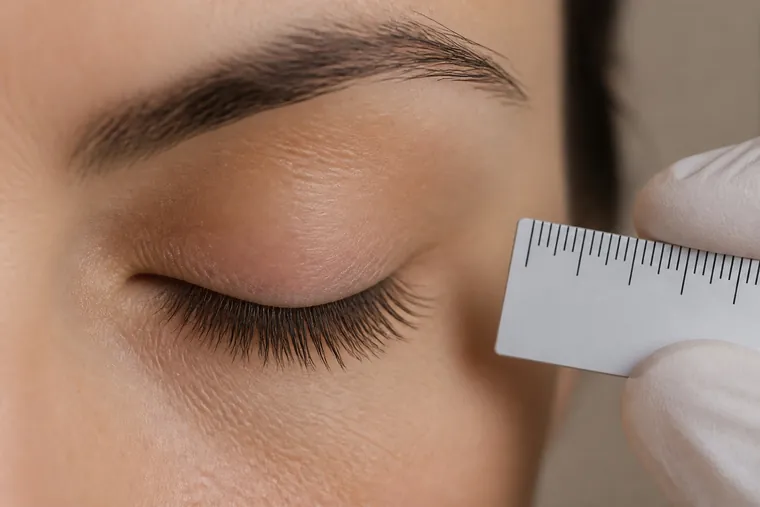
Close view of untreated natural eyelashes of slightly different visible lengths beside a small non-contact scale
Different lengths can coexist during asynchronous renewal but do not reveal each follicle phase

Asynchronous does not mean random or measurable by eye as an exact percentage. Today's visible population is temporary. An infill should not be selected only after a fixed number of days, and a repeat lift should not be authorised by counting weeks alone. Reassess distribution, growth, apparent condition, comfort, history and system directions.

Growth rate and cycle duration: how to read the numbers

A characterisation study of 29 adult volunteers, with four followed weekly for nine months, estimated average growth at about 0.12 millimetres per day, an anagen period of 34 ± 9 days and a complete cycle of 90 ± 5 days within that protocol. These are informative study findings, not a universal clock. Sample size, method and population limit personal prediction.

A dedicated review reports daily growth around 0.12–0.14 millimetres, anagen estimates of roughly four to ten weeks and total-cycle estimates of around four to eleven months across different sources. The wider ranges should not be hidden: they show how definitions, methods and individual variation matter. Eyelash research is also smaller than the literature on scalp hair.

Numbers describe studies; they do not prescribe when to infill extensions, repeat a lift or reassure someone about loss. A calendar cannot replace observation, the exact system instructions, service history or referral when change is unexplained.

What a lash professional can observe

Description is not diagnosis

Separate observation, report and decision

Observe

Distribution, direction and surface

Ask

History, treatments and comfort

Record

Standardised images and decision

Do not diagnose

Phase, disease, cause or prognosis

The record captures what is visible and what the client reports. Phase, medical cause and prognosis require evidence outside a cosmetic service.

Useful observations include visible distribution, direction, lengths, apparent diameter, curvature, crossings, surface appearance, breaks, residue and obvious change from documented photographs. The practitioner can also record what the client reports: comfort, itching, rubbing, recent treatments, sudden change and previous reactions. Use neutral language such as an area appears less dense than the last record, not the follicle has stopped growing.

Standardised images improve comparison when light, distance, magnification, angle, eye position and make-up status are controlled. They support the service record but cannot show a deep follicle, prove inflammation or assign a phase. Consent for treatment does not automatically include consent to publish close-up eye images.

Lash professional records natural-lash distribution, visible lengths and client-reported comfort before a cosmetic service
Professional observation separates visible facts, client reports and decisions

What visible lashes cannot establish

  • The exact growth phase or age of an individual lash.

  • The internal condition of the shaft or follicle from a photograph.

  • A medical cause for shedding, thinning, itching, redness or discomfort.

  • Whether a serum will produce growth for one individual.

  • The future retention of a set or exact duration of a lift.

A beauty professional should not recommend prescription medicines, change a medical treatment or describe a cosmetic as therapy for lash loss. Product claims should be tied to the evidence and legal requirements of the market in which the product is sold.

Natural cycle and lash extensions

A correctly attached extension moves and eventually sheds with its natural lash. Asynchronous renewal changes spacing, direction and density across the set, which is why an infill is an assessment rather than automatic replacement of missing fibres. A fibre that has grown far from the original attachment zone may need controlled removal before the design is restored.

The natural cycle does not explain every retention problem. Preparation, adhesive control, environment, contact area, skin contact, isolation, load, home habits and cleaning all influence a set. Multiple natural lashes glued together cannot move independently; excess load and pulling during removal add mechanical stress. Biology should never be used to excuse preventable technical errors.

Natural cycle and lash lifts

A lift changes the direction of fibres present on the day of treatment. Those fibres remain at different points in their cycle, so the result changes progressively. New lashes emerge with their natural direction beside still-lifted fibres, while treated fibres release at different times. Unevenness during renewal is not proof that the product suddenly stopped working.

The cycle also does not authorise repeat processing on a fixed calendar. Remaining treated fibres, apparent condition, previous exposure, new-growth distribution, comfort and exact system directions determine whether to proceed, adjust or wait. If the previous outcome is over-curled, crossed or apparently compromised, troubleshoot before exposing the population again.

Professional limits: useful theory, diagnosis excluded

Limits are part of technique

Recognise, stop, document and refer

1

Recognise symptoms or new change

2

Stop or postpone the service

3

Record without diagnosing

4

Refer for appropriate assessment

Eye symptoms, sudden or patchy loss and unexplained margin changes are not covered with a treatment. Competence includes not proceeding.

The practitioner can explain normal asynchronous renewal in general terms and document visible change. They cannot diagnose alopecia, infection, inflammation, blepharitis, allergy, endocrine change or a nutritional cause. Nor should a cosmetic service conceal a sudden sparse patch while the cause remains unexplained.

Postpone and recommend appropriate medical assessment when loss is sudden, patchy or clearly different from the person's record, or when pain, burning, persistent itching, redness, swelling, scaling, discharge, a foreign-body sensation, light sensitivity or visual change is present. Do not apply extensions, lift products, tint or adhesive as a test.

Use all English lashes guides to continue by intent. For structured practical education, compare the online lash courses and review the dedicated lash lift course. Theory supports training; it does not turn a page into supervised practice.

Frequently asked questions

What are the four phases of the eyelash cycle?

Anagen describes active production and growth, catagen the transition away from active growth, telogen a resting period and exogen release of the older fibre. Publications may group the transition and release slightly differently, so these phases are a biological framework rather than labels visible at an appointment.

How long is the natural eyelash cycle?

Published estimates vary with method and definitions. One small characterisation study estimated about 90 ± 5 days, while reviews report broader total-cycle ranges extending over several months. Neither figure predicts one person's next shed lash or sets an appointment date.

How fast do eyelashes grow?

Research often reports an average in the region of 0.12 to 0.14 millimetres per day, but averages do not describe every follicle or person. Growth measurement depends on protocol, and a lash artist cannot convert one visible length into an exact biological age.

Is every short lash in anagen?

No. A short fibre may be new, naturally short, partially hidden, photographed from a different angle or broken. Length and apparent diameter alone cannot identify the growth phase with certainty. Use conservative load and document rather than inventing an age.

Does a shed lash include the follicle?

The follicle is a tissue structure in the eyelid and does not normally leave with the shaft. Material at the inner end of a shed fibre is not proof that the entire follicle was removed. Unusual loss or symptoms still deserve appropriate assessment.

Does trimming make eyelashes grow thicker?

No biological mechanism allows cutting the keratinised shaft to instruct the follicle to produce a thicker fibre. Trimming changes the visible tip and may make it look blunter, but it does not alter follicular programming.

Why do natural lashes have different lengths?

Follicles cycle asynchronously, so a lash line contains fibres produced and released at different times. Natural variation and occasional breakage also affect visible length. Different lengths are expected, but a new sudden or patchy change should not be dismissed without context.

Is it normal to lose lashes with extensions attached?

A natural lash can release with its extension as part of the cycle. One fibre proves neither safe nor unsafe application. Review frequency, distribution, isolation, load, attachment, home handling and symptoms before drawing a conclusion.

Do lash extensions stop natural growth?

Extensions do not switch off the cycle by design. Poor isolation, excessive load, traction or home removal can add stress. If the lash line changes unexpectedly, remove assumptions and seek appropriate professional or medical assessment.

Does a lash lift change the growth cycle?

A lift reshapes the visible keratinised fibres; it is not intended to lengthen anagen or create follicles. The effect changes because treated lashes continue their cycle and new lashes emerge in their natural direction.

Why does a lash lift look uneven after a few weeks?

Asynchronous shedding and new growth can place untreated and still-lifted fibres side by side. That gradual change is expected. Marked kinks, apparent fragility or symptoms require a separate technical or health-focused assessment.

Can a lash artist identify each growth phase?

Not with certainty from appearance alone. Magnification improves visibility of length, direction and surface, but does not reveal follicular histology or date a fibre. Phase labels should never replace conservative design.

Can a cosmetic serum guarantee eyelash growth?

No cosmetic should be presented as a guaranteed personal outcome. Read the claim, intended use, ingredient list and evidence in the market where it is sold. Prescription substances and medical treatment sit outside routine cosmetic advice.

Can sparse areas be covered with extensions?

Extensions require suitable natural lashes for attachment. They cannot safely create a lash where no support exists, and an unexplained new gap should not be concealed before appropriate assessment. The cause matters more than the photograph.

When should a lash service be postponed?

Postpone for sudden or patchy loss, unexplained change, pain, persistent itching or burning, redness, swelling, scaling, discharge, foreign-body sensation, light sensitivity or altered vision. Do not use a cosmetic service to test whether the issue settles.

Can photographs diagnose lash damage or loss?

No. Standardised photographs can document visible distribution, length, direction and change. They cannot show the deep follicle, prove an internal fibre condition or establish a medical cause. Use them as records, not diagnoses.

Sources and editorial criteria

Sources include an open clinical review of eyelash anatomy and physiology, the characterisation study on human eyelash growth and the cycle, classic research on human eyelash follicle cycling, an aerodynamic study of the protective effect of eyelashes, a review of hair-follicle cycle control and a review of eyelash disorders and cosmetic implications. Population studies explain general biology; they do not diagnose one lash line.

Editorial review: 5 September 2026. This independent article is not sponsored and contains no competitor links. It requires review by an experienced lash educator and, for anatomy, disorders and referral statements, an appropriately qualified healthcare professional before being treated as clinically reviewed.

If you are planning to turn technique into professional work, continue with how to become a lash artist: it separates course evidence, competence, local permission, supervised practice, portfolio and business readiness.

Before enrolling, use the independent guide to choosing an online lash course: it compares curriculum, tutor, demonstrations, assessed practice, feedback, kit, access, total cost and certificate without ranking providers.

Before providing a service, use the pre-treatment consultation for extensions and lash lifts: it separates questions, descriptive observation, product instructions, contraindications, postponement and stop decisions from diagnosis.

Use the lash workstation hygiene protocol to separate hand hygiene, clean stock, reusable tweezers, single-use supplies, product dosing, surface treatment and between-client turnover without shortcuts.

Record the service with the lash client record for extensions and lifts: it separates consultation outcomes, technical delivery, product batches, permissions, privacy, aftercare, incidents and follow-up into an auditable lifecycle.

For colour-specific service planning, use the professional eyelash-tinting guide: it separates legal product suitability, colour, system compatibility, ratio, timing, closed-eye control, removal and follow-up from lash-lift reshaping.

Plan tools and stock by function with the professional lash artist kit guide: it connects tested tweezers, lighting, consumables, traceable products, measured adhesive conditions, inventory and staged purchasing without brand rankings.

For the complete client-level overview, read the eyelash extensions guide: it connects classic, volume and hybrid principles with design, the appointment, realistic duration, infills, preparation, aftercare, removal and safety boundaries.

Study the classic technique in the one-to-one eyelash extensions guide: it makes natural-lash selection, isolation, off-skin distance, direction, contact, adhesive dose and sticky checks separately verifiable.

Compare every volume-family construction in the volume, hybrid and mega-volume guide: it keeps D labels, total load, fan anatomy, hybrid design, mega-volume prerequisites and troubleshooting inside one non-cannibalising technical intent.

For a complete specification and mapping framework, continue with the guide to extension curls, lengths, diameters and total load. It explains product-label limits, leverage, zone adaptations, grow-out and sustainable set design without splitting every curl or diameter into a competing page.

Connect eye references, visible balance and texture with the complete lash mapping guide. Cat eye, doll/open eye, squirrel and wispy stay together as one non-cannibalising design intent, with no universal map assigned to an eye-shape label.

For product identity, environmental control, storage, exposure and reaction boundaries, use the complete eyelash extension adhesive guide. It also owns irritation, sensitisation and patch-test limits, so no separate competing page is needed for glue allergy.

For duration, natural shedding, early-loss troubleshooting and the choice between maintenance and replacement, use the complete lash retention and infill guide. It also owns the search intent “why eyelash extensions fall out”, avoiding a second competing page.

For product choice, a no-pull sequence, residue inspection, incident response and stop criteria, use the professional eyelash extension removal guide. It also owns DIY removal and cream-versus-gel search intent, avoiding thin competing pages.

For cleanser choice, a complete wash-and-dry method, make-up, sleep, exercise, swimming and stop signs, use the complete eyelash extension aftercare guide. It also owns “when can lashes get wet” and sleeping-with-extensions intent, avoiding thin competing pages.

For natural-lash protection, load, stickies, tension, breakage and warning signs, use the complete eyelash extension safety guide. It owns “do extensions damage natural lashes?” intent without creating a competing fear-based page.

For customer-facing costs, inclusions, maintenance budgets and quote comparison, use the eyelash extension and lash lift cost guide. It avoids misleading international averages and remains separate from professional rate-card calculation.

Before taking paying clients, use the lash artist certificate and licensing guide to verify practitioner, premises, business and insurance requirements in the exact jurisdiction. It keeps legal-entry intent separate from technique and career development.

For a currency-neutral model of paid appointments, full service time, occupancy, costs and operating profit, use the lash artist earnings guide. It keeps professional earnings separate from client price comparison and future rate-card construction.

To build a traceable unit price from complete time, real product use, overhead, labour, fees and margin, use the professional lash service pricing guide. It keeps the rate card distinct from client quote comparison and monthly earnings analysis.

For a repeatable capture workflow covering permission, lighting, focus, honest before-and-after comparison, colour and editing limits, use the professional lash photography guide. It documents completed work without replacing live technical or safety checks.

To turn real work into a coherent path through evidence, authentic reviews, enquiry, booking, follow-up and appropriate return, use the lash portfolio and client acquisition guide. It measures qualified appointments without promising demand or income.

To adjust the complete lash workstation and plan static-load interruption, reach, light, tools and recovery without prescribing treatment, use the lash artist ergonomics guide. It complements technical and hygiene controls without replacing individual assessment.

For a cautious framework on apparent lash breakage or thinning, serum limits, treatment pauses and clinical referral, read the fragile or thinning eyelashes guide. It supports a stop-or-proceed decision without diagnosing the cause or promising regrowth.

Continue learning