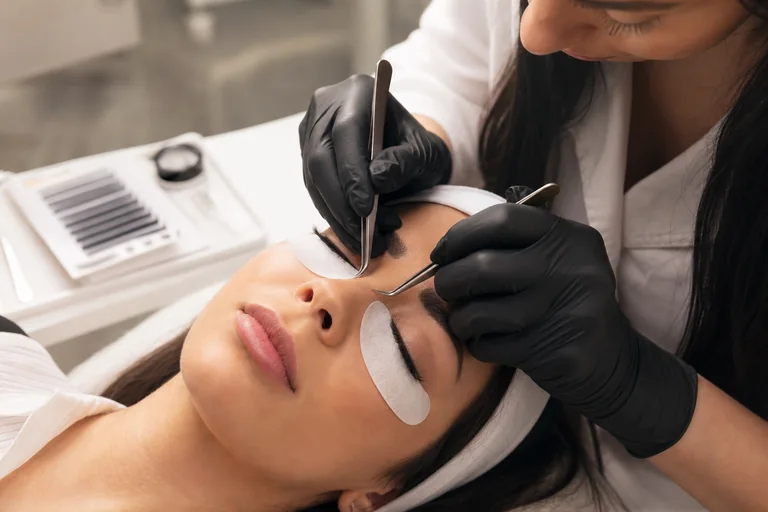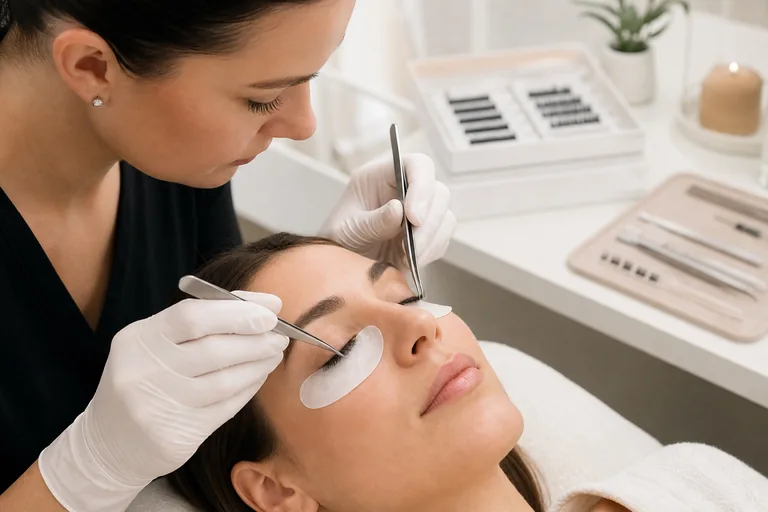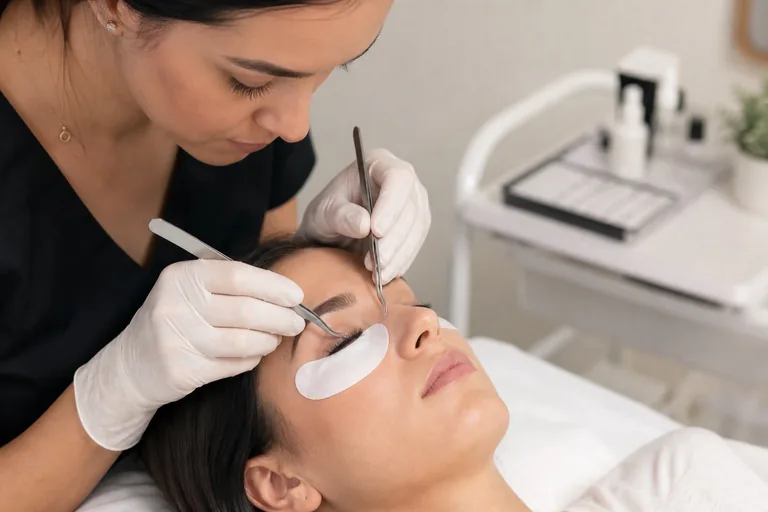
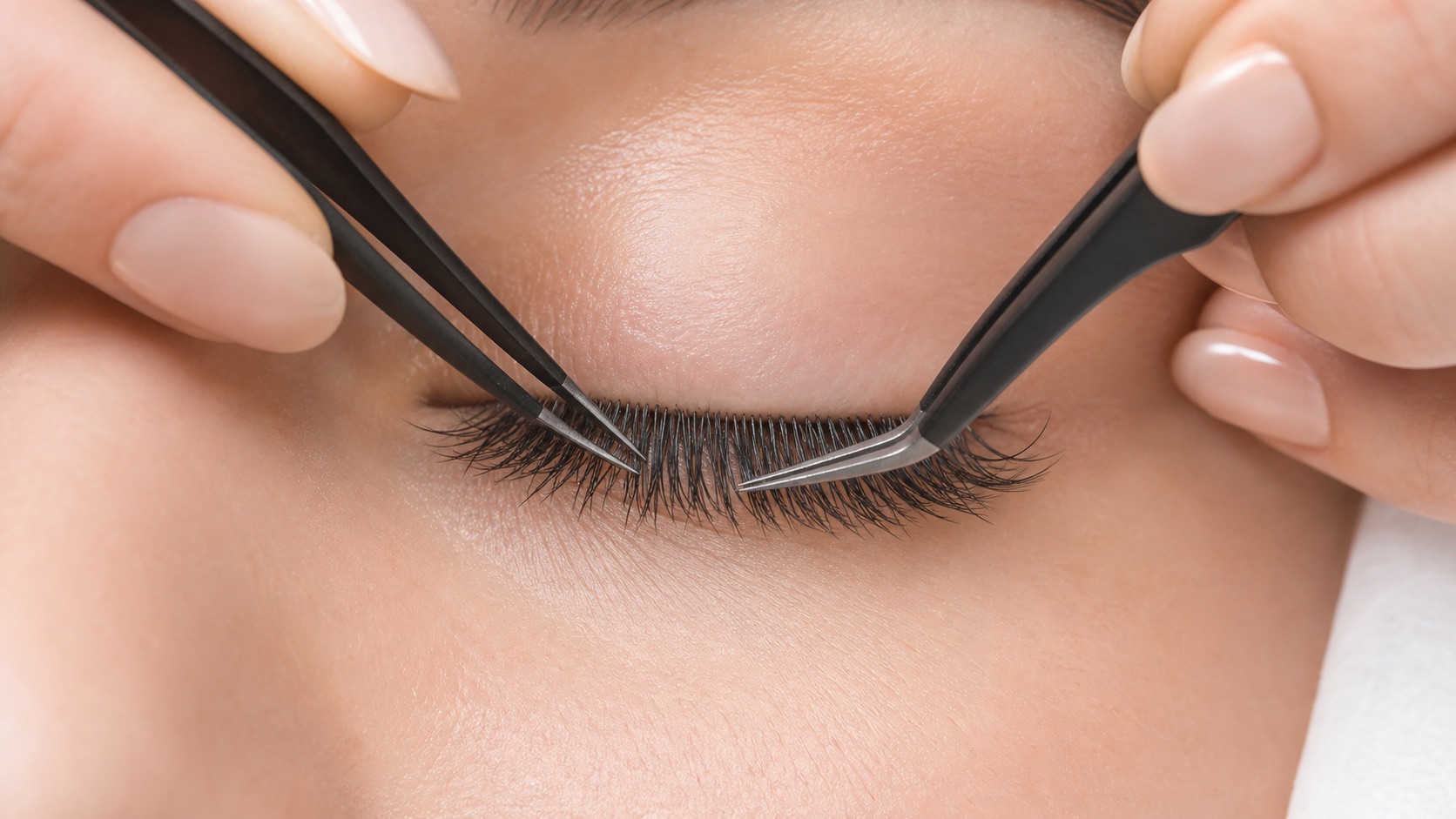
An eyelash extension set is not judged only by its finished photograph or how many weeks it remains visible. Every fibre must respect the natural lash supporting it, allow neighbouring lashes to grow independently and remain comfortable through blinking, sleep, cleansing and growth. Weight, length, leverage, attachment area, direction and isolation form one mechanical design.
This is the single BeautyLearn guide for protecting natural lashes during extension wear. It owns load, stickies, tension, traction, breakage, observable warning signs and the decision to stop. The guide to curls, lengths, diameters and sustainable set design teaches fibre selection, while the guide to retention and infills owns shedding, growth and early-loss troubleshooting. This page connects those technical decisions to natural-lash protection without duplicating them.
Stickies is the operational term for two or more natural lashes joined by one adhesive point, or an extension attachment that captures a neighbouring lash. It is a verifiable technical fault, not a medical diagnosis. Because natural lashes grow and release asynchronously, joining separate units can create tension, forced direction and discomfort as the set ages.
Quick answer: there is no single universal maximum weight ratio. Select from the apparent diameter, length, integrity, direction and stage of the natural lash, then account for extension material, nominal diameter, length, taper, fibre count, fan width, adhesive mass and attachment geometry. Every natural lash must move independently, the product must remain off skin and the set must not pull or press. Pain, marked swelling, discharge, light sensitivity, altered vision, breathing difficulty or rapidly worsening symptoms means stop and seek appropriate healthcare assessment.
Damage cannot be diagnosed from one shed fibre or a before-and-after photograph. Short lashes, a gap, redness and pain can have different causes. The lash artist records what is visible, corrects or removes unsafe cosmetic work, and refers when signs fall outside cosmetic competence. This guide teaches decision thresholds rather than assigning a disease or predicting follicle recovery.
What protecting the natural lash actually means
A natural eyelash is a keratinised shaft produced by a follicle at the lid margin. Its sequence of growth, transition, rest and release is explained in the natural eyelash anatomy and cycle guide. An extension does not pause this cycle. It travels with the lash as it grows and may leave with it during natural release, so a safe design accepts movement rather than bonding different lashes into one fixed block.
Protection does not mean promising zero loss. Distributed shedding is compatible with normal renewal, and artificially retaining every lash until an infill is not a professional target. Protection means avoiding unnecessary load and traction, preserving independent movement, monitoring changes and correcting growth before discomfort or breakage becomes normalised.
The requested photograph cannot dictate what a natural lash must carry. Low density, varied diameters, very short new growth, unstable direction, visibly stressed areas or previous symptoms change the plan. Shortening, reducing density, leaving a zone untreated or postponing are complete professional decisions—not failures to deliver the look.
Cosmetic assessment stops for sudden unexplained loss, smooth bare patches, crusting, broken skin, significant redness, swelling, discharge, pain or visual symptoms. Do not bridge an empty zone with longer fibres from neighbouring lashes or diagnose stress, hormones, infection or allergy. Document and refer to an appropriate healthcare professional.
Extension weight: why no universal ratio can guarantee safety
One percentage cannot describe a living lash and a complete extension
Mass, leverage, fibre geometry, adhesive and natural-lash selection work together
Natural lash
Length, diameter, continuity and direction
Fibre
Material, taper, curl and length
Attachment
Contact, direction and adhesive mass
Time
Growth changes leverage
Rules that an extension must not exceed a fixed percentage of a natural lash are often repeated without material, taper, length or measurement method. A salon cannot weigh an individual living eyelash and convert it into a clinically validated ratio. A percentage may be a conservative rule within one training system and product line; it should not be presented as a biological law.
Nominal diameter matters, but mass does not increase linearly with the number printed on a tray. For an ideal cylinder, cross-sectional area changes with the square of the radius. Extension fibres are not perfect cylinders: taper, profile, material and manufacturing differ. Manufacturer data and comparisons within a known range are more useful than a universal chart assembled from mixed brands.
Length creates leverage. At the same mass, moving material farther from the attachment changes how force acts during blinking, sleep, cleansing and growth. Curl and direction also determine whether tips meet skin, spectacles, pillow or neighbouring fibres. A light long fibre can be mechanically less favourable than its weight suggests.
In volume work, fan mass depends on fibre count, diameter, length, material, taper, width, foot and adhesive amount. Two fans labelled with the same D count may behave differently. The volume, hybrid and mega-volume guide owns the technique comparison; here the relevant question is whether each fan suits the natural lash selected.
More adhesive does not make a heavy or unstable design safe. Excess mass and rigidity can catch adjacent lashes and create thick irregular bases. Too little contact or misaligned placement can rotate and concentrate force. Safe attachment is neither the largest bond nor the least visible bond: it is clean, aligned, off skin and appropriate to the trained system.
Six variables that create the real load
1. Natural lash. Observe apparent diameter, length, flexibility, direction, continuity, density and distribution. A short fine lash does not automatically receive the same extension as a long robust-looking one. This remains cosmetic observation; it does not measure follicle strength or diagnose systemic fragility.
2. Artificial fibre. Material, nominal diameter, length, curl, taper and profile affect mass and behaviour. Measurements can differ across commercial lines. When an artist changes tray or supplier, the specification, handling and result must be checked and recorded rather than assuming an identical label means an identical fibre.
3. Geometry. Wide and narrow fans distribute tips differently, length increases leverage, and a twisted foot pushes the attachment off axis. Direction must serve the lash map without forcing the natural base. The aesthetic silhouette and mechanical vector are designed together.
4. Attachment. Distance from skin, alignment, contact area and adhesive amount affect stability. Bonding to the lid does not improve retention and exposes skin to product and tension. Placing too far from the base can create an attachment that grows quickly into a difficult lever.
5. Isolation. A technically light design becomes problematic when it joins two lashes. Sticky checks are not optional finishing. Allocate time for repeated checks by section and from several viewing angles, including below the lash line where hidden contact can remain.
6. Time and daily life. Growth, friction, cleaning, make-up, sleep and delayed maintenance alter the system. The extension aftercare guide reduces residue and avoidable mechanical stress, but home care cannot correct a heavy attachment or sticky created during application.
Assess natural lashes before choosing the set
Observe first; design second
Aesthetic intent must adapt to the natural lashes available today
Inspect margin and distribution
Record direction and continuity
Select or leave each lash
Adapt map, load or appointment
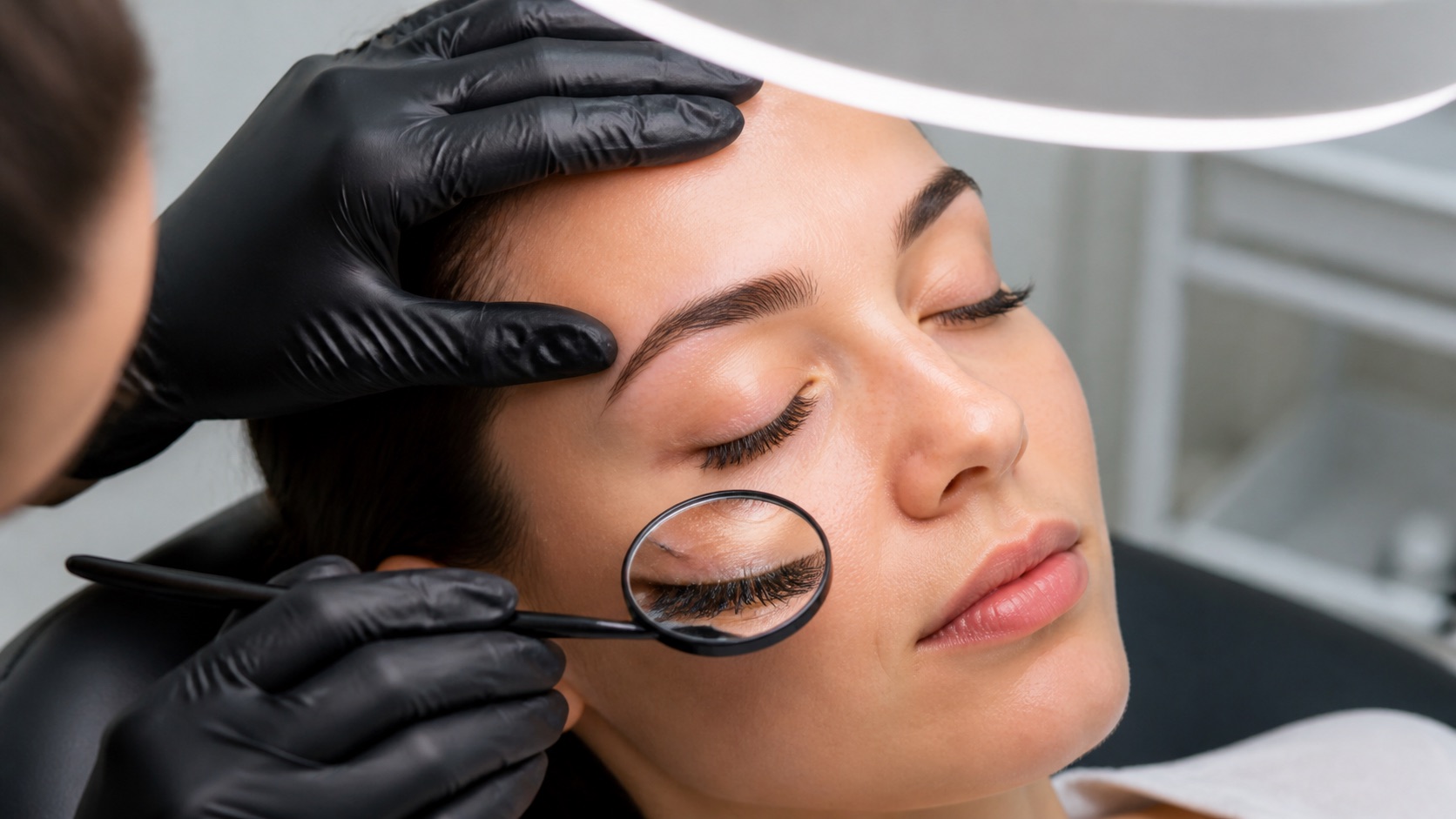
Use even light, closed eyes and a visible lash margin. Compare both eyes without expecting perfect symmetry. Record dense zones, fine inner lashes, downward directions and natural spaces before mapping. The aim is not to fill every gap, but to determine where an application is appropriate and where a gap may be a warning sign.
Look for shaft continuity and distinguish mature lashes from very short new growth as far as observation permits. A new lash does not become suitable just because tweezers can isolate it. The correct choice can be no fibre, a shorter and lighter specification or a changed transition in that zone.
Assess practical flexibility with minimal controlled contact, never by pulling to prove that a lash is strong. Direction and response can inform fibre selection but do not quantify follicle anchorage. Aggressive testing creates the very traction the assessment is intended to avoid.
Record prior sets, home removal, eyelash curler use, rubbing, symptoms and recent change in the lash client record. Consistent, unfiltered photographs from above, front and below can compare the same zones later. They document appearance and direction, not follicle health.
Redness, swelling, discharge, injury, crusting, pain or sudden loss activates the consultation and stop criteria. Consent never removes the professional duty to postpone, and the artist does not estimate healing time or prescribe a product to make the area suitable.
What stickies are and how to identify them
Visual crossing is not the same as an adhesive bond
The test is independent movement at the natural-lash base
Primary sticky
Two lashes in one attachment
Secondary sticky
Fresh base touches a neighbour
Visual overlap
Crossed view, bases still independent
Closed fan
Shape or residue—not automatically a sticky
A primary sticky occurs when two natural lashes are intentionally or accidentally included in one attachment. A secondary sticky forms when reactive adhesive or a fresh base contacts a neighbouring lash after isolation is released. In both cases, units meant to move and shed independently are joined.
Hidden versions include two bases joined beneath a fan, a natural tip caught laterally, adhesive residue that traps a short new lash, or several extension bases fused near the root. The set can look orderly from above while an underneath view reveals shared movement. Direction alone cannot confirm separation.
Not every visual crossing is a sticky. Fibres may overlap in perspective without bonding, and a wispy map may include intentional texture. The test is independent movement at the natural-lash base, checked with professional tools and without pulling. A closed fan or dirty fibre is also different: it involves shape or residue, not necessarily joined natural lashes.
Clients may notice local pulling, prickling, discomfort when blinking or one rigid section, but some stickies produce no immediate sensation. Comfort on day one cannot replace systematic checks. The artist inspects during application, after each zone and before the client opens their eyes.
Why stickies create tension during growth and shedding
A sticky can become uncomfortable after the appointment
Joined lashes grow and release on different schedules
Application
Independent units become joined
Growth
Different rates create tension
Release
One lash cannot fall freely
Correction
Professional separation or removal
Neighbouring natural lashes may be in different growth stages. If one moves faster while their bases are joined, the first can pull the second or a rigid adhesive point can redirect both. Tension is therefore dynamic and may appear days after a set felt comfortable at completion.
When one lash reaches natural release but remains attached to a neighbour, it cannot fall freely. It can hang, rotate, prick or transfer weight. This does not prove permanent follicle damage, but it is a reason for prompt professional inspection and correction rather than waiting for the cluster to resolve itself.
Tension is not determined only by the number of lashes joined. A captured natural tip can bend a shaft, a lateral adhesive mass can catch new growth and an off-axis fan can press against neighbouring fibres. Checks must follow the base, lengths and direction rather than looking only for obvious clumps.
Forcing two polymerised attachments apart can add traction and damage the shaft. The artist decides whether controlled separation is possible or whether professional selective removal is required. Clients should not insert tweezers, oil, steam or solvent near the eye to release the point at home.
Technical discomfort, shedding, breakage and medical signs
Describe what is visible; do not diagnose the cause
Technical findings and medical warning signs need different next steps
Local pull
Check sticky, growth and contact
Distributed shed
Compare cycle and baseline
Short or broken shafts
Document—do not diagnose
Ocular or patchy sign
Stop and refer
Localised pulling that changes with blinking or movement can suggest a sticky, grown-out base, rotation, skin contact or a fibre pressing a neighbouring area. It still requires inspection rather than diagnosis from a message. Burning, widespread itching and swelling may involve product exposure or another condition and follow the consultation stop route.
Natural shedding often leaves an intact shaft attached to the extension and is distributed over time. Breakage can show a shorter irregular shaft, but photographs and loose fibres are not enough to identify how or when it occurred. Groups of joined natural lashes, concentrated loss or a new bare zone changes the level of concern.
An artist can document gaps, shaft appearance, stickies, residue, direction and reported timing. They cannot diagnose traction alopecia, infection, dermatitis, a hormonal cause or a growth disorder. Persistent change, unexplained patchy loss, crusting, significant inflammation or ocular symptoms requires healthcare assessment.
A serum does not rejoin a broken shaft. Cosmetic conditioners and products intended to influence appearance or growth have different claims, ingredients and risks; prescription growth treatments belong to clinicians. Do not sell a cosmetic as treatment for unexplained loss or use it to make an unsuitable client eligible for another set.
Checks during application and before the client leaves
During placement, maintain isolation until the attachment is stable for the product and room conditions. Watch for adhesive transfer, natural tips crossing the fresh base and lower lashes escaping protection. Change angle and use a mirror rather than assuming a clean top view represents the underside.
Work in sections and run planned sticky checks before the set is complete. If a base is joined, stop adding density around it. Correct or remove through the supported method. An appointment running late is not a reason to skip independent-movement checks or ask the client to report a problem later.
At completion, inspect off-skin distance, contact, direction, fan foot, adhesive mass and separation from several angles. Ask about pressure, prickling or burning before and after opening. Photograph clean bases where consent permits and record deviations. A set is not finished while the safety check is unfinished.
Explain aftercare, how to report a pulling section and why clients must not cut or separate fibres. Agree the review window without promising that long retention proves safety. Growth can move an initially balanced attachment into a position requiring removal.
When to reduce the design, remove work or stop
Protecting the natural lash can change the booked result
Reduce, remove or stop before visual fullness
Reduce
Shorter, lighter or less dense
Leave
No extension on unsuitable growth
Remove
Correct sticky, rotation or overgrowth
Stop
Symptoms or unexplained loss

Reduce length, diameter, fan size or density when the planned effect exceeds what the observed lashes can support. Adapt transitions rather than making inner corners carry the same projection as stronger central zones. A visually lighter result is better than using neighbouring lashes as bridges across unsupported areas.
Remove a specific application when it is stuck, rotated, grown out, pressing, pulling or mechanically incompatible with the lash. Full removal may be appropriate when faults are widespread, the map cannot be restored or product and application history are unknown. Removal itself must remain controlled and never become pulling.
Stop the cosmetic service for significant symptoms, inflamed or injured skin, inability to protect the eye, new unexplained loss, or lashes that cannot support a safe design. Do not apply a lighter set as a diagnostic trial. Referral is not a claim about what the condition is; it acknowledges the limit of salon assessment.
At an infill, residual percentage is secondary to growth, balance and independent movement. Remove what has become unstable, update the map and accept that a new set or pause may be necessary. Aftercare cannot be blamed for a sticky or excessive load created at the appointment.
Professional training and a twelve-point protection checklist
Competence requires supervised practice in natural-lash assessment, fibre specification, isolation, adhesive control, direction, fan construction, sticky checks, selective removal, aftercare and stop decisions—not one memorised weight ratio. Learners should be assessed from below and from the side, not only through final front-facing photographs.
Before: 1) update consultation; 2) inspect margin and lashes; 3) photograph relevant zones; 4) adapt map and load. During: 5) isolate one suitable lash; 6) control fibre and adhesive; 7) keep product off skin; 8) check direction and shared movement. After: 9) repeat sticky checks; 10) confirm comfort; 11) document and teach aftercare; 12) reassess growth and integrity at review.
A valid course teaches the learner to reduce an effect, leave a lash untreated, correct a sticky and stop at a warning sign. Use the online lash course guide to compare practical evidence, tutor feedback and safety content, then explore current BeautyLearn lash courses.
Frequently asked questions
Do eyelash extensions always damage natural lashes?
No. Damage is not inevitable, but no cosmetic eye-area procedure is risk free. Natural-lash selection, fibre load, isolation, attachment, off-skin distance, adhesive control, growth, cleaning, infill and removal all matter. A comfortable, independently moving set designed from suitable lashes reduces avoidable mechanical stress; it cannot guarantee zero reaction, shedding or change for every client.
How much weight can one natural eyelash hold?
There is no universal salon measurement valid for every natural lash and fibre. The artist assesses the natural lash, material, diameter, length, taper, fan, adhesive and leverage within a known product system. Ratios taught by a brand or course can be conservative design rules, but should not be represented as clinically validated biological limits across all clients and products.
What are stickies in eyelash extensions?
Stickies are unwanted adhesive bonds between natural lashes, or between one extension attachment and a neighbouring natural lash. They prevent independent movement and can create tension as lashes grow or release at different times. They may be hidden beneath a fan and do not always hurt immediately, so systematic professional checks from several angles are necessary before the client leaves.
Do stickies hurt immediately?
Not always. Some cause an immediate prickling or pulling sensation, while others become noticeable only when one joined lash grows faster or reaches natural shedding before its neighbour. The absence of pain on day one does not prove complete isolation. Clients should report new local tension, and artists should inspect independent movement during application and at every review.
Can I separate a sticky at home with tweezers?
No. Home tweezers combine poor visibility, an unprotected eye and force applied to polymerised attachments. Pulling two joined lashes can break or extract natural shafts, while a sharp tool can injure the eye. Stop manipulating the area and arrange professional inspection and selective removal. Pain, swelling, discharge or visual symptoms require healthcare assessment.
How can normal lash shedding be distinguished from damage?
Normal release is generally distributed over time and may leave an intact natural lash attached to an extension, but there is no diagnostic daily count. A single fibre proves little. Clustered loss, short irregular shafts, multiple natural lashes joined, a new bare area, pain or inflammation raises concern. Compare clean baseline photographs and inspect the remaining set rather than diagnosing from loose fibres alone.
Does a natural lash attached to a fallen extension prove damage?
Not necessarily. The extension may have left with a natural lash at the end of its cycle. The attachment should still be considered alongside timing, distribution and what remains. Several lashes bonded together, broken shafts, concentrated gaps or symptoms change the interpretation. A lash artist cannot determine follicle injury or exact growth phase from one loose fibre.
Are volume extensions more damaging than classic extensions?
Not automatically. One classic fibre can be too long, thick or poorly aligned, while a carefully built fan of suitable fine fibres can have controlled mass. Natural-lash selection, total load, leverage, fan foot, adhesive, isolation and growth matter more than the service label. Advanced volume still requires additional fan and load competence and is not suitable for every lash.
Is mega volume always too heavy?
The name alone cannot calculate a fan, but mega-volume work demands advanced control, fine appropriate fibres and strict natural-lash selection. Fibre count does not replace total mass and leverage. Some natural lashes or clients are not suitable, and reducing density or declining the requested effect can be the correct professional decision. No label overrides individual assessment.
Why do extensions start pulling after a few days?
Growth can increase leverage, while stickies, rotation, shared adhesive, skin contact or a fibre pressing a neighbour can change comfort after an initially quiet appointment. Do not wait automatically for the booked infill and do not pull the section. Send clear dry photographs and arrange an early professional inspection. Ocular pain or significant inflammation needs healthcare advice.
Is pain normal during eyelash extension application?
No. Report prickling, burning, pulling, pressure or pain immediately. The artist should stop the current action, check pads, isolation, product location, eye closure and the set, and decide whether proceeding is appropriate. Significant ocular pain, marked watering, swelling, visual change or breathing symptoms is not an expected beauty treatment sensation and requires escalation.
Does more adhesive make an extension set safer?
No. Excess adhesive adds mass and rigidity, can create uneven bases and may contact neighbouring lashes. It does not correct an unsuitable fibre, poor alignment or incomplete isolation. The amount should match the known fibre, fan, adhesive and application method while producing a clean off-skin attachment. Long retention from a bulky base is not evidence of safety.
Do natural lashes need a break between extension sets?
There is no universal break that every client needs, and the visible shaft does not breathe. A pause can be appropriate to assess integrity, resolve a technical problem, allow symptoms to be medically assessed or wait until a suitable natural-lash population is present. Time alone does not treat unexplained loss, and a new set should never be used as a test of recovery.
Can a lash serum repair damaged eyelashes?
A cosmetic serum cannot join a broken shaft. Conditioning products and products intended to influence growth have different ingredients, claims and risks; prescription options belong to healthcare professionals. A lash artist should not prescribe treatment or sell a serum as the answer to unexplained thinning. Persistent or patchy loss requires assessment before another cosmetic service.
When does a grown-out extension become unbalanced?
An attachment becomes unsuitable when distance, leverage, rotation, direction or contact with neighbouring fibres can no longer be managed safely. There is no single millimetre or week for every set. At review, inspect each zone and remove overgrown work before rebuilding. Preserving an unstable fibre to improve a retention percentage is not a protection strategy.
Can I trim an eyelash extension that is prickling?
No. Cutting changes the tip and can leave a shorter rigid fibre close to the eye without correcting the attachment, rotation or sticky causing the problem. Do not pull or separate it either. Arrange professional inspection and controlled removal. If the sensation includes ocular pain, marked redness, swelling or visual symptoms, seek appropriate healthcare assessment.
Should a natural gap be covered with longer fibres from nearby lashes?
Not automatically. Extending neighbouring fibres across a gap can increase their load, create off-axis direction and conceal a new change that needs assessment. Document the area, compare baseline photographs and use only lashes suitable for their own attachment. A recent or unexplained bare patch is a stop criterion, not a styling problem to bridge with volume.
What is the difference between technical discomfort and a reaction?
Local pulling that changes with blinking may suggest a sticky, rotation or physical contact, while burning, itching and swelling can involve product exposure or another condition. Symptoms overlap and a lash artist cannot diagnose the cause. Stop and inspect cosmetic factors; marked redness, discharge, breathing difficulty, facial swelling, light sensitivity or visual disturbance needs healthcare assessment.
When should I contact the lash artist urgently?
Contact the artist promptly for pulling, persistent prickling, a rotating or pressing fibre, joined groups, difficulty cleaning or an unusual loss pattern. Do not wait for the infill or manipulate the area at home. The artist can inspect and remove technical work. Ocular pain, significant swelling, discharge, light sensitivity, breathing symptoms or altered vision takes priority and needs healthcare support.
When should lash loss be assessed by a healthcare professional?
Seek appropriate assessment for ocular pain, light sensitivity, visual change, trauma, discharge, significant swelling, marked or persistent redness, injured skin, sudden unexplained shedding or a smooth patch of loss. Breathing difficulty or swelling of the face, lips, tongue or throat can be an emergency. Provide product details, but do not rely on the salon to diagnose or treat the cause.
Can good retention still hide an unsafe extension set?
Yes. A set can stay attached while containing stickies, bulky bases, skin contact, excessive load or overgrown applications. Retention measures persistence, not complete safety or quality. Inspect independent movement, distance, direction, load, comfort, cleanliness and growth at every review. Long wear never justifies leaving a natural lash under continuing tension.
Official and scientific references
The US Food and Drug Administration’s Eye Cosmetic Safety guidance includes eyelash extensions and adhesives among eye cosmetics, emphasises clean hands and instruments and advises stopping when irritation occurs. It supports hygiene and referral boundaries, but does not define a maximum extension weight.
A prospective study on the effects of eyelash extensions on the ocular surface observed transient tear-film and corneal-staining changes after application in 32 participants. A clinical series on ocular disorders associated with eyelash extensions describes selected patients who sought care. Neither supplies a weight ratio; both reinforce that ocular symptoms are not merely aesthetic complaints.
A review of eyelid cosmetic enhancements and ocular adverse effects supports prudent communication, while the clinical review Eyebrow and Eyelash Alopecia shows that lash loss can have many traumatic and non-traumatic causes. These sources support documentation and referral, not salon diagnosis.
Continue with all BeautyLearn lash guides and current online lash courses. This guide does not replace hands-on training, manufacturer instructions or healthcare assessment.
For customer-facing costs, inclusions, maintenance budgets and quote comparison, use the eyelash extension and lash lift cost guide. It avoids misleading international averages and remains separate from professional rate-card calculation.
Before taking paying clients, use the lash artist certificate and licensing guide to verify practitioner, premises, business and insurance requirements in the exact jurisdiction. It keeps legal-entry intent separate from technique and career development.
For a currency-neutral model of paid appointments, full service time, occupancy, costs and operating profit, use the lash artist earnings guide. It keeps professional earnings separate from client price comparison and future rate-card construction.
To build a traceable unit price from complete time, real product use, overhead, labour, fees and margin, use the professional lash service pricing guide. It keeps the rate card distinct from client quote comparison and monthly earnings analysis.
For a repeatable capture workflow covering permission, lighting, focus, honest before-and-after comparison, colour and editing limits, use the professional lash photography guide. It documents completed work without replacing live technical or safety checks.
To turn real work into a coherent path through evidence, authentic reviews, enquiry, booking, follow-up and appropriate return, use the lash portfolio and client acquisition guide. It measures qualified appointments without promising demand or income.
To adjust the complete lash workstation and plan static-load interruption, reach, light, tools and recovery without prescribing treatment, use the lash artist ergonomics guide. It complements technical and hygiene controls without replacing individual assessment.
For a cautious framework on apparent lash breakage or thinning, serum limits, treatment pauses and clinical referral, read the fragile or thinning eyelashes guide. It supports a stop-or-proceed decision without diagnosing the cause or promising regrowth.