Fragile or thinning eyelashes: cosmetic care, serums, treatment breaks and clinical referral

A cautious guide to apparent breakage or thinning: reduce avoidable friction, interpret lash-serum claims, pause services when appropriate and recognise signs that need medical or urgent eye assessment.

Silvana DebiasiSilvana Debiasi1 September 2026 25 min read
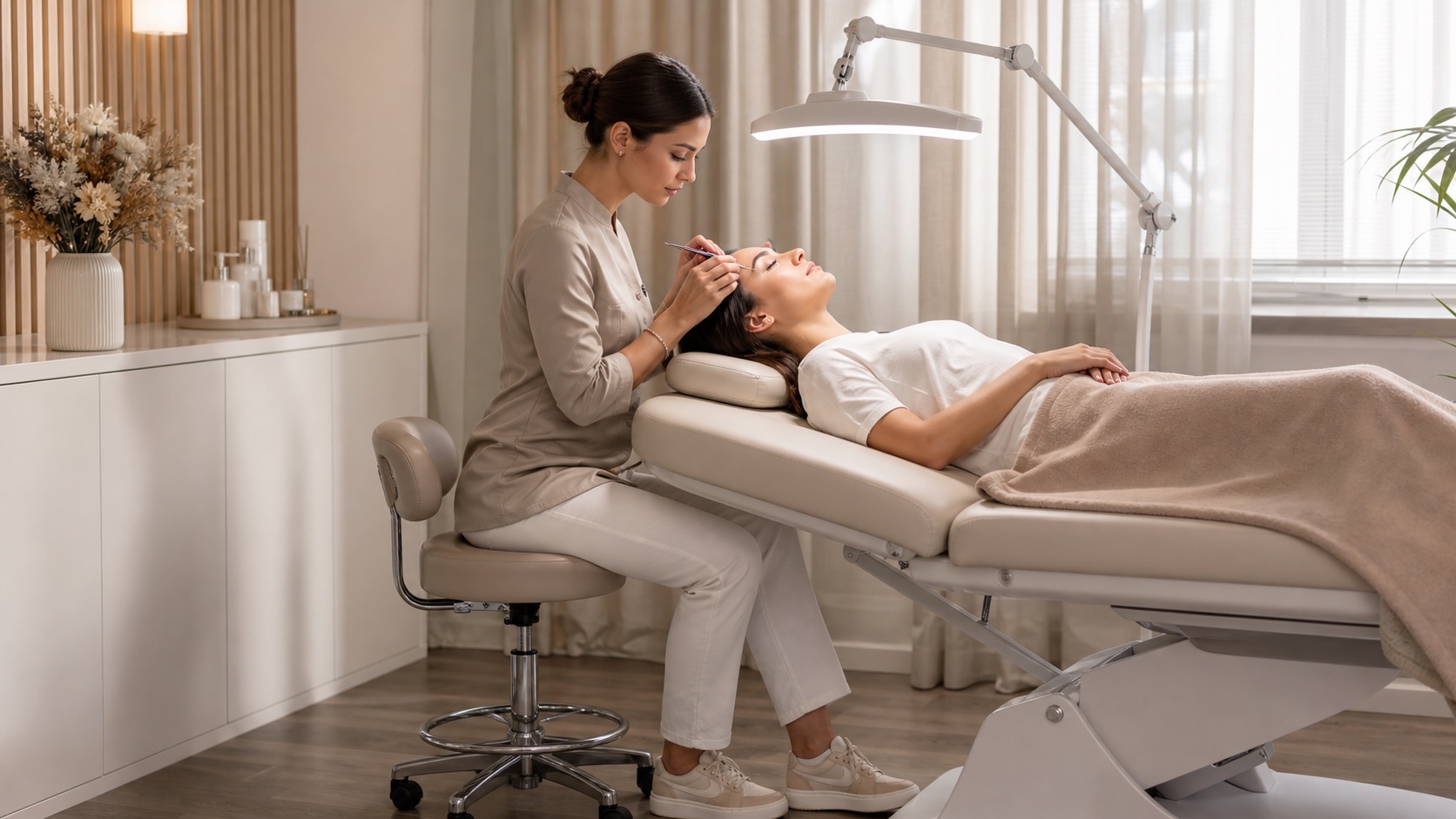
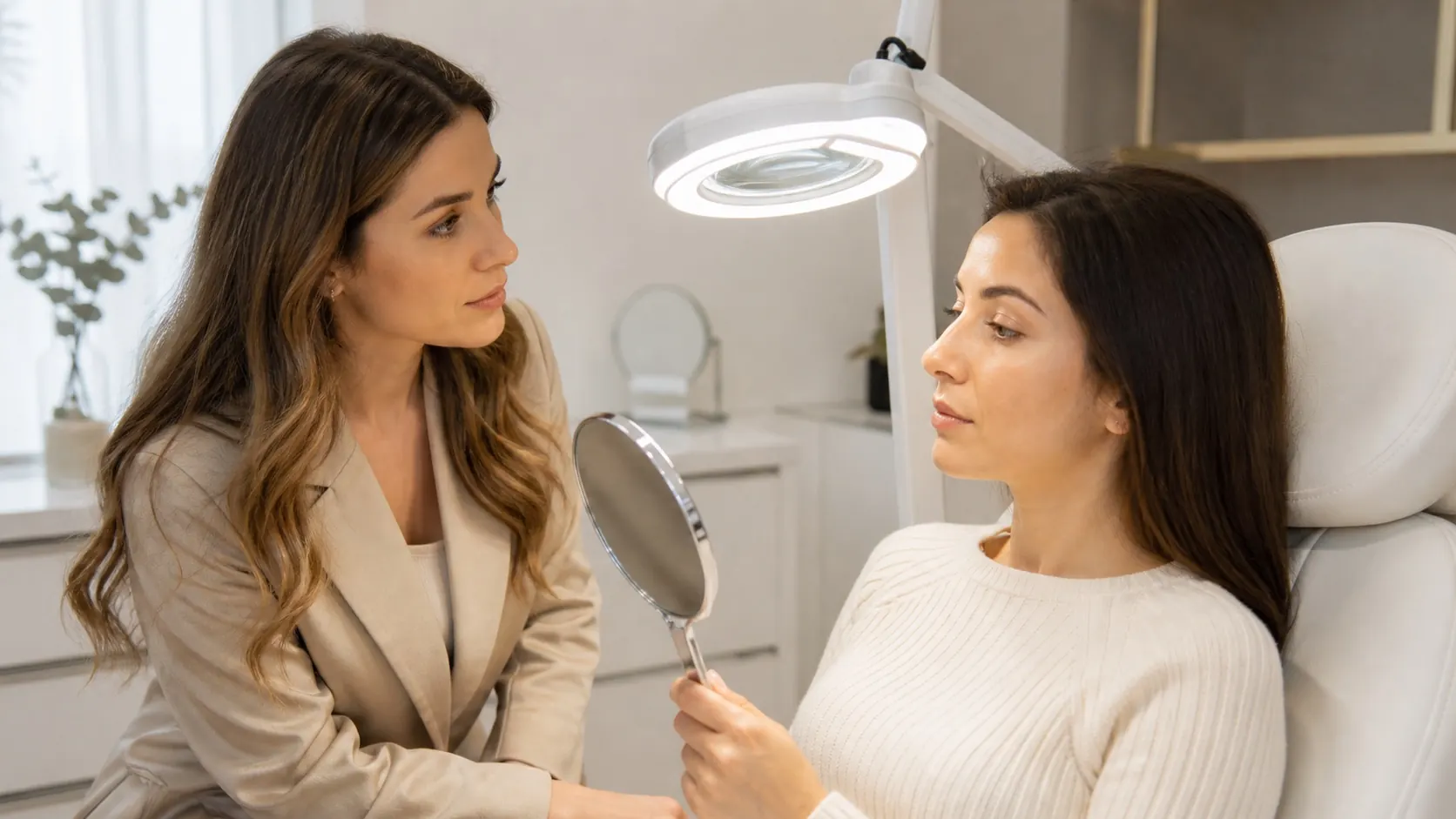
Lash professional examining an adult client’s natural eyelashes under a task light without performing a treatment
On this page
  1. 1 Quick answer: fragile, thinning or symptomatic lashes?
  2. 2 Observe without diagnosing: the lash professional's role
  3. 3 Fragile shafts and reduced density: operational differences
  4. 4 Why a list of possible causes is not a diagnosis
  5. 5 Cautious cosmetic care: reduce friction, traction and residue
  6. 6 Make-up removal, mascara and eyelash curlers
  7. 7 Eyelash serums: conditioning product or growth claim?
  8. 8 Peptides, panthenol and other non-prostaglandin ingredients
  9. 9 Prostaglandin analogues in cosmetics: updated caution
  10. 10 Prescription lash-growth treatment is not salon advice
  11. 11 Supplements and biotin are not a neutral shortcut
  12. 12 When to pause extensions, infills, lash lifts or tint
  13. 13 Existing extensions: leave, reduce or remove?
  14. 14 When to recommend medical or eye assessment
  15. 15 Urgent eye warning signs
  16. 16 Document change without turning photographs into diagnosis
  17. 17 Reassessing after a treatment break
  18. 18 How to explain a postponement without frightening the client
  19. 19 Frequently asked questions
  20. 19.1 How can I tell whether eyelashes are broken or naturally short?
  21. 19.2 Do eyelash extensions always damage natural lashes?
  22. 19.3 Will a treatment break make thin eyelashes grow back?
  23. 19.4 Does castor oil make eyelashes grow?
  24. 19.5 Are peptide eyelash serums safer than prostaglandin analogues?
  25. 19.6 How do I identify a prostaglandin analogue in an eyelash serum?
  26. 19.7 Can a lash artist recommend bimatoprost?
  27. 19.8 Should I stop medication if my eyelashes are thinning?
  28. 19.9 Can biotin or supplements fix fragile eyelashes?
  29. 19.10 Can I apply a lighter extension set over thinning lashes?
  30. 19.11 Should existing extensions be removed when lashes look sparse?
  31. 19.12 Can I repeat a lash lift to correct bent, fragile lashes?
  32. 19.13 Does waterproof mascara cause fragile eyelashes?
  33. 19.14 Does a patch test rule out a reaction to eyelash serum?
  34. 19.15 When should thinning eyelashes be assessed by a dermatologist?
  35. 19.16 When do eyelash symptoms need an eye-care professional?
  36. 19.17 Are crusts at the lash roots always product residue?
  37. 19.18 Can photographs prove that eyelashes are growing back?
  38. 19.19 Can I tint fragile eyelashes?
  39. 19.20 What belongs in the client record for fragile or thinning lashes?
  40. 19.21 What should lash training teach about thinning or damaged-looking lashes?
  41. 20 Official sources and scope limits

Eyelashes that look shorter, sparse, uneven or brittle do not explain their own cause. The appearance may reflect normal asynchronous growth, mechanical breakage, recent cosmetic processing, retained product, inflammation or a medical condition. A lash professional can describe what is visible, document change and decide whether a cosmetic service is appropriate. They cannot diagnose why lashes have changed or promise that they will regrow.

This guide separates three decisions: what low-risk cosmetic care can and cannot do; when extensions, infills, lifts or tints should be postponed; and when the client needs a doctor, dermatologist, optometrist or ophthalmologist. It does not recommend medication or replace an examination. Eye pain, a change in vision, marked light sensitivity, significant injury or a very red eye requires the locally appropriate urgent eye pathway rather than a salon appointment.

Reviewed 5 September 2026. Start with the natural lash anatomy and growth-cycle guide to understand why mixed lengths are normal. For service-related load, adhesion and warning signs, use the guide to extensions and natural-lash safety. Neither page can identify a medical cause from an image.

Quick answer: fragile, thinning or symptomatic lashes?

Describe before interpreting. Note apparently broken or bent shafts, reduced visible density compared with genuinely comparable records, localised or general change and any symptoms the client reports. Do not conceal uncertainty with a heavier set or another chemical process. Postpone the service when the base is unsuitable or the cause is unclear. Refer when loss is sudden, progressive, patchy, markedly asymmetric, affects brows or scalp, or appears with redness, swelling, crusting, itching, discharge or discomfort. Use urgent local eye care for pain inside the eye, altered vision, severe light sensitivity, injury or a very red eye.

Fragile and thinning are descriptions, not diagnoses. Fragility mainly describes shafts that look short, irregular, kinked, dry or broken. Thinning describes reduced apparent coverage or density. Both can occur together, but a photograph cannot show whether an individual follicle is active, whether a shaft shed normally or which condition produced the pattern.

The safest first move is to avoid adding stress simply to make the area look fuller. An early infill, dense camouflage set, repeated lift or stronger curl is not a treatment for lash loss. When natural-lash support is inadequate, explain the technical limit, record the decision and refer or reassess rather than negotiating away a stop criterion.

Observe without diagnosing: the lash professional's role

Observation is not diagnosis

Professional description and clinical assessment have different jobs

Describe

Distribution, lengths, direction and visible pattern

Ask

Onset, change, products and reported symptoms

Do not diagnose

No cause inferred from an image

Refer

Concerning change or symptoms

A lash professional records appearance, history and service suitability; a doctor or eye-care professional investigates causes and treatment.

A lash professional may observe distribution, lengths, direction, attached extensions, obvious stickies, visible product residue and the apparent condition of the eyelid area. They may ask when the change began, whether it was sudden or gradual, which recent services and products were used and whether the client has symptoms. With valid permission and an appropriate retention policy, they may create comparable photographs and factual notes in the client record.

They must not conclude that sparse lashes are caused by nutrient deficiency, thyroid disease, hormones, alopecia, infection, allergy, blepharitis, medication, stress or deliberate pulling. Clinical literature describes many local and systemic possibilities. That breadth is exactly why an appearance-based salon diagnosis is unreliable. Medical terms such as madarosis or hypotrichosis are not automatic cosmetic labels.

Avoid absolute reassurance as well as alarm. Statements such as it is only the growth cycle, it will grow back in six weeks or the serum will fix it exceed the evidence available at the workstation. A more accurate explanation is: I cannot determine the cause here; I can avoid additional cosmetic load, document what we see and recommend an appropriate assessment when the pattern or symptoms warrant it.

The pre-treatment consultation guide provides a decision structure without turning questions into medical screening. Ask only what is necessary to decide whether to proceed, and never represent a salon observation as healthcare clearance.

Fragile shafts and reduced density: operational differences

Move from visible change to a cautious decision

Compare, check symptoms, avoid added stress and refer where needed

1

Compare genuinely matched information

2

Check pattern, progression and symptoms

3

Do not add weight or chemistry

4

Reassess or refer

A photograph records appearance but cannot reveal follicle activity; the workflow decides only whether to observe, postpone or transfer the decision.

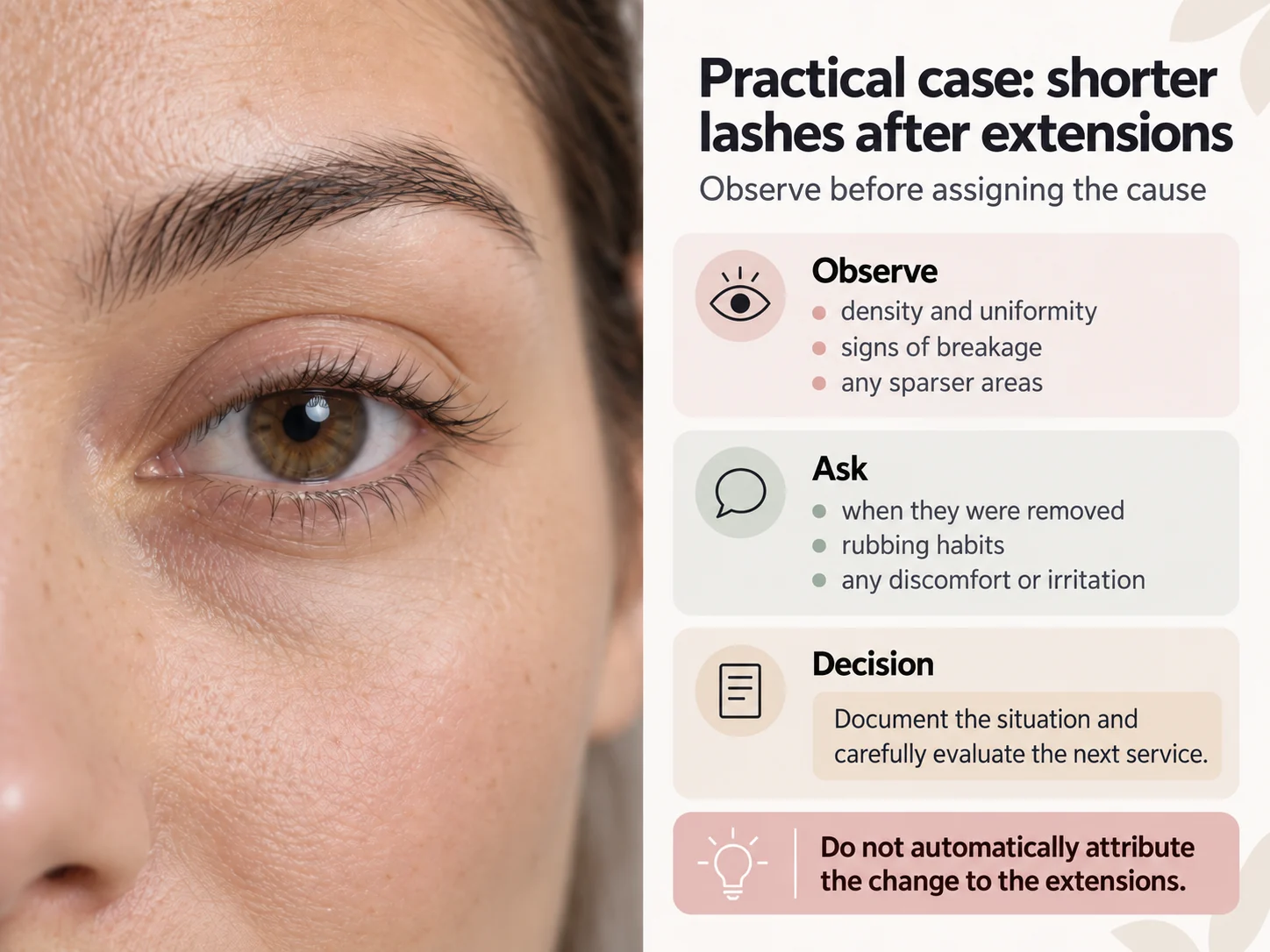
A fragile-looking shaft may be short, thin, bent, rough or uneven at the tip. That description does not prove cosmetic damage: natural lashes vary in diameter and are present at different stages of growth. Look for a repeatable pattern and compare it with previous information. Numerous short irregular lengths after difficult removal, repeated rubbing or suspected overprocessing can justify a break from cosmetic stress, but do not establish a diagnosis.

Apparent thinning is reduced visible number or coverage. It may be diffuse, localised or markedly different between eyes. A defined gap, rapid progression or change confined to one side deserves caution. Comparison requires similar light, camera, focus, distance, angle, lid position and absence of mascara. Different photographs can create false improvement or deterioration.

Ask whether the change is stable, continuing or associated with eyebrow or scalp change, but do not investigate beyond professional need. A client may volunteer medical information; record only what is relevant and permitted. Do not request tests, interpret laboratory results or advise a client to stop prescribed treatment. Suspected medication-related change belongs with the prescriber.

Why a list of possible causes is not a diagnosis

Loss of eyelashes can occur in a wide range of inflammatory, autoimmune, endocrine, infectious, nutritional, traumatic, behavioural or treatment-related contexts. Some possibilities require examination of the eyelid margin and skin; others require a complete medical history, medication review, examination of other hair-bearing areas or tests. Two clients with similar-looking gaps can have entirely different explanations and management.

Do not create a symptom-to-disease chart for clients. Explain instead that several causes can produce a similar appearance and that a beauty service cannot distinguish them. Timing is useful history, not proof: a change noticed after a new serum, removal or lift should be recorded, yet sequence alone does not establish causation.

Natural turnover also needs careful interpretation. Lashes do not enter or leave growth phases together. A few short lashes may be newer shafts rather than breakage, and a shed natural lash attached to an extension does not by itself show that the extension pulled it out. Pattern, application quality, load, symptoms and history matter; medical causes still require a clinician.

Cautious cosmetic care: reduce friction, traction and residue

Protect the shafts that are present

Reduce avoidable actions without promising regrowth

Dissolve

Allow a suitable remover to soften the film

Remove

Use light movements with the lash direction

Avoid

Rubbing, picking and traction

Simplify

One appropriate change at a time

Cosmetic care may reduce rubbing and traction; it cannot restart a follicle or treat a medical condition.
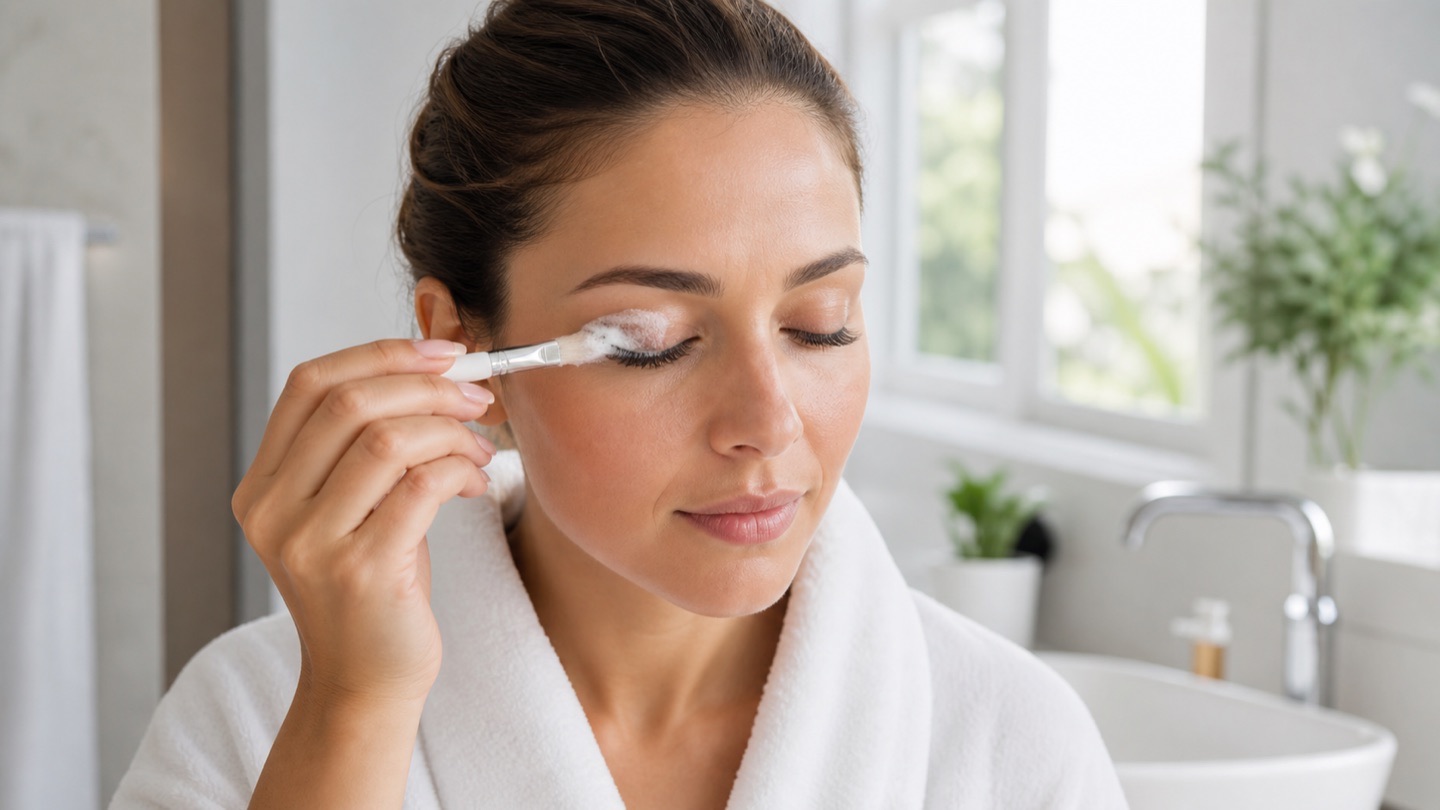
Adult client gently dissolving eye make-up without rubbing or pulling the eyelashes
Dissolve eye make-up before removing it with light directed movements

Cosmetic care cannot restart a follicle or treat a disease. It can reduce avoidable mechanical stress. Repeated rubbing, pulling extensions, scraping product from the lash line, gripping lashes between fingernails, using a curler aggressively or sleeping with persistent pressure over the same eye can add friction or traction. The objective is to protect the shafts that are present and preserve comfort, not to promise new density.

Use an eye-area cleanser or remover that is suitable for the product being removed and compatible with any extensions, following its label. Give the formula enough contact time to dissolve the film, then use light movements in the direction of the lashes. Do not rub backwards and forwards or pull at attached fibres. The extension aftercare guide explains cleansing without preserving residue in the name of retention.

Do not share mascara, applicators or eye tools. Replace products that are contaminated, altered or beyond their stated use period, and never add water to revive mascara. If a product causes burning, itching, swelling or redness, stop using it and follow the product information and locally appropriate clinical advice. Do not perform a new lash service over active symptoms.

Make-up removal, mascara and eyelash curlers

Mascara does not automatically make lashes brittle. Formula, wear, frequency, removal and behaviour all affect the practical situation. Long-wear or water-resistant films may take longer to dissolve; the problem arises when removal becomes repeated rubbing or traction. If the eyelid margin is irritated, extra make-up can worsen comfort and make the area harder to assess.

An eyelash curler should be clean, intact and used without pulling. Avoid clamping over dry mascara when adhesion increases resistance, repeated hard compression at one point or outward traction. If shafts already look very short, disordered or fragile, temporarily avoiding the curler may be more appropriate than trying to create a stronger bend.

Oils and balms can change slip and surface feel, but that does not demonstrate follicular growth. Castor oil is widely promoted online for growth without evidence that supports a guaranteed regrowth claim, and any substance can enter or irritate the eye. Products used near the eyes need a clear intended area, legible directions and an intact package. Stop if a reaction occurs.

Eyelash serums: conditioning product or growth claim?

Serum is a format, not a level of evidence

Purpose, finished-product evidence, ingredients and directions

Purpose

Conditioning appearance or medicinal claim

Evidence

Method and finished product

Formula

Complete ingredients and intended area

Boundary

No treatment prescribed by the salon

Conditioning existing shafts and pharmacologically influencing growth are different claims that require different evidence, rules and caution.
Lash professional and adult client reviewing an unbranded eyelash-serum label and a monitoring record
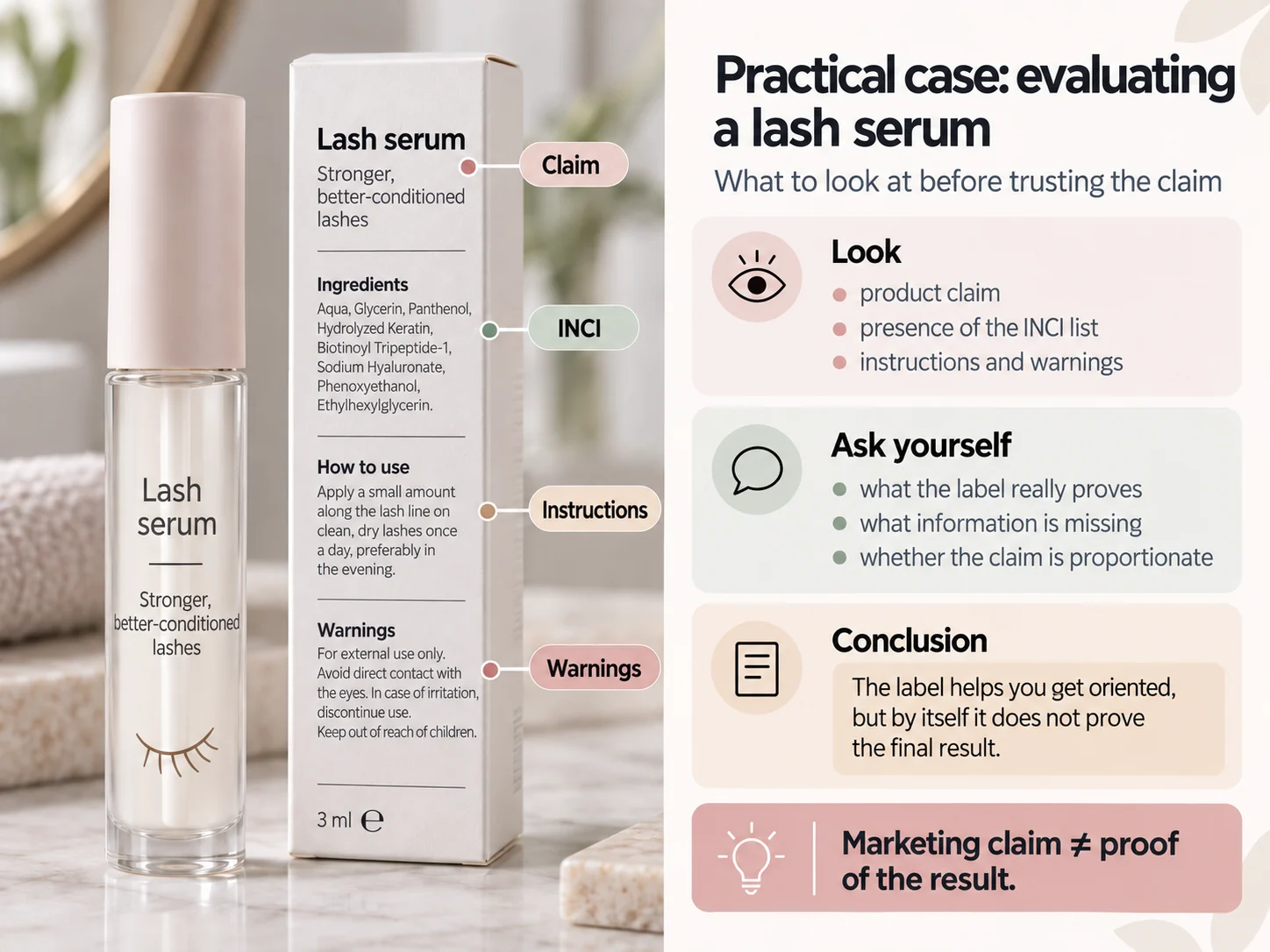
Check intended use, ingredients, directions, evidence and warnings before an eye-area serum

Serum describes a product format, not an evidence level. Some cosmetics coat or condition existing shafts and may improve softness, shine or the appearance of fullness. A visible conditioning effect is not the same as creating follicles, reliably extending the growth phase or treating a medical cause of thinning.

Read the stated purpose, full ingredient list, intended application area, directions, warnings, period after opening and responsible company. In the European Union, cosmetic claims must meet common criteria including truthfulness and evidential support. That does not mean every attractive percentage answers a useful question. Ask what was measured, on which finished product, over what period, against what comparison and with which limitations.

Do not decant a serum, share its applicator, apply it to the inner eyelid margin or increase frequency beyond directions. A skin patch procedure cannot guarantee that repeated use near the eye will be tolerated. Previous eye conditions, current eye medication, pregnancy, breastfeeding or uncertainty about a formula require the product instructions and advice from an appropriate doctor, pharmacist or eye-care professional rather than a salon protocol.

A long ingredient list is not automatically stronger, and natural is not a safety category. Tolerability depends on the complete formula, exposure, packaging and user. Avoid stacking several serums, oils and lash procedures in pursuit of speed. Multiple simultaneous changes increase exposure and make it difficult to identify what caused a reaction.

Peptides, panthenol and other non-prostaglandin ingredients

Peptides, panthenol, humectants, film-forming polymers and botanical ingredients appear in many lash products. Their proposed functions vary: holding water, coating the shaft, reducing friction or improving cosmetic appearance. The presence of a familiar ingredient does not prove the performance of the finished formula, and different ingredients grouped under one marketing label do not have interchangeable evidence.

Do not build a universal ranking from the ingredient list. Concentration, vehicle, stability, packaging, application and finished-product testing influence outcome and tolerability. A supplier study on an ingredient is not automatically evidence for every serum containing it. Keep the expectation cosmetic unless the product is a regulated medicine used under its applicable professional supervision.

When a suitable non-medicinal product is being considered, introduce only one change at a time and use it exactly as directed. Record product and batch where professionally relevant, and stop after undesirable eye or skin symptoms. If reduced density is the central concern, a serum comparison must not delay assessment of the cause.

Prostaglandin analogues in cosmetics: updated caution

The European Commission Scientific Committee on Consumer Safety issued a final opinion in February 2026 on three prostaglandin analogues used in eyelash and eyebrow growth cosmetics. After evaluating the submitted evidence, the committee concluded that none of the three assessed substances could be considered safe for that cosmetic use. The conclusion concerned methylamido-dihydro-noralfaprostal, isopropyl cloprostenate and dechloro dihydroxy difluoro ethylcloprostenolamide at the assessed conditions; it is not a salon diagnosis or a reason to generalise about every serum.

Ingredient names can be difficult to recognise and product availability does not establish suitability. Do not tell a client to reduce an uncertain serum dose or continue until the bottle is empty. Photograph the complete label when appropriate, retain product and batch details, check the current rules and seek advice from the responsible company, pharmacist, regulator or clinician.

The UK Office for Product Safety and Standards has also published research on prostaglandin analogues in cosmetics, noting their pharmacological properties and use as active ingredients in prescription medicines. UK market research and EU committee opinions have different legal roles. International readers must check the current classification and advice for the exact product and country rather than treating one jurisdiction as worldwide law.

Prescription lash-growth treatment is not salon advice

Bimatoprost is used in prescription medicines. The current US prescribing information for LATISSE identifies a specific indication, application method, warnings and adverse reactions, including potential eyelid or iris pigmentation and the need for medical oversight in defined ocular circumstances. This US label is product- and jurisdiction-specific. It illustrates why a prescription product must not be treated as an ordinary beauty serum or recommended by a lash professional.

Never suggest using glaucoma drops cosmetically, sharing a prescription, transferring medicine into cosmetic packaging or applying medication outside its authorised instructions. Do not tell a client to apply minoxidil to the eyelashes or near the eyes. Questions about a prescribed product go to the prescriber or pharmacist. The lash record should retain only information necessary for the service decision.

Do not advise a client to stop prescribed medication because lash density changed. The American Academy of Dermatology advises discussing suspected medicine-related hair loss with a doctor because abruptly stopping treatment can have serious consequences. The clinician decides whether the medication is relevant and what action, if any, is appropriate.

Supplements and biotin are not a neutral shortcut

A lash professional cannot diagnose deficiency or prescribe a supplement. A claim to nourish from within does not demonstrate that the client has a nutritional cause or that a product is necessary. Diet, symptoms, tests, medication interactions and dosing belong with appropriately qualified healthcare professionals.

More is not better. Supplements may create unwanted effects or interfere with medical testing and treatment decisions. If a client is worried about diet or deficiency, direct them to a doctor or other appropriately credentialled professional in their jurisdiction. Do not sell certainty by linking a visible lash pattern to one nutrient.

When to pause extensions, infills, lash lifts or tint

A treatment break manages risk; it is not therapy

Postpone, document, wait and reassess

1

Postpone

Do not conceal uncertainty with load or chemistry

2

Record

Products, timing, pattern and decision

3

Wait

For stability or appropriate clinical advice

4

Reassess

Use the original stop criteria

There is no universal number of weeks: return depends on symptoms, stability, clinical advice where relevant and a technically suitable base.

Postpone a new service when the natural lashes cannot support the planned load, the pattern has changed without a clear non-medical explanation, significant fragility follows a previous process, the eyelid area is symptomatic, or safe isolation and product control are not possible. A pause is a risk-management decision, not a treatment or a guarantee of regrowth.

There is no universal four-, six- or eight-week break. Timing depends on the observed base, service history, symptoms, clinical advice where relevant and what new growth is available. A finished calendar interval does not automatically make the same treatment appropriate again. Reassess rather than counting down to a preset return date.

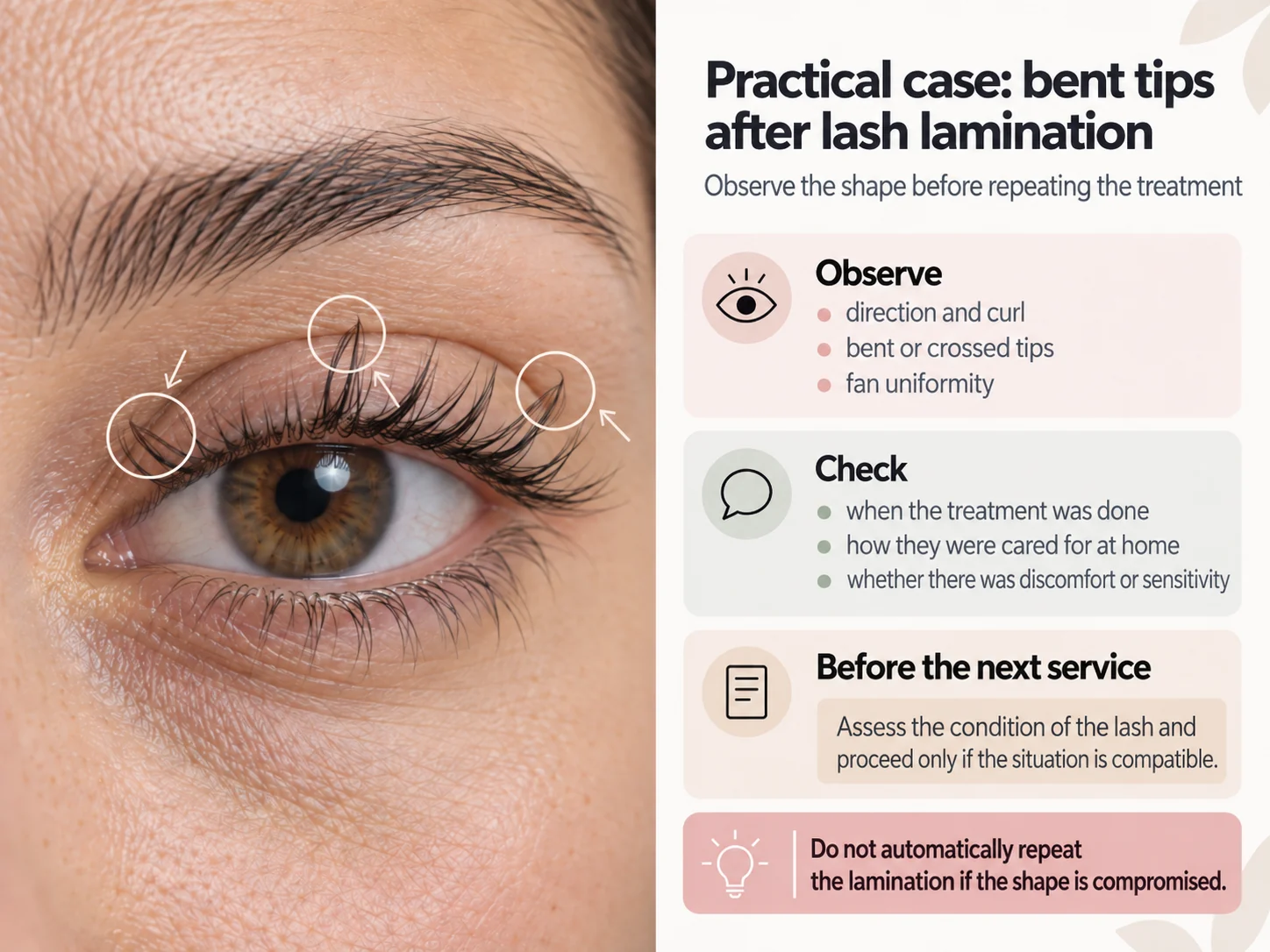
After a suspected overprocessed lift, do not use another chemical exposure as an automatic correction. The lash lift gone wrong guide explains why system history, shaft condition and stop criteria come before a second process. For tint, follow the current product system and the professional eyelash tinting guide; fragility or uncertainty may still require postponement.

Existing extensions: leave, reduce or remove?

Do not remove extensions at home by pulling. The professional decision depends on symptoms, attachment, load, outgrowth, stickies, retention and whether remover can be used safely. When there is eye pain, substantial swelling, discharge, chemical injury or acute reaction, clinical triage takes priority over a routine beauty removal.

Without acute symptoms, obvious excessive load, multiple natural lashes bonded together, painful tension or unsuitable outgrowth may support controlled professional removal or correction. Follow the professional extension-removal guide and the product instructions. Do not improvise with oil, heat, steam, solvents or mechanical picking.

A lighter set is not always a safe compromise. If the cause is uncertain, symptoms are active or isolation cannot be achieved, postponement remains the correct outcome. Document what was removed, which product and batch were used, client response and any referral recommendation.

When to recommend medical or eye assessment

Refer without assigning a diagnosis

Progression, distribution and symptoms change the pathway

Doctor / dermatologist

Unexplained or concerning lash and hair change

Doctor / eye care

Eyelid-margin or eye symptoms

Urgent

Eye pain, vision change, injury or very red eye

Salon

No treatment while suitability is unresolved

Sudden, progressive or patchy loss needs assessment; pain inside the eye, altered vision, major injury or a very red eye requires urgent local guidance.

Recommend a doctor or dermatologist when apparent loss is sudden, progressive, patchy, clearly asymmetric, persistent, unexplained or accompanied by eyebrow, scalp or other body-hair change. The client may start with primary care where that is the local route. The lash professional does not need to name a suspected disease to make an appropriate referral.

Redness at the eyelid margin, swelling, persistent itching, crusts, flakes, discharge, soreness or a gritty feeling also warrant caution and may need a doctor, optometrist or ophthalmologist according to local pathways. The NHS lists sore or itchy eyes, grittiness and crusting around lash roots among possible blepharitis symptoms, but the same page advises clinical help when symptoms worsen or do not improve. A salon should not convert that information into a diagnosis or treatment routine.

Do not clean, tint, lift or apply extensions to investigate the response. Stop the service, explain the observed reason without medical language and direct the client appropriately. A practitioner should know the local non-urgent and urgent eye-care routes before an incident occurs.

Urgent eye warning signs

Eye pain, a new change or loss of vision and a very red eye are urgent warning signs in current NHS guidance. Its red-eye guidance also escalates severe light sensitivity, chemical injury, something embedded in the eye and certain severe systemic symptoms. Local services and urgency categories vary, so use the emergency or urgent eye pathway for the client's location rather than waiting for a salon follow-up.

If product enters the eye, follow the manufacturer safety instructions and local poison or urgent-care advice. Do not neutralise one chemical with another or delay rinsing where the safety directions require immediate irrigation. Keep the product, packaging, batch and safety information available for the clinician. Do not resume the service to complete the look.

These signs are not a checklist for identifying the condition. They are thresholds for stopping beauty work and transferring the decision. If the client reports rapidly worsening symptoms after leaving, advise them to use the local urgent pathway rather than returning to the studio for assessment.

Document change without turning photographs into diagnosis

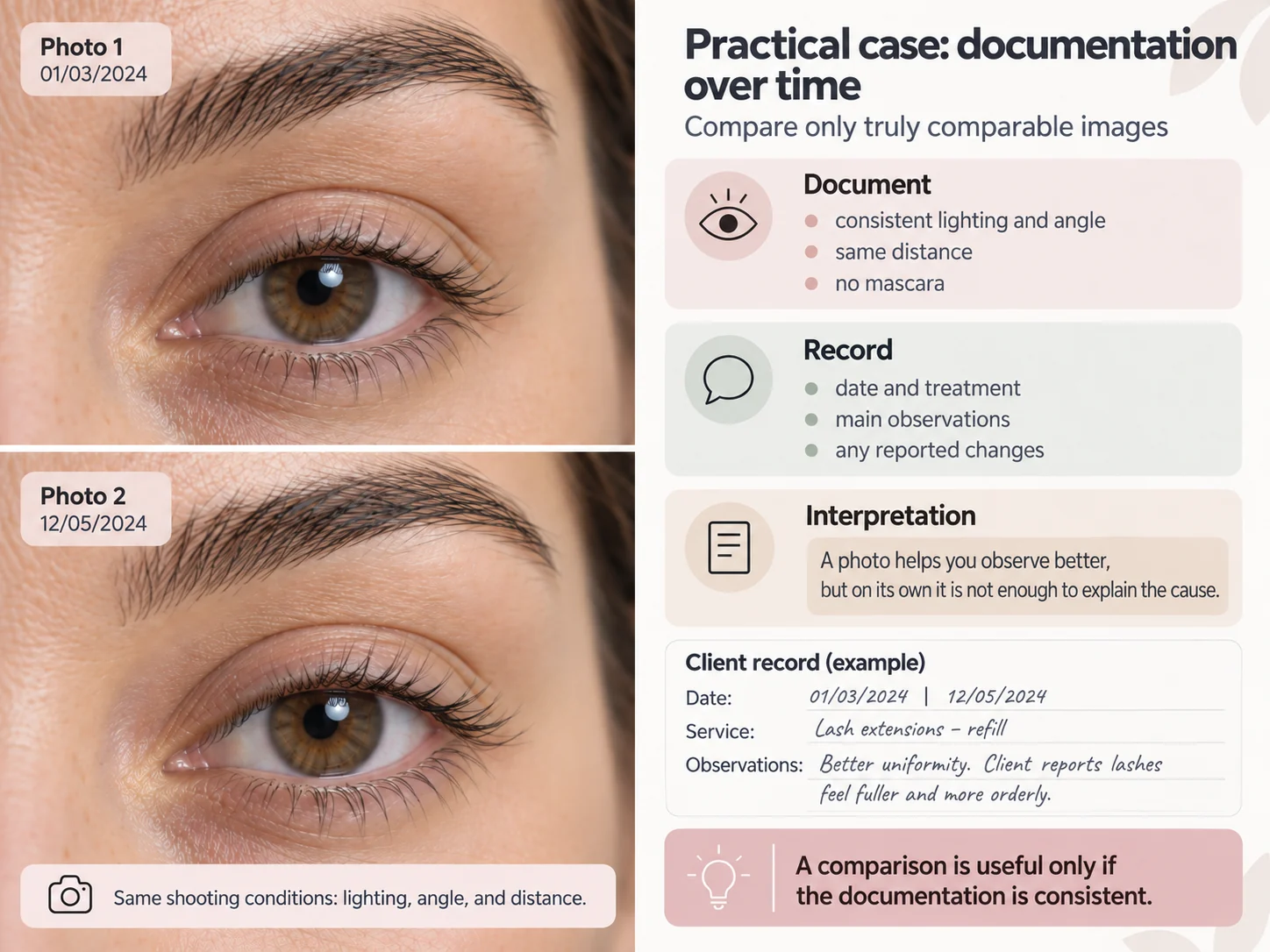
With valid consent, take standardised images before intervention and at a planned review: same camera, lens, distance, light, angle, lid position, focus and no mascara. Include enough context to locate the area without collecting unnecessary identity. Do not beautify, sharpen or selectively crop the comparison in a way that changes apparent density.

Record the client's words separately from professional observations. Useful facts include date, distribution, visible shaft lengths, attached work, reported onset, reported symptoms, recent products and services, product system and batch, decision not to treat and referral advice. The lash client-record guide covers consent, minimisation, access and retention.

Photographs can show whether the visible pattern appears different under matched conditions. They cannot establish follicle function, determine the cause or prove that a serum produced change. Do not delay referral to collect a more persuasive before-and-after sequence.

Reassessing after a treatment break

Reassess suitability without treating the image as a diagnosis

Compare, update, verify and design conservatively

1

Use matched light, angle and focus

2

Update symptoms, products and relevant advice

3

Verify the base and service controls

4

Reduce load or postpone again

A return to service requires comfort, stability and a suitable natural-lash base; completing a break does not authorise the previous design.

At review, compare comfort, symptoms, distribution and the condition of untreated newer shafts. Update product, medication and clinical-advice information only as relevant to the service. If the pattern is worsening or still unclear, do not turn the review into repeated observation without referral.

Resuming service requires an asymptomatic, stable and technically suitable base plus any required healthcare advice. It does not require every lash to have the same length. Design conservatively, reduce load where necessary, protect isolation and keep the original stop criteria. A completed pause does not authorise the previous design.

If a service resumes, document the smaller initial plan and reassess at removal or infill rather than escalating automatically. A good outcome is not simply visible fullness; it includes comfort, clean attachment, manageable aftercare and a natural-lash base that remains appropriate for continued work.

How to explain a postponement without frightening the client

Use observable language: today the distribution or shaft condition is different from the previous record, and I cannot safely support the planned service or identify the reason here. Avoid naming diseases, blaming the client or another practitioner, and promising that a product will correct it. State what you will not do and why it protects the decision.

Offer a factual copy of products used, batch details, photographs the client is entitled to receive and the service timeline. Recommend the appropriate assessment without prescribing its outcome. If the client declines referral, the professional may still decline the cosmetic service. Consent does not cancel technical unsuitability.

Training should include these conversations alongside anatomy, consultation, hygiene, product systems, sustainable set design and supervised practice. Browse the complete lash guide library and compare current lash courses for curricula that teach when not to treat as clearly as how to apply.

Frequently asked questions

How can I tell whether eyelashes are broken or naturally short?

You cannot classify every short lash from one view. Natural lashes are in different growth phases, while breakage may create irregular lengths or altered tips. Compare genuinely matched records, recent services, removal and friction history, distribution and symptoms. A lash professional may describe an apparent pattern and postpone stress, but cannot inspect follicle activity or diagnose the reason. Sudden, progressive, patchy or unexplained change warrants clinical assessment.

Do eyelash extensions always damage natural lashes?

No absolute answer describes every set. Outcome depends on assessment, isolation, attachment, total load, outgrowth, adhesive control, aftercare, removal and individual response. Excess weight, stickies and persistent tension are avoidable technical risks, but sparse lashes can also have unrelated causes. Do not use the absence or presence of extensions as a diagnosis. Review the actual work and symptoms, remove unsuitable attachments professionally and refer unexplained loss.

Will a treatment break make thin eyelashes grow back?

A break can reduce cosmetic exposure and allow untreated shafts to be observed, but it cannot guarantee density, speed or outcome. Regrowth depends on the cause and follicle status, which a salon cannot determine. There is no universal number of weeks. Postpone services while the base is unsuitable or symptoms exist, document change under comparable conditions and recommend assessment when thinning is persistent, progressive, patchy or unexplained.

Does castor oil make eyelashes grow?

Castor oil may change surface slip or shine, but that is not proof of new follicular growth. It can migrate into the eye or irritate the eyelid area, and kitchen or hair products are not automatically intended for eyelash-line use. Do not apply an unsuitable product near the eye or promise regrowth. Choose only products clearly intended for the area, follow directions and stop after irritation. Persistent thinning still requires assessment of the cause.

Are peptide eyelash serums safer than prostaglandin analogues?

Ingredient-family labels cannot guarantee safety or tolerance for an individual. A peptide product may be designed to condition existing shafts, but the full formula, concentration, packaging, instructions, evidence and user history matter. Prostaglandin analogues raise specific regulatory concerns, including a 2026 SCCS conclusion on three assessed substances, yet that does not make every other serum risk-free or effective. Review the exact product and current local rules.

How do I identify a prostaglandin analogue in an eyelash serum?

Check the complete current ingredient list and do not rely on a front-label claim such as natural or hormone-free. Names can be difficult to recognise, formulas change and an online list may not match the package. The 2026 SCCS opinion names three substances it assessed, not a universal consumer dictionary. If the function or ingredient is uncertain, retain the package and batch and ask the responsible company, regulator, pharmacist or clinician rather than guessing.

Can a lash artist recommend bimatoprost?

No. Bimatoprost appears in prescription medicines with defined indications, instructions, contraindications, monitoring and jurisdiction-specific access. A lash professional should not recommend prescription treatment, glaucoma drops, off-label application or sharing. A client who wants or uses a medicinal lash-growth product should speak with the prescriber or pharmacist and follow the authorised label. The salon only decides whether a beauty service remains appropriate.

Should I stop medication if my eyelashes are thinning?

Do not stop prescribed medication on salon or online advice. The timing of a change does not prove the medicine caused it, and sudden discontinuation may be harmful. Record the name only when relevant and permitted, postpone a service if safe assessment is not possible, and direct the client to the prescriber. A doctor can review indication, alternatives, timing and other possible causes; the lash professional cannot perform that risk-benefit decision.

Can biotin or supplements fix fragile eyelashes?

A visible lash pattern does not diagnose deficiency, and a supplement is not a neutral beauty add-on. Need, dose, interactions, medical-test interference and safety require qualified healthcare advice. A lash professional should not prescribe biotin, iron or other supplements or imply that one nutrient explains thinning. Reduce avoidable cosmetic stress, document the pattern and refer concerns about diet, deficiency, health or medication to an appropriate clinician.

Can I apply a lighter extension set over thinning lashes?

Not automatically. A lower nominal weight does not resolve unexplained loss, symptoms, poor isolation or an unsuitable natural-lash base. First assess visible support, distribution, attachment history and stop criteria. Postpone and refer when change is sudden, progressive, patchy or symptomatic. If the base later becomes stable and appropriate, use conservative design and document the plan, but do not use extensions to hide a condition that remains unexplained.

Should existing extensions be removed when lashes look sparse?

It depends on attachment, load, outgrowth, symptoms and the safety of the removal process. Never pull them off at home. Eye pain, significant swelling, discharge, chemical injury or acute reaction needs clinical triage first. Without acute symptoms, unsuitable load, stickies or tension may justify controlled professional removal following remover instructions. Sparse appearance alone does not diagnose damage, and a clinician should assess unexplained or progressive loss.

Can I repeat a lash lift to correct bent, fragile lashes?

Do not repeat chemical processing automatically. Additional exposure can worsen shafts that are already stressed. Record the exact system, lot, timing, placement, previous services and observed condition; follow the manufacturer's instructions and the professional correction limits for that system. Where fragility is marked, history is uncertain or symptoms exist, stop and postpone. A second process is not a treatment for breakage or thinning.

Does waterproof mascara cause fragile eyelashes?

Not by definition. A resistant film may need more time and an appropriate remover, while damage risk rises when the user rubs, scrapes or pulls to remove it. Dissolve the film, use light directed movements and avoid repeated clamping with a curler over dried mascara. If the eyelid area is irritated or lashes appear markedly fragile, reduce manipulation and seek advice rather than using more make-up to hide the change.

Does a patch test rule out a reaction to eyelash serum?

No. A negative skin result cannot guarantee tolerance on the eyelid margin or after repeated exposure, and it does not authorise a use outside the product directions. Eye-area exposure, complete formula, application and previous sensitisation matter. Use only a product intended for the area, follow its current instructions and stop after symptoms. Eye pain, altered vision, significant swelling or a very red eye requires the locally appropriate clinical pathway.

When should thinning eyelashes be assessed by a dermatologist?

Recommend medical assessment when apparent loss is sudden, progressive, patchy, markedly asymmetric, persistent or unexplained, or when eyebrow, scalp or other body hair has also changed. Primary care may be the first route in some systems and can direct referral. A dermatologist can examine hair and skin and investigate causes; a lash professional should not wait for a more dramatic photograph or attach a diagnostic label.

When do eyelash symptoms need an eye-care professional?

Persistent soreness, itching, grittiness, crusting, flakes, swelling, discharge or redness around the eyelid margin may need a doctor, optometrist or ophthalmologist according to local routes. Do not diagnose blepharitis from the appearance. Eye pain, vision change, severe light sensitivity, injury, chemical exposure or a very red eye needs urgent local guidance. No extensions, lift or tint should continue while the area is symptomatic or being assessed.

Are crusts at the lash roots always product residue?

No. Visible material may be cosmetic residue, but crusting or flaking can also occur with eyelid conditions that need diagnosis. Do not scrape it away to prove a theory, cover it with make-up or perform a service to see what happens. Record what is visible without naming the cause, postpone treatment and advise appropriate clinical assessment, especially when itching, soreness, redness, swelling, grittiness or discharge is present.

Can photographs prove that eyelashes are growing back?

Matched photographs can document a visible difference when camera, light, focus, distance, angle, lid position and make-up are controlled. They cannot show follicle function, identify why a lash is short or prove that a serum caused change. Keep unedited records with consent and an appropriate retention policy. Do not delay medical referral to collect more images, and do not market a comparison as a guaranteed biological result.

Can I tint fragile eyelashes?

Only if the natural-lash base is suitable, the eyelid area is asymptomatic and the exact professional system permits the service after assessment. Marked fragility, unexplained change, previous adverse response or active symptoms are reasons to postpone. Use the current product instructions for mixing, exposure, application and removal; there is no universal time or formula. Tint changes colour, not strength or follicle function.

What belongs in the client record for fragile or thinning lashes?

Record facts needed for the service decision: observed distribution and shaft appearance, the client's reported onset and symptoms, relevant products and services, system and batch, authorised matched photographs, decision to postpone or remove and the referral information given. Separate reported information from observation, avoid diagnosis and unnecessary medical detail, restrict access and use a defined retention period under applicable privacy rules.

What should lash training teach about thinning or damaged-looking lashes?

Training should combine natural-lash anatomy, consultation, hygiene, product systems, sustainable load, isolation, documentation, aftercare, stop criteria and supervised decision-making. It should demonstrate how to decline or postpone a service, communicate uncertainty and refer without diagnosing. A product list or a promise that every problem can be corrected is insufficient. Competence includes knowing when beauty work must end and clinical assessment begins.

Official sources and scope limits

The UK NHS pages on blepharitis and red eye describe symptom patterns and urgent warning signs for the UK public. They do not allow a lash professional to diagnose an eyelid or eye condition, and readers elsewhere should use their local healthcare pathways.

The European Commission SCCS 2026 final opinion on three prostaglandin analogues addresses defined cosmetic ingredients and assessed conditions. The Commission's cosmetic-claims criteria apply within the EU. Neither source is a worldwide product database or individual medical decision.

The US DailyMed prescribing information for LATISSE is a current US prescription label, not permission for salon recommendation or use in another country. The American Academy of Dermatology page on hair loss and shedding reinforces clinician assessment and warns against stopping suspected medicines without a doctor. This guide remains educational and cannot diagnose, treat or clear a client for service.

Continue learning