

Certificate, qualification, accreditation and licence are not interchangeable. A private makeup school can issue a useful record of attendance, completion or assessed work. That document does not become a government-regulated qualification or permission to offer every beauty service because it uses the word certificate. Its meaning depends on the issuer, assessment, quality system, jurisdiction and exact activity you intend to perform.
Quick answer: ask for the exact name and sample wording of the final document, legal name of the issuer, learning outcomes, hours or workload, required practical evidence, assessment and identity checks. If regulated status, a framework level or external accreditation is claimed, find the credential and awarding body in the relevant official register. Then check licences and scope with the authority where you will work. A private completion certificate can document training without being a public qualification or occupational licence.
This guide owns the credential and regulatory-verification intent in the BeautyLearn makeup library. Use how to become a makeup artist for skills, portfolio and career planning, and the course-selection checklist for programme and tutor evidence. Cost, delivery format and study time remain separate questions. A prestigious-looking certificate cannot answer all of them.
Five terms to separate before comparing courses
One page can contain five different claims
Document, education status and permission to work must be read separately
Attendance
Presence at learning activity
Completion
Internal requirements finished
Assessment
Evidence judged against criteria
Qualification
Competent regulated system
Licence
Permission for an activity and place
Marketing pages often place several terms together. Read each one literally and ask what system produces the claim. ‘Recognised’, ‘international’, ‘professional’, ‘certified’ and ‘accredited’ are incomplete without a recogniser, territory, standard and verification route. The useful question is never simply ‘Is this certificate valid?’ It is ‘What fact does this document prove, to whom, for which activity and under which rules?’
Term | What it may prove | What it does not prove automatically |
|---|---|---|
Attendance certificate | Presence at a learning activity | Practical competence or licence |
Completion certificate | Internal course requirements were completed | Regulated qualification or universal recognition |
Assessed private credential | Evidence was assessed against stated private criteria | Government-regulated status |
Regulated qualification | Award sits within a competent public regulatory system | Permission for every adjacent beauty service |
Occupational licence or registration | A legal condition for a defined activity and place | Artistic skill, employment or clients |
What a private makeup course certificate can genuinely add
A private certificate can be a meaningful education record. It can identify the learner, provider, course, dates, delivery mode, workload, modules, assessment and result. It may support a CV, portfolio discussion, insurer query, freelance proposal or employer conversation when the recipient wants to understand training completed. Its usefulness grows when it is verifiable and connected to transparent outcomes and retained practical evidence.
A document is stronger when it distinguishes participation from achievement. Watching every lesson shows completion activity; it does not show that a complexion match, eye shape, hygiene sequence or client brief was performed. If the certificate states that skills were assessed, ask which tasks, criteria, assessor, evidence, pass rule and resubmission process produced that statement.
The limitation is equally important. A private provider cannot give its own certificate the legal effect of a public qualification or local licence. It cannot guarantee employment, customers, immigration recognition, business registration or permission to perform regulated services. Current English BeautyLearn course pages must therefore be read for their exact certificate statement, learning requirements and availability rather than one generic platform promise.
Qualification, credential and course are different objects
A course is the learning experience. A credential is the record or claim issued after a process. A qualification, in formal frameworks, is normally the outcome of assessment and validation by a competent body against defined standards. The same course title can lead to different documents in different countries, and two courses with similar certificates can contain very different practice and assessment.
Do not infer qualification status from lesson hours, price or diploma design. A lengthy private programme can provide excellent learning without being regulated. A shorter regulated unit can have a precise formal status without covering an entire career. Ask separately whether the teaching is useful, the assessment is credible and the final credential belongs to the claimed public or external system.
Framework levels: useful descriptors, not marketing decorations
The European Qualifications Framework uses eight learning-outcome levels as a translation tool between national qualification frameworks. It helps readers compare the complexity of recognised qualifications across systems. An EQF level is meaningful when it is attached through the relevant national framework and competent process. A training company cannot responsibly assign its ordinary in-house certificate an EQF level merely because its curriculum seems difficult.
Other countries use their own frameworks and regulators. In England and Northern Ireland, the official Register of Regulated Qualifications lets users check whether a qualification and awarding organisation are regulated. Scotland and Wales have separate routes. A level describes the demand of learning outcomes; it does not automatically describe course size, teaching quality, employment rate or superiority over every credential at another level.
Accreditation: identify exactly who or what is accredited
Follow the claim to its source
A badge becomes useful only when the exact relationship is verifiable
Name the accreditor
Define public or private status
Find the exact approved object
Check scope and current dates
Accreditation can refer to an institution, awarding organisation, qualification, course approval, continuing-education scheme or private membership. Those are different relationships. Ask for the accreditor’s legal name, public or private status, scope, standards, directory entry, current dates and any restrictions. A logo on a page is not enough; follow the verification from the accreditor or official register back to the exact provider and course.
If the claimed organisation only confirms that a provider paid for membership, do not rewrite that as government recognition. If it approves training for an insurer or professional association, state that bounded use. If it regulates qualifications, find the exact award. Honest wording protects the learner and provider: private quality review can be valuable without pretending to be statutory authority.
Regulated profession and regulated qualification are not the same question
A qualification may be regulated within an education system while the occupation is not legally restricted in the same way. Conversely, an activity may require a licence, registration, premises approval or another professional qualification even when a particular private course is unregulated. Always verify both layers: what the education document is and what the intended work requires.
Your Europe explains that a profession is generally regulated when a particular degree, examination or professional registration is required before practice. It also warns that regulated professions differ across countries. Search the official database and contact the national assistance centre when the title or activity is unclear. Absence of one generic title from a database is not permission to assume that every related treatment is unregulated.
In the United States and other decentralised systems, requirements may vary by state, county, city, service and business location. The US Small Business Administration directs businesses to check state and local licences and permits for their actual activity. ‘Makeup artist’, retail demonstration, salon cosmetology, mobile bridal work, skin treatment and film production may be classified differently. Describe the service, tools, products, premises and client contact rather than asking about a broad label.
Practical rule: do not ask an authority only, ‘Can I work with this certificate?’ Send the exact services, location, working arrangement, products, skin contact, premises and business role. Ask which qualification, registration, licence, insurance or hygiene conditions apply to that factual scenario, and keep the written response.
How to verify a recognised-certificate claim
Four links in a verifiable claim
Missing issuer, standard, assessment or authentication leaves a gap
Issuer
Legal name and responsibility
Standard
Award, level and register
Assessment
Tasks, criteria and assessor
Authenticity
Record, code or confirmation
Translate the claim into searchable facts. Request a redacted sample of the final document before payment. Identify the issuer and awarding body. Ask whether the document records attendance, completion or assessed achievement. If public regulation or an external framework is claimed, obtain the qualification number, official title, level, register URL, approval dates and the exact provider relationship.

Question | Useful evidence | Weak signal |
|---|---|---|
Who issues it? | Legal name, role and current contact | Only a school logo |
Is it regulated? | Exact award, number and official register | ‘Internationally recognised’ alone |
What was assessed? | Tasks, criteria, assessor and pass rule | Video access or quiz only |
How is it authenticated? | Secure record, code or issuer confirmation | Unverifiable PDF |
Read dates carefully. Approval can expire, a provider can cease to be authorised and an older award can be replaced. Check the current record, not a screenshot in an advertisement. Save the course description, terms, programme, issuer information and register result as they appeared when you enrolled. If a claim cannot be traced beyond the seller’s own page, treat it as unverified until the named body confirms it.
Assessment determines what an achievement certificate can say
A practical claim should rest on practical evidence. Ask whether learners submit work on consenting adults, under what conditions, and whether assessors can see preparation, hygiene, product amount, movement and final result. One edited after photograph cannot establish the full process. A robust assessment identifies the learner, states the brief, uses criteria, records the decision and allows a defined correction or resit where appropriate.
Theory quizzes can test vocabulary, safety knowledge and product concepts, but cannot alone prove brush control, adaptation or client communication. Attendance can be a condition without being competence evidence. A provider should be able to tell you which claims arise from attendance, online activity, knowledge tests, practical submissions and live observation. That distinction is more informative than the visual weight of the paper.
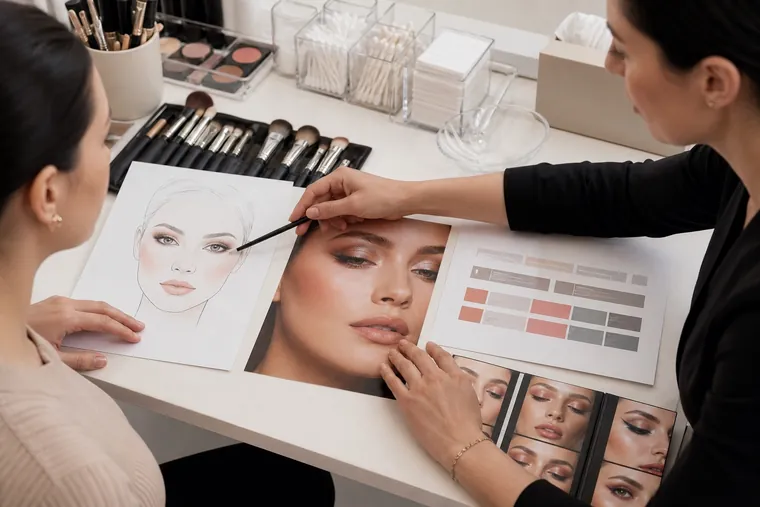
Online certificate: judge the evidence, not the delivery label
Online delivery does not automatically make a certificate meaningless. A recorded or live course can document verified identity, completed modules, knowledge checks, face charts, practical photographs, video evidence, tutor feedback and final assessment. The relevant questions are what was done, what the assessor could observe and how the record is protected. Automatic release after opening every lesson means something different from release after assessed work.
A public or regulated qualification may impose attendance, supervised practice, placement, invigilation, examination or centre requirements. Those conditions come from its own system and cannot be borrowed by an unrelated private online course. Use the online vs in-person makeup course comparison to evaluate visibility, model practice and feedback without treating format as a shortcut for status.
What a good course certificate should contain
A readable certificate normally identifies the learner, exact programme, issuer, award or credential type, issue date, relevant workload, delivery mode where material, assessment or completion basis, result and authentication route. If it names competencies, they should be observable: prepare a hygienic station, select suitable tools, apply a controlled base, adapt an eye placement or complete a client brief according to criteria.
The wording should not inflate the evidence. Completing an eye module is not the same as completing a broad artistry programme. Completing lessons is not identical to passing practical assessment. Participation is not achievement. Accurate limits make the record easier for employers and clients to interpret and protect the learner from accidentally making a false claim.
Twelve checks before paying for a credential claim
Write the exact goal: personal learning, employment, freelance services, retail, bridal, fashion, film or another setting.
Request the final document’s precise name and a redacted sample.
Identify the training provider, issuer, awarding organisation and assessor as separate roles.
Find every public or regulated claim in the competent official register.
Check approval dates, provider status, qualification number, level and scope.
Read learning outcomes, workload, entry requirements and programme sequence.
Ask which practical tasks are compulsory and how identity is checked.
Request criteria, assessor role, pass rule, feedback and resit conditions.
Verify how employers or clients can authenticate the final record.
Describe the intended work to the competent licensing or business authority.
Confirm insurance, premises and product rules separately from the education document.
Keep the programme, terms, receipts, submissions, feedback and credential together.
Red flags in certificate marketing
‘Recognised worldwide’ with no named authority, register, territory or scope.
An unexplained badge whose organisation only appears on pages selling the same courses.
A framework level assigned by the provider without a national-framework record.
Practical competence claimed after passive viewing or an unrelated multiple-choice quiz.
Guaranteed licence, job, clients, earnings or insurance acceptance in every location.
Pressure to enrol before the issuer, programme, terms or sample certificate is disclosed.
A red flag calls for evidence; it does not prove fraud by itself. Ask the provider to complete the claim. A serious organisation should be able to distinguish its teaching, private certificate, external approval and any regulated award in plain language. If a decision depends on formal status, verify it with the named regulator or competent authority before purchase.
Use the certificate accurately in a CV and portfolio
List the precise credential name, provider or awarding body, year, relevant workload and assessed areas. Do not call it a licence, diploma, regulated qualification or accredited award unless the evidence supports that term in your jurisdiction. Link it to practical portfolio evidence: brief, model consent, process, result, feedback and correction. The combination is more informative than a certificate image alone.
Protect verification details. Do not publish signatures, personal identifiers or secure codes in a way that enables misuse. Provide the authentication route privately when needed. Keep the underlying course record because providers can change websites and employers may ask what the programme contained at the time. Translation of a document also does not create recognition; cross-border use follows the receiving system’s rules.
Choose learning and legal readiness on separate tracks
Two tracks must meet before work
Course quality and legal readiness require different evidence
Learning
Outcome, practice and feedback
Credential
Issuer, assessment and status
Work
Service, place and local rules
Evidence
Portfolio and written confirmation
First choose learning that produces the relevant capability and evidence. Then verify which document, licence, premises rule or registration the intended activity needs. Those tracks influence each other but should not be collapsed. A formally regulated award can still be a poor fit for your specialist goal; an excellent private class can still be insufficient for a regulated activity.
Review the current English makeup course catalogue and individual pages such as the beginner makeup course or complete makeup artist course for the exact English-market description. Compare curriculum, assessment and certificate wording separately. Enrolment is currently unavailable and every future claim must be checked on the live page before purchase.
Frequently asked questions about makeup artist certificates
Is a makeup course certificate a professional qualification?
Not automatically. It may record attendance, completion or assessed private learning. A regulated qualification belongs to a competent system and should be verifiable in its official register. Read the exact wording and do not infer status from the word certificate.
What does an accredited makeup course mean?
It depends on who or what is accredited and for which purpose. The relationship may concern membership, private course approval, continuing education, an awarding organisation or a regulated qualification. Identify the accreditor, scope, dates and directory record before interpreting the claim.
Can I work as a makeup artist with a private certificate?
Possibly, but the certificate alone cannot answer. Requirements depend on service, products, setting, business model and location. Send the exact activity to the competent licensing or business authority and check insurance and premises conditions separately.
Is an online makeup certificate valid?
Online delivery does not determine meaning. Check issuer, identity process, activities, practical evidence, assessment and status. A completion PDF after viewing lessons differs from an assessed credential, and neither becomes regulated merely because it is issued digitally.
Does an international certificate work in every country?
No universal private certificate automatically overrides national or local rules. ‘International’ may describe learners, branding or a private network. Cross-border recognition must be checked with the authority, employer, insurer or education system receiving the credential.
What is an EQF level on a makeup qualification?
The EQF is an eight-level European translation framework linked to national qualification frameworks. Verify that the exact qualification carries the stated level in an official source. A course provider should not self-assign an EQF level to an ordinary private certificate.
How can I check a UK regulated qualification?
For England and Northern Ireland, use the official Register of Regulated Qualifications and confirm the award, number, awarding organisation and status. Wales and Scotland have separate official systems. Also verify whether the intended work has separate local requirements.
Does a certificate guarantee insurance?
No. Insurers set their own eligibility, training, treatment and documentation conditions within applicable law. Send the exact certificate, syllabus and proposed services to the insurer and obtain written confirmation rather than relying on a training provider’s general statement.
Does a certificate guarantee a job or clients?
No. Employment and clients also depend on practical reliability, portfolio, communication, location, demand, legal setup and business activity. Treat automatic work or income promises as claims requiring a defined method, sample, period and conditions.
Should the course have a practical exam?
If the credential claims practical achievement, observable practical evidence is important. Ask about tasks, models, recording, criteria, assessor, pass rule and resubmission. A theory quiz can test knowledge but cannot alone show application and adaptation.
What should appear on a makeup certificate?
It should clearly identify learner, programme, issuer, date, credential type, relevant workload, completion or assessment basis, result and authentication route. Any regulated or externally accredited status should be stated precisely enough to verify.
Can I put a private certificate on my CV?
Yes. Name it accurately with provider, year, duration and relevant content. Do not relabel it as a licence or regulated qualification. Pair it with attributable practical evidence and protect personal or secure verification details.
Is more training hours always better?
No. Workload matters, but hours do not reveal sequence, learner activity, feedback or assessment quality. Compare what learners perform and what evidence is reviewed. A framework level also describes complexity, not automatically the amount or teaching quality.
What if the certificate claim cannot be verified?
Ask the provider for the issuer, award number, register and current approval. Contact the named body directly. If formal status matters and confirmation remains unavailable, treat it as a private unverified claim and do not enrol on the assumption that it grants recognition.
What should I keep after completing the course?
Keep the syllabus, course terms, receipts, learning outcomes, submissions, assessor feedback, result, certificate and verification instructions. Together they explain what the credential meant at the time and support accurate presentation to an employer, client, insurer or authority.
Official references and legal scope
Use the official European Qualifications Framework explanation, the Your Europe page on regulated professions, the UK government’s Register of Regulated Qualifications and the US Small Business Administration guidance on licences and permits as starting points. They cover different territories and must not be combined into one universal rule.
Editorial and legal-information review: 5 September 2026. This guide explains a verification method; it is not legal advice, credential evaluation, licence approval or a statement that makeup artistry has one status worldwide. Rules, registers and provider approvals change. Verify the live official record and obtain advice from the competent authority where you intend to study or work. This independent page contains no competitor links.
When your skills need to become clear evidence, use the makeup artist portfolio guide to select relevant projects, photograph them faithfully, state roles and manage consent, credits and image rights.
When skills and evidence are ready for the market, continue with how to find makeup clients: local discovery, authentic reviews, relevant partnerships, clear quotations, privacy-aware follow-up and booking measurement.
A certificate does not determine an Italian tax position
Credentials and business registration answer different questions; use the makeup artist business-setup guide for Italy.