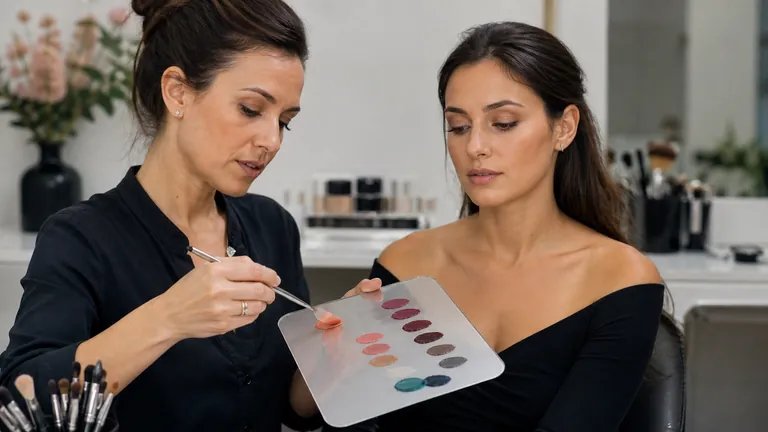
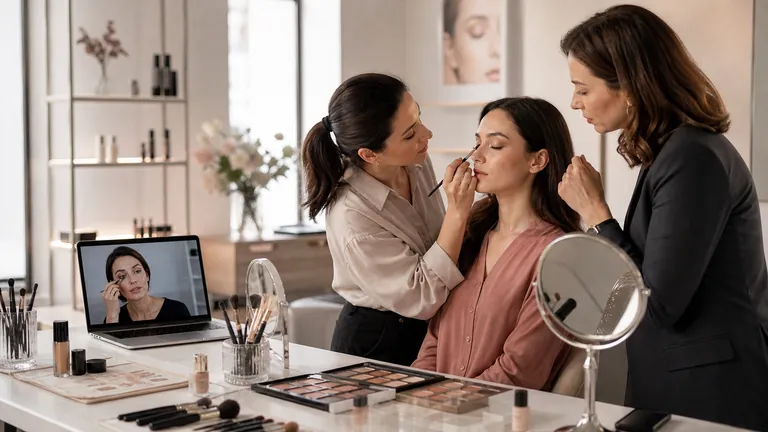
Should you choose an online or in-person makeup course? There is no universal winner because neither label describes one learning experience. A self-paced video library, a live online cohort, a blended programme, a large classroom demonstration and a small supervised workshop all distribute explanation, practice and educator attention differently. The useful question is not where the course happens, but how its design helps you see, perform, receive a precise correction and repeat.
Quick answer: choose self-paced online learning when replay, flexible scheduling and distributed practice solve your main constraint—and only when you will complete the exercises. Choose live or classroom learning when scheduled practice and immediate observation are worth the fixed timetable. A well-designed hybrid can reserve recorded content for repeatable theory and demonstrations, then use live or classroom time for questions, model work and correction.
This guide owns the training-format comparison in the BeautyLearn makeup library. It does not repeat the total-budget method in how much a makeup course costs, the beginner exercises in how to learn makeup from scratch, or the portfolio and career route in how to become a makeup artist. Here, the decision is specifically about the environment in which you learn.
The current English online makeup courses have their own curricula, teachers and availability. English enrolment may be closed while localised teaching content is prepared. Course pages are the source for current details; this independent guide supplies a reusable comparison method.
Online makeup training is not one format
Four distinct learning environments
Compare course design, not two broad labels
Self-paced
Replay and flexible timing
Live online
Questions and shared deadlines
Classroom
Direct context and observation
Hybrid
Repeatable theory plus targeted sessions
Self-paced recorded training lets you decide when to study, pause a difficult movement and revisit a demonstration. It may include exercises, downloadable notes and asynchronous feedback, or it may be a content library with no educator contact. The amount of video does not reveal which version you are buying. Check access length, lesson structure, assignments, technical support and exactly what happens after you submit work.
Live online training creates an appointment. The educator can answer questions, compare approaches and sometimes watch a technique while it happens. Its limitations are camera angle, connection, colour rendering and the number of learners competing for attention. Ask whether the class performs alongside the educator or watches first, whether every learner receives technical feedback and whether a replay or alternative date exists.
Hybrid training deliberately combines modes. It may pair recorded foundations with live critique, or online preparation with a classroom workshop. A hybrid is not automatically comprehensive: the parts must share outcomes, terminology and assessment. If online and classroom work feel like two unrelated products, the extra mode adds logistics rather than learning continuity.
Format | Potential strength | Decisive check |
|---|---|---|
Self-paced recorded | Pause, replay and study around other commitments | Exercises, feedback, access length and completion support |
Live online | Questions, shared deadlines and real-time interaction | Tutor ratio, individual viewing, replay and absence policy |
Practical classroom | Three-dimensional observation and immediate physical context | Minutes of learner practice, models and corrections per person |
Purposeful hybrid | Repeatable theory plus targeted supervised sessions | One progression connecting every mode and submission |
In-person makeup training is not one format either
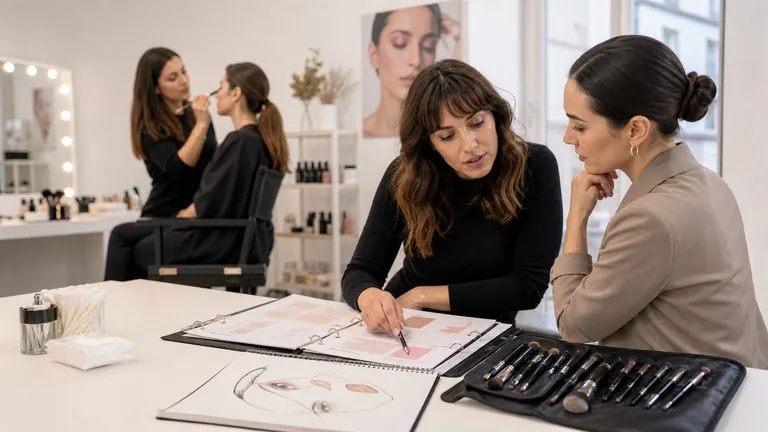
A large masterclass may be primarily a demonstration. You share the educator’s time with a room and may not practise at all. A small workshop may provide a workstation, model and repeated observation. A longer academy may mix lectures, demonstrations, practice between learners, assessments and placements. Physical proximity does not guarantee individual teaching.
Ask for the number of learners, educators and workstations; hours spent watching versus applying; number and source of models; products available; and what happens when an exercise is incomplete. If learners work in pairs, clarify whether the timetable counts both application and modelling as practical hours. If the teacher corrects a final look only, important decisions earlier in the process may remain unseen.
Visit the room or attend an open session when practical. Check sightlines, lighting, ventilation, hygiene flow and whether a camera or screen supports close detail. Classroom teaching is most valuable when the environment makes relevant information more visible and gives you enough time to act on it.
Demonstration: replay versus three-dimensional observation
A strong recorded demonstration can show product quantity, brush loading, angle and edge in close-up, then repeat the action from a second view. You can slow, pause and compare it with your own attempt. This supports procedural memory for workstation setup, complexion layers, eye placement and lip edges. Video quality matters: overexposure erases texture, automatic white balance changes colour and a distant camera hides pressure.
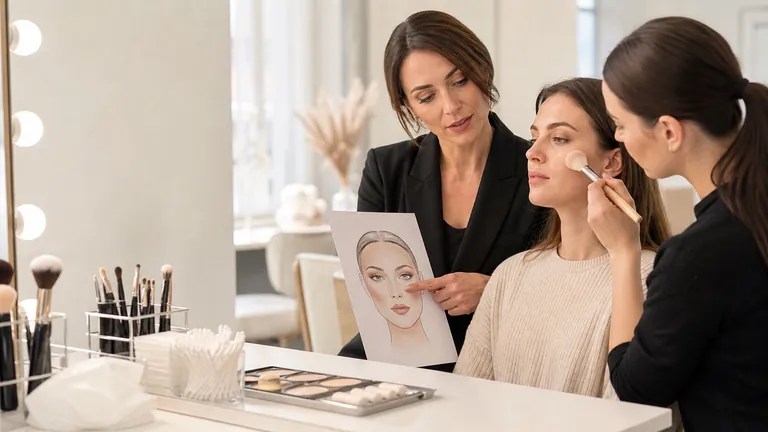
In the room, you can move around the model, compare profile and front view, observe posture and see surface reflectivity directly. The educator can explain why the same movement changes with skin texture, eye position or face direction. Yet a learner at the back of a crowded class may see less than a carefully filmed close-up. Judge how the demonstration is produced, not the medium in the abstract.
Foundations such as tool function and formula behaviour benefit from replay. Compare the professional makeup tools course and professional makeup products course as examples of bounded English topics. Whichever format you choose, a visible explanation must still become physical, repeatable practice.
Practice is the real comparison: watching versus doing
Makeup training becomes technical when the learner performs. Online, you organise your own workspace, products, time and consenting adult models. That responsibility can be an advantage: you practise in the setting you will use, learn to prepare equipment and can repeat one task across several days. It becomes a weakness when watching replaces doing or model work is postponed indefinitely.
Classroom time creates a protected appointment and may make practice more likely. But calendar hours are not learner hours. Subtract introductions, demonstrations, breaks, cleaning, waiting for products and time spent modelling for another learner. Then divide educator attention across the class. Ask how many complete or partial applications you perform and whether a corrected task can be repeated.
A beginner can use the beginner makeup course as a structured starting point, but competence comes from retrieval and repetition. The practical beginner guide supplies twelve focused exercises and progression criteria so an online course does not become passive viewing.
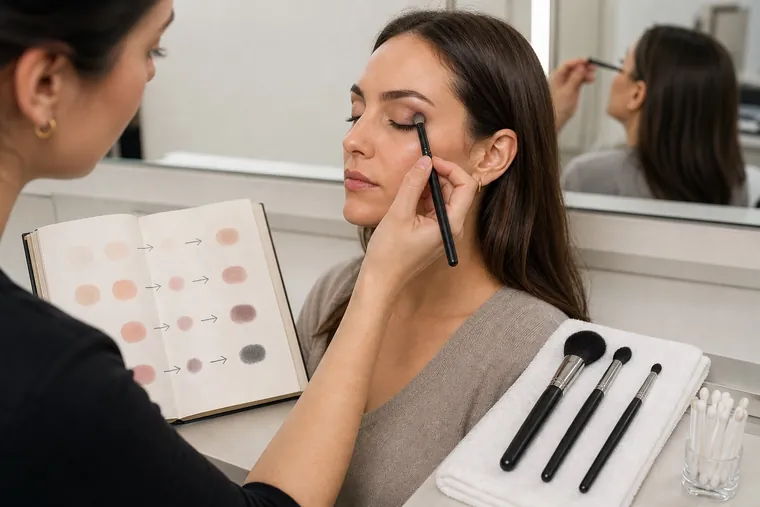
Feedback can be immediate, live online or asynchronous
The channel changes; the correction cycle does not
Useful feedback leads to a comparable second attempt
Perform and document
Identify one variable
Apply one correction
Repeat and compare
Useful feedback is more than praise or a final score. It identifies evidence, connects the result to a controllable variable and requests a new attempt. That complete learning cycle turns an observation into a change that can be tested. The variable may be preparation, quantity, pressure, direction, boundary, symmetry, timing, light or formula compatibility. This standard is the same online and in a room.
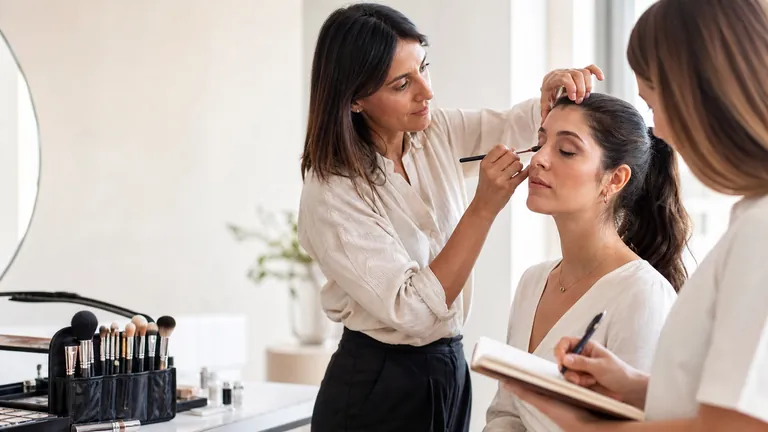
In person, an educator can intervene during the movement, change an angle and inspect texture directly. During live online teaching, the process can also be observed, but framing and connection limit detail. Asynchronous photographs and short video clips allow the reviewer to pause and document a considered response; they require consistent light, multiple angles and notes about the products and sequence used.
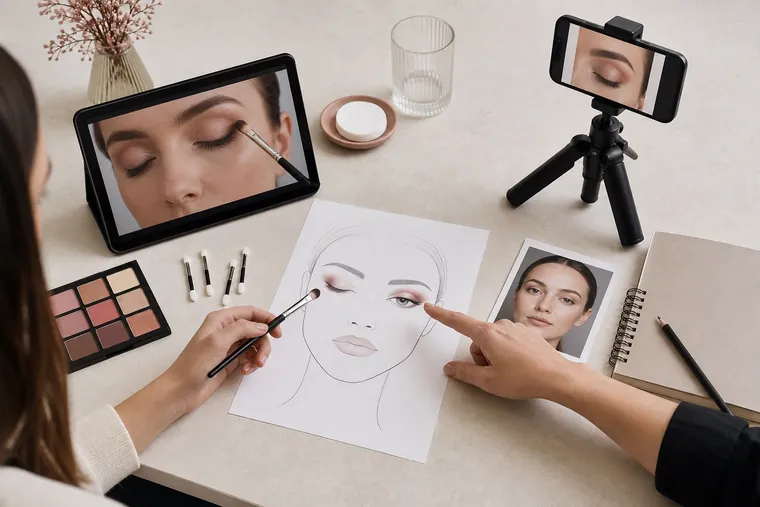
Before enrolling, ask who reviews work, how many submissions are included, whether every response is individual, the normal turnaround and whether the revised attempt is reviewed. In a classroom, ask how many technical interventions each learner can expect. ‘Support’ may mean help logging into a platform rather than teaching feedback; both should be described accurately.
Models and variation across real faces
Practising repeatedly on yourself builds familiarity, but not adaptation. Skin surface, age, depth, undertone, proportions, lid structure, sensitivity, mobility and the requested effect vary. Classroom training may organise rotation among learners or models, but verify the diversity and how much time each person receives. Online study lets you involve different adults over time, although recruitment, consent and scheduling become your responsibility.
Keep a practice record with consent, visible observations, products, lighting, sequence, result and one correction. Do not diagnose a model’s skin or eye concern. Stop when the skin or eyes are irritated, product directions exclude the intended area or the person is uncomfortable. A format is useful when it supports safe adaptation, not when it merely exposes you to more finished looks.
For structured adaptation, the corrective makeup course addresses complexion and proportions; the corrective eye makeup course narrows the brief to eye placement. These are separate skills, not evidence that one course mode is always superior.
Schedule, access and continuity
Recorded learning can fit around work and caring responsibilities, but flexibility must become appointments. Schedule lesson, exercise, evidence review and second attempt. If access expires, calculate whether the available weeks permit all four. Ask whether downloads, captions, playback, updates and tutor channels remain available after completion.
Live online and classroom training impose dates. That can protect consistency and create momentum, but absence becomes a meaningful risk. Request written rules for replays, make-up sessions, transfers, refunds and changed dates. Verify the time zone and local clock changes for international classes. An intensive week needs a consolidation plan; a weekend course may need repeated travel.
Do not choose the shortest promise. Choose a schedule that preserves spacing and repetition. If you cannot access a model until six weeks after the demonstration, the course needs sufficiently long replay or reference materials. If classroom practice ends the same day, you need a plan to reproduce the setup at home.
Technology for a useful online makeup course
You do not need a broadcast studio, but you need evidence that can be interpreted. Use a stable phone or camera support, a clean lens, neutral diffuse light and enough distance to show the complete face before moving closer. Disable beauty filters. Test audio, power and connection before live teaching. Follow the provider’s file and privacy instructions.
Camera and screen cannot provide an absolute colour measurement. Exposure, white balance, colour profile, room light and display settings alter what each person sees. A responsible educator asks for context and multiple views, distinguishes placement from colour accuracy, and states when direct observation is needed. Technology should reduce uncertainty, not conceal it with confidence.
Accessibility is part of design. Captions, transcripts, clear chaptering, keyboard operation, sufficient contrast and controllable playback can make recorded material more usable. Live sessions should explain how to ask questions and obtain materials after a technical interruption. Check platform compatibility before the withdrawal or refund window is affected by access.
Cost and logistics belong in the format decision
Online training can reduce travel, accommodation and time away, but usually transfers workspace, kit, consumables, camera and model organisation to you. Classroom training may provide products and facilities or require a fixed kit; it adds transport and may displace paid work. Compare the complete cost boundary, not only tuition.
Use the dedicated makeup course cost guide to calculate fee, compulsory equipment, practice, travel, assessment, access and payment charges. For format choice, ask which expense buys a benefit you need. Paying for a venue is reasonable when direct supervision solves a genuine problem; paying less online is not economical if you never schedule the practice.
Kit, workstation and hygiene
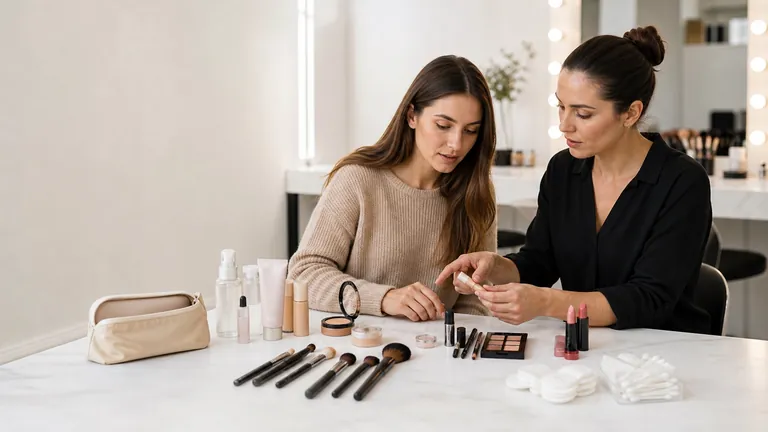
At home, you immediately learn to create a real workflow: cleanable surface, clean hands, separate clean and used tools, decanted cream and liquid products where appropriate, new single-use applicators and protected stock. The educator should show hygiene as part of every procedure. In class, observe the school’s system, but do not assume shared products and tools are safe merely because the venue is professional.
Request the complete material list before paying. Online learners should connect each purchase to a curriculum task. Classroom learners should know what is supplied, loaned or theirs to keep and what must be repurchased for home practice. Training has limited transfer if the successful result depends on a setup the learner cannot reproduce.
Community, peer comparison and professional contacts
A physical class can create spontaneous conversation and let learners compare movements. An online cohort can connect people across locations through scheduled reviews and a moderated community. Neither is automatically supportive. Ask how long the space remains active, whether the educator participates, how work is critiqued and how model images and personal data are protected.
A course mode cannot guarantee clients, work or useful contacts. It can help you create method, evidence and relationships when those activities are part of the design. The career guide separates training from portfolio, local requirements and first-client work. Treat any automatic employment or income promise as a separate claim requiring evidence.
Certificate value does not come from the delivery mode
An online certificate is not inherently worth less, and a classroom certificate is not automatically a public qualification. Ask for the exact document name, issuing organisation, entry requirements, assessment, identity verification and claimed recognition. Then verify those claims with the relevant authority, employer, insurer or professional adviser in the place where you intend to work.
Keep the curriculum, evidence, assessment record and certificate. A private course can document meaningful learning without creating a legal authorisation. Because beauty-service rules vary, this guide compares learning design and cannot determine your personal right to offer a service.
A decision matrix for five learner profiles
Choose around the real constraint
Level, practice, feedback, logistics and outcome outweigh the format name
Level
Starting point and prerequisites
Practice
Time, workspace and models
Feedback
Depth and repeat attempts
Logistics
Access, dates and travel
Outcome
One result for the next three months
Starting from zero and needing replay: choose an ordered recorded pathway if you can schedule exercises; add live feedback when you cannot identify your own technical variable.
Starting from zero and needing external structure: choose a small scheduled class, live online cohort or hybrid with deadlines, enough learner practice and a clear absence policy.
Working professional closing one gap: use a focused recorded module or short workshop whose prerequisite and outcome match the exact problem, then document repeat attempts.
Limited access to models: choose a format that helps organise varied practice, but confirm who supplies models and do not assume classmates alone provide sufficient variation.
Preparing a specialist service: combine repeatable theory with supervised work on relevant models; judge the format by consultation, timing, durability and full-service evidence.
Score each option from zero to two for prerequisite fit, demonstration visibility, practice quantity, feedback quality, model access, schedule resilience, total cost and ability to repeat. Do not sum blindly: mark one non-negotiable. If individual correction is essential, a high score elsewhere cannot compensate for its absence.
When a hybrid format is most efficient
A purposeful hybrid moves repeatable information—tool functions, product behaviour, consultation structure and demonstrations—into material that can be revisited. It reserves scarce synchronous time for questions, decisions, correction, variation and a second attempt. A classroom day can focus on posture, live texture, timing and model adaptation instead of repeating a lecture.
You can also construct a personal hybrid: study a foundation online, complete several exercises, record precise difficulties and then book a supervised workshop. Alternatively, use recorded references after classroom learning. The sequence works when each step responds to evidence from the previous one, not when more formats are added as bonuses.
Quality signals and warning signs
Entry level, outcomes and prerequisites are observable rather than described as suitable for everyone.
A sample shows camera quality, teaching language, hygiene and how errors are explained.
Practice is quantified as learner attempts, relevant models, submissions and corrected repeats—not calendar hours alone.
Tutor identity, class size, response time and the difference between technical and platform support are clear.
Access, replay, absence, kit, assessment, certificate, price, cancellation and refund conditions are available before payment.
No mode is marketed as an automatic licence, job, client list or guaranteed income.
Warning signs include a permanently urgent countdown, a ‘complete kit’ with no inventory, professional mastery promised in implausibly little practice, no explanation of model work or feedback, and refusal to provide important terms in writing. One signal does not prove wrongdoing, but it gives you a concrete question to resolve before paying.
Checklist for choosing online or in-person training
Seven checks before enrolment
See how the course makes you practise before choosing
Outcome
Goal and prerequisites
Constraints
Time, models, travel and budget
Mode
The exact learning environment
Sample
Visibility, method and hygiene
Practice
Attempts and corrections
Conditions
Access, kit, absence and cost
Compare
One matrix and one non-negotiable
Define one result for the next three months and the prerequisites you already demonstrate.
Write your available practice hours, model access, technology, travel tolerance and total budget.
Identify the exact mode: self-paced, live, classroom demonstration, practical workshop or connected hybrid.
View a sample or open session and assess visibility, method, hygiene and educator explanation.
Count learner attempts, model types, individual corrections and opportunities to resubmit or repeat.
Verify access, replay, absences, kit, assessment, certificate meaning and current total cost.
Compare at least two relevant options with the same matrix and honour your one non-negotiable.
Explore the current English makeup course catalogue or a broader route such as the complete makeup artist course. If your foundations are stable, compare bounded applications such as the daytime makeup course and evening makeup course. Availability belongs to each English course page.
Frequently asked questions about online and classroom makeup courses
Is an online makeup course as good as an in-person course?
The labels do not determine quality. Well-filmed online teaching with exercises and feedback can outperform a crowded demonstration; a small supervised workshop can observe variables a camera misses. Compare curriculum, learner practice, corrections, models and repeat opportunities.
Can a complete beginner learn makeup online?
Yes, when the programme orders foundations, demonstrates clearly, requires practice and supplies feedback or strong self-check criteria. The learner must schedule exercises and eventually adapt work to different consenting adults. Add live or classroom support if errors remain unreadable.
What is the difference between recorded and live online teaching?
Recorded teaching provides flexible pause and replay. Live teaching supplies an appointment and real-time interaction, but quality depends on class size, framing and individual attention. Check replay, absence and feedback rules for both.
Does an in-person teacher always give better feedback?
Direct observation can reveal movement and texture, but only when the educator has enough time per learner. A large class may provide little personal correction. Ask for the tutor ratio, practice schedule and number of corrected attempts.
Do I need a model for an online makeup course?
It depends on the curriculum. Some early work can use your own face or a face chart, while professional adaptation requires varied adults. Ask how many models, which tasks and what consent and evidence the provider requires.
Does a classroom course include products and a kit?
Not necessarily. Products may be provided at a workstation, loaned, sold separately or required from your own kit. Request the inventory and ownership terms, then include replenishment and home-practice materials in the budget.
Is an online makeup certificate worth less?
Delivery mode alone does not decide recognition. Examine the issuer, curriculum, assessment and claim being made. A private certificate can document learning without being a licence. Verify local professional requirements independently.
Which format works best around a job?
Self-paced learning offers maximum scheduling flexibility; evening live or weekend classes create external deadlines. Choose according to energy, practice time, model availability, replay and absence rules. Hybrid training can distribute theory while protecting selected feedback appointments.
How can I test course quality before buying?
Use a sample lesson, open session, detailed curriculum and assessment rubric. Ask how a learner practises, who reviews work and what a corrected submission looks like. Read access, payment, cancellation and refund conditions before checkout.
Is hybrid makeup training automatically better?
No. It is efficient only when every mode has a purpose and shares one progression. Recorded material should prepare the live work; live feedback should change the next attempt; classroom time should address what benefits from direct observation.
How much practice should a course include?
No single hour total fits every outcome. Look for enough attempts to apply a criterion, receive or generate a specific correction, repeat and adapt on another relevant face. Ask for learner practice rather than total course duration.
Can online feedback assess makeup colour accurately?
It can assess many placement and process decisions, but camera, light and displays alter colour. Supply neutral consistent light, multiple views and product notes. A responsible reviewer states when direct comparison is necessary.
Which format is cheaper overall?
It depends on tuition, kit, models, travel, accommodation, technology, access and displaced time. Online often reduces travel while transferring setup to the learner. Use the same total-budget categories for each offer.
Should I begin with a full pathway or one module?
A beginner often benefits from an ordered pathway. A learner with verified foundations can use one module for a precise gap. Confirm prerequisites and practice requirements; a narrow course cannot repair missing foundations merely because it is convenient.
Official references and editorial scope
The European Commission’s Digital Education Action Plan provides the wider EU policy context for high-quality, accessible digital education. It does not certify or rank the makeup course formats described here. The Your Europe page on contract information explains current EU pre-contract information and digital-content considerations. Readers outside the EU should consult the rules that apply to their purchase.
Editorial review: 5 September 2026. This independent comparison contains no competitor links and makes no universal quality ranking. Irene Tomasi’s professional perspective informs the practical criteria; current course details, price and availability remain on the relevant English page. Regulatory, consumer and accessibility requirements vary by country and must be checked with the relevant provider or authority.
To turn your chosen route into a realistic schedule, use the guide to how long professional makeup takes to learn. It separates understanding, guided execution, adaptation and professional reliability, using milestones rather than a guaranteed number of hours.
Before enrolling, apply the evidence checklist for choosing a makeup course. It compares outcomes, designed practice, feedback, educator evidence, certificate wording, access and conditions without treating price, duration or format as automatic proof of quality.
Before adding products, build a function-based beginner makeup kit. The checklist separates hygiene, complexion, colour, brushes and study tools, then adds each new function only when a planned exercise makes it necessary.
If the final document affects your decision, use the makeup certificate and qualification verification guide. It separates private completion records, assessed credentials, regulated qualifications, accreditation and local licences before you rely on a recognition claim.