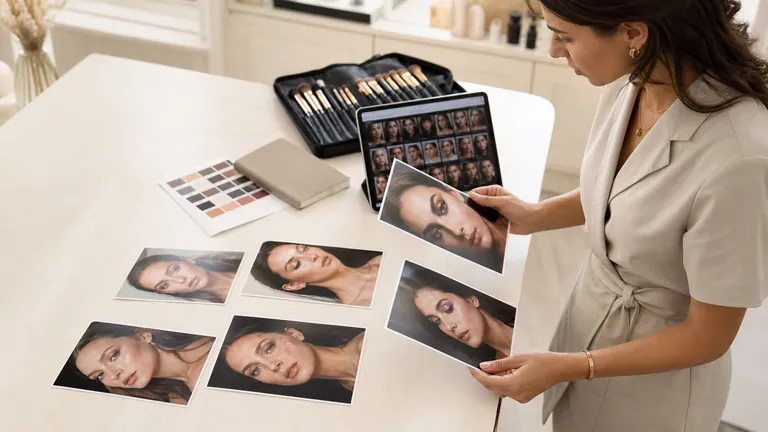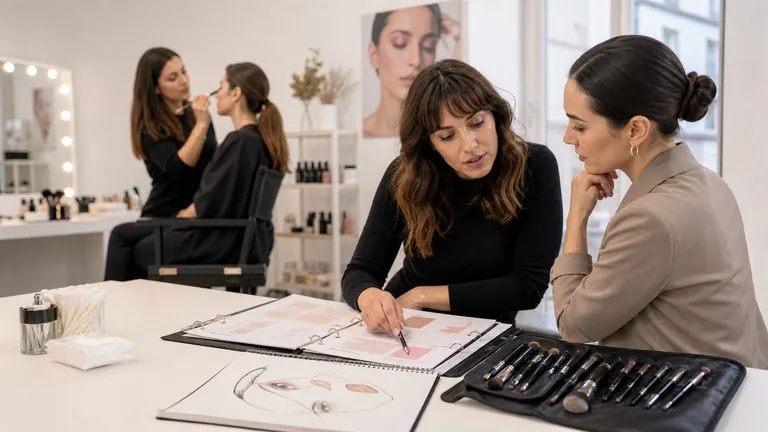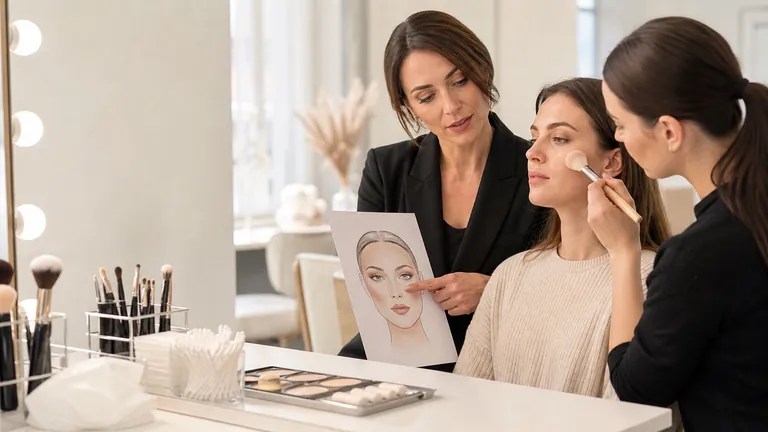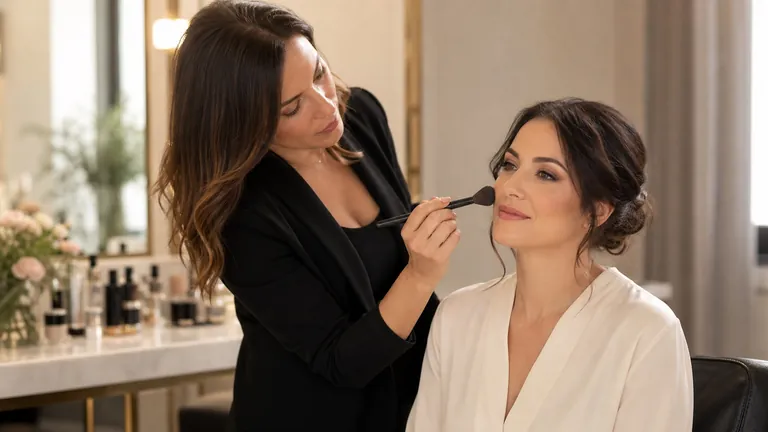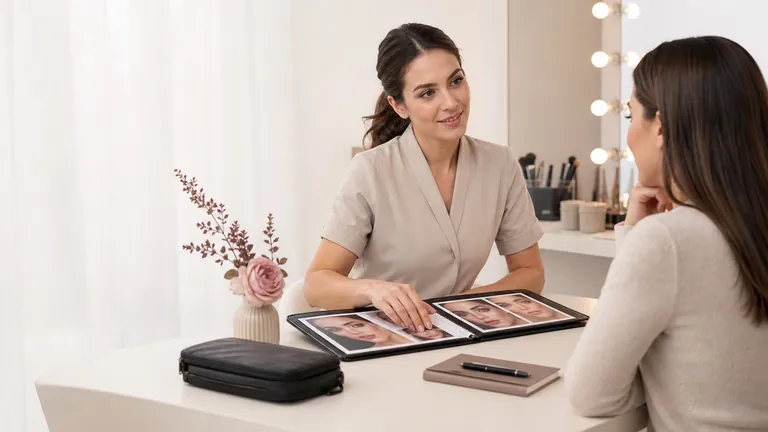
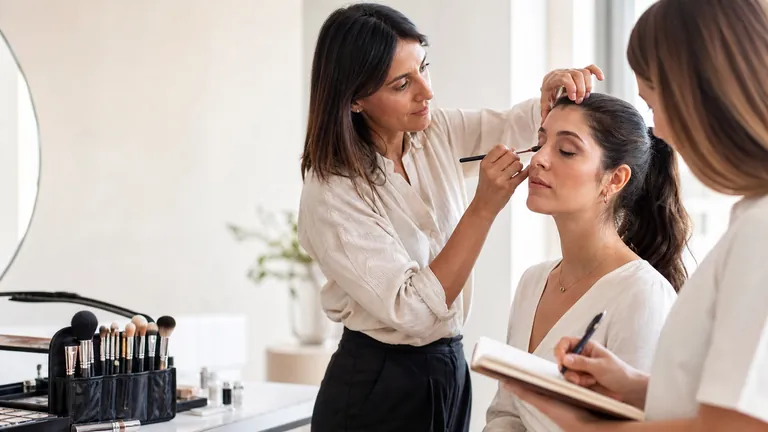
Becoming a makeup artist is not simply a matter of learning an attractive look. Professional work means turning a brief into a controlled service: reading the face and visible skin condition, choosing products for the person and setting, managing hygiene, working to time, checking the result in the relevant light and documenting what was agreed. Creativity matters, but clients and teams can rely on it only when it sits inside a repeatable process.
Quick answer: build foundations in complexion, colour, products, tools and hygiene; practise one measurable skill at a time on varied consenting adults; seek specific feedback; assemble an honest, unfiltered portfolio; then verify the business, insurance and occupational rules that apply where you will work. A private course certificate can document training, but it does not automatically prove competence or grant a universal licence to practise.
Use this career guide to plan training, practice and your first services. Explore the BeautyLearn makeup guide library. For hands-on techniques and exercises, use the separate learn-makeup-from-scratch guide linked below. If you are ready to compare structured programmes, visit the online makeup course collection. English-market programmes, instructors, prices and availability are managed independently from the Italian catalogue.
Makeup artistry is a location-dependent occupation. The job title may be unregulated in one place while the premises, business, adjacent beauty services, retail activity or work with minors is regulated. Requirements also change when a service crosses into permanent makeup, medical camouflage or another licensed activity. Use this guide to organise your questions, then obtain an answer for the exact service, address and jurisdiction before taking payment.
What a professional makeup artist actually does
A makeup artist designs and applies temporary cosmetic makeup for a stated purpose. That purpose may be a private event, bridal service, photographic beauty image, fashion story, screen production, theatre, retail demonstration or education. The technical goal changes with distance, camera, lighting, expected wear, schedule and team. A light daytime application viewed face to face is not planned like a high-resolution studio close-up, and a bridal booking includes consultation, trial, timing and continuity that do not exist in a casual demonstration.
Across those settings, the reliable core is similar: interpret the brief; observe proportions, undertone, texture and contrast without diagnosing; prepare the surface; select compatible products and tools; build coverage and definition in controlled layers; check symmetry and transitions; maintain clean and used workflows; communicate changes; and leave accurate notes when continuity matters. The result is only one part of the service. Punctuality, consent, comfort, kit control and calm problem-solving are visible professional skills too.
A makeup artist, beauty therapist, hair professional and permanent-makeup practitioner are not interchangeable titles. Training in temporary cosmetics does not automatically authorise invasive, therapeutic or separately regulated work. Describe services precisely and refuse a request that exceeds your training, insurance, permission or professional scope.
The four capability areas to build together
Four capabilities, one dependable service
Technique alone does not make client work repeatable
Application
Products, placement and finish
Judgement
Person, brief and lighting
Client care
Consent, hygiene and timing
Business
Terms, cost and permissions
Beginners often measure progress by the number of techniques watched. A stronger model asks what can be demonstrated consistently. Technical application, visual judgement, client care and business operation develop together; a weakness in any one of them can make an otherwise attractive result unusable in paid work.
Capability | Observable evidence | Common beginner gap |
|---|---|---|
Application | Clean preparation, controlled layers, deliberate placement and stable finish | Copying a look without understanding product or surface |
Visual judgement | Adapts colour, contrast, texture and shape to person, brief and light | Applying one template to every face |
Client and team care | Clear consultation, consent, comfort checks, hygiene and reliable timing | Treating communication as separate from technique |
Business operation | Costed price, records, terms, insurance, permissions and planned kit | Mistaking bookings or revenue for a sustainable business |
Technical foundations include visible skin assessment, preparation, undertone and colour relationships, texture and finish, complexion correction, feature placement, eye and lip work, durability, touch-ups and removal. They also include product literacy: knowing what a formula is designed to do, where it may be used, how it should be stored and what its label or manufacturer says. Brand familiarity is useful, but it is not a substitute for transferable reasoning.
If your immediate goal is skill development rather than career planning, continue with how to learn makeup from scratch: it separates hygiene, amount, complexion, correction, detail work and complete looks into measurable beginner exercises.
What to clarify before you start
How much to budget: a worked example
Planning scenario, September 2026: a beginner studies at home and arranges initial practice sessions with consenting adults. They already own a phone, mirror, table, neutral palette and some usable cosmetics suitable for a hygienic practice workflow. The amounts below are hypothetical allowances in euros, not market averages, a BeautyLearn course quote or the cost of starting a business. Replace each allowance with an actual local quote in your own currency; this is not an exchange-rate conversion.
Item | Example allowance | What is included / avoid counting twice |
|---|---|---|
Training | €300 | Assumption: video lessons and worksheets included; physical kit and individual tutor corrections excluded. Check the selected course's actual terms. |
Missing products | €140 | Only shades and textures needed for the planned practice cases; no duplicate palette or products already suitable for use. |
Brushes | €60 | One missing essential set; remove this allowance if it is included in the course fee. |
Disposables and hygiene | €40 | Single-use applicators, spatula, palette, suitable cleaning products and clean/used containers for the practice period. |
Lighting | €50 | One light for comparable photographs. Existing phone and mirror: no additional purchase. |
Transport | €30 | Planned local travel for practice sessions; no new trolley in this example. |
Planned total | €620 | €300 for training + €320 for supplies and organisation, with no duplicate purchases. |
Before paying, mark each item as already owned, included in the course or still needed. Ask for a written list of materials, access, assessment and feedback included in the fee. If the brushes are included in the €300, this example falls to €560. If you want individual corrections, add the quoted cost. Business registration, tax, insurance, premises and a complete professional kit are outside this practice budget.
How much time to set aside: a six-hour sample week
When | Time | Activity and output |
|---|---|---|
Tuesday evening | 1 hour | Video lesson and notes: choose one observable practice objective. |
Thursday evening | 1 hour | Video lesson and worksheet preparation: record products and review criteria. |
Saturday | 3 hours | Hands-on practice, including setup, application, photographs, timing notes and cleanup. |
Sunday | 1 hour | Review photographs and notes, collect feedback if available, and plan one correction. |
That is 2 hours of video study, 3 hours of practice and 1 hour of review. Adapt the slots around work and family; this is not the duration of a specific course. Tutor feedback must be arranged and is not automatically included. Self-review does not replace qualified feedback. If you miss a week, move the session: hours help organise your commitments, not promise professional competence or a qualification by a deadline.
To turn your chosen route into a realistic schedule, use the guide to how long professional makeup takes to learn. It separates understanding, guided execution, adaptation and professional reliability, using milestones rather than a guaranteed number of hours.
What requirements should you check to work as a makeup artist?
Requirements depend on the service and where you work. A private certificate alone does not establish permission to provide every service in every country. Use this checklist before choosing training for a particular career goal.
If you plan to work in Italy, ask the relevant regional office, the municipality's SUAP business desk and Chamber of Commerce about the actual activity. INAPP's Truccatore Artistico (MAKE UP ARTIST) profile belongs to the Sicily repertoire: it is a territorial qualification reference, not a nationwide or international licence.
INAPP — Truccatore Artistico (MAKE UP ARTIST), Sicily qualification repertoire
If the final document affects your decision, use the makeup certificate and qualification verification guide. It separates private completion records, assessed credentials, regulated qualifications, accreditation and local licences before you rely on a recognition claim.
A seven-stage route from beginner to first paid work
Build evidence before bookings
Each stage answers a different readiness question
Choose a direction and learn foundations
Practise and obtain specific feedback
Select a truthful portfolio
Verify permission and cover
Rehearse the full service
1. Define the market and service before buying everything
Start with a direction rather than a fantasy job title. Private clients, bridal, fashion, film, theatre, retail and education require overlapping foundations but different portfolio evidence, kit depth, pace and networks. You do not need a permanent niche on day one. You do need to know which first service you are preparing to deliver, because that decision shapes training, models, products and images.
2. Learn the foundations in a visible sequence
A beginner curriculum should connect hygiene, consultation, tools, cosmetic labels, visible skin condition, preparation, colour, complexion, brows, eyes, lips, finishing, photography and removal. It should show full applications as well as isolated techniques. The beginner makeup course provides an entry point, while the complete makeup artist course presents a broader pathway. Enrolment status belongs to the English course page and may differ from another market.
3. Practise deliberately, not randomly
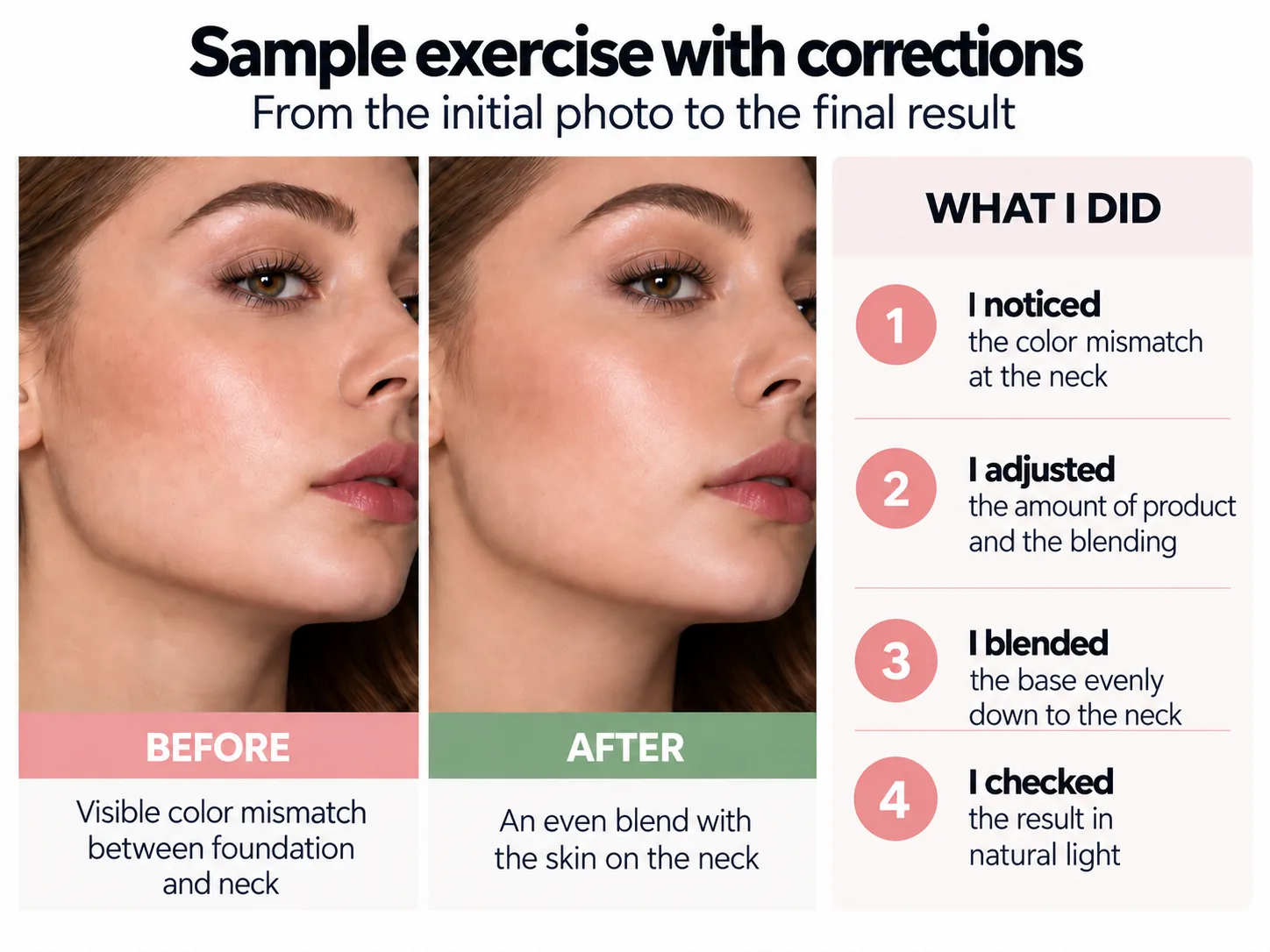
Watching creates recognition; performance requires retrieval and correction. Give each practice session one dominant objective, such as matching a base across the face and neck, neutralising only the required discolouration, controlling an outer eye direction or keeping a lip edge crisp. Record the starting point, products, amount, tools, time, light, result and next adjustment. Repeat the skill on different consenting adults rather than refining it only on your own familiar face.
For a controlled complexion match, use the foundation depth and undertone protocol. It separates depth, undertone and surface variation, then tests comparable jaw swatches in stable light after the formula settles.
Connect complexion colour to whole-face design with the corrective makeup and visagism method. It separates structure, proportion, colour and texture, then plans brows, blush, light and shadow around an agreed priority instead of a standard face map.
4. Ask for feedback that names the decision
Useful feedback is specific: the undertone changes at the jaw; coverage is heavier around the nose; the two liner angles solve different visual problems; the transition disappears under the planned light. ‘Beautiful’ and ‘wrong’ are reactions, not rubrics. Compare the result with the brief, technique criteria, comfort, hygiene and timing. Correct one cause at a time so that the next attempt teaches you something.
 Open the full-size image (new tab)
Copyable template: practice session worksheet
Complete one sheet per session. Avoid unnecessary personal information and keep permission to practise separate from permission to publish photographs.
Date and session reference: [ ] Observable goal: [ ] Person and context, without unnecessary personal data: [ ] My role and the feedback provider's role: [ ] Planned / actual time, including cleanup: [ ] Products, tools and hygiene procedure: [ ] Agreed fee or exchange / unpaid practice: [ ] Images: [front, sides, detail; consistent light and pose] Image consent and agreed uses: [ ] Credits to include: [ ] Review criterion set before starting: [ ] What I observe in the photographs: [ ] Feedback received and from whom: [ ] One correction to test: [ ] Result of the repeat attempt and next step: [ ]
5. Build a small, truthful portfolio
A portfolio is evidence for the work you are asking to do. Ten coherent cases are more useful than fifty unrelated close-ups. Show a clean before view where consent permits, the finished result in relevant light, useful details and enough variety to demonstrate adaptation. State whether a project was training, collaboration, assistance or paid work. Credit the photographer, model, hair artist, stylist and other collaborators correctly.
Do not smooth away texture, change colour or reshape features until the image no longer represents the application. Retouching may be part of a production workflow, but a makeup portfolio must allow a client or collaborator to judge makeup. Consent to receive the service is not consent to publish a face: obtain a separate, specific permission and respect a later withdrawal where the applicable rules require it.
6. Verify permissions, insurance and terms
Before advertising or taking a deposit, identify the occupation, exact service, work location and client group. Ask the competent authority whether professional licensing, beauty-service rules, premises registration, zoning, mobile-work permission or other conditions apply. Then discuss business and professional liability cover with a regulated adviser, declaring every service and place of work. Written booking terms should explain price, deposit, cancellation, lateness, travel, trial, image use and what happens if the service must stop.
Makeup contracts in Italy: quotes, deposits and cancellations
Makeup liability insurance and complaints in Italy
7. Test the complete service before the first booking
A finished look is not a finished system. Rehearse enquiry, consultation, kit packing, travel margin, setup, hand and tool workflow, application, client checks, photography, payment, cleanup, laundry or disposables, records and follow-up. Measure the full time, not only brush-on-face minutes. A supervised model or low-risk controlled case should expose missing products and weak transitions before a paying client does.
How to choose makeup training without buying a promise
A strong course states its starting level, learning outcomes, full curriculum, educator experience, demonstrations, practice expectations, feedback, assessment, access period, kit requirements and the exact document issued. It does not hide behind the word ‘certified’. Ask who recognises the certificate, what evidence earns it and whether local authorities, employers or insurers impose separate requirements.
Scope: does the programme teach complete services as well as eye-catching fragments?
Observation: does it explain why product, colour and placement change across people and settings?
Practice: are models, exercises, submissions and required evidence defined before purchase?
Feedback: is work corrected against an explicit rubric rather than praised generally?
Hygiene and boundaries: are contamination control, stop criteria and referral treated as core skills?
Transparency: are price, kit, assessment, access, certificate and limitations clear?
Online learning can teach theory, allow replay of close demonstrations and support documented assignments. It cannot make hands-on competence automatic. In-person training can offer immediate observation and model access, but attendance alone is not proof of ability. Judge the actual teaching, supervised practice and assessment rather than the delivery label.
Before choosing a training format, use the makeup course cost guide to compare the advertised fee with compulsory kit, practice, feedback, access, travel and payment terms. Its planning scenarios are not market averages or price promises.
If format is now the deciding variable, compare online, live, hybrid and classroom makeup training by demonstration visibility, learner practice, feedback, models, schedule and repeat opportunities rather than assuming one mode is universally better.
Before enrolling, apply the evidence checklist for choosing a makeup course. It compares outcomes, designed practice, feedback, educator evidence, certificate wording, access and conditions without treating price, duration or format as automatic proof of quality.
Private certificate, qualification and permission to work are different questions
Four documents, four different questions
Do not ask one certificate to prove everything
Course certificate
What training or assessment occurred?
Qualification
Which formal framework recognises it?
Permission
May this service operate here?
Insurance
What risks and locations are covered?
These terms are often collapsed in marketing. A course certificate usually records participation or an assessment under that provider’s rules. A public or recognised qualification belongs to a defined education or occupational framework. Permission to trade or perform a service comes from the law and authorities that apply to the location and activity. Insurance is a separate contract with its own conditions. One document does not silently answer all four questions.
There is no single international licence called ‘makeup artist’. The European Commission maintains a database for checking regulated professions across EU countries, but absence of one job title does not remove business, premises or adjacent-service obligations. In the UK, the official licence finder is a starting point before checking the relevant local authority. In the United States, state, county and city requirements depend on activity and location; the Small Business Administration directs businesses to the competent agencies. Other countries need their own official route.
Write the exact temporary makeup services you intend to sell and exclude anything you are not trained or permitted to do.
Record the country, state or region, municipality and every work setting: salon, home, mobile, venue, retail or production.
Ask the official licensing or local authority about the occupation, services and premises, not only the job title.
Check business registration, tax, employment, consumer, privacy and work-with-minors requirements separately.
Give the written service description to the insurer and ask about qualifications, exclusions, locations and subcontractors.
Keep the replies, policy schedule, certificates and renewal dates together and recheck when the service or address changes.
Hygiene and cosmetic safety are practical skills
A one-way working surface
Prevent used tools from travelling back into clean stock
Clean stock
Closed, labelled and protected
Active zone
Decanted product and current tools
Single use
New applicator for each contact
Used zone
Contained until cleaning or disposal
A professional kit is not a larger personal makeup bag. It must support work between different people without carrying used applicators or contaminated product back into clean stock. Wash hands at the relevant points; decant creams and liquids onto a clean palette without touching the dispenser; use new single-use applicators where required; never double-dip a used mascara wand; separate clean, active and used zones; and clean reusable tools with a documented method suitable for the material.
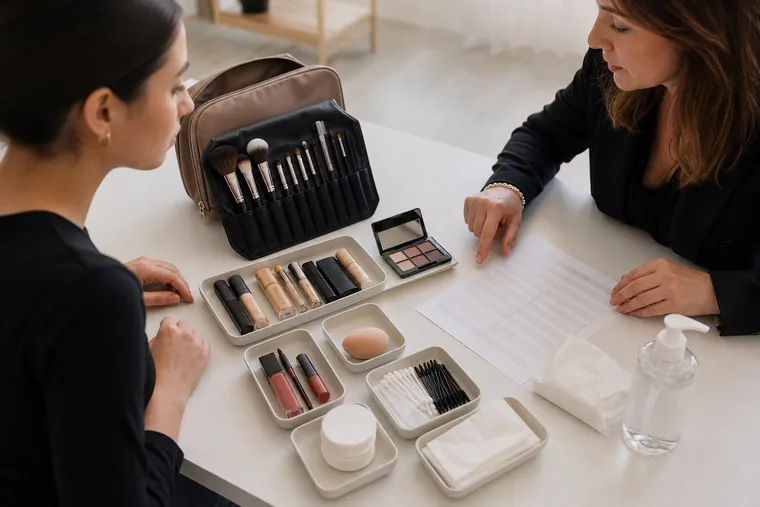
Read the complete cosmetic label and follow directions, warnings, intended use and storage. A product made for the lips is not automatically suitable for the eye area, and adding water or saliva to dried mascara can introduce microorganisms and dilute its preservation. Do not share products through the same applicator. Keep containers closed, remove products that have changed unexpectedly and record enough information to trace what was used if a problem is reported.
Ask about known sensitivities and current comfort, but do not diagnose allergy or skin disease. Visible broken skin, marked inflammation, eye infection signs, pain, swelling, discharge or an unexplained acute change can require postponement and appropriate healthcare advice. If irritation begins during application, stop the suspected product, remove it safely and follow the relevant first-aid and product directions. Difficulty breathing or a severe reaction requires emergency help.
Protect every practical exercise and client service with the makeup hygiene workflow. It separates clean and used zones, prevents double-dipping and gives brushes, sponges, products and surfaces a traceable route between people.
Build a kit around services, hygiene and shade logic
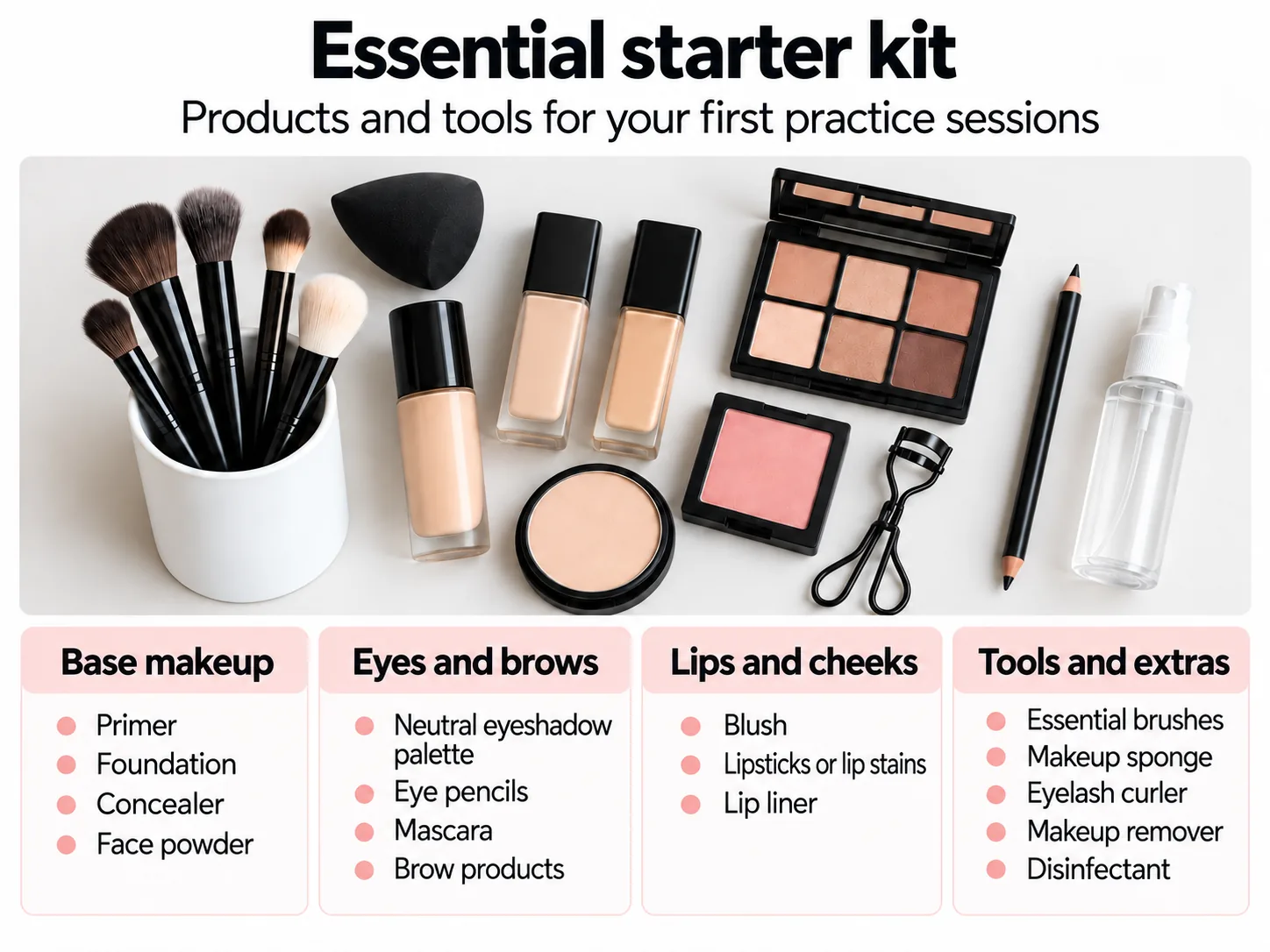
Do not try to buy every launch before you have a service. Begin with tools and products that cover preparation, adaptable complexion work, controlled correction, neutral and planned colour, brows, eyes, lips, finishing, hygiene and removal for your practice cases. Choose shade families that can be adjusted methodically and test formula compatibility. Add specialist finishes only when a portfolio or booking requires them.
Cost per use, replaceability, pack hygiene, transport, temperature, opening life and local availability matter as much as the purchase price. Keep an inventory with product, shade, batch or lot where available, opening date, condition and replacement decision. Samples and decanted products need an identification system; an anonymous pot is not professional flexibility.
Before adding products, build a function-based beginner makeup kit. The checklist separates hygiene, complexion, colour, brushes and study tools, then adds each new function only when a planned exercise makes it necessary.
 Open the full-size image (new tab)
How to create portfolio evidence that survives scrutiny
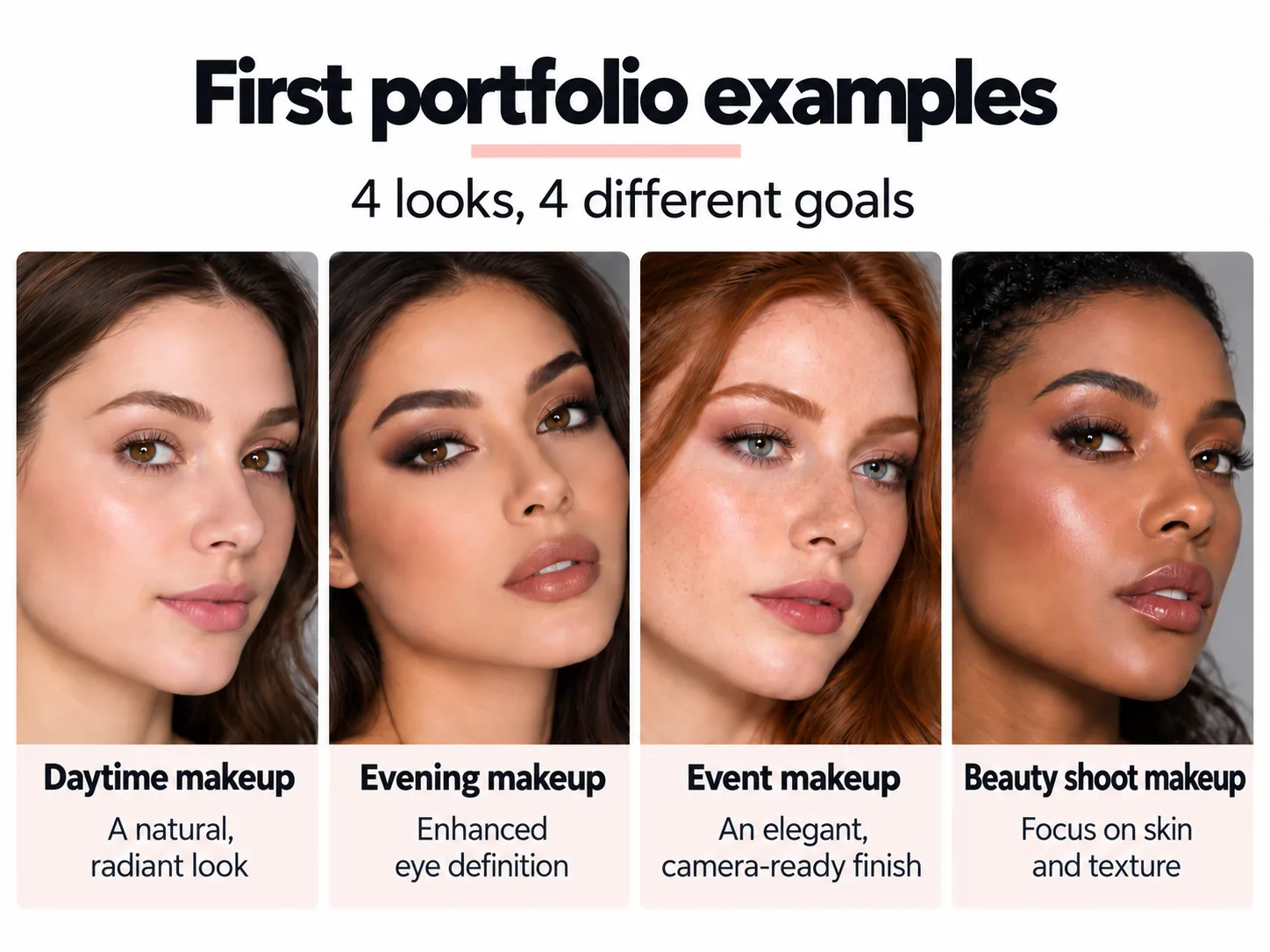
Choose cases according to the target client or collaborator. A bridal portfolio needs consultation-led looks, useful skin detail, relevant lighting and evidence of consistency. A fashion portfolio may prioritise concept, team credits and editorial control. A private-event portfolio should show polished, wearable variation across ages, visible skin textures and colour depth. Every portfolio needs truthful colour and enough context to understand the work.
Use a repeatable capture setup: clean lens, neutral or controlled light, fixed white balance where possible, front and side views, open and closed eyes when relevant, and no beauty filter. Keep the strongest images, not every image. Add a short case note privately: brief, constraints, products, time, adjustment and outcome. That record helps you explain decisions in an interview and prevents the portfolio from becoming a decorative feed with no learning history.
When your skills need to become clear evidence, use the makeup artist portfolio guide to select relevant projects, photograph them faithfully, state roles and manage consent, credits and image rights.
 Open the full-size image (new tab)
Finding first opportunities without disguising free labour
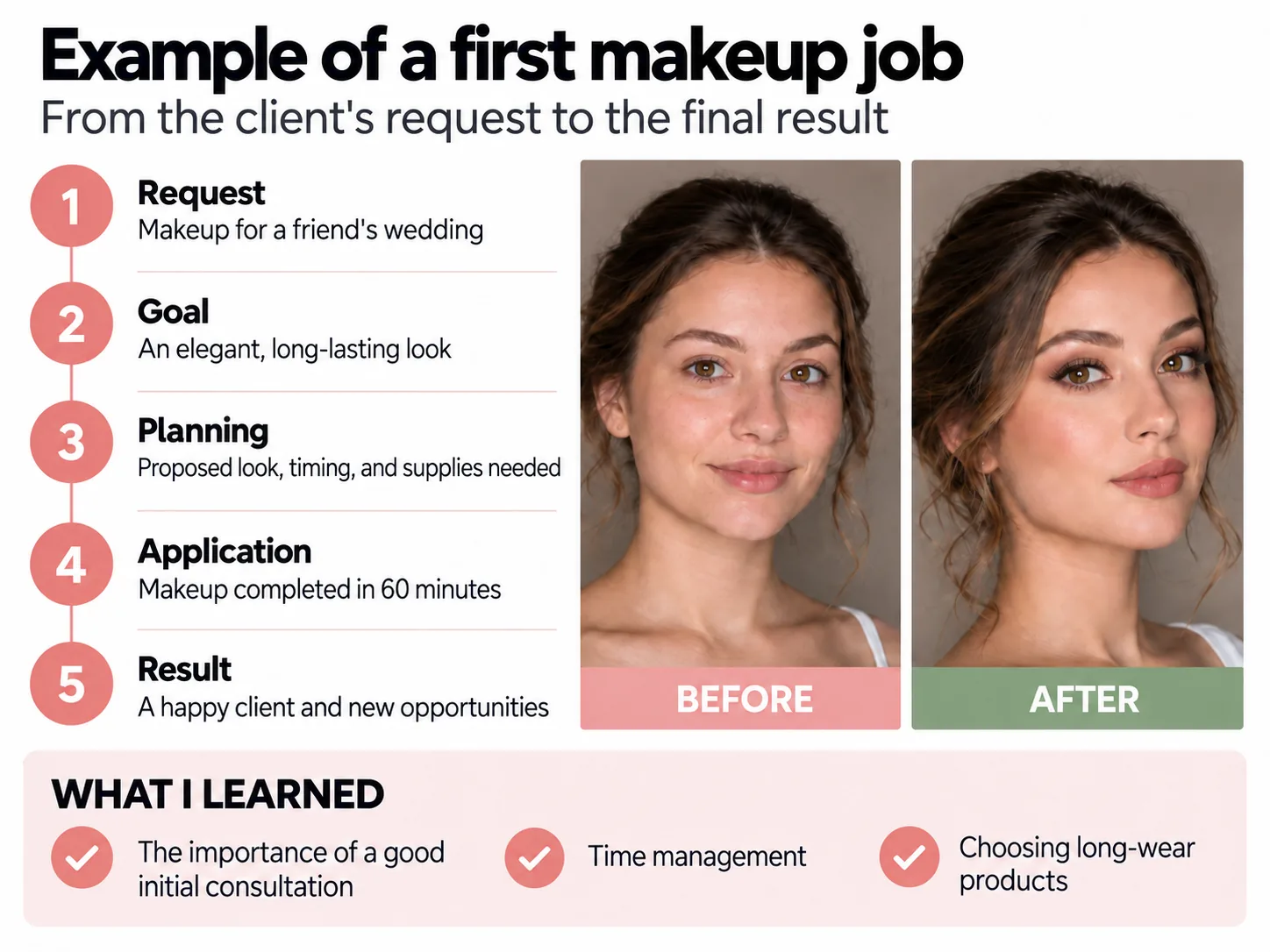
Early experience may come from supervised assisting, structured test shoots, model calls, retail work, small private bookings or collaboration with photographers, hair artists, stylists and wedding suppliers. Each route should produce a defined benefit: assessment, observation, agreed images, credit, a fee or a credible relationship. ‘Exposure’ is not a complete agreement.
Confirm the date, location, call time, finish time, brief, number of people, products, expenses, fee, image delivery, credits, usage rights, cancellation and who directs the result. For a model call, explain the trainee status and what will be practised. For assisting, clarify whether you may use photographs and whether the lead artist or production owns the client relationship. Reliability in these small agreements becomes part of your reputation.
When skills and evidence are ready for the market, continue with how to find makeup clients: local discovery, authentic reviews, relevant partnerships, clear quotations, privacy-aware follow-up and booking measurement.
 Open the full-size image (new tab)
Copyable template: propose a collaboration
Adapt this message to the project and your actual experience. A proposal becomes an agreement only when participants explicitly confirm the roles, terms and image permissions.
Hi [name], I am building a portfolio focused on [service/goal]. I would like to propose [specific project], producing [concrete output]. My role would be [ ]; I am looking for [role and contribution]. My current experience and relevant real work are here: [link]. Location, date and timings: [ ], including setup and cleanup. Supplies I provide / items to agree: [ ]. Proposed fee or precise exchange: [ ]; expenses and transport covered by [ ]. Images to deliver, selection process and deadline: [ ]. Image use, permitted channels and consent from the people photographed: [ ]. Agreed credits for each publication: [ ]. Confirmation, changes and cancellation arrangements: [ ]. Would this interest you? Let's confirm these points in writing before fixing the date.
Price the complete service, not only application time
A sustainable price includes consultation, preparation, packing, travel, setup, application, photography, cleanup, consumables, product replacement, laundry, booking administration, fees, insurance, training, tax and non-billable gaps. Revenue is not income and a busy diary can still lose money. Build a simple cost model before copying a local price list, then compare the result with the market and the value of the service you can actually deliver.
Start with a controlled menu. One reliable event service with clear inclusions is safer than promising bridal, editorial, special effects, hair styling and group bookings before the systems exist. Add a service when training, practice evidence, kit, timing, terms, permission and insurance all support it.
Working in Italy: VAT registration, invoices and costs
Makeup artist earnings in Italy: revenue, costs and income
A 90-day beginner development plan
A planning window, not a mastery promise
Progress is released by evidence, not the calendar
Days 1–30
Hygiene, products, colour and complexion
Days 31–60
Features, complete looks and feedback
Days 61–90
Portfolio, permissions and rehearsal
Readiness
Assessment decides, not day 90
Use these 90 days as an organisation programme, not a promise of being ready for paid work. Extend or repeat a phase when its review criteria are not met. The calendar does not replace a competence assessment or verification of local requirements.
Period | Activity | Material to produce | Review criterion |
|---|---|---|---|
Month 1 · days 1–30 | Study foundations and hygiene; schedule simple practice sessions with one objective each. | A kit checklist marking owned/missing/course-included items, plus practice sheets with photographs, products, timings and notes. | Does the kit avoid duplicates? Can the photos and notes identify one specific error? Are clean and used items separated? Repeat uncontrolled steps. |
Month 2 · days 31–60 | Repeat skills on different consenting adults, request focused feedback and adjust one step at a time. | A selection of varied practice cases with comparable images, feedback received and documented corrections. | Is the correction visible in comparable photographs? Can you explain what changed and why? Seek qualified feedback on unresolved technical questions. |
Month 3 · days 61–90 | Select work, describe one clearly limited service and prepare the organisation of a possible assignment. | A short portfolio, a service proposal with inclusions/exclusions and a job sheet covering brief, role, timing, kit, travel, terms and image use. | Do the images support the proposed service? Are timing and agreements realistic? Are requirements checked? If gaps remain, continue practice or assisting before expanding the offer. |
Readiness checklist before taking payment
I can complete consultation, hygiene, application, checks and cleanup without skipping stages.
My portfolio shows the service truthfully on varied consenting adults in relevant light.
I know my stop criteria and can refer concerns without diagnosing or promising treatment.
My kit supports the booked skin tones, visible conditions, hygiene workflow and location.
The competent authority has answered for my exact service and workplace where verification is required.
My insurer knows the services, locations and work model and has confirmed the relevant cover.
My price covers full service time and costs, and my written terms match what I sell.
Frequently asked questions
Do I need a licence to work as a makeup artist?
There is no worldwide answer. The job title may be unregulated while a beauty service, premises, mobile business or adjacent activity is regulated. Ask the competent authority about your exact temporary makeup services, location and client group, then confirm the same scope with an insurer.
Does an online makeup certificate let me work professionally?
Not by itself. It can record training or assessment under the provider’s rules. You still need practical competence and any local qualification, licence, business permission, premises approval or insurance required for the work you plan to do.
Can I become a makeup artist through online training?
Online training can deliver theory, replayable demonstrations, assignments and feedback. Professional readiness still needs controlled hands-on practice on varied consenting adults and assessment of complete services. Compare the learning process rather than assuming either online or in-person attendance guarantees competence.
How long does it take to become a makeup artist?
For planning, try the six-hour sample week above: 2 hours of video lessons, 3 of hands-on practice and 1 of review. This is not a competence threshold. Assess repeatable results across varied faces, hygiene, timing and the ability to correct errors, and repeat phases of the 90-day plan as needed.
Can I teach myself makeup artistry?
Self-study can develop knowledge and personal technique, but blind spots are hard to see alone. Structured education, specific feedback, supervised practice and external assessment reduce the risk of repeating weak hygiene, colour or application decisions. Local rules may also require evidence beyond self-study.
What should I learn first?
Start with hygiene, consultation, visible skin assessment, preparation, tools, product functions, colour and controlled complexion work. Then add brows, eyes, lips, complete looks, durability and photography. Advanced styles are easier to understand when surface, amount, edges and balance are already controlled.
How many models should I practise on?
There is no responsible magic number. Practise until you can repeat the complete service across relevant adult faces, skin tones, visible conditions and lighting without losing hygiene or timing. A practice log and assessment rubric say more than a model count.
What should a beginner makeup portfolio contain?
Include a small selection aligned with the work you want: truthful complexion detail, varied people, controlled eyes and lips, complete looks and relevant lighting. Use unfiltered colour-faithful photographs, identify collaborative roles and obtain separate publication consent.
Do I need an expensive makeup kit to start?
No. You need a hygienic, traceable kit that supports the models and services in training. Start with adaptable essentials and planned shade logic. Add products after a real capability or booking reveals a gap, not because a large collection looks professional.
How much does it cost to start learning makeup artistry?
The hypothetical practice budget above totals €620: €300 for training, €140 for missing products, €60 for brushes, €40 for disposables and hygiene, €50 for lighting and €30 for transport. It is not a BeautyLearn price or business startup estimate. Subtract existing or course-included items and replace the allowances with local quotes in your currency.
Can I work as a mobile makeup artist?
Possibly, subject to local rules and insurance. Mobile work adds transport, lighting, surface, handwashing, clean-and-used separation, temperature, privacy and travel-time constraints. Describe the mobile model explicitly when checking permissions and cover.
Can I work from home?
Do not assume so. Planning or zoning, landlord or mortgage conditions, insurance, premises rules, waste, sanitation, parking and client access may apply. Verify the address and services before fitting out a room or advertising appointments.
Is bridal makeup a good first specialism?
It can be a target, but it is not a low-responsibility beginner service. Bridal work requires consultation, trial, durable application, faithful photography, timing, travel, contracts, contingency planning and calm client care. Build and assess those parts before accepting a wedding-day booking.
Turn technique into a repeatable event service with the professional bridal makeup guide. It connects the brief, trial record, wear test, wedding-day timing and personal touch-up handover without replacing detailed technique or career pages.
Should I work for free to build a portfolio?
Unpaid work is not automatically exploitation or opportunity. Define the exchange: supervision, images, credits, access, expenses, time and usage. Use written terms and a limit. A collaboration that produces no learning, usable evidence, relationship or compensation is not a portfolio strategy.
Do makeup artists need insurance?
Legal requirements vary, but venues, clients, landlords or regulators may require cover. Discuss professional and public liability, products, equipment, travel and business interruption with a regulated adviser. Declare every service and location and read exclusions and reporting duties.
Can a makeup artist diagnose a skin condition or allergy?
No. A makeup artist may record what a client reports, observe visible signs and decide not to proceed. Diagnosis and treatment belong to appropriately qualified healthcare professionals. Significant or unexplained symptoms should lead to postponement and suitable referral.
How do I get my first paying clients?
First make one service demonstrably ready. Publish a faithful consented portfolio, clear scope, prices, location, terms and availability. Build local relationships with complementary professionals and ask completed clients for genuine feedback. Consistency and a low-friction booking process usually matter more than posting every trend.
How much can a makeup artist earn?
There is no universal figure. Revenue depends on market, sector, price, bookings and season; profit also subtracts products, travel, insurance, fees, tax, cancellations, training and unpaid administration. Model several local scenarios instead of treating a course provider’s income example as a forecast.
When am I ready to specialise?
Specialise when your foundations remain stable under the new setting. If you can already deliver clean complexion, controlled features, hygiene, consultation and timing, a sector-specific course and portfolio can add bridal, editorial, screen or another direction without hiding missing basics.
Official sources and editorial scope
For occupational requirements in Europe, use the European Commission’s database of regulated professions and then the competent national or local authority. UK readers can begin with the official licence finder. US readers can use the Small Business Administration’s business launch guidance before checking state, county and city agencies. These links are starting points, not a licence decision for one reader.
Cosmetic hygiene and eye-area statements are informed by the US Food and Drug Administration’s current guidance on using cosmetics safely, eye cosmetic safety and microbiological safety. Product directions and the rules of the market in which a cosmetic is supplied remain essential.
Editorial update: 24 September 2026. Irene Tomasi’s professional perspective informs the structure, while regulatory and healthcare statements require verification for the reader’s jurisdiction and circumstances. This independent educational article contains no competitor links, does not diagnose or prescribe, and does not guarantee employment, income, licensing or course outcomes.