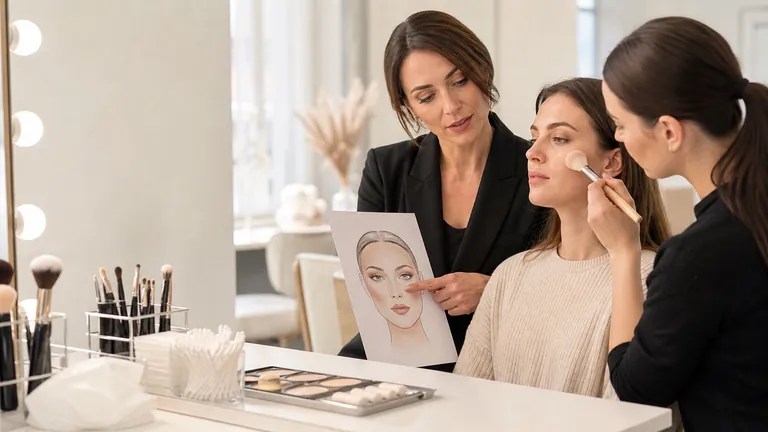
A makeup artist portfolio is not a storage folder for every face you have worked on, and it is not a social feed designed only to collect reactions. It is a selected body of evidence. In a few minutes, a private client, bridal client, photographer, agency or collaborator should be able to understand what you can do, whose features and needs you have adapted to, what role you performed and whether your work fits the assignment they have in mind.
Quick answer: include a compact selection of complete, technically readable work that matches the market you want to enter. Show different adult skin depths, ages, textures, features and briefs; combine full-face views with purposeful details; state your role and team credits; avoid editing that changes skin or colour. Publish only images whose subject permission and photographic usage rights cover the intended channels.
This guide owns the question of what to include, exclude and present in a makeup artist portfolio. The broader route into the profession belongs to how to become a makeup artist. Detailed camera and lighting technique, and the separate task of finding clients, deserve their own pages. If the evidence is not ready yet, build the underlying skills through the online makeup course catalogue rather than trying to make an unfinished result look commercial.
Start with the assignment your portfolio must win
One archive, four purposeful edits
Select for the assignment rather than sending everything
Beauty
Real skin and bookable results
Bridal
Consultation, detail and reliability
Set
Brief, precision and team credits
Entry
Repeatable foundations and honest context
Selection begins with the reader. A bridal client wants to recognise polished skin, a considered consultation, comfort and a look that photographs well without losing identity. A beauty client needs to see services they can actually book. A photographer looks for edge control, colour fidelity, speed and collaboration under a brief. An agency may look for consistency, versatility and production-ready files. One undifferentiated gallery rarely answers all four readers clearly.
Write the target assignment at the top of your private selection sheet: for example, natural occasion makeup for local clients, bridal services, e-commerce beauty or editorial collaboration. Every project that remains should answer at least one question that target reader is likely to ask. If an image is attractive but unrelated, keep it in your archive rather than forcing it into the public sequence.
Audience | Prioritise | Make visible |
|---|---|---|
Private beauty clients | Day, evening, event and corrective work | Real skin, balanced result and bookable service |
Bridal clients | Different ages, styles and lighting conditions | Consultation decisions, detail and complete look |
Editorial or set | Beauty, fashion and coherent concepts | Brief interpretation, precision and team credits |
Early opportunities | Repeatable fundamentals and honest personal projects | Current standard and accurately stated role |
What a professional makeup portfolio should prove
A pleasing image is not enough. The sequence should let a viewer assess skin preparation, colour decisions, transitions, edges, symmetry, correction choices, relationship between facial zones and the finish of the complete look. A tight eye crop cannot prove foundation work. A distant portrait cannot show whether eyeshadow edges are clean. Complementary views of one project are more useful than several unrelated hero shots.
Useful breadth means adaptation, not a checklist of trends. Include work on a meaningful range of adult skin depths and types, visible skin textures, ages, eye and lip shapes, style preferences and intensity levels. Representation should arise from competent decisions made for each person, not from labels added to a caption. Never describe natural features as faults. If your work only looks convincing on one face or under one filter, the next step is practice rather than promotion.
The core work to include
Complexion and correction: work where undertone, texture, discolouration and dimension remain readable without digital smoothing.
Eyes: different placements and intensities, rather than many near-identical versions of the same smoky eye.
Lips: controlled outline, colour and finish shown in relation to the whole face, not only isolated macro crops.
Natural or daytime makeup: restrained product, believable skin and a finish that survives ordinary light.
Evening or occasion makeup: increased contrast and wear without losing proportion, comfort or cleanliness.
A genuine specialism: bridal, editorial, photographic or another field only when it serves your target and the evidence is deep enough.
There is no universal number of photographs. As a practical starting point, roughly 12 to 20 strong images can be clearer than 50 uneven examples. One project may justify a complete portrait, a purposeful detail and a short project note, but it should not fill half the portfolio with nearly identical frames. The weakest included work often sets the viewer’s estimate of your minimum standard.
Build an evidence matrix before selecting photographs
From image folder to evidence set
Each project needs one clear reason to stay
Name the target assignment
Assign one primary proof
Remove weak repetition
Plan the next practice gap
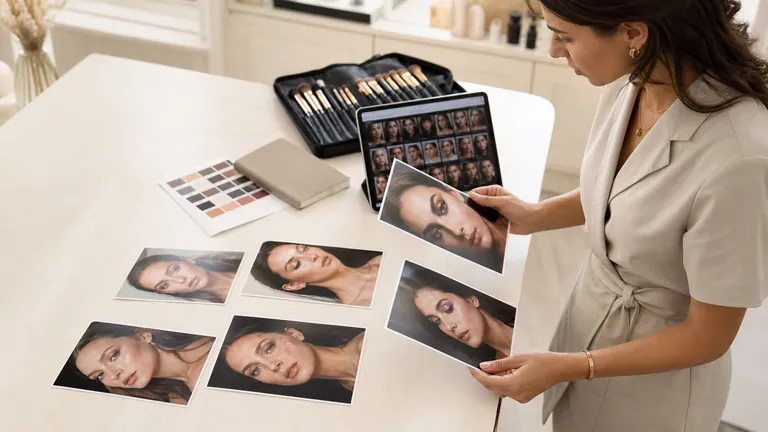
Make a private grid. Use rows for complexion, eyes, lips, complete look, hygiene and response to a brief. Use columns for skin depth and type, adult age range, feature shape, lighting and intended market. Assign each candidate project one primary proof. The exercise quickly reveals when five photographs show the same neutral eye while none demonstrates foundation matching across skin depths or adaptation to mature texture.
The matrix is not a demand to fill boxes quickly or recruit people as tokens. It is a plan for deliberate practice. Turn a genuine gap into a controlled personal project with an adult participant, a written brief, defined light, agreed image use and one technical aim. The corrective makeup course can support face and complexion analysis; the bridal makeup course is relevant when your intended offer is truly bridal.
Use a short project card, not a vague caption
For major projects, add a concise note covering the objective, context, relevant visual characteristics without unnecessary health information, colour or texture decisions, time or lighting constraints, your role and the collaborators. “Makeup by me” gives little evidence. “Corrective beauty for continuous studio light; sheer layered base and reduced eye contrast” explains a choice without turning the portfolio into a long tutorial.
State assistance accurately. If you prepared skin, maintained the station or completed one area under another artist’s direction, name that contribution. Do not claim photography, styling, hair, retouching or creative direction performed by someone else. Clear credits increase trust and make the work easier for potential collaborators to interpret; they do not diminish your role.
Photograph makeup faithfully enough to assess
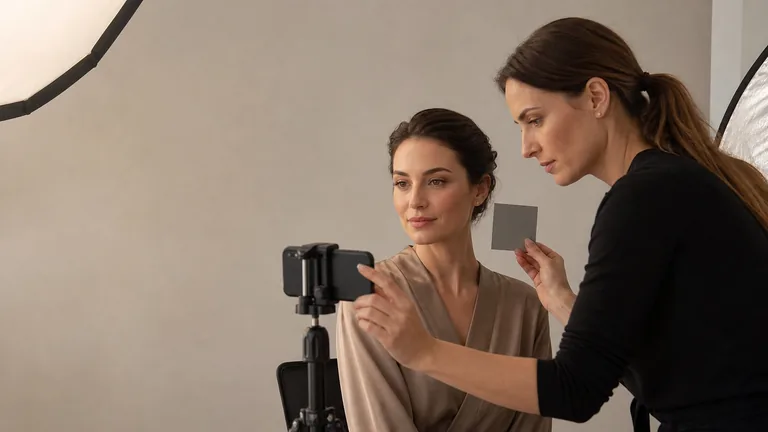
Use controllable, repeatable light and check white balance before producing a whole series. Capture a front or three-quarter portrait, one relevant detail and, where useful, a wider view that explains context. Focus on the skin and the area whose technique you want to prove. Avoid beauty filters, excessive sharpening and edits that rebuild texture, edges, colour or facial structure. Technical correction should help the file resemble the observed result, not manufacture a different result.
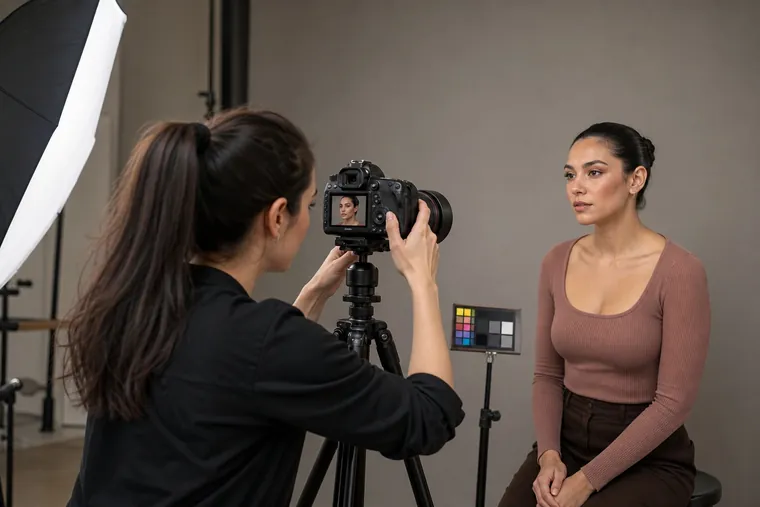
Google’s official guidance for Business Profile photographs recommends images that are in focus, well lit and free of significant alteration or excessive filters so they represent reality. That is also a useful portfolio test: the person viewing the image should be able to connect it to the service they may receive. See Google’s business photo guidance. This does not mean every photograph must look identical; it means aesthetic choices should not conceal the evidence.
Before-and-after images: useful only when comparison is fair
A before-and-after pair can show correction and respect for facial structure only when light, distance, focal perspective, pose and expression are comparable. If the first frame is deliberately unflattering and the second is filtered, the pair measures photography rather than makeup. Present the person with dignity, use neutral wording and never imply that untreated skin is unacceptable.
The format is optional. A bridal reader may learn more from the approved complete look, focused details and a documented wear result. An editorial reader may care more about interpretation of the brief. A well-controlled pair may be valuable for corrective work. The “before” photograph still has a subject, purpose and publication channel and therefore needs the same permissions as the finished image.
Consent, privacy and photographic rights are separate checks
Three permissions that are not interchangeable
The subject, photographer and team each require a clear agreement
Subject
Information and image use
Photographer
Copyright and licensed channels
Team
Roles and accurate credits
Register
Files, versions and permissions
An identifiable face can be personal data, but the applicable legal basis and obligations depend on jurisdiction and context. Before the shoot, explain who controls the images, why they are collected, where they may appear, how long they may be used, who may receive them and how applicable rights can be exercised. Permission to take a photograph is not automatically permission to publish it on a website, social platform, advert, course page and printed material. Keep the choices understandable and documented, and obtain local legal advice where necessary.
Do not put diagnoses, allergy histories or other unnecessary health information into project captions. If an image documents a skin characteristic relevant to technique, use neutral visual language and disclose only what the person has knowingly agreed to share. Avoid using minors as an easy route to portfolio variety: child safeguarding, consent and commercial-image rules require specific professional assessment, not an improvised template.
Subject permission and copyright are also different. UK Intellectual Property Office guidance explains that a freelance creator will generally be the first owner of copyright unless an agreement says otherwise, and that a licence for one purpose does not automatically permit every later use. International rules vary, but the workflow lesson is stable: agree ownership or licence, channels, duration, territory, permitted edits and credits with the photographer and team. Giving a credit is not a substitute for usage rights. Review the official guidance on digital images and photographs and check the law that applies to your project.
Website, PDF, social media and Google serve different jobs
Your website should carry a stable, fast and service-led selection. A tailored PDF should show only work relevant to a particular application or collaboration. Social media can reveal process, personality and current activity, but platform order and access are not under your control. A Business Profile should show truthful examples of the services offered locally. Keep a broader private archive, then publish purpose-built edits rather than pushing the same gallery everywhere.
Channel | Primary function | Common failure |
|---|---|---|
Website | Authoritative selection and enquiry path | Slow galleries with no service context |
Targeted application or proposal | Sending every project to every recipient | |
Social | Process, relationship and updates | Confusing popularity with competence |
Real services and local presence | Stock images or heavily altered results |
Create credible projects before you have paying clients
Plan supervised practice or personal shoots around written objectives, consenting adults and defined roles. A time-for-portfolio collaboration can be useful when everyone agrees in advance which images may be selected, how and when files will be delivered, who receives credit and which uses are permitted. Never present an exercise as paid client work. Honesty about context does not make a strong result less valuable; it makes your claim verifiable.
A portfolio is also a structured self-assessment tool. Selecting evidence against criteria helps expose both competence and gaps. Cedefop’s portfolio-method material describes portfolios as organised evidence that can include photographs of completed work and emphasises the value of selecting that evidence for reflection. Read the official portfolio method resource. The document is not a beauty-industry standard; it supports the evidence-selection principle.
Three practical edits for three different readers
For private beauty clients, lead with services that can be booked: a believable daytime look, balanced evening makeup, corrective work on more than one complexion need, a result on mature skin and a project where colour and intensity were adapted to the individual. Add details only when they reveal something the complete portrait cannot. The sequence should answer “what could this artist do for me?” rather than imitate a fashion editorial.
For bridal, show consultation-led decisions across different adult ages and styles, complexion in honest light, eye and lip detail and, if genuinely documented, the appearance after a stated wear period. Do not label an exercise “bridal” simply because a veil was added. Describe it as a personal bridal concept unless it formed part of a real service. Link the selection to the service process described in the professional bridal makeup guide.
For editorial, e-commerce or creative teams, show accurate interpretation of different briefs, disciplined close-ups, consistency across a series and full credits. State whether the work was published, commissioned, assisted or independently produced. One coherent story of four images often communicates more than four unrelated concepts. Keep beauty and special-effects claims separate unless you have the training and evidence for both.
Edit for quality, not chronology or trends
Remove an image when it is below your current technical standard, repeats a stronger project, no longer reflects the services you want, lacks usable permission or depends on editing that cannot be defended. Do not preserve early work merely to prove how long you have practised. Growth can be discussed in a biography; the portfolio should show the standard a reader may reasonably expect now.
Trends can inspire practice but should not control the whole collection. A viral placement or finish may date quickly and does not prove foundational decisions. Retain work that shows adaptable complexion preparation, proportion, colour, edges and communication. Review quarterly or after a meaningful new project, but replace only when the new evidence is stronger or more relevant.
Order the portfolio for a useful first minute
Open with one of the strongest and most relevant complete looks, not a logo animation or a long personal statement. Follow with a project that proves a different decision, then alternate enough context and detail to keep the evidence readable. Group by service when clients browse; group by project or story when a creative team evaluates collaboration. End with another strong result and a clear next action.
On the web, optimise file dimensions and formats, use descriptive alternative text and test mobile reading. Alternative text should communicate the useful content and context of the image rather than repeat “makeup artist portfolio” on every frame. Keep decorative images from competing with project evidence. Confirm that contact links work, PDFs have accessible text and no private metadata or unauthorised behind-the-scenes files are exposed.
Makeup artist portfolio checklist
Final check before sharing
The weakest image should not lower the whole selection
Relevant, non-duplicate work
Faithful skin, colour and texture
Role, credits and permissions
Fast page and clear contact
Name the audience and assignment the selection should support.
Map the primary competence each project proves.
Select only focused, colour-faithful and technically readable photographs.
Show meaningful adaptation across adult people, skin and briefs.
Add concise project context, your role and accurate team credits.
Verify subject permission, privacy information and photographic licences.
Prepare distinct website, PDF and social selections where needed.
Remove duplicates, weaker work and evidence that no longer fits the offer.
Test mobile speed, alternative text, contact route and PDF accessibility.
Keep a private rights register and review the public edit periodically.
Frequently asked questions about makeup artist portfolios
How many photos should a makeup artist portfolio contain?
There is no compulsory number. Roughly 12 to 20 strong, non-repetitive images can be a clear starting edit, but the right size depends on the audience, number of projects and evidence each image adds.
Can I use photographs from course practice?
Yes, when the makeup is genuinely your work, the standard is ready and subject permission, photographer rights and credits cover publication. Label it as supervised practice or a personal project, not a commercial commission.
Do I always need before-and-after photographs?
No. They help only when light, perspective, pose and editing are comparable and permission covers both images. For some services, faithful final portraits and relevant details communicate the work more fairly.
Is practising makeup only on myself enough?
Self-application can demonstrate particular techniques, but it does not prove adaptation to different faces, skin, ages, preferences and time constraints. Client-facing work needs supervised practice on a meaningful range of consenting adults.
Should I have one general portfolio or several specialist edits?
Maintain a broad private archive and create focused public edits. Bridal clients, private beauty clients and editorial teams look for different evidence; one enormous gallery can weaken every message.
Can portfolio photographs be retouched?
Light technical correction can improve exposure or restore faithful colour. Do not erase texture, rebuild edges, reshape the face or alter the makeup being evaluated. Keep original files and disclose material compositing or retouching.
Do I need a professional camera?
Not necessarily. Controlled light, accurate focus, colour management and consistent framing matter more than the device price. A well-used phone can create useful evidence when beauty filters and automatic smoothing are disabled.
Can I publish a client because they allowed me to take the photo?
Do not assume so. Taking, storing and publishing can have different purposes and conditions. Explain intended channels and duration, document the appropriate permission or legal basis and follow the law in your jurisdiction.
How should team credits be written?
State your exact role and credit the photographer, model, hairstylist, stylist and creative direction according to the agreement. Credits recognise work but do not replace the licence needed to publish the photograph.
Can Instagram replace a portfolio website?
It can support discovery and show process, but platform order, reach and formats change. A fast website or tailored PDF gives you a more stable selection, stronger context and a direct enquiry route.
How often should I update my portfolio?
Update when a new project raises the standard or changes the service you can credibly offer. A periodic review, such as quarterly, is useful for removing repetition and checking permissions, credits, links and files.
Should I include product lists for every look?
Only when they help explain the brief or a professional decision. Long product lists can distract from evidence and date quickly. Never disclose personal health information as a substitute for useful project context.
Does a strong portfolio guarantee paid work?
No. It reduces uncertainty by showing relevant evidence, but work also depends on technical reliability, communication, location, professional network, offer, pricing and market conditions. Avoid guarantees from any course or marketing service.
Continue your professional makeup path
Build the evidence before selecting it with the complete makeup artist course, the corrective makeup course and, for a genuine bridal offer, the bridal makeup course. Place the portfolio within the wider makeup artist career roadmap, protect the working process with the makeup hygiene guide and explore the full English makeup guide library without mixing languages or unrelated claims.
When skills and evidence are ready for the market, continue with how to find makeup clients: local discovery, authentic reviews, relevant partnerships, clear quotations, privacy-aware follow-up and booking measurement.
Prepare makeup for the camera before selecting images
Check flashback, surface and the recorded result using the photographic makeup guide.
Keep portfolio work connected to a real business process
Before accepting paid work in Italy, separate presentation from administration with the guide to VAT, ATECO, invoices and costs.
Keep portfolio permission separate from booking acceptance
A paid service does not automatically authorise public images; review the makeup contract and image-permission guide for Italy.
Document image permission before portfolio selection
A technically strong image still needs a valid purpose and rights check; follow the makeup photo-consent and privacy guide.
Turn portfolio selection into a consistent capture system
Once the work is selected, document it through the makeup photography and true-colour guide.
Treat portfolio as evidence, not an income promise
Connect selected work to real bookings using the Italy makeup earnings report.
Connect each portfolio section to a bookable service
Name and scope those services through the makeup artist price-list architecture.