
How do you choose a makeup course without relying on its cover image, discount or lesson count? Start with evidence. What will you be able to do, which exercises will you complete, how will a reviewer correct them, who teaches and which conditions are visible before payment? A credible course does not promise an automatic professional transformation. It makes outcomes, practice, assessment and boundaries understandable.
Quick answer: choose the course that connects each outcome with a readable demonstration, a learner task, specific feedback and a corrected attempt. Verify the educator through relevant work and teaching evidence rather than follower count. Check models, kit, access, support, certificate wording, total cost and contract terms. If those facts are unavailable before enrolment, you do not yet have enough information to compare the offer.
This guide owns the course-selection intent in the BeautyLearn makeup library. For money and compulsory extras use the makeup course cost guide. For learning environment use the online vs in-person comparison. For a practice schedule use how long professional makeup takes to learn; for technique order use learn makeup from scratch; and for career, portfolio and work use how to become a makeup artist. This separation keeps the checklist precise.
Start with the outcome, not the course label
Outcome before label
A useful goal connects an action, evidence and an observable standard
Define one outcome
Name the learner task
Request evidence
Verify the standard
‘Professional’, ‘academy’, ‘masterclass’, ‘certified’ and ‘intensive’ are labels, not learning specifications. Write one concrete outcome before opening a comparison table. Do you need to organise a hygienic station and complete a clean daytime look? Correct eye placement? Work confidently across deeper complexions? Build a durable bridal service? Each outcome needs different prerequisites, practice and evidence.
A useful outcome names an action, condition and standard. ‘Learn complete makeup’ is too broad. ‘Select and apply a thin complexion base on three consenting adults, explain the product choice and show a clean transition under neutral light’ can be assessed. The provider should state who the course is for, what learners should already be able to do and what remains outside its scope.
The European Qualifications Framework describes learning outcomes through knowledge, skills, responsibility and autonomy. It does not automatically recognise or accredit a private makeup course, but its vocabulary is a useful prompt: does the offer only transfer information, or does it also require performance and increasingly independent decisions?
Question | Weak answer | Useful evidence |
|---|---|---|
What will I be able to do? | ‘Complete professional makeup’ | Actions, conditions and observable standard |
Who is it for? | ‘Everyone, from beginner to expert’ | Entry level, prerequisites and exclusions |
How will I be assessed? | ‘Certificate on completion’ | Tasks, rubric, feedback, resubmission and pass rule |
Read the curriculum through verbs, sequence and depth
A topic list is not yet a teaching plan. ‘Skin, eyes, lips, bridal’ could occupy four hours or four months. Look for verbs: observe, explain, select, apply, adapt, verify and correct. For every unit, identify the demonstration, learner task, evidence and review. If the provider cannot connect a topic to something the learner does, the curriculum may describe content consumption rather than skill development.
Check sequence. Hygiene, workstation, tools, formulas, visible skin observation and preparation should support complexion, correction, eyes and lips. Complete looks should integrate controlled components. Bridal, evening or photography should add a new brief after shared foundations, not replace them. A dramatic final photograph cannot prove that the programme teaches the decisions underneath it.
Use the current beginner makeup course, professional makeup tools course and professional makeup products course as bounded pages to inspect. Their current English descriptions and availability—not their titles alone—show whether they fit your route.
Be cautious with both very short and enormous syllabuses. A few topics may be appropriate for one focused module. One hundred topics do not guarantee depth. Ask how many include learner practice, how long demonstrations are, which submissions are compulsory and how often a reviewer sees a corrected attempt.

Practice must be designed, not merely recommended
Watching is not the learner task
Practice becomes learning when feedback changes a new attempt
Demo
Observe the movement and criterion
Task
Perform one bounded exercise
Feedback
Connect evidence and cause
Repeat
Change one variable
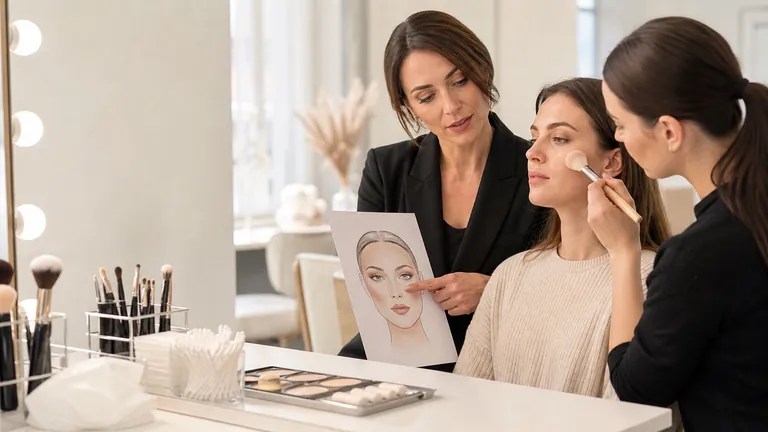
Watching and performing are different activities. A practical course tells you when to pause, what to prepare, which adult or practice surface is suitable, what to record and how success is judged. Focused tasks should come before complete looks: product amount, complexion edge, brow direction, eyeshadow transition, liner with the eye open, lip edge, hygiene and timing.
Ask for the practice architecture. Does each demonstration lead to a task? Is the task optional or required? Does the learner submit evidence? Who reviews it? Can the learner repeat after correction? A statement such as ‘practise at home’ transfers all teaching design to the student. That may suit an experienced independent learner, but should not be presented as tutor-guided practice.
Inspect model progression. Working only on yourself does not establish adaptation across skin surfaces, ages, depths, features and briefs. A beginner may start with one familiar consenting adult, then introduce controlled variety. The provider should explain model requirements, photographic consent, hygiene, single-use products and stop criteria without asking learners to diagnose medical conditions.
Count corrected submissions rather than videos. Three units with attempt, specific feedback and resubmission may produce more usable learning than ten demonstrations with no learner evidence. Verify the submission format, file quality, deadlines, response window and whether feedback remains accessible after the support period ends.
Feedback needs evidence, cause, correction and another attempt
‘Lovely’ and ‘blend more’ do not explain what to change. A teaching correction begins with readable evidence, identifies a plausible variable, proposes an action and asks for a comparable attempt. For example: the transition is abrupt because the brush still carries too much pigment; unload it, reduce pressure and work only at the edge, then photograph under the same light.
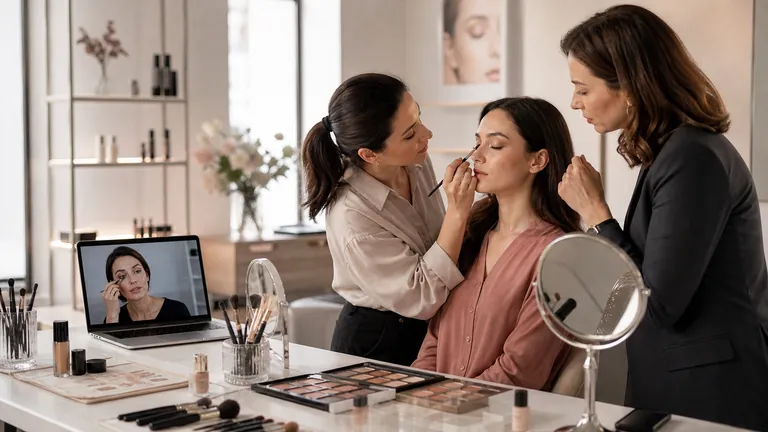
Feedback may be asynchronous photographs, short videos, face charts, live online observation or direct classroom intervention. The channel changes what can be seen, but not the need for a complete loop. Ask whether comments are individual, whether the educator uses consistent criteria, whether you can ask a follow-up question and whether the revised work is reviewed.
Evaluate the educator’s technical relevance and teaching ability
Four proofs—not a follower count
Technical credibility and teaching skill are separate checks
Work
Experience relevant to the module
Portfolio
Attributable and varied evidence
Sample
Visible movement and reasoning
Feedback
Consistent criteria and resubmission
A strong working artist is not automatically an effective educator, and a large audience proves neither skill. Look for an attributable biography: relevant services, current work, specialist experience for the module, identifiable portfolio and clarity about roles. A beginner course requires the ability to break down movements; a bridal or corrective course also needs relevant service evidence.
Observe an explanation. Does the educator distinguish a principle from personal preference? Do they show errors and recovery rather than only an edited result? Do they work across different adults and explain why product, amount, pressure or shape changes? A sample lesson reveals more about teaching than a promotional montage.
The educator’s portfolio establishes relevance, not teaching quality. Learner work can show progression when it includes context, date, starting point, brief and corrections. Testimonials add information when they discuss assignments, feedback and support; generic praise or follower numbers should not receive the same weight as direct evidence of the course process.
Tutor support, class size and response times
Ask who responds after purchase: the named educator, a trained tutor or customer support. Ask how many learners they support and which questions belong to each channel. A numerical ratio does not determine quality, but it constrains available time. Recorded courses need a support duration; live courses need participant and replay rules; classroom courses need workstation numbers and minutes of supervised application.
A quick generic answer can be less useful than a slower technical review. Request an anonymised feedback example or assessment structure. Useful categories might include preparation, hygiene, amount, boundary, symmetry, adaptation, timing and result. If tutoring is a separate product, include it in the total budget and verify its expiry.
Seven checks for a sample makeup lesson
Outcome: you know what you should understand or perform by the end.
Visibility: product quantity, movement, angle, texture and result stay in frame.
Reasoning: the educator explains why a tool, formula or placement was chosen.
Real errors: signs, likely causes and recovery are demonstrated or explained.
Adaptation: the principle is not presented as identical for every face or skin surface.
Practice: the learner receives a concrete task and observable self-check.
Hygiene: hand, tool, single-use and product handling are visible and coherent.
If no sample is published, ask for a demonstration, open session or detailed unit walkthrough. The provider need not release the whole course. You do need enough evidence to understand teaching language, pace, filming, technical reasoning and the learner task before committing time and money.
Kit, products and commercial relationships
Establish whether the kit is included, compulsory, recommended or learner-selected. Request inventory, sizes, shades, brush types, single-use items, shipping and replenishment. A large kit does not repair weak teaching. It should support the exercises without unexpected purchases and leave you able to practise after the lesson.
If the provider or educator sells the products, the commercial relationship should be clear. Teaching should explain functions and substitution criteria rather than only brand names. Transferable knowledge survives a formula change, a stock shortage or a different budget. Ask whether suitable items you already own can be checked and used.
Review the cost guide for the distinction between included, compulsory and optional purchases. Do not let an attractive kit replace analysis of curriculum, practice and feedback. Conversely, a kit-free course may be appropriate when its material requirements are transparent and alternatives are genuinely allowed.
Hygiene, workstation and professional boundaries
Hygiene should not be a footnote. The curriculum should address hand hygiene, clean and used tool separation, compatible cleaning methods, single-use applicators, decanting, mascara and lip-product handling, storage and waste. These rules must appear in demonstrations, learner tasks and assessment rather than only in an introductory slide.
A responsible course distinguishes visible cosmetic observation from medical diagnosis, states when not to proceed and follows product instructions for intended area and use. It should also address consent, model comfort, photography permissions and personal-data handling. A beautiful technique is not professional training if its workflow cannot be delivered safely and respectfully.
Certificate, qualification and claims to interpret carefully
A certificate may document attendance, completion or successful assessment; those are different claims. Ask for the exact wording, issuer, identity checks, assessment requirements and resit conditions. Do not assume that ‘accredited’, ‘recognised’, ‘certified’ or ‘professional’ means a public qualification or authority to work in every country.
Transparency matters more than the certificate design. The provider should separate private training, any specific external recognition and local business or occupational requirements. Connect the document to demonstrated learning and verify legal or employer requirements with the appropriate authority. A course page cannot answer every jurisdiction.
Access, technology, updates and accessibility
For digital content, check access duration, compatible devices and browsers, video quality, captions, transcripts, downloadable materials, playback control, progress tracking, updates and the ability to revisit a lesson during practice. A long curriculum is not useful if access ends before you can complete its evidence cycle.
Ask what happens when the platform changes, a live class is missed or an educator updates a technique. Check support contacts, response expectations, keyboard access, readable contrast and accommodation process where relevant. Technology belongs in the course description because it can determine whether the promised content is usable.
Price, conditions and the right to understand before purchase
Before payment, identify the seller, main service characteristics, total price, delivery or access, duration, support, compulsory extras, cancellation and refund terms. For EU consumer purchases, digital-content rules include specific pre-contract information; starting access may affect withdrawal rights when the required express agreement is given. Read the current terms before opening lessons and seek appropriate advice for your jurisdiction when needed.
Keep dated copies of the curriculum, fee, kit list, educator, timetable and terms. A sales call can clarify the offer, but important promises should appear in a durable written form. Countdown timers, crossed-out reference prices and instalments are not learning evidence. Compare the final package with the same checklist you apply elsewhere.
A 100-point comparison matrix—editorial tool, not certification
Compare the same six areas
Award points only when evidence is available
20
Outcomes and sequence
25
Designed learner practice
20
Individual feedback
15
Educator evidence
10
Commercial transparency
10
Access and usability
Use a score only to prevent one appealing claim from dominating the decision. Award points for evidence you can inspect, not assumptions. The following weights are an editorial planning aid and do not certify a course, rank the market or replace a sample. Change the weights before comparing if one factor is essential to your circumstances.
Area | Points | Full-score evidence |
|---|---|---|
Outcomes and sequence | 20 | Actions, prerequisites, exclusions and coherent progression |
Designed learner practice | 25 | Required tasks, relevant models, evidence and corrected repeats |
Individual feedback | 20 | Named reviewer, rubric, response window and resubmission |
Educator evidence | 15 | Relevant work, attributable portfolio and effective sample teaching |
Commercial transparency | 10 | Complete price, kit, certificate, seller and contract conditions |
Access and usability | 10 | Compatible, accessible, replayable content and responsive support |
Do not let the total conceal a critical failure. Mark non-negotiables before scoring: a high total cannot compensate for a failed non-negotiable. A learner who requires individual correction should reject a course with none even if its content, price and filming score highly. The matrix structures judgement; it does not automate it.
Warning signs before enrolment
The curriculum is only a list of glamorous look names without outcomes, tasks or depth.
No sample or concrete teaching-method explanation is available.
Practice is encouraged, but no learner evidence is required or reviewed.
The educator is described only through followers, vague awards or unattributed work.
Employment, clients, income or universal professional status are promised automatically.
Kit, renewals, assessment, tutoring or compulsory costs appear only after payment.
A ‘recognised certificate’ is not accompanied by the named body and exact meaning.
Seller identity, contact, access period, technical requirements or terms are missing.
Final checklist before paying
Write the outcome, current level, available time and one non-negotiable.
Connect every relevant curriculum item to demonstration, learner task and evidence.
Count individual reviews and confirm how a corrected task is resubmitted.
Evaluate a sample for visibility, reasoning, errors, adaptation, practice and hygiene.
Verify the educator’s relevant technical work and separate teaching evidence.
Check models, kit, consumables, support, assessment and every necessary cost.
Clarify certificate wording, pass conditions and any recognition claimed.
Read access, compatibility, updates, cancellation and refund conditions.
Apply the same matrix to relevant alternatives and retain dated evidence.
Choose the route that fits the outcome—not the largest promise or bonus count.
Apply the checklist to the current English makeup course catalogue. Compare a broad route such as the complete makeup artist course with bounded applications such as daytime makeup, evening makeup and bridal makeup. Enrolment, teachers and content are specific to the English market and must be checked on each page.
Frequently asked questions about choosing a makeup course
How can I recognise a credible makeup course?
Look for observable outcomes, coherent sequence, designed practice, individual feedback, an attributable educator, sample teaching and complete conditions. Credibility comes from alignment between what is promised, demonstrated, performed and assessed—not one badge or claim.
What should a makeup course curriculum include?
It should name entry level, outcomes, module order, demonstrations, learner tasks, assessment criteria and final evidence. Hygiene, tools, formulas, skin preparation and adaptation should be explicit. Depth matters more than the number of topic names.
How much practice should a good course contain?
No universal hour count fits every outcome. Check how many tasks are required, which models or surfaces they use, how evidence is reviewed and whether a corrected attempt follows. An invitation to practise without criteria is not tutor-guided practice.
How do I evaluate the educator before enrolling?
Verify relevant work, attributable portfolio and current specialist experience. Then inspect teaching: can they make movement visible, explain causes, show recovery, adapt a principle and set a measurable task? Technical and teaching ability require separate evidence.
Does a large social following indicate a better tutor?
No. It measures audience reach, not curriculum, feedback or teaching clarity. Social content may provide examples, but a sample lesson, assessment rubric, correction and learner progression are more relevant to the course decision.
Can an online makeup course provide real feedback?
Yes, through readable photographs, short video, live observation or annotated records. Confirm who reviews, how many submissions, response time, criteria, follow-up questions and resubmission. A video library without this cycle remains primarily self-directed content.
Should a makeup kit be included?
Not necessarily. Included, compulsory and recommended kits can all work when inventory, sizes, alternatives, ownership, shipping and cost are clear. The kit must support practice; item count cannot compensate for weak teaching.
What does the final certificate mean?
It depends on its exact wording, issuer and assessment. It may document attendance, completion or achievement without being a public qualification or universal licence. Ask for the claim in writing and verify local requirements independently.
Is a sample lesson important?
Yes. It reveals language, pace, filming, technical reasoning, hygiene, handling of errors and whether a learner task follows. It need not disclose the whole course; it should provide enough evidence to judge teaching fit.
How do I compare two very different makeup courses?
First narrow them to the same outcome and identify their exact format. Then apply one matrix for sequence, practice, feedback, educator, conditions and usability. Do not add videos, hours or topics as though they measured identical activity.
Is the most expensive course usually the best?
No. Price can reflect tutor time, venue, kit or brand positioning, but cannot prove relevance or teaching quality. Use the cost guide for the total budget and this checklist for the evidence delivered in return.
Should a beginner choose a complete pathway?
A coherent pathway can reduce sequencing decisions, but only if its entry level, exercises and access suit the learner. A bounded beginner module may be a better test. Compare relevance and completion capacity rather than assuming more content is safer.
What are the biggest warning signs?
Missing outcomes, no sample, practice with no review, vague educator claims, concealed compulsory costs, unexplained certificate wording, absent seller details and automatic job or income promises all require resolution before payment.
How long should course access last?
Long enough for the stated workload, model practice, feedback and corrected attempts. There is no universal duration. Estimate your realistic weekly time and confirm expiry, extensions, replay, updates and what remains available after completion.
Can a makeup course guarantee professional work?
No. A course can support learning and evidence, while professional reliability, portfolio, business setup, local requirements, demand and client acquisition remain separate. Treat an automatic employment, client or earnings promise as a claim requiring strong evidence.
Official references and editorial scope
The Europass explanation of the eight European Qualifications Framework levels supplies the knowledge, skills, responsibility and autonomy vocabulary used as a reading aid; it does not accredit any course in this article. The Your Europe page on contract information explains current EU pre-contract and digital-content information. Readers elsewhere should check their applicable rules.
Editorial review: 5 September 2026. The 100-point matrix is an explicit editorial comparison aid, not accreditation, certification or a market ranking. This independent guide contains no competitor links. Current English curricula, teachers, prices and availability must be checked on the relevant course page. Irene Tomasi’s authorship provides a professional makeup perspective; legal, consumer and occupational claims require verification with the relevant authority or adviser.
Before adding products, build a function-based beginner makeup kit. The checklist separates hygiene, complexion, colour, brushes and study tools, then adds each new function only when a planned exercise makes it necessary.
If the final document affects your decision, use the makeup certificate and qualification verification guide. It separates private completion records, assessed credentials, regulated qualifications, accreditation and local licences before you rely on a recognition claim.
For a controlled complexion match, use the foundation depth and undertone protocol. It separates depth, undertone and surface variation, then tests comparable jaw swatches in stable light after the formula settles.
Connect complexion colour to whole-face design with the corrective makeup and visagism method. It separates structure, proportion, colour and texture, then plans brows, blush, light and shadow around an agreed priority instead of a standard face map.
Practise controlled colour placement with the eyeshadow blending guide. It separates brush load, pressure, placement and edge work so patchiness can be diagnosed before more pigment is added.
Turn technique into a repeatable event service with the professional bridal makeup guide. It connects the brief, trial record, wear test, wedding-day timing and personal touch-up handover without replacing detailed technique or career pages.
Protect every practical exercise and client service with the makeup hygiene workflow. It separates clean and used zones, prevents double-dipping and gives brushes, sponges, products and surfaces a traceable route between people.
When your skills need to become clear evidence, use the makeup artist portfolio guide to select relevant projects, photograph them faithfully, state roles and manage consent, credits and image rights.
When skills and evidence are ready for the market, continue with how to find makeup clients: local discovery, authentic reviews, relevant partnerships, clear quotations, privacy-aware follow-up and booking measurement.
Training and Italian business registration remain separate checks
A course can build technique without deciding tax or local scope; consult the makeup artist VAT and ATECO guide for Italy.