How long does it take to learn professional makeup? The answer changes with what ‘learn’ means. Reproducing one look on your own face, adapting a technique to different adults and delivering a complete, hygienic service within an agreed time are different thresholds. Course hours are only one input. Progress also depends on focused attempts, useful feedback, spaced repetition, model variety and your ability to diagnose and correct an error.
Planning answer, not a promise: at three to five structured practice hours a week, a complete beginner might spend two to four weeks orienting themselves to tools, hygiene and a simple sequence; six to twelve weeks building one controlled complete look; and the following months adapting it across people and conditions. Professional reliability has no universal deadline. Move forward when the result is safe, explainable and repeatable, not when a calendar page turns.
This guide owns the learning-time intent in the BeautyLearn makeup guide library. Use how to learn makeup from scratch for technique order and exercises, the online vs in-person course guide for delivery format, the course cost guide for budgeting and how to become a makeup artist for career, portfolio and local requirements. Keeping those questions separate prevents one attractive timetable from becoming a promise of professional readiness.
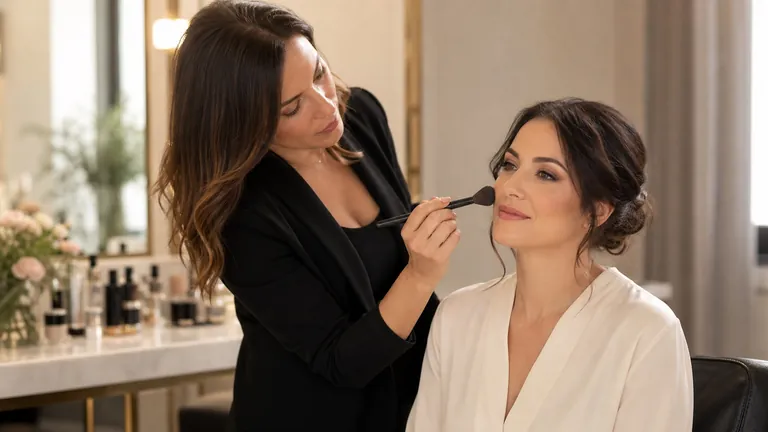
Learning makeup has four different thresholds
Four thresholds—not one finish line
Completing a lesson is not the same as delivering a reliable service
Understand
Explain purpose and sequence
Execute
Complete a guided bounded task
Adapt
Change the plan for a real face
Deliver
Repeat hygiene, result and timing
A learner may understand a demonstration without being able to reproduce it. They may reproduce it with a reference but fail to adapt it when skin, features or products change. They may complete it in unlimited time yet lose control when consultation, workstation setup, hygiene, timing and clean-down become part of the service. Define the threshold before asking how long it takes.
Threshold | What changes | Observable evidence |
|---|---|---|
Understanding | You recognise tools, sequence and purpose | You explain a decision before seeing the answer |
Guided execution | You reproduce a bounded task with a reference | You complete the movement without constant rescue |
Adaptation | You change texture, colour and placement for a real face | Your reasoning and result remain coherent across adults |
Professional reliability | You manage brief, hygiene, time and ordinary variation | You repeat a defined service without ideal conditions |
The first threshold may develop over a few focused sessions. The last continues to deepen through work. Finishing a course and being ready for every client are therefore not synonyms. A credible programme describes its intended threshold and the evidence used to assess it rather than converting calendar duration into a competence guarantee.
Why there is no universal number of makeup practice hours
Learners begin with different experiences in colour, drawing, skincare, photography, hand control and client communication. Those can reduce the difficulty of some tasks but do not remove the need to learn cosmetic hygiene, product selection and adaptation. Attention, rest and frequency also matter. Three shorter sessions can provide more correction loops than one occasional long day.
Research on deliberate or purposeful practice supports specific goals, focused effort, feedback and repeated refinement, but it does not establish one number of hours for becoming a makeup artist. Much of the expertise literature examines other domains, and later work has challenged overly simple claims about how much practice alone explains. Apply the learning principles; do not import a stopwatch from music, sport or chess as a vocational promise.
The popular 10,000-hour rule is not a makeup qualification formula. The opposite claim—that a weekend creates complete professional competence—is not credible either. Hours can organise a plan. Observable, repeatable outcomes decide whether the plan is working.
Course duration and learning time are not the same
Eight hours of video can require many more hours of real work. You prepare the station, watch a short section, perform it, clean, photograph, compare, receive or generate a correction and repeat. Likewise, one hundred scheduled classroom hours are not necessarily one hundred hours of learner application; theory, demonstrations, waiting, modelling for a classmate, assessment and breaks may be included.
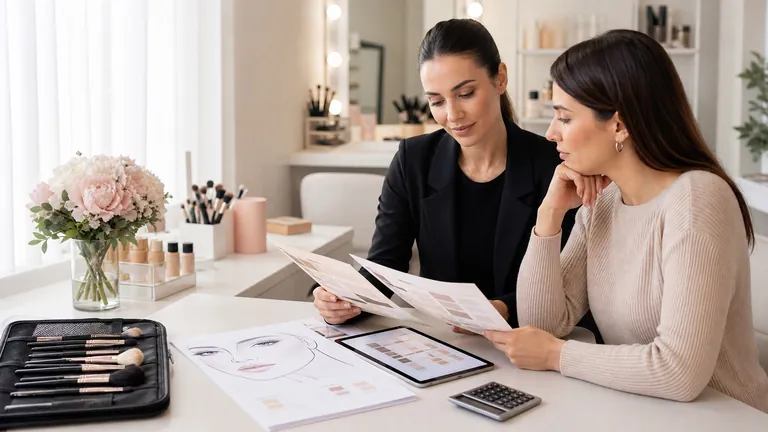
When evaluating a course, separate recorded content, live contact, estimated independent practice, assessed submissions and the period during which feedback and replay remain available. The English makeup course catalogue provides current programme information for this market. Compare those details without treating video length as the time required to stabilise a technique.
A course can be short and appropriately narrow. The professional makeup tools course focuses on a foundation, while the complete makeup artist course represents a broader route. Judge each against its stated outcome, then add the practice required to transfer learning.
Four planning phases for a complete beginner
The following windows assume roughly three to five focused hours each week. They are editorial planning scenarios, not research-derived deadlines, certifications or individual guarantees. Extend or shorten them in response to evidence. Their purpose is to prevent two common errors: expecting professional results immediately, or consuming lessons indefinitely without testing a milestone.
Orientation, approximately weeks 1–4: build a one-way hygienic workstation, identify core tool and product functions, observe visible complexion needs, control small amounts and follow one simple sequence.
One controlled look, approximately weeks 5–12: practise complexion, brows, eyes, cheeks and lips separately, then integrate them. The aim is a clean, explainable and repeatable first look—not maximum complexity.
Adaptation, often several further months: work across adults with different skin surfaces, depths, proportions, ages and briefs. Change one product or technique for a reason while protecting hygiene and the intended result.
Reliability and portfolio, commonly six to twelve months or longer: improve consultation, timing, wear, photography and consistency; define a narrow service you can evidence and identify situations you should not yet accept.
Ten hours compressed into one week followed by a month away is not equivalent to three repeated sessions every week. Calendar windows only make sense alongside frequency, quality of attention and corrected practice. A learner with prior relevant skills may pass an early criterion quickly; they should demonstrate it rather than skip it because it looks familiar.
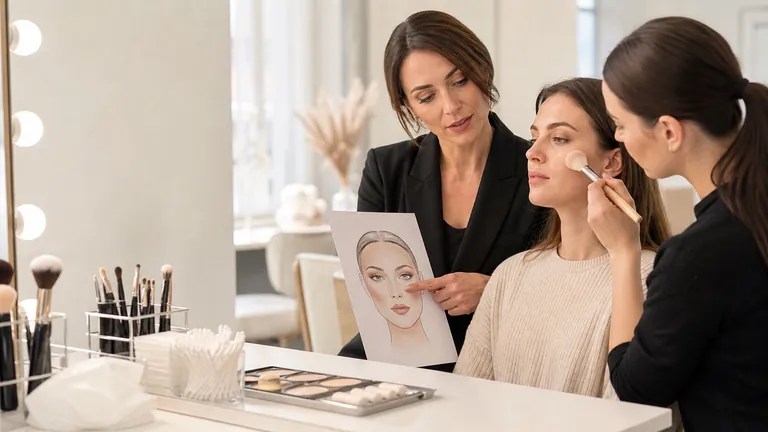
Deliberate practice: one error, one correction, one new attempt
Practice quality matters more than the counter
A short loop makes the error observable and the correction testable
Define one criterion
Perform and document
Identify one cause
Correct and repeat
Repeating the same complete look without criteria can reinforce the same mistake. Narrow the task. In one session assess foundation quantity and the perimeter transition. In another, assess brow direction; then eyeshadow edge, liner direction or lip precision. Record the result, identify one variable and repeat under comparable conditions.
The loop is short: define the target, perform, collect readable evidence, identify the most plausible cause, change one variable and compare. Useful teaching links the visible result to pressure, quantity, tool loading, texture, light, posture or sequence. Self-review also improves when photographs and criteria remain consistent.
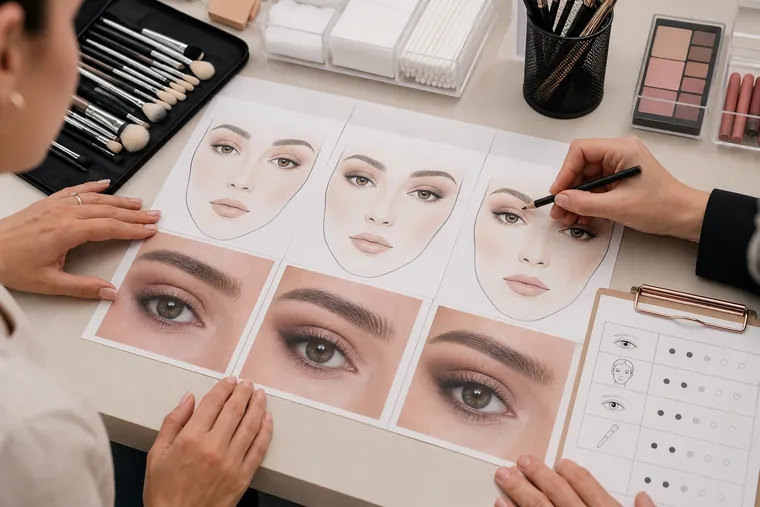
What genuinely accelerates makeup learning
Sustainable frequency: appointments you can keep for months, not one burst of enthusiasm followed by silence.
A narrow target: one primary criterion per exercise so you know which change produced the result.
Causal feedback: evidence, likely variable, next action and a reviewed second attempt rather than a general score.
Progressive variety: first stabilise a task, then vary skin, features, age, light, product and brief deliberately.
A consistent station: known tools, hygienic workflow, useful light and comparable documentation.
Recovery and attention: tired hands and distracted repetitions add hours but little diagnostic information.
Opening more courses does not automatically accelerate progress. Use the professional makeup products course to reduce random formula choices and the beginner makeup course to organise foundations. Speed comes from applying the information and closing a loop, not from accumulating open tabs.
A 12-week makeup practice plan—example, not promise
Twelve weeks organise evidence, not a universal deadline
Extend or compress a phase in response to feedback and repeatability
1–2
Hygiene, workflow and tools
3–4
Preparation and complexion
5–6
Brows, eyes and lips
7–8
A complete daytime look
9–10
Relevant adult variation
11–12
Repeatability and next plan
This plan uses three touchpoints a week: one for explanation and prediction, one for focused execution, and one for integration or review. A touchpoint need not be long. If you have less time, extend each block. If you have experience, test the stated evidence before advancing.
Weeks | Primary focus | Evidence to keep |
|---|---|---|
1–2 | Hygiene, workflow, tools and observation | Station checklist and product-function test |
3–4 | Preparation, shade decisions and thin base | Three comparable complexion attempts |
5–6 | Brows, eyes and lips as separate tasks | Close views before and after one correction |
7–8 | Integration into a controlled daytime look | Written sequence, timing and full-face views |
9–10 | Two or more adults with relevant differences | Records explaining adaptations and outcomes |
11–12 | Repeatability, timing and next-plan review | Repeated look, remaining gap and next milestone |
The daytime makeup course can be an integration point after the components are controlled. The corrective makeup course adds decisions about colour and placement. Increased evening contrast should come after a stable base rather than being used to conceal a weak process.
Why practising only on yourself is not enough
On your own face you already know distances, sensitivity and movement. You can move towards the mirror, feel product pressure and compensate unconsciously. On another adult, posture, viewing angle, communication and responsibility change. Skin surface, depth, undertone, proportion, age, lid movement and expectations also change.
Add variety progressively. Stabilise one simple goal on a familiar adult, repeat after correction, then change one meaningful feature. The corrective eye makeup course and corrective lip makeup course become valuable when their criteria are applied to real variation. Obtain consent for practice and images, and separate teaching evidence from photographs approved for a public portfolio.
When to start measuring speed
Timing too early encourages skipped observation, hygiene and correction. Stabilise sequence and quality first. Then time blocks: setup, consultation, complexion, eyes, lips, final check and clean-down. Record why a block overran. Searching for products, changing a plan repeatedly and correcting preventable contamination are different problems from a careful technique that simply needs fluency.
Reduce time without removing safety or decision quality. Prepare a written station map, limit products to those relevant to the brief, rehearse transitions and set a review point. A professional time is not the fastest possible application; it is a truthful duration you can repeat while preserving the agreed result.
How to measure progress without chasing hours
A competency record beats one percentage
Move each area from guided to independent and then repeatable
Workflow
Hygiene and station control
Plan
Observation, brief and product choice
Technique
Amount, edges and symmetry
Adaptation
Coherent choices across adults
Reliability
Repeatable result and timing
Use a competency record instead of one overall percentage. Score each area as guided, independent or repeatable: hygiene and workflow; visible observation and plan; amount and edges; colour and placement; communication; adaptation; timing; durability; and documentation. Attach one piece of evidence and one next action. A mean score can hide a critical hygiene or consultation gap, so review the individual rows.
Repeatability needs more than a lucky result. Reproduce the criterion in at least three separate sessions, then adapt it to another suitable adult or condition. If the result fails, return to the variable rather than counting more hours. A reviewed failure often teaches more than an unexamined success.
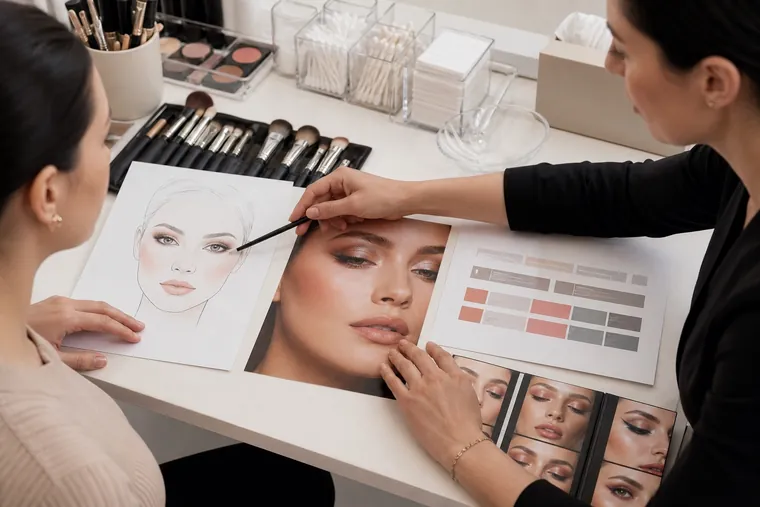
Plateaus: why more repetition may stop helping
Progress can stall when the task is too broad, feedback is vague, evidence changes every time or the learner repeats a comfortable version. It can also stall when a product or tool behaves inconsistently and every failure is blamed on hand skill. Return to a small comparison: keep product and light constant, vary one amount or movement, and inspect the edge or wear relevant to the target.
A plateau may signal that you need better explanation, a direct demonstration, a different model or a tutor review—not more identical attempts. It may also indicate fatigue or an unrealistic practice schedule. Change the information available to the learner before increasing total volume.
How many models do you need before working?
There is no official number that automatically creates professional readiness. Ten very similar models may expose fewer decisions than five selected for relevant differences and followed through correction. Conversely, changing models every time without repeating the corrected task makes it hard to tell whether the underlying problem was solved.
Build a matrix gradually: varied adult skin surfaces and depths, eye and lip structures, ages and briefs. Repeat a simple goal on two or three people before adding complexity. The useful threshold is the ability to explain choices, maintain hygiene and produce the defined standard—not a collection of faces or social posts.
When can you begin charging for makeup services?
Your first paid scope should be narrower than your ambition. Define the look you can deliver, truthful time, inclusions, hygiene process and cases you do not yet accept. One successful result proves possibility, not reliability. Run complete simulations with consultation, setup, application, checks, payment workflow and clean-down before presenting the service as repeatable.
Before accepting clients, verify business registration, tax, insurance and any local professional requirements with appropriate authorities and advisers. Manage consent, images and personal data. A private course certificate documents what its issuer says it documents; it does not universally authorise every service. Moving into paid work combines technique, operational control and applicable rules.
Specialisation creates a second learning curve
Bridal, evening, photographic, editorial and corrective makeup are not simply colour variations. The brief, light, wear, touch-up, timing, collaboration and consequences of failure change. Stable foundations shorten the next curve, but each service still needs relevant tests. Bridal work, for example, adds consultation, trial, photography, emotion, punctuality and wear.
Open a specialisation after you can diagnose and correct the shared foundations, not to avoid a gap. Use three stages: isolate the new technical task, complete the look across relevant adults, then simulate the full service with timing and ordinary disruptions. The bridal makeup course and evening makeup course should therefore follow rather than replace a controlled base.
Choose a makeup course around the time you actually have
Calculate realistic weekly time and divide it among study, setup, application, cleaning, documentation and review. If you have three hours, do not assign all three to video. One model might use 30 minutes for explanation, 90 for a focused application, 30 for safe clean-down and evidence, and 30 for analysis. A later short session repeats the correction.
Check access length, prerequisites, independent workload, models, submissions and feedback. A compact programme can suit a narrow outcome; a wider pathway needs months to integrate. Do not buy duration. Buy a sequence you can apply. The format guide helps determine how much external structure your schedule needs, while the cost guide accounts for the time and resources that structure requires.
Frequently asked questions about the time needed to learn makeup
How long does it take to learn makeup from scratch?
A beginner can orient themselves to foundations over several weeks of regular practice, while adaptation and reliability usually require continued work over months. The windows in this guide are planning scenarios, not guaranteed individual outcomes. Advance by evidence.
How many hours a week should a makeup beginner practise?
Three to five focused hours can be a sustainable starting plan when they include execution, evidence, feedback and a corrected repeat. More hours without a narrow goal, or practice while attention is poor, do not automatically produce faster progress.
Does course duration tell me how long learning will take?
No. Published hours may describe video or scheduled contact, not setup, practice, cleaning, models, documentation, feedback and repetition. Ask how hours are defined and which final evidence is assessed.
Can I learn professional makeup in three months?
You may build strong foundations and a controlled first repertoire in three months with consistent practice and feedback. That does not guarantee autonomy across every adult, product or service. Define a narrow scope and test repeatability.
Can I learn makeup in one weekend?
A weekend can introduce a method or improve one bounded skill. It cannot by itself supply months of repeated adaptation and service evidence. Plan the exercises, models and feedback that follow the intensive teaching.
How many models should I practise on?
There is no universal count. Choose relevant variation, repeat after correction and record why the plan changed. Variety without repetition and repetition without variety both leave gaps. Use demonstrated consistency rather than a number alone.
When can I start charging clients?
When a clearly bounded service is hygienic, repeatable and deliverable in the time and conditions you state, and when local business, insurance and professional requirements are met. A single good result or course completion is not sufficient evidence.
Does online learning take longer than classroom learning?
Not necessarily. Recorded lessons support replay and spacing; classroom teaching may offer direct observation. Time depends on practice, feedback, model access, schedule and teaching design. Compare the complete learning process, not the location label.
Why am I practising but not improving?
The task may be too broad, evidence inconsistent or feedback non-causal. Isolate one movement, keep products and light stable, identify one variable and repeat. If the plateau remains, change the information or supervision rather than repeating identically.
How do I know whether I am progressing?
Track observable criteria such as workflow, amount, edges, symmetry, adaptation, timing and repeatability. Keep the target, comparable evidence, correction and next attempt. A competency record is more informative than accumulated hours.
When should I begin timing my makeup practice?
After hygiene, sequence and quality are stable. Time separate service blocks and diagnose the cause of delay. Reduce searching and indecision before reducing the care required for safe application and a controlled result.
How long does a bridal or evening specialisation take?
There is no fixed period. Begin with stable shared foundations, then practise the specialist brief, durability, lighting, timing and complete service across relevant adults. Add it to a portfolio only when its standard is repeatable.
Is the 10,000-hour rule relevant to makeup artists?
Not as a qualification or deadline. Expertise research supports focused goals and feedback, but does not prove that every person needs or succeeds after one universal number of makeup hours. Use hours for planning and evidence for progression.
Should I practise makeup every day?
Daily face application is not required and may be unsuitable if repeated cleansing, friction or products cause discomfort. Alternate application with face charts, station workflow, tool control, photo review and rest. Follow product directions and stop if skin or eyes are irritated.
Can previous creative experience shorten the process?
It may help with colour, observation or hand control, but does not automatically transfer to hygiene, cosmetic behaviour, client communication or adaptation. Test each criterion and use prior experience as a resource rather than an exemption.
Research references and editorial scope
The discussion of focused practice draws on Ericsson and Harwell’s 2019 review, Deliberate Practice and Proposed Limits on the Effects of Practice on the Acquisition of Expert Performance, and Macnamara and Maitra’s 2019 replication work, The role of deliberate practice in expert performance. These papers address expertise research, not a validated makeup-training duration.
Editorial review: 5 September 2026. All week and month ranges are explicit planning scenarios created to organise practice; they are not promises, formal standards or conversions from another profession. This independent guide contains no competitor links. Current English course content, teachers, prices and availability must be verified on the relevant course page. Irene Tomasi’s authorship provides a professional makeup perspective; health, legal and occupational questions require the appropriate specialist or authority.
Before enrolling, apply the evidence checklist for choosing a makeup course. It compares outcomes, designed practice, feedback, educator evidence, certificate wording, access and conditions without treating price, duration or format as automatic proof of quality.
Before adding products, build a function-based beginner makeup kit. The checklist separates hygiene, complexion, colour, brushes and study tools, then adds each new function only when a planned exercise makes it necessary.
If the final document affects your decision, use the makeup certificate and qualification verification guide. It separates private completion records, assessed credentials, regulated qualifications, accreditation and local licences before you rely on a recognition claim.