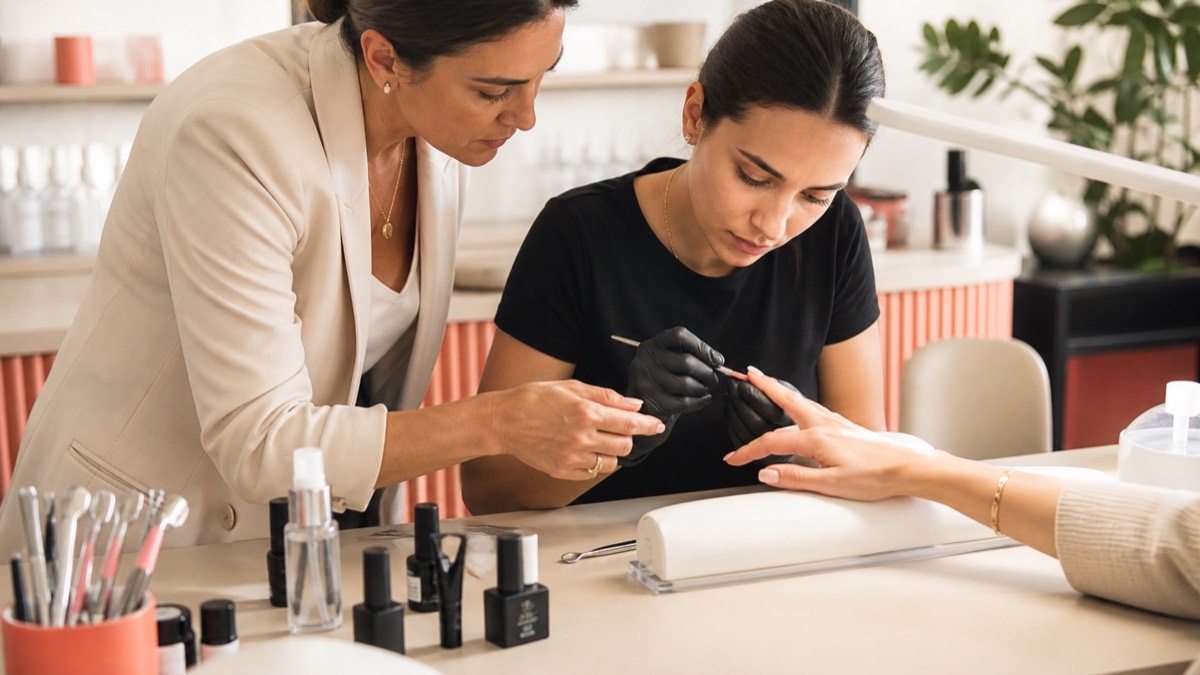

If you provide nail services in Italy on a regular, organised basis, obtaining a Partita IVA—an Italian VAT number—is only one part of setting up correctly. You must describe the real activity, verify professional and local requirements, choose the appropriate business and social-security position, configure invoices or retail receipts and price the service for tax, contributions and operating costs. Under ATECO 2025, code 96.22.01 covers manicure and pedicure services and is the first classification to verify for a nail-service business.
A VAT number identifies an activity for tax purposes. It is not a professional qualification, a municipal authorisation, a premises approval or permission to perform every treatment described in a business plan.
This English-language guide is for people planning to work in Italy. It reflects official information checked on 5 September 2026, but it is educational rather than personalised tax or legal advice. Italian national law, regional rules, municipal procedures and the facts of your business must be assessed together. Before opening or changing the activity, ask an Italian commercialista and the competent SUAP and Chamber of Commerce to validate the complete position.
If your first question is whether a course certificate lets you work, begin with the guide to nail technician certificates, qualifications and licences. For premises, municipal procedure and launch planning, use the guide to opening a nail salon in Italy. This page owns the separate tax and administrative intent: VAT registration, ATECO, business classification, social security, records and cash planning.
Partita IVA and permission to work are separate checks
Tax registration is not permission to practise
Resolve the fiscal and professional tracks together
Partita IVA
Tax identity and business reporting
Qualification
Professional eligibility for the service
SUAP
Local procedure and premises
Insurance
Cover for the real operating model
Partita IVA is the tax identifier used for an economic activity. Registering it tells the tax administration how the activity begins; it does not establish that the operator holds every qualification or local authorisation required for a particular nail treatment. Italian Law no. 1 of 4 January 1990 defines the activity of an estetista broadly, while Regions and local authorities implement professional, premises and procedural rules. Nail services can therefore require checks that cannot be solved by selecting an ATECO code online.
Write a factual service list before contacting an adviser: basic manicure, gel polish, overlays, extensions, pedicure, retail products, teaching, mobile work, home studio or commercial premises. State what is performed on a client and what is only sold or taught. Small wording differences can affect qualification, SUAP, Chamber of Commerce, social-security and insurance questions, so avoid a generic description such as ‘beauty services’ if it hides what will actually happen.
Question | Who normally helps verify it | What the answer controls |
|---|---|---|
May I perform this service here? | Region, SUAP and Chamber of Commerce | Qualification, procedure and premises |
How is the activity classified? | Commercialista and Chamber of Commerce | ATECO, business form and registrations |
How are income and contributions calculated? | Commercialista and INPS position | Tax regime, deadlines and cash reserve |
ATECO 2025 code 96.22.01 for manicure and pedicure
Classify the activity you actually perform
96.22.01 is a starting point, not a blanket licence
Describe every revenue stream
Identify the predominant activity
Validate ATECO and registrations
Keep invoices mapped to activity
ATECO is Italy’s official classification of economic activities. ATECO 2025 entered into force on 1 January 2025 and began operational use for statistical and administrative purposes on 1 April 2025. Istat’s structure and explanatory notes identify 96.22.01 as ‘Servizi di manicure e pedicure’—manicure and pedicure services. The 2026 update did not change the classification structure or descriptions, although Istat can update correspondence tables and implementation material.
Code 96.22.01 is a classification, not a licence. Istat itself explains that ATECO is used for statistical and administrative purposes; it does not decide professional qualifications. A nail technician should ask whether 96.22.01 correctly represents the predominant activity, then disclose any material secondary activities. Copying a code from another salon can be wrong because that business may combine services, retail, training, content creation or employment in a different way.
Planned activity | Check before registration | Why it matters |
|---|---|---|
Nail services for clients | 96.22.01 and applicable local rules | Describes the main activity but does not prove eligibility |
Regular product sales | Retail classification and SUAP obligations | Retail may need separate treatment |
Paid training | Actual teaching activity and appropriate secondary code | Teaching is not the same activity as treating clients |
Affiliate or creator income | Contracts, revenue source and regularity | Digital income must not be hidden inside salon revenue |
When one person carries out several activities, the adviser should evaluate the main and secondary codes, registration consequences and the combined revenue. Separate ATECO codes do not create a separate flat-rate tax threshold for each stream. Keep an income map that connects every payment method and invoice description to the activity that generated it.
Artisan business, sole trader or professional activity?
A person who personally performs organised nail services with products, equipment and a client base is often structured as an individual artisan business—impresa individuale artigiana—with registration in the Business Register, possible Artisan Register requirements and INPS artisan social security. ‘Often’ is important: it is not an automatic conclusion from the word nails. A business limited to teaching, consultancy or media may have a different substance and cannot be classified safely from a social-media biography.
The distinction affects Comunicazione Unica, Chamber of Commerce fees, INPS, possible INAIL obligations and the way the business is administered. Do not choose ‘freelancer’ solely because the process sounds lighter, and do not assume artisan status solely because a colleague uses it. Give the adviser a complete operating description, including who performs services, whether staff or collaborators are involved, where clients are received and how products are sold.
A practical opening sequence
For an individual business, Comunicazione Unica can coordinate filings with the Business Register, Revenue Agency, INPS, INAIL and the Artisan Register where relevant. SUAP deals with administrative requirements attached to the activity and location. The exact order depends on the business and municipality, so treat the sequence below as a meeting agenda rather than an online do-it-yourself procedure.
Describe every service, workplace, sales channel, training activity and person involved.
Verify the professional qualification and services allowed in the relevant Region and municipality.
Build a twelve-month estimate of receipts, costs, investment, labour and owner drawings.
Have the commercialista validate ATECO, legal form, tax regime and VAT treatment.
Define Chamber, INPS, possible INAIL, certified email, digital signature and SUAP filings.
Configure invoices, receipts, payment reconciliation, privacy, insurance and document retention before the first appointment.
The Revenue Agency’s AA9 form is used by individual businesses and self-employed persons to report the start, change or cessation of activity for VAT purposes; its instructions refer to filing within 30 days of the event. Where the Business Register route and Comunicazione Unica apply, the filing channel is coordinated through that process. Do not send duplicate forms merely because both exist: confirm who is filing what and keep the receipt.
Flat-rate tax regime or ordinary accounting
The Italian regime forfetario is available to individuals who satisfy its conditions and do not fall within an exclusion. For 2026, the general prior-year revenue or compensation limit remains €85,000. If receipts exceed €100,000, the regime ceases during that same year under the statutory rule, with VAT consequences from the operation that takes the taxpayer beyond the limit. Other conditions include a €20,000 gross limit for specified employee and collaborator expenditure and several exclusions that require case-specific review.
For activities within ATECO division 96, the commonly applicable profitability coefficient in the flat-rate regime is 67%. This does not mean that 67% is profit in the bank. Taxable income is calculated by applying the coefficient to qualifying receipts, then deducting eligible compulsory social-security contributions under the relevant rules. The substitute tax is generally 15%, or 5% for the start-up period when every statutory condition for a genuinely new activity is met.
A simplified educational example shows the difference. With €30,000 of qualifying receipts and a 67% coefficient, income before the social-security deduction is €20,100. Actual rent, products, payment fees, education, laundry, insurance and equipment are not then deducted one by one for this calculation; the coefficient has already replaced analytical costs. The cash left to the owner still has to fund those real expenses, INPS, tax and future payments.
Issue | Regime forfetario | Ordinary accounting |
|---|---|---|
VAT on sales | Generally not charged under the regime, subject to exceptions | Applied under ordinary VAT rules |
Actual business costs | Replaced by the profitability coefficient | Deductibility and input VAT depend on the applicable rules |
Income tax | Substitute tax at 15% or 5% when eligible | Progressive IRPEF and additional taxes |
Decision method | Test revenue, exclusions and real cost structure | Test investment, VAT recovery, growth and administration |
Never choose the regime by comparing 5% with an income-tax headline. The reduced rate is conditional, INPS remains separate and a salon with high rent, products, staff or equipment can have real costs above the allowance implied by the coefficient. Ask for two written simulations built from the same business forecast, including contributions, tax, VAT where relevant, advance payments and the timing of cash outflows.
INPS artisan contributions in 2026
Keep 2026 figures in context
Thresholds, coefficients, contributions and cash are different numbers
€85,000
General prior-year flat-rate limit
67%
Common profitability coefficient for division 96
24%
2026 artisan contribution rate
€18,808
2026 INPS minimum income base
INPS Circular no. 14 of 9 February 2026 sets the contribution rate for artisans at 24% up to the first income band and identifies a minimum annual income base of €18,808. It reports an annual minimum contribution of €4,521.36 for an artisan owner or assisting family member, including the maternity contribution, before any case-specific adjustment. Income above the minimum is subject to the stated rates and bands; above the first band the rate increases by one percentage point.
This is why low first-year receipts do not necessarily produce low contributions. The minimum contribution can apply even when business profit or turnover is modest, unless a valid relief changes the position. The reduced social-security arrangement linked to the flat-rate regime is not created merely by selecting that tax regime: it requires its own conditions and procedure and can influence pension accrual. Request a schedule showing fixed instalments, variable balance, deadlines and any relief actually approved.
What opening and annual costs should include
Registering a VAT number is not the main cost of starting. The budget may include professional advice, Chamber filings and annual fee, certified email, digital signature, INPS, possible INAIL, SUAP or technical work, premises compliance, invoice or till software, point-of-sale fees, insurance, privacy documentation and training. Product stock, disposable items, extractor filters, energy, laundry and non-billable time belong in the service calculation too.
One-off setup: advisory work, filings, signatures, technical reports, furniture and premises adaptation.
Annual overhead: accountant, Chamber fee, certified email, software, insurance and required updates.
Periodic public charges: social security, taxes, stamp duty and any insurance position.
Service costs: product, disposables, energy, premises, payment fees, cleaning and non-client time.
Convert the complete cost map into a sustainable tariff with the nail technician price-list guide and test one service in the beauty treatment price calculator. Then compare turnover, costs and owner income in the guide to nail technician earnings. Estimates are pre-tax planning tools, not a substitute for the adviser’s calculation.

Invoices, retail receipts and €2 stamp duty
An electronic invoice and a retail document are not interchangeable. Services supplied to consumers are commonly certified through the applicable electronic retail-receipt process when an invoice has not been requested within the required timing. When an invoice is required, it is issued electronically through the Sistema di Interscambio under the correct XML treatment. The exact procedure depends on the transaction and business setup, so configure it before taking the first payment.
The Revenue Agency’s electronic-invoice compilation guide states that code N2.2 is used by operators in the flat-rate regime for invoices sent through SDI. A €2 stamp can apply to invoices without VAT when the relevant amount exceeds €77.47, subject to the detailed rules and exclusions. The Agency prepares lists in the Fatture e Corrispettivi portal, but software does not remove the need to use the correct nature code, stamp flag, dates and customer data.
Reconcile daily appointments, payment methods, documents issued, refunds, deposits and gift vouchers. Do not treat the bank balance as turnover and do not treat cash as invisible. Keep supplier invoices and receipts in a consistent digital folder, label personal transfers separately and ask how to handle deposits and cancellations before building them into booking terms. A future dedicated deposit guide will own customer-policy wording; this page only places those transactions inside record keeping.
A monthly system for documents and cash reserves
Close the business records every month
Do not wait for the annual return to find missing documents
Reconcile
Appointments, payments and documents
File
Supplier costs and business movements
Reserve
INPS, tax and scheduled payments
Review
Thresholds, margin and pricing
Good administration is a repeatable routine, not a box of papers delivered once a year. Use a dedicated calendar for public deadlines and a monthly close for documents. Separate business movements from personal spending even when a dedicated bank account is not legally mandatory for the chosen form. This makes missing receipts, duplicated entries and cash-flow pressure visible while they can still be corrected.
Match each appointment and product sale to payment and the correct invoice or retail document.
Upload supplier documents and distinguish fixed costs, consumables, investment and owner transfers.
Review year-to-date receipts against the €85,000 and €100,000 thresholds when the flat-rate regime applies.
Move the adviser-approved tax and INPS reserve to a separate savings position.
Compare booked hours, non-billable hours, average ticket and product use with the price list.
Send questions with source documents instead of waiting for the annual return.
Do not reserve a universal percentage copied from social media. A new artisan business with minimum INPS contributions, a start-up tax rate and modest turnover has a different timing profile from an established operator near a regime threshold. Request an annual forecast divided by month and update it when prices, opening hours, rent, employees or revenue streams change.
Business records also improve commercial decisions: booked source, average ticket and repeat interval show which enquiries become sustainable work. Build evidence with the nail technician portfolio guide and use the separate guide to finding nail clients through Google, Instagram and referrals. Marketing records must still follow privacy, consent, invoicing and truthful-claims rules.
Checklist for the commercialista, SUAP and Chamber of Commerce
Bring one shared factual pack so each professional is answering the same business model. It should contain identity and residency information, qualifications, the detailed service and sales list, address and use of premises, expected opening date, projected receipts and costs, equipment investment, previous or concurrent employment, partners or staff and any other income-generating activity. Ask for written confirmation of what is included in the adviser’s engagement.
Which main and secondary ATECO codes describe the activities, and why?
Is the business artisan, commercial, professional or mixed for registration and INPS purposes?
Which qualification, technical manager, SCIA, premises and local conditions apply?
Which tax regimes are actually available and what do two complete annual simulations show?
What are the INPS, possible INAIL, invoice, receipt, VAT, stamp and payment deadlines?
How are deposits, gift cards, product sales, refunds, training and online income recorded?
Home studio, mobile work and chair rental
A VAT number does not make a home suitable for receiving clients. Home-based work can be restricted or conditioned by regional rules, municipal procedure, planning use, building rules, hygiene requirements, insurance and condominium arrangements. Mobile service still needs an appropriate tax and professional position and does not eliminate safe transport, hygiene or client-record obligations.
Chair or table rental must be documented as the arrangement it really is. A contract does not automatically solve questions about independent organisation, premises authorisation, customer payments, invoicing, stock, equipment, insurance and responsibility. Ask the adviser and SUAP to review the proposed relationship before advertising appointments, especially if the host business collects money or controls price and schedule.
Training, competence and business compliance
Technical education can improve service quality, hygiene, product control and client communication, but it cannot replace legal or administrative requirements. If you are still building the professional pathway, read how to become a nail technician and compare the online nail courses available in the English catalogue. Course records and enrolment availability are separate from the Italian market.
Keep four decisions separate: what you are trained to do, what the law and local procedure allow, what the insurer covers and what the business can deliver profitably. A strong technique does not cure an incomplete filing, and a correctly filed business does not make an unsuitable treatment safe. Review all four when services, premises or personnel change.
Frequently asked questions about VAT for nail technicians in Italy
What is the ATECO code for a nail technician in Italy in 2026?
ATECO 2025 code 96.22.01 covers manicure and pedicure services. It is the first code to verify when client nail services are the predominant activity, but a commercialista must compare it with the actual services, secondary income and business classification. It is not proof of qualification or municipal authorisation.
Can I obtain a Partita IVA without a nail qualification?
Tax registration and permission to perform a service are separate. A VAT number can identify the activity without proving that the operator meets the professional requirements for that treatment. Verify the current rules with the competent Region, SUAP and Chamber of Commerce before accepting clients.
Is the regime forfetario always best for a nail technician?
No. It can simplify VAT and income calculation, but actual costs are replaced by a coefficient and INPS remains separate. Rent, equipment, stock, employees and growth can change the comparison. Ask for flat-rate and ordinary-regime simulations using the same realistic forecast.
How much tax does a flat-rate nail technician pay?
There is no universal percentage of turnover. The result depends on qualifying receipts, the profitability coefficient, deductible social-security contributions, the 15% or conditional 5% substitute tax and the timing of payments. Real salon expenses must also be paid even though they are not individually deducted in that calculation.
Does the 5% start-up rate apply automatically for five years?
No. It applies only when all statutory conditions for a new activity are satisfied, including rules about continuation of previous work. The period includes the first tax year and the following four years when eligible. Have a commercialista document why the rate applies before using it in prices or reserves.
Must a nail technician register with INPS artisans?
It is a frequent position for a person who personally runs an artisan nail-service business, but the actual classification and registration must be checked. Teaching, consultancy, employment or a mixed activity can produce a different analysis. Do not select a social-security fund only because its estimated cost looks lower.
Do I need to issue an invoice to every nail client?
Consumer services are commonly documented through the applicable electronic retail-receipt process when an invoice is not requested within the required timing. When the customer requests or the transaction requires an invoice, it is issued electronically under the correct rules. Configure both cases with the adviser before opening.
When does the €2 stamp apply to an invoice?
It can apply to electronic invoices without VAT when the relevant amount exceeds €77.47, subject to statutory rules and exclusions. The Revenue Agency provides portal lists, but the issuer remains responsible for correct data. Ask the adviser to configure nature code, stamp flag and payment schedule.
Can I work from home with only a VAT number?
No. The VAT number does not make a residential space suitable for client services. Check regional law, SUAP procedure, planning and building conditions, hygiene, insurance and any condominium restriction. A mobile model also requires an appropriate professional and administrative position.
Can I sell nail products under the same ATECO code?
Regular retail can require a secondary classification and additional administrative treatment. A narrowly accessory sale may be analysed differently from an organised shop or ecommerce activity. Give the commercialista and SUAP the product range, sales channels, expected revenue and payment flow.
Do I need a separate business bank account?
The legal requirement depends on the business form and applicable rules, but separating personal and business movements is sound practice. It improves reconciliation, cash-flow control, cost analysis and the quality of documents supplied to the adviser. It also makes tax and contribution reserves visible.
How much should I reserve for tax and INPS?
Do not use a percentage copied from another technician. Ask for an annual calculation covering fixed and variable INPS, tax, advance payments, stamp duty and deadlines, then translate it into a monthly reserve. Update the forecast when receipts, regime, costs, employment or secondary activities change.
How often should this information be reviewed?
Review ATECO implementation, flat-rate thresholds, INPS rates and minimums, invoicing and local procedures at least annually and whenever the business changes. If the substantive review date on this page belongs to an earlier year, treat numerical values as historical until official sources and the individual position are checked again.
Official sources and review date
Istat — ATECO 2025 and 2026 updates: entry into force, operational adoption and official classification resources, including 96.22.01 for manicure and pedicure.
Normattiva — Law no. 1 of 4 January 1990: national framework for the activity of an estetista; local application still requires competent-authority checks.
Unioncamere — Starting a business guide: Comunicazione Unica, Business Register, SUAP, INPS and INAIL overview.
Italian Revenue Agency — AA9 instructions: declaration of commencement, changes and cessation for VAT purposes.
Normattiva — Law no. 190 of 23 December 2014: flat-rate regime requirements, thresholds and cessation rules as amended.
INPS — Circular no. 14 of 9 February 2026: artisan and trader contribution rates, minimum and income bands for 2026.
Italian Revenue Agency — electronic invoice compilation guide and electronic invoice stamp-duty guide: N2.2 treatment and stamp management.
Substantively reviewed on 5 September 2026 using the official sources above. Editorially curated by Chiara Daso, Nail Master and educator with 14 years of experience. Independent review by an Italian commercialista is recommended and has not yet been completed. Verify every fiscal, social-security, professional and local decision against current law and your own facts before acting.