Safe manicure work does not begin with a quick spray over dusty tools. It requires a documented sequence that classifies each item, separates used from processed equipment and distinguishes cleaning, disinfection and sterilisation. Confusing these stages can leave physical debris in place, interfere with a disinfectant or steam process and create a false impression that an instrument is ready for another client.
Short answer: clean every reusable item before any terminal process. Disinfect compatible tools when that is the level required for their intended use and local rules. Sterilise compatible tools with a validated process when their use and jurisdiction require it. Discard single-use items after one client; labelling a file with a name does not make it safely reusable.
This is a decision framework, not one international recipe. Licensing, permitted services, blood-exposure procedures and reprocessing requirements differ by country, state and local authority. Product labels, equipment manuals and the rules applying where the salon operates take priority. CDC material cited here supplies technical definitions from healthcare; it is not presented as a nail-salon law.
Cleaning, disinfection and sterilisation are different stages
Three terms describe three different outcomes
Every later stage depends on complete prior cleaning
Clean
Remove visible and adherent soil
Inspect
Verify every surface and joint
Disinfect
Meet labelled contact conditions
Sterilise
Use a validated process when required
Cleaning physically removes filing dust, product residue, oils and other visible or adherent soil. Water, a compatible detergent and mechanical action may be involved. It is the essential first step because remaining material can shield microorganisms and prevent a later chemical or steam process from reaching every surface, serration and joint.
Disinfection uses a validated chemical or physical process to inactivate microorganisms within the spectrum claimed for that product. It does not automatically achieve sterility. Its performance depends on previous cleaning, correct concentration, full contact time, temperature, surface compatibility and whether the object can actually be reached on all sides.
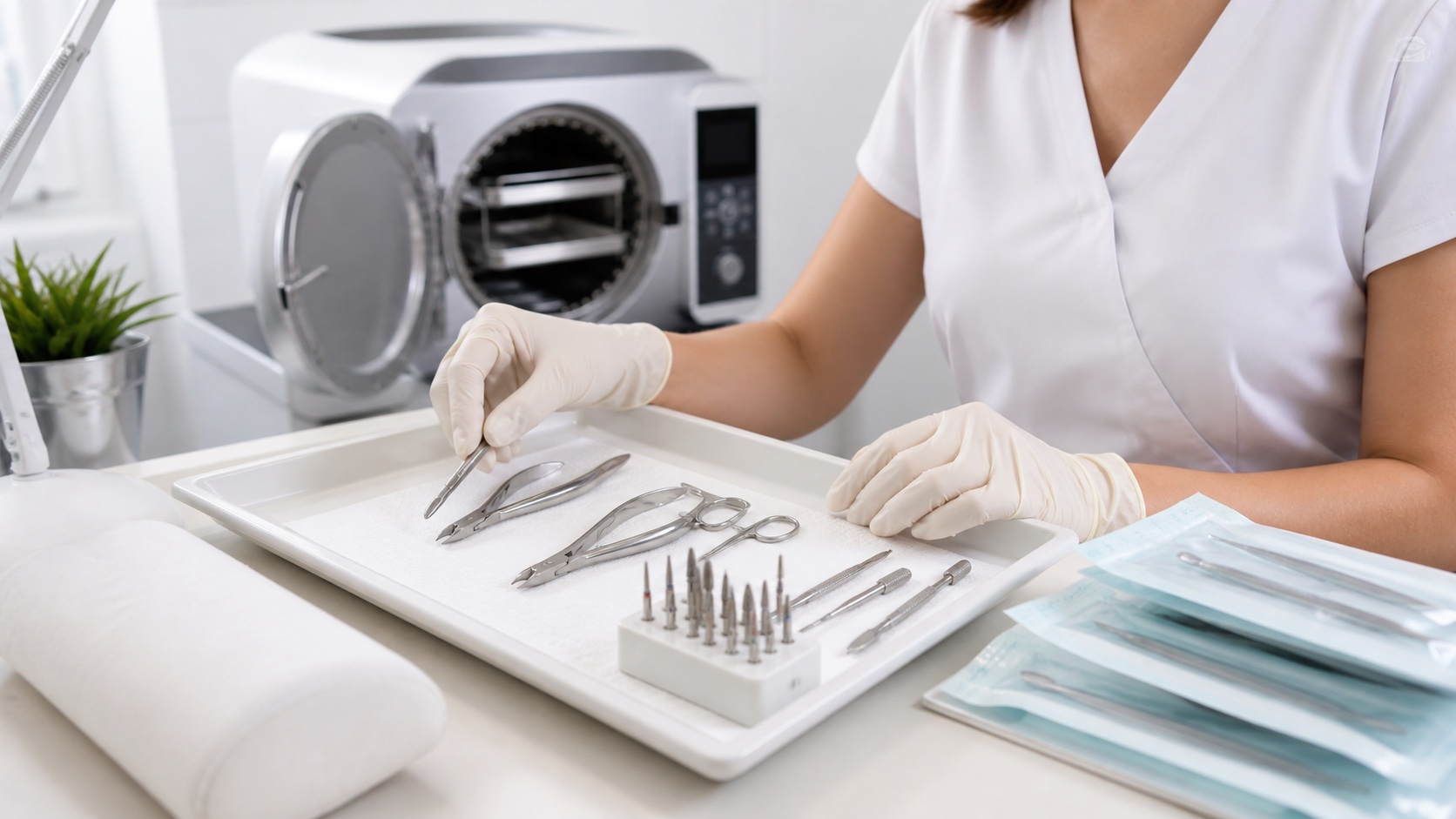
Sterilisation is a validated process intended to render a product free of viable microorganisms. It is not a generic name for a UV cabinet, ultrasonic bath, hot-bead pot or closed storage box. A reliable steam process requires a suitable steriliser, compatible instruments, correct cleaning and drying, packaging where required, a defined load, controlled cycle parameters and monitoring.
Stage | Primary job | What it does not prove | Essential control |
|---|---|---|---|
Cleaning | Removes soil and residue | Disinfection or sterility | Visual inspection and complete drying |
Disinfection | Inactivates the organisms on its label | Elimination of all spores | Dilution, wet contact time and compatibility |
Sterilisation | Validated elimination of viable microorganisms | Protection after a package is wet or damaged | Validated cycle, monitoring and traceability |
Classify each manicure tool before writing the protocol
The tool's use and material determine its route
Object names alone do not establish reprocessability
Single-use
Discard after one client
Reusable
Confirm material and manual
Contact
Intact skin, nail or blood risk
Condition
Remove damaged tools
Do not choose a process from the object’s familiar name alone. Record whether the manufacturer identifies it as single-use or reusable, what it is made from, whether it can be opened or disassembled, which body area it contacts and whether its real use could break skin or contact blood. A porous emery board and a stainless-steel cuticle pusher cannot follow the same route.
Single-use or non-reprocessable items
Many files, buffers, wooden sticks, toe separators and abrasive sanding bands are single-use or too porous to process in a verifiable way. Read the product information. If the manufacturer specifies single use, discard the item after the client. Saving it in a named envelope does not validate cleaning, drying or microbial control.
Reusable items used on intact skin or nail
A non-porous, intact and genuinely washable tool may be cleaned and subjected to the disinfecting process required by its intended use and local rules. Handles, lamps, machines and electrical parts that cannot be immersed need their own manufacturer-approved surface procedure. Liquid must not enter motors, switches or unsealed components.
Sharp tools and possible blood contact
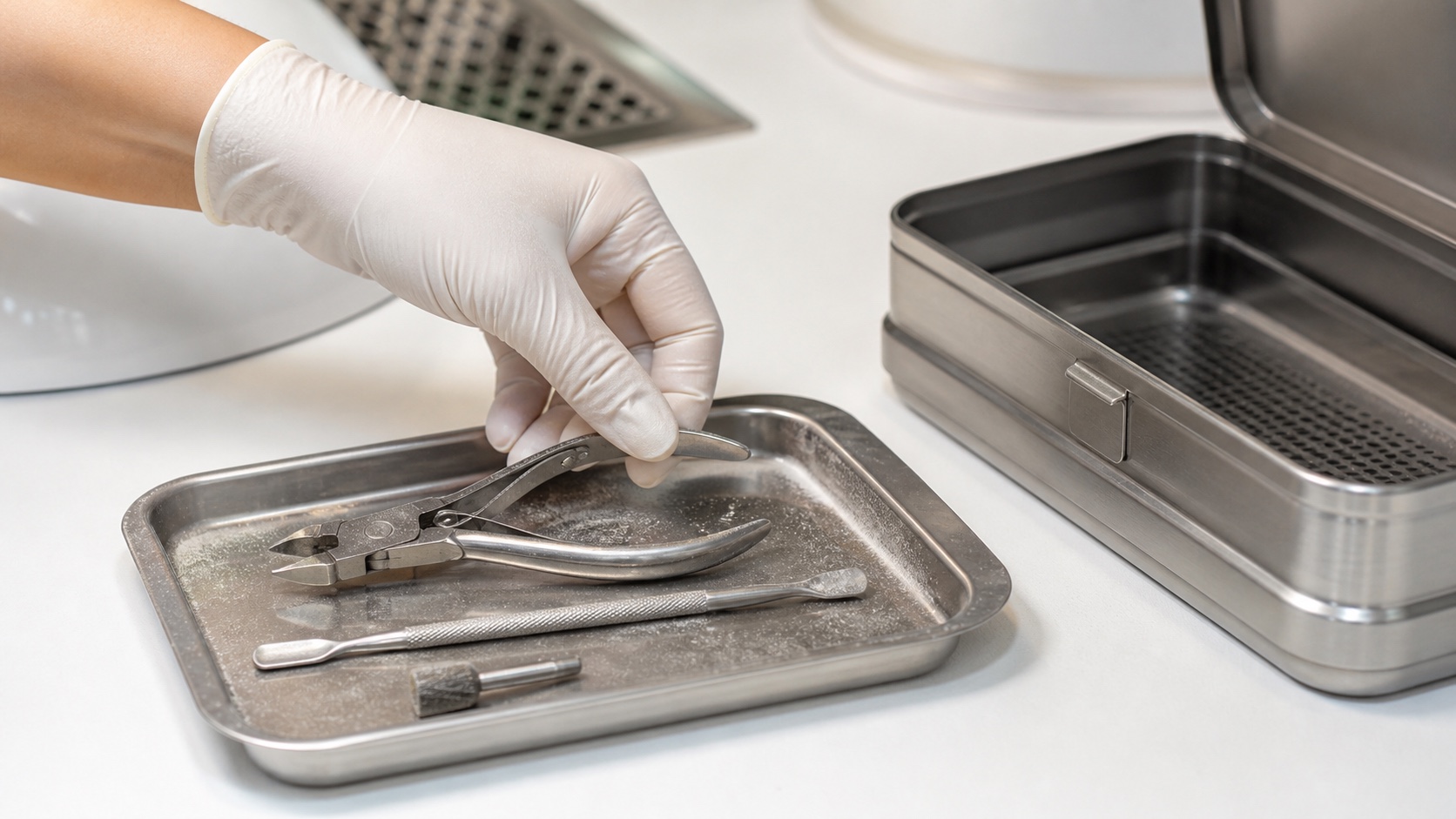
Nippers, scissors, sharp pushers and some reusable drill bits can injure skin or contact blood when a service goes wrong. They need the highest control required by the item’s use and the law where the salon operates. That may include meticulous cleaning, suitable packaging and validated sterilisation. A corroded, chipped, fixed-shut or incompletely cleanable instrument must be removed from service.
The dry and Russian manicure guide explains why increasing precision near living skin also increases the need for stop rules and tool control. The professional nail-filing guide owns abrasive selection and technique rather than instrument reprocessing.
Build a one-way dirty-to-clean workflow
Processed tools never travel backwards
Physical separation protects the completed process
Dirty
Contain and sort used items
Process
Clean, dry and inspect
Terminal
Disinfect or sterilise
Protected
Store clean and dry
A reliable workflow moves in one direction. Used instruments do not cross the prepared client area, and processed tools are not placed beside dust, waste or the cleaning sink. Physical separation, labelled containers and a clear order prevent more errors than decorative jars whose hygiene status is unknown.
Collect used tools promptly in a closed, puncture-resistant container identified for the dirty area.
Sort single-use items, reusable tools, electrical parts and damaged equipment without crossing into clean storage.
Wear the required protective equipment, open joints and clean with a compatible detergent and controlled mechanical action.
Rinse where specified, dry fully and inspect hinges, teeth, channels, surfaces and cutting edges under good light.
Disinfect or package for sterilisation according to the tool classification and local written procedure.
Run and document the specified process without overloading the bath, container or steriliser.
Store processed tools and intact packages in a closed, clean, dry area protected from dust and handling.
Dirty-to-clean separation should also be visible during service setup. Open only what is needed, keep unused processed instruments away from the working field and move a touched or dropped tool out of circulation rather than returning it to the clean tray.
Manual cleaning and ultrasonic baths have limited roles
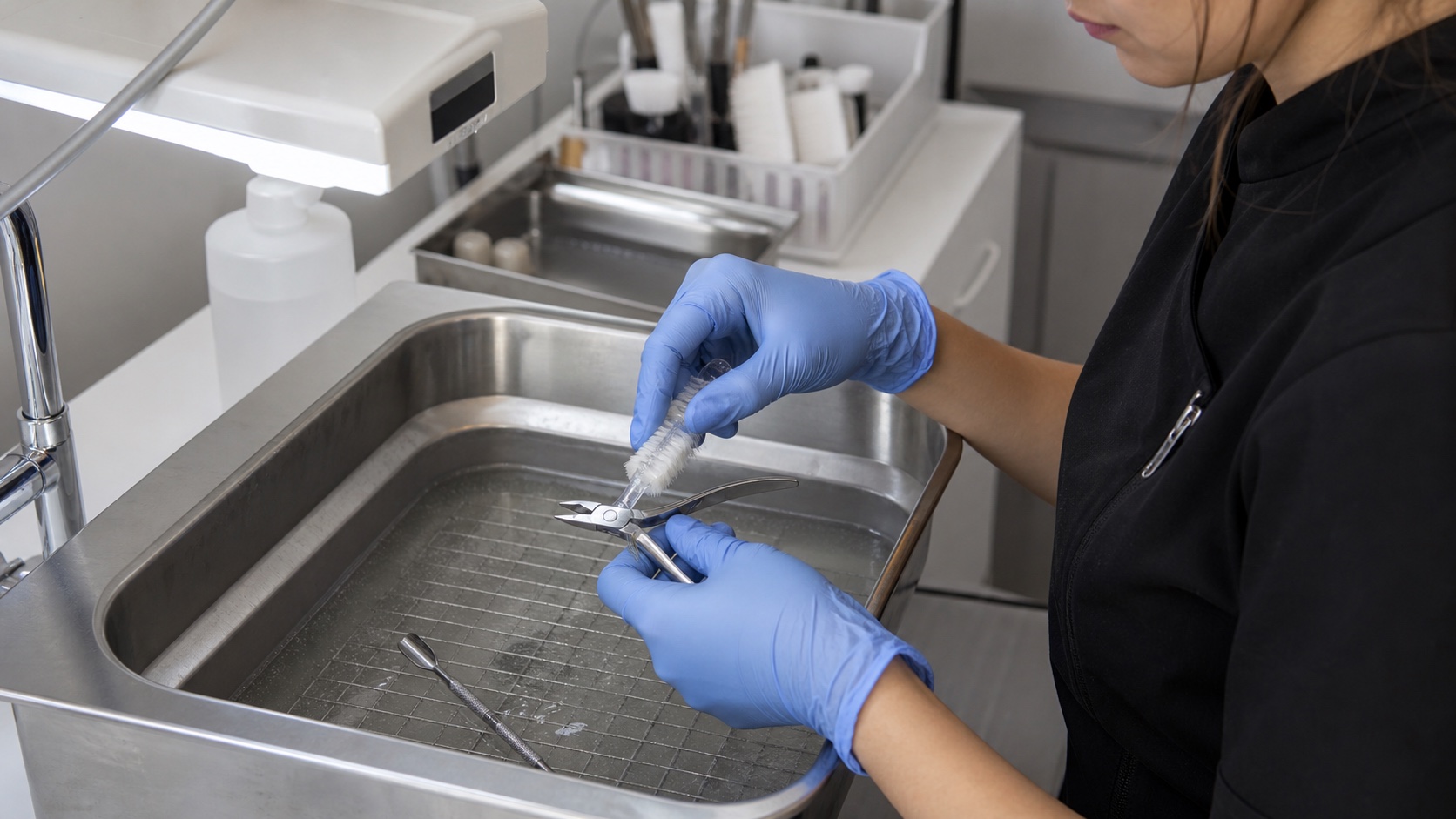
Manual cleaning needs a compatible detergent, dedicated brush, controlled action and attention to concealed surfaces. Work in a designated area, keep splashing away from the face and direct sharp points away from the hands. Clean hinges open and follow the manufacturer’s water-quality, dilution, rinsing and drying instructions. The stage ends only when inspection shows no visible residue.
An ultrasonic bath may help loosen debris from serrations, joints and recesses. It does not sterilise an instrument and does not make inspection optional. Solution, time, temperature, load arrangement, degassing and maintenance depend on the bath and detergent manuals. Tools should not be packed together so tightly that surfaces cannot be reached.
Choose and use a disinfectant from its authorised label
Words such as professional, antibacterial or sanitising do not establish that a product is suitable for salon tools. Use an authorised disinfectant for the declared object or surface in your jurisdiction. Check its registration or authorisation, antimicrobial claims, concentration, contact time, application method, material compatibility, hazards and solution-replacement schedule.
Measure the exact dilution; stronger is not automatically more effective and may increase corrosion or exposure.
Keep the whole required surface wet or immersed for the complete labelled contact time.
Replace prepared solution at the stated interval and immediately when visibly contaminated.
Do not mix chemicals or transfer them to an unlabelled container.
Keep the label and safety data available, and train the person who prepares and uses the solution.
A spray applied over powder does not provide reliable surface contact. A wipe may be appropriate only for the compatible environmental surface and exact labelled method; it cannot be assumed to reach every hinge and serration of an instrument. Product choice must follow the intended use, not a salon shortcut.
Autoclave preparation, cycle control and package integrity
An autoclave result depends on the whole load pathway
The machine cannot correct a dirty, wet or overloaded package
Prepare
Clean, dry, open and package
Run
Validated cycle and load
Verify
Data, indicators and drying
Release
Only intact acceptable packs
Steam under pressure can be a sterilising process, but owning an autoclave does not make every load sterile. An instrument enters the steriliser only when it is clean, dry, intact and declared compatible with heat and moisture. Open joints, use suitable packaging when required and arrange the load exactly as the manufacturer specifies so air removal, steam contact and drying are not obstructed.
Do not copy a time and temperature from social media. Select the validated cycle for the steriliser, load and packaging. Review physical cycle data and the chemical or biological monitoring required by the equipment instructions, written procedure and local authority. A colour-changing mark indicates exposure to defined conditions; by itself it does not prove that every item in an overloaded or poorly prepared package is sterile.
A wet, open, perforated or poorly sealed package no longer provides a dependable barrier. Reprocess the instrument; do not place the compromised pouch in clean storage.
Storage life is not one universal number. It depends on packaging, seal, handling, environmental conditions and the salon’s validated procedure. Opening an intact package in front of the client can make a completed process visible, but presentation never replaces cleaning, monitoring and records.
UV cabinets, bead pots and ultrasonic units are not autoclaves
A UV cabinet may be marketed for storage or limited surface exposure, but shadows, geometry and distance prevent it from being treated as a substitute for a validated steam cycle. An ultrasonic unit assists cleaning. A hot-bead device or localised dry-heat product does not automatically expose every external and internal surface to validated sterilising conditions.
Use equipment only for the function stated by its manufacturer and accepted by the applicable authority. A display temperature, blue light or closed lid is not evidence of sterility. Process claims need documented intended use, load limits, monitoring, maintenance and traceable results.
Nail drill bits, handpieces and workstation surfaces need separate routes
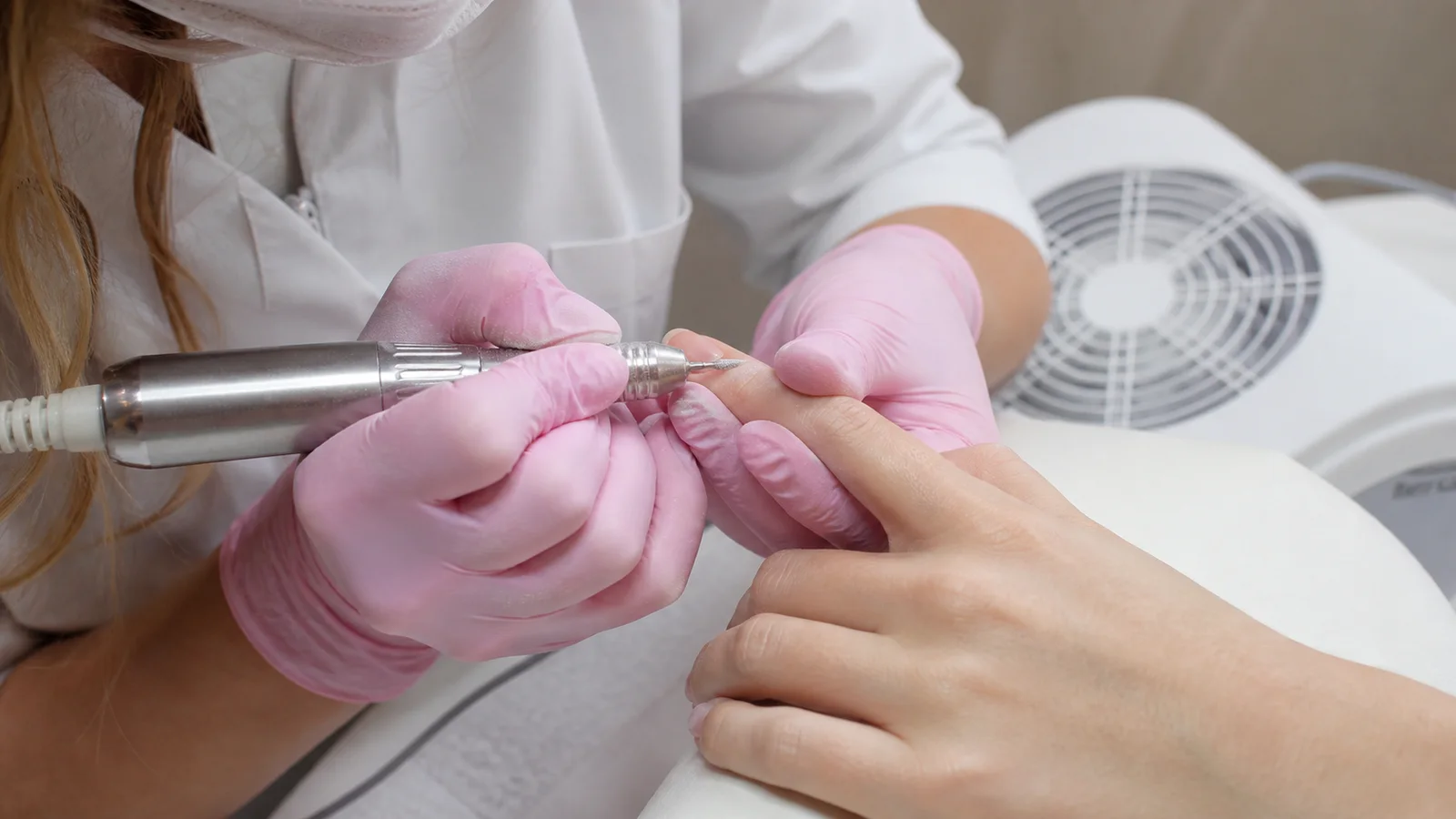
Reusable drill bits can retain product between teeth, flutes and abrasive surfaces. Separate them from the handpiece, clean them with the compatible method and inspect under directional light. Remove a bit from service if it is corroded, distorted, shedding abrasive or impossible to clean. Sanding bands are generally single-use when labelled that way; the reusable mandrel follows its own material and use classification.
Do not immerse a powered handpiece unless its manufacturer explicitly permits it. Treat removable components and external surfaces according to their manuals. The electric nail-file guide covers machine control and maintenance; the guide to drill-bit selection for gel removal covers geometry and task choice. Neither replaces reprocessing instructions.
Between clients, discard single-use barriers and waste, contain reusable tools, remove dust without spreading it, then clean and disinfect compatible high-touch surfaces. Include the table, armrest, lamp, dust collector exterior, product bottles, handles, switches, phone and payment device when touched during the service. Gloves do not replace hand hygiene or authorise movement from contaminated items to clean supplies.
Records turn a hygiene claim into a traceable process
Record | Minimum purpose | Example evidence |
|---|---|---|
Tool inventory | Assign one approved route to each item | Material, single-use status, manual and condition |
Disinfectant log | Reconstruct preparation and expiry | Product, dilution, date, time and operator |
Steriliser cycle | Connect load, cycle and monitoring | Date, load ID, parameters, indicators and release |
Exception | Stop unsafe release and correct the cause | Wet pouch, failed check, damaged tool or exposure |
The written protocol should also define staff training, responsibilities, spill and injury response, maintenance intervals, failed-cycle handling and stock rotation. Check it when equipment, products, services or local rules change. A signature is not proof of competence unless staff can demonstrate the sequence and know when to stop.
Hygiene planning belongs inside the business, not in an isolated poster. The nail-salon opening guide illustrates how local requirements can govern premises and processes in one jurisdiction, while the nail technician qualification guide explains why a course certificate does not replace local authorisation.
Four failures that can invalidate the workflow
Disinfecting over dust or dried residue, so the active product cannot contact the surface uniformly.
Reusing a single-use file because it was stored for the same client, despite no validated reprocessing route.
Overloading an ultrasonic bath, disinfectant container or steriliser and obstructing contact, circulation or drying.
Returning wet packages, failed loads or processed tools to a drawer beside uncontained used equipment.
A fifth failure is silence after blood contact or a sharps injury. Stop the service, follow the written exposure procedure immediately, dispose of contaminated single-use items and isolate reusable tools. The affected worker should use the occupational-health route required locally; cleaning the table and continuing is not a complete response.
Frequently asked questions
Does an ultrasonic bath sterilise manicure tools?
No. It can assist cleaning when used correctly. Rinsing, drying, inspection and the terminal process selected for the tool are still required.
Does a UV sanitising box sterilise tools?
Do not treat it as an autoclave substitute. Use it only for the purpose documented by its manufacturer and accepted by local requirements; shadows and geometry limit uniform exposure.
Can nail files and buffers be disinfected and reused?
Only when the manufacturer identifies the exact item as reusable and provides a compatible process. Many porous files, buffers and sanding bands are single-use.
Is cleaning with soap and water enough?
Cleaning is essential but may not be the terminal process required for a reusable tool. Classification, intended use and local rules determine whether disinfection or sterilisation follows.
Can disinfectant be sprayed directly over filing dust?
No reliable protocol should depend on that shortcut. Remove soil first; visible residue interferes with contact and can protect the surface beneath it.
What should happen if a client bleeds during a manicure?
Stop, use the salon’s first-aid and blood-exposure procedure, discard affected single-use items and contain reusable tools. Follow local reporting and occupational-health rules after worker exposure.
Which autoclave should a nail salon buy?
Start with the actual tools, packaging, loads and local requirements. Compare validated cycles, documentation, monitoring, service support and compatibility with the items the salon must process.
Does a pouch indicator prove the tool is sterile?
Not by itself. It indicates exposure to specified conditions. Load preparation, cycle data, required monitoring, drying, package integrity and correct release all matter.
How long does a sterile pouch stay sterile?
There is no one global shelf-life number. Packaging, seal, handling, storage, manufacturer instructions and the validated local procedure determine whether the barrier remains acceptable.
Can the nail-drill handpiece be immersed?
Only if the manufacturer explicitly permits it. Most powered handpieces require a specific external procedure; removable bits follow their own cleaning and terminal process.
Do gloves replace hand hygiene?
No. Gloves can become contaminated and must be changed at the correct moments. Perform hand hygiene and do not use one pair across the client, phone and clean supplies.
Are salon hygiene rules the same everywhere?
No. Requirements vary by jurisdiction and service. Verify current rules with the competent licensing, public-health and workplace-safety authorities before adopting or changing a protocol.
Learn tool hygiene as part of complete professional practice
Use BeautyLearn's online nail courses to compare curricula that connect nail assessment, tool use, workstation organisation and contamination prevention. The English nail guide library adds technique, equipment and business context. Confirm that any selected course teaches the rules applying where you intend to work.
Sources and scope
Technical definitions and the importance of prior cleaning: CDC introduction and definitions. Nail-salon biological hazards and manufacturer-directed disinfection: OSHA nail salon guidance. A current example of local UK salon guidance: City of Wolverhampton Council. The CDC healthcare guideline informs terminology, not direct salon compliance.
Editorial boundary: this page owns reusable-tool classification, cleaning, disinfection, sterilisation and dirty-to-clean flow. Service technique, electric-file control, abrasive selection, premises licensing and treatment of infection remain separate intents.