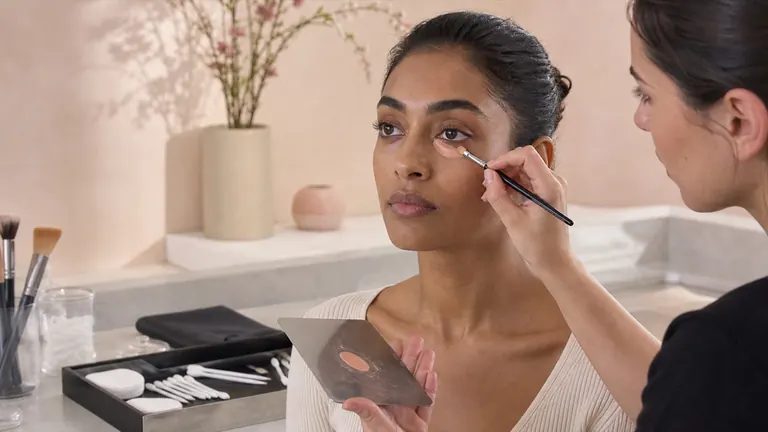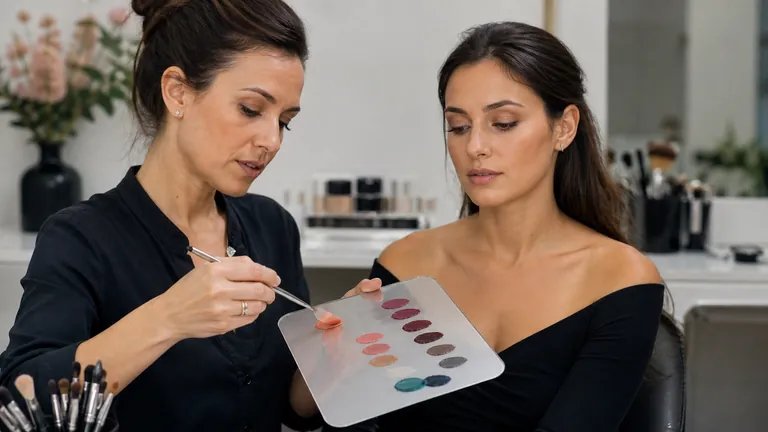
Cosmetic camouflage uses highly pigmented, removable products to reduce the visible colour contrast between an area and the surrounding skin. When the person wants it, it may make a fully healed scar, stable vitiligo patch, healed tattoo or known flat discolouration less noticeable. It is an appearance technique, not a treatment. It cannot change scar tissue, flatten a raised area, fill a depression or determine why a skin change exists.
Short answer: work only on intact, calm and fully healed skin after agreeing a realistic goal with the person. Do not camouflage open, infected, inflamed, painful or uncertain skin; an unhealed scar or tattoo; or a new or changing lesion. Read colour, texture and volume separately, test several small skin-tone mixtures, neutralise only where necessary and build coverage in thin layers. Stop if symptoms appear.
This guide owns the specialist intent of covering larger or high-contrast areas. The guide to colour correctors for dark circles and local discolouration deals with small facial corrections; makeup for acne-prone skin focuses on comfort, active blemishes and post-acne marks; and makeup for rosacea and sensitive skin owns reactive redness. Keeping those intents separate prevents a high-coverage protocol being applied where restraint or healthcare assessment should come first.
Understand what cosmetic camouflage can and cannot change
Compared with an everyday foundation, a camouflage system usually offers greater pigment concentration, adhesion and resistance. Those properties can create substantial coverage with thin layers, but they do not make every product suitable for every area. Follow the manufacturer's intended use, application, setting, removal and warnings. Claims such as professional, waterproof or dermatologist tested do not override the label or guarantee suitability for an individual client.
Pigment modifies perceived colour. A hypertrophic or keloid scar remains raised and continues to cast light and shadow. An atrophic scar remains depressed. Irregular texture remains visible in movement and directional light. Trying to fill or flatten it with more cream usually makes thickness, cracking and edge contrast more obvious. A responsible objective is to reduce chromatic contrast while preserving believable skin texture.
Put the safety boundary before the colour match
Safety comes before colour
Camouflage belongs only on intact, calm and fully healed skin
Intact skin
Agree the goal and run a small trial
Fully healed
Keep colour and texture separate
Active symptoms
Do not apply product
Uncertainty
Leave visible and refer
A makeup artist does not diagnose a patch, scar or changing mark. Ask whether the area is known, stable, fully healed and free from pain or active symptoms. Observe without scraping or manipulating it. If the person is uncertain, postpone work on that area and recommend appropriate healthcare advice. Covering first can hide information the client or clinician needs to see.
Do not apply to skin that is open, bleeding, weeping, hot, very red, swollen, painful, infected, producing discharge or odour, or covered by an unstable scab. Do not apply to a fresh tattoo, unhealed procedure or burn, a recent scar without appropriate clearance, or a new, changing, itching or bleeding lesion. Stop for burning, increasing itch, pain, swelling or irritation during the test, remove gently and do not attempt a second, heavier layer.
NHS hospital guidance states that skin camouflage cannot be used on skin that is unhealed, infected, inflamed or broken. NHS scar information also notes that camouflage may make a scar less noticeable but cannot remove it, and lists pain, warmth, swelling and discharge as reasons to seek care. Use the separate guide to cosmetic reactions and stop criteria to organise removal, documentation and escalation without presenting a cosmetic test as a medical allergy test.
Separate colour, texture and volume before choosing a product
Pigment changes colour, not geometry
Three separate observations prevent unrealistic promises and heavy layers
Colour
May be neutralised and covered
Texture
Remains visible at close range
Raised
Still produces highlight and shadow
Depressed
Cannot be filled with pigment
Describe the area on three lines. Colour: lighter, darker, red, brown, bluish, violet or mixed. Texture: smooth, dry, glossy, porous or irregular. Volume: flat, raised or depressed. Pigment can directly alter only the first line. Texture and volume require adjusted expectations, appropriate light and even tighter control of product quantity.
Move the light and viewing angle. If the contrast changes substantially, relief or depression is contributing to it. If the colour remains stable, camouflage may reduce it. Side lighting and sharp photography reveal more texture; frontal diffuse light reduces its visibility but does not mean the makeup changed the skin. For camera work, use the photographic makeup guide to test exposure, white balance and texture honestly.
Observation | What makeup may change | Professional limit |
|---|---|---|
Flat colour difference | Reduce chromatic contrast | No diagnosis of its cause |
Dry or irregular texture | Modify finish and edge visibility | Texture remains visible |
Raised or depressed area | Reduce colour contrast only | Pigment cannot change geometry |
Agree consent, purpose and the right not to cover
Never assume that vitiligo, a scar or a tattoo should be hidden. Ask what the person wants, where the result will be seen and how long it needs to perform. Softening contrast at conversation distance, unifying a wedding photograph, reducing transfer onto a garment and creating water resistance are different briefs. Full coverage, partial coverage and no coverage are all valid choices.
If the area is photographed for a client record, comparison or portfolio, obtain purpose-specific consent. A scar, tattoo or body area can identify a person even when the face is absent. Record capture device, storage, access, retention and permitted publication channels before taking the image. The guide to makeup client records, photo consent and privacy explains how to keep technical documentation separate from marketing permission.
Match the surrounding skin with controlled micro-mixtures
The reference is not the colour in the package or a distant part of the body. Compare the immediate healthy perimeter under neutral, diffuse light, then check the wider area because face, chest and arms may differ in depth and colour direction. Tanning, temporary flushing and warm lamps distort the reading. The guide to skin undertone and foundation matching helps separate depth, surface colour and chromatic direction.
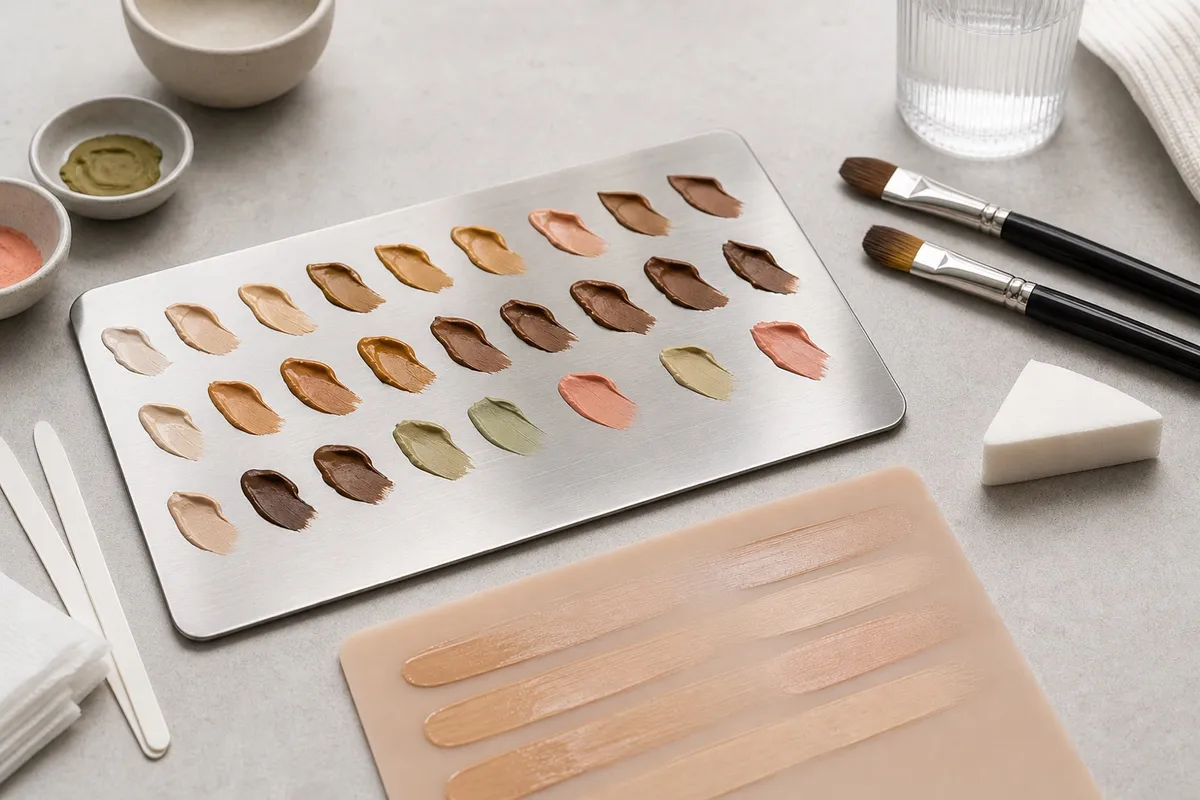
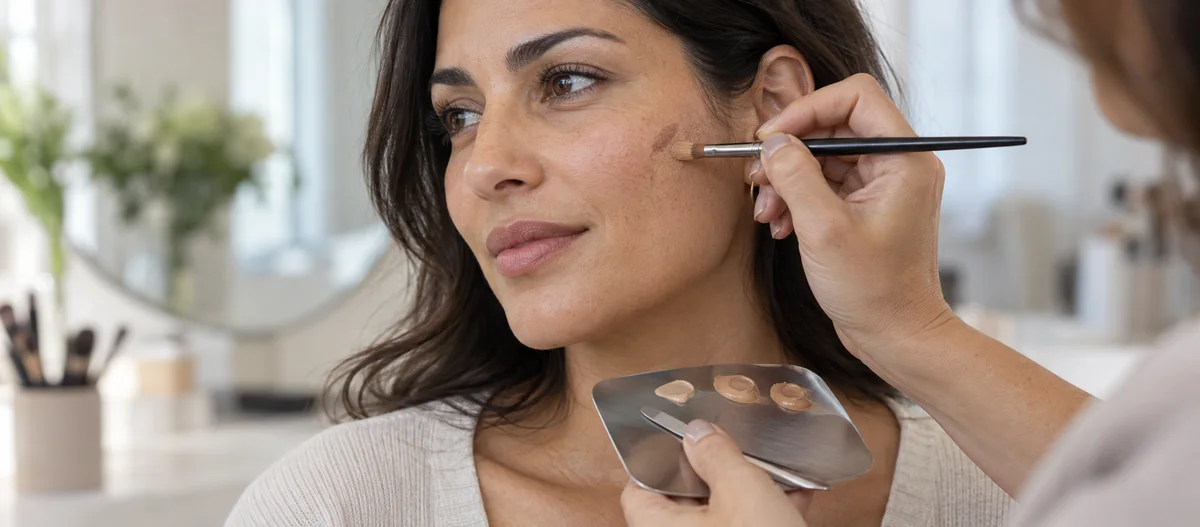
Prepare three or four neighbouring micro-mixtures: one at the apparent depth, one slightly lighter, one deeper and one with an adjusted undertone. Apply very thin samples to intact skin at the edge, allow them to settle and inspect them frontally, from the side and at conversation distance. The most useful match disappears into context without a grey, orange or pink border. Repeat the match when season or tanning changes.

Neutralise a strong colour cast before adding skin-tone coverage
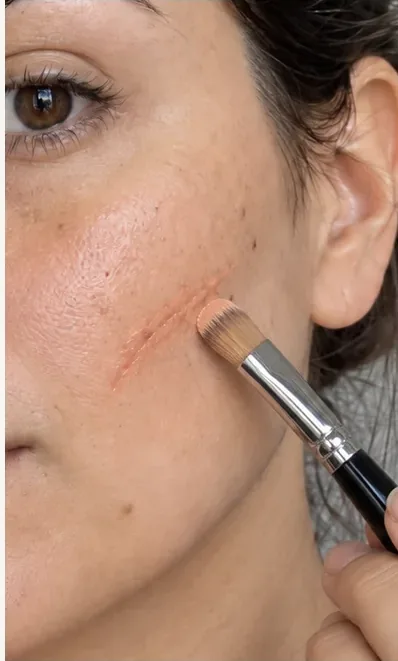
A strong local cast may need a sheer chromatic step before the skin-tone layer. Blue and blue-black may lead to muted peach, orange or terracotta tests; red and pink to low-saturation green or olive; violet to yellow-peach; and some brown areas mainly to a skin tone at the correct depth. These are trial directions, not universal recipes. Hue, saturation, depth and transparency must be adjusted to the actual area.
Neutralisation should be local and nearly invisible. If green, orange or peach is still obvious after feathering, it is too saturated, too deep or too abundant. Hiding it with more flesh-coloured product creates a plaque. Review hue, value and saturation in the makeup colour theory guide, and use the local corrector protocol for small facial areas rather than importing the entire camouflage method.

Camouflage a fully healed scar without promising to erase texture
Four cases, four limits
The technique changes, but intact fully healed skin remains the shared requirement
Scar
Fully healed; texture remains
Vitiligo
Optional coverage; sunscreen stays separate
Tattoo
Fully healed; test fabric transfer
Discolouration
Known, stable and flat only
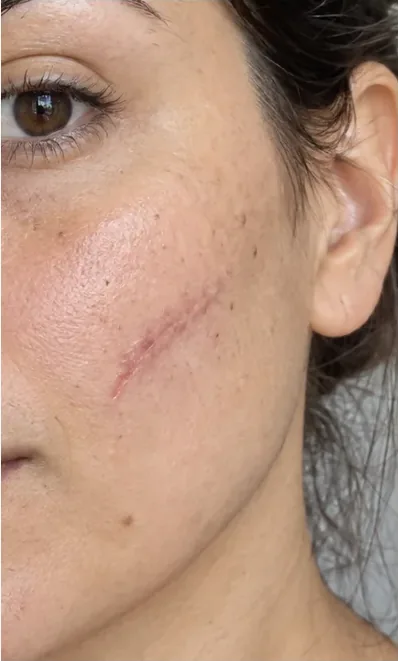
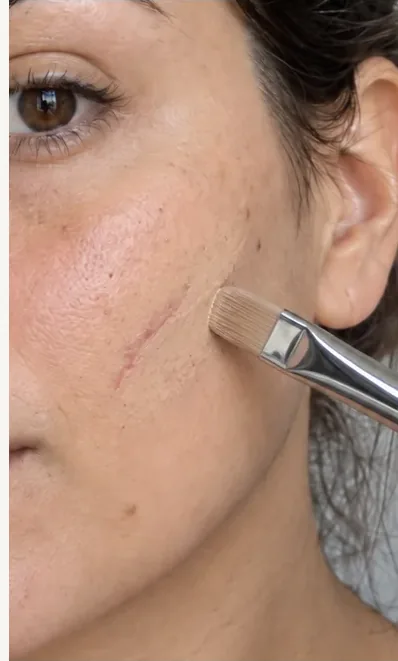
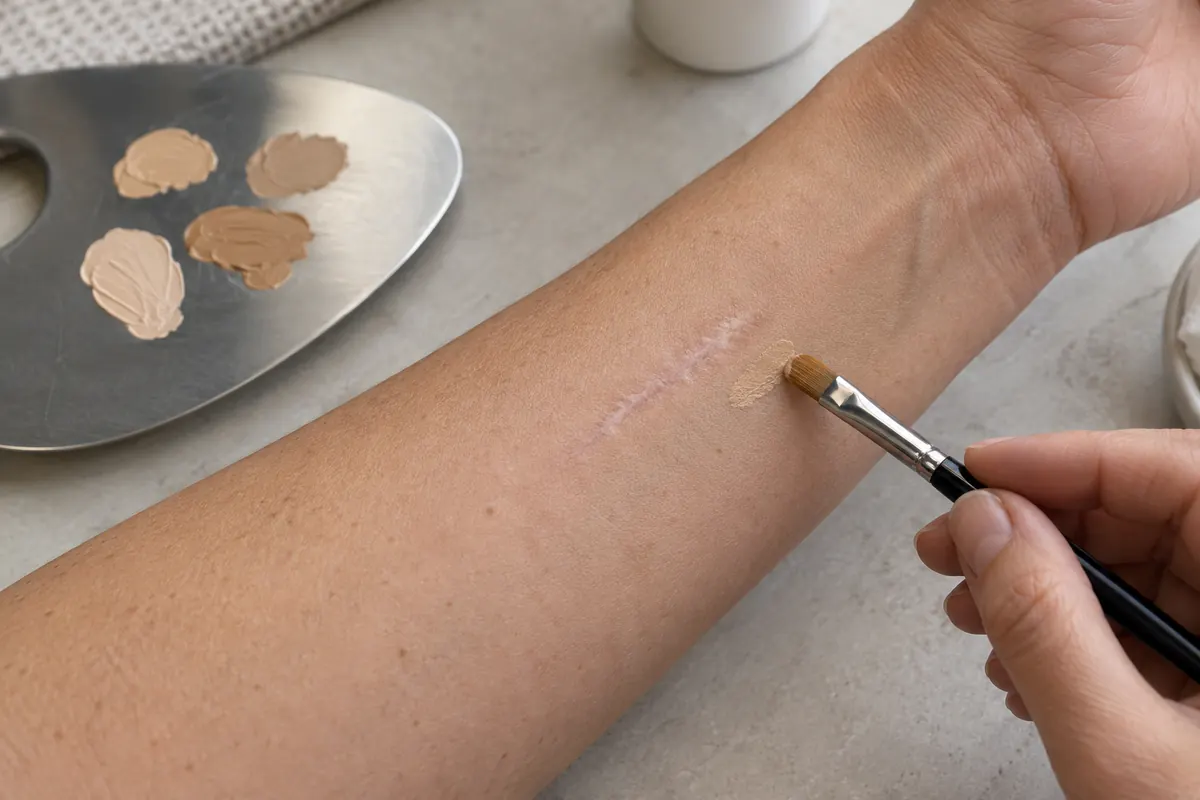
A fine, flat, fully healed scar may respond well to a custom colour. Raised, keloid, hypertrophic, contracture and depressed scars retain their shape and shadow. The NHS notes that a scar cannot simply be removed and that camouflage creams and powders can make it less noticeable. Do not describe a recent red or violet scar as ready merely because foundation adheres to it; healing status and any clinical instructions come first.
On irregular texture, avoid rich preparation, multiple elastic layers and broad powder. Press a small quantity, keep the perimeter thinner than the centre and inspect the area as the body moves. If the scar becomes painful, warm, swollen or produces discharge, apply nothing and direct the client towards healthcare assessment. Flat post-acne colour can use chromatic reasoning; active acne or evolving scars follow the limits in the acne-prone skin guide.
Treat vitiligo camouflage as a personal option, not a correction
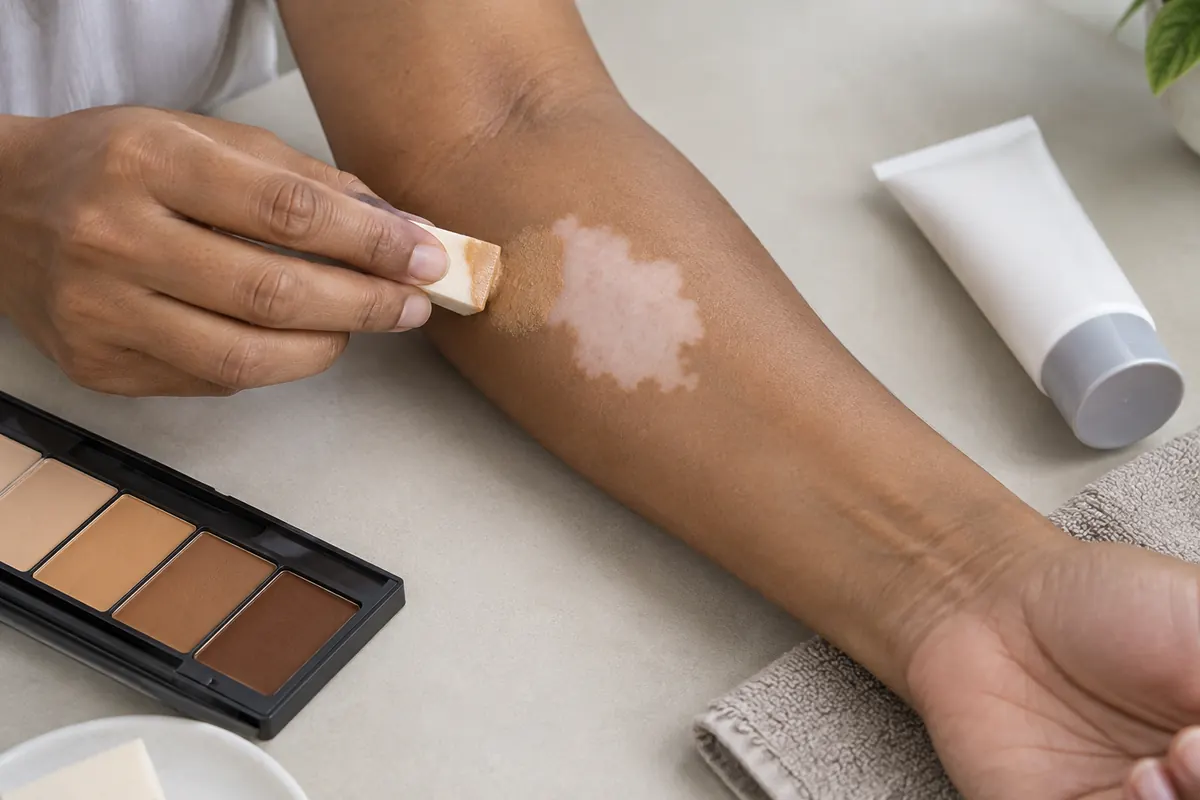
Vitiligo is a medical condition and not a flaw that must be hidden. The American Academy of Dermatology states that not everyone wants to even their skin tone; makeup, self-tanner or skin dyes are optional appearance choices. If removable camouflage is requested, work on intact skin, build the match from the surrounding area and avoid orange, overly dark or sharply edged coverage.
Depigmented skin can sunburn more readily. Camouflage does not automatically replace sunscreen. Apply the sun-protection product in its labelled amount, let its film settle, check compatibility and avoid dragging it while layering pigment. Reapplication may require partial removal or reconstruction of the camouflage, so plan it before the service with the guide to sunscreen and makeup order and reapplication.
Do not suggest cosmetic tattooing as the automatic next step. Current AAD guidance explains that skin injury, including tattooing, can trigger new vitiligo patches for some people. A makeup artist stays within removable cosmetics and refers decisions about a medical condition or invasive procedure to appropriately qualified professionals.
Cover a healed tattoo by segmenting pigment and testing transfer
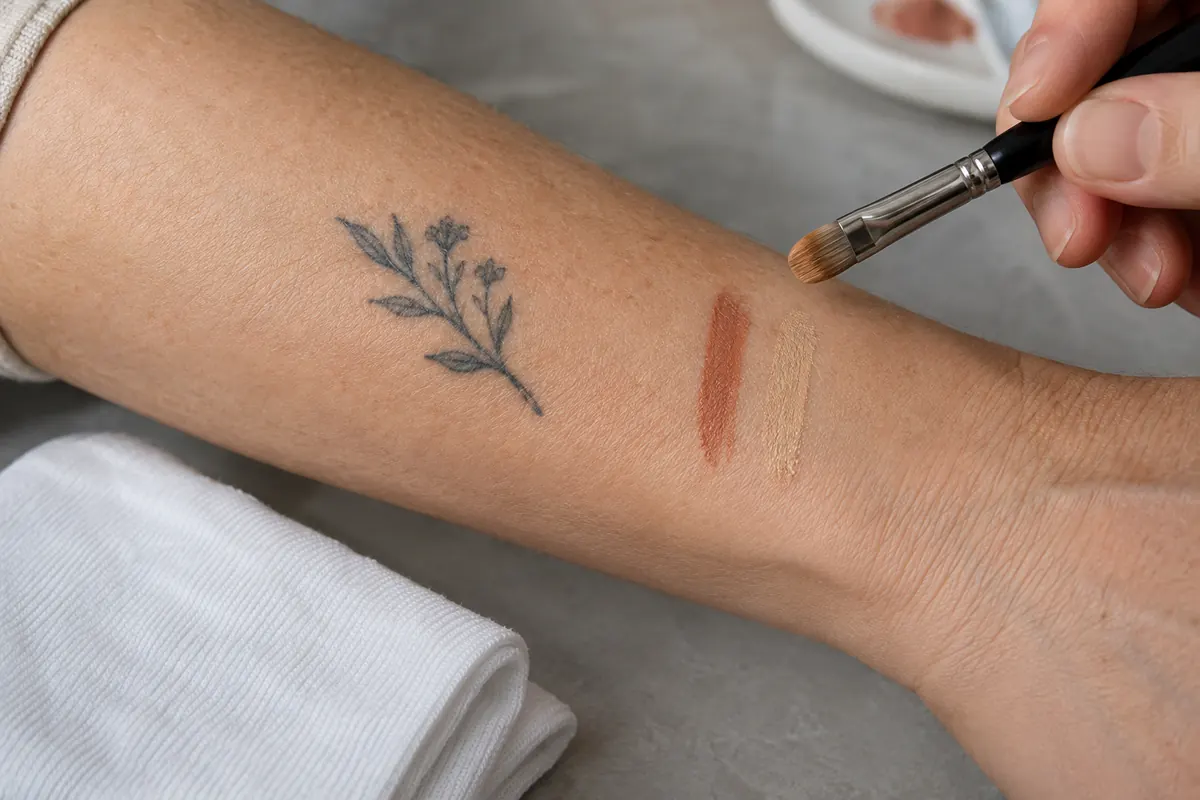
Work only on a completely healed tattoo with no scabs, warmth, pain, discharge or active aftercare. A fresh tattoo is healing skin and should not be covered with makeup. Do not camouflage a new or changing mole, spot or lesion inside the design. AAD guidance notes that tattoo pigment can make skin changes harder to see; uncertainty requires visibility and assessment, not coverage.
Blue-black ink may require muted peach, orange or terracotta, while other colours need separate tests. Do not coat an entire multicolour design in one orange layer. Segment the most intense areas, deposit minimal corrector, add a high-coverage skin match and feather beyond the design edge. Check for grey shift under cool light and orange shift under warm light.
For weddings and production work, test sleeve, collar, seating, hugs, water, sweat and movement. Use the actual garment or a clean fabric sample when possible. Water-resistant does not mean transfer-proof under every condition. Set only as the system instructs and give removal and touch-up directions. The waterproof makeup guide explains realistic heat, humidity and friction testing.
Keep known flat discolouration separate from diagnosis
For a known, stable and flat area, record only visible properties: colour, extent, depth, saturation and the stability reported by the person. Brown, red and bluish marks do not share one protocol. Do not conceal an area that is new, changing, bleeding, itching, painful or not understood. A makeup artist describes and stops; a healthcare professional determines cause.
A small difference may require only foundation or a local concealer. Specialist camouflage becomes relevant when more pigment, precision or resistance is genuinely needed. Compare liquid, cream and stick behaviour in the guide to foundation texture, coverage and finish. Choose the least complex product that meets the agreed goal, not the highest-coverage option by default.
Follow an eight-step professional camouflage protocol
From consent to wear test
Every stage must pass before more coverage is added
Goal, consent and skin integrity
Micro-mixtures and compatibility trial
Neutralise and layer locally
Set, wear-test and document
Define the client's goal, area, duration, clothing, water, friction, photography and right not to cover.
Confirm that skin is intact, calm and fully healed and the condition is known; stop when any point is uncertain.
Read intended use and warnings, check batch, PAO and package integrity, and prepare a hygienic workflow.
Observe colour, texture and volume under neutral light and compare micro-mixtures on surrounding intact skin.
Perform a small compatibility and appearance trial without calling it an allergy test or guarantee.
Neutralise only the strongest cast, then build the skin-tone mixture in thin complete veils.
Set according to the system and verify at distance, in motion, under multiple lights and expected wear conditions.
Document formula and result with consent, provide removal and touch-up guidance, and record any stop event.
Practise colour control and thin layering through the BeautyLearn makeup courses, including the corrective makeup course, the beginner makeup course and the professional makeup products course. English-market enrolment and availability remain separate from the Italian catalogue.
Keep hygiene, layering, setting and removal in one system
Decant creams with a clean spatula onto a disinfectable palette and never re-enter a container with a tool that touched skin. Use disposable applicators where appropriate and separate clean from used equipment. A large body area multiplies contact points and service time, so expand the hygiene plan instead of relying on the habits of a quick facial base. Review the full workflow in the guide to makeup brushes, sponges, products and workstation hygiene.
Build complete thin layers: micro-neutralisation, first skin-tone veil, a second veil only over residual contrast, a transparent perimeter and proportional setting. Let each phase settle. If colour reappears, reassess hue and depth before adding quantity. A wrong mixture becomes a more visible patch when it is simply made thicker.
A wear test should reproduce part of real use: flexion, heat, fabric contact, natural and artificial light, photography and time. Inspect separation, cracking, shine, colour shift, edge and transfer. Remove with the compatible product and adequate contact time; dissolve the film before using light pressure. Do not scrape, use improvised solvents or repeatedly rub the same area.
Stage | Pass criterion | If it fails |
|---|---|---|
Colour match | Perimeter disappears after settling | Change depth or undertone, not quantity |
Layering | Coverage is thin and flexible | Remove excess; rebuild locally |
Wear test | Acceptable movement, edge and transfer | Revise system or reset expectations |
Avoid the common cosmetic camouflage mistakes
Promising to erase a scar, vitiligo, tattoo or texture instead of defining a realistic visible result.
Applying to unhealed, inflamed, painful, infected or uncertain skin.
Assuming the person wants coverage and beginning without goal, consent and a small trial.
Using an over-saturated corrector and hiding it beneath a thick skin-tone layer.
Matching from the package rather than surrounding skin after the sample has settled.
Trying to fill depressions or flatten raised tissue with pigment, powder or primer.
Ignoring clothing, sun, water, sweat and movement while claiming zero transfer.
Photographing identifiable scars or tattoos without specific consent and secure file handling.
Frequently asked questions about cosmetic camouflage
Can cosmetic camouflage remove a scar?
No. It can reduce colour contrast on a fully healed scar and make it less noticeable if the person wants that result. It cannot remove scar tissue, flatten a raised scar or fill a depression.
Can makeup be applied to a recent scar?
Not until it is fully healed and relevant aftercare or clinical instructions allow it. Warmth, pain, swelling, discharge, unstable scabs or uncertainty are stop criteria.
Is vitiligo camouflage a treatment?
No. Removable camouflage is an optional appearance choice, not a cure. The person's choice to cover partly, fully or not at all should be respected.
Does camouflage replace sunscreen on vitiligo?
Not automatically. Sunscreen protection depends on a suitable product used and reapplied according to its label. Camouflage must be layered without disrupting that film and the reapplication plan needs to be agreed.
When can a tattoo be covered with makeup?
Only when it is completely healed and has no scabs, warmth, pain, discharge or active aftercare. A fresh tattoo is healing skin and should not be covered.
Which corrector covers a black tattoo?
There is no universal orange. Blue-black may lead to muted peach, orange or terracotta tests, but depth and saturation must suit both skin and ink. Use a minimal local trial before skin-tone coverage.
Is waterproof camouflage always transfer-proof?
No. Performance depends on quantity, setting, fabric, friction, heat, sweat and time. Reproduce expected wear conditions and explain the remaining transfer risk.
Can a new dark spot be covered for an event?
Not when it is new, changing, itching, bleeding, painful or not understood. Cosmetic coverage should not delay assessment or hide a change that needs to remain visible.
How can heavy, mask-like coverage be avoided?
Neutralise only the strongest cast, match depth accurately, complete one thin layer before the next and keep the perimeter transparent. Stop when the area no longer dominates at normal distance.
Does a patch test guarantee there will be no reaction?
No. A small compatibility trial can reveal an immediate problem or poor colour match, but it does not diagnose allergy or guarantee future tolerance. Stop if symptoms develop.
Can camouflage flatten a raised scar?
No. It may reduce colour contrast, while light and movement continue to reveal height. Extra product usually makes the surface more visible rather than flatter.
How is body camouflage removed?
Use the compatible remover, enough contact time and a soft support. Dissolve the film before light wiping; never scrape or repeatedly rub the area.
Should tattooed moles be covered?
A new or changing mole or spot should remain visible and be assessed. Tattoo pigment can already make changes harder to see, so cosmetic coverage is not the appropriate response to uncertainty.
When must a camouflage service stop?
Stop before application for broken, infected, inflamed, unhealed, painful or uncertain skin, and during application for burning, increasing itch, pain, swelling or irritation. Remove gently and seek appropriate healthcare advice when needed.
Official sources and scope
NHS — Scars; healed-skin camouflage, scar limits and symptoms requiring care.
University Hospitals of Leicester NHS Trust — Cosmetic skin camouflage; camouflage must not be applied to unhealed, infected, inflamed or broken skin.
NHS — Vitiligo treatment; sun protection and camouflage as an appearance option rather than a cure.
American Academy of Dermatology — Vitiligo self-care; optional coverage, sun protection and risks from skin injury including tattooing.
American Academy of Dermatology — Do tattoos cause skin cancer?; tattoo pigment can make changing lesions harder to detect.
EUR-Lex — Regulation (EC) No 1223/2009 on cosmetic products; current European cosmetic safety, labelling and intended-use framework.
Substantive review: 5 September 2026. This educational guide is written by Irene Tomasi, a makeup artist with 10 years of professional experience. It teaches removable cosmetic technique and professional stop criteria; it does not diagnose or treat scars, vitiligo, discolouration, tattoo reactions or other skin conditions. Independent dermatological review is required before this guide is presented as clinically reviewed. Continue with the English makeup guide library.