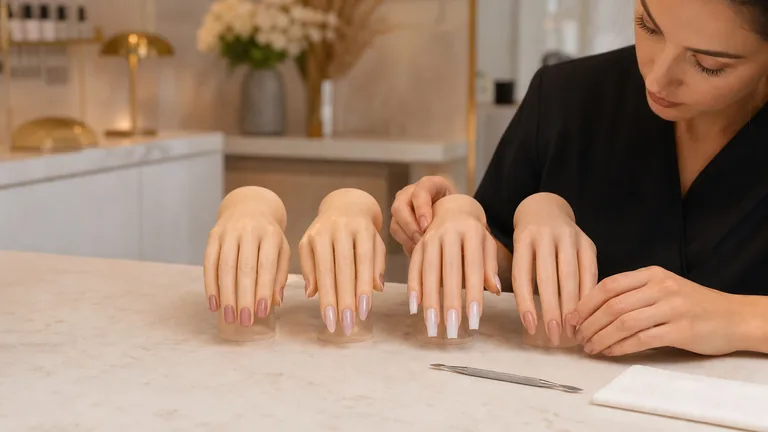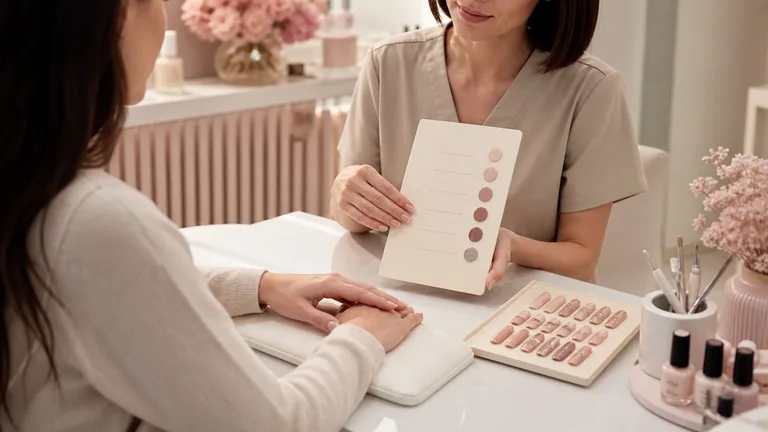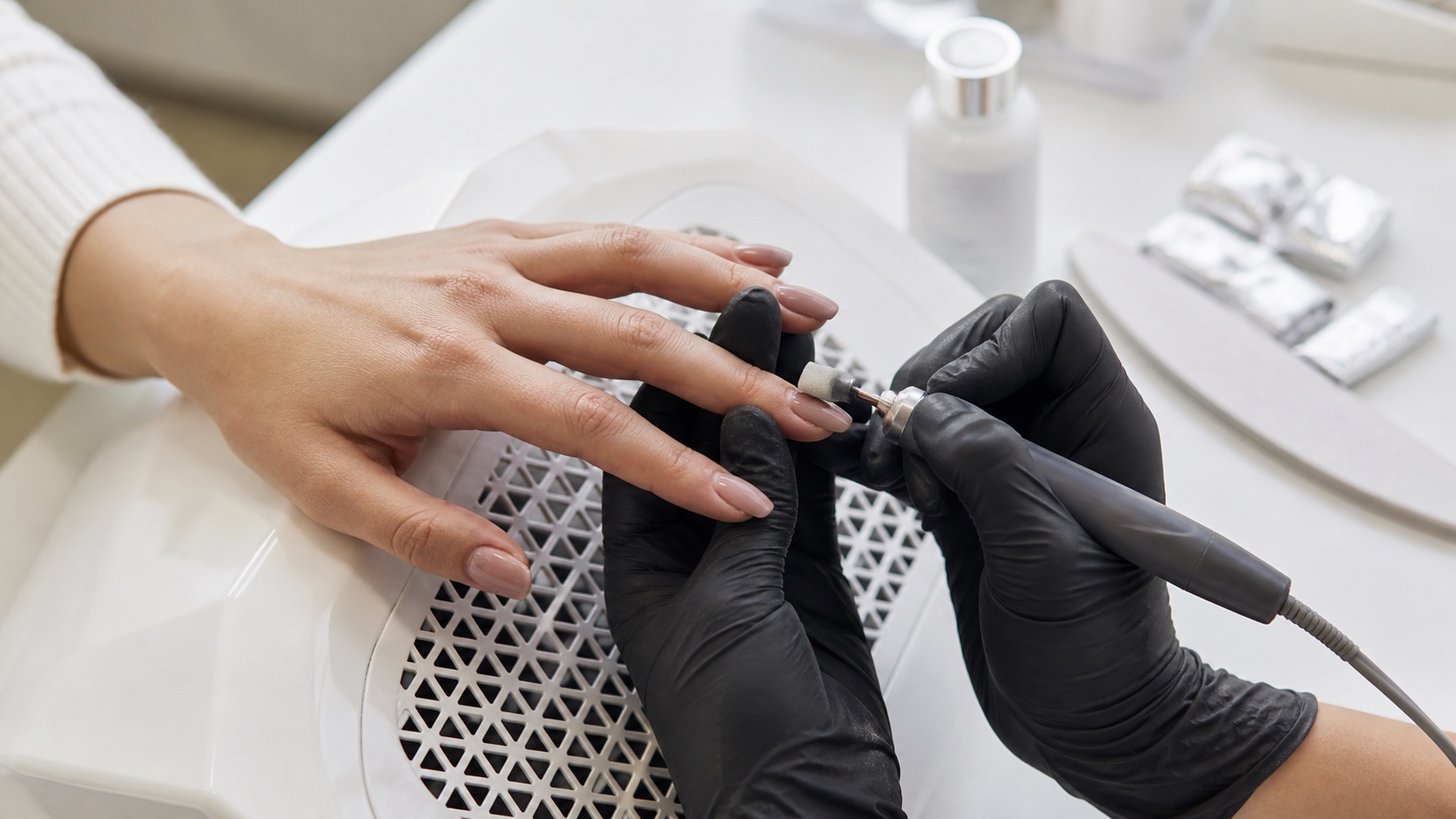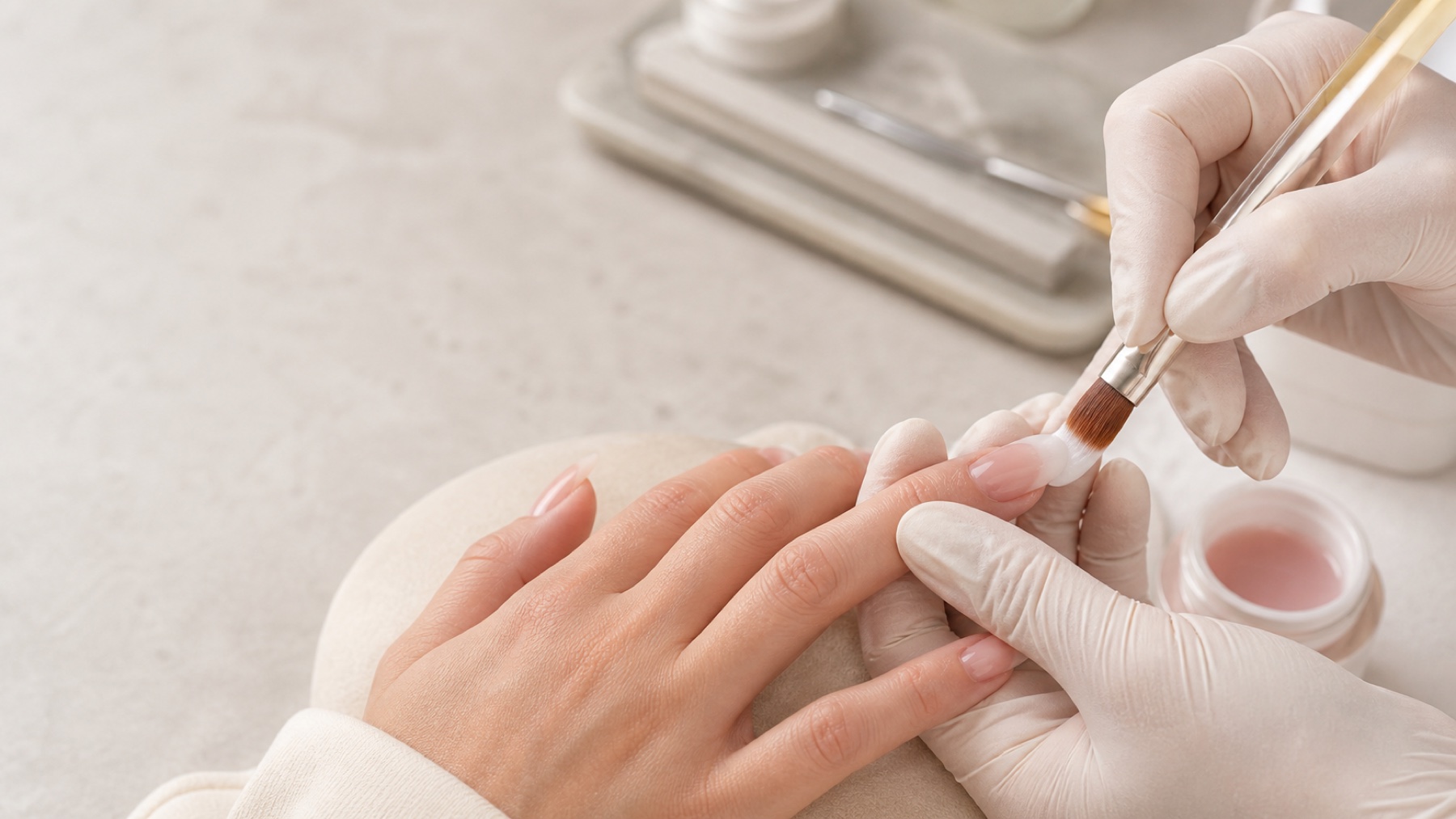
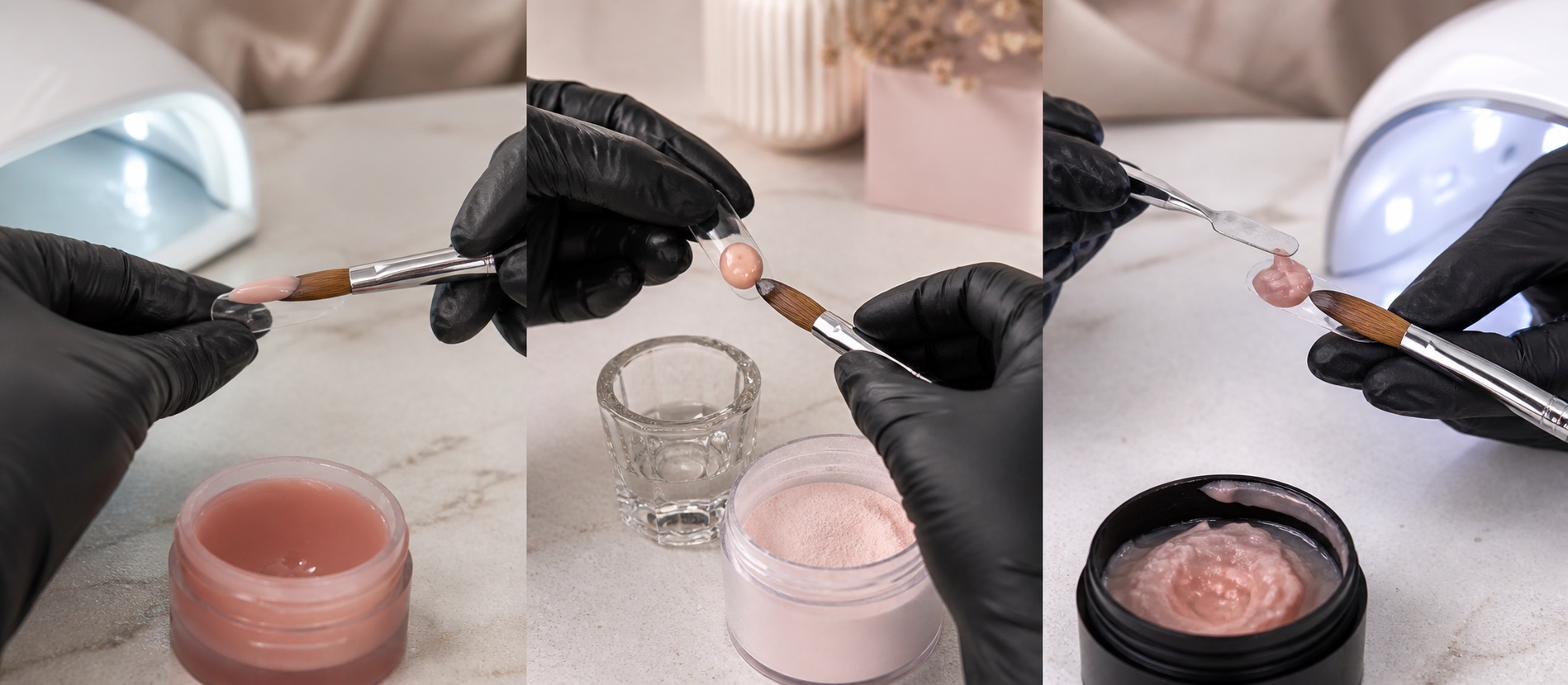
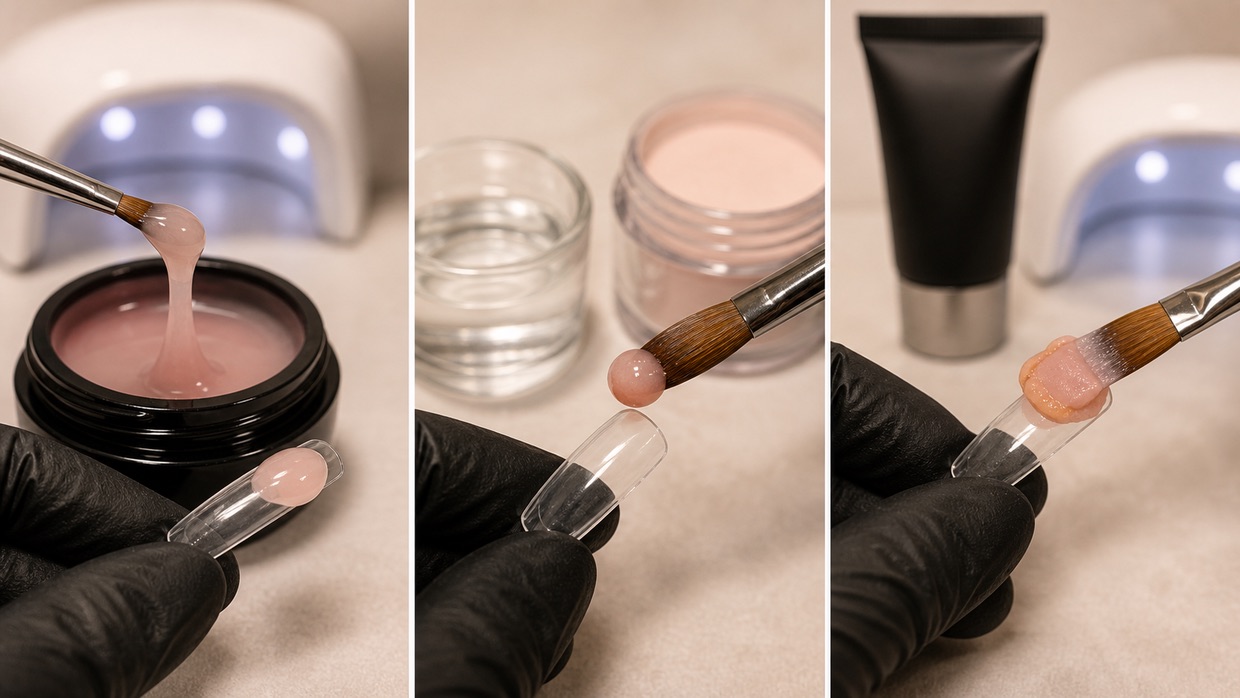
Gel, acrylic and acrygel are families of professional nail-enhancement systems, not three fixed recipes. They can all create overlays, repairs or extensions when the specific product is intended for that use and the technician controls preparation, structure, polymerisation or setting, finishing and maintenance. The practical difference is how each system is supplied, how it moves before hardening and what initiates the change into a solid coating.
Quick answer: gel is usually supplied ready to apply and hardens under the compatible lamp; acrylic combines liquid and powder and sets through their chemical reaction; acrygel is a dense hybrid-style system that is positioned with a compatible liquid and hardens under its specified lamp. None is automatically stronger, safer, thinner or more natural. Compare the exact product, intended service and complete system.
This comparison belongs to the BeautyLearn professional nail guide library. It owns the broad ‘gel vs acrylic vs acrygel’ intent; the individual technique guides will teach application, structure and troubleshooting without repeating this whole comparison. Review nail-matrix anatomy and professional hand filing before treating removal as product scraping. For structured training, compare the online nail course catalogue and the current programmes for beginner gel nails, beginner acrylic nails and acrygel nails. Each English course is a separate market record.
The three systems in one comparison
Three systems, three working behaviours
Compare the complete product system
Gel
Ready to apply · lamp cured
Acrylic
Liquid + powder · chemically sets
Acrygel
Dense paste · lamp cured
Feature | Gel | Acrylic | Acrygel |
|---|---|---|---|
Supplied as | Ready-to-use light-curable product | Liquid monomer plus polymer powder | Dense light-curable paste or gel |
Working behaviour | Ranges from self-levelling to non-levelling | Bead changes as the reaction advances | Stays where placed until manipulated |
Hardening | Specified UV/LED lamp and cure schedule | Liquid-powder chemical reaction | Specified UV/LED lamp and cure schedule |
Main control | Viscosity, gravity, placement and cure | Ratio, bead stage, placement and timing | Portion, placement, compatible slip liquid and cure |
Finishing | May self-level; filing depends on application | Usually refined after complete setting | Often designed for controlled placement and filing |
These are working tendencies, not purchasing specifications. A flexible bottled builder gel, a high-viscosity sculpting gel and a hard gel can behave very differently. Acrylic powders and liquids vary in setting speed and intended temperature range. Acrygel products differ in density, required brush liquid, lamp and removability. Read the whole system before comparing names.
How gel works
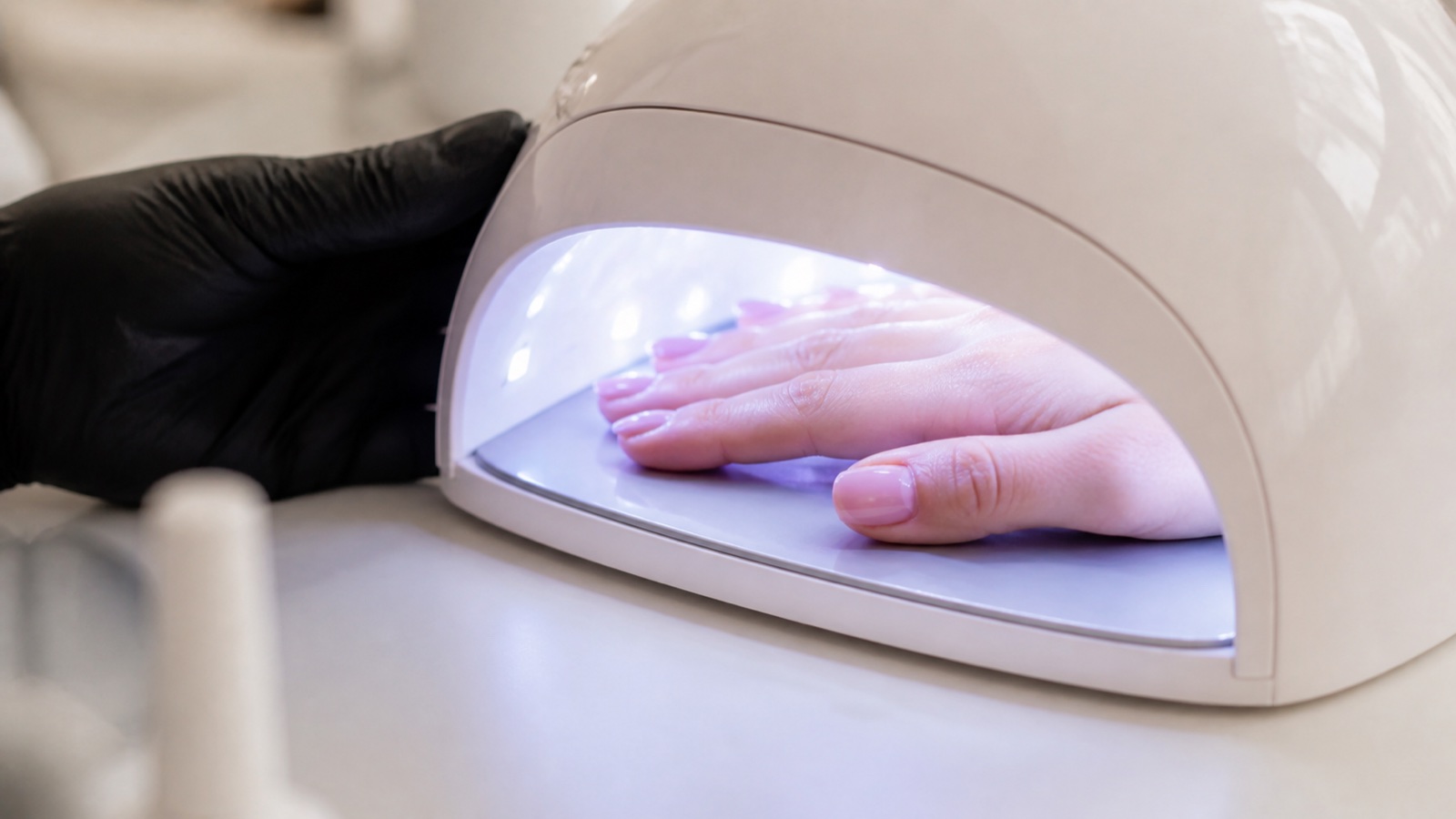
Professional gel contains reactive ingredients and photoinitiators. Energy from a compatible lamp starts polymerisation. ‘LED gel’ and ‘UV gel’ are often commercial shorthand: the relevant question is whether the lamp’s output and exposure schedule are validated for the exact product. Visible hardness, a cool surface or a dry top does not prove complete cure.
Viscosity changes application. A self-levelling gel can smooth quickly but move into sidewalls if too much product or delay is introduced. A non-levelling or thixotropic gel gives more placement time but may require deliberate surface control. Strength is created by the cured material and architecture together; a thick application is not automatically well structured.
How acrylic liquid and powder work
Acrylic systems combine a liquid monomer and polymer powder. The brush picks up liquid and then powder to create a bead. Ratio affects workability: too wet can flood skin and alter performance; too dry can reduce cohesion and make placement rough. The bead progresses through working stages as polymerisation continues, so timing begins when liquid and powder meet.
Acrylic does not need a curing lamp, but ‘air dries’ is an imprecise explanation. It sets through a chemical reaction, and room conditions, component compatibility and ratio affect the working window. Mix-and-match liquid and powder only where the manufacturer expressly permits it. Odour is not a reliable measure of safety or set completion; ventilation and exposure controls remain necessary.
How acrygel works
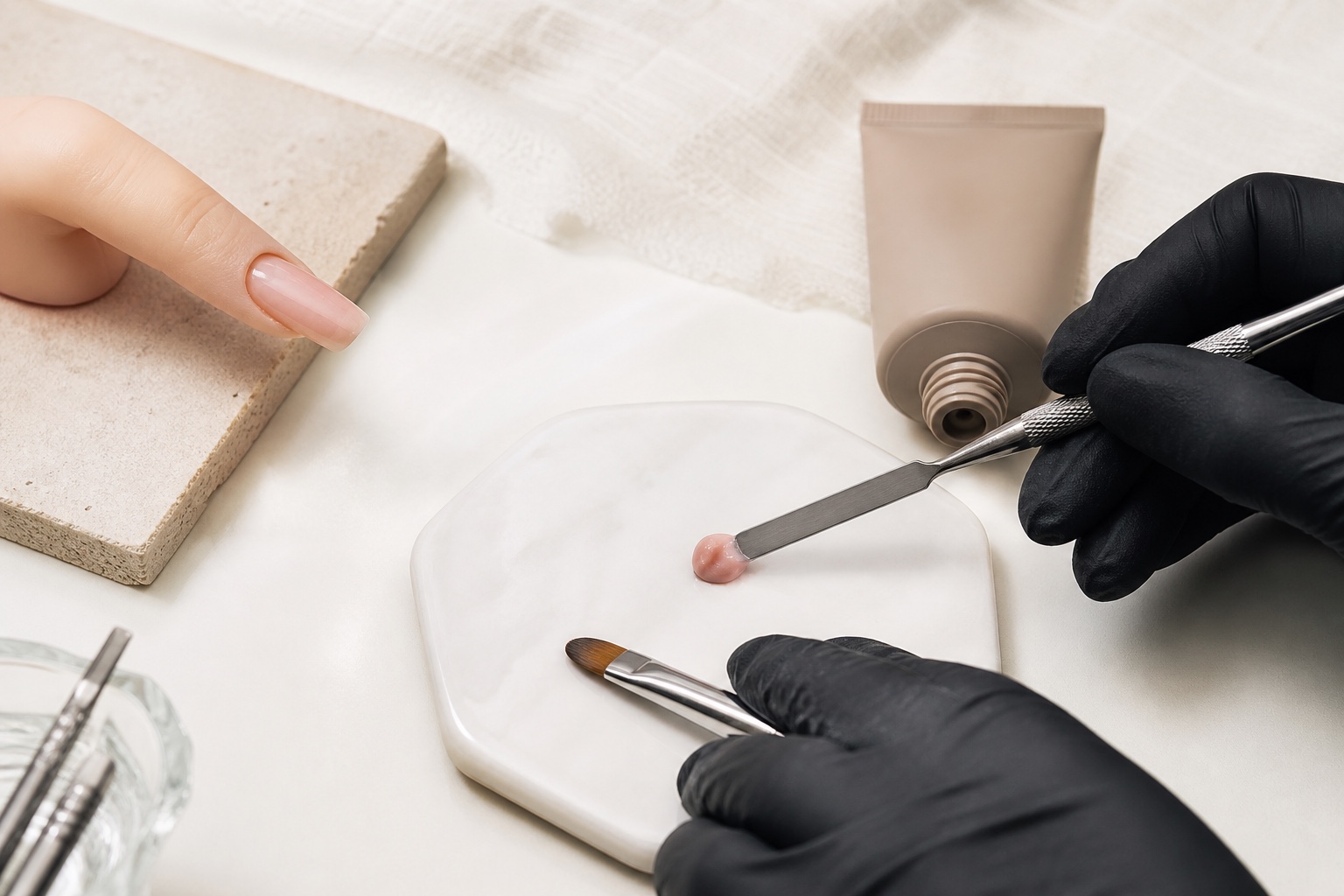
Acrygel—also marketed under names such as polygel or hybrid gel—is generally a dense light-curable enhancement. A portion is placed, then shaped with a brush and the system’s compatible liquid before curing. Unlike acrylic, the product does not advance through a liquid-powder setting window while the technician works; unlike a self-levelling gel, it usually remains where it is pushed.
That stability can support dual forms, extensions and controlled corrections, but it does not remove the need to judge thickness, apex, side lines and underside. Too much slip liquid, an incompatible cleanser or thick uncontrolled portions can affect handling and cure. Use only the liquid, brush method, maximum thickness and lamp specified by the system.
Strength, flexibility and thickness are separate properties
Structure is more than thickness
Separate the material from the architecture
Material
Rigidity and flexibility
Architecture
Apex and stress distribution
Length
Leverage on the natural nail
Lifestyle
Forces between appointments
Clients often ask which system is strongest. A useful answer separates hardness, stiffness, toughness, flexibility, adhesion and wear. A rigid material may resist bending yet be unsuitable for a flexible natural plate or a very long lever. A more flexible product may move comfortably on a short overlay yet lack the intended support for a demanding extension. Architecture and lifestyle affect failure as much as the family name.
Thin does not always mean natural-looking, and thick does not guarantee durability. The product must remain within its supported thickness and cure parameters, then be distributed to resist the stresses of the chosen length and shape. If a structure repeatedly cracks or lifts, adding more product everywhere can increase bulk without correcting preparation, apex, side lines, curing or maintenance interval.
Preparation and adhesion: the system name is not the diagnosis
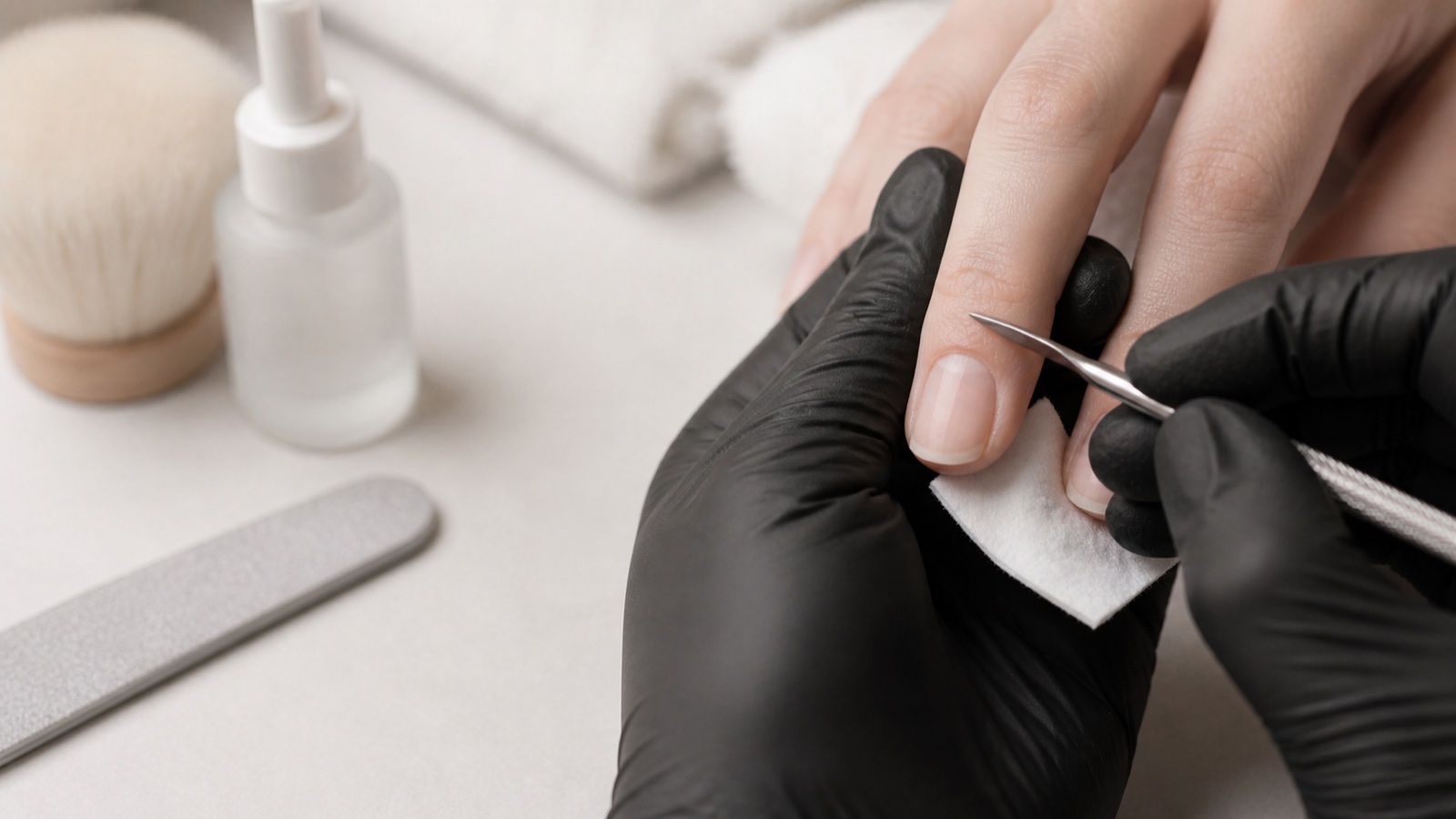
All three systems need a clean, assessed surface and a preparation protocol matched to the product. Lifting can involve contamination, skin contact, unsuitable prep, incompatible primer or base, movement, architecture, under-curing, ratio, old product, impact or maintenance delay. Switching from gel to acrylic without identifying the mechanism may simply reproduce the same failure.
Do not over-file the natural plate to ‘make it grip’. Adhesion should not depend on visible grooves or pain. Avoid product contact with skin and remove accidental contact before curing or setting according to the product instructions. Repeated exposure to uncured methacrylates can contribute to sensitisation; the goal is controlled placement, not testing whether the client reacts.
Curing, setting and the heat question
Hardening is system specific
A lamp cure and a liquid–powder set are not interchangeable
Gel
Matched lamp + specified exposure
Acrylic
Correct ratio + reaction time
Acrygel
Matched lamp + specified exposure
Heat / pain
Stop and correct the cause
Gel and acrygel require the specified lamp, position and full exposure schedule. Hand angle, thumb placement, lamp maintenance, layer thickness, pigment and wrong equipment can affect cure. A heat spike can occur during rapid polymerisation; remove the hand only according to the system’s trained protocol, never encourage the client to endure pain, and correct portioning or curing strategy rather than treating burning as proof of a strong product.
Acrylic also generates heat during reaction, although the client may experience it differently. Do not pinch, file or stress the enhancement before it reaches the stage required by the system. Surface feel is not a laboratory test of conversion. Follow documented times and conditions instead of inventing a universal number for every brand.
Maintenance and removal
Maintenance interval depends on growth, length, balance, wear and the condition of the existing enhancement. A refill or rebalance restores structure; it is not merely colour over regrowth. Inspect lifting, cracks, side lines, apex movement and the natural nail before deciding what sound product can remain.
Removal is product-specific. Some gels and acrygels are designed to soak off; others must be reduced mechanically. Acrylic is commonly reduced and soaked according to the system, but decorative layers and mixed services change the route. Never assume ‘gel’ means file-off or ‘hybrid’ means soak-off. Keep a controlled residual layer where appropriate rather than chasing every trace into the natural plate.
Safety and product-system discipline
The FDA nail-care product overview explains that professional nail products are cosmetics in the US when used for cosmetic purposes, that warnings and directions matter, and that methacrylate exposure and skin contact can be relevant to adverse reactions. Other markets have their own law; always use the current label, safety information and instructions for the country where the service is performed.
Keep complete records for brand, line, product, batch, opening date, lamp, primer or base, liquids and removal method. ‘Same brand’ does not automatically make every product compatible, and ‘professional use’ does not waive safe-use directions. Stop for pain, burning, swelling, broken skin or a suspected reaction and seek appropriate healthcare advice according to severity.
How to choose the system for a service
Choose from the service backwards
Assessment comes before product preference
Assess nail and skin
Define length and result
Plan maintenance or removal
Select one complete system
Record and review
Define the service: short overlay, repair, infill, salon extension, advanced shape or dual-form application.
Assess the natural nail, growth direction, existing product, skin integrity, lifestyle and realistic maintenance.
Read the exact system’s intended uses, exclusions, preparation, thickness, lamp or ratio, finishing and removal.
Choose a working behaviour you can control with trained technique and available equipment.
Build the correct architecture for the length and shape; do not ask the product name to compensate for design.
Document the result and review retention, comfort, condition and removal evidence at the next appointment.
Frequently asked questions about gel, acrylic and acrygel
Which is strongest: gel, acrylic or acrygel?
There is no universal winner. Compare the exact cured material, architecture, length, flexibility, intended use and maintenance rather than relying on the family name.
Which looks most natural?
A natural appearance depends on colour, opacity, cuticle transition, thickness, shape and finish. Any of the three can look refined when the chosen product and structure suit the service.
Does acrylic air-dry?
It hardens through the reaction between liquid and powder. Air is not the curing mechanism, although temperature and conditions influence the working time.
Does acrygel dry without a lamp?
Most professional acrygel systems are light-curable and require their specified lamp and exposure. Follow the exact product documentation.
Can gel and acrygel use any UV/LED lamp?
No. Compatibility depends on the product’s photoinitiator system, lamp output, geometry and validated cure schedule. Use the specified equipment.
Can acrylic liquid and powder from different brands be mixed?
Only when both manufacturers expressly document compatibility. Ratio, initiators, colour stability and performance are designed as a system.
Is acrygel safer because it has less odour?
Low odour does not prove low hazard or low sensitisation potential. Avoid skin contact, control dust and use the full product safely.
Which system is easiest for beginners?
The easiest is the one taught with clear product-system instructions, supervised practice and suitable services. Each requires different timing and control.
Which system is best for weak natural nails?
‘Weak’ is not a complete assessment. Identify length, flexibility, damage, symptoms, desired service and whether cosmetic coverage is appropriate before selecting material.
Do all three systems need primer?
No universal primer rule applies. Use only the preparation and adhesion products specified for the exact system and client assessment.
Can gel, acrylic and acrygel all be soaked off?
No. Removability is product-specific. Confirm it from the manufacturer rather than the marketing family name.
Why does product keep lifting after I switch systems?
The unresolved cause may involve assessment, prep, contamination, skin contact, structure, cure or ratio, impact or maintenance. Diagnose the process, not just the product family.
Last reviewed: 5 September 2026. Product families and regulations vary. Follow the current manufacturer instructions, local law, trained scope and appropriate medical advice for adverse reactions.
Continue with application method: the professional dual-form guide covers dry fitting, product distribution, placement, curing and diagnostic checks without repeating this material comparison.
Follow the complete material workflow in the acrylic nail extensions guide, which connects liquid-to-powder control, bead stages, architecture, exposure controls, filing and maintenance.