
There is no single makeup artist salary in Italy. An employee receives pay under the contract, grade, hours and duties that actually apply. A freelancer invoices services or days but still funds products, travel, unbillable work, overhead, social-security contributions and tax. A useful comparison therefore separates gross employee pay, fee, revenue, operating result and personal net income.
2026 snapshot: where the Italian Hairdressing and Beauty collective agreement applies, published gross monthly table minima run from €1,387.87 to €1,699.67 from January through September 2026 and €1,406.73 to €1,722.76 from October, depending on grade. No verified national freelance average can represent bridal, event, set, home and studio work. The three transparent examples below produce €640–€5,400 monthly revenue but only €362–€3,112 before social-security contributions and tax. They are models, not income promises.
This Italy-specific guide was reviewed against the cited 2026 sources on 5 September 2026. It does not classify an individual job, calculate payroll, determine VAT or social-security status, or provide tax advice. The Italian CCNL, INPS category and tax treatment require assessment of the real employer, work, legal form and personal circumstances. Obtain tailored employment and commercial advice before making financial decisions.
This page owns earnings, capacity and operating-result intent. How to become a makeup artist owns training and entry into work. The Italy VAT, ATECO and invoicing guide owns setup and public obligations, while the separate price-list guide will own service pricing. Compare training through the English makeup course catalogue.
The key numbers in this 2026 report
Hairdressing and Beauty CCNL: published 2026 gross monthly table minima span €1,387.87–€1,699.67 through September and €1,406.73–€1,722.76 from October, by grade. These figures matter only where that agreement and grade apply and do not equal take-home pay.
Excelsior 2025: 15,680 opportunities reported by businesses for the broad occupational group beauty therapists and makeup artists; 15,240 requested vocationally qualified or diploma-level candidates. The category does not isolate makeup artists, freelancers or pay.
BeautyLearn freelance models: €640, €2,400 and €5,400 monthly revenue under three stated service configurations; assumed variable and fixed costs leave €362, €1,370 and €3,112 before social-security contributions and tax.
INPS 2026 context: Circular 14 states a €18,808 annual minimum income base and rates of 24% for craftspeople and 24.48% for traders up to the first band. The word makeup artist cannot determine which, if either, applies to a real case.
Each figure measures something different. A table minimum is gross contractual pay; a reported opportunity is employer demand; freelance revenue is money generated before costs. Combining them into a single salary ranking produces a persuasive but unusable number.
Makeup artist is a skill, not one employment model
One skill can support five economic models
Salary, fee, package, day rate and operating result measure different things
Employee
Gross pay, agreement, grade and hours
Private
Collected service fee and complete time
Bridal
Trial, travel and event package
Production
Defined day, continuity and overtime
Studio
Revenue less operating costs
One person may be employed by a beauty business, invoice private clients, collaborate on events, work on photographic or audiovisual productions, teach or combine several channels. Contract, continuity, responsibility, cost and unit of sale change. Monthly payroll, service fee, package price and day rate cannot be compared until their scope is normalised.
Model | Primary measure | Main variability |
|---|---|---|
Employee | Gross pay and contracted hours | Agreement, grade, hours, duties and supplements |
Private freelance | Price per service | Bookings, materials, travel, acquisition and cancellations |
Bridal and events | Trial, package or event day | Season, travel, early hours, assistant and touch-up |
Set and production | Day rate or assignment | Call, continuity, waiting, overtime and non-consecutive days |
Own studio | Revenue and operating result | Space, utilities, cover, software, promotion and stock |
Before comparing two numbers, ask whether they are gross or net, whether VAT is included, who pays products and travel, how many complete hours the assignment occupies, and which unpaid or unavailable periods the amount must support. Only then does the comparison describe work rather than a headline.
Employee pay depends on the actual agreement and grade
An employee is not paid from the retail price of one makeup service. Employer sector, collective agreement, grade, hours, actual duties, seniority and individual supplements matter. The Hairdressing and Beauty CCNL is a useful reference for activities inside its scope, but makeup work can appear in other settings with different agreements. The job title alone cannot choose the contract or grade.
Grade | Jan–Sep 2026 | From Oct 2026 |
|---|---|---|
1 | €1,699.67 gross/month | €1,722.76 gross/month |
2 | €1,552.68 gross/month | €1,573.78 gross/month |
3 | €1,472.00 gross/month | €1,492.00 gross/month |
4 | €1,387.87 gross/month | €1,406.73 gross/month |
These are published gross monthly table minima, not take-home estimates. Part-time pay is proportionate and the relationship may include thirteenth salary, seniority increments, individual supplements, premiums and other items. When assessing an offer, request the agreement, grade, hours, probation, workplace, travel expectations and real duties in writing.
Compare an employment offer with the whole package
A gross monthly minimum is only the starting coordinate. Compare contracted weekly hours, the number of salary instalments, paid leave, overtime and Sunday rules, commissions, reimbursement, compulsory travel, product responsibility and training time. A higher headline figure may buy more hours or broader duties; a lower one may sit beside a documented supplement or a shorter schedule. Convert both offers to annual gross compensation and contracted hours before drawing a conclusion, then keep take-home estimates separate because family and tax circumstances differ.
Also distinguish work performed from the title printed on a vacancy. Retail consultation, counter sales, reception, skincare service and makeup application may sit inside one role. Ask which activities occupy a normal week and how performance is measured. That evidence helps the parties identify the appropriate classification; a social-media label does not.
Freelance revenue is not freelance income
Revenue passes through distinct deductions
The guide stops at operating result before personal contributions and tax
Collected service revenue
Less direct variable costs
Less fixed operating costs
Operating result before personal obligations

The basic revenue equation is paid assignments multiplied by the average amount actually collected. From revenue subtract direct materials and travel, fixed overhead and the cost of non-billable capacity. Social-security contributions and tax come later and depend on the individual position. Receiving €3,000 in a month does not mean taking home €3,000.
Classify costs before estimating a result
Direct variable costs move with the assignment: disposables, decanted product, lashes, local travel and payment fees are common examples. Fixed operating costs continue even without a booking: software, insurance, professional advice, storage, phone, education and a studio commitment may belong here. Equipment and kit replacement need a planned allowance instead of disappearing because the payment happened in another month. Record VAT separately where relevant; money collected for a public obligation is not business performance.
Do not force every expense into an arbitrary percentage. Measure high-value items and review the assumption against receipts. A compact day service and a destination bridal package rarely consume the same products, travel or administrative time. Service-level contribution is useful only when its inputs follow the service actually delivered.
Three transparent monthly scenarios
Scenario | Revenue calculation | Before contributions and tax |
|---|---|---|
Part-time start | 8 services × €80 = €640 | €362 after 20% variable and €150 fixed costs |
Regular diary | 20 services × €120 = €2,400 | €1,370 after 20% variable and €550 fixed costs |
Established practice | 30 services × €180 = €5,400 | €3,112 after 22% variable and €1,100 fixed costs |
Fees, volumes and percentages are teaching assumptions, not market averages. Eight event makeups, twenty mixed appointments and thirty assignments with bridal or travel components need different time and infrastructure. Replace every input with collected payments, receipts and complete hours from the actual practice.
Fee, revenue and effective hourly value are different
A service sold for €150 is not automatically €150 for two hours of work. It may require enquiries, quote, kit preparation, travel, parking, setup, application, photographs, reset, cleaning, invoicing and gaps between bookings. If the complete cycle takes five hours and direct cost is €35, €115 remains before overhead: €23 per operational hour, still before contributions and tax.
Record visible chair time and complete assignment time. The latter controls capacity and sustainability. The Italy makeup contract guide helps define scope, travel, change and cancellation without hiding work inside an apparently simple fee.
Calculate effective hourly value without pretending every hour is billable
Start with the assignment: subtract its direct cost from the amount collected, then divide by complete assignment hours. Next calculate the month: subtract monthly variable and fixed operating costs from revenue, then divide by all working hours, including administration and acquisition. The two measures answer different questions. The first compares services; the second tests whether the entire operating system supports the time invested.
An hourly value is not an hourly wage. It is a management indicator before contributions, tax, paid leave and personal risk. Use it to redesign travel radius, booking windows, minimum call, package boundaries or product use—not to promise an employee-equivalent net income.
Bridal pricing pays for more than the application
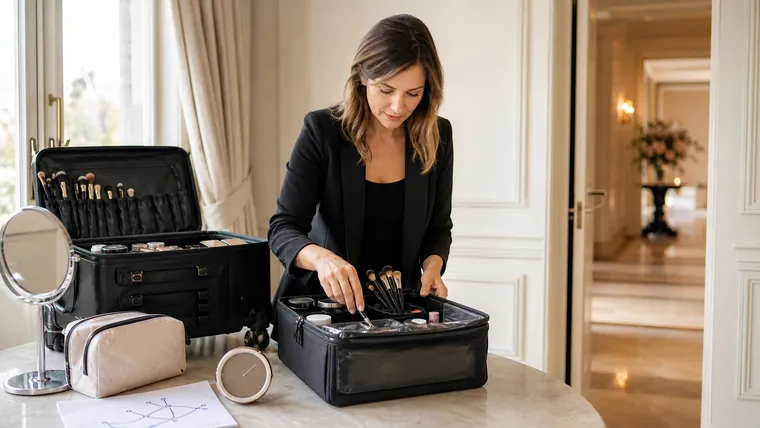
A bridal assignment can include consultation, trial, product record, travel, early access, skin preparation, application, additional people and touch-up handover. Calling the trial free does not remove its labour; the package must fund it. A venue three hours away can consume capacity that would otherwise serve several clients.
Use the professional bridal makeup guide to map trial, event-day sequence and handover. Revenue quality comes from the whole assignment, not the number of minutes in front of the mirror. Measure assistant cost, parking, tolls, luggage, accommodation, unavailable hours and cancellation risk explicitly.
Set and production work needs a defined day
A production day may include early call, preparation, continuity between takes, touch-ups, waiting, look changes and wrap. Before accepting a day rate, define expected hours, people, looks, location, kit use, assistant, travel, meals, overtime and payment timing. An undefined day rate can purchase many more hours than either party assumed.
The camera-ready makeup guide covers flashback, high definition and continuity. The makeup photography guide covers documenting the finished work for a credible portfolio. Neither determines the commercial day terms.
Eight levers change the operating result
Average amount collected: use payment after discounts, not the highest published price.
Paid assignments: followers, enquiries and quotes are not confirmed bookings.
Complete time: include preparation, travel, reset, administration and acquisition.
Service mix: day, evening, bridal, production and tuition have different frequency and cost.
Conversion and no-show rate: qualified enquiries and clear terms protect capacity.
Product and kit cost: excess stock, expiry and impulse purchases consume margin.
Geography and travel: demand, competition, parking, distance and venues change available work.
Specialism and reliability: a valued skill sells only with evidence, hygiene, timing and continuity.
Document real work through the makeup artist portfolio guide and build measurable demand with the makeup client acquisition guide. Neither audience size nor specialisation creates income until the diary converts at a sustainable service value.
Calculate the assignments needed for an operating target
A target becomes a booking requirement
Contribution per service connects the target to diary capacity
Target
Required operating result
+ Fixed
Monthly operating commitments
÷ Contribution
Collected fee less direct cost
Capacity
Complete hours and realistic occupancy

Use: (target operating result + monthly fixed costs) divided by (average collected price − direct variable cost per service). For a €1,500 target before contributions and tax, €600 fixed costs, €120 average collection and €24 variable cost, about 22 assignments are required: (€1,500 + €600) / €96 = 21.9.
Then test capacity. Twenty-two assignments at four complete hours need about 88 hours; at six hours they need 132. Add administration, business development, sickness, training and unusable gaps. Sustainability does not come from compressing hygiene or precision. It comes from an offer, workflow and price that make the full cycle possible.
Run a capacity test before treating the formula as a plan
List bookable days, realistic start times, travel zones and the longest service mix the diary can absorb. Reserve turnaround time and do not sell the same hour twice through optimistic travel. Then apply a conservative occupancy rate: an available slot is not automatically demanded, confirmed or completed. If the required assignments exceed safe capacity, the answer is not to shorten hygiene or rush application. Rework service mix, complete price, geography, fixed cost or target.
Repeat the calculation under a quiet-month and a cancellation scenario. If a plan only works at full occupancy with no rescheduling, sickness or equipment replacement, it is a fragile maximum rather than a sustainable forecast.
Seasonality makes one strong month a poor annual forecast
Weddings, ceremonies, productions and holidays concentrate demand. Track at least twelve months, distinguish deposits from completed service revenue and plan costs through quieter periods. Include weeks for illness, leave, training, administration, equipment maintenance and unpaid enquiry. A peak month is not an average income.
Clear deposits and cancellation rules reduce uncertainty without eliminating it. Professional liability cover does not increase sales, but can protect the operating system within understood limits. Build reserve from the annual pattern rather than spending every high-season receipt.
Use cohorts and channels instead of one blended monthly total
Separate bridal, private occasion, production, lesson and collaboration revenue. For each channel record leads, accepted quotes, completed work, average collection, complete hours, direct cost and repeat or referral source. A growing channel can hide a falling contribution if it requires more travel or discounting. Conversely, a small channel may be valuable because it fills otherwise unused capacity or introduces qualified repeat clients.
Review deposit timing with care. A deposit improves cash certainty but is not a second fee and may relate to work delivered months later. Keep a simple schedule linking collection, obligation and completed assignment so that one month is not overstated and another understated.
Improve earnings without promising shortcuts
Measure collected price, full hours, direct cost, cancellations and repeat rate before changing price.
Reduce duplicate products and unused stock through a modular professional makeup kit.
Sell services that can be delivered at repeatable quality and time before expanding the menu.
Use faithful photography and show only skills actually available for booking.
Treat travel, trial, assistant and overtime as parts of scope rather than permanent exceptions.
Review service contribution quarterly and public obligations annually with competent advisers.
Use a monthly makeup business dashboard
Four metrics make the diary economically readable
Measure collected value, time, demand and result together
Ticket
Average amount actually collected
Time
Value per complete operational hour
Demand
Qualified quote-to-booking conversion
Result
Revenue less variable and fixed costs
Metric | Formula | Decision |
|---|---|---|
Average collected ticket | Collected service revenue / paid assignments | Shows actual mix, not price list |
Value per operational hour | (Revenue − direct costs) / complete hours | Makes hidden time visible |
Quote conversion | Bookings / qualified quotes | Tests fit and clarity |
Operating result | Revenue − variable costs − fixed costs | Separates activity from cash collected |
Add a short note beside exceptional months: a large replacement purchase, one destination wedding, a production delay or a cancelled event can change the result without changing the underlying service quality. Review a rolling three-month view for operating decisions and a twelve-month view for seasonality. Keep the source records so the dashboard can be reconciled rather than becoming a decorative spreadsheet.
Avoid five common earnings claims
Presenting revenue as personal take-home income.
Dividing service price by chair time while excluding preparation and travel.
Assigning one CCNL or grade from the role name alone.
Ignoring VAT, contributions and tax or calculating them before status is known.
Forecasting a career from one high-season month or an influencer's published fee.
Frequently asked questions about makeup artist earnings
How much does a makeup artist earn in Italy in 2026?
There is no single figure. Where the cited CCNL applies, published gross monthly minima span €1,387.87–€1,699.67 through September and €1,406.73–€1,722.76 from October. A freelancer needs revenue, cost and full-time records.
How much can a freelance makeup artist make per month?
It depends on the model. These scenarios produce €640–€5,400 revenue and €362–€3,112 before contributions and tax. They are transparent examples, not an Italian average or forecast.
How much should a makeup artist charge?
Build price from scope, complete time, direct materials, travel, overhead, responsibility, market and capacity. Day, bridal and production work are not comparable without a brief.
Does an employed makeup artist use the beauty-sector CCNL?
Not automatically. The employer's activity, agreement and actual duties determine the answer. Verify the named CCNL, grade and hours in the proposal and seek competent employment advice where unclear.
Is bridal makeup more profitable?
It may command a higher package price but often includes trial, communication, travel, early hours, touch-up and strong seasonality. Measure margin after the complete assignment and capacity used.
What is a makeup artist day rate on set?
There is no universal rate. Define hours, people, looks, continuity, kit, assistant, travel, overtime and payment. A number without boundaries does not describe the assignment.
How many clients are needed to live from makeup?
Divide target plus fixed cost by contribution per service. With a €1,500 operating target, €600 fixed cost and €96 contribution, about 22 monthly assignments are needed before contributions and tax, subject to capacity.
Do followers predict makeup income?
No. Track qualified enquiries, quotes, paid bookings, repeat rate, collected ticket, complete hours and operating result. A small relevant local network may convert better than a large unrelated audience.
Does a makeup artist need an Italian VAT number?
The answer depends on continuity, organisation and the real work. Do not treat occasional as a label that resolves the issue. Review the actual case with the competent advisers and authorities.
Does a makeup course guarantee earnings?
No. Training can develop technique and method; income also depends on practice, evidence, reliability, demand, costs, capacity and commercial skill. Treat guaranteed-income claims with caution.
How do I know whether one service is profitable?
Record collected amount, direct costs, a defensible overhead share and complete hours. Compare periods and services without reducing hygiene or quality to improve the calculation artificially.
What is the difference between revenue and net income?
Revenue records the business generated. Operating result subtracts variable and fixed costs. Personal net income also requires social-security contributions, tax and individual circumstances.
Is a studio or mobile service more profitable?
A studio concentrates equipment but creates fixed cost; mobile work reduces some premises cost but adds travel and unusable time. Compare full cost per assignment and realistic capacity rather than rent alone.
Official sources and calculation method
FILCAMS CGIL — Hairdressing and Beauty CCNL and 2026 minima: published tables from 1 January and 1 October 2026.
Unioncamere–Ministry of Labour, Excelsior — Vocational training and work 2025: broad beauty therapists and makeup artists occupational group.
INPS — Circular 14 of 9 February 2026: 2026 craftspeople and traders rates, minimum and maximum income bases, including the official correction notice.
INPS — craftspeople and traders contribution simulator: anonymous indicative simulation for a concrete set of inputs, not certified advice.
Editorial review: 5 September 2026. BeautyLearn scenarios are teaching calculations with visible assumptions. They do not replace payroll, a quote, contract, contribution assessment or personalised tax advice. Recheck all time-sensitive figures before reuse.
Turn operating evidence into public service lines
After measuring capacity and result, build the professional makeup price list.