We use necessary cookies and the Meta Pixel to measure campaigns and improve our offers. You can change your optional-cookie preferences at any time. Read our Terms and conditions.
How to become a color analyst: training, practice and career
To become a personal color analyst, you need to learn how fabrics near the face change its appearance, explain your observations and help a client use a palette. A course gives you a method; practice with an instructor helps you spot and correct mistakes. Turning those skills into a US business also takes a suitable workspace, a clearly defined service and a budget that includes the work before and after each appointment.
At a glance
Choose training that lets you perform draping exercises and receive feedback on your own work. Practice with physical fabrics on different people, then have an instructor observe a complete consultation. Buy tools that fit your method and check what tuition includes. Before taking paid bookings, define your service, price and deliverables, and check state and local business requirements. Completing a course does not guarantee competence, clients or a government license.
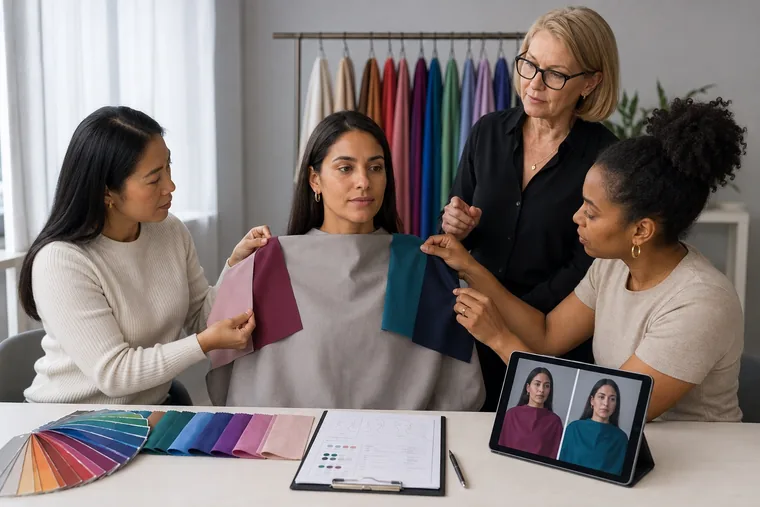
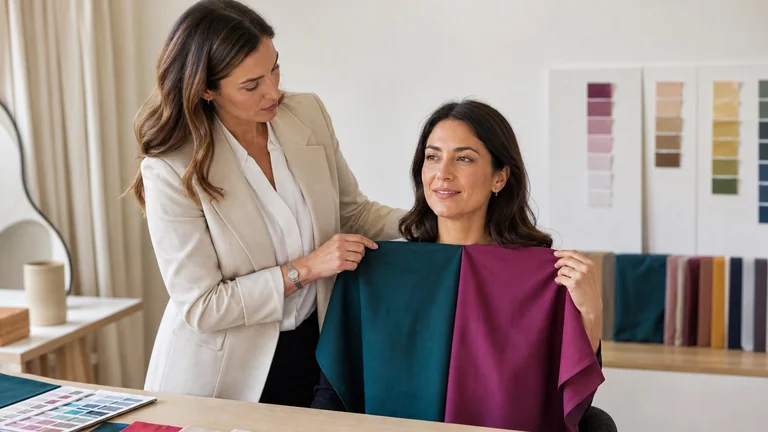
A color analyst prepares the light and materials, asks about the client's needs and compares fabrics near the face. The analyst looks for changes in apparent skin evenness, shadows and facial definition, checks whether they repeat, and turns those observations into clothing, accessory and makeup color suggestions. The client should leave able to use the advice, including when a precise seasonal classification remains uncertain.
Start with color perception, lighting and the differences between undertone, value, chroma and contrast. Seasonal systems organize these characteristics differently. Name the system you use and explain its limits; eye color, ethnicity or a selfie cannot establish a season on their own. Color advice does not include diagnosing skin conditions or providing medical treatment.
The job also includes scheduling, cleaning and storing fabrics, keeping records and answering follow-up questions. Ask before touching a client, positioning a cape or taking photos. Discuss preferences and accessibility needs without judging age, weight or appearance. A client may want to use clothes they already own rather than replace a wardrobe.
How to choose color analysis training
Ask what you will personally do during the course. Watching an instructor, performing a comparison while someone observes, and getting feedback on your notes are different learning activities. Look for a curriculum that connects color theory to lighting, drape selection, uncertain cases and a useful explanation of the palette.
How many complete consultations will each student conduct, and who provides the practice models?
Will an instructor assess setup, observations and the explanation to the client, or only the final season?
Does support mean general questions, written case reviews or live observation? How many reviews are included?
Which materials do you keep, and which are available only during class?
How long can you access lessons and feedback, and what must you submit to receive the certificate?
Check the instructor's training and examples of their teaching. A useful demonstration explains what changed between two fabrics, where to look on the face and why a comparison needs repeating. Try describing what you see before hearing the instructor's conclusion, then compare the reasoning.
An online course can make theory and demonstrations easy to revisit. You still need practice with physical drapes and people in front of you: camera processing, compression and displays can change subtle color differences. An in-person course gives you direct viewing, but only helps you practice if each student gets enough time at the workstation.
BeautyLearn's Complete Colour Analysis Course lists 13 on-demand lessons with a displayed duration of 1 hour 54 minutes. On October 20, 2026, the English page says “Coming soon” and purchasing is unavailable. It lists a completion certificate, lifetime access to a purchased course and dedicated support. It does not specify a physical kit, individually supervised draping sessions or a practical competency assessment. Review the enrollment terms when purchasing reopens before treating it as your complete professional training plan.
Course costs, time commitments and kit fees
Compare tuition, the work you will submit and the tools you will need. A six-week course schedule describes how lessons are organized; it cannot tell you when you will handle unfamiliar clients independently. These published US-market examples were checked on October 20, 2026. Prices are in USD.
Online in English for US students. $3,900 upfront, or six monthly payments of $690 ($4,140 total). The school describes 10 weeks at about 4 to 6 hours a week, recorded lessons and live sessions scheduled for US time zones. A professional draping kit is included and shipped to a US address. Certification follows evaluation of case studies and a recorded analysis. Paris practice days belong to a separate program.
$3,999 for online training organized over six weeks, with up to one year to finish assignments. Student-community access and monthly live calls are included, but the page gives conflicting six- and 12-month support periods; confirm the term in writing. Drapes are separate; the FAQ lists an additional $1,500 to $2,500. Assignments, case studies and practical demonstrations are submitted for review.
Training option: ESR School of Color: Certified Color Analyst
Published price, schedule and inclusions: Online in English for US students. $3,900 upfront, or six monthly payments of $690 ($4,140 total). The school describes 10 weeks at about 4 to 6 hours a week, recorded lessons and live sessions scheduled for US time zones. A professional draping kit is included and shipped to a US address. Certification follows evaluation of case studies and a recorded analysis. Paris practice days belong to a separate program.
Training option: Tatum Mae: Color Analysis Certification Training
Published price, schedule and inclusions: $3,999 for online training organized over six weeks, with up to one year to finish assignments. Student-community access and monthly live calls are included, but the page gives conflicting six- and 12-month support periods; confirm the term in writing. Drapes are separate; the FAQ lists an additional $1,500 to $2,500. Assignments, case studies and practical demonstrations are submitted for review.
For the Tatum Mae example, tuition plus the listed drape add-on is $5,499 to $6,499. That calculation does not include any additional shipping, applicable tax, lighting, furniture or other business expenses. Ask for an itemized total and the exact drape package before paying. For either program, confirm the next start date, feedback arrangements, refund terms and any assessment or retake charges in writing. Avoid buying a second kit when your course already supplies a suitable one.
Separate scheduled teaching from your own practice and from access to support. Reserve recurring time for all three. Someone who already works with color may need less introductory study but still need substantial feedback on faces, drapes and client communication.
Certificates, certification, membership and licenses
A certificate can mean different things depending on who issues it and what was assessed. Use the exact credential you earned when describing your training.
A certificate of attendance records participation. A completion certificate may include assignments or assessment; ask what the provider requires.
A private professional certification follows the issuing organization's criteria. For example, AICI Certified Image Consultant requires both an exam and a portfolio review. It covers image consulting and is separate from a government license.
Association membership means you have joined an organization. Membership alone does not mean you have passed its certification process.
A government occupational license authorizes activities under the issuing jurisdiction's rules. A private color analysis course cannot substitute for one where it is required.
Write down the activities you intend to offer and where you will work. The US Small Business Administration's licensing guidance explains that requirements depend on activity and location, including state, county and city rules. Check business registration, home-business or premises rules, tax registration and insurance for the actual service. A mentor's advice about draping cannot settle these requirements.
Check adjacent services separately before adding them. For example, the Texas Department of Licensing and Regulation lists makeup application as unregulated in Texas, while facial beautifying or cleansing treatments and hair coloring fall within licensed services. That distinction is specific to Texas. Ask your own state board about the exact activities you plan to perform; recommending a lipstick color and applying a treatment are different tasks.
Practice with feedback and assess your readiness
Begin with a narrow question, such as comparing light and deep colors while keeping other characteristics similar. Prepare a pair of drapes and a second pair for a cross-check. Stabilize the lighting and position, then alternate A, B and A again. Write down what changes in the same areas of the face. The draping-test guide explains the setup and sequence.
Keep a record with a participant code, date, lighting, preparation, fabric pairs, order and observations. Add your provisional conclusion, unresolved question and instructor's correction. An illustrative note such as “The shadow under the eyes looks stronger with B and softer again with A” gives you something to recheck. “B looks bad” does not explain the observation.
Ask the instructor to identify the step to change, then repeat it under the same conditions. Use another pair to check whether the effect holds. If it does not, leave the result open and review the light, positioning and fabrics. Writing the observation before the seasonal label makes it easier to notice a result that challenges your first impression.
During supervised practice, explain what you are comparing before naming a season. Compare the fabrics in person; photos can help document the exercise.
Move on to full sessions with adults of different ages, skin depths, visible contrast and facial features. Agree on breaks and adjustments, including hair-covering preferences and accessibility aids. Do not use ethnicity as a shortcut for a seasonal classification or collect personal details that the exercise does not need.
Have a competent instructor observe a complete session. You should be able to prepare the workstation without prompts, notice a lighting change, explain the comparisons, handle an uncertain result and give usable palette advice. Mark each skill as independent, supported or unresolved. A set number of cases does not establish readiness; use the remaining difficulties to choose the next exercise.
Build a kit around the method you learn
Start with drapes that cover the comparisons required by your training. Within a pair, similar size, surface and opacity help you distinguish color effects from reflections or transparency. A pair that changes warmth, depth and gloss at once is a poor exercise for isolating one characteristic.
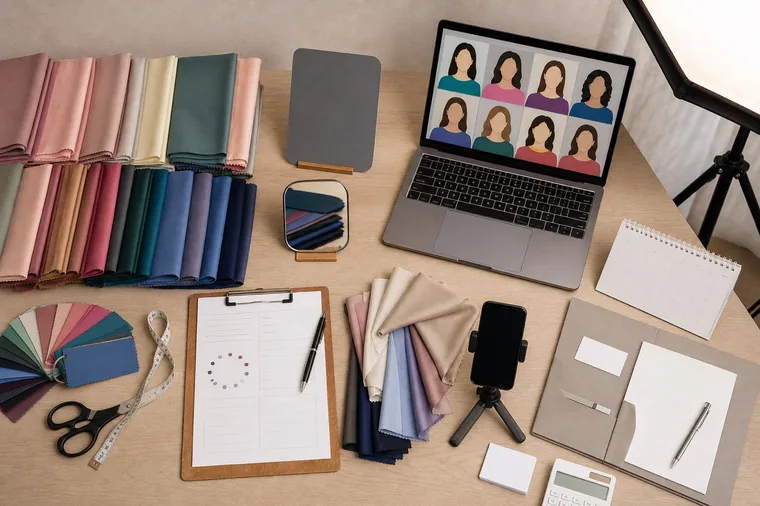
You will also need a neutral cape and appropriate hair-covering options, a stable mirror, a comfortable seat and a plain matte background. Set up diffuse, consistent lighting; avoid direct sunlight or changing light during a comparison. Keep notes, palette references and any take-home materials within reach. Store clean and used fabrics separately, following the supplier's cleaning instructions.
Keep comparison fabrics, notes and client materials organized. The laptop illustrations do not replace viewing physical drapes beside a person.
Before buying, check fabric dimensions, the system they belong to, replacement options and care instructions. Inspect the range under your working light, including whether neighboring drapes are visibly distinct. Keep fabrics away from damaging light and moisture, and replace faded or damaged pieces. The professional color analysis kit guide covers equipment and setup in more detail.
Add a camera, printer or travel case when it serves a specific task. If you photograph comparisons, use a stable support and consistent exposure and white balance. Include replacement palette supplies, cleaning and transport in recurring costs.
Define and rehearse your first service
Write a short description of what the client receives: an initial conversation, draping in your named system, an explanation of the result, a palette and guidance on using it. State the appointment length, total price, delivery deadline and follow-up window. List any separate services, such as makeup application, wardrobe editing or shopping, and disclose travel fees and cancellation terms before booking.
Rehearse the whole appointment, including preparation, breaks and the explanation at the end. Ask the practice client to choose a neutral and an accent from the palette to wear with an item they own. If they cannot explain the choice, improve your explanation or materials. The guide to using a personal color palette gives practical wardrobe examples.
Plan what happens when the evidence is mixed. Explain which observations repeat and which remain uncertain. Pause for unstable light or discomfort; arrange a recheck only when there is a concrete condition to improve. Describe pilot sessions honestly, including whether they are free or paid and what feedback you request. Do not promise a precise subseason regardless of the comparisons.
Create a portfolio and protect client information
A useful beginner portfolio shows the question tested, comparable drapes, your observations and how the palette was applied. Include a case where feedback changed your first hypothesis. Keep lighting, exposure, pose and framing consistent in comparative photos, and avoid editing skin color or texture to exaggerate a difference.
Ask separately for permission to take photos, share them privately for instruction and use them in public marketing. Explain the intended channels and how someone can contact you about their images. A free practice session should not depend on agreeing to publicity. When you lack permission to show a face, use fabric layouts, your workstation and case notes that cannot identify the participant.
Keep only the client information you need, restrict access and decide when to delete it. The Federal Trade Commission's privacy and security guidance provides a starting point for handling customer data. Have photo permissions and privacy procedures checked for the states and services involved. Using a code instead of a name does not make a recognizable face anonymous.
Price the full workload
Track time spent on preparation, messages, the appointment, cleanup, the written summary and follow-up. Include direct materials, payment fees, travel and a share of recurring overhead. Sales revenue has to cover expenses and taxes before it becomes money you can keep.
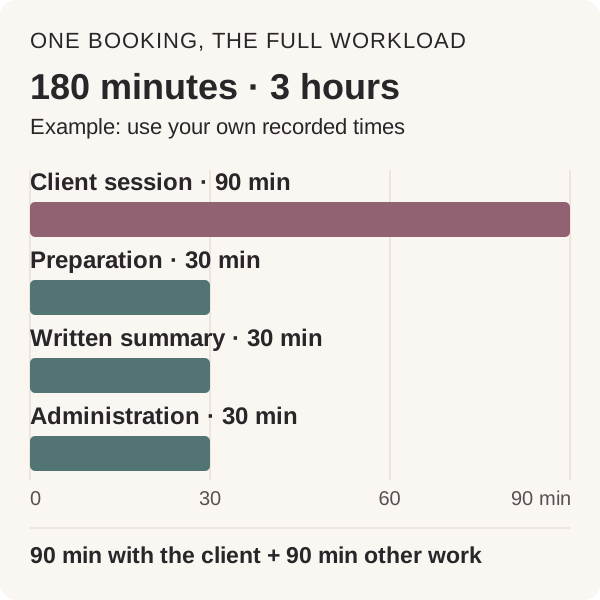
Planning example: the 90-minute session uses half of the three-hour workload. Replace these figures with the times recorded during your own trial appointments.
For an illustrative calculation, allow three total work hours at a target of $30 per hour: $90. Add $20 in direct costs and $15 in allocated overhead to reach $125 before taxes and any additional profit allowance. This is a planning example, not a market rate or a take-home pay estimate. Check that your cost categories do not count the same expense twice, and review tax assumptions with an accountant.
Capacity also needs a realistic calendar. If you set aside 12 hours a week for client work and each booking takes three hours in total, the maximum is four appointments a week, or 16 in a four-week month. Marketing, training and other business tasks need separate time. Empty slots and cancellations can reduce actual bookings.
To estimate recovery of an initial expense, divide it by the amount available per booking after the costs you have included. An illustrative $1,200 expense divided by $60 available per appointment requires 20 appointments. The calculation estimates recovery of that expense under your assumptions; it does not predict demand. You can test different inputs in the BeautyLearn pricing calculator, then replace estimates with your own records.
Find clients and keep improving the service
Possible settings include your studio, a suitable rented room or a partnership with a boutique, stylist or photographer. Visit the space at the time you intend to work. Check lighting, colored reflections, privacy and whether the workstation can stay in position. A bright storefront with mixed lighting may be unsuitable for controlled draping.
Prepare a one-page offer for a potential partner with the service, timing, price, deliverables and permitted examples of your work. Agree in writing on bookings, payments, any referral compensation, cancellations and handling of client information. Ask partners to share your booking details with interested clients. Agree on permissions before exchanging customer information.
On your website or local business profile, make the service area and booking process clear. Show a useful palette application or a step in the consultation. If you seek employment, read the duties in image-consulting and retail roles closely: color analysis may be one skill alongside sales or other services. Ask about targets, training and the work expected; a certificate does not guarantee a job.
After appointments, review whether you finished on time, delivered the promised materials and explained the palette clearly. Repeated questions may reveal a weak explanation; recurring difficulty with one color dimension may call for more supervised practice. Client satisfaction is useful feedback, but it does not prove a seasonal classification was technically sound.
Give clients a clear way to raise a concern and a timeframe for your response. Review the relevant records privately and apply your service terms and applicable consumer rules. If a complaint reveals a repeated problem, correct that part of the service before offering it again. Choose further training from these actual difficulties, such as lighting, borderline cases or communicating the palette.
An example 12-week practice plan
Use this schedule after selecting a course, adapting it to lesson dates and access to an instructor. Reserve recurring practice and review sessions. This is a sample schedule, not a qualification deadline; extend any phase that still needs correction.
Period
Work to complete and review
Weeks 1 to 4
Study color and light, watch demonstrations and set up your workstation. Practice one variable at a time. Be able to explain why you chose the fabric pair and identify a comparison affected by lighting or material differences.
Weeks 5 to 8
Alternate focused exercises with complete supervised sessions. Two cases a week would make eight cases in this four-week block; that is a scheduling example, not a required number for certification. Record corrections and repeat unclear comparisons.
Weeks 9 to 12
Rehearse the pilot service, measure the full workload and test your client materials. Finish pricing, booking terms and local business checks. Take paid bookings when you can conduct the promised service independently and handle uncertain results; otherwise continue supervised practice.
Period: Weeks 1 to 4
Work to complete and review: Study color and light, watch demonstrations and set up your workstation. Practice one variable at a time. Be able to explain why you chose the fabric pair and identify a comparison affected by lighting or material differences.
Period: Weeks 5 to 8
Work to complete and review: Alternate focused exercises with complete supervised sessions. Two cases a week would make eight cases in this four-week block; that is a scheduling example, not a required number for certification. Record corrections and repeat unclear comparisons.
Period: Weeks 9 to 12
Work to complete and review: Rehearse the pilot service, measure the full workload and test your client materials. Finish pricing, booking terms and local business checks. Take paid bookings when you can conduct the promised service independently and handle uncertain results; otherwise continue supervised practice.
Before opening your calendar, review any skills still marked supported or unresolved with your instructor. Confirm that your equipment, delivery process and business arrangements match the service you advertise.
Frequently asked questions
How can I find practice volunteers?
Invite adults through your personal network, local groups or training community. Explain that you are learning, what the session involves, its expected length and whether it is free or paid. Ask for feedback on comfort and clarity. Seek people whose coloring differs from the cases you have already practiced, while keeping photography optional.
Can I start by offering only online consultations?
You can define a remote service around applying an existing palette or planning outfits. Classifying someone from photos introduces camera and display variables as well as the draping method. Before selling that service, learn to request a consistent image set, reject unsuitable images and recognize when an in-person comparison is needed. Physical draping practice helps you understand what a photo may leave out.
Can I practice before buying a complete drape set?
You can use suitable fabric pairs for isolated comparison exercises. A complete seasonal consultation needs the range and cross-checks required by your method. Borrowing a training kit or practicing in a supervised classroom can help you learn before buying; do not sell a classification your available tools cannot support.
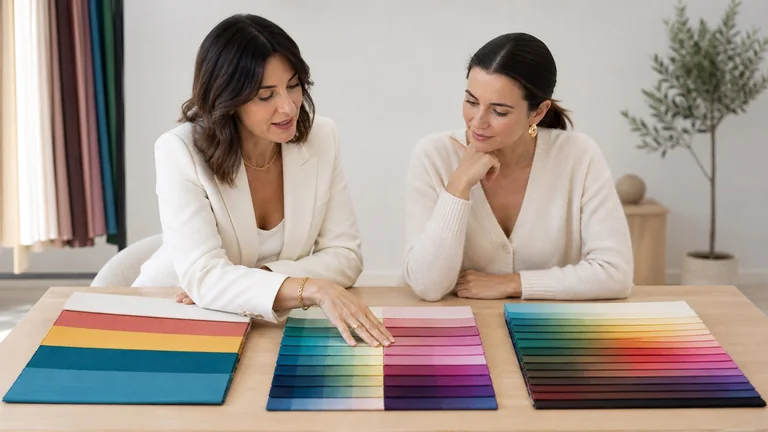
Compare swatches with real fabrics, combine neutrals and accents, and use your personal color palette to plan outfits and shop for clothes you will wear.
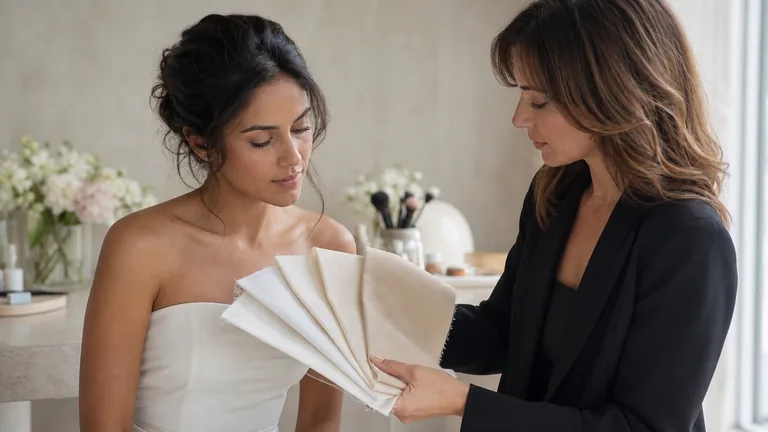
Compare wedding dress fabrics, then try makeup, hair, jewelry and flowers together. Use real swatches, clear notes and the lighting you expect on the day.
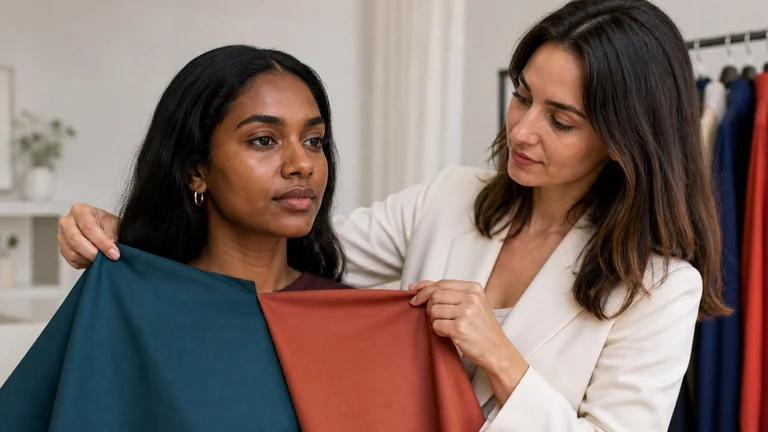
Compare fabrics on olive and deep skin tones with steady light, matched pairs and repeatable observations. Keep useful results when a season remains uncertain.