Four, twelve or sixteen seasons in personal colour analysis: how the systems differ

Compare four-, twelve- and sixteen-season colour systems by criteria, granularity, crosswalks, boundary cases and practical usefulness—without assuming that more groups mean a better method.

BeautyLearn Editorial Team29 August 2026 16 min read
Professional colour analyst and adult client compare broad, intermediate and fine seasonal palette systems on the same neutral worktable
On this page
  1. 1 Seasonal systems are maps, not natural boxes
  2. 2 What rigorous systems share before the final name
  3. 3 The four-season system: broad, memorable families
  4. 4 The twelve-season system: how the extra directions work
  5. 5 Sixteen seasons is not one universal taxonomy
  6. 6 Granularity and quality answer different questions
  7. 7 Can the same person receive two different season names?
  8. 8 Why crosswalk tables are rarely one-to-one
  9. 9 Boundary cases, neutrality and non-decisive results
  10. 10 How to evaluate a system without counting seasons
  11. 11 Choosing training: questions that matter more than the number
  12. 12 Frequently asked questions
  13. 12.1 Is a sixteen-season system more accurate than a twelve-season system?
  14. 12.2 Is a four-season analysis too basic for professional work?
  15. 12.3 Do all twelve-season systems use the same subgroups?
  16. 12.4 Do all sixteen-season systems use the same categories?
  17. 12.5 Can the same person belong to different seasons in different systems?
  18. 12.6 Can an online chart convert my season into another system?
  19. 12.7 Is one dimension always dominant in a twelve-season system?
  20. 12.8 What does a neutral season mean?
  21. 12.9 How should a consultant handle a boundary case?
  22. 12.10 Can I mix drapes from different systems?
  23. 12.11 Does a larger seasonal system require a larger drape kit?
  24. 12.12 Should a final palette ban every colour outside the season?
  25. 13 Official sources and editorial scope
  26. 14 Continue learning

Four, twelve and sixteen seasons are not three levels of professional competence. They are maps with different resolutions, names and decision rules for organising colour observations. A broad map may be entirely suitable for a clear client brief. A more detailed map may describe some boundary cases more precisely, but only when its definitions, drapes and reasoning genuinely support that finer distinction.

Quick answer: a four-season system uses four broad families; many twelve-season systems divide each family into three directions; systems described as sixteen-season add further groups, but do not all use the same categories. More subgroups do not automatically create a better or more scientific analysis. Judge the clarity of the criteria, the quality of controlled comparisons, the handling of boundaries and the usefulness of the palette returned.

This guide compares classification systems rather than selecting a course or teaching every seasonal palette. Start with what personal colour analysis actually assesses, distinguish undertone, value, chroma and contrast and use the professional draping-test protocol for the operational method. Those three pages explain the evidence beneath any seasonal name.

Seasonal systems are maps, not natural boxes

Three resolutions, not a league table

The group count describes the map’s granularity

4 seasons

Broad families and robust directions

12 seasons

Commonly three directions per family

16 seasons

Additional zones defined by each method

Quality

Evidence, controls and practical value

Four, twelve and sixteen seasons can all be useful when their definitions, tools and outcome match the precision they promise.

A season is an applied synthesis. A particular method groups colours that it considers coherent across temperature, value, chroma, contrast or other stated relationships. The person does not change when the taxonomy changes. What changes is the map’s resolution, the threshold between groups, the vocabulary and sometimes the order in which evidence is combined.

There is no international standard that universally assigns every person to Spring, Summer, Autumn or Winter and then fixes all possible subgroups. CIE colorimetry defines observers, illuminants, colour spaces and measurement conventions; it does not certify a seasonal personal-colour taxonomy. Seasonal systems are professional frameworks and should be named, taught and audited according to their own rules.

This distinction avoids two opposite mistakes. The first treats a season as a biological diagnosis. The second assumes every label is equally useful because all frameworks are subjective. A system earns value when it connects repeatable observations to an understandable palette, explains uncertainty and helps the client make decisions. A compelling label alone is not a method.

What rigorous systems share before the final name

Every credible system begins with viewing conditions and comparison. Stable light, a neutral background, controlled drapes, respectful preparation and a stated question matter whether the framework has four groups or forty. If the face appears different because the camera exposure, fabric sheen, drape area or room reflection changed, additional categories cannot restore the missing information.

The dimensions come next. Warm and cool, light and deep, clear and muted, low and high contrast are not synonyms, and systems may weight them differently. A useful framework defines its terminology, shows which pairs test each relationship, states when evidence is decisive and includes a route for weak or contradictory results.

Finally, it needs a synthesis rule. Two consultants trained in the same method should be able to reconstruct the reasoning from a session record, even when they discuss a boundary case. Repeatability does not require a mechanical answer. It requires disagreements and uncertainty to remain traceable instead of disappearing behind the authority of a seasonal title.

Question

What to inspect

Weak sign

Definitions

Operational meaning of every dimension and group

Names without boundaries

Drapes

Pairs that represent the claimed distinctions

One generic set for every subtype

Decision rule

A traceable path from evidence to group

Intuition presented as a rule

Output

A usable range with priorities and alternatives

A label with no practical translation

The four-season system: broad, memorable families

A four-season model organises palettes into Spring, Summer, Autumn and Winter. Traditional descriptions associate each family with a broad combination of temperature, value and chroma—for example, a warmer family that leans lighter and clearer, or a cooler family that leans softer. Exact definitions vary between schools, so the familiar names never replace the framework’s own criteria.

Its principal strength is clarity. Four families are easy to explain, remember and translate into initial choices for clothing, accessories and makeup. The system may be entirely appropriate when the client wants robust directions, when the observed evidence is strong, or when the service openly promises a broad rather than highly segmented palette.

Its limitation is resolution. Two people in the same family may need different depth, chroma or contrast. A very wide palette can contain colours that technically belong to the family yet are less useful for one individual. A skilled consultant can manage that by marking primary, secondary and flexible zones without inventing a subgroup that the four-season method does not define.

Four seasons does not mean shallow analysis. A four-category protocol can be controlled, carefully recorded and fit for purpose. It becomes weak only when the name is assigned from eye colour, veins, jewellery, hair or a single photograph without comparison, or when one broad board is presented as an equally strict prescription for everybody in the family.

The twelve-season system: how the extra directions work

Many twelve-season systems divide each of the four families into three groups. One may represent the family’s central or ‘true’ direction, while the others emphasise a dominant or transition such as light, deep, bright, soft, warm or cool. The architecture is familiar, but names, priorities and crossovers are not identical across providers.

The added granularity can narrow the useful palette and distinguish clients who would share a four-season family. It is valuable only when the drape set contains enough balanced comparisons to test the claimed differences and the analyst can explain why the evidence moved from a broad family to a particular direction.

Transitions reveal the limitation. Similar labels can describe different intervals, and the same translated name may not carry the same palette in two schools. Someone called a ‘Soft’ season does not automatically receive equivalent recommendations in every twelve-season model. Comparing results requires operational definitions and sample ranges, not a word-level match.

A strong twelve-season method also explains what happens when two dimensions are equally important, a dominant is weak, or a neighbouring palette contains several useful colours. If every uncertainty is resolved by sounding more confident, the label becomes more precise while the evidence does not.

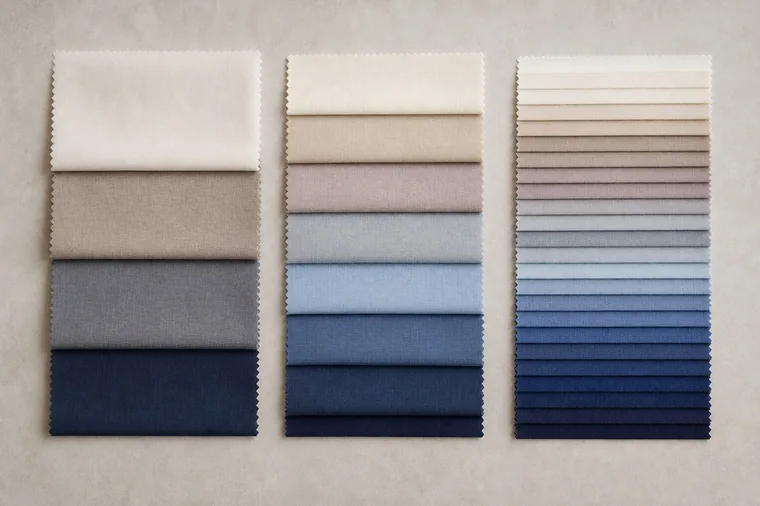
Three coordinated sets of fabric swatches show broad, intermediate and fine levels of seasonal palette granularity on a neutral table
More groups increase the available resolution; they do not automatically improve the underlying method

Sixteen seasons is not one universal taxonomy

The phrase sixteen seasons can sound like a standard extension of twelve. In practice it is used for different structures. Some frameworks add neutral or pure groups; some divide certain boundaries more finely; others reorganise dominant characteristics or use proprietary names. The number may match while the map does not.

To understand a sixteen-season system, ask which sixteen groups it contains, which dimensions separate them, how the drapes are constructed, which sequence leads to a decision and how boundary cases are recorded. Without that information, it is impossible to claim that one group exactly equals a similarly named category in another framework.

Its potential strength is the ability to describe zones that a broader taxonomy combines. This may produce a more targeted palette when the materials and training include dedicated comparisons. Its potential weakness is false precision: neighbouring categories, poorly discriminating drapes or implicit rules can increase disagreement between consultants without creating a more useful result.

Sixteen is not a higher score than twelve. It places a heavier burden on the protocol. Every added category needs a describable boundary, adequate samples, distinct examples, controls and a practical difference in the final advice. If only the label changes while the palette and application remain indistinguishable, the granularity is nominal.

Professional colour analyst and adult client compare three palette boards arranged from broad colour families to increasingly granular fabric groups
A finer map is useful only when each additional boundary changes the evidence or the practical recommendation

Granularity and quality answer different questions

Evaluate quality beyond the count

A taxonomy is only as good as the path from evidence to palette

Definitions

Explicit dimensions and boundaries

Materials

Drapes that represent each distinction

Decision

Traceable evidence and uncertainty

Output

A palette the client can use

Audit definitions, drapes, decisions and real-life usefulness independently of how many named groups are available.

Granularity asks how many zones the map distinguishes. Quality asks whether those zones are defined, represented by the kit, tested with suitable controls, interpreted consistently and translated into a useful palette. Increasing the first number does not guarantee any of the others.

More groups help when an observable difference genuinely changes a colour range, contrast strategy or application. They may also be useful in advanced training because the learner must justify finer decisions. They do not help when the original observation is poor, the thresholds are hidden or the output becomes so restrictive that the client cannot use it.

Fewer groups help when the goal is a robust, memorable direction or when the available evidence does not support a fine split. They do not help when one family is so broad that it combines opposing recommendations without priorities. Professional fit means matching the map’s resolution to the tools, analyst competence and client brief.

System size

Potential benefit

Main risk to control

Four

Clear, broad directions and easy application

A family too wide for individual priorities

Twelve

Explicit dominant or transitional directions

Assuming names match across schools

Sixteen

Finer zones where the method supports them

False precision and unstable boundaries

Any size

A shared language for useful choices

Treating the label as proof

Can the same person receive two different season names?

Yes, especially when systems use different categories, thresholds or weighting. That fact does not automatically prove one consultation wrong. Compare what each label actually describes: temperature direction, value range, chroma, contrast, central colours, difficult colours and practical styling guidance.

Two different names may produce palettes with substantial overlap. Conversely, the same name may conceal very different boards. A serious comparison starts with samples and decisions rather than online translations. Ask for the framework, the group definition and the comparisons that carried the most weight.

When outcomes diverge sharply, reconstruct the conditions: light, preparation, tan or hair colour, drape set, decisive pairs, order and treatment of uncertainty. Do not simply merge both palettes into an imagined average truth. First determine whether the difference comes from the taxonomy, the protocol or the observations.

Why crosswalk tables are rarely one-to-one

Convert evidence, not just a season name

A crosswalk is reliable only when both systems are defined

1

Recover conditions and observations

2

Restate temperature, value and chroma

3

Compare boundaries and terminology

4

Re-test non-equivalent decisions

Recover the observations, express them as dimensions, compare thresholds and repeat any draping that the target system treats differently.

A crosswalk between four, twelve and sixteen seasons is trustworthy only when it compares two defined frameworks. Similar words are not enough. One system may divide a family by its dominant dimension; another may introduce a neutral zone or place greater weight on chroma than value. Categories can overlap without being equivalent.

A careful conversion has four stages: recover the original observations; rewrite them as explicit colour dimensions; consult the target system’s definitions and drapes; then repeat any comparisons that do not share the same threshold. If the original session record is missing and only a label remains, the crosswalk is a hypothesis, not a fresh analysis.

Treat universal statements such as ‘this season always becomes that season’ with caution. They may be internal memory aids within a school, but cannot be extended to every similarly named taxonomy. When sharing a result with another professional, state the system and version alongside the season name.

Boundary cases, neutrality and non-decisive results

A client near a boundary is not an error to remove. One dimension may be less selective, two directions may work in different proportions, or a taxonomy may draw a discrete line through a continuous visual range. The framework should state how to record that situation and still return useful guidance.

Neutrality does not mean absence of colour or inability to analyse. It may describe a weak temperature preference compared with value or chroma, but its meaning depends on the system. Before assigning a dedicated neutral group, check that warm–cool pairs are balanced and that light or surrounding reflections have not compressed the difference.

When the result remains uncertain, return a range and identify colours already verified. A provisional palette with future checks is more professional than choosing a subgroup simply to complete a form. The ability to suspend judgement is a competence, not a failure of confidence.

How to evaluate a system without counting seasons

Audit the entire method

Move from the promise to the palette returned

1

Define the map and dimensions

2

Test the kit, light and sequence

3

Record decisions and boundaries

4

Check usefulness and autonomy

The strongest system is the one whose categories, comparisons, uncertainty and application can be explained and reviewed across diverse clients.
  1. Definitions: does every category and dimension have an operational meaning?

  2. Tools: do the drapes, neutralisers and palettes represent the promised boundaries?

  3. Procedure: are light, preparation, sequence and controls documented?

  4. Decision: is the evidence that moves a client from family to subgroup explicit?

  5. Repeatability: can a trained colleague reconstruct and discuss the reasoning?

  6. Boundaries: can the method retain weak, neutral and non-interpretable evidence?

  7. Application: does the palette help with colour, contrast, area and placement?

  8. Ethics: is the result communicated without diagnosis, judgement or absolute bans?

AICI Core Competencies cover technical knowledge, professional application, communication and business conduct. They do not certify a particular number of seasons. They reinforce the broader principle that a framework lives through competent, transparent use rather than through taxonomy marketing.

Choosing training: questions that matter more than the number

When comparing training programmes, do not stop at four, twelve or sixteen. Ask which named system is taught, which dimensions it uses, how much supervised practice is included, how varied the practice cases are, which drapes are used, how exercises receive feedback and whether the tutor demonstrates uncertain cases as well as clear examples.

Check that observation, classification and application are taught as separate stages. A programme should show how to document the test rather than memorise palette boards; adapt colour without imposing bans; explain the limits of photographs and remote work; manage consent and privacy; and serve a genuine range of skin depths and visible colour relationships.

BeautyLearn courses are supplied by different educators, so read the curriculum, tools, learning outcomes and tutor information on each listing. The English colour analysis course category and the complete colour analysis course page let you compare the actual programme separately from this editorial systems guide.

Frequently asked questions

Is a sixteen-season system more accurate than a twelve-season system?

Not automatically. Sixteen groups provide finer nominal resolution, but accuracy depends on clear boundaries, suitable drapes, controlled observation, traceable decisions and practical usefulness. A rigorous twelve-season analysis can be more dependable than a poorly defined sixteen-season one.

Is a four-season analysis too basic for professional work?

No. It may be professionally appropriate when it is well controlled and matches the promised outcome. The limitation is breadth, not automatic lack of rigour. The consultant should mark priorities within the family rather than claim that every colour on a broad board works equally.

Do all twelve-season systems use the same subgroups?

No. Many use familiar light, deep, bright, soft, warm, cool and true directions, but names, boundaries and palette content vary. Always identify the framework and compare operational definitions rather than assuming a translated label means the same thing everywhere.

Do all sixteen-season systems use the same categories?

No. Sixteen can describe several architectures, including extra neutral, pure or transitional zones and proprietary systems. Ask for the complete map, decision rules and drape construction before comparing one sixteen-season result with another.

Can the same person belong to different seasons in different systems?

Yes. Different maps can place the same colour evidence on different sides of a boundary or use different names for overlapping ranges. Compare the palette, dimensions and practical advice before deciding that two labels conflict.

Can an online chart convert my season into another system?

It can suggest an approximate crosswalk only when both frameworks are clearly defined. A label alone omits the original observations. Accurate conversion may require the session record and fresh draping where the destination system uses different thresholds.

Is one dimension always dominant in a twelve-season system?

That depends on the framework. Some organise subgroups around a leading characteristic; others describe transitions or balanced central groups. The method should explain how dominance is tested and what happens when two dimensions carry similar weight.

What does a neutral season mean?

The meaning varies. It may indicate that temperature is less selective than value or chroma, or it may be a dedicated category within a particular map. It never means that every colour works. Read the framework’s definition and verify the warm–cool comparisons.

How should a consultant handle a boundary case?

Record the stable colours, the weak dimension, the neighbouring range and the conditions that could have affected the result. Return useful options and a certainty level. Repeat decisive comparisons later if necessary rather than forcing the closest label.

Can I mix drapes from different systems?

Only after verifying how both sets were designed and which variable each sample is intended to isolate. Mixing proprietary or undocumented sets can create a hybrid category with no coherent decision rule and make the analysis impossible to reconstruct.

Does a larger seasonal system require a larger drape kit?

Usually it requires enough carefully designed comparison material to represent every extra boundary, but quantity alone is not sufficient. Sample condition, pair balance, surface, range and documented use matter more than a headline drape count.

Should a final palette ban every colour outside the season?

No. A palette is a tool for managing relationships, quantity and placement. A colour outside the central range can work farther from the face, in a smaller area, through a different texture, with a bridge colour or simply because the client chooses it deliberately.

Official sources and editorial scope

The CIE International Lighting Vocabulary entry for perceived colour distinguishes perceptual attributes and the role of viewing conditions. CIE’s Colorimetry, 4th Edition defines colorimetric fundamentals. Neither source establishes a universal four-, twelve- or sixteen-season taxonomy.

Professional conduct and scope are informed by AICI’s Core Competencies and Code of Ethics Handbook. These references support competence, transparent communication, inclusion and respect for client autonomy; they do not endorse one commercial seasonal framework. Editorial review: 5 September 2026. No competitor links are included.

Continue learning

Return to the personal colour analysis pillar, review the four colour dimensions and apply them with the controlled draping-test method. Browse the full personal colour analysis guide hub or compare the English colour analysis courses when you want a structured learning pathway.

See how the dimensions become a practical seasonal palette in the guide to Winter colour analysis, sub-seasons and colour combinations. It separates controlled observations from physical stereotypes and universal colour bans.

Explore a cooler, softer seasonal direction in the guide to Summer colour analysis, sub-seasons and palette building. It distinguishes tested colour relationships from physical stereotypes and pastel-only rules.

Explore a warmer, richer seasonal direction in the guide to Autumn colour analysis, sub-seasons and palette building. It separates tested colour relationships from complexion, hair and earth-tone stereotypes.

Explore a warmer, lighter and clearer seasonal direction in the guide to Spring colour analysis, sub-seasons and palette building. It separates tested colour relationships from hair, eye, complexion and neon stereotypes.

Turn a seasonal result into practical wardrobe decisions with the guide to reading and using a personal colour palette. It covers equivalent colours, contrast, prints, accessories, capsules and shopping without perfect-match rules.

Before using shortcuts, review the evidence and limits behind common DIY personal colour tests. It explains why veins, jewellery, tanning, photos and apps cannot assign a season alone.

For the professional pathway, use the guide to becoming a personal colour consultant. It connects training, deliberate practice, ethical service design, local checks, portfolio, pricing and continuing development.

For equipment selection and setup, use the professional colour analysis kit guide. It treats drapes, light, neutralisation, client records, care and transport as one controlled system rather than a shopping list.

To connect method, preparation, records, draping, results and follow-up, use the complete personal colour consultation protocol. It shows how technical comparisons become a transparent client service without forcing certainty.

For remote work, use the guide to online personal colour analysis and the limits of photos and screens. It defines capture, file acceptance, display, uncertainty, privacy and when an in-person referral is the responsible outcome.

When comparing or building a service, use the guide to personal colour analysis consultation cost, duration and inclusions. It separates appointment time from total work, reusable studio tools from take-home deliverables, and headline price from the final service total.

To translate a personal palette into complexion, cheek, eye and lip decisions, use personal colour analysis and make-up by season. It separates foundation matching, colour correction, iris, placement and cosmetic safety from the broad seasonal colour direction.

For a realistic hair-colour direction, continue with personal colour analysis and hair colour, tone and contrast. It converts the palette into a visual brief while keeping starting base, chemical decisions, preliminary tests, fibre integrity and maintenance with the qualified colourist.

Apply an established palette to shirts, tailoring, beard, eyewear and accessories with personal colour analysis for men. The guide prioritises face-zone colour, dress code, identity, useful combinations and responsible grooming without creating a separate colour system for men.

For an inclusive method that separates depth, olive appearance, ethnicity and season, continue with personal colour analysis for olive and deep skin tones. The guide audits light, exposure, drape representation, four dimensions, photography, language and bias before assigning a family.

Continue learning