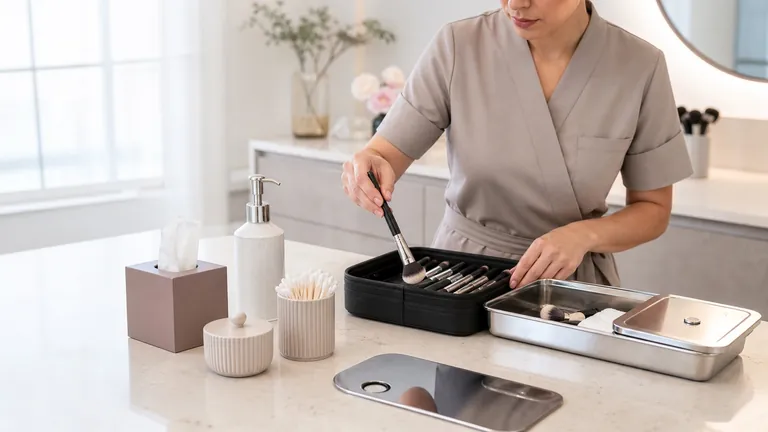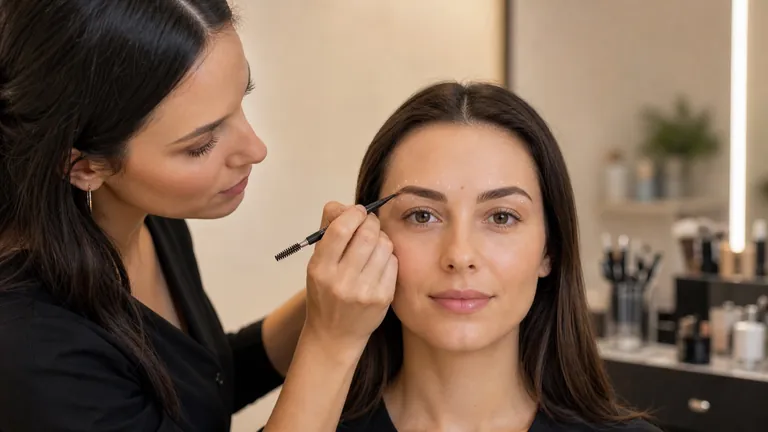
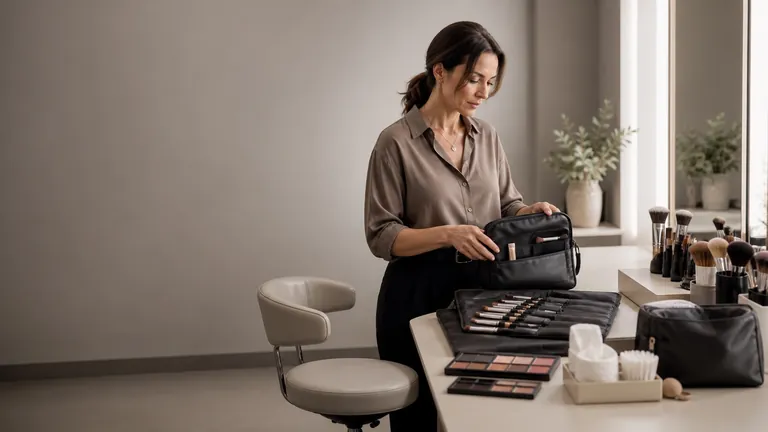
A professional makeup kit is not the largest collection of products. It is a controlled system that makes the agreed service possible, keeps clean and used materials distinct, protects product information and reduces interruption. The workstation turns that system into a visible sequence: preparation, active application, used items, waste and reset should never compete for the same surface.
Quick framework: map the service and client range; build a compact shared core plus service modules; preserve labels, batches and warnings; separate ready, active, used and waste zones; adjust chair, surface, mirror and light before the client arrives; transport liquids, fragile items and clean tools securely; carry backups for real single points of failure; reorder from measured use rather than fear.
This page owns professional kit architecture, workstation layout, transport and continuity. The beginner makeup kit guide covers a learner's first practice purchases. The professional brush guide owns brush behaviour, and the makeup hygiene guide owns cleaning and contamination controls. Those boundaries prevent overlapping shopping lists.
The guide was reviewed against the cited official references on 5 September 2026. Product directions, workplace requirements and aviation restrictions can change. Follow manufacturers, applicable risk assessment and current carrier, airport and authority information. Compare structured learning in the English makeup course catalogue.
A professional kit is a modular system
A professional kit has four coordinated layers
Range and reliability matter more than collection size
Core
Functions used across booked services
Modules
Bridal, corrective, editorial or other brief
Consumables
Clean transfer and single-use stock
Continuity
Tested alternatives for critical failure
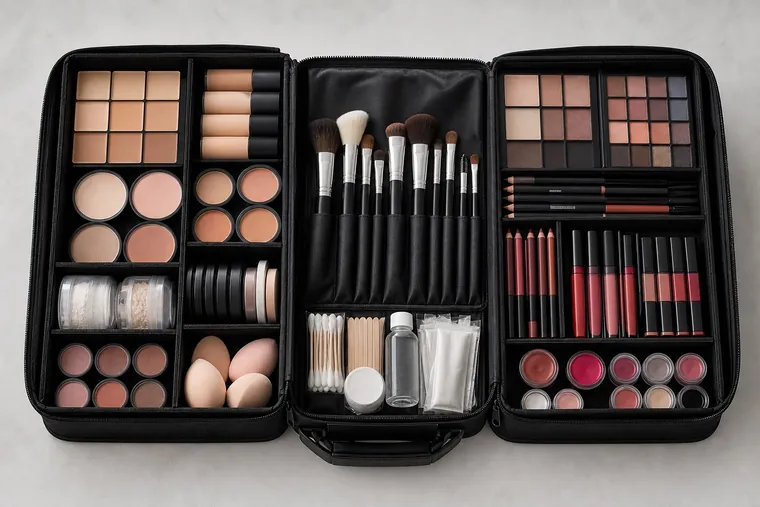
Build one stable core for preparation, complexion adjustment, sanitation support and finishing, then add modules for bridal, editorial, mature skin, corrective work, eyes, lips or another declared service. The module includes product, applicators, disposables, records and backup needed for that assignment. Removing an unused module should not make the remaining kit disorganised.
Modularity improves traceability and weight. A large palette can still belong to one module, while a tiny pot without identity may not belong anywhere. Every item should answer four questions: which service decision needs it, how is it used hygienically, where is its label or batch information, and what happens if it fails or runs out?
Layer | Purpose | Example |
|---|---|---|
Shared core | Every booked service | Prep, complexion control, basic eyes and lips |
Service module | Specific brief or environment | Bridal wear, photography or corrective range |
Consumables | Clean transfer and single use | Applicators, tissues, palettes and waste bags |
Continuity | Protect critical delivery | Duplicate adhesive, sanitising support or light |
Design purchases from the service map
Every purchase begins with a service promise
Functions, gaps and measured use come before brand or trend
Define the booked result and boundary
Translate the result into functions
Test realistic briefs and log gaps
Buy, measure and remove duplication
Write the service promise before the product list: people served, skin-depth range, finish, wear time, setting, travel, photography, touch-up and any technique outside scope. Translate each promise into functions rather than brands. A complexion range may need adjustable depth and undertone, different coverage and finish, not every shade from one line. The foundation texture and finish guide helps define those functions.
Then test gaps on realistic briefs. Can the core serve the lightest and deepest clients within the intended market? Can it adapt to dryness, oil, texture and camera? Is each product compatible with the others and with the environment? A gap supported by repeated service data becomes a purchase. A trend seen online but absent from the business does not.
Define the booked result and professional boundary.
List product functions, shades, tools and consumables required.
Test the system on representative briefs and record recurring gaps.
Buy the smallest reliable addition that closes a verified gap.
Remove duplication that does not improve range or continuity.
Divide the workstation into four zones
The surface must show the state of every item
Ready, active, used and waste never share one ambiguous space
Ready: protected stock and clean tools
Active: only the current application stage
Used: isolated for the approved next step
Waste: removed without crossing clean zones

Ready stock stays protected until needed. The active zone contains only items for the current step. Used tools move immediately to a distinct container and waste enters the correct receptacle without crossing clean materials. Personal phone, keys, drinks, outer packaging and spare stock stay away from the active surface. The zones can be small; their boundaries must be obvious.
Zone | Contains | Rule |
|---|---|---|
Ready | Closed modules and protected clean tools | Open only when required |
Active | Current products, palette and clean applicators | Keep the surface readable |
Used | Tools awaiting the approved reprocessing flow | Never return to ready storage |
Waste | Spent disposables and appropriate packaging | Reach without crossing the client |
Adjust ergonomics before the service starts
EU-OSHA identifies awkward or static posture, repetitive work, poor lighting, long sitting or standing and work organisation as interacting musculoskeletal risks. Raise or lower the client so the artist can work with shoulders relaxed, elbows close and neck near neutral. Bring the active tray within easy reach instead of twisting repeatedly toward an open case on the floor.
Use a stable adjustable chair with safe access and a working height suited to eyes, lips and complexion. Change posture between stages, alternate hands where technique allows and schedule micro-pauses between clients. Pain, tingling or weakness is not solved by buying a fashionable stool; reassess layout, workload and risk with competent occupational support.
Plan light, mirror and electrical safety as one system
The artist needs broad stable light that reveals colour and texture without glare. A mirror helps the client confirm direction but should not obstruct the artist or become the only light source. Keep cables away from feet, chair movement, hot tools, liquids and exit paths. Inspect plugs, adapters, batteries, stands and clamps before setup; venue permission and local electrical requirements still apply.
Bring extension equipment only when suitable for the load and environment. Do not create a daisy chain of unknown adapters. A battery lamp can be a continuity backup, but test colour, output and runtime before relying on it. For faithful records and portfolio frames, use the professional makeup photography guide.
Organise products for traceability and stock control
Keep product identity, responsible person, nominal content, durability or PAO, batch, precautions and function available as required. Decanting or depotting can break the link to those facts. Maintain a map from working container to original product and batch, label small containers unambiguously and retain manufacturer directions. Do not refill one pot indefinitely without a controlled cleaning and replacement process.
Record opening date where useful, inspect changes in smell, colour, texture and packaging, and follow storage directions. Separate active stock from unopened reserve. First-expiring-first-out is more useful than arranging by brand colour. The makeup label, batch and PAO guide provides the complete traceability method.
Inventory field | Decision supported | Trigger |
|---|---|---|
Product, shade and batch | Trace service and affected stock | Purchase, replacement or complaint |
Opened and review date | Inspect and rotate | Calendar or service threshold |
Quantity and lead time | Set reorder point | Enough stock for lead time plus buffer |
Services per unit | Calculate real product cost | Review after a representative period |
Choose brushes, tools and consumables by function
Count simultaneous clean working sets and reprocessing time, not social-media set size. One brush can serve several functions when shape, load and hygiene allow; two similar brushes may behave differently enough to justify both. Duplicate only when it supports continuity, client flow or a genuinely different formula. Store clean tools protected and move used ones out of the active set immediately.
Consumables need a calculated par level: expected clients before restock, use per service, lead time and reserve. Include palettes, spatulas, mascara wands, lip applicators, tissues, cotton products, protective items and approved cleaning materials appropriate to the procedure. A full drawer is not continuity if every item shares the same unrecognised failure point.
Protect the kit during travel and off-site work
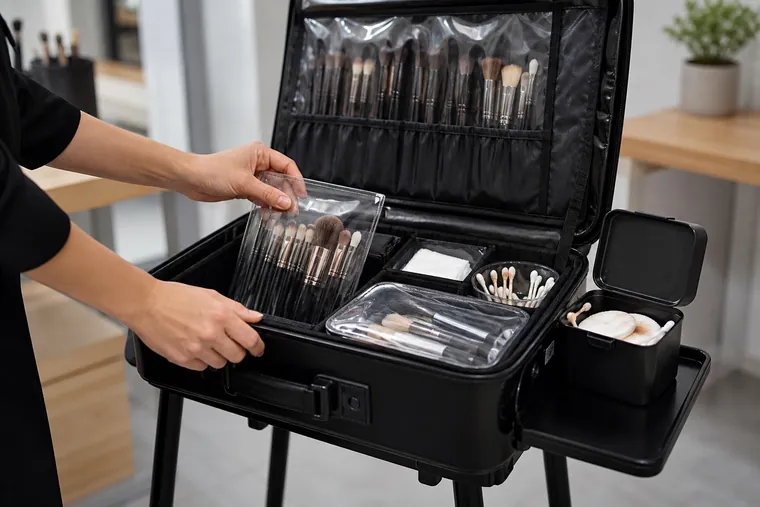
Use rigid dividers or padded modules for fragile products, upright leak-resistant secondary containment for liquids and dust protection for clean tools. Keep the used-items container and waste kit physically distinct. Do not store personal shoes, food or laundry against professional stock. On arrival, inspect leaks, broken pans, damaged seals and temperature exposure before setting up.
Air travel needs a current trip-specific check. ENAC classifies creams, lotions, oils, sprays, gels, pastes and similar consistencies as liquids, aerosols or gels for cabin screening and notes airport-specific arrangements. Airline, airport, security and dangerous-goods rules can differ. Check official departure, connection and destination information before packing; never assume a previous journey sets the rule for the next.
Back up critical functions, not every product
Backup protects promises, not shopping volume
Duplicate a single point of failure only when the service cannot recover
Critical
Failure stops a time-bound service
Alternative
Compatible and tested before the job
Accessible
Packed where it can be used quickly
Measured
Retained only while it protects real demand
Identify single points of failure: the only foundation adjuster for deep tones, eyelash adhesive for a booked service, power supply, light, sanitising product, disposable applicator, payment device or transport key. Carry a tested alternative or documented fallback when failure would stop the job. A backup should be compatible, in date and accessible, not an unfamiliar purchase left sealed for years.
For bridal and time-critical events, add contact, route, schedule and substitute planning. The professional bridal makeup guide distinguishes trial record, event kit and touch-up handover. Backup does not mean carrying the entire studio; it means protecting the promises that cannot be recovered later.
Use consumption data to reorder
Set a reorder point from average use during supplier lead time plus a justified buffer. Review fast, medium and slow movers separately. A scarce specialist shade may need one reliable reserve despite low use, while an inexpensive disposable may need a higher par level. Record expired and discarded stock so waste becomes visible rather than being hidden inside purchases.
Connect service count and material use to the pricing system. Excess choice ties up cash and makes rotation harder; insufficient range excludes clients and weakens results. A quarterly range review and a short weekly quantity check usually provide different information. Use both rather than one large annual clean-out.
Run opening and reset checklists
Confirm brief, client record, permissions, location and access.
Select core, service module, consumables and verified backup.
Inspect products, labels, batches, dates, packaging and transport condition.
Set chair, surface, light, mirror, cables and four zones.
Expose only current-stage materials and preserve clean stock.
After service, isolate used items and complete waste and reprocessing flows.
Record consumed, damaged, low or affected stock and any incident.
Reset modules only after all required controls are complete.
Invest in the bottleneck before the attractive extra
Prioritise safe service delivery: suitable light, adjustable client position, hygiene workflow, representative complexion range, core tools, consumables, traceable storage and transport. Next fund quality or range gaps shown by briefs and feedback. Creative extras come last. One robust product that solves a frequent gap is more valuable than five exciting duplicates.
Budget purchase price, replacement cycle, usable services, transport space, cleaning time and waste. Review return and warranty terms before buying equipment. Record the reason and success measure for a major addition; if it does not improve range, reliability, time or result, it may not belong in the next version of the kit.
Avoid workstation errors that look efficient
Opening every product creates clutter and exposes stock without purpose.
Keeping the case on the floor creates repeated bending and uncontrolled access.
Using the same tray for clean and used tools makes state unreadable.
Unlabelled mini containers sever product and batch traceability.
A ring light placed for appearance rather than task can flatten or obstruct the work.
Buying complete shade ranges without service data creates waste while leaving functional gaps.
A trolley that is too heavy to move safely is not a professional solution.
Frequently asked questions about professional makeup kits
How does a beginner kit differ from a professional kit?
A beginner kit supports controlled practice on a limited range. A professional system must deliver declared services across intended clients, preserve traceability, manage clean and used flows, travel reliably and survive predictable failures.
Must I carry every foundation shade?
No single strategy suits every market. Build a tested depth and undertone system using direct shades and compatible adjusters where appropriate. Validate mixes for formula, finish and repeatability rather than improvising on the client.
How can I organise a very small workstation?
Make the four states visible with compact trays or containers and expose only the current stage. Store reserve below or behind, keep used items isolated and position waste so it can be reached without crossing clean material.
Should I use a ring light or LED panels?
Choose for task, colour, output, flicker, stability, footprint and transport. Panels or a broad diffused source offer flexible direction; a ring light is near the lens axis. Test skin and product colours in the real setup.
Can I decant foundation into small containers?
Only through a controlled process that preserves product identity, batch, date, conditions and directions and uses a suitable clean container. Do not top up an old pot or lose the link to original information.
How many brush sets do I need?
Calculate consecutive clients, functions and complete approved reprocessing time. The answer may be more than one clean working set, but not every brush needs a duplicate. Count functions rather than handles.
What belongs in a bridal module?
Use the confirmed trial record to select complexion, colour, lashes and wear system, then add touch-up handover, time-critical backups and event logistics. It should be client-specific without dismantling the core.
How do I protect powders and palettes in transit?
Use snug padded dividers, keep palettes flat where the manufacturer allows, prevent movement and avoid heavy objects above them. Inspect before setup and isolate damaged packaging or contaminated product.
Can cosmetics go in cabin baggage?
Rules depend on product form, container, airport, route, airline and security arrangements. Verify current official departure and connection guidance. Creams, oils, gels, sprays and pastes may be treated as LAG items.
How heavy should a professional kit be?
There is no ideal number. It must be safely movable through the real route and sufficient for the brief. Weigh core and modules separately, use a trolley where appropriate and remove unverified duplication.
Which products need a backup?
Back up functions whose failure would stop a time-critical service: essential complexion adjustment, suitable adhesive where used, hygiene support, power, light and key consumables. Test every alternative before the job.
How should workstation cables be organised?
Route them away from feet, chair wheels, liquids and exits; secure without damaging them and use suitable rated equipment. Inspect plugs, adapters, stands and venue connection before the client arrives.
How often should inventory be counted?
Check critical quantities before assignments and on a short recurring cycle; run a deeper range, expiry, waste and cost review periodically. Frequency should reflect service volume, lead time and risk.
How do I choose chair and table height?
Choose stable adjustable equipment that brings the working area to the artist without raised shoulders, prolonged neck flexion or twisting. Assess client access, weight rating, cleaning and transport too.
What should never stay on the active surface?
Keep phones, keys, drinks, food, personal belongings, outer shipping material, unneeded reserve and used tools out. The active surface should show only the current clean application step.
Is a hard or soft makeup case better?
Choose by protection, weight, cleanability, weather exposure, route and module system. A hard case can protect fragile stock but add weight; a soft system may be lighter but needs adequate internal protection.
Where should the first professional investment go?
Fund safe delivery and verified range first: light, adjustable position, hygiene flow, core complexion functions, essential tools, consumables, traceable storage and transport. Add creative options after actual briefs reveal the need.
Official references and scope
Italian Ministry of Health — cosmetic product labelling: required information, precautions, function, ingredients and presentation.
EU-OSHA — work-related musculoskeletal disorders: awkward and static posture, repetition, lighting, layout and work organisation.
ENAC — transport of liquids, aerosols and gels: LAG categories and current airport-screening information.
Editorial review: 5 September 2026. This guide does not replace manufacturer directions, a workplace risk assessment, competent ergonomic advice or current transport rules. Adapt modules, quantities, equipment and checks to the actual service and people.
Measure stock and kit decisions through service contribution
Connect purchasing to the makeup artist earnings dashboard.
Connect kit consumption to service price
Measure purchasing and replacement through the makeup service costing method.
Organise clean and used mascara wands
Add the single-dip sequence from the professional mascara guide.