Reading an INCI list means understanding which ingredients a cosmetic declares, how they are ordered and where to check them. This guide walks through moisturizer, cleanser and foundation labels, then compares two apparently similar formulas. The aim is to separate what you can observe from what still needs evidence.
How do you read an INCI list? Find Ingredients and check the exact product and variant. Under EU rules, ingredients above 1% follow descending order by weight when added; those below 1% may appear in a different order after the higher-concentration ingredients. The threshold is not marked and a position is not a percentage. Use CosIng to identify a name and the relevant legislation to check its conditions of use.
The regulatory examples below concern the European Union. Other jurisdictions have their own labelling rules: check the market for which the product is supplied. Use the free INCI Analyzer to organise a list and the ingredient database to explore individual names; always keep the exact product label as your starting point.
What INCI means and where to find the list
INCI stands for International Nomenclature of Cosmetic Ingredients. Cosmetic labels use standardised ingredient names so that the same substance is not hidden behind a different marketing name in every product. Aqua identifies water, Glycerin identifies glycerol and CI numbers identify many colourants. Botanical names may include genus, species and plant part, while Parfum and Aroma can identify fragrance or flavour compositions.
In markets including the European Union, the ingredient list is normally preceded by the word ‘Ingredients’ and appears on the container, packaging or an attached leaflet or label when space makes direct printing impracticable. Other jurisdictions have their own labelling rules. Always use the requirements that apply to the product’s market rather than assuming every pack follows one global format.
The INCI list is only one part of the label. Product identity, responsible company, nominal content, batch reference, minimum durability or period-after-opening symbol, directions and warnings answer different questions. A complete professional check therefore goes beyond counting ingredients.
How to read an INCI list step by step
Transcribe first, interpret second
Seven checks from the physical label to the finished formula
Identify the product and complete list
Transcribe accurately and read the order
Recognise exceptions and notation
Verify the source and return to use
Identify the exact product: brand, product name, format, variant or shade and market. Similar packaging can contain a reformulated or market-specific list.
Find the complete list. Check whether it continues on another panel, a peel-back label or an enclosed leaflet. Do not analyse a cropped photograph.
Transcribe what is printed rather than correcting it from memory. Preserve commas, brackets, hyphens, slashes, CI numbers and any [nano] notation.
Read the order cautiously. It provides a broad hierarchy before the 1% threshold, not a concentration table.
Recognise special conventions for colourants, multi-shade ranges, fragrance compositions and nanomaterials.
Verify the exact name in an authoritative source. A database entry is useful only when the spelling and identity match.
Return to the finished product: intended area, directions, amount, contact time, rinse-off or leave-on use, packaging and the person using it all affect the practical context.

Checking a list with the BeautyLearn INCI Analyzer
The photograph starts the check; it does not finish it
Local OCR, manual review, analysis and authoritative sources
Photo
Sharp, complete and free from glare
Proofread
Correct names, numbers and brackets
Analyse
Preserve order and unknown entries
Verify
Use database and official sources
The INCI Analyzer accepts a pasted list or can attempt to read a photograph locally on your device. Always compare extracted text with the physical packaging, especially long names, brackets, numbers and similar letters. Correct the transcription before analysing it.
The result preserves label order, connects recognised entries to the ingredient database and leaves unrecognised names visible. It does not apply a red-or-green safety score and cannot replace the product safety assessor, responsible company, pharmacist, dermatologist or doctor.
For a clearer photograph, stabilise the package, use soft even light, fill the frame and avoid glare. Photograph curved labels in overlapping sections. If the OCR output contains nonsense words, repeat the photograph or type the list manually rather than analysing corrupted text.
The photograph starts the check; it does not finish it.
To analyse an INCI list from a photo, include the full label and review every recognised word before using the result. The same tool accepts a carefully transcribed ingredient list.
What ingredient order really tells you
The list has an invisible boundary
EU rule: ordered above 1%, flexible below 1%
> 1%
Generally descending order by weight
Boundary
Not marked on the label
< 1%
Flexible order after higher levels
Colourants
Additional conventions may apply
Under EU cosmetic rules, ingredients are listed in descending order by weight when they are added to the product. This lets you read a broad hierarchy in the ordered part of the list. It does not tell you that the first ingredient has a particular percentage or that the fifth is present at an effective dose.
Under the EU Cosmetics Regulation, ingredients at concentrations below 1% may be listed in any order after those above 1%. The label does not identify where that flexible zone starts. Do not automatically extend this exception to an ingredient at exactly 1%, and do not use Phenoxyethanol or Parfum as a ruler for assigning percentages to neighbouring ingredients.
The rule concerns weight at the point of incorporation, not every change that occurs during manufacture. Two products with a similar list can still differ in percentages, raw-material specifications, process, pH, structure, packaging and performance. Treat order as one piece of evidence, not a reconstructed recipe.
Fifth ingredient ≠ 5%. Near the end ≠ ineffective.
The EU wording and the separate rules for colourants are in Article 19 of the Cosmetics Regulation. They describe label order, not a method for reverse-engineering the formula.
Ingredient families, names and cosmetic functions
INCI names, botanical names and ingredient functions
One ingredient may have several possible cosmetic functions. Its role in a particular formula depends on concentration, vehicle, pH, processing and the other ingredients around it. Search the exact name in the BeautyLearn ingredient database for a first description, then use current official sources when regulatory status matters.
What you see | What it may suggest | What it does not prove |
|---|---|---|
Solvent or vehicle | The medium carrying other materials | Final texture, absorption or quality |
Humectant, emollient or occlusive | A possible contribution to hydration or comfort | Suitability for every skin type |
Surfactant or emulsifier | Cleansing, dispersion or emulsion stability | Finished-product mildness or cleansing power |
Preservative | A role in microbiological control | Shelf life after contamination or poor storage |
UV filter | Presence of an ingredient used to filter UV radiation | The product’s SPF, UVA protection or water resistance |
For moisturising formulas, the guide to humectants, emollients, occlusives and ceramides explains how these families work together. For cleanser labels, use the cleansing and double-cleansing guide rather than judging a surfactant in isolation.
A botanical name can specify the plant and the part used: leaf extract and seed oil are not interchangeable descriptions. Similarly, Cetearyl Alcohol is a fatty alcohol with structural and emollient roles; do not confuse it with Alcohol or Alcohol Denat. The name alone does not establish the formula’s tolerability.
Fragrance, aroma and individually labelled allergens
EU fragrance allergen labelling
Two dates for two stages of the transition
Regulation 2023/1545 expands individual labelling
31 July 2026
New placements on the EU market must meet the expanded requirements
31 July 2028
End of the transition for qualifying products already placed on the market
Parfum and Aroma identify fragrance or flavour compositions. For the fragrance allergens covered by EU Annex III, individual labelling is required above 0.001% in leave-on products and above 0.01% in rinse-off products. Regulation (EU) 2023/1545 adds individual labelling requirements for 56 further fragrance allergens.
Since 31 July 2026, products newly placed on the EU market must meet the expanded requirements. Products placed on the market before that date under the transitional conditions may continue to be made available until 31 July 2028. A longer ingredient list can therefore reflect updated labelling; it does not, by itself, establish that the formula changed. Check the packaging, variant and batch. See the European Commission’s explanation of the transition.
The presence of Parfum does not prove that a product will cause a reaction, and a fragrance-free claim cannot guarantee universal tolerance. Someone with a diagnosed allergy should compare the substances identified by their healthcare professional with the label of the exact product. An app must not diagnose an allergy from the list.
Colourants, CI numbers and the +/− clause
Colourants other than hair colourants may be listed in any order after the other ingredients under EU rules. Decorative cosmetics sold in several shades may use a ‘may contain’ or ± clause to declare the range of colourants used across the shade family where the rules allow it. A CI number identifies a colourant; it is not a score or a percentage.
Nanomaterials and the nano notation
Ingredients present as nanomaterials are identified with ‘nano’ in brackets where that labelling rule applies. The notation describes a regulated form; it does not automatically mean dangerous or superior. Substance, specifications, exposure, authorised use and the finished product still require context.
The European Commission explains the EU requirements for nanomaterials in cosmetics. Check the substance’s form and the conditions applicable to its particular use.
How to use CosIng without overclaiming
Information database, binding legislation
Move from the exact name to its conditions of use
Search the exact name or identifier
Open the regulatory reference
Check use, limits and date
Compare with the actual product
CosIng is the European Commission database for information on cosmetic substances and ingredients. It can help you search INCI names, chemical names, CAS or EC identifiers, recorded functions and regulatory references. The Commission also states that the database is informative and has no legal value by itself. Finding a name does not prove that every use is authorised or safe without conditions.
For EU legal status, read the current consolidated Cosmetics Regulation and the relevant annexes for prohibited or restricted substances, colourants, preservatives and UV filters. Maximum concentration, product type, body area, population, warnings and purity criteria may all matter. Elsewhere, consult the regulator responsible for the target market.
A reliable sequence is: search the identical name, check synonyms and identifiers, open the regulatory reference, confirm the date, compare the conditions with the actual product and keep the source. If a name cannot be found, check the transcription instead of inventing a correction.
Question | Source to consult | Limit |
|---|---|---|
Which ingredient is this? | A name or identifier is not permission for every use. | |
Can it be used in this EU cosmetic? | Concentration, form and intended use still matter. | |
How is safety assessed? | SCCS Notes of Guidance and product assessment | The complete formula and exposure data are needed. |
Is it suitable for my diagnosed allergy? | Healthcare professional and the exact product documentation | A database cannot make an individual diagnosis. |
For common ingredient names on EU labels, the glossary is updated by Commission Implementing Decision (EU) 2025/1175 of 16 June 2025. As the Commission’s glossary page explains, it is a naming resource, not a list of ingredients authorised for use.
Case studies: three INCI lists and a comparison of formulas
These four case studies concern products whose identities are kept anonymous. The supplied images are illustrative reconstructions, not photographs of the original packaging; educational wording within the graphics describes their presentation. The commentary uses the ingredients shown and separates label observations from claims that need formulation data or finished-product testing.
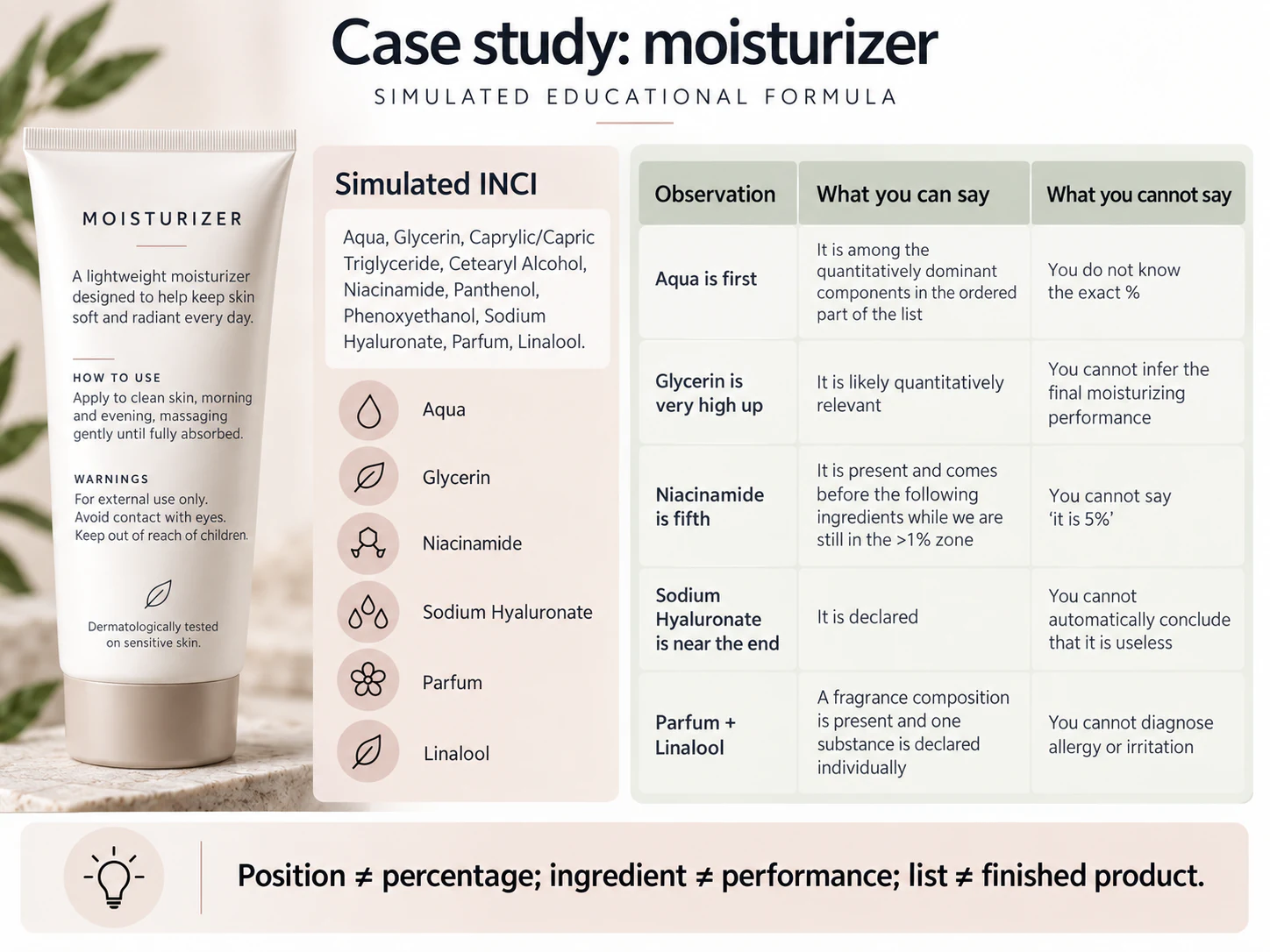
Case study 1: moisturizer
Start with the highlighted ingredients and compare their positions with their possible roles. The useful question is what the label tells us, not which score to give the cream.
 Open the full-resolution image (new tab)
Case study INCI: Aqua, Glycerin, Caprylic/Capric Triglyceride, Cetearyl Alcohol, Niacinamide, Panthenol, Phenoxyethanol, Sodium Hyaluronate, Parfum, Linalool.
Declared ingredient | What you can observe | What you cannot infer |
|---|---|---|
Water appears first. | Its exact percentage. | |
A humectant appears second. | How much hydration the finished cream will provide. | |
An ingredient with an emollient role. | The product’s richness or comedogenicity. | |
A fatty alcohol with structural and emollient roles. | That it behaves like ethanol. | |
It is declared in fifth position. | That it is present at 5% or has demonstrated efficacy. | |
A possible humectant and conditioning contribution. | A dose or clinical result from its position. | |
An ingredient used as a preservative. | The microbiological stability of the entire system. | |
It appears near the end. | That it is ineffective, or what its molecular weight is. | |
A fragrance composition is declared. | How many substances it contains or their concentrations. | |
An individually declared substance. | That it will cause a reaction in everyone. |
The 1% boundary remains unknown in this case. Do not turn a preservative or fragrance position into a concentration estimate for the other ingredients. For choices within a routine, read the guide to introducing skincare actives.
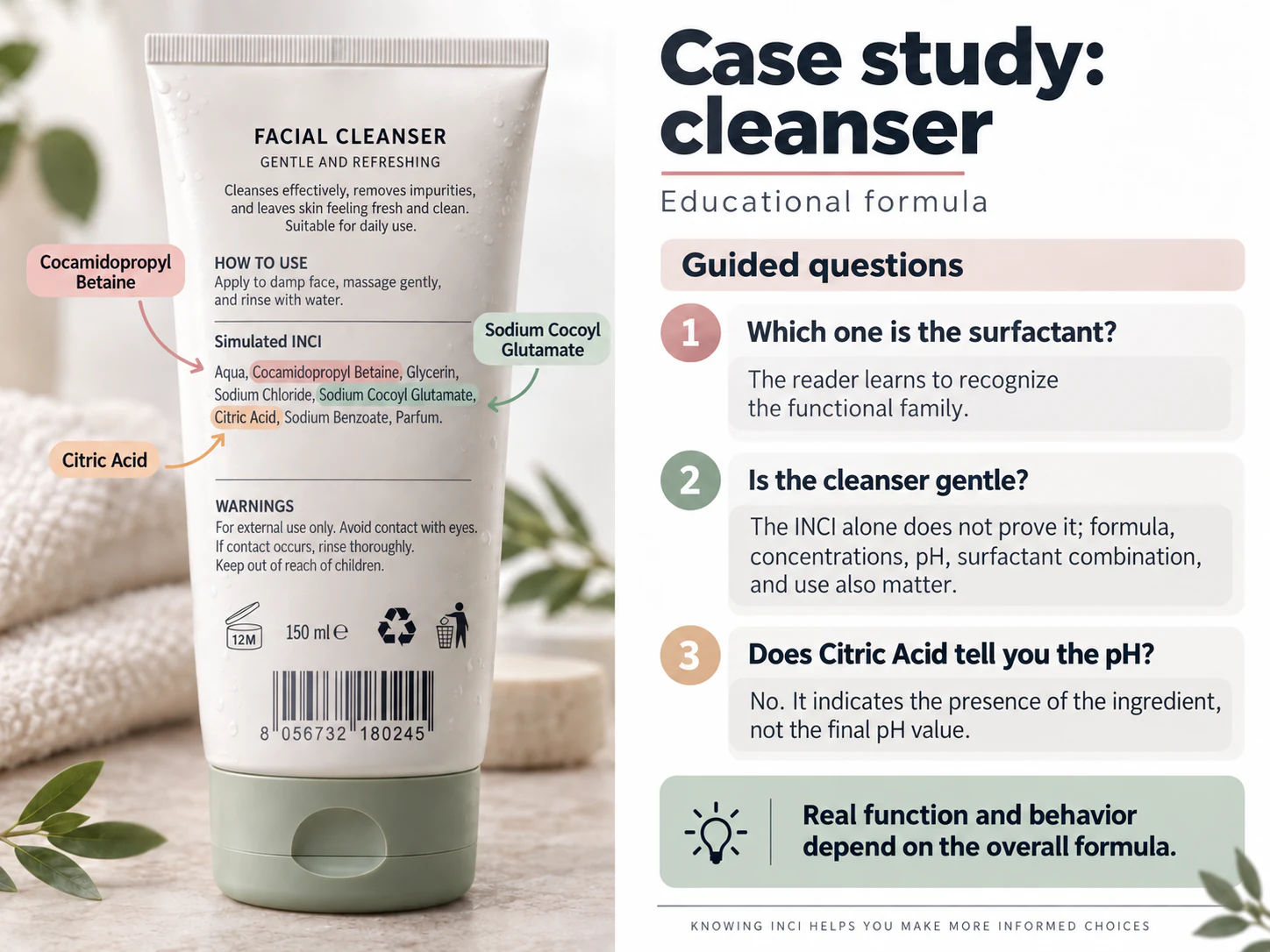
Case study 2: facial cleanser
Identify the surfactant system and distinguish ingredient functions from finished-formula performance. The graphic’s questions are addressed in the ingredient list and the table below.
 Open the full-resolution image (new tab)
Case study INCI: Aqua, Cocamidopropyl Betaine, Glycerin, Sodium Chloride, Sodium Cocoyl Glutamate, Citric Acid, Sodium Benzoate, Parfum.
Ingredient | Possible function | Conclusion to avoid |
|---|---|---|
Solvent and aqueous base. | The water percentage is known. | |
A surfactant in the cleansing system. | The finished cleanser is definitely gentle. | |
Humectant. | Rinsing leaves a quantified moisturising effect. | |
May contribute to viscosity adjustment. | The product is harsh because it contains salt. | |
Another surfactant, to read alongside the first. | One surfactant describes the behaviour of the whole blend. | |
May adjust pH. | The final pH can be calculated from the INCI list. | |
A preservative whose use requires appropriate conditions. | Its presence alone proves effective preservation. | |
Fragrance composition. | The absence of other fragrance names excludes every allergen. |
Assessing mildness requires concentrations, pH, the surfactant combination, tests on the finished formula and the conditions of use. Citric Acid identifies an ingredient; it does not supply a measured pH value.
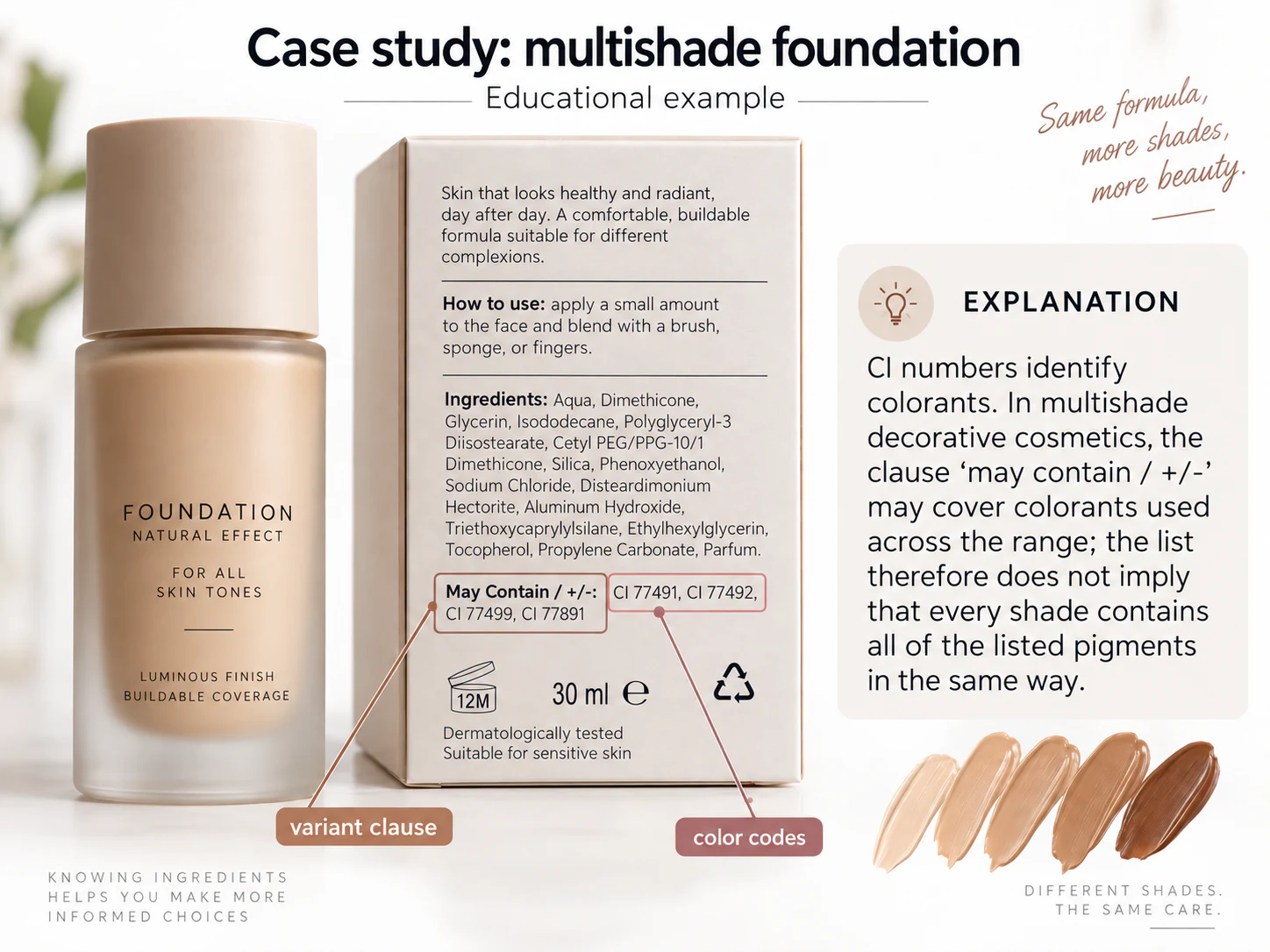
Case study 3: multishade foundation
Read ingredient names, Colour Index numbers and shade variants together. The following extract focuses on the parts highlighted in the graphic; it is not a complete transcription of the product label.
 Open the full-resolution image (new tab)
Incomplete INCI extract from the case study: Aqua, Dimethicone, … May Contain / +/−: CI 77491, CI 77492, CI 77499, CI 77891.
Label entry | How to read it | What remains unknown |
|---|---|---|
Aqua, Dimethicone, … | The extract shows only the beginning of the list. | The complete formula: you need the entire label. |
May Contain / +/− | May cover colourants used across the shade range under the applicable rules. | Which pigments are present in the exact shade and at what concentrations. |
CI 77491, CI 77492, CI 77499 | Colour Index numbers for iron oxides. | Pigment ratios, coverage and appearance on skin. |
CI 77891 | The Colour Index number for titanium dioxide. | SPF or UVA protection: a pigment name is not a sunscreen test. |
Check the exact shade and do not read +/− as a percentage tolerance. Colourants on a decorative product label do not, on their own, demonstrate the sun protection delivered by that product.
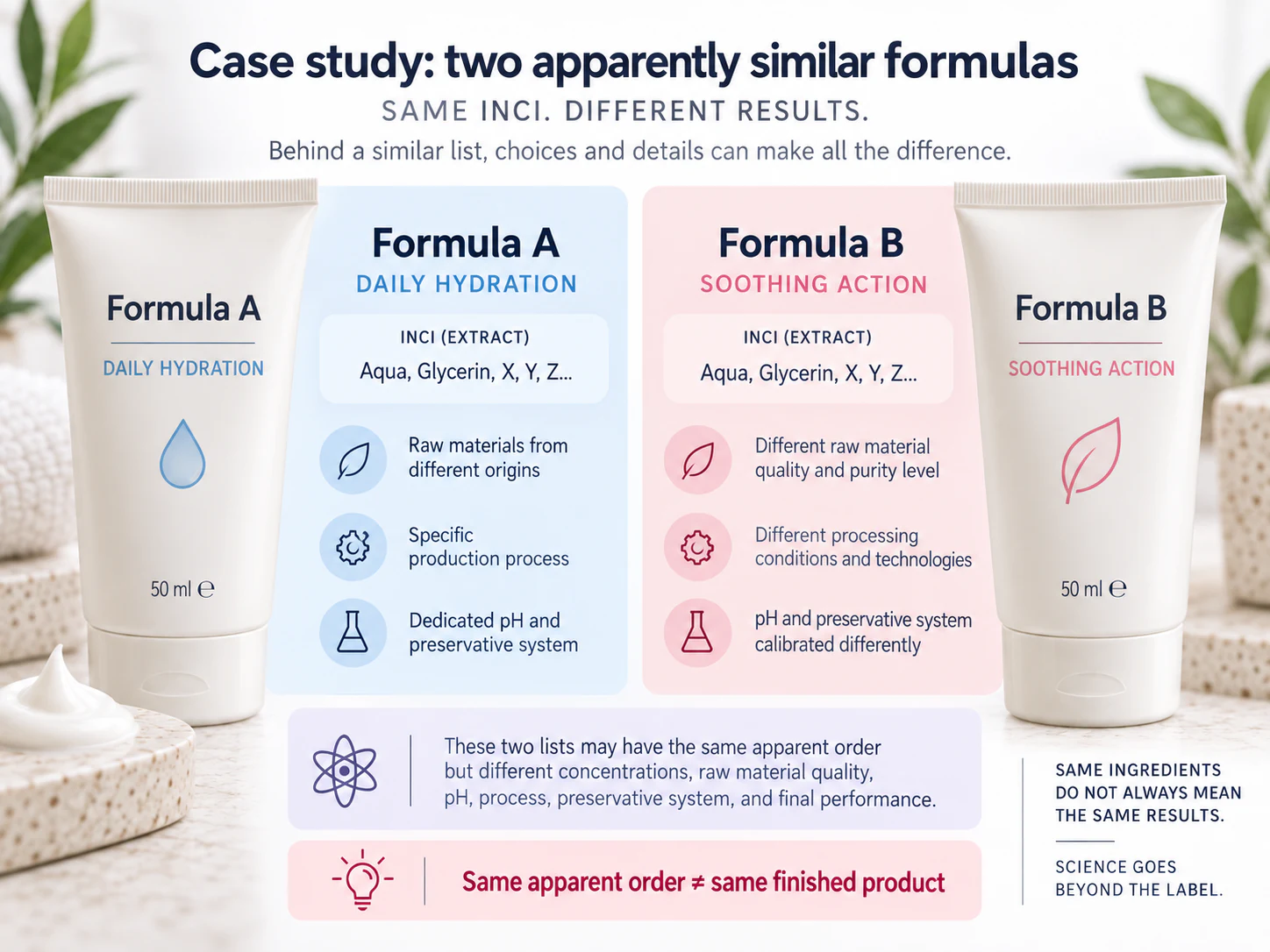
Case study 4: two formulas with apparently similar INCI lists
Compare the two anonymous products without confusing label similarity with formula equivalence. The graphic summarises variables to investigate; it does not report measured efficacy results for these products.
 Open the full-resolution image (new tab)
The graphic shows Aqua and Glycerin followed by X, Y and Z. Those letters are placeholders, not ingredient names to search in CosIng or enter into the Analyzer. Different concentrations can preserve the same apparent order, while raw-material specifications, pH, manufacturing process and preservation can also differ. Complete labels and product documentation are needed to establish which differences actually apply. The hydration and soothing claims shown in the illustration are not proved by the ingredient list.
Position ≠ percentage. Ingredient ≠ performance. List ≠ finished product.
What an INCI list cannot tell you
Ingredient list is not product assessment
What the list shows — and what still needs evidence
Shows
Declared names and broad hierarchy
Does not show
Percentages, pH, purity or stability
Does not prove
Efficacy, SPF or comedogenicity
Does not diagnose
Allergy or cause of a reaction
Exact percentages unless the manufacturer discloses them separately in a reliable form.
pH, viscosity, stability, microbiological quality or packaging compatibility.
Raw-material origin, grade, purity and manufacturing specifications beyond what the name communicates.
Release, penetration and interactions inside the finished formula.
SPF, water resistance, clinical efficacy, comedogenicity or hypoallergenicity without relevant finished-product evidence.
Individual tolerance or the cause of a reaction. Skin condition, dose, frequency, body area, allergies and other products need separate assessment.
The SCCS Notes of Guidance, 12th revision (SCCS/1647/22), describe scientific assessment of cosmetic ingredients using exposure and toxicological information. This explains why an isolated ingredient name cannot establish the safety of a finished cosmetic.
When professional or medical advice is appropriate
Ask a pharmacist, doctor or dermatologist when you need to check a diagnosed allergy, prescribed treatment, pregnancy, use on a child, a persistent reaction or an existing skin condition. Significant pain, marked swelling, breathing difficulty, eye or mucosal involvement, widespread blistering or rapid deterioration needs appropriate medical care, not another cosmetic experiment.
If a reaction is suspected, stop using the product as appropriate, retain the packaging, ingredient list, batch reference, photographs and timeline, and avoid applying new products to ‘neutralise’ it without professional advice. The BeautyLearn guide for sensitive and sensitised skin explains routine simplification without attempting diagnosis.
How to judge an INCI list: common mistakes and myths
There is no universal score that turns an INCI list into a good or bad one. You can check declared ingredients, known functions and regulatory references. Choosing a product also involves its intended use, complete formulation, relevant evidence and your tolerance.
Are there cosmetic ingredients everyone should avoid?
Substances prohibited under the rules applicable to a product must not be used. For permitted or restricted ingredients, a name-based blacklist cannot replace concentration, form and exposure. If you have a diagnosed allergy, follow your healthcare professional’s advice and check the exact product.
Short, natural or synthetic is not a shortcut
A short list does not establish higher concentration, better quality or greater safety. Natural and synthetic describe aspects of origin; neither guarantees performance. Preservatives, emulsifiers and stabilisers have useful roles and should not be counted as defects merely because they appear in the list.
Treating the first five ingredients as a fixed regulatory category.
Guessing exact percentages from position and ignoring the flexible order below 1% under EU rules.
Judging a substance because its name sounds chemical, natural, long or difficult to pronounce.
Assuming every function listed in a database is the ingredient’s role in this product.
Treating a CosIng record as universal authorisation or a safety certificate.
Using a retailer’s old list without checking the pack, shade, market and reformulation date.
Reducing the finished product to one supposedly good or bad ingredient.
Using an ingredient list to diagnose allergy, acne, dermatitis or another condition.
Frequently asked questions about INCI lists
What does INCI stand for?
INCI stands for International Nomenclature of Cosmetic Ingredients. Look for Ingredients on the label. In the EU, common ingredient names are set out in the Commission glossary, which takes account of INCI.
Are ingredients always listed in order of quantity?
Under EU rules, the ordered part follows descending weight when ingredients are added. Ingredients below 1% may appear in a different order after those above the threshold; colourants have separate rules. The label does not mark the boundary. Check the applicable market rules rather than assuming a global exception at exactly 1%.
Are the first five ingredients always the most important?
No fixed first-five category determines quality, safety or performance. Ingredient position gives limited ordering information; a lower-dose ingredient may still have an important role in the complete formula.
Can I calculate an ingredient percentage from its position?
No. Position gives a broad hierarchy in part of the list, not a number. Comparing where niacinamide, retinol, exfoliating acids or vitamin C appears cannot replace a declared concentration, formulation data or finished-product evidence.
What does Parfum mean in an INCI list?
It identifies a fragrance composition. It does not reveal every component or its concentration. Applicable rules may require certain fragrance allergens to be named individually above specific thresholds.
Is a short INCI list better than a long one?
No. Length reflects the product’s aims, format, stability, preservation, sensory profile and colour. A short formula can be unsuitable or unstable; a longer one can be carefully designed. Judge the intended use, evidence, directions, tolerance and compliance rather than the number of commas.
Can the INCI list prove a cosmetic is natural, organic or clean?
No. These claims require their own definitions, evidence or certification criteria. A name alone does not establish an ingredient’s full origin, processing history or the finished product’s compliance with a standard.
Does an ingredient’s presence in CosIng mean it is approved?
Not necessarily. CosIng is an information resource. Legal status depends on current legislation and any conditions that apply to the ingredient’s concentration, product type, body area and warnings.
Can an INCI list show whether a product is comedogenic?
No. Ingredient scoring tables collapse different tests, concentrations and formulas into an unreliable single number. The finished product, the way it is used and the individual response matter. Persistent or worsening acne deserves dermatological assessment rather than a sum of ingredient scores.
Is a photograph of the label enough to analyse an INCI list?
It is a starting point if the image is complete, legible and belongs to the exact product. Review OCR against the packaging, including variant and batch where relevant. The photograph does not provide concentrations, testing or manufacturing details.
Can an app tell me whether a cosmetic is safe?
Not from a simple ingredient score. Finished-product safety considers formula, exposure, purity, stability, packaging, intended use and target population. A tool can organise names and sources; it cannot replace the product’s safety assessment or individual medical advice.
How can I tell whether a moisturizer has a good INCI list?
Check the complete list, possible functions, intended use and your needs. The list helps you ask better questions; it does not certify efficacy, overall safety or individual tolerance. An automatic score cannot replace finished-product evidence.
Official sources and updates
Regulation (EC) No 1223/2009: Article 19 on EU labelling and the current annexes on prohibited or restricted ingredients, colourants, preservatives and UV filters.
European Commission CosIng database: information on names and functions, without the legal force of an authorisation.
EU glossary of common ingredient names and Commission Implementing Decision (EU) 2025/1175: naming for labels, distinct from an ingredient’s legal status.
Regulation (EU) 2023/1545 and the Commission’s fragrance allergen guidance: individual labelling thresholds and the 2026–2028 transition.
SCCS Notes of Guidance, 12th revision, SCCS/1647/22: adopted 15 May 2023, with corrigenda of 26 October and 21 December 2023; scientific assessment and exposure.
European Commission guidance on nanomaterials: nano notation and specific conditions.
United States: FDA cosmetic labelling guide for requirements that apply to cosmetics marketed in the US.
Last substantive update and source check: 23 September 2026. This revision adds four illustrated anonymous case studies, clarifies EU fragrance allergen dates and cites glossary Decision 2025/1175 and the SCCS guidance. Rules can change: consult the legislation applicable to the product’s market and date.
Continue learning
Use the free INCI Analyzer and browse the cosmetic ingredient database to turn a label into names and functions you can verify. Then connect formulation to use through the guides on skincare routine order and introducing skincare actives.
Explore all skincare guides or compare the online skincare courses. For structured learning that connects product selection, skin observation and professional protocols, review the skincare and facial massage course and its current enrolment status.