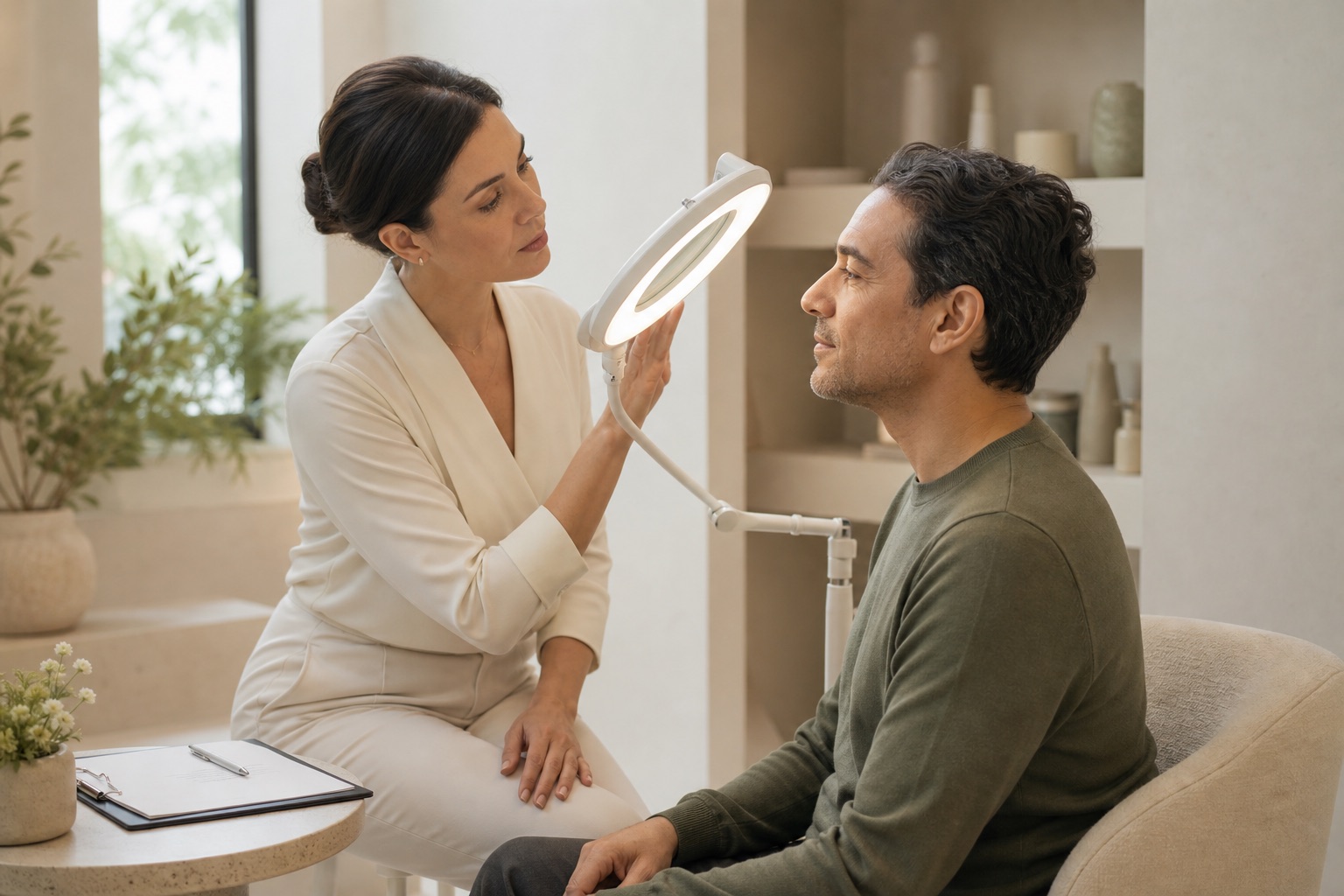
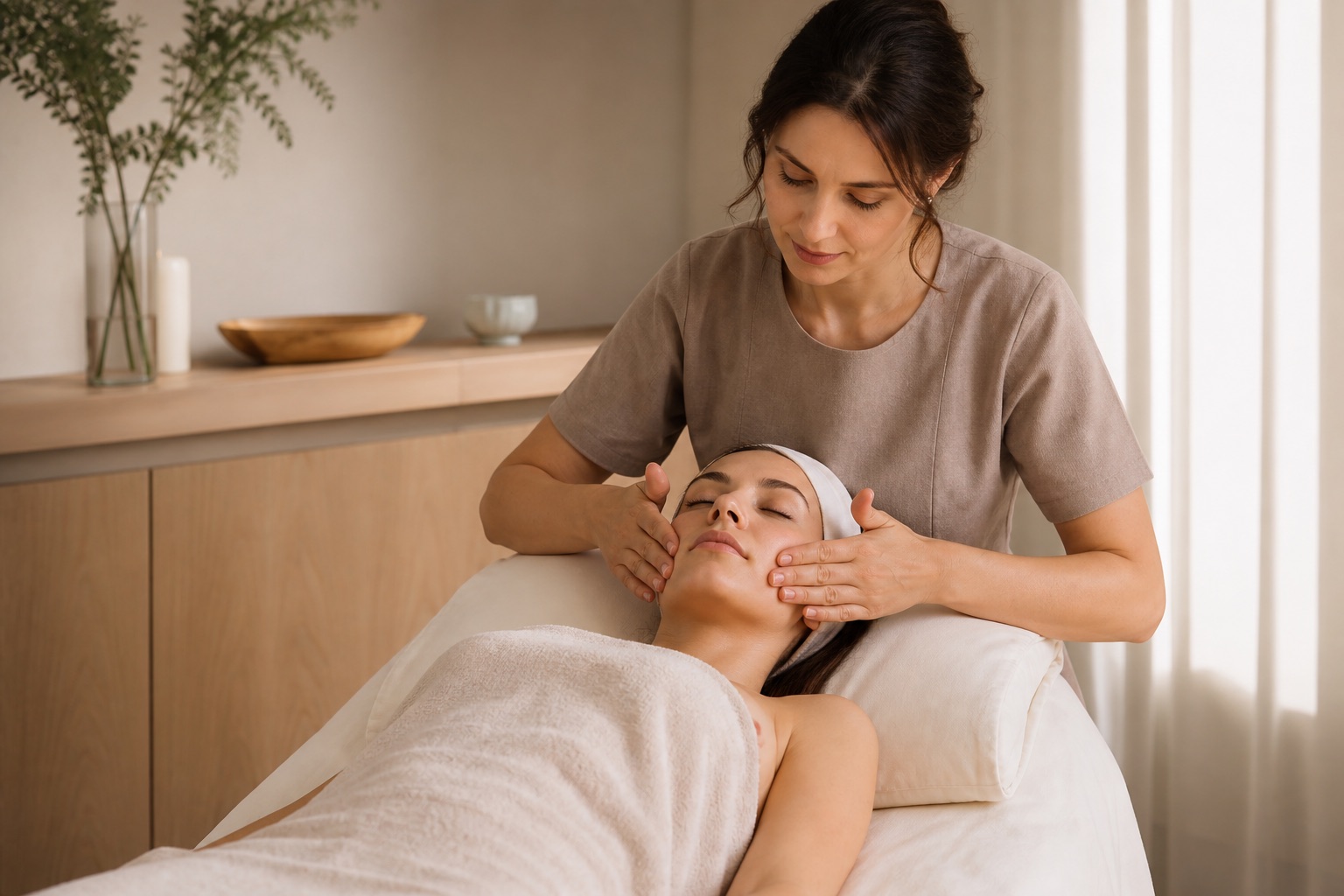
Cosmetic facial massage is a controlled surface treatment, not a contest to lift, drain or reshape tissue. A professional session begins with a brief consultation, excludes incompatible signs, defines comfort and pressure, uses enough slip to prevent dragging, keeps every transition readable and stops as soon as the client’s comfort or the skin’s response changes. The skill is as visible in restraint as it is in hand movement.
Quick answer: check scope, consent, recent procedures, products and stop signals; position client and practitioner securely; clean hands and prepare single-use or controlled materials; begin with broad light contact; adjust pressure, speed and amplitude by zone; avoid the eyeball, injured skin and uncertain conditions; finish by removing excess product, observing the response and recording what was done.
This guide owns the manual cosmetic facial-massage intent. The cosmetological skin-analysis guide owns observation; the skincare consultation guide owns routine planning and follow-up; and the client-record guide owns documentation and data governance. Here the focus is safe, repeatable manual execution.
This educational guide by Clara Salis requires independent dermatological and professional review and has not been medically reviewed. It does not teach therapeutic massage, manual lymphatic drainage, rehabilitation, temporomandibular treatment or disease management. Qualifications, protected titles, permitted touch, insurance, premises and hygiene rules differ by country and region. Verify local requirements before offering any paid hands-on service.
What cosmetic facial massage can realistically do
Cosmetic facial massage uses hand contact and surface movement on the face and, when agreed, adjacent areas for aesthetic and non-therapeutic wellbeing purposes. It can create temporary warmth, comfort, softness and relaxation and help distribute an appropriate cosmetic. Those immediate changes do not prove detoxification, permanent lifting, fat removal, muscle correction or anatomical remodelling.
Claims must match evidence, technique and professional scope. Small studies on rollers, self-massage or short-term blood-flow measurements do not establish that every manual protocol reverses wrinkles or changes facial structure. Describe the experience and observable short-term response precisely. A client can value a calm, comfortable treatment without being promised biological transformation.
Professional scope: cosmetic touch is not therapy
A cosmetic protocol remains superficial, non-diagnostic and non-therapeutic. It does not treat pain, oedema, scar restriction, nerve problems, jaw dysfunction, headache or lymphatic disease. Even when a movement resembles a technique used in healthcare, changing its name does not grant the practitioner a regulated scope or establish a therapeutic outcome.
Before practising commercially, check the rules in the client’s and practitioner’s jurisdiction: qualification, establishment licence, permitted modalities, supervision, insurance, infection control and advertising. A private certificate or online course can document education but is not automatically a professional licence. When scope is uncertain, seek competent local advice before touching clients.
Begin with objective, consent, record and a zone map
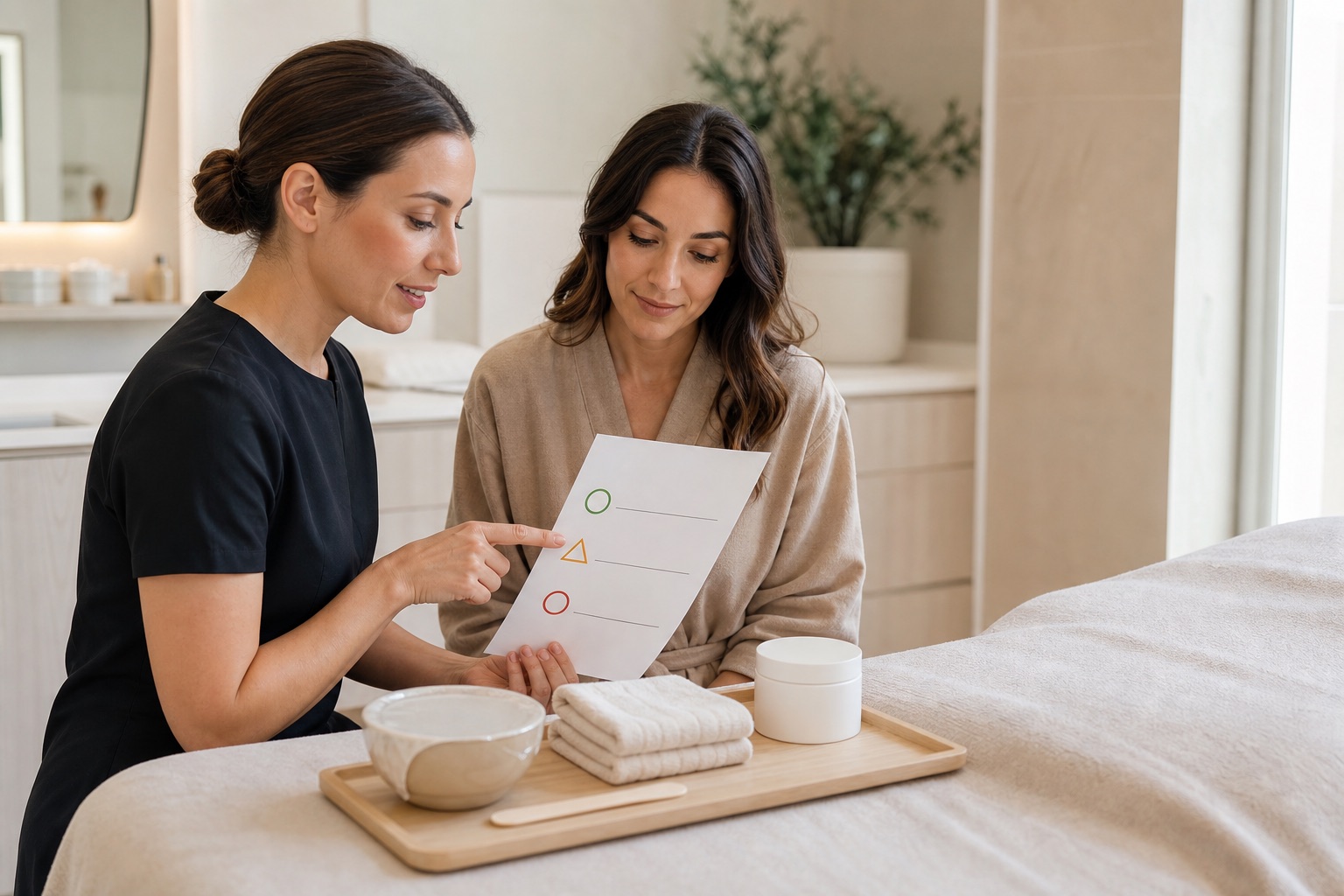
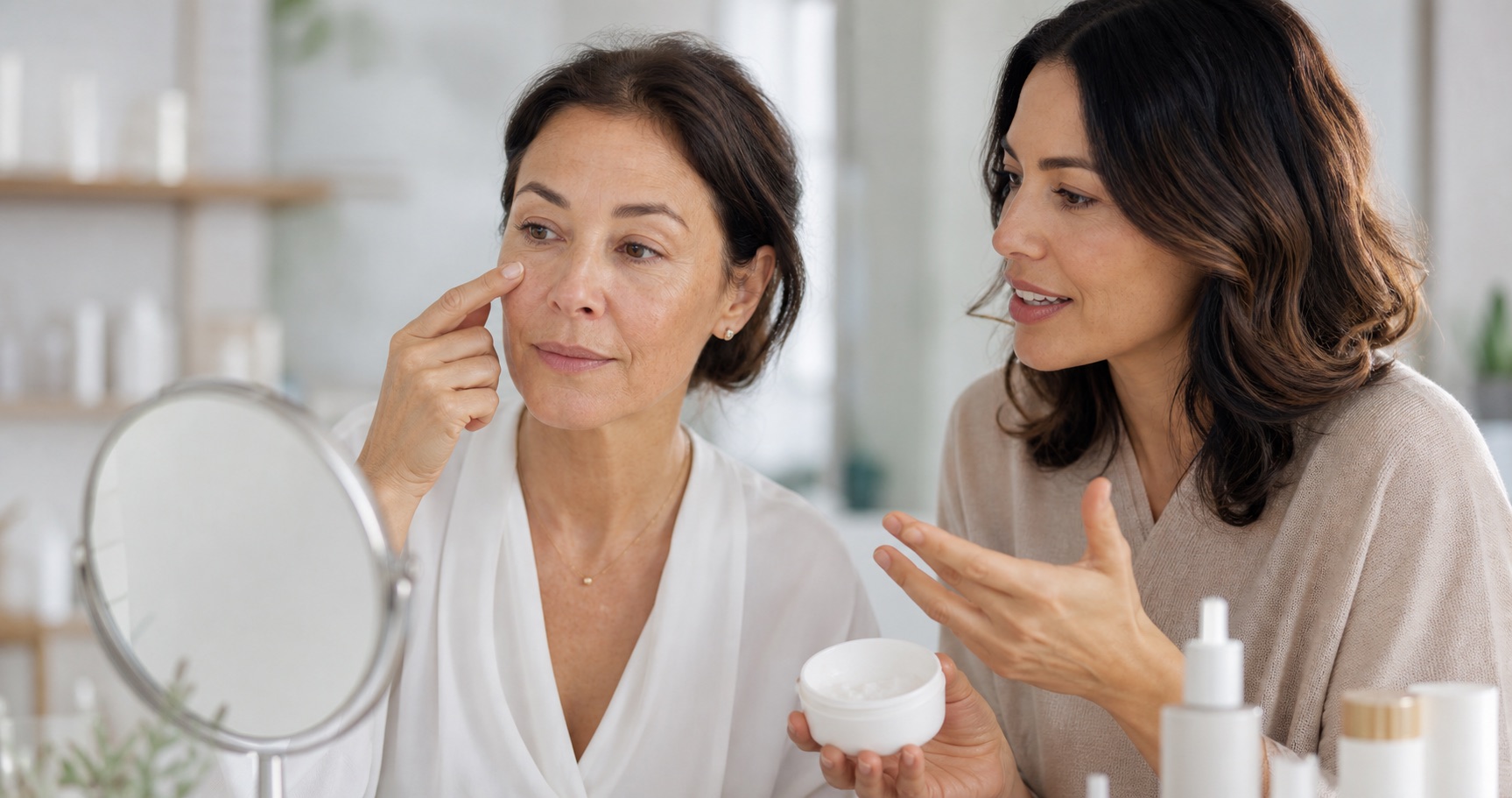
Ask what the client wants from the session and reformulate it within cosmetic limits: comfort, relaxation, gentle product application or a calm treatment experience. Explain areas, approximate duration, product, position, pressure and the right to pause. Consent is continuous; agreement at reception does not remove the need to check comfort around the eyes, neck or another sensitive area.
Use the skincare client record to document relevant products, reported reactions, recent procedures, excluded zones, stop criteria and the product used. Mark areas to avoid rather than relying on memory. Never request a complete medical history by habit; collect only what the defined service and applicable rules justify.
Use a safety traffic light: proceed, adapt or stop
Proceed when the skin is intact, the objective is cosmetic, preparation is clear and the client is comfortable. Adapt by reducing duration, pressure, zones, temperature or product when there is a known tolerance issue that remains within scope. Stop or postpone for active injury, significant irritation, possible infection, unexplained swelling, painful lesions, eye symptoms, an incompatible recent procedure or uncertainty outside competence.
The traffic light is reassessed throughout the session. A green start can become amber when friction rises and red when burning or swelling appears. Do not complete the sequence for symmetry or because time was booked. Product removal, appropriate first response, documentation and referral matter more than finishing every movement.
Prepare hands, nails, textiles, containers and the workstation
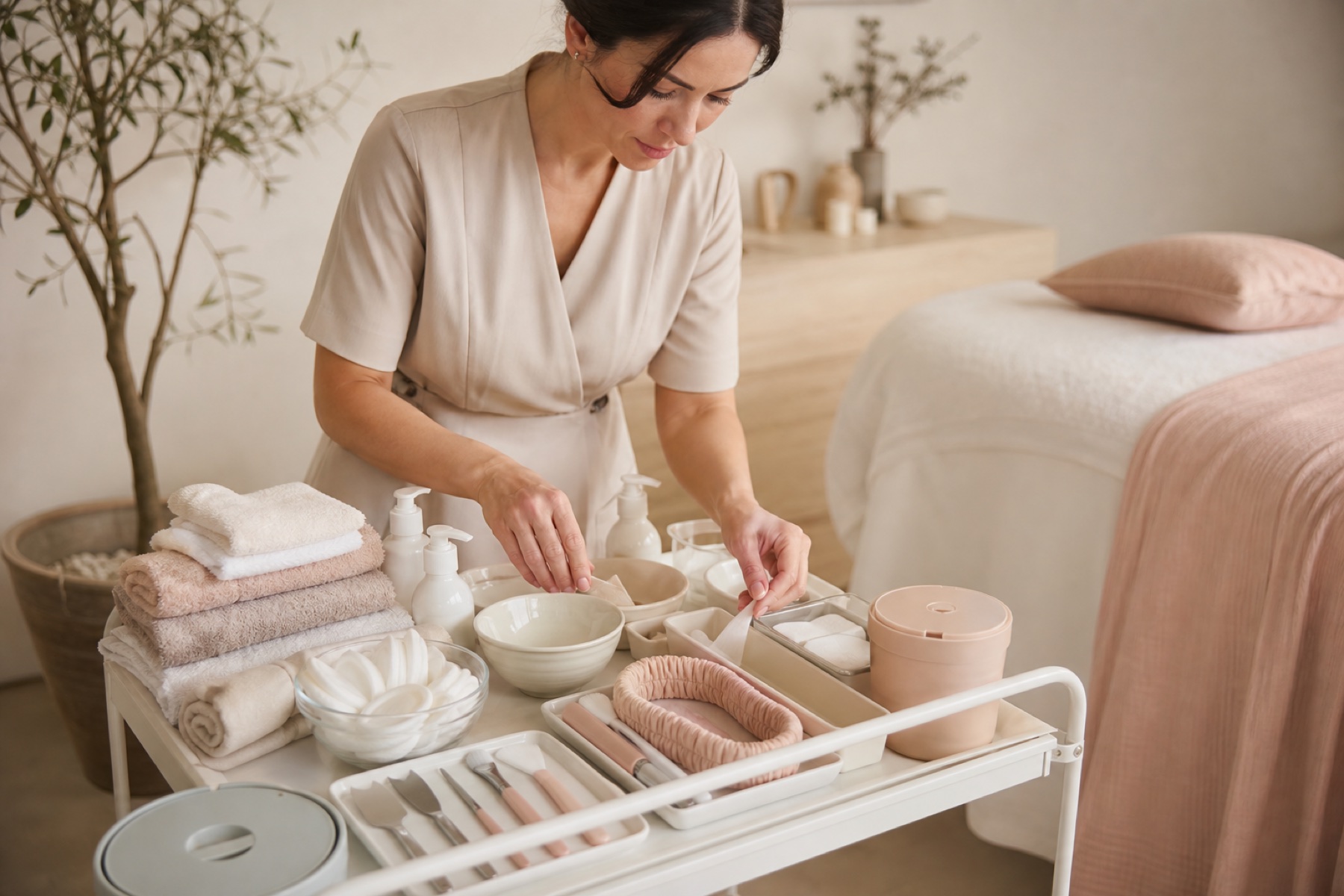
Perform hand hygiene at the correct moments, keep nails short and smooth, remove jewellery that can scratch, cover cuts and avoid working when hand conditions compromise hygiene. Prepare clean textiles and enough single-use material before contact. Hair restraints, headbands and supports must be clean for each client and stored so used items never cross the clean area.
Dispense product without contaminating the container. Use pumps, clean spatulas or a controlled portion rather than returning used product or repeatedly touching a jar. Clean and disinfect reusable surfaces and tools according to material, product label, contact time and local rules. The treatment must have a validated hygiene workflow before use; a visually tidy trolley is not evidence of decontamination.
Position client and practitioner for stability
Support the head and neck without forcing extension. Check breathing, temperature, hair traction, clothing, jewellery and access to the call bell or verbal stop. Clients who cannot lie flat, are pregnant, have reflux, dizziness, respiratory difficulty or mobility needs may require a more upright position, shorter session or postponement based on appropriate advice.
Set bed height so shoulders remain relaxed, wrists neutral and weight transfer comes from the body rather than repeated finger force. Keep products within reach and do not twist over the client. Stable ergonomics improves pressure control and reduces sudden hand movement near the eyes. Practitioner discomfort is an early signal to reposition, not something to push through.
Choose a slip product for controlled friction, not an active-ingredient showcase
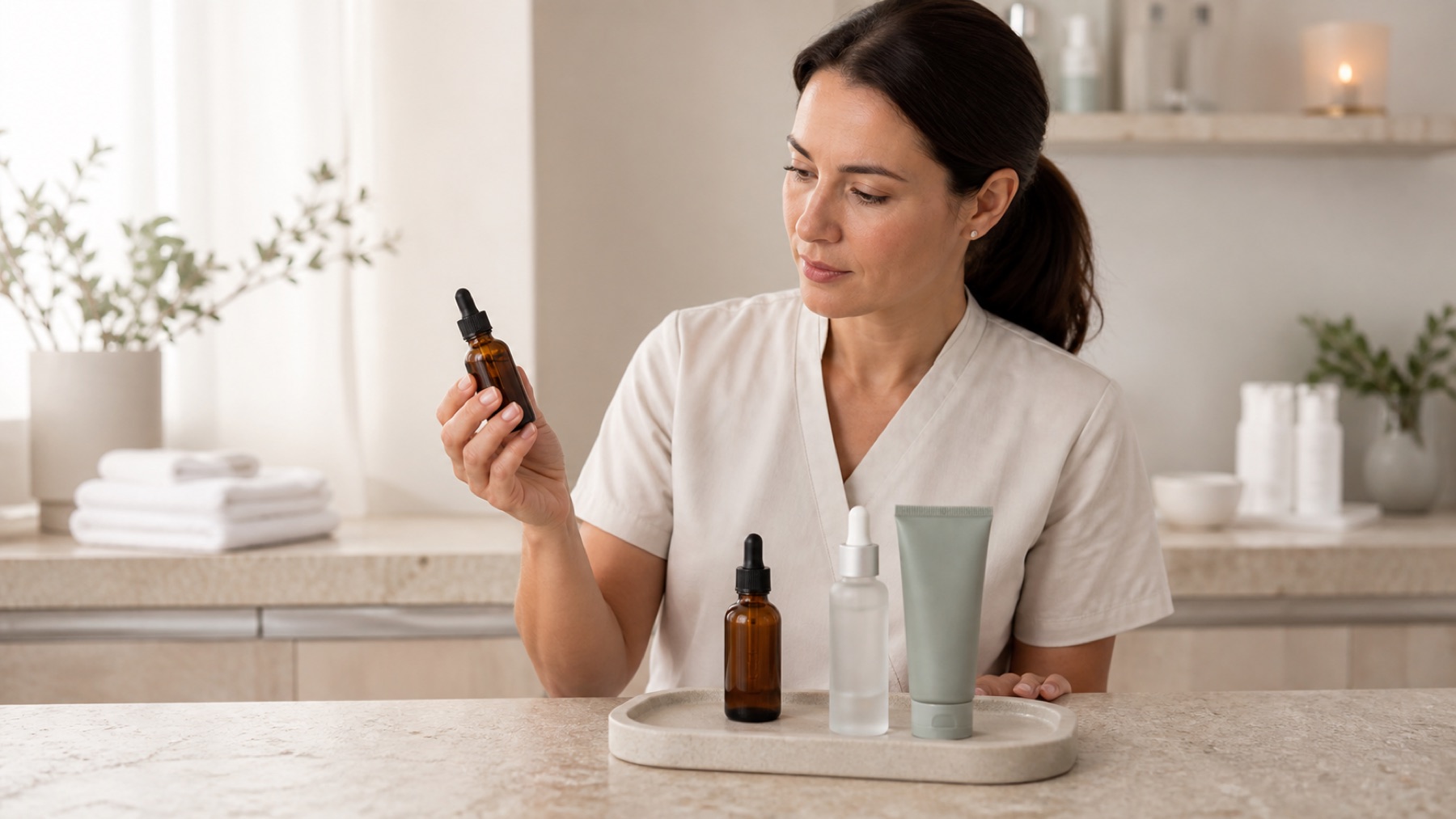
The product must provide enough glide for the selected technique while remaining compatible with the client, treatment duration and removal plan. Too little creates drag; too much removes tactile control and can migrate into eyes or hair. Start with a measured amount and add through a clean method. Do not use fragrance, essential oils or high-active formulas merely to make the service feel premium.
Verify exact product, variant, label, expiry or period after opening, packaging integrity and relevant reported history. The guides to skin hydration ingredients and sensitive versus sensitised skin help with formula reasoning but do not replace product instructions or individual assessment.
Control four variables: pressure, speed, amplitude and rhythm
Pressure should be light enough to preserve comfort and tissue control. Speed affects stimulation, heat and the client’s ability to anticipate contact. Amplitude determines how much surface is moved in one pass. Rhythm makes the sequence predictable. Change one variable at a time so feedback has meaning; increasing all four to create intensity makes the response harder to interpret.
Watch hand colour, blanching, rebound, product absorption, drag and client expression, but ask rather than guessing comfort. Use a simple agreed scale and invite immediate correction. Pressure must never be justified by the phrase no pain, no gain. Pain, sharp pulling, numbness or increasing burn are stop signals, not evidence that tissue is releasing.
Core techniques: broad contact, glide, static pressure and superficial kneading
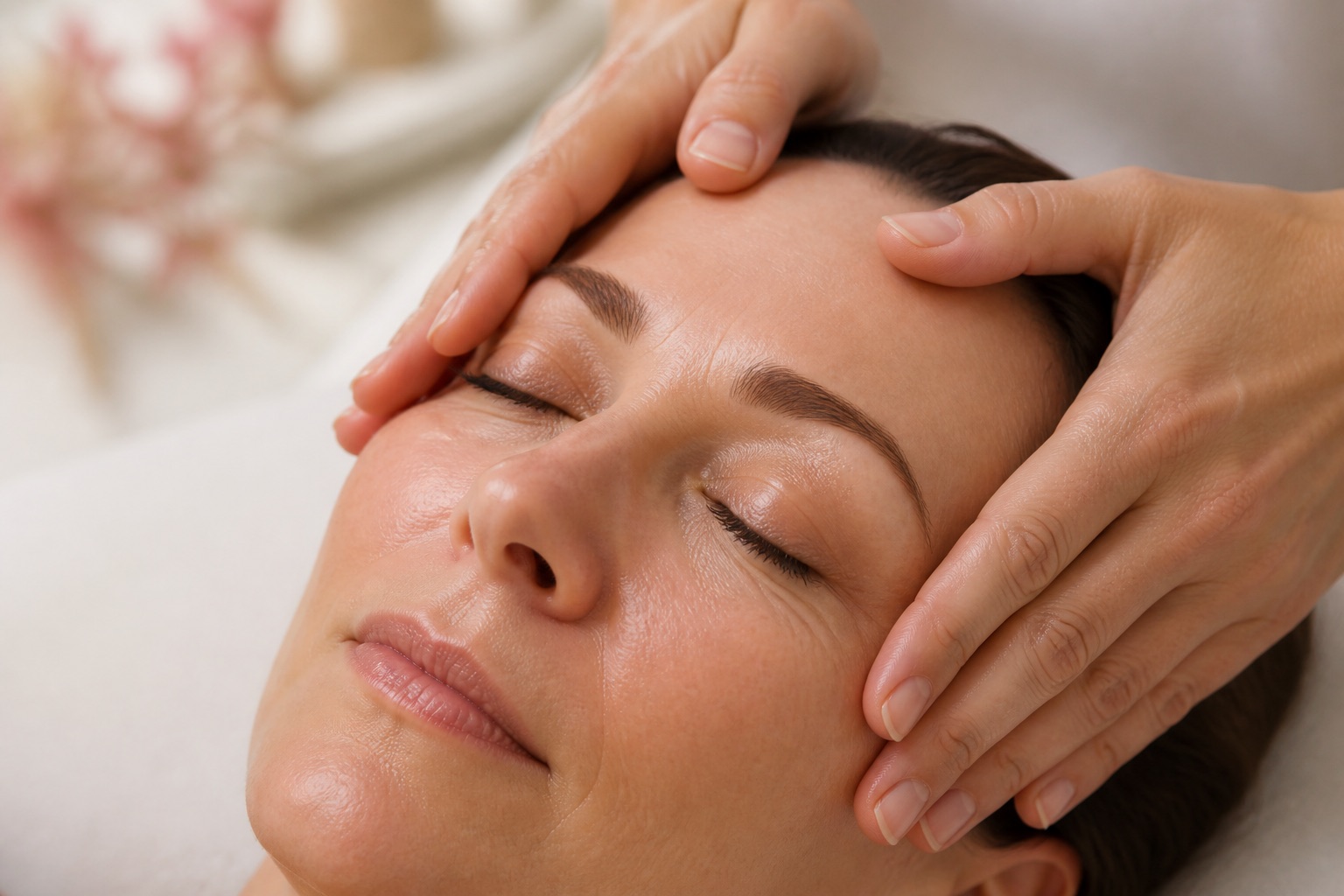
Broad contact introduces touch and tests comfort. Glide moves over a sufficiently lubricated surface with a relaxed hand. Static pressure pauses without sliding and must avoid vulnerable structures. Superficial kneading gently gathers mobile tissue only where appropriate; it is not deep pinching. Each technique has an entry, stable phase and release rather than an abrupt grab.
Practise on models under qualified supervision and observe from front, side and client perspective. A movement that looks fluid may feel sharp because fingertips lead, product has disappeared or one hand loses contact. Video can support posture review but cannot show comfort or tissue response. Competence requires feedback, correction and repeatable control.
A seven-stage professional sequence
Confirm scope, excluded zones, product and the client’s stop signal.
Settle the head and shoulders, then establish broad light contact.
Distribute the measured slip product without rubbing it in aggressively.
Work through agreed facial zones with consistent pressure and transitions.
Integrate zones with broad movements rather than sudden direction changes.
Reduce speed and pressure, finish contact and support the client upright.
Remove excess product as planned, observe, give aftercare and document.
This is a framework, not a universal recipe. The client’s objective, skin response, product, permitted scope and training determine the actual movements and time. A shorter coherent sequence is safer than copying a long choreography that the practitioner cannot control.
Forehead and temples: broad support with lower intensity at the sides
Use a broad hand or finger pads with enough product to avoid folding dry skin. Work from a stable central position towards the sides without pulling the brows or hairline. Pressure typically decreases over the temples. Avoid strong circular friction, superficial vessels, tender points and any area the client reports as painful.
Do not claim that forehead strokes erase expression lines or treat headache. Temporary relaxation and product distribution are proportionate outcomes. If pain, visual symptoms, recent trauma or a new neurological concern is reported, stop and direct the client to appropriate care.
Cheeks and cheekbones: glide without squeezing or aggressive pinching
Maintain broad contact and follow the available surface rather than pushing tissue towards an imagined lifting point. Pressure over bone, inflamed areas and thin tissue needs reduction. Superficial kneading may be used only where trained, permitted and comfortable, without trapping the inside of the cheek against teeth.
Avoid active inflamed lesions, bruises, uncertain lumps and recent injections. Repeated hard pinching can produce redness without meaningful benefit. The correct visual target is smooth hand travel and a calm skin response, not maximum movement of the cheek.
Perioral area and jaw: precision without rehabilitation claims
Reduce amplitude around the mouth and avoid stretching lips, active cold sores, broken skin or painful dental areas. On the jaw, surface contact may be relaxing when the area is comfortable, but it does not realign the mandible, release the temporomandibular joint or treat bruxism. Those are not cosmetic claims.
Clicking without pain still does not justify deeper work. Pain, locking, recent dental surgery, trauma or restricted opening requires appropriate dental, medical or physiotherapy assessment. The practitioner should document the excluded area, not attempt a corrective technique learned from social media.
Eye area: minimal contact and no pressure on the eyeball
Use very light, controlled contact on the orbital bone only when the area is intact and the client agrees. Keep product out of the eye and do not press, tap rapidly or stretch the eyelids. Contact lenses, recent eye surgery, active irritation, swelling, infection concern or visual symptoms require adaptation or exclusion and appropriate advice.
Massage does not remove structural eye bags or treat dark circles. A temporary change after cooling, position or light contact is not proof of lymphatic treatment. The eye-area skincare guide separates dryness, transient puffiness, structural bags and colour-related shadows.
Neck and décolletage: optional areas with tighter boundaries
Include the neck or upper chest only when the service description, consent, draping, product and practitioner’s local scope cover them. Avoid pressure over the front of the neck, thyroid area, carotid region, enlarged nodes, painful structures, wounds, devices and unexplained swelling. Comfort and privacy must be checked before changing draping.
Do not present downward or upward strokes as therapeutic drainage. Broad superficial contact can be part of a cosmetic sequence, but manual lymphatic drainage has specific indications, contraindications and training in healthcare or regulated practice depending on jurisdiction. Refer rather than borrowing the name.
Adapt for sensitive, dehydrated-feeling or mature skin
For a client reporting sensitivity, reduce variables: short duration, familiar bland product, lower friction, slower transitions, fewer repetitions and frequent feedback. For dehydrated-feeling skin, avoid mistaking more oil for water content; choose comfortable slip and remove it gently. The dry versus dehydrated skin guide explains the distinction.
Mature skin is not automatically fragile or contraindicated. Assess the individual, recent procedures, medicines reported as relevant, bruising tendency, dryness and comfort. Use stable support and controlled glide without promising to reverse ageing. The mature-skin routine guide owns product planning.
Acne, rosacea, dermatitis and lesions: touch is not neutral
Do not massage across painful inflammatory lesions, crusting, weeping, active rash, possible infection or broken skin. Friction, occlusion, pressure and a new product can worsen discomfort or confuse the picture. A cosmetic practitioner does not diagnose acne, rosacea or dermatitis. Describe, stop, avoid the area and recommend appropriate assessment.
The acne-prone skincare guide and sensitive versus sensitised guide define cosmetic support and referral limits. A new, changing, bleeding or non-healing lesion is not worked around casually; it needs appropriate medical review.
Recent fillers, toxin, laser, peel, microneedling or surgery
There is no universal waiting period that a beauty practitioner should invent. Procedure type, depth, product, area, healing and provider instructions differ. Ask what was performed and when, then follow written aftercare or obtain clearance from the treating professional. Do not massage to move, settle or dissolve an injectable product.
Postpone when skin integrity, swelling, tenderness, bruising or aftercare is uncertain. Avoid using a recent procedure as a marketing opportunity for a recovery massage. The correct service may be no touch until the provider confirms that normal cosmetic care can resume.
Rollers and gua sha are not interchangeable with manual massage
A tool changes contact area, leverage, pressure feedback, hygiene and breakage risk. It needs a separate material check, cleaning process, storage and technique. Smooth appearance does not guarantee a non-porous or intact surface. Chipped tools, uncertain material or products that cannot be cleaned appropriately should not be used between clients.
Small studies of rollers and gua sha report selected short-term or preliminary outcomes, but they do not justify claims of permanent lifting, detoxification or disease treatment. Do not scrape until petechiae appear or apply pressure over the eye, thyroid, inflamed skin or recent procedures. Tool use belongs within verified training and local scope.
Pregnancy, medicines and systemic conditions require individual decisions
Pregnancy is not a universal ban or universal clearance. Position, nausea, reflux, temperature, comfort, product exposure and individual medical advice matter. Avoid unsupported claims that facial massage detoxifies pregnancy swelling. When the client has a high-risk condition, unexplained swelling or specific restrictions, seek appropriate healthcare guidance before an optional service.
Medicines or systemic conditions may affect bruising, sensitivity, healing or safe positioning, but a beauty practitioner should not interpret an exhaustive health history or change treatment. Ask only relevant functional questions through a lawful process, record the limit and refer uncertainty to the prescriber or treating professional.
Duration and frequency: design a controlled dose, not a marathon
There is no evidence-based universal number of minutes for every face. Duration depends on objective, preparation, zones, product, tolerance, training and the rest of the service. Ten controlled minutes can be more appropriate than thirty repetitive minutes. State the planned duration but allow the session to shorten when friction, heat or discomfort increases.
Frequency should reflect response, not a sales target. Record duration and outcome so the next session can be adapted. Daily self-massage is not automatically beneficial; repeated friction or pressure may irritate some skin. Clients should stop when the skin becomes sore, persistently red, itchy or swollen and seek advice for significant symptoms.
Finish with removal, observation, aftercare and documentation
Reduce rhythm and pressure before lifting the hands. Remove excess product according to its instructions without adding an aggressive second cleanse. Help the client sit up gradually and check comfort. Observe colour, swelling, residue and any reported sensation in the same neutral language used before treatment.
Give concise aftercare: what remains on the skin, whether and when to cleanse, which familiar routine to resume, and which signs require contact or care. Avoid layering unnecessary actives immediately. Record product, batch if relevant, duration, zones, adaptations, response and advice in the client record.
Common mistakes in cosmetic facial massage
Starting the choreography without a current consultation or zone check.
Using too little slip and treating redness from friction as a good result.
Applying the same pressure, speed and repetitions to every zone and client.
Pressing the eyeball, front of the neck, inflamed lesions or recent procedure sites.
Using a new fragranced or highly active product to increase perceived value.
Calling a cosmetic sequence lymphatic drainage, rehabilitation or jaw treatment.
Completing the full sequence after the client reports burning, pain or dizziness.
Reusing contaminated product, textiles or tools between clients.
Promising permanent lifting, wrinkle removal, detoxification or disease treatment.
Failing to record product, excluded areas, adaptations and the skin response.
A twenty-minute teaching framework to adapt, not copy blindly
A training framework might allocate three minutes to consultation and positioning, two to product distribution and broad contact, ten to controlled zone work, three to integration and closure, and two to observation and documentation. These are teaching proportions, not a promised dose. Preparation and aftercare may sit outside the hands-on time depending on the service.
The learner should be assessed on hygiene, client communication, posture, pressure consistency, product control, hand transitions, anatomical avoidance, recognition of stop signals and accurate documentation. Memorising movement order is not enough. Explore online skincare courses for programme detail, then verify practical supervision and local professional requirements.
Frequently asked questions about cosmetic facial massage
What does cosmetic facial massage actually do?
It can provide relaxation, comfortable touch, temporary warmth or softness and controlled cosmetic distribution. It does not prove detoxification, permanent lifting, fat loss or treatment of disease.
How long should a facial massage last?
There is no universal duration. It depends on objective, zones, product, tolerance and the wider service. Quality is controlled pressure and response, not the longest possible sequence.
Which direction should facial massage movements follow?
Direction should fit anatomy, surface mobility, product slip, training and comfort. Always moving upward is not a scientific rule and does not create permanent lifting. Avoid pulling delicate tissue.
How much pressure should be used?
Begin light and adjust by zone and feedback. Pressure must remain controlled and painless. Eye area, temples, inflamed skin, recent procedures and superficial structures require particular restraint or exclusion.
Which products are suitable for facial massage?
Use an intact, identifiable cosmetic that provides controlled slip and is appropriate for the client and technique. Avoid adding fragrance or powerful actives for spectacle. Follow label and hygiene instructions.
Can facial massage remove wrinkles?
It may create temporary softness or a rested appearance, but evidence does not support promising permanent wrinkle removal from a cosmetic massage. Ageing changes have multiple structural and biological causes.
Does it drain the face or remove eye bags?
Position, cooling and light contact may temporarily change perceived puffiness, but cosmetic massage is not therapeutic lymphatic drainage and cannot remove structural bags. Persistent or one-sided swelling needs assessment.
Can facial massage be performed on acne-prone skin?
Do not massage painful inflamed lesions, broken skin or possible infection. Acne diagnosis and treatment belong to healthcare professionals. An unaffected area may sometimes receive adapted cosmetic contact within scope.
What about rosacea or visible capillaries?
Do not diagnose. Heat, friction, pressure and fragranced products may worsen comfort for some people. Active burning, significant redness or uncertainty calls for postponement and appropriate medical guidance.
When is facial massage contraindicated?
Avoid or postpone for broken or infected skin, acute reaction, painful inflammation, unexplained swelling, eye symptoms, incompatible recent procedures or any concern outside competence. Product and local professional rules add specific limits.
Can massage be performed after botulinum toxin or filler?
Do not invent a universal interval. Follow the treating professional’s aftercare and clearance for the specific procedure, product, area and healing. Never massage to move, settle or dissolve an injectable.
How long after a peel, laser or microneedling should I wait?
The procedure provider should decide because depth, device, area and healing vary. Postpone while integrity, tenderness, swelling or instructions are uncertain. A fixed social-media timetable is not adequate clearance.
Is facial massage suitable during pregnancy?
It requires an individual decision about position, comfort, product and medical advice. Pregnancy is neither automatic prohibition nor automatic clearance. High-risk circumstances or unexplained swelling require appropriate guidance.
Can sensitive skin be massaged?
Sometimes with a familiar simple product, shorter time, lower friction and frequent feedback. Active burning, rash, significant irritation or uncertain causes require stopping rather than attempting to calm the skin through massage.
Can gua sha be included?
Only with appropriate training, intact cleanable tools, suitable product, restrained pressure and the same stop criteria. It is a separate tool technique and should not be used to scrape or create bruising.
Does a facial roller improve circulation?
A small study found short-term changes in measured skin blood flow after roller use, but that does not prove broad clinical benefits or permanent change. Do not convert a preliminary finding into a treatment claim.
Can I self-massage every day?
Daily use is not automatically better. Keep pressure light, tools clean and product compatible, and stop for soreness, persistent redness, itching or swelling. Repeated friction can irritate some skin.
What should happen if the skin starts burning?
Stop immediately, remove the product according to its instructions without further rubbing, assess the response and seek appropriate care when significant or persistent. Record exact product, timing, area and action without diagnosing.
Is strong redness a sign that the massage worked?
No. Mild transient warmth may occur, but intense, irregular, burning, itchy or persistent redness is not the goal. Review pressure, friction, temperature and product and stop when the response is concerning.
Can facial massage treat jaw pain?
Not as a cosmetic service. Pain, locking, trauma, restricted opening or painful clicking needs suitable dental, medical or physiotherapy assessment. Cosmetic touch does not diagnose or rehabilitate the jaw.
Do I need a qualification to offer paid facial massage?
Requirements vary by country, region and service. Verify protected titles, permitted touch, premises, insurance, hygiene and advertising locally. A private course certificate is not automatically a licence to practise.
Professional, hygiene and scientific sources
EUR-Lex: current consolidated EU Cosmetics Regulation for cosmetic purpose and product safety. Read Regulation (EC) No 1223/2009
World Health Organization: hand-hygiene principles and technique. Read the WHO brochure
Miyaji et al.: pilot study of short-term facial-roller effects on skin blood flow and vascular reactivity. Read the PubMed record
Ahn et al.: small randomised trial of roller and gua sha use over eight weeks. Read the PubMed record
Kim et al.: preliminary study of morphological changes after self-massage. Read the PubMed record
Khanna and Datta Gupta: report of adverse reactions following beauty treatment with facial massage. Read the PubMed record
Ernst: systematic review of massage safety and reported adverse events. Read the PubMed record
American Academy of Dermatology: testing cosmetics on a small area and responding to reactions. Read the AAD guidance
Browse the English skincare guide hub for analysis, consultation, routines, ingredients and professional limits. Manual skill is visible through control: each movement has a reason, every zone can be excluded, each claim remains proportionate and every session can stop before comfort becomes risk.
For a verifiable clean-to-used workflow covering hands, textiles, tools, surfaces, cosmetic dispensing and turnover, read the skincare workstation-hygiene guide before designing or auditing a hands-on service.
If you are turning this topic into a structured learning plan, use the online skincare-course selection checklist to compare curriculum, teacher, demonstrations, practice, feedback, access, total cost and certificate wording without confusing private training with professional authorisation.
If you want to turn this knowledge into a defined service, continue with the guide to becoming a skincare consultant: it connects training, demonstrable skills, portfolio, boundaries, work models and a controlled launch without confusing cosmetic consultation, beauty treatment and healthcare.
Turn the protocol into a proportionate inventory with the professional skincare and facial-massage kit guide: it sizes furniture, textiles, tools, consumables, cosmetics, stock and optional equipment to the real service instead of building an unnecessarily complex trolley.