The eye area is not one problem, and one cream cannot correct everything that makes it look darker, lined or puffy. Surface dryness, irritation, temporary fluid accumulation, structural under-eye bags, pigment, visible vessels and anatomical shadow can overlap. They do not have the same cause, endpoint or professional pathway. The most useful first step is therefore not choosing the most famous ingredient. It is describing what changes, when it changes and whether the symptom affects skin alone or the eye itself.
Quick answer: gentle removal when needed, a tolerated moisturiser, eye-area-compatible sun protection and one optional treatment are a sufficient cosmetic base. Cosmetics may improve comfort, flaking, temporary surface smoothness and some mild colour components. They cannot remove orbital fat, fill a tear trough, treat allergy or infection, correct the ocular surface or turn an anatomical shadow into even skin.
This guide owns the eye-area routine and cosmetic-limits intent. The mature-skin routine covers the whole face; the sensitive-versus-sensitised guide owns general reactivity and tolerance; the facial dark-spots guide owns pigment assessment across the face. Colour correction with makeup is a separate intent and is not duplicated here.
This is educational cosmetic content by Clara Salis. It requires independent dermatological and ophthalmological review and has not been medically reviewed. It cannot diagnose dermatitis, allergy, infection, oedema, thyroid or kidney disease, or an eye disorder. Eye pain, light sensitivity, discharge, a visual change, breathing difficulty or sudden marked swelling needs healthcare assessment rather than another cosmetic.
Why the eye area needs a separate assessment
Eyelid skin is thin, mobile and close to the lash line, mucosa and ocular surface. Blinking, tearing, rubbing, contact lenses, makeup and migrating products alter both tolerance and wear. A formula that feels comfortable on the cheek may sting when it moves towards the eye. A product labelled for the eye area can still irritate or cause an individual allergic reaction.
‘Eye area’ also describes several zones: the upper orbital area, mobile lid, inner corner, lower lid, tear trough and upper cheek. Do not spread the same formula to the lashes by default. Follow the labelled application area and remember that warmth and movement can carry a fluid or oily product closer to the eye after application.
First separate skin symptoms from eye symptoms
Skin symptoms
Tightness, rough surface, visible flakes, superficial lines, local colour and mild cosmetic stinging can begin in the skin. They still require caution: persistent itching, a recurring eyelid rash or swelling after different products may need medical assessment and formal allergy investigation. Hands, nail products, cleanser, makeup, applicators, metals and hair products can transfer substances to the eyelids.
Eye symptoms
A gritty sensation, ocular burning, pain, light sensitivity, discharge, difficulty opening the eye or blurred vision is not an under-eye skincare objective. Stop the suspected product, follow its accidental-contact instructions and seek appropriate help if symptoms are significant or persist. A cosmetic eye cream is not a sterile ophthalmic treatment and must not be used as eye drops.
Observe four dimensions: surface, colour, volume and pattern
Look in diffuse front light and then side light, without a filter and without stretching the skin. Describe surface — comfort, scale and lines; colour — brown, blue-violet, red or mixed; volume — swelling, hollow or projection; and pattern — symmetry, duration and change through the day. This does not diagnose a cause, but it prevents buying a depigmenting product for a shadow or a rich cream for sudden unilateral swelling.
Compare the same time of day for one week before assigning a pattern. A soft change strongest on waking and variable through the day may have a transient component. A stable projection with a shadow below it may be more structural. Colour that remains similar as the face turns may contain a pigment component; darkness that changes substantially with light direction may be dominated by depth and shadow.
Close-up phone photographs are not diagnostic. Automatic exposure, white balance, HDR, sharpening and front-camera geometry can change colour and contour. For cosmetic documentation, repeat light, distance, expression, camera and time. Record itch, pain and burning in writing because a photograph cannot measure comfort.
Dryness, dehydration and flaking around the eyes
What ordinary cosmetic dryness may look like
Dryness may feel tight or rough and can make fine surface lines and makeup separation more visible. Expression lines and anatomy remain visible on well-hydrated skin, so every crease is not evidence that more cream is required. Start by reducing hot water, long cleansing, rubbing and the number of leave-on products.
When flaking is not a cue to exfoliate
Flaking with redness, itch, swelling or recurrence may accompany irritant or allergic contact dermatitis and should not be scrubbed away. The dry-versus-dehydrated skin guide explains water and lipid observations across the face. Near the eyes, use fewer variables and seek assessment when a rash persists, spreads or repeatedly returns.
Temporary puffiness, structural bags and festoons are not synonyms
A variable morning appearance
Temporary puffiness can vary with sleep position, crying, rubbing, allergies, salt intake and many medical factors. A clean cool compress may offer short-lived comfort for mild puffiness. Do not place ice directly on skin, press the eyeball or use extreme cold. The observation is about pattern, not a claim that lifestyle explains every change.
A stable anatomical projection
Orbital fat prominence, laxity, tear-trough depth, malar oedema and festoons involve different structures and may coexist. A topical product does not remove fat or reposition deep tissue. Painful, hot, sudden, strongly asymmetric or progressive swelling must not be massaged or labelled as ordinary bags.
Dark circles can be pigmentary, vascular, structural or mixed
Pigment is only one possible component
Brown or grey-brown colour may include constitutional pigment, post-inflammatory change or the effect of repeated rubbing. Colour should be assessed across lighting and together with surface symptoms. Persistent flat pigmentation belongs to a competent skin assessment before strong brightening ingredients or procedures, especially where irritation may leave additional post-inflammatory hyperpigmentation.
Visible vessels and thin skin influence colour
Blue, violet or reddish appearance may include visible vascular structures through thin skin, but colour alone cannot establish the cause. Depth, lighting and pigment can modify what the eye or camera records. Calling every blue circle ‘poor circulation’ creates an unsupported diagnosis and often an unrealistic drainage claim.
Hollows and projections create shadow
A tear trough, cheek relationship or bag can cast shadow that changes as the head or light moves. More brightener or more pigment does not fill anatomy. Scientific reviews commonly describe mixed categories because pigment, vessels, surface and structure frequently overlap. This is why before-and-after images need controlled light and a named endpoint.
A simple morning and evening eye-area routine
Morning: support comfort and reduce exposure
Rinse or cleanse only when needed. Apply a small amount of tolerated moisturiser in the labelled zone, allow it to settle, then use a sunscreen that can be worn near the eyes without stinging. Sunglasses with good coverage, a hat and shade reduce exposure and squinting. The complete morning and evening skincare order remains the site-wide routine pillar.
Evening: remove resistant film without dragging
Let a compatible remover soften makeup and sunscreen before wiping or rinsing. Use clean hands or a soft clean support and avoid repeated lateral pulling. A second cleanser is useful only if residue remains and the skin tolerates it; the double-cleansing guide explains how to match removal to film rather than treating two cleansers as compulsory.
Moisturise dry eyelid skin without migration and overload
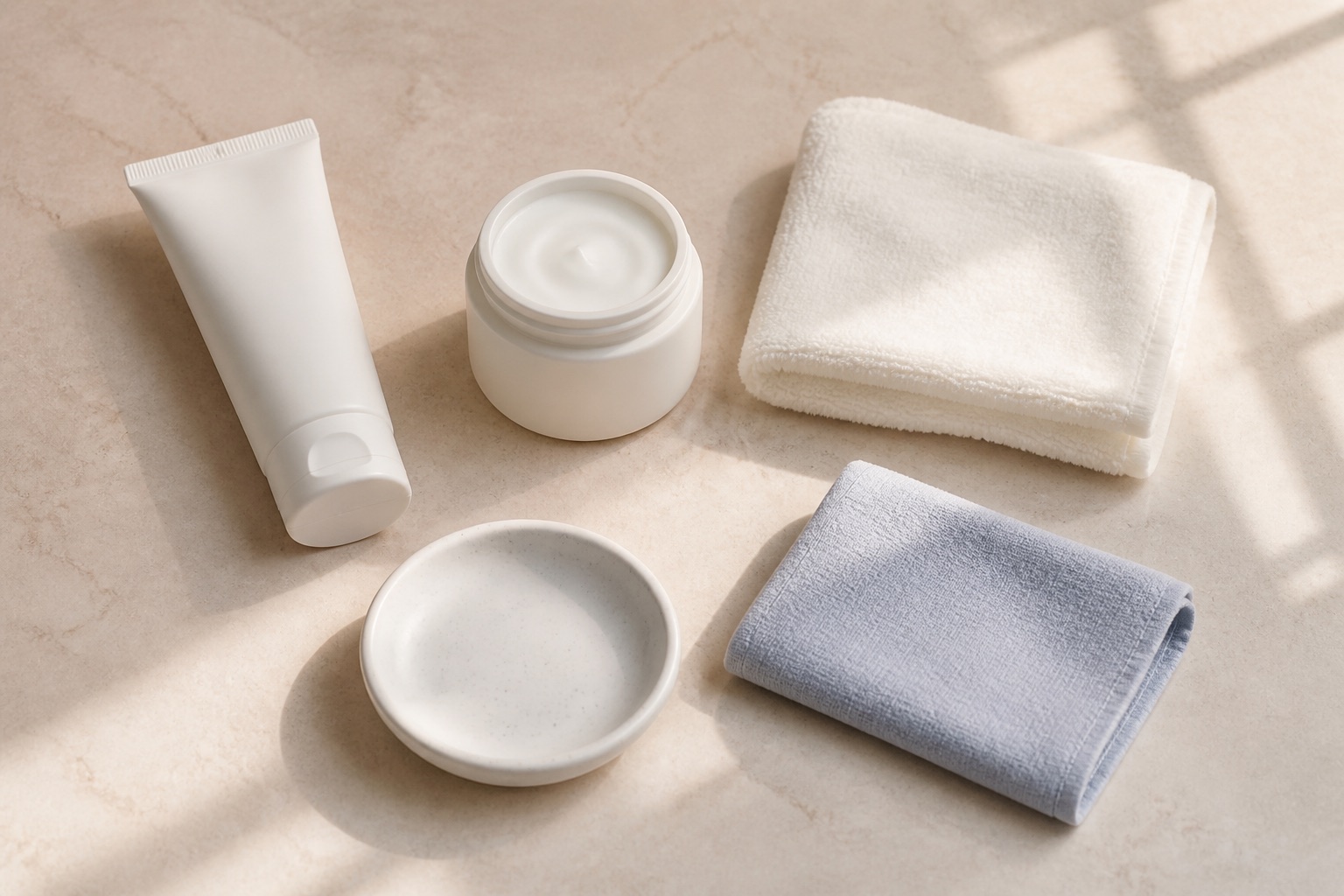
Humectants such as glycerin and hyaluronic acid, emollients and occlusives can improve water retention and surface feel. Results depend on the finished formula. A very fluid product may migrate; a dense film may feel heavy or affect makeup; fragrance and many extracts increase the number of variables without proving greater effectiveness.
A dedicated eye cream is optional. A simple face moisturiser may be enough if the label permits use in that area, it does not sting and it remains where applied. ‘Ophthalmologist tested’, ‘hypoallergenic’ and ‘natural’ do not guarantee individual tolerance. Read the skin hydration guide for the roles of humectants, emollients, occlusives and ceramides.
When the area becomes irritated, stop experiments and return to the shortest previously tolerated routine. Essential oils, fragrance, food remedies, scrubs and cleansing brushes are not recovery tools. The damaged barrier guide provides a general simplification framework, but swollen or repeatedly itchy eyelids need specific assessment.
Caffeine, peptides and de-puffing claims
Caffeine is a cosmetic option, not tissue drainage
Topical caffeine is marketed for vascular-looking darkness and puffiness, but concentration, vehicle, penetration and finished-product studies vary. Small studies often use multi-ingredient formulas and do not robustly compare every dark-circle component. Treat it as one optional product with a measured endpoint, not as a treatment for persistent oedema or structural bags.
Peptides and film formers change the surface, not anatomy
Peptides, antioxidants and film-forming polymers may improve hydration, feel or immediate surface appearance in suitable formulations. ‘Lifting effect’ often describes temporary film tension or hydration, not repositioning of fat or skin. Hydrogel patches and cooling applicators can be pleasant and transiently smoothing; they are formats, not permanent structural treatments.
Retinoids, vitamin C, niacinamide and acids near the eyes
Vitamin C and niacinamide
Suitable vitamin C or niacinamide formulas may support visible evenness and barrier function, but they cannot correct a hollow. Do not move a face serum closer to the eye to intensify results. Form, stability and tolerance are explained in the vitamin C guide and the niacinamide guide. The eye-area label and actual comfort take priority.
Retinol, retinal and prescription retinoids
Retinoids may improve selected photoageing endpoints, but irritation, peeling and migration can worsen comfort and make surface lines more obvious. Use only an intended formula in the intended zone and introduce cautiously. Do not apply on the lash line or mobile lid unless directions explicitly include them. The cosmetic retinoids guide covers precautions and the distinction from medicines.
AHA, BHA, PHA and strong brightening products
Acids, peels and strong depigmenting treatments are not casual experiments near the eye. A face product does not become eye-safe by using less. The AHA, BHA and PHA guide owns exfoliant-family decisions. Persistent periocular pigmentation should be classified before treatment, particularly when irritation may worsen post-inflammatory colour.
Sun protection around the eyes without persistent stinging
Photoprotection supports prevention of photodamage and pigment change, but a formula that repeatedly burns and causes tearing will be used poorly. Choose facial sunscreen whose directions allow suitable proximity, reduce incompatible layers and let films settle. Do not reduce the amount on the entire face to compensate for one migrating product.
The daily face-sunscreen guide covers SPF, UVA, amount, water resistance and reapplication. Around the eyes, combine product with well-fitting sunglasses, a hat and shade. If sunscreen enters the eye, follow the label and rinse as directed; persistent symptoms require advice.
How to apply an eye-area product with less friction
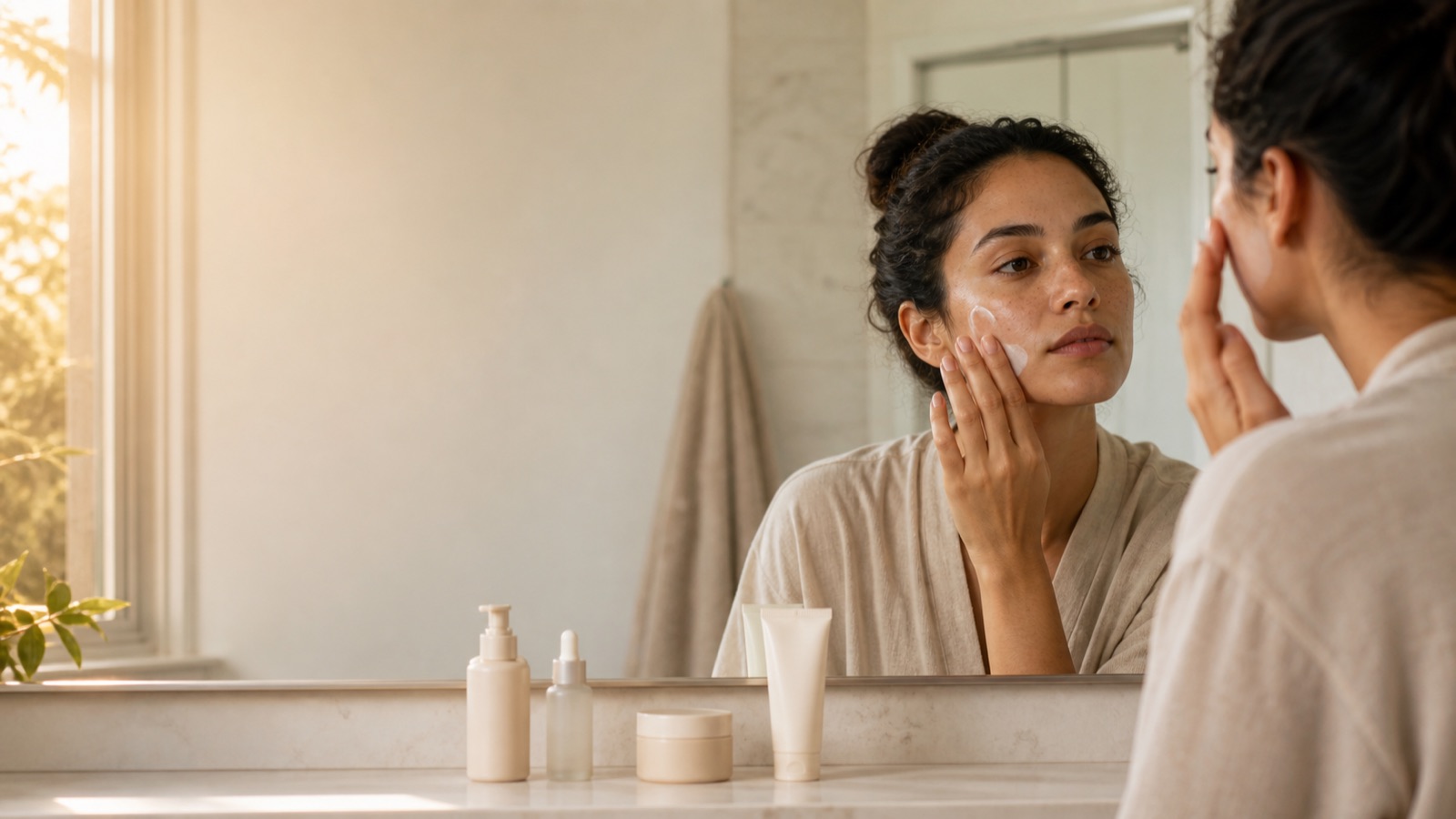
Wash your hands, take the labelled amount and distribute a small quantity along the orbital bone or specified zone. Pat with minimal pressure until the film is even. The ring finger is not compulsory; choose the finger that gives control. Do not stretch laterally, rub until the skin warms or add product merely because it is no longer visible.
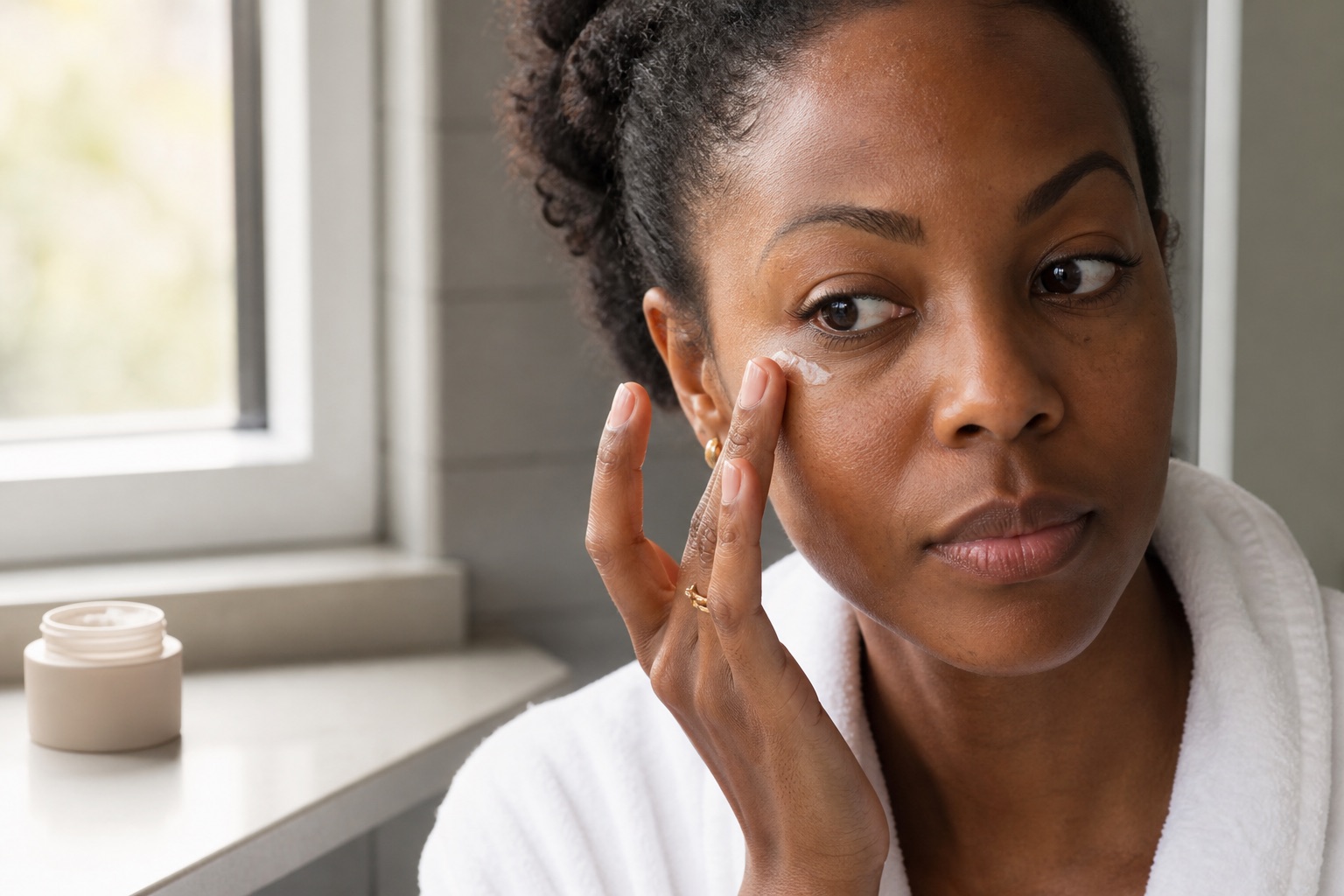
Wait for the formula to settle before sunscreen or makeup. When layers pill, reduce amounts and unnecessary products instead of rubbing. If tearing, burning or blurred vision follows application, stop and remove the product according to its directions. Finishing a package is never more important than eye comfort.
Makeup can reduce colour contrast but cannot treat dark circles
Concealer and colour corrector can alter visible contrast within minutes. They do not change pigment production, vessels, swelling or anatomical depth. Peach, orange, yellow and other correctors are chosen against the local colour, depth of skin tone and product layered above. A hollow does not need more material, and excess product may crease or make dry texture more visible.
Use only products intended for the eye area, keep applicators clean and do not improvise with lip products. Remove makeup gently at the end of wear. The English makeup correction guide will own neutralisation and layering when published; this skincare page deliberately keeps the two intents separate.
Choose and test one eye-area cosmetic at a time
Check area, instructions and packaging
Read whether the product is intended for the eye contour, upper lid or only the orbital area. Check amount, frequency, warnings, period after opening and storage. Pumps and tubes may reduce repeated finger contact; jars are not automatically unsafe when hands and spatulas are clean. Marketing terms do not replace a complete ingredient list and directions.
Introduce on intact skin and record the date
Do not test several new eye products together. Use the new formula in the labelled zone on intact skin, beginning cautiously when appropriate, and keep the rest of the routine stable. Consumer screening does not predict every delayed allergy and is not medical patch testing. Stop for growing burn, rash, swelling, ocular symptoms or any warning specified on the product.
Use the broader skincare actives guide to plan one variable, baseline and stop rule. Do not re-challenge a severe reaction at home. A dermatologist can decide whether diagnostic patch testing or another assessment is appropriate.
Eye-product hygiene and contamination control
Wash hands, keep caps and applicators clean, avoid sharing and do not return used disposable applicators to a container. Discard products used during an eye infection as advised, and remove formulas that have changed in smell, colour or texture. Do not add water or saliva to a dry cosmetic: this can introduce microorganisms and dilute preservative protection.
Follow the manufacturer's period after opening and storage instructions rather than a universal internet deadline. Heat, an open lid and direct contact can affect product condition. Clean spectacles and tools that repeatedly touch the area. Never apply or remove eye makeup in a moving vehicle, where an applicator can injure the eye.
Measure progress using a realistic endpoint
Match the metric to the component
For dryness, record tightness, visible scale and makeup behaviour after two to four weeks. For colour and fine surface lines, use repeatable photographs at a sensible interval, often four weeks or longer. For temporary puffiness, record time, symptoms and duration. Do not attribute the natural difference between a morning and evening photograph to one application.
Know when no meaningful benefit is the result
‘Skin no longer feels tight and concealer separates less’ is a measurable hydration endpoint; ‘no lines’ is not. ‘Mild morning puffiness looks slightly reduced for two hours’ is different from ‘bags removed’. When an expensive or irritating formula provides no benefit consistent with its cosmetic function, discontinuing it is a rational outcome.
What eye-area cosmetics cannot do
Cosmetics cannot diagnose the reason for darkness or swelling, cure allergic dermatitis or infection, treat systemic or ocular disease, remove orbital fat, fill a hollow or correct deep laxity. They cannot replace sleep, prescribed allergy care or a medicine. Terms such as ‘clinical’, ‘medical grade’, ‘detoxifying’ and ‘draining’ do not remove these limits.
Fillers, lasers, medical peels and surgery around the eye are healthcare procedures with their own indications and risks. A competent consultation distinguishes surface, pigment, vessels, structure and expectation before discussing a procedure. Social-media images and the word ‘bag’ are not enough to choose an intervention.
When to see a dermatologist, optometrist or ophthalmologist
Seek prompt or urgent assessment
Seek urgent help for breathing difficulty or a severe allergic reaction. Prompt assessment is also appropriate for sudden or strongly one-sided swelling, pain, heat, marked redness, trauma, fever, discharge, difficulty opening the eye, light sensitivity, visual change or severe headache. Do not massage, disguise or wait for a caffeine product to affect these signs.
Book a non-urgent assessment when a problem persists
Arrange assessment for itch, scale, redness or swelling that persists or returns; a new unexplained change in dark circles; a progressive projection; ocular discomfort; suspected cosmetic allergy; or no improvement after simplifying. Bring product names, ingredient lists, introduction dates and a symptom timeline. A clear chronology is more useful than an unlabelled bag of samples.
A responsible protocol for beauty and skincare professionals
Ask, observe and stay within cosmetic scope
Record the goal, duration, symmetry, variation, symptoms, products, contact-lens use, reported allergies and recent procedures without interpreting medical conditions. Observe skin integrity and stop a service for pain, discharge, marked inflammation or a lesion. A beauty professional does not diagnose, recommend eye drops, prescribe or alter treatment.
Write the recommendation, endpoint and stop rule
A useful plan might specify one simple moisturiser along the orbital bone for two weeks, with the amount, no other new product, stopping for burn or rash, and referral if swelling persists. Vague instructions such as ‘drain toxins’ are not measurable. Explore online skincare courses for structured study of observation, cosmetic formulation, hygiene and professional limits.
Frequently asked questions about eye-area skincare
Do I really need a separate eye cream?
No. It is an optional product category. A simple facial moisturiser may be enough when its label permits use in the zone and it remains comfortable. A dedicated product may offer a more suitable texture or applicator, but it is not automatically more effective.
Can a cream remove under-eye bags?
It may temporarily improve hydration or the look of mild variable puffiness. It cannot remove orbital fat, correct laxity or festoons, or treat persistent oedema. A new, painful or asymmetric change requires assessment.
Does caffeine work for dark circles?
Some formulas may provide a modest temporary change in a vascular-looking or puffy component. Evidence on finished products and different causes is limited. Caffeine does not correct deep pigment, a hollow, volume loss or structural bags.
Will more sleep erase dark circles?
Sleep can change appearance and puffiness for some people, but constitutional, pigmentary, vascular and structural dark circles do not depend only on hours slept. Automatically attributing a person's appearance to fatigue is a stereotype, not an assessment.
Can retinol be used under the eyes?
Only when the formula, labelled zone and individual situation allow it. Start cautiously, keep away from the lash line and mobile lid unless included, and stop for dermatitis or ocular symptoms. Pregnancy, trying to conceive, breastfeeding, treatment and disease require appropriate advice.
Does topical hyaluronic acid fill a tear trough?
No. In a cream it mainly acts as a humectant at the skin surface and may make dehydration lines look temporarily softer. It is not an injected filler and does not fill a deep hollow. Injectable procedures are medical and have specific risks.
Do brown dark circles always need a brightener?
No. Brown appearance may combine pigment, inflammation, rubbing and shadow. First reduce irritation and protect from exposure; persistent pigmentation needs classification. Strong brighteners and peels near the eye are not casual home experiments.
Are blue or violet circles always vascular?
Not necessarily. Thin skin, vessels, depth, light and pigment can overlap. A photograph cannot classify the component by colour alone. Examine several lighting angles and consider symmetry and change over time.
Can a cool compress help puffiness?
A clean cool compress may briefly comfort mild puffiness. Do not use direct ice, extreme temperature or pressure on the eye. Pain, heat, trauma, marked asymmetry or ocular symptoms require assessment.
Does lymphatic massage remove bags?
It may briefly change mild transient puffiness, but it does not remove fat or correct laxity and festoons. Avoid massage on an inflamed or painful area, after a procedure or when eye symptoms are present. Strong pressure can irritate skin and eye.
Can I put cream on the mobile eyelid?
Only when the manufacturer explicitly includes that area and the product is tolerated. Many formulas are intended for the orbital bone because movement spreads the film. Moving closer to the lash line does not strengthen a cosmetic result.
Why can a gentle eye cream still burn?
It may migrate into the eye, contain an irritant or allergen, be applied in excess or meet an already disrupted barrier. ‘Gentle’ is not an individual guarantee. Stop, remove as directed and seek help when symptoms persist.
Do under-eye patches work?
They may hydrate, cool and temporarily smooth the surface. They cannot correct deep pigment, a hollow or structural bag. Check fragrance, adhesive, hygiene and wear time; a patch is a delivery format rather than a permanent treatment.
Do I need different morning and evening eye creams?
Not necessarily. One moisturiser can work at both times; in the morning it needs to sit well with sunscreen and makeup. Add a difference only when it performs a distinct, needed function rather than because two labels exist.
How much eye cream should I apply?
Follow the manufacturer's amount and whether it is divided between both eyes. Begin with a controlled quantity: accumulation increases migration and pilling. Add more only when the product remains comfortable and the skin actually needs it.
Can concealer make dryness look worse?
Yes. A rigid formula, excess quantity or a flaky surface can emphasise lines. Use fewer layers, moisturise early enough to let the film settle and apply pigment only where colour needs correction. Powder cannot repair an overloaded base.
Can allergy or dermatitis contribute to dark circles?
Inflammation, itch and rubbing may contribute to colour and swelling, but the cause cannot be established online or from a photograph. Recurring rash and itch need dermatological assessment; ocular symptoms may also need an eye-care professional.
When should an eye-area cosmetic be discarded?
Follow its expiry and period after opening. Discard formulas that change in smell, colour or consistency and products that may have been contaminated during infection. Never share applicators or dilute a dry cosmetic with water or saliva.
When is eye swelling urgent?
Urgent help is appropriate when swelling is sudden or severe, affects breathing, or accompanies pain, heat, marked redness, trauma, fever, discharge, difficulty opening the eye, light sensitivity, visual change or severe headache. Do not wait for a cosmetic to work.
Scientific and professional sources
US Food and Drug Administration: infection, applicator injury, hygiene and intended eye-area use. Read FDA eye cosmetic safety
US Food and Drug Administration: consumer safety questions and stopping after irritation or infection. Read the FDA Q&A
American Academy of Dermatology: contact dermatitis around the eyes and transfer from products, tools, metals and nails. Read the AAD guidance
American Academy of Dermatology: eczema and eye problems, symptoms and the importance of assessment. Read the AAD guidance
Michelle et al.: systematic review of periorbital hyperpigmentation interventions and evidence limitations. Read the PubMed record
Roberts: review of periorbital hyperpigmentation evaluation and treatment. Read the PubMed record
Sarkar et al.: review of genetic, inflammatory, vascular, pigmentary and anatomical dark-circle components. Read the PubMed record
Pissaridou et al.: evidence-based review of pigmentary, vascular, structural and mixed classification. Read the PubMed record
Samaan and Cartee: review of pigment, vascularity and multifactorial periorbital appearance. Read the PubMed record
Browse the English skincare guide hub for separate guidance on hydration, sensitivity, actives, pigmentation and sunscreen. Good eye-area care begins with a precise question and respected boundaries: improve surface comfort when cosmetics can help, and refer when the signal is not cosmetic.
To turn cosmetic observations and existing products into a plan a client can understand and follow, use the professional skincare-consultation protocol for intake, product audit, written handover, follow-up and referral boundaries.
For a proportionate record of products, reported reactions, separate permissions, photographs, retention and professional stop decisions, read the skincare client-record guide without turning cosmetic documentation into an improvised medical chart.
For a controlled hands-on protocol covering preparation, pressure, zone sequence, contraindications and realistic claims, read the cosmetic facial-massage guide and keep every movement inside professional scope.
For a verifiable clean-to-used workflow covering hands, textiles, tools, surfaces, cosmetic dispensing and turnover, read the skincare workstation-hygiene guide before designing or auditing a hands-on service.