
A good skincare consultation is not a rapid product list. It is a defined service with an opening question, an agreed decision and a review. The practitioner clarifies what the client wants to make easier or more comfortable, collects only relevant information, recognises concerns that sit outside cosmetic practice, reviews current products and turns the findings into a routine the client can realistically follow.
Quick answer: set the scope before booking; agree one observable cosmetic objective; review current use before buying anything; keep the first routine small; teach it in plain language; write down order, frequency and stop rules; then schedule follow-up with a defined question. The correct outcome may be keeping existing products, simplifying the routine or referring the client rather than selling something new.
This guide owns the design and delivery of a professional skincare-consultation service. The cosmetological skin-analysis guide owns repeatable observation and instruments; the skin types and conditions guide owns classification; and the morning and evening routine guide owns general product order. A separate client-record guide will cover documentation governance in depth. Here the centre is the consultation journey: intake, decision, handover and follow-up.
This educational guide by Clara Salis requires independent dermatological, legal and privacy review and has not been medically or legally reviewed. It does not diagnose or treat acne, rosacea, dermatitis, allergy, infection, lesions or other disease. Professional titles, permitted services, insurance, consumer rules and data-protection duties vary by country and region; verify the rules that apply where the service is offered.
What a skincare consultation is — and what it should produce
A skincare consultation is a structured cosmetic advisory process. It connects the client’s objective, current routine, experience, preferences, budget, environment and reported tolerance. Depending on local qualifications and rules, it may be educational or part of an aesthetic service. It is not a dermatology appointment, prescription, allergy test, medical triage system or promise of a particular result.
The deliverable should be useful after the conversation ends: the agreed priority; products to keep, pause pending clarification or finish; morning and evening steps; introduction dates; label-led amounts and frequencies; areas of application; a minimum version for difficult days; warning signs; and the date and purpose of review. The document should distinguish what the client reported from what the practitioner observed or recommended.
A consultation can conclude without a new purchase. Correcting over-cleansing, making sunscreen easier to use or removing duplicate exfoliants may be the entire plan. If a concern needs medical assessment, a safe outcome is referral and, where appropriate, a minimal cosmetic baseline compatible with advice already received. Creating a replacement diagnosis to preserve a sale is not professional care.
The six-stage protocol: scope, listen, verify, design, teach and review
Scope defines the service, practitioner limits, price, duration, data and possible outcomes. Listen establishes the client’s language, priority and real behaviour. Verify checks product identity, instructions, tolerance and stop criteria. Design selects the smallest coherent plan. Teach makes the plan usable without the practitioner. Review tests adherence, comfort and change, then keeps, simplifies or modifies one variable.
These stages are connected, not mechanically linear. Pain disclosed during intake may stop observation. A prescribed topical product found during the audit may change sequencing and require the client to ask the prescriber. A texture the client dislikes may make an otherwise plausible formula unusable. The protocol provides a visible decision trail, not a script that forces every client into the same recommendation.
Give each stage an exit question. Is the scope understood? Is the objective observable? Are the data sufficient but proportionate? Is there a reason to stop or refer? Does every recommended step serve the priority? Can the client explain the routine back? Does follow-up have a date and endpoint? More products cannot repair a missing answer.
Before booking: explain the service, requirements and limits
The booking page should state that the service concerns cosmetics and habits rather than diagnosis or treatment. Describe what to bring, whether the session is online or in person, duration, price, included follow-up, cancellation terms and any image use. Avoid phrases such as skin diagnosis, medical-grade scan or acne cure unless the provider, device and service genuinely have the required regulated status.
Ask the client to bring the products actually used, or clear photographs of the front, back and ingredient label: cleansers, sunscreen, occasional products and relevant prescribed topicals. Never instruct a client to stop medication. If a makeup-free face or a gap after product application would improve cosmetic observation, make the request proportionate, explain why and allow the session to proceed from history when it is not appropriate.
Publish a postponement pathway. Acute swelling, pain, broken skin, possible infection, a severe active reaction, a recent invasive procedure or a conflict with medical instructions may mean no application or analysis that day. Time can instead be used to organise information and direct the client towards suitable care. A safety stop is a valid service outcome, not an administrative failure.
Intake: understand the objective and real routine without interrogating
Begin broadly: what would you like to make simpler, more comfortable or more consistent? Then ask when the concern began, how it varies, what has been tried and what a useful improvement would look like. Preserve the client’s words but do not promote them into facts. Terms such as dull, congested, toxic or enlarged pores need clarification and context, not automatic clinical interpretation.
Record the routine that happens, not the routine the client thinks should happen. Ask about skipped days, amounts, areas, rinsing, alternating products, shaving, makeup, work, climate, travel and sun exposure. Include texture and fragrance preferences, dexterity, visual accessibility, time, budget and local availability. A theoretically elegant formula that feels unpleasant, is unaffordable or cannot be replaced is unlikely to support adherence.
Questions about health, medication, pregnancy, allergy or recent procedures must be limited to what is genuinely relevant to safety and the defined service. Use the appropriate notice and lawful process in the client’s jurisdiction. Under the GDPR where it applies, data minimisation matters and health data receive special protection. A beauty consultation record should not become an unnecessary shadow medical record.
Agree one primary objective and observable indicators
Improve my skin is too broad. Translate it into a cosmetic or behavioural objective: reduce tightness after cleansing, make daily sunscreen easier, reduce perceived midday shine without making the cheeks uncomfortable, tolerate a basic moisturiser, or identify which recent change coincided with overload. The client chooses the priority; the practitioner checks that it is realistic, ethical and within cosmetic scope.
Define how change will be noticed. Options include a consistently worded comfort scale, the number of days the plan was followed, notes on visible flaking, approximate use or standardised photographs when justified. Do not present subjective ratings as clinical measurements. Do not change lighting, focal distance or image processing to manufacture a more persuasive before-and-after.
One primary objective and one supporting objective are usually enough for the first cycle. Trying to address dark spots, pores, lines, shine, eye shadows and texture simultaneously multiplies products, confounders and irritation risk. A sequence might stabilise comfort and photoprotection first, introduce one compatible treatment later and then reassess.
Turn cosmetological observation into a decision without duplicating analysis
A consultation may include brief observation or receive a completed analysis. When a full protocol for type, current condition, facial zones, photography and devices is needed, use the professional cosmetological-analysis method. In the consultation, those findings are inputs used to prioritise cosmetic functions such as proportionate cleansing, comfort, hydration and photoprotection, never to declare disease.
Compare visible signs with reported sensations and actual product use. Shine after a rich cream does not establish an oily skin type. Tightness after washing does not prove systemic dehydration. One device number does not select an ingredient. When evidence conflicts, document uncertainty and choose a conservative baseline. Uncertainty can be a reason to simplify, pause or refer.
Use classification only as a working map. The guide to dry, oily, combination, sensitive and dehydrated skin explains the distinction. The consultation asks a different question: which feasible change best serves this client’s priority now, and how will its tolerance and use be checked?
Audit the products already owned before recommending more
Arrange products into daily base, treatment, occasional and prescribed groups. For each, record the exact name and variant, labelled purpose, texture, application area, frequency, order, relevant opening date and reported response. An ingredient list alone cannot establish concentration, pH, delivery, stability, packaging performance or individual tolerance, so do not grade the entire formula from one fashionable ingredient.
Look for functional duplication: two exfoliants, several retinoid products, alternating cleansers without a reason or masks that repeat existing actives. Check unidentified, decanted, altered, expired or poorly stored products. Claims such as natural, clean, hypoallergenic or dermatologically tested do not guarantee that an individual will not react. Use the label and trustworthy product information rather than assumptions.
Protect the client’s investment. A tolerated product that performs its role does not need replacement because it is not sold by the consultant. A safe but non-priority product might be finished later if its instructions and condition allow. Prescribed medicines are not altered in amount, sequence or frequency by a cosmetic adviser; questions return to the prescriber.
Design the smallest routine the client can actually follow
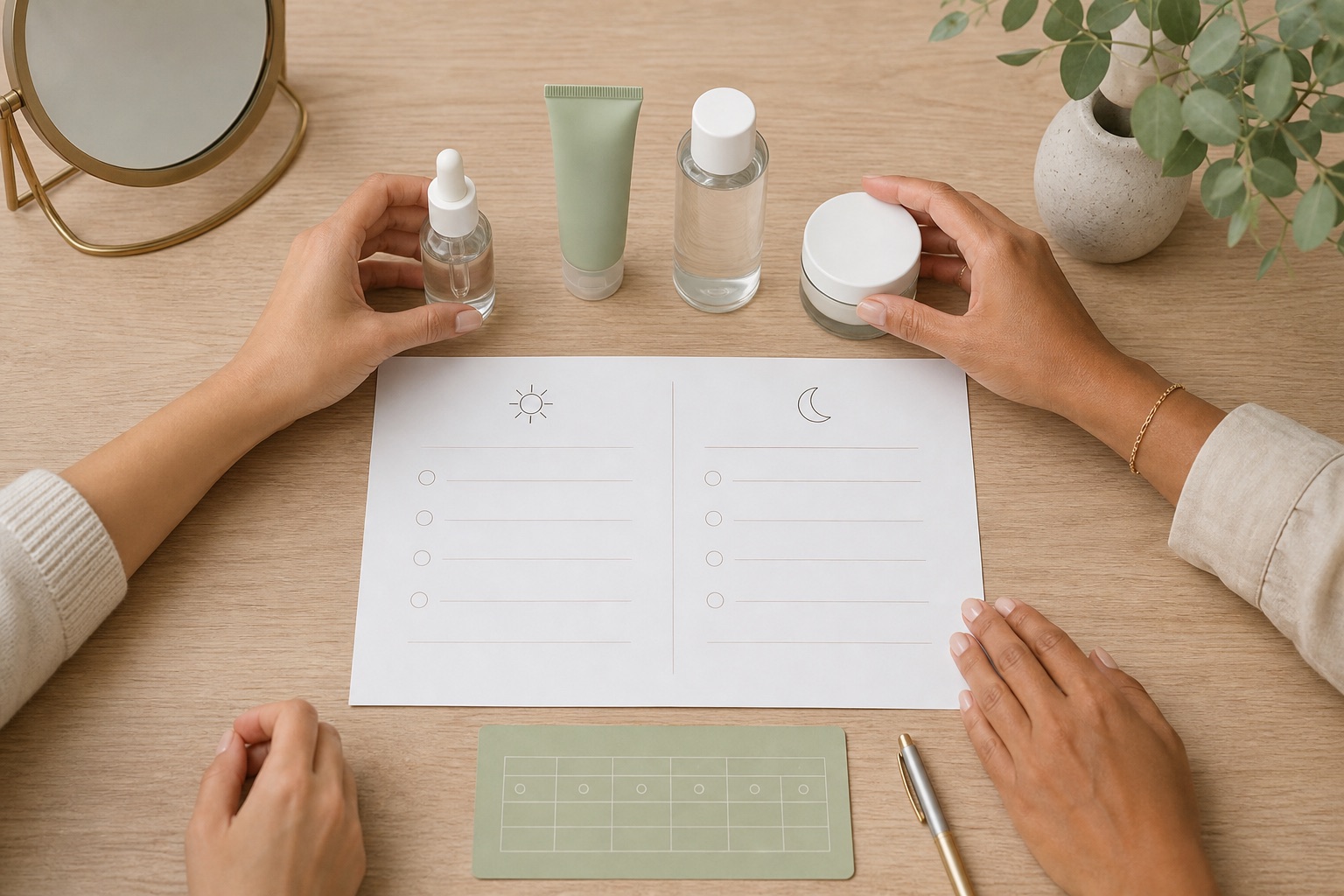
Build the base before adding treatments. In the morning this may mean cleansing when needed, moisturising for comfort and appropriate sunscreen. In the evening it means removing sunscreen, makeup and residue with proportionate cleansing, then moisturising as needed. The routine-order guide explains general sequencing, while the cleansing guide distinguishes one cleanse from double cleansing.
Name the exact product for every step, plus area, time, label-led amount and frequency. Write a complete routine and a minimum version for difficult days. The minimum might protect only essential cleansing, moisturising and sunscreen functions. It prevents one missed step from turning into abandonment and makes the plan more resilient to travel, disability, caring responsibilities or fatigue.
Show the total cost, likely replacement rhythm and availability. Multifunctional products may reduce friction, but their claims should not be added together as guaranteed benefits. The guide to humectants, emollients, occlusives and ceramides helps choose a moisturising function without turning the consultation into a catalogue.
Choose one treatment and write an introduction plan
Consider a treatment only after the baseline and primary objective are clear. The skincare actives guide owns selection and combinations. Dedicated guides cover AHA, BHA and PHA exfoliants, cosmetic retinoids, vitamin C and niacinamide in depth.
Do not choose the highest percentage or most famous active by default. Consider the whole formula, vehicle, packaging, area, plausible frequency, concurrent exposures and manufacturer instructions. Products sharing a headline ingredient may behave differently, while different ingredients can add to the same irritation burden. Never position a cosmetic as a substitute for prescribed treatment.
Introduce one variable with a start date, conservative label-consistent frequency, area, products to keep and stop rules. Do not call every deterioration purging or instruct a client to persevere through pain, swelling, hives or a significant rash. Gradual introduction can make a response easier to interpret; it cannot make an unsuitable formula harmless.
Small-area product testing: useful precaution, limited conclusion
For a new cosmetic, a small-area use test may be sensible when consistent with the label and appropriate advice. The American Academy of Dermatology suggests testing many skincare products on a limited area twice daily for seven to ten days, using the normal contact time. This may reveal some reactions but does not guarantee tolerance on the face, over time, with sun exposure or alongside other products.
A consumer use test is not diagnostic patch testing. Medical patch testing is selected and interpreted by qualified healthcare professionals investigating contact allergy. A negative home test cannot exclude future allergy or irritation; a reaction does not identify the responsible ingredient by itself. Significant, persistent or spreading symptoms need appropriate assessment.
Give simple written instructions: area, amount, duration, frequency, products not to layer, observations and stop action. Do not test on broken, already reactive or periocular skin to accelerate a decision. Product-specific warnings take priority, and questions about medicines go to the prescriber.
Teach and hand over the routine so it works without the consultant
Divide the handover into morning, evening, named treatment days and minimum routine. Write exact product and variant, area, sequence, frequency, label-led amount, rinse or contact instructions where relevant and introduction date. Add what should stay unchanged, what to observe, how to ask a question and which signs mean stop or seek help. Avoid internal abbreviations and vague instructions such as use sparingly.
Demonstrate only within competence and service scope. Explain spreading without aggressive rubbing, avoiding prohibited areas, closing packaging, clean handling and sunscreen coverage. Ask the client to explain the routine back in their own words. Teach-back checks the clarity of the instruction rather than testing intelligence, and it reveals confusing labels or an unrealistic number of steps.
Provide an accessible format: readable contrast and type, plain language, meaningful headings and a digital or paper option. Keep recommendations separate from marketing copy. If a product is sold by the practitioner, state that alternatives may perform the same function and make clear whether purchase is optional.
Follow-up: check use, tolerance and change before changing the plan

Start with what actually happened. Which products were used, how often and in what amount? Which steps were skipped? Did the texture, cost, packaging or schedule create friction? Did comfort, appearance or symptoms change, and when? A product cannot be judged as ineffective when it was rarely used, but poor adherence may show that the plan itself was badly designed.
Compare with the agreed endpoint, not with a new list of concerns. Record unchanged, improved, less tolerable or uncertain. Then choose one action: keep long enough to assess, simplify, correct technique, modify one variable, stop, or refer. The practitioner should be willing to revise the first recommendation rather than defend it.
Follow-up timing depends on the product, objective, risk and instructions. An early contact can check understanding and reaction; a later review can assess consistency and change. Repeated daily scoring may create noise and anxiety. Do not wait for the booked review when swelling, breathing difficulty, eye symptoms, severe pain or other urgent concerns require prompt care.
Use photographs only with standardisation, purpose and proportionate consent
If photographs are necessary, keep camera, lens, distance, angle, expression, background, lighting, time and recent product use as consistent as practicable. Disable beauty filters, portrait relighting and automatic edits where possible. A matched image can support discussion but does not isolate a product from natural variation, behaviour, treatment or image processing.
Define the purpose before capture. Service documentation, remote review, teaching and public marketing are different uses. Do not bundle all of them into a condition of receiving the consultation. Explain access, storage, retention, deletion and withdrawal where applicable, and collect no more imagery than the purpose needs.
Avoid emotionally manipulative magnification. Close-ups can make normal texture appear alarming and encourage unnecessary purchases. Use neutral framing and the same crop at follow-up. Never publish identifiable before-and-after material merely because the client once agreed to a private service photograph.
Respond to irritation, worsening or no visible result
Mild discomfort does not automatically prove allergy, and no immediate change does not prove failure. Establish timing, distribution, amount, recent additions and whether instructions were followed. When a newly introduced cosmetic is a plausible trigger, follow its label and the agreed stop plan; do not add several soothing products that make the sequence impossible to interpret.
For overload and cosmetic irritation, the damaged skin-barrier guide explains a minimal approach, while the sensitive versus sensitised skin guide distinguishes a persistent tendency from a changing state. Neither replaces assessment for severe, persistent or uncertain symptoms.
If the plan was followed and tolerated but the endpoint did not change, check whether the timescale and claim were realistic. Keep, modify or discontinue with a reason. Avoid moving the goalposts or adding a costly product simply to demonstrate action. The honest conclusion may be that cosmetic care cannot deliver the desired change.
Work safely around prescriptions, pregnancy and procedures
Ask only relevant questions and never advise stopping or altering prescribed treatment. Record the name as reported when needed to avoid conflicts, then direct uncertainty to the prescriber or pharmacist. A cosmetic consultation should support, not compete with, a medical plan. The same caution applies when a procedure provider has supplied aftercare.
Pregnancy and breastfeeding are not a licence for sweeping safe or unsafe ingredient lists. Product classification, exposure, individual circumstances and local guidance matter. Refer questions that exceed cosmetic competence. Do not market natural alternatives as inherently safe substitutes for evidence-based advice.
After lasers, peels, injections, surgery or other procedures, follow the treating professional’s timing and aftercare rather than creating a competing protocol. When instructions are missing or the skin is not intact, postpone optional testing and application. Document who supplied the advice and what remains uncertain.
Make the consultation inclusive across skin tone, gender, age, disability and budget
Do not treat redness on light skin as the universal measure of reactivity. On deeper skin tones, warmth, swelling, scale, tenderness and pigment change may be more informative, and post-inflammatory colour change can be a major concern. Training, images and product examples should represent the clients served. The guide to facial dark spots and skincare sets cautious boundaries around pigment concerns.
Ask about shaving, hair distribution, makeup and goals rather than inferring them from gender. The men’s skincare guide covers shaving and beard-specific routine design. For older clients, the mature-skin routine guide focuses on comfort and gradual actives without promising reversal of ageing.
Offer packaging and formats compatible with dexterity, vision, sensory preferences and living conditions. Ask for a total budget before designing the plan. A lower-cost routine using existing products is not a lower-quality consultation. Accessibility and affordability are technical constraints, not signs that a client is less committed.
Online skincare consultations: useful tasks and hard limits
Online work can clarify objectives, audit products, simplify sequencing, teach label use and conduct follow-up. Cameras, compression, screen profiles, white balance and ambient light alter colour and texture. Do not claim to determine inflammation, lesion depth, skin type or diagnosis from a video feed. Ask for standardised images only when needed and treat uncertainty explicitly.
Define platform, access, recording, suppliers, retention, transfer, emergency contact and what happens if the connection fails. Do not ask clients to send sensitive photographs through unmanaged personal accounts when the service promises professional data handling. Explain the time zone, duration, handover format and support window.
Remote follow-up uses the same endpoints as an in-person review: actual use, tolerance, feasibility and change. It must not become continuous informal messaging without boundaries. Specify what channel is monitored, when replies are expected and what symptoms require local healthcare rather than a chat response.
Professional boundaries and referral signals
Stop and recommend appropriate assessment for suspected disease, a new or changing lesion, persistent inflammatory eruption, significant swelling, pain, broken or non-healing skin, infection signs, eye involvement, scarring concern, severe or recurrent reaction, or anything the practitioner cannot safely interpret. Emergency symptoms require urgent local services, not a routine beauty referral.
Describe rather than diagnose: location, onset reported by the client, visible distribution and reason the cosmetic service stopped. Do not speculate about cause or recommend a medicine. With the client’s permission, a concise product list and timeline may help the healthcare professional, but it should not contain invented clinical conclusions.
Cosmetic guidance can continue only when compatible with medical advice and within local scope. Guides on acne-prone skin and the eye area explain cosmetic support and clear limits, not treatment pathways.
Recommend ethically when the consultant also sells products
Separate the service fee from optional purchases. Disclose own-brand products, commission, gifts, affiliate relationships and viable alternatives. Do not make follow-up available only to clients who buy the full basket, and do not withhold the written routine until products are purchased. A client should be able to apply the reasoning with compatible options in their budget.
Explain why each recommended function is needed, what existing product was considered and what uncertainty remains. Avoid fear-based sales around pores, toxins, skin age or magnified texture. The goal is an informed decision, not maximum basket value. A no-purchase outcome must remain legitimate.
A twelve-step operating checklist
Define scope, format, price, data use, image policy, handover and follow-up before booking.
Explain professional limits and obtain the permissions genuinely needed for the service.
Open with the client’s objective and agree one observable primary priority.
Collect the real routine, relevant history, preferences, constraints and stop signals.
Observe only within cosmetic scope and document facts, reports and inferences separately.
Audit exact products, instructions, duplication, condition, cost and reported tolerance.
Keep an adequate baseline and remove unnecessary complexity before recommending additions.
Design complete and minimum routines with clear order, areas and label-led directions.
Introduce no more than one treatment variable with an explicit start and stop plan.
Teach the routine, invite questions and use teach-back to verify clarity.
Provide an accessible written handover and disclose commercial relationships.
Schedule review with a meaningful endpoint, then keep, simplify, change one variable or refer.
Common skincare-consultation mistakes
Starting with a scanner or product catalogue before asking what the client needs.
Treating one observation, photograph or questionnaire answer as a diagnosis.
Replacing tolerated products without a functional reason or because another brand is sold.
Adding several actives simultaneously and losing the ability to interpret tolerance.
Ignoring price, sensory preference, disability, schedule or product availability.
Using vague amounts and frequencies instead of label-consistent instructions.
Collecting health details or photographs without necessity, purpose or protection.
Calling every reaction purging, or encouraging persistence through significant symptoms.
Booking follow-up without an endpoint, then judging the client for poor adherence.
Treating an online image as equivalent to controlled examination or medical assessment.
Frequently asked questions about skincare consultations
What happens during a skincare consultation?
The practitioner defines scope, listens to your objective, reviews current products and use, observes within cosmetic limits, agrees a priority, designs a manageable routine, explains it and schedules review. A good consultation may simplify rather than add products.
How long does a skincare consultation take?
There is no universal duration. It depends on format, product count, observation and handover. The provider should state what the appointment and follow-up include. A longer session is not automatically better when it repeats questions or uses devices without changing a decision.
Should I arrive without makeup?
Follow proportionate preparation instructions, but do not stop necessary or prescribed care. Makeup-free observation can be useful, yet the practitioner should record recent products and avoid aggressive removal that changes the surface. The consultation can begin with your history and product audit.
What products should I bring?
Bring what you actually use: cleanser, moisturiser, sunscreen, treatments, occasional products and relevant prescribed topicals. Bring original packaging where possible or clear photographs of front, back and ingredient label, including the exact variant.
Is a skincare consultation a skin diagnosis?
No. It can describe cosmetic characteristics, reported comfort and product use, but disease diagnosis and medical treatment belong to appropriately qualified healthcare professionals. A camera, lamp or scanner does not change that boundary.
Can the consultant tell me my skin type?
They may form a cosmetic working description using history and standardised observation, while recognising zone and time variation. It is not a permanent biological label or diagnosis, and the recommendation should remain testable and open to revision.
Will I receive a written routine?
A professional service should make the deliverable clear before booking. A useful plan names exact products, areas, order, label-led frequency, introduction date, minimum routine, stop rules and review. Verbal recommendations alone are difficult to follow and audit.
Do I have to buy products from the consultant?
Purchase should be optional unless a clearly described product is an intrinsic part of a separately regulated treatment. The practitioner should disclose commercial relationships, explain alternatives and provide the paid consultation output without making it conditional on a full basket.
How many products should a routine contain?
There is no correct number. Begin with the smallest routine that covers the agreed functions and the client can sustain. Extra steps need a clear purpose, compatible instructions and a way to assess tolerance. More products do not prove a more personalised service.
Can I keep products I already own?
Yes, when they remain suitable, in good condition, compatible with the plan and tolerated. Auditing and retaining useful products protects budget and reduces waste. Prescribed products are changed only with the prescriber.
Should several new actives be started together?
Usually that makes tolerance and cause harder to interpret. Establish the base, introduce one meaningful variable according to its instructions and review before adding another. Individual product warnings and professional medical advice take priority.
Can a skincare consultation help acne-prone skin?
It can support gentle cleansing, moisturising, sunscreen use, product organisation and referral awareness. It cannot diagnose acne, grade severity, prescribe medicines or replace dermatological care, especially with persistent inflammation, pain or scarring.
Can it help with dark spots?
A cosmetic consultation can support consistent photoprotection and cautious product use. New, changing or uncertain pigmented lesions and persistent concerns need appropriate medical assessment. Photographs and online colour do not establish a diagnosis.
Is a small-area test the same as a medical patch test?
No. A home use test may reveal some reactions but cannot diagnose contact allergy or guarantee future tolerance. Diagnostic patch testing is selected and interpreted by qualified healthcare professionals. Significant reactions need suitable care.
When should follow-up happen?
Timing depends on the objective, product, instructions and risk. An early check can catch confusion or intolerance; a later one can assess consistent use and change. Set the date and endpoint when handing over the routine rather than waiting for a problem.
What if I did not follow the routine consistently?
Follow-up should identify the obstacle: time, cost, texture, packaging, access, irritation or unclear directions. The response is often a minimum routine or one practical change, not blame. Feasibility is part of technical quality.
What if my skin reacts?
Follow the product label and written stop plan, record timing and recent changes, and avoid adding several products to mask the sequence. Severe, spreading or persistent reactions, swelling, eye involvement, breathing symptoms or significant pain require appropriate prompt care.
Can a skincare consultation be done online?
Yes for goals, product audit, routine design, teaching and follow-up. Camera and screen limitations must be declared, data protected and referral available. An online image cannot establish diagnosis, lesion depth or precise colour.
Are before-and-after photographs reliable?
They can support comparison when acquisition is matched, but do not prove that one product caused the change. Lighting, camera processing, expression, natural variation and other behaviours matter. Use neutral standardisation and a predefined endpoint.
What information should the practitioner keep?
Only what the defined service and applicable law justify: objective, relevant products and responses, observations, recommendation, consent choices, stop rules and review. Access, security and retention need a clear policy. Detailed governance belongs in the dedicated client-record guide.
When should a dermatologist be recommended?
For suspected disease, significant or persistent inflammation, severe or recurrent reactions, pain, infection signs, scarring, a new or changing lesion, non-healing skin or any concern outside cosmetic competence. Urgent symptoms require urgent local care.
Does completing an online skincare course authorise paid consultations?
Not automatically. A course documents learning, while professional titles, permitted services, insurance, premises and consumer obligations depend on jurisdiction. Explore online skincare courses for programme scope, then verify local requirements independently.
Regulatory, dermatological and adherence sources
EUR-Lex: current consolidated EU Cosmetics Regulation for cosmetic purpose, product information and safety framework. Read Regulation (EC) No 1223/2009
EUR-Lex: GDPR principles, data minimisation and special-category data where applicable. Read Regulation (EU) 2016/679
American Academy of Dermatology: the general order for applying skincare products. Read the AAD guidance
American Academy of Dermatology: consumer guidance for testing a skincare product on a small area. Read the AAD guidance
American Academy of Dermatology: building effective skincare on a budget and limiting unnecessary products. Read the AAD guidance
Feldman et al.: review of adherence barriers and interventions in dermatology. Read the PubMed record
Thorneloe et al.: systematic review of factors associated with adherence to topical treatment. Read the PubMed record
Sagransky et al.: observational evidence on follow-up visits and topical-treatment adherence. Read the PubMed record
Browse the English skincare guide hub for routines, cleansing, hydration, actives, sunscreen and condition-specific education. A strong consultation does not maximise recommendations: it makes one defensible plan understandable, achievable, transparent and open to revision.
For a proportionate record of products, reported reactions, separate permissions, photographs, retention and professional stop decisions, read the skincare client-record guide without turning cosmetic documentation into an improvised medical chart.
For a controlled hands-on protocol covering preparation, pressure, zone sequence, contraindications and realistic claims, read the cosmetic facial-massage guide and keep every movement inside professional scope.
For a verifiable clean-to-used workflow covering hands, textiles, tools, surfaces, cosmetic dispensing and turnover, read the skincare workstation-hygiene guide before designing or auditing a hands-on service.
If you are turning this topic into a structured learning plan, use the online skincare-course selection checklist to compare curriculum, teacher, demonstrations, practice, feedback, access, total cost and certificate wording without confusing private training with professional authorisation.
If you want to turn this knowledge into a defined service, continue with the guide to becoming a skincare consultant: it connects training, demonstrable skills, portfolio, boundaries, work models and a controlled launch without confusing cosmetic consultation, beauty treatment and healthcare.
Turn the protocol into a proportionate inventory with the professional skincare and facial-massage kit guide: it sizes furniture, textiles, tools, consumables, cosmetics, stock and optional equipment to the real service instead of building an unnecessarily complex trolley.