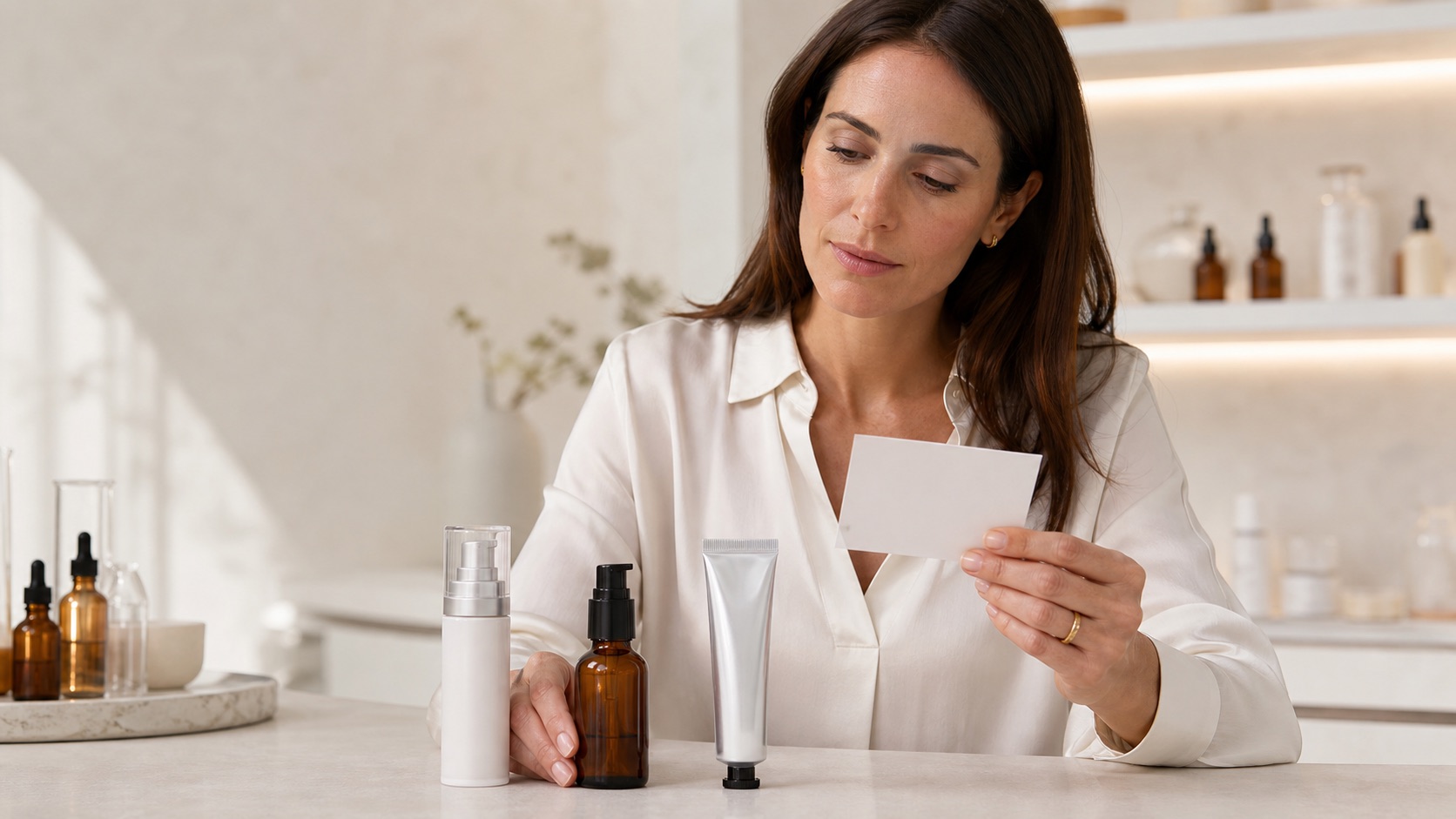
The best skincare active is not the ingredient with the highest percentage or the loudest online reputation. It is the ingredient delivered in a suitable formula, chosen for one observable concern, used at a tolerable dose and frequency, and supported by a stable routine. ‘What not to mix’ cannot be answered by one universal blacklist because medicines, cosmetic forms, instructions and individual tolerance differ.
Quick answer: stabilise cleanser, moisturiser and sunscreen first; choose one goal; read the complete label; introduce one product at a time; and increase only when tolerance and directions support it. Many combinations are not chemically forbidden but may be too irritating or duplicative in the same routine. Prescription instructions and advice from your dermatologist or pharmacist take priority.
This is the BeautyLearn pillar for choosing and combining actives. It owns the broad ‘what should I not mix?’ intent without replacing later ingredient-specific guides. Start with the basic skincare routine and pause experimentation when the damaged skin barrier guide identifies significant reactivity or stop criteria.
What counts as a skincare active
‘Active’ is used loosely in cosmetics. It may refer to an ingredient promoted for a measurable cosmetic effect, an over-the-counter drug active in jurisdictions where that category exists, or a prescription medicine. Those are not interchangeable. A cosmetic retinol serum, a salicylic-acid cosmetic and prescription tretinoin have different evidence, regulation, instructions and risk.
No ingredient works outside its formula. Concentration, pH, vehicle, stability, packaging, release, application area and frequency determine exposure. The ingredient list confirms declared names and approximate order at higher percentages; it does not reveal every exact amount or prove finished-product performance.
Cleansers, moisturisers and sunscreen also contain functional ingredients, but ‘actives’ in routine planning usually means optional targeted products for acne-prone skin, pigment appearance, fine lines, texture or another defined cosmetic concern. Optional is important: a routine does not fail because it lacks a serum.
Choose an active from an observable goal
Begin with one concern that can be described and tracked. ‘Better skin’ is vague. ‘Reduce the appearance of post-blemish marks while keeping the skin comfortable’ or ‘improve rough texture without worsening dryness’ creates a usable decision. Confirm that the concern is cosmetic rather than a new, painful or changing condition that needs assessment.
Match the goal to an evidence-informed family, then compare actual products. A retinoid may be considered for acne, texture or photoageing in an appropriate user; salicylic acid can support pore-related concerns; azelaic acid exists in cosmetic and medicinal contexts; vitamin C and niacinamide have different formulation questions. The name alone does not choose the product.
Define success before buying: fewer inflammatory lesions over an appropriate interval, more even-looking tone under repeatable photographs, less roughness, or better tolerance of a routine. Do not use immediate tingling as evidence of action or a viral before-and-after as your measurement standard.
A map of ingredient families, not a shopping list
Retinoids: a family derived from vitamin A, spanning cosmetic retinol and retinaldehyde to regulated medicines such as adapalene or tretinoin, depending on jurisdiction.
Hydroxy acids: AHA, BHA and PHA products affect exfoliation through different properties and require attention to concentration, pH, vehicle and frequency.
Antioxidant and tone-supporting ingredients: vitamin C forms, niacinamide and other materials with formula-specific stability and evidence.
Acne-treatment ingredients: benzoyl peroxide, salicylic acid, retinoids and azelaic acid may sit in cosmetic, OTC-drug or prescription frameworks depending on product and country.
Barrier and hydration support: glycerin, ceramides, urea, emollients and occlusives are functional even when marketing does not call them ‘power actives’.
This map prevents a common error: assuming every family belongs in one routine. Select the smallest set that addresses the goal. The skin hydration guide keeps barrier-support ingredients in their proper context instead of treating them as an afterthought.
Four checks before adding any active
Identity: is it a cosmetic, an OTC medicine or a prescription product where you live, and what exact ingredient form does it contain?
Instructions: application area, amount, frequency, rinsing, warnings, sun-exposure advice and storage.
Context: current medicines, pregnancy or planning pregnancy, breastfeeding, procedures, diagnosed conditions and known reactions.
Duplication: the same acid, retinoid or exfoliating function may already appear in cleanser, toner, serum, mask or spot treatment.
If any answer is unclear, ask the manufacturer, pharmacist, prescriber or dermatologist as appropriate. Do not infer safety from packaging colour, ‘clean’ language or the absence of a prescription.
Introduce one product at a time
A one-product introduction is the most informative method. Keep cleanser, moisturiser and sunscreen stable; add the active at the lowest directed frequency; record amount, application area and response; and wait long enough to distinguish a transient sensation from a recurring problem. Starting three products together removes that information.
A small-area test may reveal some local reactions but cannot guarantee full-face tolerance or exclude delayed allergy. The AAD suggests repeated testing on a small area for new cosmetics, while recognising that clinical patch testing may be needed to investigate allergic contact dermatitis. Do not test on broken or actively inflamed skin.

Dose, frequency and area matter as much as percentage
A high percentage is not automatically faster or more effective. Exposure depends on how much product is used, how often, where, in what vehicle and alongside which other products. A lower concentration applied too frequently across the entire face may irritate more than a carefully used higher-strength product in another context.
Use the labelled amount and do not ‘spot treat’ with a product that requires even application or spread a spot treatment across unaffected skin without direction. Eye contours, nose folds, lip corners and the neck may tolerate exposure differently. Increase frequency only when instructions permit and the current level is stable.
More peeling does not prove a better result. Scaling can interfere with sunscreen, makeup and adherence and can contribute to post-inflammatory hyperpigmentation, particularly when irritation is repeated. The goal is the lowest effective, sustainable exposure — not the most visible reaction.
Morning and evening order: function before texture
A general routine places treatment after cleansing and before moisturiser, with sunscreen closing the morning sequence. Product instructions can override that order. A retinoid medicine may require dry skin and evening use; a buffering moisturiser may be recommended by a dermatologist; a rinse-off acid never belongs in a leave-on slot.
Separating products between morning and evening can reduce crowding, but it is not a universal compatibility fix. Stability, photoreactivity, irritation and the product’s own directions matter. Sunscreen is not an antidote that makes any aggressive combination acceptable; it is one part of safe daily exposure management.
What not to mix: three different problems
Online mixing charts often combine three questions. Chemical incompatibility asks whether ingredients or vehicles degrade one another. Irritation stacking asks whether two useful products create too much cumulative stress. Functional duplication asks whether several products perform the same job without adding value. Most home-routine problems are about irritation and duplication rather than an instant toxic reaction in the bottle.
The same pair may be intentionally combined in a tested commercial product or prescribed plan yet be difficult when two unrelated high-strength products are layered by a beginner. Do not dismantle a formulated combination based on a generic chart, and do not recreate a medical combination from separate products without guidance.
Retinoids and exfoliating acids
Retinoids and AHA/BHA exfoliants can each cause dryness, peeling and irritation. Using both in the same evening may increase cumulative irritation, particularly for a beginner, dry or reactive skin, or when strength and frequency are high. That is a tolerance concern, not proof that every molecule chemically cancels the other.
Start with one family. If there is a clear reason to use both, stabilise the first, then consider a separate day or professionally designed schedule. Prescription retinoid instructions take priority. Persistent burning, rawness, swelling or significant inflammation means stop and seek advice rather than ‘push through’.
Retinoids and benzoyl peroxide
The answer depends on the exact retinoid and formula. Some older advice focused on possible degradation of tretinoin by benzoyl peroxide, while modern stabilised products and fixed combinations change the picture. Adapalene and benzoyl peroxide are intentionally combined in regulated acne medicines. The existence of that combination does not authorise a user to layer any two products in any amount.
The FDA-approved 2026 adapalene/benzoyl peroxide label warns that irritation is more likely when more than one topical acne medicine is used and advises reducing frequency, moisturising or using one product at a time if irritation occurs. Follow the exact medicine label and prescriber; do not generalise from one drug product to all retinoids.
Vitamin C, niacinamide and acids
The claim that vitamin C and niacinamide can never be used together comes largely from outdated or oversimplified interpretations. Many modern products combine them successfully. The more useful questions are which vitamin C form, pH, concentration, vehicle and total irritation load are involved, and whether both products add a distinct benefit.
An acidic L-ascorbic-acid serum combined with another low-pH exfoliant may sting or irritate some users even if the ingredients do not become dangerous. Use one first, separate times or days when needed, and keep the combination only if it is stable, comfortable and compatible with sunscreen.
Hidden duplication: acids, scrubs and devices
A cleanser with salicylic acid, exfoliating toner, AHA serum, grain scrub, cleansing brush and peel mask can create six versions of one function. Users may count only the serum as an active and overlook the total weekly exposure. Read every label and map function rather than product category.
Mechanical and chemical exfoliation can both irritate. The AAD advises considering current retinoids, retinol or benzoyl peroxide because added exfoliation may worsen dryness or breakouts. If skin is darker or prone to post-inflammatory marks, preventing irritation is particularly important.
Supportive combinations are still individual
Moisturiser can improve tolerance of many routines, and dermatologists may recommend applying it before or after a retinoid depending on the medicine and skin. Niacinamide may support barrier-related functions; humectants and emollients can reduce discomfort; sunscreen protects exposed skin. None guarantees that an otherwise excessive schedule becomes tolerable.
Combining different functions in one tested formula can reduce layering uncertainty. A lower-complexity routine with one combination product may be easier than several bottles, but compare active amounts, directions and total cost. ‘All in one’ does not remove the need for gradual introduction.
Sunscreen supports the plan
Daily broad-spectrum sun protection is particularly relevant when the concern includes pigmentation, photoageing or treatments that increase sun sensitivity. Apply the labelled amount as the final morning skincare layer and reapply according to exposure and product directions. Shade, clothing and timing remain part of protection.
Do not add an irritating active and assume sunscreen cancels the irritation. If peeling makes adequate sunscreen impossible or the protective film pills over too many layers, reduce routine complexity. The routine must work as a system, not as isolated hero steps.
Pregnancy, breastfeeding, medicines and procedures
Pregnancy and planning pregnancy require specific review. The European Medicines Agency states that topical retinoid medicines must not be used during pregnancy or by women planning a pregnancy. Cosmetic retinol products also require cautious professional advice rather than assumptions based on low concentration.
Breastfeeding, fertility treatment, prescription medicines, isotretinoin, peels, lasers, waxing and other procedures alter product choices and timing. Provide the clinician or qualified practitioner with exact names and ingredient lists. Do not rely on a broad ‘pregnancy-safe’ badge or combine advice from several unrelated sources.
Signs that the combination is too intense
Increasing tightness, persistent sting, raw patches, new scaling, redness, itch, pain, swelling or a sudden inability to tolerate usual products indicates that exposure needs review. Pilling and dryness alone do not identify the responsible ingredient, but they can signal too many layers or excessive frequency.
Stop the likely non-essential trigger and return to a simple tolerated baseline. Severe swelling, hives, blisters, eye or lip involvement or breathing difficulty needs prompt care; breathing difficulty is an emergency. Persistent acne, pigment change or dermatitis-like symptoms need a dermatologist rather than more actives.
A six-step introduction plan
Stabilise gentle cleansing, moisturiser and sunscreen before adding a treatment.
Choose one measurable concern and confirm that it is appropriate for cosmetic self-care.
Check exact product status, ingredient form, directions, warnings, storage and current medicines.
Introduce one product at the lowest directed frequency while all other variables remain stable.
Record amount, zone, comfort and result under comparable conditions; do not chase daily change.
Increase, maintain, reduce or stop based on directions, tolerance and professional advice — not pressure to reach daily use.
Frequently asked questions about skincare actives
Which skincare actives should not be mixed?
There is no universal blacklist. Separate true formulation incompatibility from cumulative irritation and duplicated function. Retinoids plus exfoliating acids, several acids, or multiple acne treatments can be too irritating. Follow exact labels and prescriptions rather than generic charts.
Can vitamin C and niacinamide be used together?
Often yes, and formulated products may contain both. Tolerance depends on the vitamin C form, pH, concentration and complete routine. Separate them only when stability, pilling or irritation makes that useful.
Can retinol and glycolic acid be used together?
They may create excessive irritation, especially when introduced together. Start with one and consider alternating only after it is stable and there is a clear reason. Prescription retinoid users should follow their clinician.
Do retinoids and benzoyl peroxide cancel each other?
It depends on the exact retinoid and formulation. Regulated adapalene/benzoyl-peroxide combinations exist, while some tretinoin products require different handling. Use the specific label or prescription; do not generalise across the whole family.
How should I choose my first active?
Choose one observable goal, confirm that it is suitable for cosmetic care, compare complete products and select the lowest-complexity option you can use consistently. A stable basic routine comes first.
How long should I wait before adding a second active?
Long enough to establish tolerance and observe the first product over its relevant timeframe. That may be several weeks, not days. The exact interval depends on product directions, concern and professional plan.
Does a higher percentage work faster?
Not automatically. Higher exposure can increase irritation without proportional benefit. Vehicle, pH, stability, amount and frequency influence results. Use the lowest effective, tolerable product.
Can I use two exfoliating acids in one routine?
It may duplicate function and increase irritation. A formulated blend is different from layering separate high-strength products. Begin with one exfoliant and add complexity only for a justified goal.
Does moisturiser reduce active effectiveness?
Not necessarily. Moisturiser can improve tolerance and adherence, and clinicians sometimes recommend buffering a retinoid. Follow the product or prescription directions because placement varies.
Which actives should be avoided in pregnancy?
Topical retinoid medicines must not be used during pregnancy or while planning pregnancy under EMA guidance. Review all medicines and cosmetic actives with a doctor or pharmacist rather than relying on a generic online list.
Sources and further reading
American Academy of Dermatology: skincare order and irritation risk from too many products. Read the AAD guidance
American Academy of Dermatology: safe exfoliation and interactions with retinoids or benzoyl peroxide. Read the AAD exfoliation guidance
European Medicines Agency: pregnancy-prevention measures for oral and topical retinoid medicines. Read the EMA guidance
FDA-approved 2026 label for adapalene 0.1% and benzoyl peroxide 2.5%, including irritation warnings. Read the FDA label
Continue your skincare pathway
Build actives on the basic routine, compare barrier support in the hydration guide and simplify promptly with the damaged skin barrier guide when tolerance changes. Browse the English skincare guides or explore the online skincare courses for structured study.
For a complete comparison of exfoliant families, frequency and stop criteria, read the AHA, BHA and PHA guide before adding another acid, scrub or exfoliating device.
For form, percentage, gradual introduction and the boundary between cosmetics and medicines, use the retinol, retinal and cosmetic retinoids guide before changing strength, frequency or combinations.
For vitamin C form, stability, oxidation, packaging and routine use, read the complete vitamin C skincare guide before comparing percentages or adding another antioxidant serum.
For SPF, UVA, full application amount and exposure-based reapplication, read the daily face-sunscreen guide before adjusting treatment layers or reducing the sunscreen dose.
For benefits, realistic concentration comparisons and tolerance, read the niacinamide skincare guide before adding another niacinamide product to the routine.
For a complete morning and evening plan based on sebum, shine and comfort, read the oily and combination-skin routine before adding another mattifying or exfoliating step.
To distinguish a stable dry profile from temporary surface water loss and build a practical routine, read dry vs dehydrated skin: differences, textures and review criteria.
For a tolerable base, treatment support and clear referral criteria, read the acne-prone skincare guide without treating oily skin, irritation and acne as the same condition.
To separate a recurring sensitivity pattern from temporary reactivity and build a controlled baseline, read the sensitive versus sensitised skin guide for tolerance testing, a minimal routine and clear referral criteria.
To distinguish an acne lesion from a normal follicular structure and visible texture, read the blackheads, sebaceous filaments and visible pores guide for realistic skincare, strip and extraction limits.
For a cautious distinction between cosmetic discolouration and a mark that needs assessment first, read the facial dark spots and skincare guide for photoprotection, cosmetic options, measurement and dermatology referral criteria.
For a simple base when comfort, hydration and tolerance change over time, read the mature-skin skincare guide for essential care, photoprotection and the gradual introduction of one active at a time.
For a careful comparison of dryness, puffiness, structural bags and different dark-circle components, read the eye-area skincare guide for a simple routine, periocular safety and realistic cosmetic limits.
For a practical routine shaped by skin, shaving and facial hair rather than gendered packaging, read the men’s skincare guide for cleansing, moisturising, razor-bump prevention, beard care and sunscreen.
For a repeatable professional method that separates observation from diagnosis, read the cosmetological skin-analysis guide for type, current conditions, tools, documentation, privacy and referral limits.
To turn cosmetic observations and existing products into a plan a client can understand and follow, use the professional skincare-consultation protocol for intake, product audit, written handover, follow-up and referral boundaries.
For a proportionate record of products, reported reactions, separate permissions, photographs, retention and professional stop decisions, read the skincare client-record guide without turning cosmetic documentation into an improvised medical chart.
If you are turning this topic into a structured learning plan, use the online skincare-course selection checklist to compare curriculum, teacher, demonstrations, practice, feedback, access, total cost and certificate wording without confusing private training with professional authorisation.
If you want to turn this knowledge into a defined service, continue with the guide to becoming a skincare consultant: it connects training, demonstrable skills, portfolio, boundaries, work models and a controlled launch without confusing cosmetic consultation, beauty treatment and healthcare.
Turn the protocol into a proportionate inventory with the professional skincare and facial-massage kit guide: it sizes furniture, textiles, tools, consumables, cosmetics, stock and optional equipment to the real service instead of building an unnecessarily complex trolley.