
Retinol, retinaldehyde and other cosmetic retinoids belong to the vitamin A family, but their names are not interchangeable and they are not steps on a ladder that predicts results or irritation. Chemical form, concentration, stability, vehicle, packaging, frequency, application area and skin condition all matter. Medicinal retinoids have their own authorised indications, doses and clinical controls: a cosmetic does not replace them, and this guide does not prescribe treatment.
Quick answer: choose one finished product for a defined cosmetic goal; identify the exact INCI form; begin at the lowest labelled frequency; keep cleanser, moisturiser and sunscreen stable; and do not introduce acids, scrubs or another irritating treatment at the same time. Retinoid medicines must not be used during pregnancy or while planning pregnancy. For any cosmetic vitamin A product, show the actual formula to a doctor or pharmacist when pregnant, planning pregnancy, breastfeeding, using medicines or preparing for a procedure.
Editorial status: this page uses dermatology, scientific and regulatory sources and is deliberately conservative, but it has not yet received independent dermatologist sign-off. It is cosmetic education, not personal medical advice. Persistent acne, eczema, rosacea, changing pigmentation, medicine use or a significant reaction belongs with a qualified healthcare professional.
This is BeautyLearn’s single guide to retinol, retinal and cosmetic retinoids. It includes the retinol-versus-retinal question, percentages, frequency, ‘purging’, combinations, pregnancy and safe introduction instead of creating thin articles around every form. The broader decision framework remains in the skincare actives pillar; here we go deeper on one family without duplicating the complete routine order.
Retinol, retinaldehyde and retinoids: the practical differences
Retinoid is an umbrella term for vitamin A-related compounds used in cosmetics and medicines. Sharing a chemical family does not make their regulation, clinical evidence or directions equivalent. Retinol, retinaldehyde — commonly shortened to retinal — and retinyl esters can appear in cosmetics. Tretinoin, adapalene, tazarotene and other retinoids may be regulated as medicines according to the product and country.
The familiar pathway retinyl esters → retinol → retinaldehyde → retinoic acid is useful for understanding that some forms undergo conversion in skin. It is not a consumer potency calculator. It does not reveal how much remains stable in the bottle, reaches the target tissue, converts under real conditions or is moderated by the vehicle. Being one conversion step from retinoic acid does not create a home equivalence to tretinoin.
Terms such as ‘next-generation retinoid’ can also cover different proprietary ingredients. Before comparing products, identify the INCI name, determine whether the item is a cosmetic or medicine, read its directions and warnings and consider the entire formula. A front-label name that sounds like retinol proves neither identity nor biological activity.
Retinol: the familiar name does not describe the product
Retinol is a vitamin A form used in cosmetics intended to maintain skin condition or improve appearance. Evidence for photoageing is less extensive and consistent than the evidence for medicinal tretinoin, and outcomes depend on concentration, stabilisation, vehicle, duration and population studied. A cosmetic percentage cannot promise a medicine-like result, and a larger number does not guarantee a faster useful change.
Retinol is sensitive to light, oxygen and formulation conditions. Encapsulation, antioxidants, emulsion design and packaging can influence stability, but words such as ‘stabilised’ or ‘microencapsulated’ are not substitutes for finished-product data. A moderate, well-packaged product that can be used consistently may make more sense than an aggressive formula chosen for the number on its box.
Retinal or retinaldehyde: chemical proximity is not clinical equivalence
Retinal and retinaldehyde are two names for the same form. Because retinal sits closer to retinoic acid in the simplified conversion chain than retinol, it is often described as automatically stronger, faster and gentler. That conclusion goes too far. Published studies concern particular concentrations and formulations; they do not allow a mechanical conversion from 0.1% retinal to a dose of retinol or tretinoin. Retinal can also irritate and requires a gradual introduction.
The 2022 SCCS opinion on vitamin A addressed retinol, retinyl acetate and retinyl palmitate and explicitly excluded retinal because the dossier lacked substance-specific data. Do not transfer those numerical conclusions to retinaldehyde. Its absence from that entry is not proof of either superiority or no risk.
Retinyl esters and newer cosmetic derivatives
Retinyl palmitate, retinyl acetate and other esters are often presented as milder. They generally require additional conversion, but real tolerance still depends on the finished product. A fragranced ester formula or one combined with several actives may be less comfortable than a carefully delivered retinol product.
Names such as granactive retinoid or retinoate can refer to different ingredients or proprietary complexes. Read the INCI list and product documentation. If the manufacturer does not explain the form, useful concentration or instructions, do not fill that gap with equivalence charts from social media.
Cosmetic or medicine: a boundary that matters
Under EU Regulation 1223/2009, a cosmetic is principally intended to clean, perfume, change appearance, protect or keep external body parts in good condition. Medicines are outside that definition, and borderline classification is assessed case by case. Purpose, claims, active substance, dose, authorisation and product information matter more than whether the texture is called a serum or cream.
A cosmetic may support the appearance of texture, tone or fine lines within substantiated cosmetic claims. It does not diagnose or treat disease. A medicine is authorised for therapeutic indications and has specific contraindications, dosing and clinical responsibilities. Tretinoin, adapalene and tazarotene are not merely stronger retinol products to imitate by increasing a cosmetic percentage.
Moderate or severe acne, scarring, persistent inflammatory lesions, rosacea, dermatitis, new pigmentation or changing lesions need medical assessment. Do not stop, alternate, buffer or replace a prescribed retinoid because of a cosmetic guide. Contact the prescriber with the exact reaction and all products in use.
A beauty or skincare professional can document the cosmetic routine, recognise duplicated exposure and identify when a concern exceeds their scope. They do not select a prescription retinoid, alter treatment or promise to cure acne. Structured online skincare courses should make those limits explicit.
What cosmetic retinoids can and cannot promise
Retinoids affect epidermal differentiation, pigmentation pathways and the dermal matrix, but the evidence is not equally robust for every molecule. Tretinoin is the most studied for photoageing and acne. Retinol and retinaldehyde have cosmetic and clinical studies, often smaller, heterogeneous or tied to specific formulations. Evidence for one tested formula should not become a claim for every product bearing the ingredient name.
Use observable cosmetic outcomes: smoother-looking texture, more even appearance, brightness and superficial line appearance over time. Do not promise wrinkle removal, acne treatment or complete pigment correction. Standardised photographs may help compare appearance, but lighting, distance, expression, makeup and inflammatory cycles must remain consistent; a photograph cannot measure collagen or diagnose a condition.
Results require time and continuity. ‘New skin in seven days’ or ‘complete results in one month’ are not responsible universal deadlines. Studies use different endpoints and durations, while real-world adherence depends on tolerance, moisturising and sun protection. More peeling is not evidence of more useful biological effect.
Percentage, formula, packaging and stability
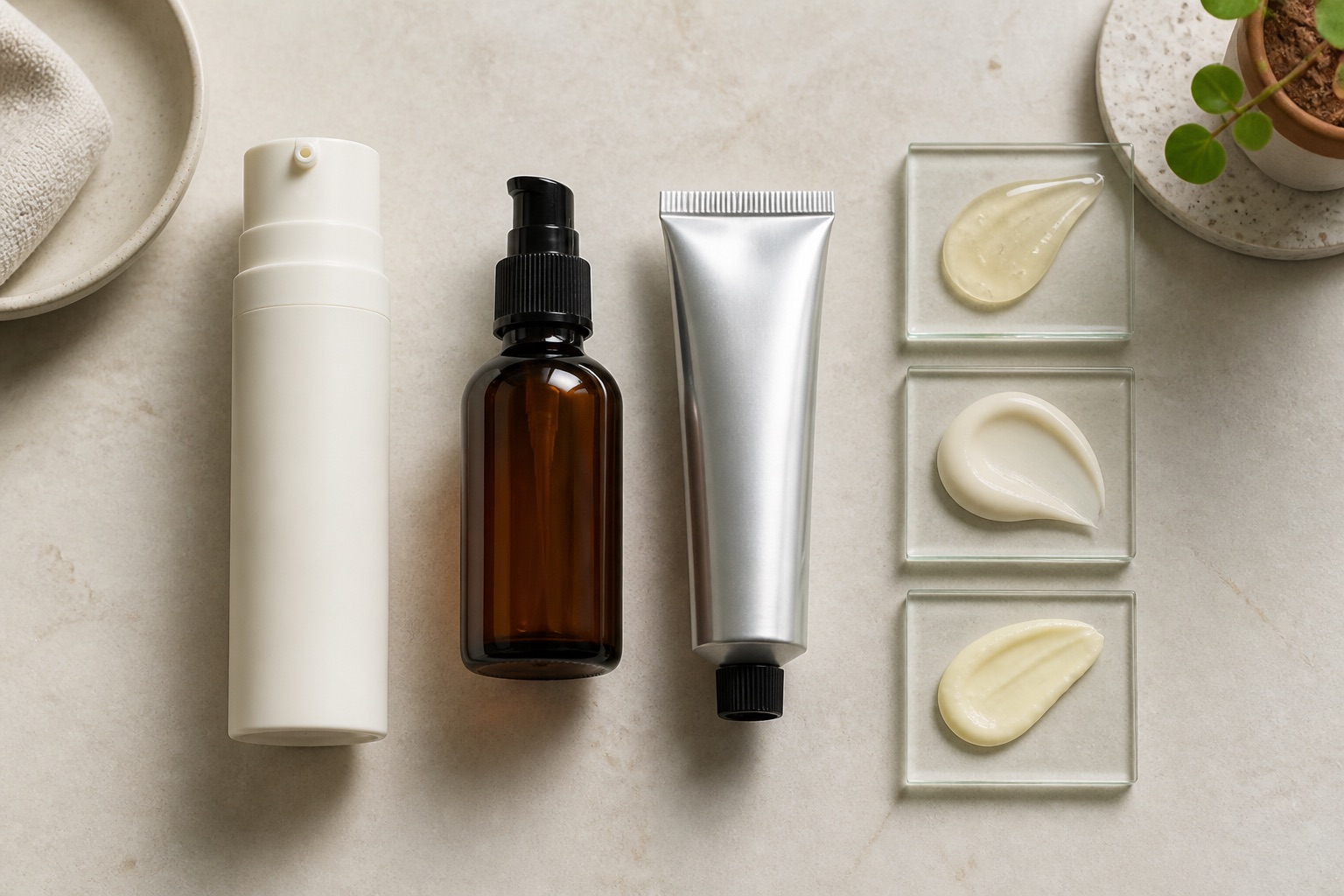
Comparing 0.1%, 0.3% and 1% only becomes meaningful after identifying the substance. A 0.1% retinal product is not the same as 0.1% retinol; a percentage of a proprietary complex may not equal the percentage of retinoid molecule. Some brands declare a ‘retinol equivalent’ or a blend. Read how the number is defined and never convert it into a clinical dose.
INCI identity: retinol, retinal, retinyl palmitate, retinyl acetate or another derivative.
Declared concentration: molecule, retinol equivalent or commercial blend.
Vehicle: cream, emulsion, anhydrous serum, encapsulation and supporting ingredients.
Packaging: protection from light and air, dispenser and contamination during use.
Directions: amount, area, frequency, period after opening, storage and warnings.
Keep the original package closed and away from heat or direct light. Do not decant into a clear jar or continue past the stated period after opening. A major change in smell, colour or texture is a reason for caution, but the absence of a visible change cannot prove chemical integrity. Never mix the retinoid into the moisturiser jar, which alters preservation and distribution.
How to introduce retinol or retinal without creating a prescription
Before starting, record the current routine, intended area, comfort and goal. If water or moisturiser already burns, fissures are present or skin is recovering from over-exfoliation, do not add a retinoid. Begin with the minimal barrier routine and seek care if significant signs persist.
Confirm that it is a cosmetic, identify the INCI retinoid form and read the full packaging and manufacturer directions.
Check pregnancy planning or pregnancy, breastfeeding, medicines, recent procedures and diagnosed conditions with the appropriate professional.
Keep a tolerated gentle cleanser, moisturiser and sunscreen stable and postpone other new actives.
Apply only the labelled amount and only to the stated area; more product does not mean more benefit.
Begin at the lowest permitted frequency and allow enough recovery time to observe more than one use.
Record dryness, sting, redness, scaling, new areas and concurrent products while changing only one variable.
Maintain, reduce or stop according to directions and response, never to chase a feeling of potency.
There is no universal weekly frequency. Once weekly may be excessive for one product and negligible for another; nightly use is not a compulsory destination. AAD dermatologists describe starting slowly and using moisturiser to reduce irritation. Follow the cosmetic label, and follow the prescription and leaflet for a medicine.
Dry skin, amount and vulnerable areas
Some formulas are applied to dry skin to limit rapid spread or sting, while others have different instructions. Do not invent a mandatory thirty-minute wait after cleansing. Avoid eyelids, nostril folds, lip corners, broken skin and recently depilated areas unless the product explicitly includes them. Moving a face retinoid closer to the eyes does not make it an eye treatment.
A pea-sized amount is often mentioned for certain medicines or full-face products, but it is not a universal unit. Pea size, application area, texture and pump output vary. Use the stated dose. A thick layer, prolonged rubbing or covering it with a highly occlusive layer may increase exposure and irritation.
Moisturiser before or after: buffering and the sandwich method
Moisturiser before, after or in both positions may improve comfort for some people; online this is called buffering or the sandwich method. It cannot make every concentration appropriate. Moisturiser formula, occlusivity, retinoid type and manufacturer directions all matter. Do not mix products together in the palm to create an uncontrolled concentration unless the directions explicitly allow it.
Choose a previously tolerated moisturiser with a texture suited to the skin. The hydration guide explains humectants, emollients and occlusives without suggesting that moisturiser cancels a contraindication or persistent inflammation.
Purging, irritation and worsening are not synonyms
Purging is a popular term for a temporary increase in lesions in areas already prone to comedones when treatment changes cell turnover. It is not a diagnosis, and no calendar makes every deterioration normal. New lesions in unusual areas, itching, plaques, swelling, persistent burning or pain point toward irritation, reaction or another problem that requires evaluation rather than endurance.
Do not continue simply because ‘it gets worse before it gets better’. If a cosmetic causes marked deterioration, stop it and return to the stable routine. Persistent or scarring acne needs a dermatologist. If a prescribed medicine causes a problem, contact the prescriber before changing it. Timing alone cannot distinguish purging from acne or dermatitis.
Expected adjustment, excessive irritation and stop criteria
Mild dryness or tightness can appear during introduction, but neither is a goal. Increasing redness, persistent burning, pain, fissures, sheet-like scaling, crusts, blisters, swelling or eye and mucosal involvement require stopping the cosmetic and seeking proportionate care. Breathing difficulty or tongue or throat swelling is an emergency.
Repeated irritation can contribute to post-inflammatory hyperpigmentation, particularly in deeper skin tones but potentially in anyone. Do not counter it with a scrub, acid or stronger vitamin C. Reduce exposure, protect from UV and seek assessment for persistent marks or an unfamiliar lesion.
Retinoids and other actives: compatible does not mean tolerable
The frequent problem is not ingredients cancelling each other but combined exposure exceeding recovery. AHA, BHA, PHA, benzoyl peroxide, scrubs, low-pH vitamin C, harsh cleansers, shaving and procedures can add dryness and irritation. Do not introduce a retinoid in the same period as another potentially irritating active.
A multi-active product is one formula designed around stability, vehicle and instructions. It does not prove that unrelated serums can be layered. Alternating nights reduces simultaneous application but not total weekly exposure. Use the dedicated AHA, BHA and PHA guide to compare exfoliation and frequency.
Benzoyl peroxide and retinoids may appear in dermatological protocols or authorised combinations, but formulation and tolerance depend on the molecule and product. Do not copy a therapeutic regimen with different cosmetics. Azelaic acid, niacinamide and vitamin C are not universally forbidden, yet each addition needs a distinct goal and a stable baseline.
Waxing, laser, peels, microneedling and shaving
Waxing and depilation can lift or irritate the surface; laser, peels, microneedling and other procedures temporarily alter barrier and inflammation. There is no single number of days to stop or restart every retinoid. Tell the practitioner the exact product, form, concentration, frequency and area and follow their pre- and post-procedure instructions. A prescribed medicine should only be changed with its prescriber.
Retinoids and sunlight without myths
Many retinoids are recommended at night because of stability, tolerance or treatment design. This does not mean that retinoids permanently thin skin or replace sun protection. Irritation and peeling can reduce tolerance to exposure, while photoageing and pigmentation — common reasons for choosing retinoids — are worsened by ultraviolet radiation.
Use broad-spectrum sunscreen according to its label, plus shade, clothing and reapplication when relevant. If sunscreen stings because of substantial irritation, stop the non-essential trigger and restore tolerance rather than abandoning protection while continuing the retinoid. Sunscreen does not make a significant dermatitis acceptable.
Pregnancy planning, pregnancy and breastfeeding
The European Medicines Agency states that topical retinoid medicines must not be used during pregnancy or by women planning a pregnancy. The AAD also advises avoiding retinoids during pregnancy. Do not rely on social-media distinctions such as ‘retinal is allowed but retinol is not’ or ‘this percentage is low enough’. Show the complete cosmetic or medicine to a doctor, dermatologist or pharmacist before use.
If pregnancy is discovered after cosmetic use, stop the experiment, keep the packaging and INCI list and contact the professional managing the pregnancy. Do not calculate individual risk from an online percentage. During breastfeeding, molecule, area, frequency, skin integrity and infant contact all matter; avoid applying retinoids to the breast and obtain product-specific advice. Pregnancy and breastfeeding guidance is not automatically identical.
EU vitamin A cosmetic limits and transition dates
Commission Regulation (EU) 2024/996 limits retinol, retinyl acetate and retinyl palmitate to 0.05% retinol equivalent in body lotion and 0.3% retinol equivalent in other leave-on and rinse-off products. Products containing these substances must carry the warning ‘Contains Vitamin A. Consider your daily intake before use’.
From 1 November 2025, products containing those substances that do not meet the new conditions may no longer be placed on the EU market. Products already placed on the market may continue to be made available until 1 May 2027. The regulatory maximum is not a recommended personal starting strength or frequency. The entry concerns those three named substances and does not automatically apply the same percentages to retinaldehyde or newer derivatives.
Who should seek advice before starting
Ask a doctor, dermatologist or pharmacist before beginning when pregnancy is planned or confirmed, during breastfeeding, when using a prescription or over-the-counter acne medicine, after a substantial previous reaction, or when eczema, rosacea, recurrent dermatitis or another diagnosed condition is active. The same applies when a laser, peel, microneedling, waxing or other procedure is planned and the practitioner needs to coordinate timing.
Do not use a cosmetic retinoid trial to investigate a changing mole, unexplained pigmentation, painful eruption, widespread rash or acne that is persistent, deep or scarring. These are not questions of choosing retinol versus retinal. Bring the product name, ingredient list, concentration claim, photographs of the reaction when appropriate and a list of everything used; precise information is more useful than the category word ‘retinoid’.
Checklist before buying or starting
Do I have an observable cosmetic goal, or am I trying to treat a condition?
What is the exact INCI retinoid form, and what does the displayed percentage represent?
Is the product clearly a cosmetic or a medicine with specific patient information?
Does the package protect the formula, and are storage, dose and frequency explained?
Is the routine stable, or does it already contain acids, scrubs, retinoids or medicines?
Do pregnancy, breastfeeding, a diagnosed condition, medicine or recent procedure need discussion?
Do I know which signs require reduction, stopping or professional care?
Are cleanser, moisturiser and sunscreen already tolerated so the trial remains readable?
Frequently asked questions about cosmetic retinoids
Are retinal and retinaldehyde the same thing?
Yes. Retinal is the common shortened name for retinaldehyde. It is a retinoid form often placed between retinol and retinoic acid in the simplified conversion pathway. That position does not create a direct percentage conversion to retinol or tretinoin.
Is retinal stronger than retinol?
It may show activity at different concentrations because it requires one fewer conversion step, but ‘stronger’ is not a universal product measure. Studies concern particular formulas, and no reliable multiplier compares every retinal and retinol product. Retinal can also irritate.
What percentage of retinol should a beginner use?
There is no universal beginner percentage. The number may refer to the molecule, an equivalent or a complex and does not describe vehicle or stability. Identify the INCI form, choose clear directions and begin at the lowest labelled frequency.
How many times a week should retinol be used?
Frequency depends on the exact product and response. Start at its minimum direction, keep other actives unchanged and observe recovery between uses. Nightly application is not a compulsory target. A medicine follows its prescription, not this guide.
Do retinol and retinal always cause purging?
No. A flare is not mandatory and every deterioration is not purging. Itch, plaques, swelling, pain, persistent burning or lesions in unfamiliar areas require stopping and assessment rather than automatic persistence.
Can retinol be used with AHA or BHA?
Tested combination products and professionally designed routines may use both, but unrelated products often increase irritation. Do not introduce them together. Alternating nights reduces simultaneous application but not total weekly exposure.
Can retinol be used with vitamin C?
There is no universal ban. The practical concern is total irritation, especially with low-pH ascorbic acid. Add one product first and separate morning and evening if the labels and tolerance support that plan.
Does moisturiser cancel retinol?
Not as a general rule. Moisturiser can support comfort and may be used before or after according to the retinoid directions. It does not make excessive use safe, and mixing both products together can create uneven distribution.
Are retinol and tretinoin the same?
No. Retinol is used in cosmetics; tretinoin is retinoic acid and is used as a medicine for authorised indications. Their evidence, dose, regulation and risks are different. Never imitate or replace a prescription with a high-percentage cosmetic.
Can retinol be used during pregnancy?
Do not rely on a generic online threshold. Topical retinoid medicines are contraindicated during pregnancy and pregnancy planning under EMA guidance, and the AAD advises avoiding retinoids in pregnancy. Show the actual cosmetic or medicine to a doctor or pharmacist.
Can retinol be used while breastfeeding?
Product, area, frequency, skin integrity and infant contact require individual review. Do not apply it to the breast and do not treat a generic answer as permission, particularly for a medicine or several vitamin A products.
Does retinol thin the skin?
The claim confuses superficial scaling with more complex epidermal and dermal effects. Retinoids can cause dryness and peeling, especially during introduction or excessive use. A real reaction should not be dismissed, but the myth is not an accurate account of retinoid biology.
Can retinol be applied around the eyes?
Only when the product explicitly includes that area and the stated dose and distance are followed. Eyelids, eye corners and mucosa are vulnerable. Tearing, burning or swelling requires stopping; eye problems need a healthcare professional.
When should retinoids be stopped before waxing, laser or a peel?
No single number of days fits every cosmetic, medicine and procedure. Give the practitioner the exact product, form, concentration, frequency and area and follow their instructions. A prescription change belongs with the prescriber.
How can I tell whether a retinol product has oxidised?
A major change in smell, colour or texture is a reason not to continue, but loss of stability may have no visible sign. Check expiry, period after opening and storage directions and keep the original container closed away from heat and light.
Sources and review status
Independent dermatologist review has been requested but not completed. BeautyLearn will add a reviewer’s name and date only after documented review and will not imply a medical endorsement that has not occurred.
American Academy of Dermatology: retinoid and retinol differences, gradual introduction and pregnancy caution. Read the AAD guide
European Medicines Agency: pregnancy-prevention measures for oral and topical retinoid medicines. Read the EMA guidance
Commission Regulation (EU) 2024/996: vitamin A cosmetic limits, warning and transition dates. Read EUR-Lex
SCCS 2022 revised opinion on retinol, retinyl acetate and retinyl palmitate. Read the SCCS opinion
EU Regulation 1223/2009: cosmetic-product definition and requirements. Read EUR-Lex
Systematic review of randomised studies of topical tretinoin for photoageing. Read the PubMed record
Continue your skincare pathway
Place a cosmetic retinoid inside a stable morning and evening routine; use the actives pillar to avoid duplication; compare the exfoliation burden with the AHA, BHA and PHA guide; and return to the minimal barrier routine if tolerance changes. Browse the English skincare guide hub or explore online skincare courses for structured study.
For vitamin C form, stability, oxidation, packaging and routine use, read the complete vitamin C skincare guide before comparing percentages or adding another antioxidant serum.
For SPF, UVA, full application amount and exposure-based reapplication, read the daily face-sunscreen guide before adjusting treatment layers or reducing the sunscreen dose.
For benefits, realistic concentration comparisons and tolerance, read the niacinamide skincare guide before adding another niacinamide product to the routine.
For a complete morning and evening plan based on sebum, shine and comfort, read the oily and combination-skin routine before adding another mattifying or exfoliating step.
To distinguish a stable dry profile from temporary surface water loss and build a practical routine, read dry vs dehydrated skin: differences, textures and review criteria.
For a tolerable base, treatment support and clear referral criteria, read the acne-prone skincare guide without treating oily skin, irritation and acne as the same condition.
To separate a recurring sensitivity pattern from temporary reactivity and build a controlled baseline, read the sensitive versus sensitised skin guide for tolerance testing, a minimal routine and clear referral criteria.
To distinguish an acne lesion from a normal follicular structure and visible texture, read the blackheads, sebaceous filaments and visible pores guide for realistic skincare, strip and extraction limits.
For a cautious distinction between cosmetic discolouration and a mark that needs assessment first, read the facial dark spots and skincare guide for photoprotection, cosmetic options, measurement and dermatology referral criteria.
For a simple base when comfort, hydration and tolerance change over time, read the mature-skin skincare guide for essential care, photoprotection and the gradual introduction of one active at a time.
For a careful comparison of dryness, puffiness, structural bags and different dark-circle components, read the eye-area skincare guide for a simple routine, periocular safety and realistic cosmetic limits.
For a practical routine shaped by skin, shaving and facial hair rather than gendered packaging, read the men’s skincare guide for cleansing, moisturising, razor-bump prevention, beard care and sunscreen.