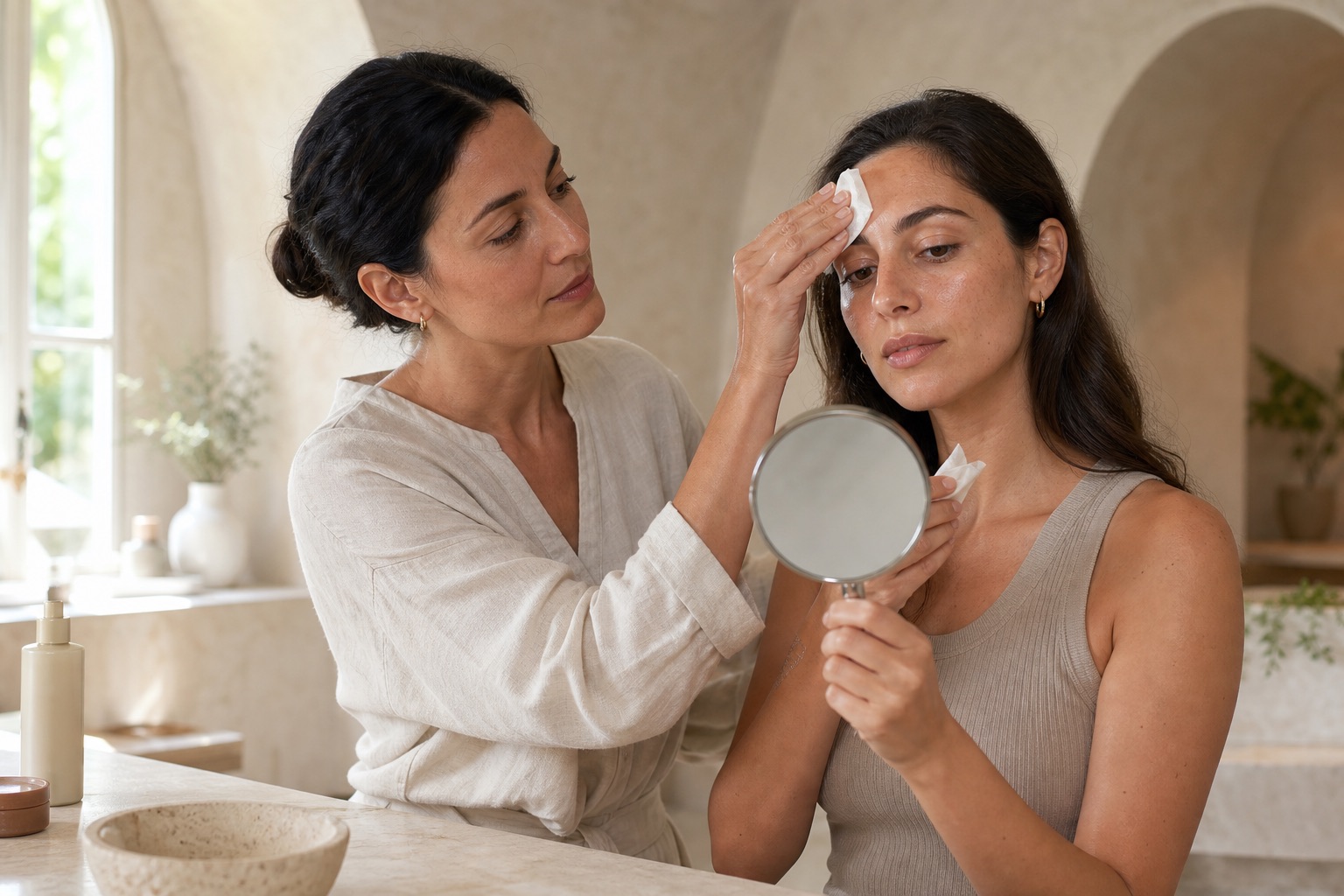

Stinging, burning, itching and tightness can occur even when the skin looks unchanged. Choosing a bottle labelled ‘sensitive’ does not explain why this is happening. A useful approach separates a recurring tendency from a temporary period of increased reactivity, reduces the number of variables and records tolerance without turning a skincare routine into a home diagnosis.
Quick answer: sensitive skin describes a persistent or recurring tendency to unpleasant sensations in response to stimuli that would not normally cause them. ‘Sensitised skin’ is a non-standard cosmetic expression for reactivity that appears or worsens after overload, friction, climate, procedures or products. The two can overlap. Keep products that are already tolerated, simplify to cleansing only when needed, moisturiser and broad-spectrum sunscreen, then reintroduce one variable at a time. Persistent, recurrent or severe symptoms need medical assessment.
This page owns the sensitive-versus-sensitised intent: terminology, tolerance, a minimal routine and referral criteria. The damaged skin barrier guide owns cosmetic overload and recovery, while the skin types and conditions guide separates sebum, hydration and reactivity. Redness alone cannot diagnose rosacea, dermatitis or allergy.
Clara Salis presents this as cosmetic education. It requires independent dermatological review and has not been medically reviewed. It cannot diagnose a skin condition, identify an allergen, prescribe treatment or replace advice from a dermatologist, pharmacist or clinician who knows your history.
Sensitive and sensitised skin: the useful distinction
An international expert definition describes sensitive skin as unpleasant sensations — including stinging, burning, pain, itching and tingling — caused by stimuli that should not normally provoke them. The skin may look normal or show redness, and the symptoms should not be better explained by a skin disease. That definition describes a syndrome for research and clinical discussion; it is not a checklist for self-diagnosis.
‘Sensitised skin’ is used differently in beauty and skincare education. It usually describes an acquired or temporary reduction in tolerance after a new active, several simultaneous changes, repeated cleansing, friction, a procedure, shaving, cold, wind, heat or low humidity. It is not a standard medical diagnosis and it does not prove that the barrier is ‘destroyed’. It is a working description that supports a cautious next step: reduce load and observe.
Timing matters, but it does not prove causation. A pattern present for years and triggered by different exposures differs from burning that began after three new products in one week. Equally, a long history does not exclude rosacea or dermatitis, and a recent reaction does not prove that the newest product is responsible. Date of onset, location, sensation, duration, visible signs, exposures and recurrence are more informative than the label you choose.
Describe sensations and signs before interpreting them
Use concrete words: stinging, burning, warmth, itching, tightness, tenderness or pain. Add intensity, duration and distribution. A brief tingle beside the nose is not equivalent to burning that grows across the face and neck. Photographs taken in consistent light can document visible change, but they cannot measure pain, itch, barrier function or cause.
Record visible redness, swelling, scale, cracks, papules, blisters, discharge or crust. Sensitive skin can look normal, but persistent lesions require a differential diagnosis. Atopic dermatitis, seborrhoeic dermatitis, allergic or irritant contact dermatitis, rosacea and other disorders can coexist with sensitive skin or resemble it. Repeatedly buying a new ‘calming’ product is not a substitute for assessment.
Sebum and sensitivity are separate dimensions. Skin can be oily and reactive, dry and tolerant, or combination and temporarily sensitised. Use the oily and combination-skin routine for zone-based sebum management and the dry-versus-dehydrated guide for lipid deficiency and water-related tightness. Neither should absorb the distinct intent of reactivity.
What can temporarily increase skin reactivity
Common contributors include introducing several actives together; using exfoliants, retinoids or spot treatments too frequently; long contact with hot water; repeated cleansing; scrubs, brushes and rough towels; close shaving; professional procedures; removing resistant makeup with pressure; and exposure to wind, cold, heat or dry indoor air. The relationship is individual and the same exposure may be tolerated at one time and not another.
A medicine or clinician-directed procedure can also alter comfort and tolerance. Do not stop, dilute or reschedule prescribed treatment on the basis of a general article. Contact the prescriber if side effects make the plan hard to follow. The aim of cosmetic support is to reduce unnecessary friction and complexity, not to override clinical instructions.
Do not use ‘detox’, ‘purging’ or ‘the product is working’ to explain every deterioration. Increasing itch, swelling, painful rash, blistering or symptoms in unexpected areas are not useful adaptation targets. Pause experimentation and assess the pattern. If symptoms are significant, progressive or recurrent, ask a clinician rather than conducting a series of challenge tests at home.
A simple routine: purpose, duration and ground rules
A minimal routine does not cure sensitive skin. It reduces variables, contact time and friction so that tolerance becomes easier to interpret. Some mild overload settles after a few days of simplification; other presentations persist because the cause is different. There is no mandatory recovery calendar, and worsening symptoms should not be watched until an arbitrary deadline.
Keep products that are necessary and already tolerated. Remove optional extras rather than replacing everything. Do not discontinue prescription medicines without the prescriber. Introduce no more than one new cosmetic at a time, avoid brushes and scrubs, use lukewarm water and pat rather than rub. A simple formula is useful only if the finished product is effective and tolerable; the shortest ingredient list is not automatically the best.
For the complete order of a stable routine, read the morning and evening skincare pillar. The sequence below is intentionally reduced. It is designed to answer one question at a time: does the skin tolerate the cleansing method, moisturiser and sunscreen needed in daily life?
Morning routine for sensitive or sensitised skin
Step 1 — Decide whether morning cleansing is necessary
If there is no resistant residue to remove, lukewarm water or no wash may be sufficient. When sweat, sebum or a treatment requires cleansing, use a tolerated mild cleanser briefly and rinse thoroughly. More foam and a tight finish do not indicate a better clean. The cleansing and double-cleansing guide explains how to match the method to the film being removed.
Step 2 — Apply one tolerated moisturiser where needed
One formula can combine humectants, emollients, occlusives and barrier lipids. Four separate layers are not required. Select a texture that spreads without rubbing, does not sting and maintains comfort for the intended period. The guide to humectants, emollients, occlusives and ceramides explains functions without turning one ingredient into a universal solution.
Step 3 — Finish with broad-spectrum sunscreen
Choose a sunscreen that can be applied at the labelled amount without persistent stinging, heavy rubbing or pilling. Mineral and organic filters do not form a universal tolerance ranking; vehicle, dispersion, fragrance, alcohol, eye area and individual response all matter. The daily face-sunscreen guide covers amount, texture and reapplication. Add shade, clothing and exposure management when tolerance limits product use.
Evening routine: remove the day's film with the minimum effective method
Step 1 — Match removal to sunscreen and makeup
A resistant film may need an oil-based or biphasic first cleanser followed by a mild water-based cleanser. A day without tenacious makeup may need one step. Double cleansing is a strategy, not an obligation or a sign of superior hygiene. Use fingertips, short contact and complete rinsing; do not scrub until a pad appears perfectly white.
Step 2 — Restore comfort without adding a treatment stack
Apply the tolerated moisturiser according to its directions, adjusting amount by zone. If cheeks need more occlusion than the forehead, vary the amount instead of adding a full-face layer. Do not use burning as evidence of efficacy. If a prescribed product is part of the evening plan, follow the clinician's order and contact them when tolerance prevents consistent use.
Step 3 — Keep the routine stable long enough to observe
Avoid changing cleanser, cream and sunscreen in the same weekend. A stable base does not mean ignoring a reaction; stop earlier for increasing symptoms. It means that, in the absence of warning signs, one controlled change gives more useful information than a rotating shelf of soothing masks, mists and serums.
How to choose cleanser, moisturiser and sunscreen
Cleanser: judge the complete method
Assess what must be removed, contact time, water temperature, rinsing and comfort in the next thirty minutes. Foam, texture and a declared pH cannot predict tolerance alone. If removal requires repeated pressure, change the solvent or format before choosing a harsher second cleanser. Avoid cleansing brushes and rough cloths during reactive periods.
Moisturiser: function is more useful than an ingredient hero
Glycerin, ceramides, petrolatum, dimethicone and many other ingredients can support different functions in suitable formulas. Concentration, vehicle, preservation, packaging and amount affect the finished experience. ‘Non-comedogenic’ does not mean ‘suitable for sensitive skin’, and ‘for sensitive skin’ does not guarantee freedom from irritation or allergy.
Sunscreen: tolerance must support adequate use
Assess protection, water resistance, fragrance, alcohol, eye comfort, visible cast and compatibility with moisturiser or makeup. A theoretically elegant formula fails in practice if it stings so much that the applied amount is too small. If every sunscreen causes a reaction, seek professional help rather than abandoning photoprotection or repeatedly challenging inflamed skin.
Fragrance, INCI and sensitive-skin claims
If fragrance is a known trigger, ‘fragrance-free’ is generally more informative than ‘unscented’: a product with no noticeable smell may still use fragrance-related ingredients to mask odour. Essential oils and botanical extracts can contain fragrant components too. This does not make every fragranced product unsafe for everyone; it means a person with a diagnosed allergy needs to identify and avoid the specific allergen.
The European Union expanded individual fragrance-allergen labelling through Regulation (EU) 2023/1545. Finding a listed allergen in the INCI does not establish that the cosmetic is unsafe or that it caused a symptom. Labelling mainly enables people who already know their sensitisation to recognise an exposure. Product-market transition dates also mean labels can change over time.
‘Hypoallergenic’, ‘dermatologically tested’, ‘clean’, ‘natural’ and ‘suitable for sensitive skin’ are not zero-risk guarantees. Ask what was tested, on whom, how and with what outcome. Natural origin does not predict gentleness, and synthetic origin does not predict irritation. Evaluate the finished formula, instructions, exposure and personal history.
At-home tolerance testing: method and limits
How to screen a new finished product
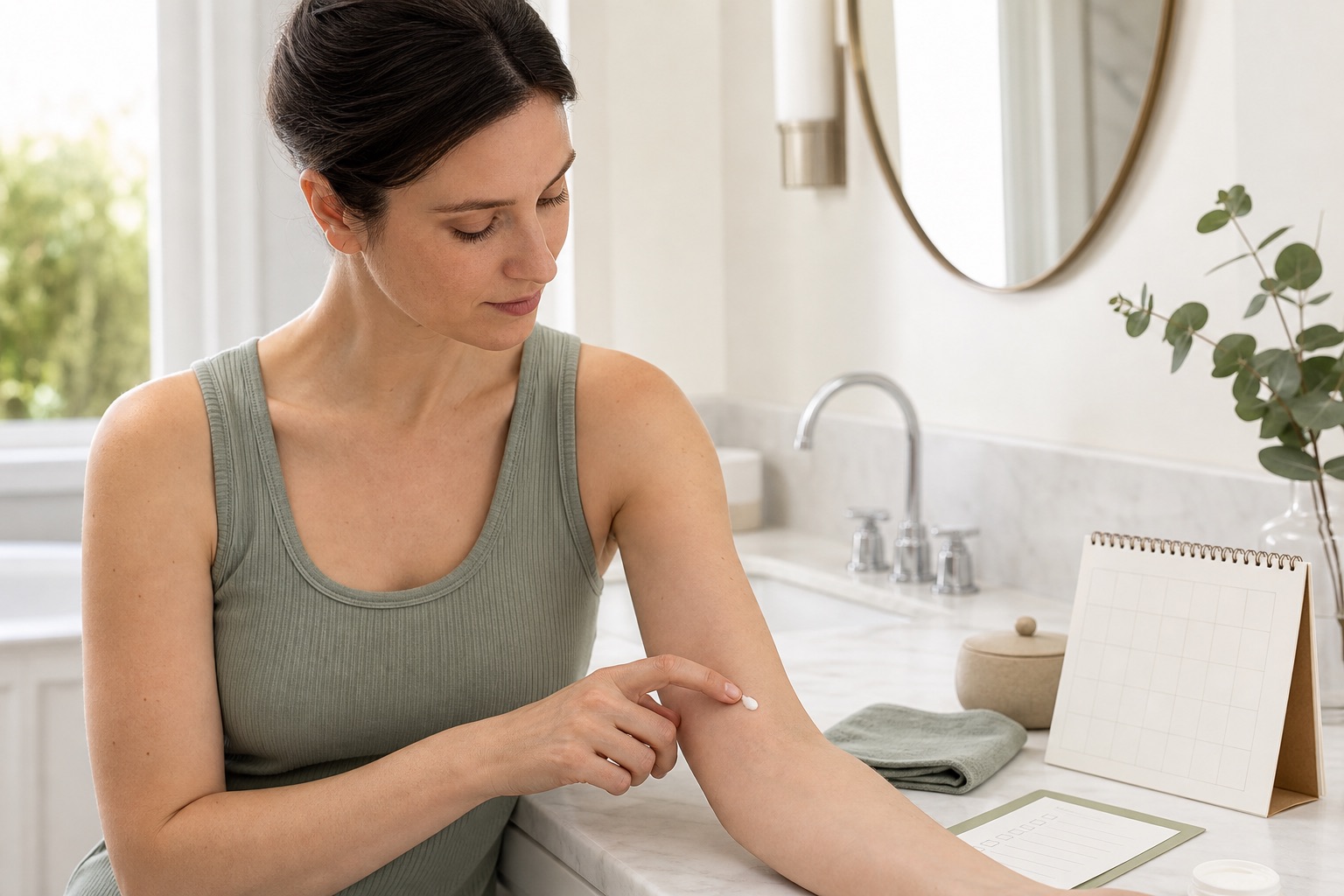
The American Academy of Dermatology advises applying the normal amount to a small intact area twice daily for seven to ten days. A rinse-off cleanser should remain only for its normal contact time and then be rinsed. Choose an area that is easy to observe and unlikely to be rubbed or washed away, and follow the product directions. Do not deliberately retest a product that caused a significant reaction.
What a negative test cannot prove
This is an orientation test of the finished product. It does not identify a responsible ingredient, diagnose contact allergy or guarantee tolerance on the face, eyelids or already inflamed skin. Exposure differs by area, amount, frequency and combination. A negative result reduces uncertainty but does not remove it.
Home product testing is not medical patch testing
Diagnostic patch testing is planned, applied and interpreted by healthcare professionals using defined allergens, concentrations, timing and readings. It investigates delayed allergic contact dermatitis; it is not reproduced by putting a cosmetic under an adhesive patch overnight. If reactions recur or the cause remains unclear, take product packaging and a timeline to a dermatologist.
Reintroducing products and actives after the base is stable
Choose one objective and one variable
Wait until the basic routine is tolerated and sensations have returned to their usual level, with no active lesions or contrary medical advice. Select either a previously used product or one new active, not both. Keep cleanser, moisturiser and sunscreen stable, follow the most cautious labelled frequency and record dose, area, date and response.
Do not reintroduce every active on the same schedule
Retinoids, exfoliants, vitamin C products and niacinamide have different formulas and tolerance profiles. Use the skincare actives pillar to set priorities, the AHA, BHA and PHA guide for exfoliation limits and the retinol and retinal guide for cosmetic retinoid precautions. Sensitivity does not create a universal ban, but it makes restraint and a readable baseline more important.
Do not raise concentration simply because a product is tolerated at first. The vitamin C guide and niacinamide guide explain why formula, pH, vehicle and total routine load matter more than chasing the largest number on a label.
A tolerance diary that produces useful evidence
Record date, area, product, amount, frequency, the rest of the routine, recent procedure or climate exposure, sensation, intensity, duration and decision. A zero-to-three scale is sufficient if the descriptive words remain consistent. ‘Burning 2/3 on both cheeks for twenty minutes’ is more useful than ‘my barrier is ruined’.
Compare similar days and avoid changing several products together. Improvement after removing one product is a temporal clue, not proof of allergy. Recurrence after deliberate re-exposure may be clinically relevant but should not be provoked after a meaningful reaction. Bring the diary, unfiltered photographs and packaging to the dermatologist when a pattern persists.
Include practical outcomes: whether sunscreen could be applied at the full amount, whether cleansing required rubbing and whether discomfort interrupted sleep or work. Tolerance is not only a score at the moment of application; it includes whether the routine is sustainable and whether symptoms affect daily life.
Keep barrier impairment, rosacea and contact allergy separate
Barrier impairment can increase water loss and susceptibility to irritants, but a person cannot confirm it from tightness alone. The barrier article owns overload, recovery and minimal-care decisions. Sensitive skin is a sensory pattern; it may coexist with barrier changes but should not be used as their synonym.
Rosacea is a medical condition with its own diagnostic features. Flushing, persistent central redness, papules, visible vessels or eye symptoms deserve evaluation; a selfie or sensitivity questionnaire cannot confirm it. This English guide deliberately does not link to an untranslated makeup page or teach colour correction, because cosmetic coverage and clinical assessment are separate intents.
Allergic contact dermatitis is a delayed immune reaction to a specific substance, while irritant contact dermatitis does not require prior sensitisation. Burning after over-cleansing, itching under a fragranced product and a recurring eyelid rash may have different mechanisms. A home tolerance test cannot distinguish them. Persistent rash, recurrence or uncertainty belongs with a dermatologist and, where indicated, diagnostic patch testing.
A responsible protocol for beauty and skincare professionals
Collect a non-diagnostic client record
Record reported history, location, sensations, duration, products, procedures, medicines, known allergies and clinicians already involved. Describe what is observed without labelling it ‘allergy’, ‘rosacea’ or ‘barrier damage’. Obtain specific consent for photographs and store them according to privacy requirements; marketing use needs separate permission.
Define the service boundary before touching the skin
Do not perform a cosmetic procedure on active rash, broken skin, blisters, discharge, marked swelling or unexplained pain. Do not promise desensitisation or advise stopping medicine. Provide a written cosmetic routine with function, order, indicative amount, frequency and stop criteria, and refer when the presentation is outside a cosmetic service.
Make follow-up measurable
Agree what will remain unchanged, what one variable is being assessed and when to review. Document the product and batch when relevant. If symptoms worsen before follow-up, the client should not wait for the appointment. Explore online skincare courses for structured work on cosmetic observation, formulation, client communication and professional limits.
When to see a dermatologist or seek urgent care
Arrange medical assessment when burning, pain or itching persists, returns frequently or affects daily life; when a rash, swelling, blisters, discharge, crusting or cracks appear; when the eyelids, lips or eyes are involved; when several unrelated products cause reactions; or when the condition worsens rapidly. Assessment is also appropriate when it is unclear whether rosacea, eczema, contact dermatitis or another disorder is present.
Bring a timeline, photographs, ingredient lists and the actual packaging where possible. A clinician may decide that diagnostic patch testing or another examination is appropriate. Do not cover an active unexplained rash with repeated cosmetic trials while waiting for it to identify itself.
Breathing difficulty, faintness, widespread blistering or rapid swelling of the lips, tongue, mouth or throat can be an emergency. Contact local emergency services immediately. An online guide, retailer, beauty professional or home patch cannot assess airway risk.
Frequently asked questions about sensitive and sensitised skin
Are sensitive and sensitised skin the same?
No. Sensitive skin describes a recurring tendency to unpleasant sensations from normally tolerated stimuli. Sensitised skin is a cosmetic, non-standard term for acquired or temporary reactivity after products, friction, procedures or environment. They can overlap, and neither term is a medical diagnosis.
Does sensitive skin always look red?
No. International descriptions allow normal-looking skin or redness. Sensation, trigger, duration and recurrence matter. Persistent central redness, papules, scale, cracks, blisters or eye symptoms should not automatically be attributed to sensitivity.
How long does sensitised skin last?
There is no universal duration because the term does not identify one cause. Mild cosmetic overload may improve after simplification, while dermatitis or a poorly tolerated treatment follows a different course. Persistent, recurrent or worsening symptoms need assessment rather than a cosmetic countdown.
What is the minimum routine for sensitive skin?
Cleanse only as much as the day's film requires, apply one tolerated moisturiser and use broad-spectrum sunscreen. Morning cleanser can be optional; evening removal depends on sunscreen and makeup. Keep known tolerated products and introduce only one new variable at a time.
Should I stop every product immediately?
Not automatically. Keep necessary products that are already tolerated, remove optional extras and never stop prescribed medicine without the prescriber. For a significant active reaction, stop the suspected cosmetic and seek advice rather than changing the entire routine daily.
Does hypoallergenic mean allergy-proof?
No. The claim cannot guarantee zero risk or predict one person's response. A diagnosed allergy requires avoidance of the specific allergen and careful label reading. A symptom after one product does not identify the ingredient responsible.
Are natural products gentler?
Not necessarily. Essential oils, fragrance and botanical extracts can irritate or cause allergy in some people. Natural and synthetic describe origin, not personal tolerance. Formula, concentration, exposure, preservation and individual history all matter.
Are mineral sunscreens always better tolerated?
No. They suit some people, but vehicle, dispersion, fragrance, alcohol, dryness, cast and eye-area behaviour influence use. Compare complete formulas at the correct amount, not ingredient categories in isolation.
Can sensitive skin use retinol or exfoliants?
There is no universal ban. Objective, formula, amount, frequency, other products and previous tolerance must be clear. Introduce one active only when the base is stable and follow the label or medical plan. Increasing burning is not a required adaptation stage.
Does a home patch test diagnose allergy?
No. At-home use testing observes the finished product on a small area. Diagnostic patch testing uses selected allergens and professional readings. A negative home test does not guarantee tolerance on the face or eyelids and cannot identify a culprit ingredient.
Are sensitive skin and rosacea the same?
No. Burning and redness can occur in both, but rosacea is a medical condition with specific features and management. Sensitivity cannot confirm or exclude it. Persistent flushing, central redness, papules, visible vessels or eye symptoms deserve medical assessment.
When should I see a dermatologist?
Seek assessment for persistent or recurrent burning, pain or itching; rash, swelling, blisters, cracks, discharge or crusts; eye or lip involvement; reactions to multiple products; rapid worsening or diagnostic uncertainty. Breathing difficulty or rapid mouth and throat swelling is an emergency.
Clinical and regulatory sources
Misery et al.: International Forum for the Study of Itch definition of sensitive skin syndrome. Read the PubMed record
American Academy of Dermatology: at-home testing of a new skincare product and the limits of that process. Read the AAD guidance
American Academy of Dermatology: recognising possible contact dermatitis and when recurring rash needs a dermatologist. Read the AAD guidance
European Commission: fragrance-allergen labelling and Regulation (EU) 2023/1545. Read the Commission guidance
Richters et al.: systematic review of non-invasive sensitive-skin measurements and their limitations. Read the PubMed record
Dreno et al.: narrative review of barrier function in dry, flaky and sensitive skin, with declared industry relationships. Read the PubMed record
Browse the English skincare guide hub for separate guidance on cleansing, hydration, barrier, actives, acne and sunscreen, or explore online skincare courses for structured professional learning.
To distinguish an acne lesion from a normal follicular structure and visible texture, read the blackheads, sebaceous filaments and visible pores guide for realistic skincare, strip and extraction limits.
For a cautious distinction between cosmetic discolouration and a mark that needs assessment first, read the facial dark spots and skincare guide for photoprotection, cosmetic options, measurement and dermatology referral criteria.
For a simple base when comfort, hydration and tolerance change over time, read the mature-skin skincare guide for essential care, photoprotection and the gradual introduction of one active at a time.
For a careful comparison of dryness, puffiness, structural bags and different dark-circle components, read the eye-area skincare guide for a simple routine, periocular safety and realistic cosmetic limits.
For a practical routine shaped by skin, shaving and facial hair rather than gendered packaging, read the men’s skincare guide for cleansing, moisturising, razor-bump prevention, beard care and sunscreen.
For a repeatable professional method that separates observation from diagnosis, read the cosmetological skin-analysis guide for type, current conditions, tools, documentation, privacy and referral limits.
To turn cosmetic observations and existing products into a plan a client can understand and follow, use the professional skincare-consultation protocol for intake, product audit, written handover, follow-up and referral boundaries.
For a proportionate record of products, reported reactions, separate permissions, photographs, retention and professional stop decisions, read the skincare client-record guide without turning cosmetic documentation into an improvised medical chart.
For a controlled hands-on protocol covering preparation, pressure, zone sequence, contraindications and realistic claims, read the cosmetic facial-massage guide and keep every movement inside professional scope.
For a verifiable clean-to-used workflow covering hands, textiles, tools, surfaces, cosmetic dispensing and turnover, read the skincare workstation-hygiene guide before designing or auditing a hands-on service.
If you are turning this topic into a structured learning plan, use the online skincare-course selection checklist to compare curriculum, teacher, demonstrations, practice, feedback, access, total cost and certificate wording without confusing private training with professional authorisation.
If you want to turn this knowledge into a defined service, continue with the guide to becoming a skincare consultant: it connects training, demonstrable skills, portfolio, boundaries, work models and a controlled launch without confusing cosmetic consultation, beauty treatment and healthcare.
Keep skincare and makeup decisions separate
Continue with makeup for rosacea and highly reactive skin.