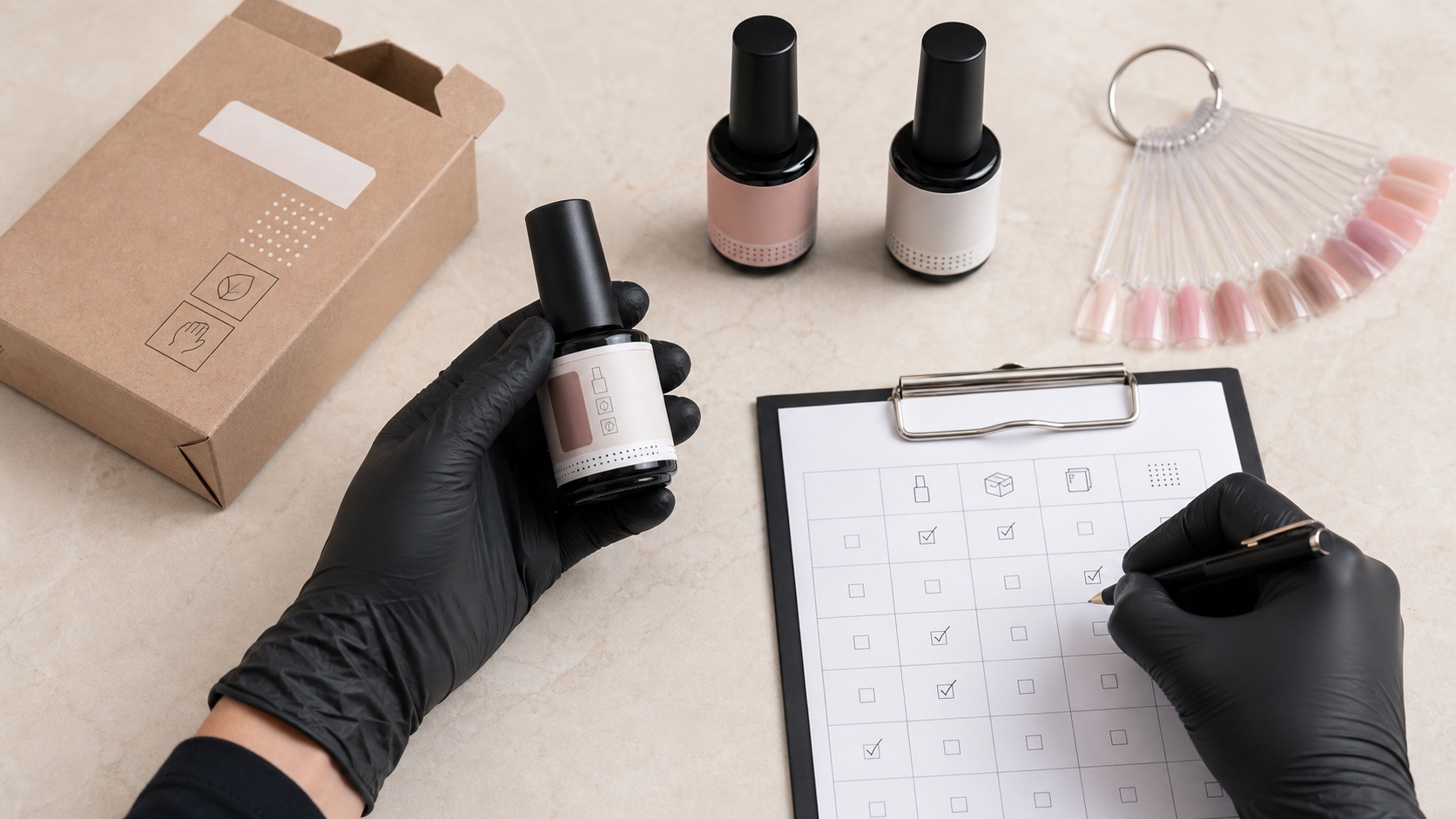
Before a gel, gel polish, primer, adhesive or remover enters a salon protocol, read the complete product label and packaging for the exact item and market. For an EU cosmetic, check the responsible person, nominal content, minimum durability or period after opening where applicable, precautions, batch reference, function and ingredient list. For a product made outside the EU, the country of origin must also appear. Missing or unreadable information is a purchasing and use decision—not a detail to reconstruct from a reseller post.
A professional-use statement, HEMA-free claim, QR code, CPNP notification or safety data sheet does not replace a compliant cosmetic label and does not prove that the product suits every client, lamp or technique. Preserve the original packaging, current instructions and batch traceability.
This English-language guide focuses on cosmetic nail products made available in the European Union, with notes for professionals working in Italy. It reflects official sources checked on 5 September 2026. It is not a legal conformity assessment, ingredient safety assessment or medical opinion. Importers, private-label brands and sellers have obligations beyond salon-level checks; if product identity, responsible person, labelling or notification is uncertain, stop and obtain documented clarification from the responsible economic operator or competent authority.
For the EU TPO prohibition and stock quarantine workflow, use the dedicated guide to TPO in nail products. For itching, swelling or eczema, consult the separate guide to gel nail allergy, methacrylates and HEMA. This page owns label reading and product traceability without diagnosing a reaction or rating formulas from one ingredient.
Seven core elements to check on an EU cosmetic label
Read the whole label as one compliance map
Container, box and leaflet can each hold required information
Identity
Responsible person and origin
Time
Minimum durability or PAO
Trace
Batch or identifying reference
Use
Function, warnings and Ingredients
Article 19 of Regulation (EC) No 1223/2009 sets the labelling framework. Information must be indelible, easily legible and visible on the container and packaging as required. Small packaging can use an attached leaflet, label, tape, tag or card for specific information, with the prescribed reference symbol where applicable. A QR code can add access, but it is not a general excuse to remove mandatory information from the physical product.
Element | What to identify | Salon decision |
|---|---|---|
Responsible person | Name or registered name and EU address | Quarantine if no identifiable EU contact |
Nominal content | Weight or volume at packaging | Confirm unit and pack identity |
Durability or PAO | Date or open-jar period when applicable | Record receipt and opening date |
Precautions | Warnings and professional-use conditions | Build them into training and protocol |
Batch | Manufacturing lot or identifying reference | Link product to stock and client record |
Function | Purpose unless clear from presentation | Do not invent an off-label role |
Ingredients | List introduced by Ingredients using common names | Preserve the exact list and market version |
Country of origin is an additional mandatory item for imported cosmetics. The label may also contain storage instructions, usage instructions, symbols, claims, distributor information and recycling details. Read all surfaces, inner container, outer box and any enclosed leaflet together. Never discard outer packaging before recording information that appears only there.
EU responsible person and country of origin
The responsible person is the EU-based legal or natural person responsible for compliance of the cosmetic placed on the market. Article 19 requires their name or registered name and address; where several addresses appear, the address where the product information file is readily accessible is highlighted. A marketplace seller, social profile or shipping warehouse is not necessarily the responsible person.
For imported cosmetics, the country of origin must be specified. ‘Designed in Europe’, an EU flag or a distributor address does not answer where the product was made. An overseas manufacturer can be part of a compliant supply chain when an EU responsible person fulfils the regulation; conversely, attractive EU-style branding does not prove that one exists.
If your salon imports directly from outside the EU, uses private label or alters product presentation, do not assume the obligations remain those of an ordinary end user. Obtain specialist regulatory advice before placing or making products available on the market. A nail technician’s label check is a procurement filter, not the complete responsible-person compliance process.
Minimum durability and PAO are not the same
Date before opening and period after opening
Do not convert one into the other
Minimum durability
Product unopened and stored correctly
PAO
Period begins at first opening
Condition
Change or damage overrides the calendar
Minimum durability tells you the date until which a cosmetic, stored appropriately, continues to fulfil its initial function and remain safe under the regulation’s conditions. For products with minimum durability of more than 30 months, that date is not required; where relevant, a period after opening can be shown with the open-jar symbol and a number such as 12M. PAO describes the period after first opening, not a guarantee from purchase date.
The open-jar clock begins when the product is first opened, not when it is first sold or first used on a client. Record the opening date on the container or stock system without covering mandatory text. PAO can be irrelevant for some formats, so absence is not automatically non-compliance. A minimum-durability date and a PAO are different tools and should not be converted into each other.
Neither date authorises use when the product has changed unexpectedly. Quarantine a container with altered odour, colour, texture, phase separation, leakage, damaged seal, unreadable label or contamination. Correct storage, clean dispensing and closing the pack after use remain necessary throughout the indicated period.
Batch or lot: the reference that makes the product traceable
A batch number or other identifying reference connects the container to a manufacturing run. It is not the expiry date, barcode, shade number, purchase order or PAO. On very small cosmetics it may appear only on the packaging, which is why the salon should capture it before discarding the box. Do not invent a batch from another bottle in the same shipment.
Create a stock record with product, variant, supplier, purchase or receipt date, batch, package status, opening date where relevant and disposal or quarantine action. The nail client-record guide explains how to link a client appointment to the exact product and batch without copying the full label file into every record. Traceability is valuable only when the information can be retrieved quickly.
Function, precautions and professional use
The cosmetic function must appear unless it is clear from presentation. Do not use a builder, primer, adhesive or remover for another purpose because the texture seems similar. Read application surface, preparation, layer, compatible system, lamp, time, removal, storage and any restriction. The label and instructions for the exact market prevail over an old tutorial or translated seller summary.
‘For professional use only’ is a condition, not an exemption from cosmetic law. It does not make missing responsible-person details, batch, warnings or ingredients acceptable. It also does not guarantee that anyone buying the product has suitable training. For products whose legal conditions restrict use to professionals, verify the exact ingredient restriction and follow the complete application and warning requirements.
Language matters. For products made available in Italy, specified mandatory information must appear in Italian under national application of Article 19, even on multilingual labels. An English-only warning cannot be assumed sufficient for an Italian-market product. Verify the destination market rather than treating packaging sold online as one universal EU version.
How to read INCI without turning it into a diagnosis
INCI identifies ingredients; it does not score the formula
List order does not reveal exact percentages or cure quality
Capture the exact Ingredients list
Verify names in official sources
Read warnings and intended use
Do not infer individual safety
The ingredient list is introduced by Ingredients and uses common ingredient names from the applicable glossary or recognised nomenclature. Ingredients above 1% are generally listed in descending order of weight at incorporation; those at 1% or less can be listed in any order after the higher-concentration ingredients, and colourants can follow specific rules. The list therefore does not normally disclose exact percentages.
Do not infer cure quality, final polymer exposure, viscosity, adhesion or allergy probability from list position alone. Two products containing a similarly named ingredient can differ in concentration, formulation, intended use and system instructions. A product without one named methacrylate can contain others. Use the label to identify and verify, not to award a green or red score to the whole formula.
If a clinician has identified a relevant allergen, preserve the exact product and ingredient list and follow medical advice; do not search for a near-synonym and declare another formula safe. The BeautyLearn INCI Analyzer can help parse names and functions, but the physical label, responsible-person information, instructions and professional assessment remain primary.
Open-jar, hourglass and leaflet-reference symbols
The open-jar symbol indicates the period after opening when PAO is relevant. The hourglass accompanies minimum durability in the regulation’s symbol set. The hand-and-book reference symbol directs the user to information supplied on an enclosed or attached leaflet, label, tape, tag or card when practical constraints apply. A symbol is meaningful only with the information it refers to; keep the leaflet with the product and stock record.
CPNP notification is not a public quality badge
The Cosmetic Products Notification Portal is the EU notification system used by responsible persons and, in defined circumstances, distributors to submit information before making cosmetics available on the market. Its information is accessible to competent authorities and poison centres or similar bodies for their stated purposes. CPNP is not a public consumer database or a certification logo for a salon to verify by scanning a code.
A seller’s statement that a product is ‘CPNP registered’ does not prove independent approval, effectiveness or correct label content. Notification is one regulatory obligation inside a larger framework that includes a responsible person, safety assessment, product information file, manufacture, labelling, claims and market surveillance. If notification status is material to your role, request evidence through the appropriate supply-chain channel instead of treating a badge as proof.
Safety data sheets: when they apply and what they do
A safety data sheet communicates hazard, handling, storage, disposal, transport, first-aid, fire and exposure-control information for substances or mixtures under REACH and CLP conditions. ECHA explains when an SDS must be provided to downstream users. There is no simple rule that every finished cosmetic product supplied to consumers must have an SDS merely because it is used in a salon.
Some professional nail products or associated chemicals may fall within SDS supply conditions, and a supplier may provide safety documentation voluntarily. Read the document, revision date, product identifier and language and integrate relevant controls. The presence of an SDS does not prove that the cosmetic label is compliant, that CPNP obligations are fulfilled or that the product-lamp combination is validated.
Keep current safety information accessible to staff, but do not post documents containing supplier or operational information indiscriminately. Train the team on storage, spills, ventilation, personal protection and disposal that genuinely apply. For airborne filing exposure and placement, use the guide to nail dust extractors, filters and workstation setup.
Claims such as HEMA-free, TPO-free and hypoallergenic
EU cosmetic claims must meet common criteria including legal compliance, truthfulness, evidential support, honesty, fairness and informed decision-making. A claim describes a supported characteristic within its scope; it does not replace the ingredient list or warnings. ‘TPO-free’ must not distract from whether the full current formula and stock comply with applicable restrictions. ‘HEMA-free’ does not mean methacrylate-free or zero allergy risk.
Treat ‘hypoallergenic’, ‘non-toxic’, ‘clean’, ‘vegan’, ‘cruelty-free’ and similar wording as claims requiring precise interpretation, not universal safety conclusions. Natural origin does not remove sensitisation or irritation potential. Ask what the claim means, which product version and market it covers and what evidence supports it. Never convert marketing language into medical reassurance for a client with a previous reaction.
Online purchases and imports: reasons to stop
A low price, fast shipping or familiar bottle shape cannot replace supply-chain traceability. Before purchase, confirm seller identity, exact product and variant, EU responsible-person details, country of origin for imports, readable images of mandatory label information, destination-market language, batch format, instructions and returns. Product photographs can be outdated or borrowed, so retain the listing and compare it with the item received.
No identifiable EU responsible person or address.
Ingredients, warnings, function or batch missing, blurred, covered or inconsistent across pack surfaces.
Sticker appears to hide original information or different bottles carry duplicated batch references without explanation.
Only seller-written translations are supplied for a product marketed in Italy.
Claims promise zero allergy, universal compatibility, medical treatment or cure without appropriate basis.
Container arrives open, leaking, altered, unsealed where expected or different from the ordered market version.
Quarantine the item rather than testing it on a client. Photograph the received package, record seller, order, batch and discrepancy, and contact the responsible operator. If safety or conformity remains uncertain, do not relabel or transfer the product to make it usable.
A salon inventory procedure that preserves traceability
Approve supplier and product only after checking complete label, market version and current restrictions.
On receipt, compare item with listing and order; record supplier, date, variant, batch and package condition.
Store label photographs, current instructions and relevant safety documents in a controlled master record.
Mark first-opening date when PAO applies without covering mandatory information.
Link each appointment to identifiable products and batches through the client-record system.
Run scheduled stock checks for PAO, minimum durability, label updates, restrictions, damage and recalls.
Quarantine first; investigate, return or dispose through the documented route without returning it to active stock.
Unlabelled, faded or decanted products
Do not use a cosmetic whose identity, batch, warnings or storage history can no longer be established. Handwritten names on an anonymous pot do not reconstruct the compliant label. Faded containers should be quarantined if the salon’s controlled record cannot unambiguously link them to the original product and batch. Never guess from colour or viscosity.
Decanting creates contamination, compatibility, stability and traceability problems and can change the role of the operator under applicable law. Keep products in original containers unless the manufacturer’s professional procedure explicitly requires temporary dispensing for immediate service in a suitable clean vessel. Never refill branded packaging with another product or combine residual batches.
If a client reports an unwanted effect
Advise the client to stop further exposure and seek appropriate healthcare; severe symptoms need urgent or emergency help. Preserve the exact product, batch, label and ingredient list, supplier, application area, sequence, lamp and time, removal, onset and factual client report. Do not diagnose from an image or promise that a product without one ingredient is safe.
Quarantine relevant stock without contaminating evidence, contact the responsible person or supplier and follow the applicable complaint, insurer and cosmetovigilance route. The Italian Ministry of Health explains that users, healthcare professionals and cosmetics-sector operators can report undesirable effects. A clear label and batch record support investigation; they do not by themselves establish cause.
Purchase and pre-use checklist
Trace the product from listing to client record
Approve, receive, open, use and quarantine with evidence
Approve
Supplier, version and complete label
Receive
Batch, seal and listing match
Use
Instructions, condition and client link
Quarantine
Missing, altered or uncertain product
Before purchasing | On receipt | Before each use |
|---|---|---|
Seller, exact version, responsible person and full label | Pack identity, batch, seal, condition and listing match | Identity, opening date, PAO or date, appearance and instructions |
Current ingredient restrictions, warnings and market language | Record label, instructions and relevant safety documents | Compatible system and lamp, clean dispensing and client link |
Product literacy belongs alongside technique. Review the guide to UV/LED nail-lamp compatibility and the controlled process for curing gel nails so label, instruction and equipment are read as one system. Browse the online nail courses for structured technical foundations; course completion does not replace regulatory product checks.
Frequently asked questions about nail product labels
What must appear on an EU nail gel cosmetic label?
The label framework includes the responsible person’s name and address, nominal content, minimum durability or PAO where applicable, precautions, batch reference, function unless clear and ingredient list. Imported cosmetics also state country of origin. Exact placement and exceptions follow Article 19.
What is the difference between expiry and PAO?
Minimum durability concerns the unopened product’s stated period under appropriate storage. PAO is the period after first opening during which the product is safe and suitable when the concept is relevant. One cannot be calculated reliably from the other, and unexpected change requires quarantine regardless.
When does PAO begin for a nail product?
It begins when the container is first opened, not on purchase or first client use. Record that date without obscuring the label. Follow storage and dispensing instructions and quarantine the product before the PAO ends if it changes, becomes contaminated or loses traceability.
Can I use a product without a batch number?
Do not use a product when the required batch or identifying reference cannot be found on the container or permitted packaging. Quarantine it and ask the responsible operator for documented clarification. A barcode, shade or batch copied from another bottle is not a substitute.
Who is the EU responsible person?
It is the EU-based legal or natural person responsible for specified regulatory compliance of the cosmetic. Their name and address appear on the label. The retailer, marketplace, shipper or overseas manufacturer is not automatically the responsible person.
Does CPNP notification mean a cosmetic is approved?
No. CPNP is the EU notification portal through which required product information is made available to authorities and poison centres. It is not a public approval mark, quality score or substitute for safety assessment, responsible-person duties, compliant labelling and market surveillance.
Does every finished cosmetic need a safety data sheet?
No universal rule says every finished consumer cosmetic has an SDS. REACH and CLP specify when safety data sheets are supplied for substances and mixtures. Some professional products or associated chemicals may require one. Its presence does not replace cosmetic labelling or prove conformity.
Are INCI ingredients listed from highest to lowest concentration?
Ingredients above 1% are generally listed in descending order of weight at incorporation. Ingredients at 1% or less may be listed in any order after those above 1%, with specific provisions for colourants. The list normally does not reveal exact percentages or final product performance.
Does HEMA-free mean the product cannot cause allergy?
No. It means the claim addresses HEMA within its supported scope; it does not mean methacrylate-free, irritant-free or zero risk. Read the complete ingredient list and warnings, avoid skin contact, cure with the validated system and refer previous reactions for medical assessment.
What does professional use only mean?
It indicates a use condition or restriction requiring professional knowledge and compliance with the product instructions. It is not an exemption from EU cosmetic requirements and does not excuse missing label information, unvalidated lamp use, unsafe application or inadequate training.
Can I transfer gel polish into a more convenient bottle?
Routine decanting can compromise identity, batch, warnings, stability, compatibility and hygiene and may alter regulatory responsibilities. Keep the original container. Temporary dispensing should occur only where the instructed professional method requires it, without returning remainder or relabelling stock.
How should I check a nail product bought online or outside the EU?
Check the seller, exact version, EU responsible person, origin for imports, complete readable label, destination-market language, batch, instructions and package integrity. Compare the received item with the listing. Missing or inconsistent information calls for quarantine, not a client test.
What should I preserve if a client reports a reaction?
Preserve product identity, batch, label, ingredient list, supplier, application area, service sequence, cure system, timing and the client’s factual report. Quarantine relevant stock, refer the client to healthcare, avoid diagnosis and follow the supplier, insurer and applicable cosmetovigilance process.
Official sources and review date
Italian Ministry of Health — cosmetic labelling: mandatory elements and language requirements for products made available in Italy.
European Union — Regulation (EC) No 1223/2009: responsible person, safety, notification, labelling, claims and undesirable effects.
European Commission — Cosmetic Products Notification Portal: purpose, users and authority access to CPNP.
European Chemicals Agency — safety data sheets: SDS purpose, contents and supply conditions under REACH.
Italian Ministry of Health — cosmetic product safety and cosmetic claims: safety assessment, surveillance and common claim criteria.
Substantively reviewed on 5 September 2026. Product formulas, labels, restrictions, instructions and market versions can change. Verify the current physical package, official documents and competent-market requirements before purchase and each use. This guide is professional education, not a conformity certificate, legal opinion, formula assessment or medical advice.