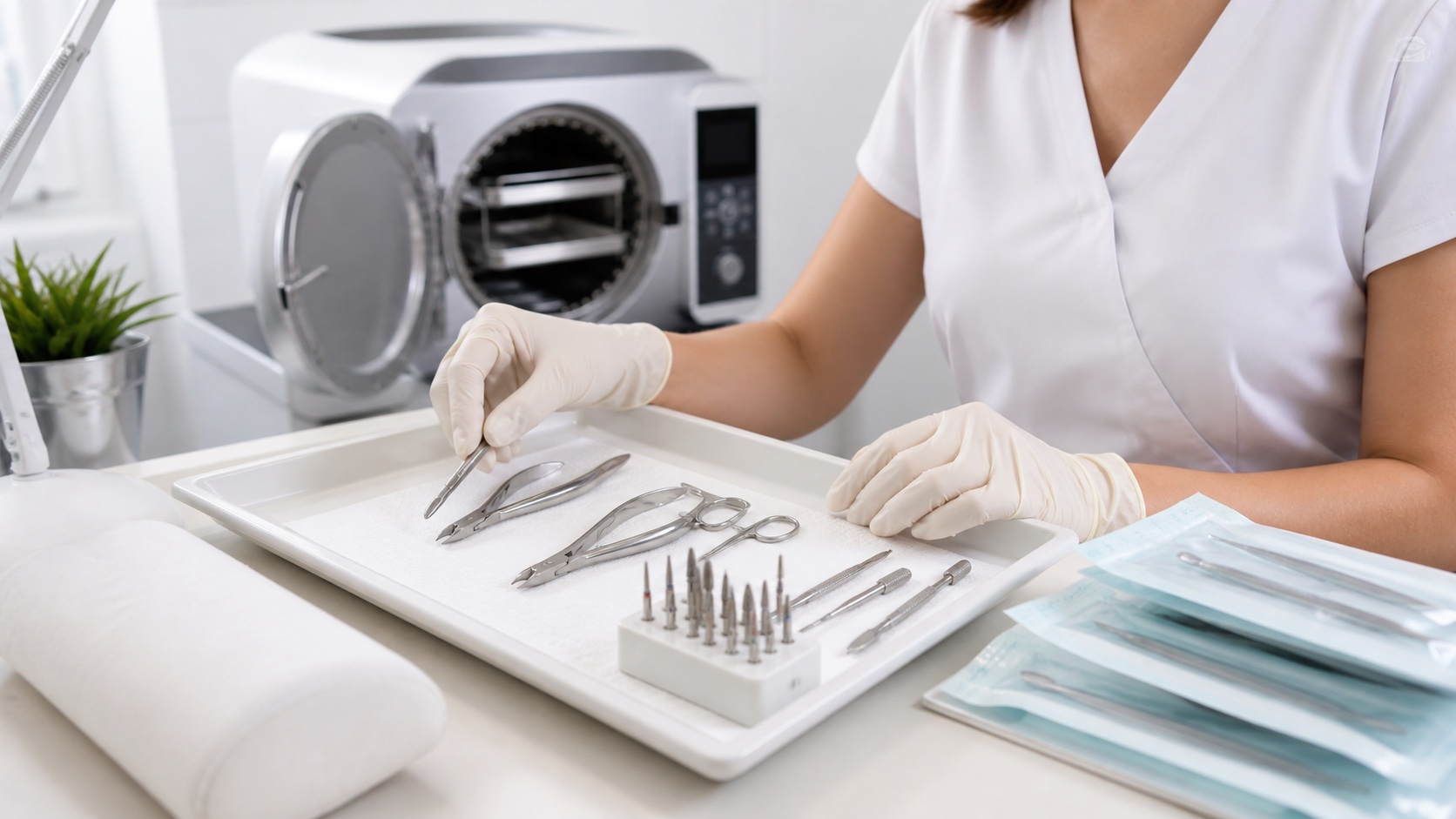

A nail client record should preserve the facts needed to deliver and reconstruct a service: who attended, what was requested, what the client reported, what was externally observed, why the service proceeded or stopped, which products and batches were used and which instructions were supplied. It is not a medical history and it is not a blanket waiver. A privacy notice, the lawful basis for necessary data, any condition for health-related information, service acknowledgement, photograph choice and marketing permission are separate decisions.
The record supports consistent decisions and traceability. It does not authorise diagnosis, make a contraindicated service safe, prove that a product was used correctly or release the practitioner from professional responsibility.
This guide reflects official sources checked on 5 September 2026 and is written for a professional nail-service context, especially within the EU and Italy. It is educational, not a downloadable form and not legal or medical advice. Have the actual questions, privacy notice, systems, providers, security, retention periods, service terms and incident process reviewed by an appropriate privacy lawyer or DPO and healthcare professional before use. That independent review has not yet been completed for this editorial guide.
If the client reports itching, swelling, blisters or eczema, use the guide to gel nail allergy, methacrylates and HEMA. For nail separation or green colour, follow the separate stop protocol for onycholysis and green nails. This page owns documentation and data handling; it does not replace either safety decision.
Client record or medical history? Use accurate language
Medical history is collected and interpreted by healthcare professionals for clinical assessment and care. A nail technician does not perform that role. ‘Client record and pre-service nail questionnaire’ is usually a more accurate name. If a business uses the phrase consultation or beauty history, the introduction should still state that answers are client-reported and observations are non-diagnostic, used only to decide whether to proceed, adapt or postpone within professional scope.
The distinction changes the questions. A complete disease list is rarely the right starting point. Ask about previous nail-service reactions, when they occurred, which areas were involved and what product was known; ask whether the skin and nails are currently comfortable and intact; record visible separation, colour change or damage neutrally. Every answer should lead to a defined service decision, not a clinical label.
Write ‘client reports itching around several fingers the morning after a previous gel service; product unknown’ rather than ‘HEMA allergy’. Write ‘green discolouration visible beneath a separated area; enhancement not applied and healthcare assessment advised’ rather than naming an infection. Source, timing and uncertainty make the record more useful and reduce the risk of a copied assumption becoming a permanent diagnosis.
Five separate layers—not one signature for everything
One client journey, five distinct purposes
Do not bundle required records with optional choices
Service
Decision, technique, products and outcome
Acknowledgement
Scope, limits and aftercare
Privacy
Purpose, basis, access and retention
Images
Technical, teaching or public use
Marketing
Separate optional contact choice
A client should understand what each document or choice does. Bundling service agreement, privacy, sensitive information, photographs and promotions under ‘sign here’ makes the process less transparent. Some data are necessary to organise or document the service; some information receives higher protection; photographs can have several purposes; marketing is optional. Separate layers also make later withdrawal or correction manageable.
Layer | Purpose | Avoid |
|---|---|---|
Service record | Appointment, decision, technique, products, outcome and instructions | Calling it medical consent |
Service acknowledgement | Record scope, limits, maintenance and questions answered | A release from every responsibility |
Privacy notice and legal basis | Explain controller, purpose, basis, recipients, retention and rights | Generic ‘privacy consent’ |
Photograph choices | Distinguish internal record, restricted teaching and publication | One compulsory image permission |
Marketing | Optional promotional contact by specified channels | Turning booking contact into advertising permission |
What belongs in a nail client record
Every field needs a reason
Collect decisions and traceability—not a general medical history
Name the real purpose
Collect only necessary detail
Restrict access by role
Delete on the justified schedule
Apply GDPR data minimisation: collect information that is adequate, relevant and limited to what the purpose needs. More questions do not create more safety. Before adding any field, state which decision it supports, the lawful basis, who can access it, how long it remains useful and whether a less intrusive alternative works. If the business cannot answer those questions, do not collect the field by default.
Minimum identity and contact: name or client code and the channel authorised for appointment communication.
Appointment: date, location, practitioner, requested and delivered service, duration and agreed change.
Pre-service decision: relevant client reports, external observations and proceed, adapt, postpone or stop outcome.
Technique and design: preparation, product system, structure, length, shape, colour and repairs actually delivered.
Product traceability: identifiable base, builder, colour, top, primer, adhesive or solvent and batch where available.
Outcome and aftercare: discomfort, deviations, maintenance or removal guidance, next review and contact route.
Record governance: form version, update date, author of changes, image purpose and applicable retention category.
Use a separate inventory process for product legality, labels, batches and stock. The guide to TPO in nail products and EU stock checks shows why a client record can point to a product and batch without replacing the salon’s master stock register. When an instruction or formula changes, update the product record once and preserve which version was used at each appointment.
What not to ask without a real need
A routine list of diseases, medicines, surgery, pregnancy or family diagnoses can create a sensitive archive that the technician is not qualified to interpret. Even a short answer can reveal health data. Ask the privacy adviser whether the question is necessary, which GDPR Article 9 condition applies, whether the same decision can be reached with a narrower question and whether staff genuinely need access.
Avoid large blank boxes that invite unrelated medical stories. Use concise operational prompts and a limited relevant-notes field. Do not routinely copy test results, prescriptions or medical reports. If the nail or surrounding skin is not suitable, record the neutral stop reason and advise appropriate assessment. You do not need the later diagnosis to prove that the service was postponed.
Do not collect an identity document automatically because a date-of-birth field exists. If age or representative authority must be verified, design a separate proportionate process and record the verification outcome rather than retaining a copy without a defined reason. Billing data may belong in the accounting system rather than the technical service record, with different access and retention.
Previous reactions: useful questions without diagnosing allergy
Record facts, then make the stop decision
Do not convert a client report into a diagnosis
Report
Symptom, timing, area and previous service
Observe
Intact skin, comfort, separation or colour
Decide
Proceed, adapt, postpone or stop
Refer
Healthcare when assessment is required
‘Are you allergic?’ is too broad and depends on the client already knowing the diagnosis. Ask for observable history: after gel polish, enhancement, adhesive or removal, was there itching, burning, redness, swelling, blistering, eczema, pain or separation? When did it begin, which areas were involved and which product or service was used if known? Record the answer as reported, not as a conclusion.
Do not apply uncured gel to the skin or one nail as an improvised allergy test. Diagnostic patch testing belongs to healthcare. The European Commission’s SCCS opinion on HEMA and Di-HEMA stresses restriction to the nail plate and avoidance of adjacent skin contact; a small studio exposure cannot prove that a client will not react later and may add exposure.
Stop for pain, burning, bleeding, broken skin, marked redness, swelling, blisters, discharge, unexplained odour, significant separation or colour that requires clarification. Record what was seen and what the client said, without writing fungal infection or allergy unless that diagnosis comes from an appropriate clinician and is genuinely necessary to retain. Never cover a warning sign merely because the client signed.
Product and batch traceability at each appointment
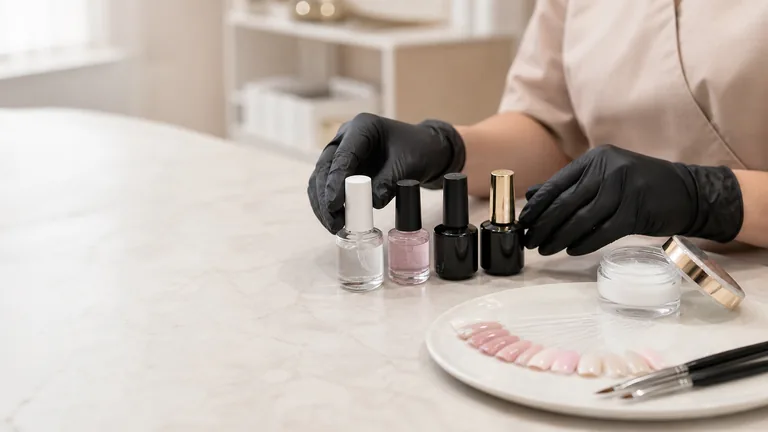
Record enough detail to identify the actual material: full product name, line and shade or variant; function in the service; batch or lot number where available; opening or expiry information when operationally relevant; and the compatible lamp or other system component when it affects safe use. ‘Pink gel’ and ‘brand X base’ are not sufficiently traceable when the range contains several formulas.
Keep a central product register for label photographs, INCI, supplier, safety information and batch evidence. The client record can link to an internal product code and record what was used. This avoids multiplying large files and sensitive client data. If a product is replaced during the service, preserve both the initial and substitute reference, the time and the reason rather than rewriting the plan.
Record | Example of useful detail | It does not prove |
|---|---|---|
Product identity | Full name, role, shade and internal code | Correct application or compatibility |
Batch or lot | Exact label reference linked to stock register | Expiry, opening date or absence of defect |
Delivered technique | Preparation, layers, structure, cure and changes | That an unwanted effect had one cause |
Service acknowledgement is not a waiver
A clear service acknowledgement can show that the objective, meaningful steps, realistic limits, maintenance, removal route, aftercare and stop conditions were explained, that the client could ask questions and that relevant information was updated. It cannot waive statutory rights, make negligence acceptable, validate a non-compliant product or justify continuing through a stop signal.
Make the wording proportionate. A manicure, gel-polish service, long enhancement and removal do not have identical considerations. Avoid ‘I accept all risks’ and ‘the salon has no responsibility’. State what will be delivered, which maintenance or removal route is expected, what not to do at home, how to report an issue and which signs call for healthcare rather than a cosmetic correction.
Privacy starts with purpose and lawful basis
GDPR does not require consent for every datum. The controller first identifies a purpose and an Article 6 lawful basis, such as steps necessary for a booking or contract, compliance with a legal obligation for fiscal records or a carefully assessed legitimate interest. Consent is one possible basis, not a universal permission called ‘privacy consent’. The client receives information about processing; they do not consent to the existence of privacy law.
Health data are a special category under Article 9 and processing is generally prohibited unless a specific condition applies. Contract necessity alone is not an Article 9 exception. Explicit consent may be considered where appropriate, but it must be freely given, specific, informed, unambiguous, demonstrable and withdrawable. It does not remove the duties of necessity, minimisation, security or professional scope.
The privacy notice should be available before or when data are collected, in language the client can understand. Article 13 information includes the controller, purposes and bases, relevant recipients, transfers, retention period or criteria, rights, complaint route, whether data are required and the consequences of not providing them. List booking software, cloud, messaging, accounting and other providers according to their actual roles rather than calling them all internal collaborators.
Photographs: technical record, teaching and publication differ
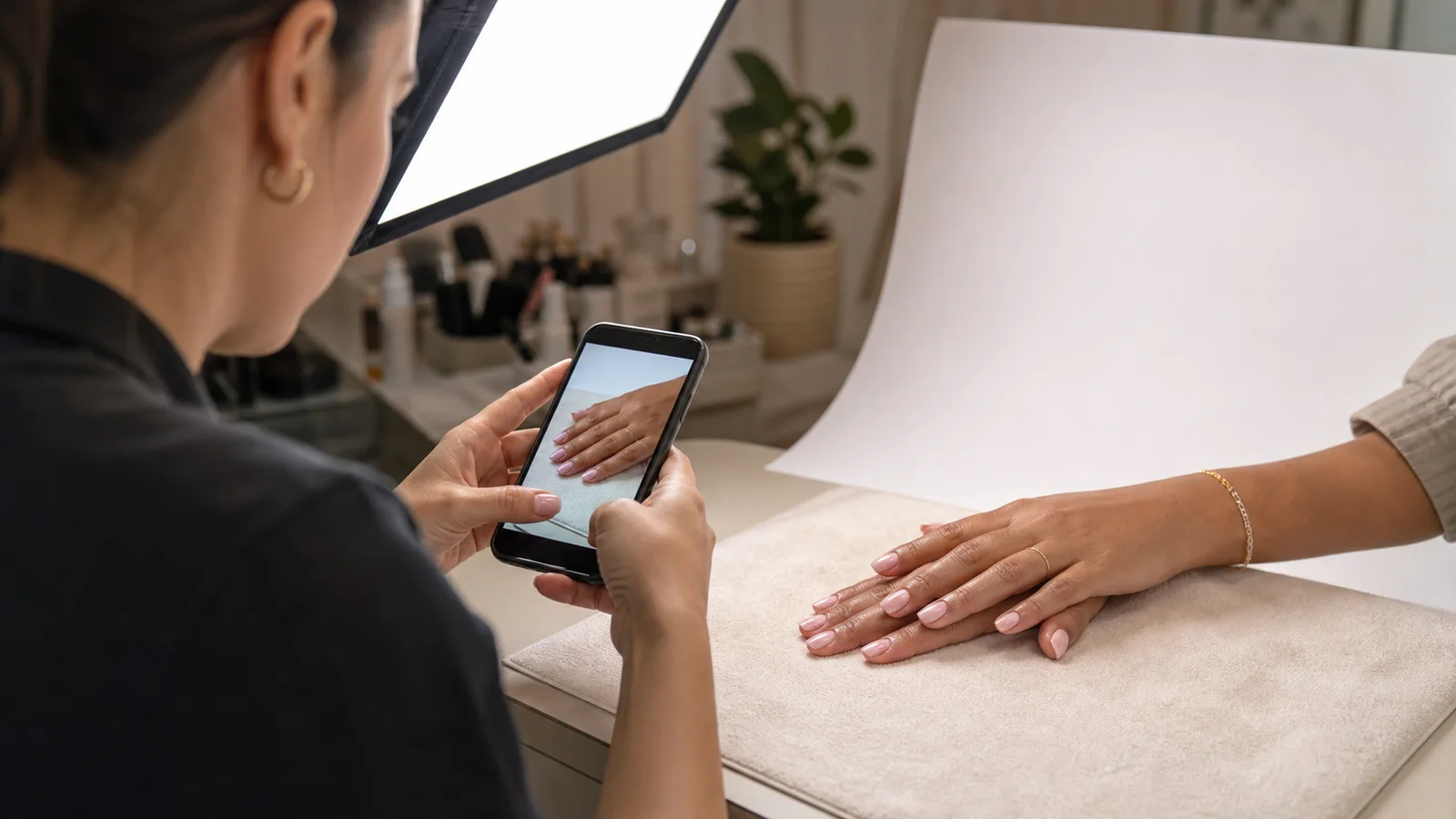
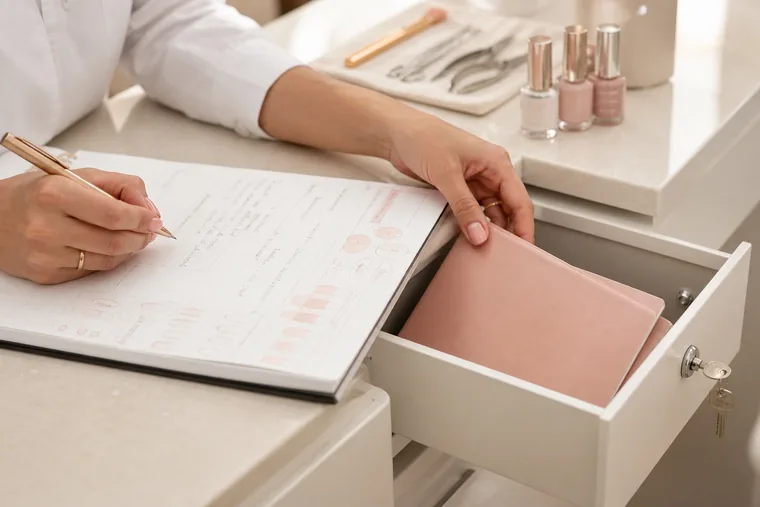
Define the purpose before taking a photograph. A close-up held in a restricted client record to compare structure or growth is different from an image shared with an educator, displayed in a portfolio, posted on social media or used in an advertisement. Each purpose needs its own necessity, notice, legal basis, access, retention and withdrawal handling. Do not take images automatically because the software contains a camera button.
Hands are not automatically anonymous. Tattoos, jewellery, scars, distinctive nail art, background, date, metadata and links to an appointment can identify a person. Crop and remove unnecessary context where appropriate, use a client code and keep the identity key separate from the image archive. Do not promise anonymity if the client or people around them could reasonably recognise the image.
Refusal of public images must not reduce normal service quality. Separate private technical documentation, restricted training use and public promotion into clear choices. The nail technician portfolio guide explains selection and presentation; this page governs the client-record purpose and permissions before any image enters that workflow.
Marketing must remain optional and reversible
A telephone number used to confirm an appointment does not automatically authorise newsletters, promotions or advertising audiences. If marketing relies on consent, use a separate unticked choice for specified channels and purposes. Preserve the date and version shown and make withdrawal as simple as joining. Refusing marketing must not block service or necessary appointment communications.
Retention: one period does not fit every field
Control the complete data lifecycle
Paper, software, photographs and backups all count
Collect
Purpose and minimum fields
Use
Named accounts and role-based access
Review
Accuracy, versions and incidents
Dispose
Delete or anonymise across copies
GDPR does not supply one universal retention period for every client record. Fiscal documents, contract evidence, technical notes, health-related data, internal photographs, public portfolio files and marketing preferences can have different purposes and legal needs. Define a justified schedule for each category, considering statutory duties, limitation periods, evidence, risk and storage limitation. At the endpoint, delete or anonymise data across systems, exports and devices.
Withdrawal of consent stops future processing based on that consent, subject to a reviewed basis for any limited retention still required. It does not rewrite history or automatically erase a valid accounting document. Explain the distinction and document the request, the decision and the systems actioned. Review retention whenever providers, services, law or business structure change.
Security for paper, software, phones and backups
Paper should be protected from clients, visitors and unauthorised staff, with controlled keys and a disposal process. Digital systems need named accounts, strong authentication, least-privilege access, supported devices, encryption where appropriate, secure backups, audit logs and tested deletion. A spreadsheet in a shared consumer cloud or photographs in a personal phone gallery are not secure merely because a password exists.
Map data flow from booking form to device, inbox, salon software, cloud, adviser, social scheduler and backup. Disable old staff accounts promptly. Avoid putting health-related details in a calendar or message preview visible at reception. Do not upload identifiable client records or photographs to an AI tool for summary unless purpose, contract, provider role, transfers, security and lawful basis have been deliberately assessed.
Corrections and versions must preserve the history
Date every client confirmation and form version. At a new appointment, ask about changes relevant to the service rather than presenting every old answer as current. Correct inaccurate data transparently: preserve the original where legitimate evidence requires it, record the corrected value, author, date and reason. Do not erase a stop decision or alter notes retrospectively to make the service appear different.
Version aftercare and service information too. ‘Aftercare supplied’ is weak if nobody can identify what the client received. Link the record to a dated instruction version and note any individual adaptation. This helps distinguish information that was actually supplied from advice written later and supports consistent practice across staff.
Minors need a dedicated process
A minor’s own signature does not answer every question about service authority, data processing or image publication. Requirements depend on age, service, law and context. Verify parental responsibility or other authority as appropriate, consider the young person’s understanding and best interests, minimise data and make public images a separate decision. If authority or suitability is uncertain, postpone rather than improvise.
Reactions, complaints and personal-data breaches
For a reported reaction, advise against further exposure, preserve proportionate product, batch, timing, area and sequence facts, and direct the client to appropriate healthcare. Severe symptoms require urgent or emergency care. Do not diagnose from a photograph or promise that a different brand is safe. The Italian Ministry of Health explains that users, health professionals and cosmetic-sector operators can report undesirable effects through cosmetovigilance.
For a complaint, preserve the relevant record and communications without adding blame. For lost paperwork, unauthorised access or an image sent to the wrong person, contain the incident and activate the data-breach process. The controller documents breaches and assesses risk; where GDPR notification criteria are met, the supervisory authority is notified without undue delay and, where feasible, within 72 hours. High risk can also require communication to affected people.
Not every incident must be reported externally, but every incident needs prompt documented assessment by the responsible person. The salon should know who receives an internal alert, how accounts are secured, which evidence is preserved and who contacts the privacy adviser, insurer, supplier or authority. Do not wait to determine whether the event becomes public.
A practical record workflow
Map purposes, fields, Article 6 bases, Article 9 conditions, providers, access and retention before collection.
Provide the current privacy notice and proportionate pre-service questions before the client is already seated.
Confirm relevant changes and document reported facts, external observation and operational decision separately.
Proceed, adapt, stop or postpone; record the neutral reason and information given.
Record delivered technique, identifiable products, batches, deviations, outcome and aftercare version.
Capture internal-photo, teaching, publication and marketing choices separately.
Store in the approved system, restrict access, reconcile changes and apply the deletion schedule.
Handle reactions, complaints, access requests, corrections, withdrawal and incidents through reviewed procedures.
Connect the record to the operating model described in the guide to opening a nail salon in Italy and keep fiscal records distinct with the guide to VAT, ATECO, tax and invoices for nail technicians. The client record is one governed system inside the business, not a substitute for qualification, hygiene, insurance or accounting.
Quality checklist before the form goes live
Non-clinical title, neutral wording and a clear explanation of professional limits.
Every field tied to a defined decision, purpose, basis, access group and retention category.
Separate service record, acknowledgement, privacy information, photographs and marketing.
Product and batch register linked without duplicating uncontrolled label files.
Article 13 notice delivered before collection with version evidence.
Named accounts, least privilege, backup, deletion, rights and data-breach response tested.
Specific route for minors, representatives, reactions, complaints and public images.
A template can reveal missing topics but cannot prove compliance. Adapt the design to services, premises, booking software, cloud, messaging, payment providers, staff and image workflow. Build professional foundations through the online nail course catalogue and how to become a nail technician. Connect the written record to the guide on cleaning, disinfection and sterilisation for manicure tools and the nail dust extractor and workstation protocol. Training still does not replace independent legal and medical review.
Frequently asked questions about nail client records
Is one standard nail client record legally mandatory?
There is no single universal form for every nail service. Contract, tax, product, safety, privacy, insurance and local professional obligations can still apply. A proportionate record organises evidence and decisions, but its content must match the actual service and jurisdiction rather than a downloaded template.
Should I call the form a medical history?
Client record or pre-service questionnaire is usually more accurate. Medical history has a clinical meaning. A nail technician records service-relevant client reports and non-diagnostic external observations; they do not interpret medical reports, diagnose disease or prescribe treatment.
Does the client have to consent to privacy?
There is no generic consent required for every use of data. The controller identifies an appropriate Article 6 lawful basis and provides information. Consent is used only where appropriate and must satisfy its conditions; health-related information, image purposes and marketing must not be bundled under one signature.
Can allergy and reaction information be health data?
Yes. A symptom, diagnosis, allergy or treatment can reveal health status and fall within GDPR Article 9. Collect it only for a defined necessary purpose, minimise the detail, restrict access and verify the applicable condition and safeguards with a privacy professional.
Can I patch test gel on one nail or on the skin?
Do not improvise diagnostic testing by applying uncured material to skin or a nail. Medical patch testing follows healthcare protocols, while a small salon exposure cannot rule out a later reaction and may increase exposure. An unexplained previous reaction calls for postponement and appropriate healthcare advice.
Does a signed waiver remove all practitioner responsibility?
No. A record can show what was reported and explained, but cannot make an unsuitable procedure, non-compliant product, poor hygiene or ignored stop signal proper. Avoid sweeping releases and have service acknowledgements and terms reviewed for the real business and jurisdiction.
How long should a nail client record be kept?
There is no one period for every field. Fiscal documents, contract evidence, technical notes, health-related data, private images, portfolio files and marketing choices may require different justified schedules. Define and apply them rather than retaining everything indefinitely.
Can records and photographs stay in WhatsApp or a personal phone?
Messaging, downloads, galleries and backups can create uncontrolled copies and access. Assess provider roles, accounts, transfers, device security and deletion. A personal phone should not become the default permanent archive for health-related notes or identifiable client images.
Do I need separate permission for photographs?
Different uses should be distinguishable. A restricted technical close-up is not the same as teaching access, a website, a social post, a partner repost or paid advertising. Explain purpose, channels, retention, withdrawal and realistic limits once an image is public.
How should I record a postponed or refused service?
Record the date, relevant client report and observable facts in neutral language, such as skin not intact, unexplained separation visible or increasing burning reported. State that the service was postponed and appropriate assessment advised, without adding a diagnosis or unnecessary medical detail.
What if a client reports a reaction after the appointment?
Advise against further exposure and direct the client to healthcare; severe symptoms require urgent or emergency help. Preserve proportionate product, batch, area, sequence and timing facts, do not diagnose from a photograph and follow reviewed complaint, insurer and cosmetovigilance procedures.
What if a record is lost or an image is sent to the wrong person?
Contain access, establish which data and people are affected, document the event and assess risk promptly. Notify the supervisory authority and affected people when GDPR criteria are met. Involve the responsible privacy adviser immediately rather than waiting to see whether the incident spreads.
Can I use a nail client-form template downloaded online?
A template may provide headings but cannot prove compliance. It may request excessive data, name the wrong providers, use an invalid basis, omit product traceability or bundle images with marketing. Map the actual service and data flow, then obtain tailored legal and healthcare review before use.
Official sources and scope
European Union — General Data Protection Regulation: Articles 5, 6, 7, 9, 13, 32 and 33 on principles, lawful bases, consent, special categories, information, security and breaches.
European Data Protection Board — Guidelines 05/2020 on consent: freely given, specific, informed, demonstrable consent and withdrawal.
Italian Data Protection Authority — fundamental processing principles and personal-data breach guidance.
Italian Ministry of Health — cosmetovigilance: undesirable-effect reporting by citizens, healthcare professionals and cosmetics operators.
European Commission Scientific Committee on Consumer Safety — HEMA and Di-HEMA opinion: sensitisation risk and the need to restrict uncured material to the nail plate and avoid adjacent skin.
Editorial review: 5 September 2026. This guide does not authorise clinical data collection, diagnose allergy or provide a compliant form for every salon. Have the real fields, notices, lawful bases, Article 9 condition, product register, providers, security, retention, image choices, stop rules and incident response independently reviewed before use.