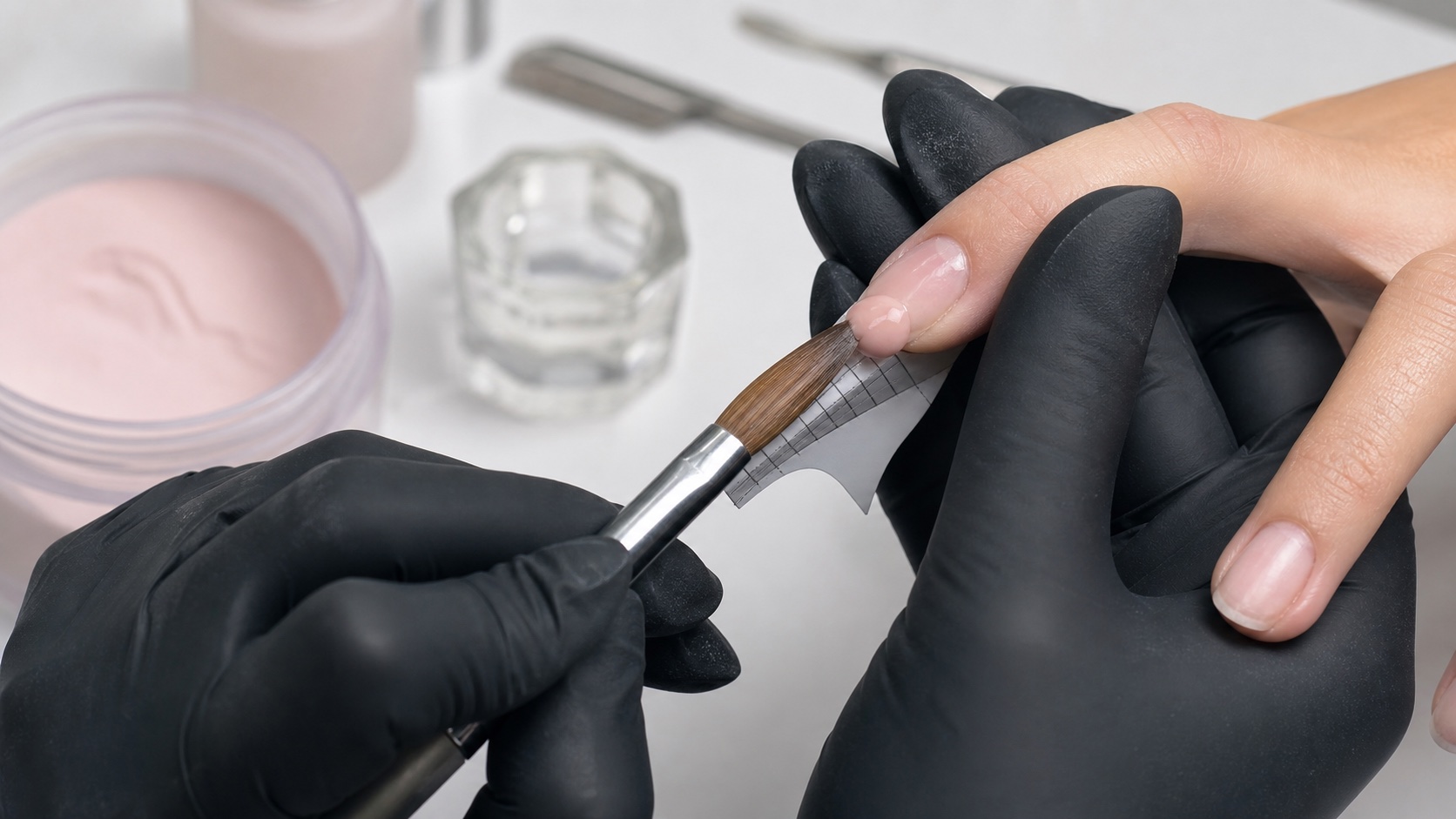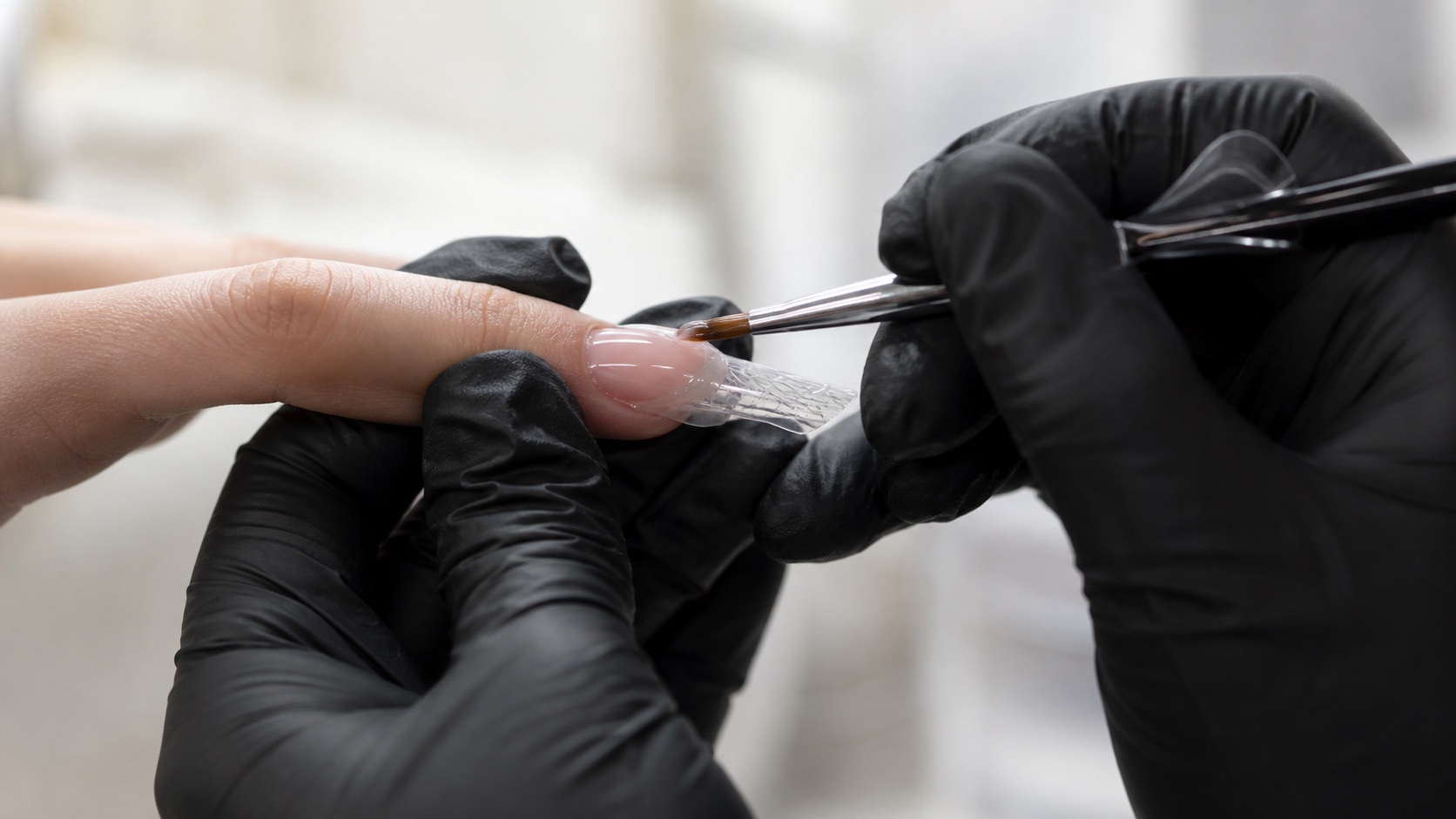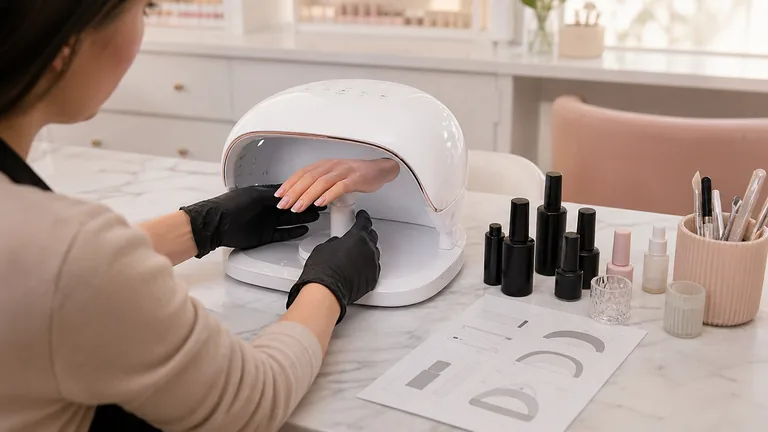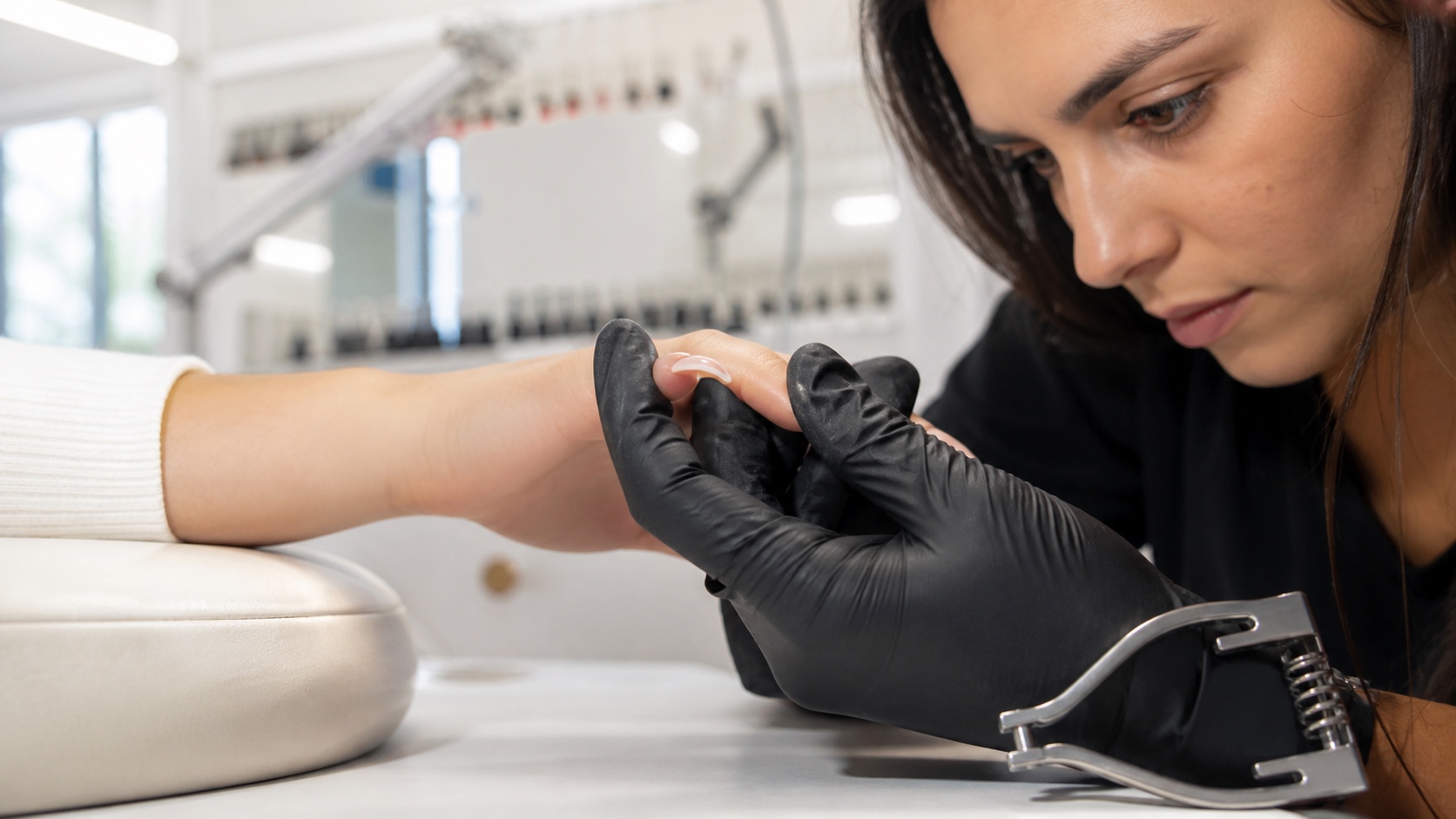
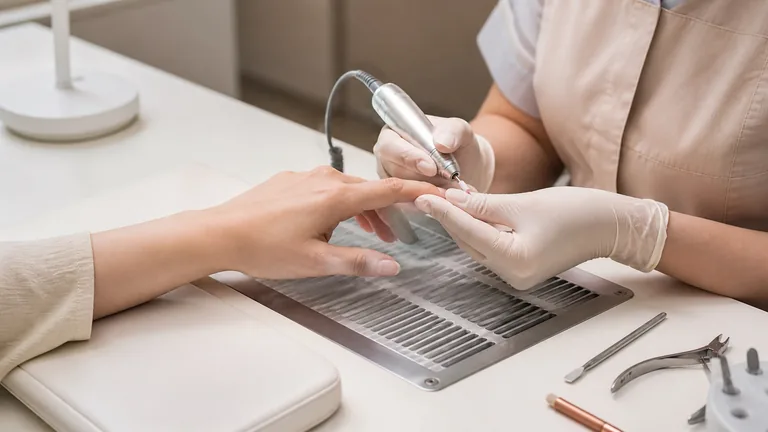
A nail dust extractor works best when it captures filing debris close to the point where it is generated, before the plume crosses the technician’s breathing zone or settles across the room. It is one part of exposure control—not a replacement for general ventilation, product management, cleaning, suitable personal protective equipment or a workstation that keeps hands close enough to the capture opening.
Do not choose extraction from watts, noise or visible suction alone. Ask what contaminant it is designed to capture, at what working distance, through which filter, where the cleaned or exhausted air goes and how performance is checked as the filter loads.
This guide owns dust extraction and workstation control. The electric nail file guide covers machine handling, the nail drill-bit guide covers bit selection and the professional filing guide covers manual abrasives. Here the question is what happens to particles after the tool meets the product.
Where nail dust, particles and vapours come from
Particles and vapours need different controls
Catching visible dust does not prove the room air is fully controlled
Coarse dust
Falls quickly but contaminates surfaces
Fine particles
Can travel with room air
Vapours
Require substance-specific control
Skin transfer
Needs product and hand control
Manual filing and e-file work generate particles from cured gel, acrylic, acrygel, gel polish, natural nail and abrasive wear. Particle size and trajectory vary with material, bit or file, speed, pressure, direction and moisture. Coarse fragments may fall quickly; fine material can remain airborne longer and travel with room currents. Dust visible on a black surface is evidence of escape, but an apparently clean surface does not prove that smaller airborne particles were controlled.
Liquids and uncured products can also release vapours. Acetone, solvents and volatile ingredients behave differently from solid filing dust. A particle filter can collect particles; it does not automatically remove gases or vapours. Activated carbon may adsorb some substances under defined conditions, but capacity, bed depth, contact time, contaminant and saturation matter. A small carbon sheet is not proof of comprehensive vapour control.
NIOSH notes that nail technicians may be exposed through inhalation, skin absorption and ingestion, and can face chemical and musculoskeletal hazards. Control therefore starts before the extractor: keep containers closed, dispense only what is needed, prevent skin contact, avoid food in the work zone and organise repetitive work and posture. The gel allergy guide explains why dust control cannot compensate for uncured product on skin.
Local extraction, air purifier and general ventilation are different controls
Control starts at the source
Local capture, room ventilation and PPE form layers—not substitutes
Source
Closed containers and controlled process
Capture
Local exhaust at the filing point
Room
General ventilation and cleaning
Person
Selected PPE and safe work practice
Control | Primary function | Important limit |
|---|---|---|
Local exhaust or downdraft extraction | Capture contaminant near the filing source | Performance falls with distance, poor hand position, leaks and loaded filters |
General room ventilation | Dilute and replace contaminated room air | Does not capture the plume before it crosses the breathing zone |
Portable room air cleaner | Filter some air after contaminants enter the room | Placement, airflow, filter and room size determine usefulness |
Personal protective equipment | Reduce individual exposure when correctly selected and used | Last line of defence; does not remove contamination from the room |
NIOSH recommends good general ventilation and describes local exhaust controls at nail workstations, including portable units and downdraft ventilated tables. The two work together: local extraction aims to intercept the plume, while general ventilation manages contaminants that escape and other room sources. Opening a door intermittently is not a measured ventilation design, and a room purifier across the salon is not source capture.
HSE defines local exhaust ventilation as an engineered system that captures airborne contaminants at or near the source. A recirculating system returns filtered air to the workplace rather than discharging it outdoors. HSE’s 2025 research review warns that a wrong, ineffective or failed filter can return harmful contaminants to the room. Recirculation therefore needs evidence of suitable filtration, performance and maintenance—not just a bag that catches visible dust.
Types of nail dust extractor and their practical trade-offs
A desktop unit sits on the work surface and may be easier to add or move, but its height changes wrist position and can reduce working space. An integrated downdraft unit places the inlet in the table and can support a flatter hand position, but installation, ducting, electrical safety, access and cleaning need planning. A source-capture arm or hood can be positioned near a task, yet may obstruct visibility if its geometry is not designed around manicure work.
Some units discharge outdoors through ducting; others filter and recirculate air. Outdoor discharge avoids returning captured particulate to the room when properly designed, but requires a competent installation, make-up air and compliance with building and environmental rules. Recirculating systems are easier to place but depend completely on filter suitability, seals and timely replacement. A removable dust bag is not equivalent to a documented high-efficiency filter system.
There is no universally best form factor. Map the service: manual shaping, product removal, pedicure, source position, client hand height, working distance, hours per day and available ventilation. A powerful unit placed beyond the dust trajectory can underperform a well-designed inlet used close to the source.
How to choose a nail dust extractor beyond wattage
Electrical watts are not capture performance
Evaluate the complete air path under realistic use
Capture
Inlet, distance and hand position
Air path
Filter, seals and exhaust route
Loaded state
Resistance and maintenance signal
Workability
Posture, noise and cleanability
Watts describe electrical power consumption, not capture efficiency. Two motors with the same input can produce different airflow under filter load. Marketing airflow values may be measured without the working filter, at a different pressure or at the fan rather than the capture opening. Ask for the stated airflow and test conditions, filter class or documented efficiency, pressure or loaded-filter behaviour, working distance, noise at a defined measurement point and replacement-filter availability.
Contaminant scope: filing particles only, or an engineered claim for specific additional contaminants?
Capture geometry: inlet area, guard, recommended distance and hand position.
Air path: outdoor exhaust or recirculation, with seals that prevent bypass.
Filter evidence: type, efficiency statement, capacity, replacement interval and disposal method.
Serviceability: safe access, cleanable surfaces, spare parts and a maintenance record.
Workability: noise, vibration, client comfort, visibility and neutral wrist posture.
Treat a ‘HEPA’ statement as the start of verification rather than the end. Ask whether it applies to the complete installed filter, which standard and efficiency are claimed, and whether air can bypass the media around edges. A high-efficiency filter downstream cannot capture dust that never reaches the inlet. Avoid unsupported promises such as ‘removes 100% of nail dust’ or ‘protects from all chemicals’.
Filters, activated carbon and the limits of recirculation
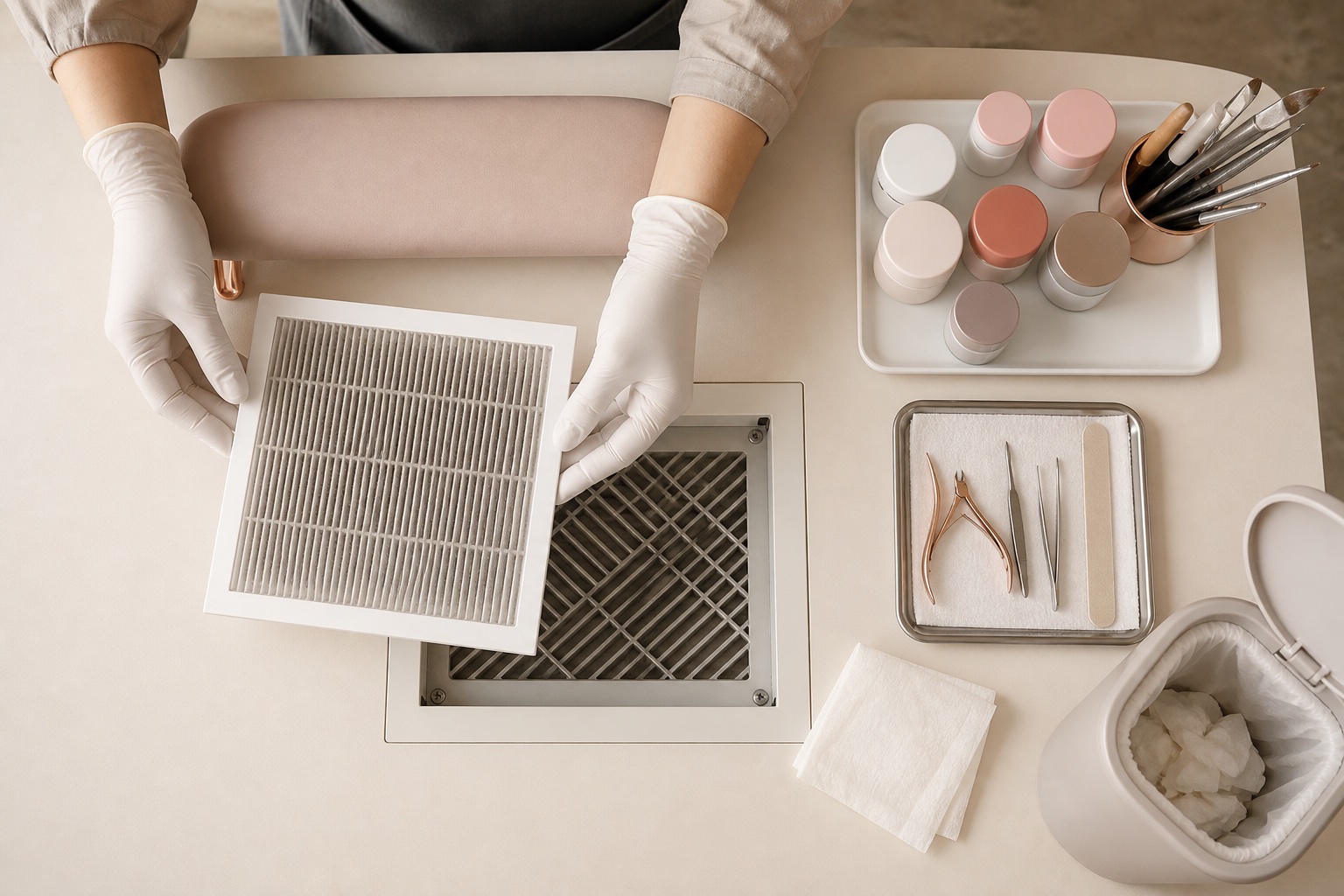
Particle filters load as they collect material. Loading can increase resistance and reduce airflow even when the surface does not look full. A prefilter may protect the final filter from coarse debris, but it also needs inspection. Washable, vacuumable and disposable are not interchangeable labels: cleaning a filter in a way the manufacturer forbids can damage fibres, open leaks or aerosolise retained dust.
Activated carbon is not a universal vapour filter. Adsorption depends on the substance, concentration, humidity, contact time, carbon mass and saturation. Carbon does not provide a visible ‘full’ line, and odour is not a reliable exposure meter. If volatile product exposure is material to the work, a competent ventilation assessment should determine the required control. Do not rely on an added charcoal pad to convert a particle collector into a complete chemical-control system.
Keep product containers closed, use small-opening dispensers where appropriate and avoid leaving solvent-soaked materials exposed. These source controls reduce what ventilation must manage. Consult safety data and product instructions for storage, spill control, waste, gloves and ventilation. The guide on the TPO ban in EU nail products also shows why checking exact inventory and jurisdiction is more reliable than treating ‘nail chemicals’ as one category.
Position the hands and tool inside the capture zone
Capture velocity decreases rapidly as the source moves away from a small inlet. Keep the filing point within the working position defined for the unit, with the extractor between the dust source and the direction contamination would otherwise travel. Do not put the client’s hand far beyond the grille to create space for your own hand. Rehearse the path for sidewalls, underside and free edge so each view remains controlled.
Direct the e-file and manual file so particles travel towards the inlet rather than across your face. Speed and pressure should follow technical control, not be increased to finish before dust escapes. The guide to electric nail-file direction and RPM and the drill-bit removal guide explain how a stable contact point reduces uncontrolled heat and debris.
Switch extraction on before generation begins and leave it running for the stated clearance or post-task period. Check that sleeves, towels, cable loops and loose wipes do not block the inlet. A hand rest can stabilise the client, but it must not bridge the entire capture area. Workstation design should make the correct position the easy position.
Build a maintenance plan from use, pressure and instructions
There is no universal replacement interval such as every month or every 50 clients. Loading depends on service mix, filing volume, filter area, motor behaviour and hours. Start with the manufacturer’s inspection and replacement schedule, then record actual use and performance. High-volume removal days may justify earlier checks than weeks dominated by colour-only services.
Frequency | Check | Record |
|---|---|---|
Before each work period | Correct filter, seating, grille, cable, noise and basic airflow | Ready, defect or removed from service |
After dusty services | Visible bypass, deposits, bag level or prefilter condition | Service type and unusual escape |
Scheduled | Filter change, seals, housing, fan and electrical condition | Date, part, person and outcome |
After a defect or change | Performance before return to use | Fault, action and verification |
Do not blow a loaded filter with compressed air or shake it into the workroom. This can release captured particles into the breathing zone and contaminate surfaces. Do not wet a filter unless the manufacturer identifies the exact component as washable and gives a complete drying and inspection method. Disconnect power before maintenance, use the specified replacement and contain waste without compressing it.
HSE guidance treats commissioning, testing, maintenance schedules and marking defective LEV as part of an effective system. Requirements vary by jurisdiction and installation: a small recirculating salon unit and a ducted workplace LEV system do not have identical legal duties. Employers should obtain competent occupational-hygiene and ventilation advice rather than using this article as an inspection certificate.
Clean the workstation without resuspending captured dust
Let extraction operate for the stated post-task period, then remove large disposable debris carefully. Use a suitable damp or manufacturer-approved method on compatible surfaces rather than dry sweeping or brushing settled dust into the air. A domestic vacuum without appropriate filtration and sealed disposal can exhaust fine particles back into the room. Keep product and electrical limits in mind when choosing wipes and liquids.
Cleaning removes soil; disinfection addresses susceptible microorganisms on an already clean compatible surface; sterilisation is a separate validated process for suitable reusable instruments. Dust extraction does none of these. Use the guide to cleaning, disinfection and sterilisation for manicure tools to prevent a dusty table from collapsing distinct hygiene stages into one spray.
Clean from less contaminated zones towards the task zone with a planned cloth sequence, not one wipe carried across drawers, lamp controls and client belongings. Store clean instruments and packaged consumables away from the filing plume. Replace contaminated textiles and avoid shaking them in the salon. Wash hands after glove removal and before accessing clean storage or records.
Respirators and masks: what PPE can and cannot do
A surgical or procedure mask is not a tight-fitting respirator and should not be treated as the primary control for fine occupational dust. A properly selected particulate respirator such as an N95 or FFP2 is designed for particles, not solvent vapours. It also depends on fit, seal, condition, correct wear and the respiratory-protection requirements of the jurisdiction. Facial hair across the sealing surface can prevent a tight seal.
A particulate respirator does not remove contamination from the salon and does not protect the client or surfaces by itself. Gloves, eye protection and protective clothing address different routes and must be selected from risk assessment and product safety information. Gloves contaminated with uncured gel or dust must not touch phones, door handles or clean drawers. PPE comes after elimination, substitution and engineering and administrative controls—not instead of them.
Do not diagnose occupational asthma or allergy from symptoms online. Persistent cough, wheeze, breathlessness, eye or throat irritation, dermatitis, facial rash or symptoms that improve away from work deserve medical and occupational-health assessment. Acute breathing difficulty is an emergency. Record products, tasks, timing and safety data without deliberately repeating exposure.
Design the workstation for capture and ergonomics
NIOSH identifies awkward postures and repetitive motion as nail-technician hazards. Extraction should not force the technician to elevate shoulders, bend the neck sharply or reach around a tall machine. Adjust chair, client chair, table, hand rest and lighting together. The client’s hand should reach the capture zone while the technician keeps elbows supported or close, wrists near neutral and the visual field clear.
Place the foot pedal where the leg rests naturally rather than twisting the hip. Route cables away from knees, wheels and cleaning pathways. Alternate demanding tasks where possible and use brief recovery pauses before discomfort becomes persistent. A quiet machine helps communication, but lower noise cannot be traded for inadequate capture. Evaluate both performance and posture during a real service simulation.
Separate clean, active and contaminated workstation zones
Give every item a one-way place in the workflow
Clean storage should never share the filing plume
Clean
Processed tools and closed consumables
Active
Current client and capture zone
Return
Used tools and contained waste
Reset
Clean, process, record and restock
Define a clean zone for packaged or processed instruments and closed consumables, an active zone for the items required for the current client, and a contaminated return zone for used reusable tools and waste. The extractor sits within the active dust-generating zone but must remain accessible for safe cleaning. Phones, drinks, handbags, client records and clean stock should not share the plume.
Only dispense what the appointment needs. Close containers promptly and never top up unlabelled jars. Keep safety information and batch records accessible outside the contaminated area. If the table also hosts consultation or payment, reset the surface and hands before paperwork or devices return. A workflow drawing is more reliable than expecting every person to remember invisible boundaries under time pressure.
Warning signs that extraction is underperforming
Dust repeatedly travels towards the technician’s face or settles beyond the immediate task zone.
Airflow feels weaker, the motor sounds different, vibration increases or the unit overheats.
Dust appears around filter seals, outlet grilles or housing joints, suggesting bypass or leakage.
The filter deforms, tears, becomes wet, no longer seats correctly or exceeds the stated service condition.
Correct hand placement is impossible without sustained awkward posture or blocked visibility.
Workers develop repeated irritation or respiratory symptoms associated with tasks or the workplace.
Visible dust is useful qualitative evidence, not a complete exposure test. Smoke pencils, airflow instruments and occupational sampling require competent selection and interpretation. Do not create a hazardous aerosol as a demonstration. Remove a defective unit from service, label it and verify the repair or replacement before relying on it again.
Daily nail workstation checklist
Confirm extraction, room ventilation and any required test status before clients arrive.
Inspect the correct filter, seals, grille, housing, cable, noise and basic airflow.
Set chairs, hand rest, lamp, pedal and tools so the filing point remains in the capture zone.
Separate clean storage, active items, contaminated returns, waste and personal belongings.
Close containers, dispense carefully and use PPE identified by risk assessment and product information.
Run extraction before and during dust generation and for the specified clearance period.
Remove debris, clean surfaces and process instruments without dry sweeping or shaking dust.
Record defects, maintenance and replacement; remove failed equipment from service.
Use online nail courses to connect e-file technique, hygiene and workstation control. Training should show capture while changing angles and hands, not only a pristine table before the service begins. Compare the curriculum with the guides on filing, drill bits, allergy prevention and tool processing.
Frequently asked questions about nail dust extractors
Do nail dust extractors really work?
Appropriate local extraction can reduce contaminants by capturing them near the source, but performance depends on design, working distance, airflow, filter, seals, maintenance and use. It does not eliminate every particle or replace room ventilation.
Does a nail dust extractor replace room ventilation?
No. Local extraction targets the task plume; general ventilation replaces and dilutes room air and manages escape and other sources. The required combination should follow risk assessment and local rules.
How many watts should a good nail dust extractor have?
Wattage is electrical input, not a direct measure of capture. Compare documented airflow under realistic filter resistance, inlet geometry, working distance, leakage, noise and maintenance rather than choosing the largest watt number.
Is a HEPA filter necessary and sufficient?
A documented high-efficiency particle filter may be useful, but the complete system still needs good capture and sealed airflow. ‘HEPA’ does not control vapours, compensate for bypass or collect dust that misses the inlet.
How often should the nail extractor filter be changed?
There is no universal interval. Follow the exact manufacturer instructions, record hours and service mix, inspect performance and replace earlier for damage, leakage, deformation or unacceptable airflow.
Can I wash or blow out a nail dust filter?
Only if the manufacturer identifies that exact part and method. Compressed air and shaking can aerosolise captured dust; washing can damage non-washable media or leave moisture. Contain and replace as instructed.
Is an integrated or desktop nail extractor better?
Neither is universally better. Compare capture position, verified performance, filter path, cleaning, installation, noise and posture in the real workstation. The best form is the one that controls the defined task consistently.
Does a surgical mask protect against e-file dust?
A surgical mask is not a tight-fitting particulate respirator. Respiratory protection must be selected, fitted and managed for the assessed exposure and jurisdiction, after source and engineering controls.
Does an N95 or FFP2 protect against nail-product vapours?
A particulate N95 or FFP2 is designed for particles, not solvent vapours. Vapour control needs source management and suitable ventilation or specialist respiratory protection identified by competent assessment.
Can I use a domestic vacuum on the nail table?
A household vacuum is not automatically designed for local capture of nail dust. Poor filtration or seals may return fine particles to the room, while hoses and electrics may obstruct the service. Use equipment assessed for the task.
Where should the client’s hands be relative to the extractor?
Keep the filing point within the manufacturer’s defined capture zone and arrange tool direction so debris travels towards the inlet. Do not let hand rests, towels or sleeves block the opening.
Why do I still see dust when the extractor is on?
Check distance, hand position, tool direction, blocked inlet, loaded filter, damaged seals, reduced airflow and whether the unit suits the task. Remove defective equipment from service rather than increasing speed or relying on a mask.
Institutional sources and occupational-safety boundary
CDC/NIOSH — Nail Technicians: Workplace Safety and Health: chemical, ventilation, PPE and musculoskeletal context; updated 16 January 2026.
CDC/NIOSH — Controlling Chemical Hazards During the Application of Artificial Fingernails: source control, ventilation and work practices.
US Occupational Safety and Health Administration — chemical hazards in nail salons: hazard information, ventilation and worker controls.
UK Health and Safety Executive — HSG258 local exhaust ventilation guidance: design, commissioning, testing, maintenance and defect control.
UK Health and Safety Executive — RR1224 review of recirculating LEV: filter suitability, recirculation and possible return of contaminants when systems fail.
Substantively reviewed on 5 September 2026. This guide provides general occupational-safety education, not a workplace exposure assessment, LEV commissioning report, respirator programme or medical diagnosis. Employers and self-employed professionals must apply the laws, manufacturer instructions, safety data and competent ventilation and occupational-health advice relevant to their country and premises.