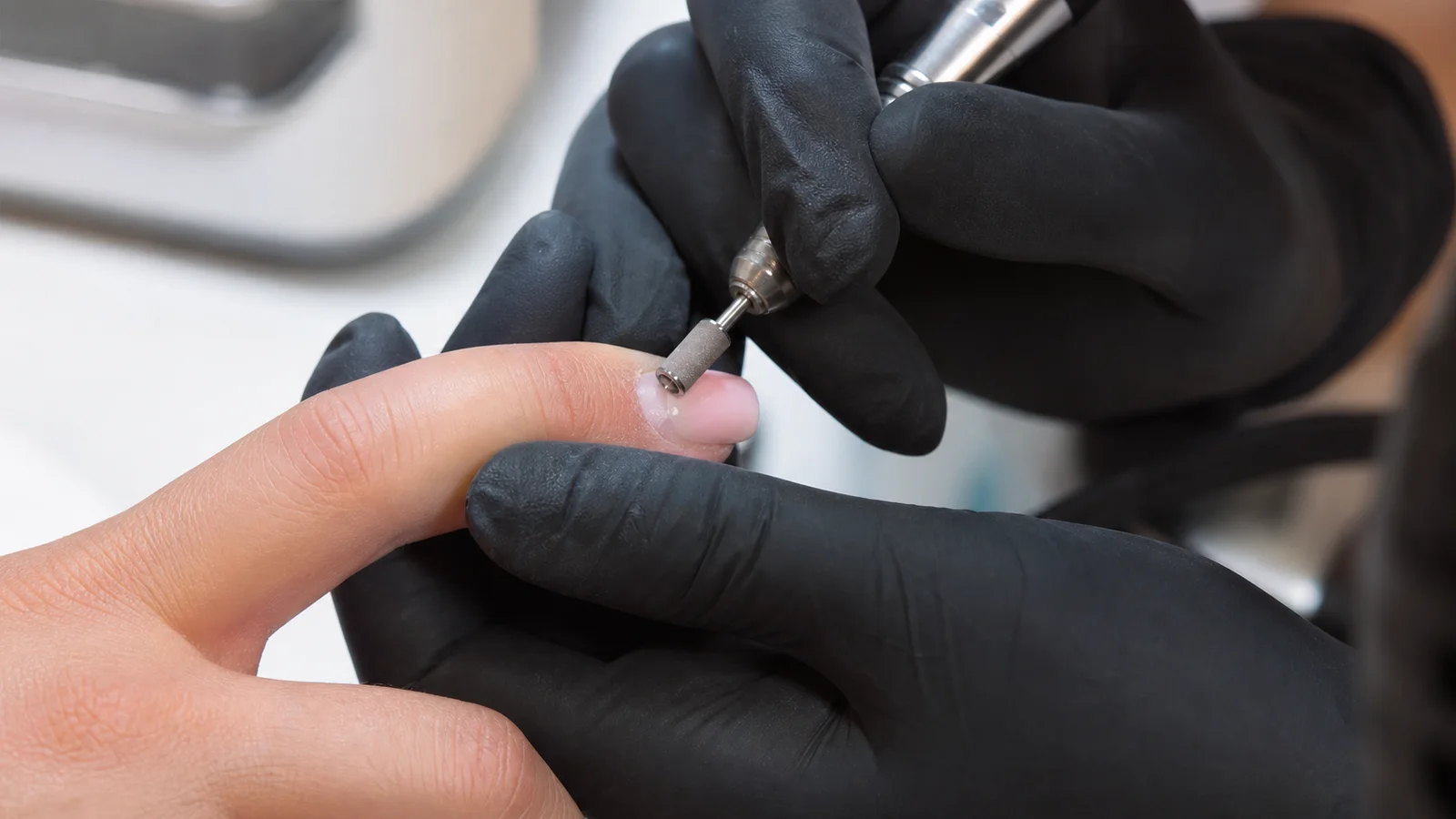
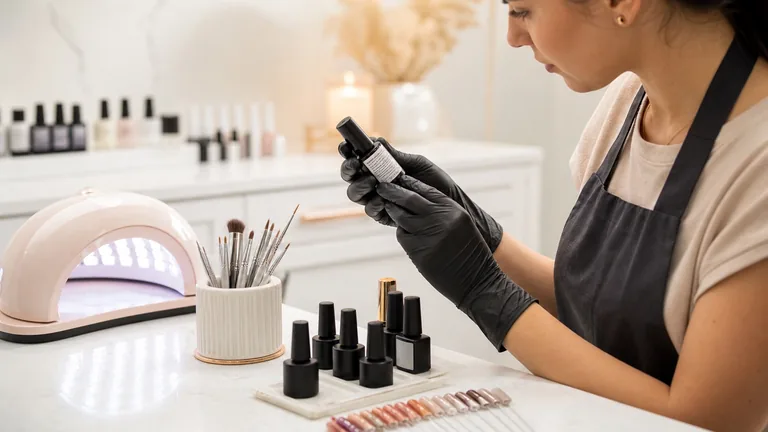
Since 1 September 2025, cosmetics containing TPO cannot be placed or made available on the European Union market. For a nail salon, this is not limited to ordering new bottles: the European Commission explains that applying a TPO-containing cosmetic to a client during a paid professional service counts as making it available. Stock bought or opened before the date cannot be used up on clients.
Fast check: read the ingredient list for the exact INCI name Trimethylbenzoyl Diphenylphosphine Oxide. If it appears, the label cannot be connected to the exact bottle, or a supplier statement does not identify the product and batch you hold, take the bottle out of service. A front-label ‘TPO-free’ claim, colour chart or current web page cannot prove the formula inside an older unit.
This guide turns the current EU rule into a traceable stock-control method. It does not give legal, waste-management or medical advice and does not extend an EU rule to the United Kingdom, United States or another jurisdiction. The cosmetic INCI reading guide owns general ingredient-list interpretation; the gel nail allergy guide owns exposure and healthcare boundaries. Here the independent intent is TPO, the EU prohibition and salon inventory decisions.
What TPO is and why the rule changed
Identify the substance before deciding on the bottle
The exact INCI name connects the formula to the EU rule
INCI
Trimethylbenzoyl Diphenylphosphine Oxide
CAS
75980-60-8
EU rule
Annex II from 1 September 2025
Unit
Exact shade, code and batch
TPO is a common abbreviation for diphenyl(2,4,6-trimethylbenzoyl)phosphine oxide. Its International Nomenclature of Cosmetic Ingredients name is Trimethylbenzoyl Diphenylphosphine Oxide, its CAS number is 75980-60-8 and its EC number is 278-355-8. In light-cured nail materials it functioned as a photoinitiator: it absorbed suitable light energy and helped start the chemical reaction that changes a liquid or gel system into polymerised material.
Before the prohibition, TPO appeared in Annex III to the EU Cosmetics Regulation and was restricted to professional artificial-nail systems at up to 5%. Commission Delegated Regulation (EU) 2024/197 introduced a harmonised classification as toxic to reproduction, category 1B, applying from 1 September 2025. Commission Regulation (EU) 2025/877 then moved TPO into Annex II of the Cosmetics Regulation, the list of substances prohibited in cosmetic products, from the same date.
The European Commission’s Questions and Answers explains that no Article 15(2) derogation request had been submitted before Regulation 2025/877 was adopted. It also explains why an earlier SCCS opinion about a defined professional use does not override the later category 1B classification and Annex II entry. A technician does not need to reinterpret toxicology studies bottle by bottle; the operational question is whether the exact cosmetic placed in service contains the prohibited INCI ingredient.
Identifier | What to record | Why it matters |
|---|---|---|
INCI name | Trimethylbenzoyl Diphenylphosphine Oxide | This is the name to search on the cosmetic ingredient list. |
CAS number | 75980-60-8 | Useful when checking authoritative substance records. |
Product identity | Brand, line, shade, code, size and batch | Connects a formula statement to the unit actually held. |
Rule and date | Regulation (EU) 2025/877; 1 September 2025 | Prevents an old web article from becoming the salon rule. |
What the EU rule prohibits from 1 September 2025
Old stock does not create a professional use-up period
Buying, supplying and client application must be read together
New supply
Do not place on the EU market
Old stock
No sell-through or use-up route
Client use
Professional application must stop
Verified unit
Continue all other safety checks
Regulation (EU) 2025/877 applies directly in EU Member States from 1 September 2025. Cosmetic products containing TPO may not be placed on the market or subsequently made available in the course of a commercial activity. Placing on the market generally describes the first supply in the EU; making available covers subsequent supply for distribution, consumption or use, whether paid or free.
The Commission Q&A applies that definition to professional users: a nail technician or salon cannot apply a TPO-containing cosmetic to a client from the date, even when the product was purchased beforehand. It also states that the Cosmetics Regulation has no sell-through or use-up provision for this category 1A or 1B CMR route. Giving a bottle away or including a free application in a commercial activity does not create a loophole.
Situation in an EU business | After 1 September 2025 | Controlled action |
|---|---|---|
Buying a new TPO-containing cosmetic | Not compatible with the EU prohibition | Do not purchase; query and document the supplier response. |
Old stock bought before the date | No professional use-up period | Remove from service and arrange a compliant return or disposal route. |
Free client application or sample | Still may be making available commercially | Do not apply, sell, transfer or give away the product. |
Exact bottle verified without TPO | This specific TPO check is passed | Continue every other conformity, instruction and safety check. |
The rule is about composition, not the marketing category. Builder gel, colour gel, base, top coat, gel polish and another cosmetic nail system require the same ingredient check. ‘Professional use only’ is not permission to keep using a prohibited cosmetic. Conversely, absence of TPO proves only that this particular ingredient is not declared; it does not certify the entire product, its supply chain or its compatibility with a lamp.
Geographic scope: EU rules are not automatically worldwide rules
Regulation (EU) 2025/877 is an EU legal instrument. A business must identify where a product is supplied and where the service takes place, then check the current rule in that jurisdiction. Do not present the EU effective date as if it were automatically the law in Great Britain, Northern Ireland, Switzerland, the United States or every country that sells European brands.
A manufacturer may operate different formulas, labels or launch dates for different markets. A foreign retailer listing a TPO-free reformulation does not establish what was placed on the EU market in the bottle on your shelf. For cross-border purchasing, identify the EU responsible person, check the required label information and retain commercial records. When the legal route is uncertain, obtain advice from the competent authority or a qualified regulatory professional.
How to check the exact product and batch
Audit the bottle on the table, not the brand in general
Every conclusion needs an attributable evidence chain
Identify product, shade and batch
Read and preserve the physical INCI
Match current written evidence
Record a controlled decision
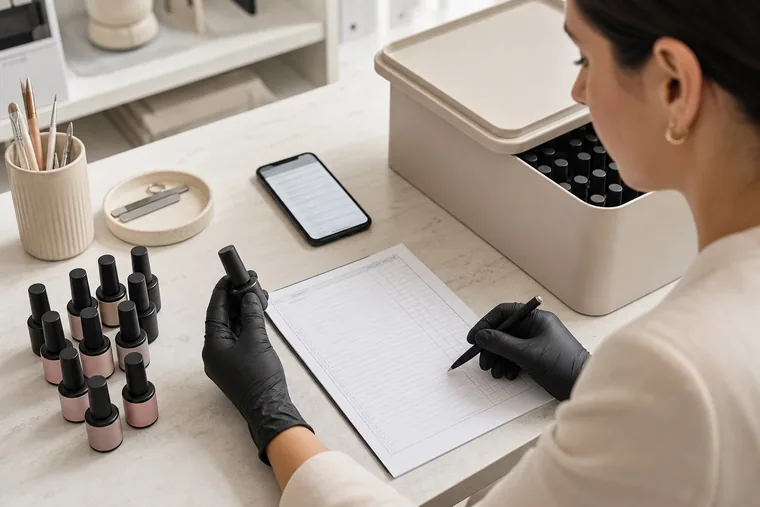
Start with the physical unit intended for use, not a brand-level spreadsheet. Photograph the front, back, base, outer packaging, ingredient list, product code, shade and batch before boxes are separated from bottles. Read the complete list for Trimethylbenzoyl Diphenylphosphine Oxide. Searching only for the letters TPO will miss labels that use the full INCI name.
Identify the exact product: brand, range, product type, shade, size, code and batch.
Read the ingredient list on the unit or its inseparable associated packaging. Preserve clear photographs.
Search for the full INCI string Trimethylbenzoyl Diphenylphosphine Oxide and verify uncertain spelling against an official source.
Compare a manufacturer or EU responsible-person statement with the same product code, market and batch or formula generation.
Classify the unit as verified for this check, awaiting evidence or withdrawn from use. Only the first enters active stock.
If the label is worn, covered, missing, detached or unreadable, do not reconstruct it from memory. A current online listing can help you formulate a question, but packaging, screenshots and supplier statements must refer to the same unit. Use the free BeautyLearn INCI Analyzer and its public cosmetic ingredient database to organise a transcription, then compare every extracted character with the physical label. OCR can confuse long ingredient names and neither tool can certify a formula or batch.
TPO-free claims, similar names and common false shortcuts
A TPO-free statement can be useful when it is accurate and linked to the product, but it does not replace the mandatory ingredient information or the responsibilities in the supply chain. Packaging may remain visually similar after reformulation, and retailers may update one product page while old stock continues to circulate. Audit bottles, not brand reputation.
Do not decide that every name containing phosphine, phosphinate or trimethylbenzoyl is the prohibited TPO. TPO-L and other photoinitiators are not identified merely by word fragments. Equally, ‘not TPO’ does not mean ‘legally compliant everywhere’, ‘non-sensitising’ or ‘works with every lamp’. Verify each exact INCI name and its current regulatory conditions rather than making a do-it-yourself equivalence from chemical-looking terms.
The ingredient list and a safety data sheet are documents with different purposes. Do not use a safety data sheet as an automatic substitute for the cosmetic INCI list, and do not treat absence from one marketing document as proof of absence from the formula. Ask the supplier which document identifies the precise cosmetic and retain the answer with its date and version.
Salon stock-control workflow
Separate uncertainty from active salon stock
A repeatable intake gate prevents withdrawn bottles returning
Incoming
Hold before shelving
Verified
Release with date and evidence
Unclear
Quarantine and query
TPO present
Withdraw; do not transfer
A one-day purge will fail if new batches arrive without checking or several people order independently. Create one stock register with product, range, shade, code, batch, purchase source, date checked, result, evidence and physical location. Add a discreet internal verification marker without covering the ingredient list, batch or mandatory symbols. Assign ownership for new deliveries and scheduled rechecks.
Inventory status | Physical location | Next decision |
|---|---|---|
Verified without TPO | Active stock | Recheck when batch, label or formula changes. |
Ingredient list or identity unclear | Closed quarantine container | Request product-specific evidence; do not use. |
TPO declared | Withdrawal area away from service stock | Arrange an authorised return or local disposal route. |
New delivery | Incoming-goods hold | Release only after the exact unit is verified. |
Brief employees, freelancers, trainees and anyone who restocks the table. A bottle must not return to service because it has always been there, is nearly empty or was expensive. Link inventory control with the wider procedure for cleaning, disinfecting and sterilising manicure tools, while keeping the decisions distinct: hygiene processing cannot turn a prohibited cosmetic into a permitted one.
What to ask the manufacturer, responsible person or supplier
A generic reply that ‘all products comply’ is difficult to audit. Write with the full commercial name, product type, shade, size, code and batch. Ask whether Trimethylbenzoyl Diphenylphosphine Oxide is present in the exact formula made available in the EU, request the current ingredient list and ask when any reformulation entered distribution. Identify who is answering and preserve the message, attachment and date.
Does the statement cover this exact shade and batch, or only the current range?
Did the name, bottle or product code remain unchanged across a reformulation?
Who is the responsible person shown for the EU cosmetic and where is that information labelled?
What return, recall or withdrawal process applies to remaining TPO stock?
Which lamp, exposure and layer instructions apply to the replacement formula?
Buying through a marketplace, social profile or non-EU shop does not transfer the compliance decision to the courier. Confirm the authorised economic route before purchase. If documentation is ambiguous or cannot be tied to the unit held, keep the product out of service and seek competent regulatory advice rather than treating uncertainty as permission.
Handling TPO stock and bottles that cannot be verified
Close and isolate withdrawn bottles so they cannot be selected during a service. Record quantity, identity, batch and reason for withdrawal. Do not sell them, give them to a colleague or learner, or use them on practice tips as part of a commercial class. Contact the supplier for a return or collection route and the relevant local waste service for instructions that apply to the business and material.
Do not pour gel or gel polish into a sink, transfer it into unlabelled containers or leave it where clients can reach it. Indiscriminately curing an entire bottle and putting it in general waste is not a universal disposal rule: composition, quantity, local classification and collection arrangements matter. Preserve written instructions and any collection record under the document-retention procedure used by the business.
A TPO-free product is not automatically risk-free or lamp-compatible
The TPO prohibition addresses one substance under a specific regulatory route. It does not certify a formula as hypoallergenic, eliminate every acrylate or methacrylate concern, or permit uncured product to touch skin. Product quantity, margins, layer thickness, wavelengths, exposure time, hand position and removal still require control.
A replacement formula may behave differently even when the product name and colour look familiar. Re-read application, storage, compatible-lamp, curing and removal instructions; do not automatically import the old timing. The guide to curing gel nails explains why wattage alone cannot prove compatibility, while the gel-polish safety protocol connects application, curing and removal without claiming zero risk.
If a client or technician reports itching, swelling, blistering or dermatitis-like changes, do not use a TPO-free replacement as a diagnostic challenge. Stop exposure, preserve product and batch information and refer for healthcare assessment. Severe swelling, breathing or swallowing difficulty, faintness or another emergency sign needs urgent help rather than a salon product comparison.
Audit checklist before a nail product enters service
Jurisdiction: confirm the market and service location to which the rule applies.
Identity: record brand, line, type, shade, size, code and batch from the physical unit.
Ingredients: preserve a legible list and verify that the TPO INCI name is absent.
Supply chain: identify supplier and the EU responsible person shown for the cosmetic.
Formula evidence: connect any written confirmation to the correct market, code and batch.
System instructions: record compatible lamp, layer, exposure, storage and removal directions.
Release decision: sign and date the check before moving the bottle from quarantine to active stock.
A good audit leaves an evidence trail another trained person can follow. English-market online nail courses can develop application and workstation technique, but course attendance does not replace current product documentation or legal duties. Recheck the register when a new batch, reformulation, supplier or rule appears.
Frequently asked questions about TPO in nail products
When did the EU TPO cosmetics ban start?
Commission Regulation (EU) 2025/877 applies from 1 September 2025. It added TPO to Annex II of the EU Cosmetics Regulation.
Which INCI name should I search for?
Search for Trimethylbenzoyl Diphenylphosphine Oxide. TPO is an abbreviation and may not appear on the ingredient list.
Can an EU salon finish a bottle bought before the ban?
No. The Commission Q&A states that professional client use must stop from 1 September 2025 regardless of when the bottle was purchased, because there is no use-up period.
Can I use TPO gel on practice tips?
Do not use, supply or give it away within a commercial class or service. Isolate it and follow the appropriate withdrawal, return or waste route.
Does the ban cover gel polish as well as builder gel?
The decisive fact is whether the cosmetic contains TPO, not whether it is marketed as builder gel, colour, base, top or gel polish.
Is a TPO-free label enough?
It is supporting information, not a substitute for the ingredient list and product-specific evidence. Check the exact bottle, formula generation and batch.
Is TPO-L the same ingredient as prohibited TPO?
Do not infer identity from similar abbreviations. Verify the complete INCI name and current official regulatory entry for the exact substance.
Does TPO-free mean HEMA-free?
No. They are different ingredients and claims. Neither statement by itself means methacrylate-free, hypoallergenic or suitable for an allergic person.
Can a product from outside the EU contain TPO?
Other markets may have different rules or formulas. An EU business must verify the product legally made available for its own market rather than relying on the seller’s country.
What if the ingredient list is unreadable or missing?
Keep the unit out of service. Ask for evidence linked to the exact product and batch; do not reconstruct the formula from memory or a generic web page.
Can OCR or an INCI app certify that a product is TPO-free?
No. OCR can help transcribe a label but can misread long names. A database can organise information, not certify the physical unit, formula or regulatory status.
Can I give old TPO stock to another technician?
Not as a way to use up stock in EU commercial activity. The Commission explains that making available includes supply for payment or free of charge.
How should TPO-containing bottles be disposed of?
Ask the supplier and competent local waste service for the route applicable to the business, material and quantity. Do not pour product down a drain or assume one disposal method fits every location.
Who should own the TPO check in a salon?
Assign a named person for incoming stock and periodic audits, while training everyone to recognise quarantine status and avoid returning unchecked products to service.
Does a TPO-free reformulation use the same lamp and timing?
Not necessarily. Obtain the current instructions for the replacement formula and its specified lamp, thickness, exposure, storage and removal instead of copying the former protocol.
Official EU sources and editorial boundary
Primary legal text: Commission Regulation (EU) 2025/877, including the Annex II entry, removal of the former Annex III entry and application date. Operational interpretation: the European Commission’s TPO in Nail Products — Questions & Answers, dated 7 August 2025, covering professional use, existing stock and the absence of a transition period.
Substance identifiers and current restriction record: European Chemicals Agency legislative obligations for TPO. Historical scientific context: the European Commission page for the SCCS opinion on TPO, which predates the later harmonised category 1B classification and prohibition.
This page was substantively reviewed on 5 September 2026. It is general educational information, not legal, regulatory, medical or waste-management advice. Check amendments, competent-authority instructions and the rules in the jurisdiction where the product is supplied and used. BeautyLearn does not assess or certify any named manufacturer, supplier, formula or batch.