Personal colour analysis and hair: how to choose colour, tone and contrast

Turn a personal colour palette into a realistic hair-colour brief by separating depth, tone, chroma and contrast while respecting starting base, colour history, hair integrity and maintenance.

BeautyLearn Editorial Team29 August 2026 23 min read
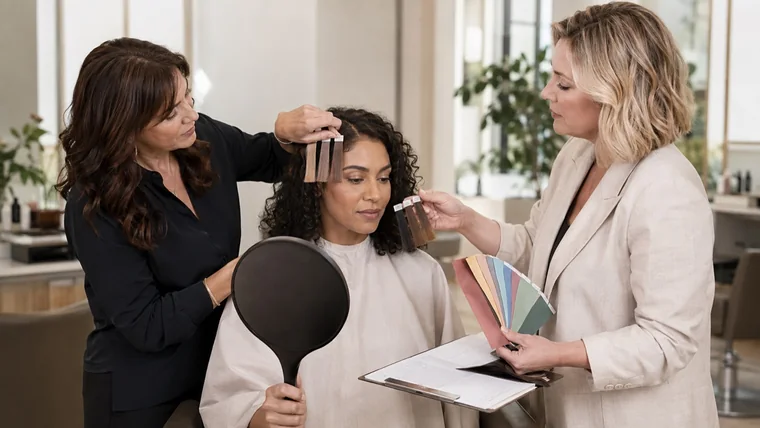
Hair colourist compares depth tone and contrast swatches with a personal colour palette beside an adult client in neutral salon light
On this page
  1. 1 Natural or coloured hair does not determine the season
  2. 2 A seven-step route from personal palette to hair-colour brief
  3. 3 Depth, tone, chroma and contrast are different decisions
  4. 4 The starting base comes before the target colour
  5. 5 Cool, neutral and warm tones: read the result, not the label
  6. 6 Hair contrast: roots, brows, face framing and internal dimension
  7. 7 Hair-colour directions for Winter, Summer, Autumn and Spring
  8. 8 Winter hair: depth and contrast without compulsory black
  9. 9 Summer hair: softened relationships without compulsory blonde
  10. 10 Autumn hair: warmth and richness without mandatory copper
  11. 11 Spring hair: light and clarity without forced bleaching
  12. 12 Grey and white hair: transition, tone and contrast
  13. 13 Highlights, lowlights and face framing: design the distribution
  14. 14 Maintenance is part of the colour decision
  15. 15 Safety, preliminary tests and professional boundaries
  16. 16 Build a useful brief for the colourist
  17. 17 Common personal-colour and hair mistakes
  18. 18 Frequently asked questions about personal colour analysis and hair
  19. 18.1 Does natural hair colour determine the season?
  20. 18.2 Must I change my hair after a personal colour consultation?
  21. 18.3 Does a cool season always need ash hair?
  22. 18.4 Should every Winter dye hair black?
  23. 18.5 Should every Summer become blonde?
  24. 18.6 Does every Autumn need copper or red hair?
  25. 18.7 Should every Spring lighten their hair?
  26. 18.8 Does grey hair automatically make the palette cool?
  27. 18.9 How do I know whether a warmer or cooler tone works?
  28. 18.10 How much can hair be lightened safely?
  29. 18.11 Can highlights change contrast without changing the whole base?
  30. 18.12 Should brows and hair be the same colour?
  31. 18.13 Can a phone simulation predict the final hair colour?
  32. 18.14 Is an allergy alert test needed after previous trouble-free colour?
  33. 18.15 Why disclose a black-henna temporary tattoo?
  34. 18.16 Can colour be applied to an irritated scalp or very damaged hair?
  35. 18.17 How can I choose a lower-maintenance colour?
  36. 18.18 Will purple shampoo cool every blonde?
  37. 18.19 Are personal colour analysis and salon colour theory the same?
  38. 18.20 What should I bring to a colourist after an analysis?
  39. 19 Official sources and editorial limits
  40. 20 Continue from palette to a responsible hair brief

Personal colour analysis and hair meet when a palette is translated into a realistic design brief: overall depth, visible tone, clarity, the placement of light and dark, and the contrast around the face. A personal palette can guide comparisons, but it cannot prescribe a universal salon formula or make every transformation technically possible. Natural base, existing colour, grey percentage, porosity, texture, scalp condition, fibre integrity, previous treatments and willingness to maintain the result all remain decisive.

Quick answer: do not choose a hair dye from the season name alone. Begin with a reliable personal-colour result, separate depth, tone, chroma and contrast, compare believable options beside the face and take the colourist a visual direction rather than an internet formula. The colourist must decide feasibility, product system, preliminary tests, timing, maintenance and safety after examining the actual hair and colour history.

This guide owns the colour-analysis-to-hair brief. It does not assign a season from natural hair colour, replace the professional draping test or teach hair-colour chemistry. Start with what personal colour analysis examines if the palette has not yet been established. Here the goal is a clear, conservative brief that an appropriately qualified colourist can assess and revise.

Natural or coloured hair does not determine the season

Black, blonde, brown, red, grey and white hair cannot assign Winter, Summer, Autumn or Spring on their own. People with similar colouring can respond differently to the same drapes, while one seasonal family can include many hair, eye and skin combinations. Hair contributes to the visible face, but the analysis examines repeated relationships across temperature, value, chroma and contrast rather than matching a phenotype to a chart.

Coloured hair is not a diagnostic shortcut either. A warm dye can reflect onto the face and alter perception during draping. Dark regrowth can increase contrast at the forehead. Very light bleaching can change the visual weight of the whole head. When hair interferes, it may be held back or covered consistently for a baseline comparison, then restored for practical styling. The result belongs to the person, not the current bottle or salon shade.

If the result came from veins, jewellery, tanning, celebrity photographs or an app, keep it provisional. The guide to DIY personal colour analysis mistakes explains why these clues lack control. You can still design an attractive hair direction without naming a season: compare depth, tone and contrast beside the face, describe the desired effect and allow the colourist to assess what is realistic.

A change in hair colour can change the practical palette balance without proving that the original analysis was wrong. A deeper root, brighter copper or transition to grey changes contrast and styling. Record the current colour at the consultation date and distinguish the underlying drape evidence from recommendations made for the person’s present appearance.

A seven-step route from personal palette to hair-colour brief

Visual direction comes before technical formulation

Brief, base, dimensions, options, feasibility, distribution and maintenance

1

Goal, history and starting base

2

Depth, tone, chroma and contrast

3

Feasibility and preliminary checks

4

Placement and maintenance plan

The image consultant describes the desired relationship. The qualified colourist examines the real hair and chooses or declines the technical route.

Jumping from Spring to honey blonde or from Winter to blue-black creates fragile advice. A professional route separates visual direction from technical feasibility and makes the responsibilities of client, image consultant and colourist explicit.

  1. Define the brief: identity, desired change, work environment, budget, appointment frequency, home care, sensory needs and what the client will not compromise.

  2. Record the real starting point: natural depth, regrowth, grey distribution, coloured lengths, highlights, direct dye, henna or plant mixtures, chemical services and previous reactions.

  3. Translate the palette into a useful value range, warm-cool direction, chroma and contrast. Name the dominant dimension rather than relying only on a subseason label.

  4. Build three visual options: maintenance of the current direction, a moderate change and a more visible transformation. Use credible physical swatches beside the face.

  5. Ask the colourist to assess fibre, scalp, compatibility, preliminary product tests, strand test where appropriate, achievable lift, number of sessions and likely exposed undertone.

  6. Agree the designed distribution: root, mid-lengths, ends, lowlights, highlights, face framing, blocks or a uniform result, with the haircut and movement considered.

  7. Define maintenance and tolerance: regrowth, fading, toning, products, heat, sun, water, timing, cost and the point at which the result will no longer feel acceptable.

The order matters. The colour consultant describes an optical direction. The colourist who sees and treats the hair determines the technical route. If the proposed change would compromise integrity, comfort, allergy controls or realistic maintenance, revise the plan. A slightly less exact colour-theory match that remains healthy, wearable and repeatable is often the more professional outcome.

Hair colourist and personal colour consultant compare realistic warm neutral and cool hair swatches beside a client with naturally textured medium-dark hair
Turn depth, tone and contrast into a visual brief before the colourist determines the technical route

Depth, tone, chroma and contrast are different decisions

One hair-colour name hides four levers

Move only the dimension the brief actually needs

Depth

Overall light-to-dark value

Tone

Cool, balanced or warm reflection

Chroma

Clear, rich or softened colour

Contrast

Face, roots and internal dimension

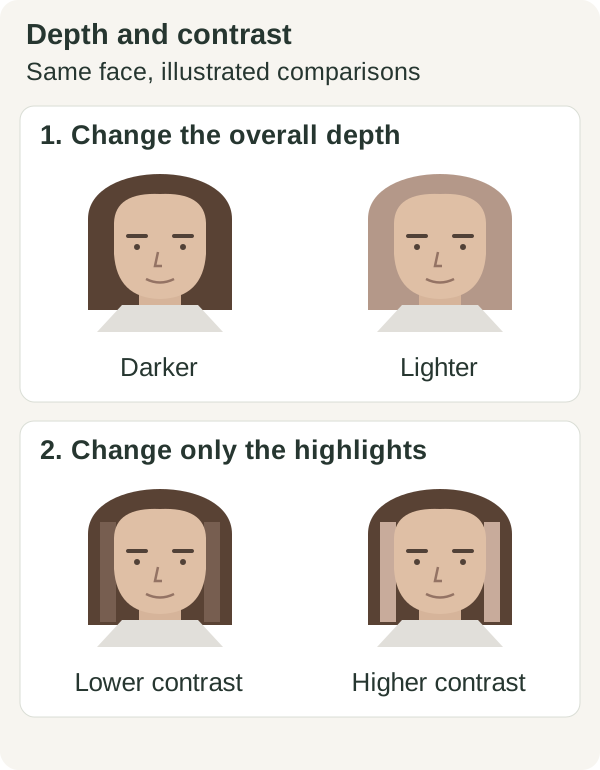
Depth is light to dark, tone is the reflected colour direction, chroma is clarity and contrast is the distance between roots, hair, face and internal pieces.

Everyday requests such as cool brown, warm blonde or vivid copper compress several variables into one phrase. Depth describes how light or dark the hair appears. Tone describes the visible colour direction in the light. Chroma describes whether that reflection feels clear, rich or muted. Contrast describes the distance between hair, skin, brows, roots, lengths and lighter or darker pieces. One lever may need to move while the others remain stable.

Lever

Question

Possible design change

Common confusion

Depth

How light or dark should the whole result read?

Root, lengths, ends and face-framing value

Lifting or darkening dramatically to obey a season

Tone

Does reflected colour lean cool, balanced or warm?

Ash, beige, gold, copper, red, mahogany or violet direction

Assuming shade names are consistent between systems

Chroma

Should the reflection appear clear, rich or softened?

Saturation, mixture complexity and visible purity

Treating ash as soft or copper as automatically bright

Contrast

How far apart should face, root and internal dimensions be?

Highlights, lowlights, root shadow, placement and blocks

Equating contrast with one dark solid colour

These levers connect to the guide on undertone, value, chroma and contrast but hair adds surface shine, translucency, porosity, density and movement. A glossy cool brown can appear more defined than a matte brown at the same depth. Fine woven highlights can add dimension without creating the contrast of a wide light panel. Describe what the eye should perceive before choosing a salon technique.

The starting base comes before the target colour

A reference photograph shows an appearance, not the route required to create it. The same target applied to different bases will not produce the same result. Natural pigment, artificial colour, highlights, grey hair, porosity and undertones exposed during lifting all change the outcome. Lighting, styling, filters and retouching can also make different technical colours appear identical online.

Give the colourist a complete history: permanent and demi-permanent colour, toners, direct pigments, metallic salts where known, henna or plant mixtures, relaxers, perms, bleach, smoothing treatments, heat damage and home incidents. Do not omit a service because it happened months ago; it may remain in the lengths. Compatibility cannot be inferred safely from surface appearance and may require product-specific preliminary checks.

Professional depth scales and tone codes are not a universal language across brands. For the image-consulting brief, record visual range and relationship to the face. The colourist will translate that direction into the chosen system after assessment. Do not take a formula or level number from social media and ask for exact replication on a different base.

Grey percentage and distribution matter because resistant white strands, salt-and-pepper areas and concentrated temples can change coverage, brightness and maintenance. Decide whether the goal is coverage, blending, celebration of the natural pattern or a transition. Personal colour can guide surrounding depth and tone; it does not decide that grey must be hidden or retained.

Clarify responsibility before the technical appointment. The client provides an accurate history, preferences and maintenance limits. The image consultant translates observed colour relationships into a non-chemical visual brief and states uncertainty. The colourist examines scalp and fibre within professional scope, chooses the product system, performs the required consultation and preliminary checks, explains achievable outcomes and obtains consent for the service. When one person holds more than one role, the decisions should still be documented separately rather than allowing a seasonal label to become the technical assessment.

Role

Provides

Does not assume

Client

History, preferences, symptoms, routine and consent

That a reference image is technically achievable

Image consultant

Colour direction, comparison record and visual alternatives

A salon formula, diagnosis or safety clearance

Colourist

Technical assessment, product route, tests and maintenance plan

That the season overrides base or fibre limits

Cool, neutral and warm tones: read the result, not the label

Ash, pearl, beige, sand, gold, honey, caramel, copper, red, mahogany and violet are descriptive families rather than standard colours. A beige can lean almost cool, balanced or golden. Mahogany may appear red or violet. Ash can look neutral, smoky, dull or greenish according to base and formula. Visible tone depends on depth, underlying pigment, concentration, translucency, light and the product system.

The personal palette suggests comparisons. A cool dominant direction benefits from comparing balanced-cool and balanced-warm swatches at the same depth. A warm direction requires checking whether warmth brings connection or becomes a separate yellow-orange cast. A soft direction may favour complex muted mixtures. A bright direction may support cleaner reflections. None of these visual observations authorises home chemical neutralisation or a formula outside the consultant’s competence.

View sample directions under stable neutral illumination and then consider the person’s ordinary environment. A salon colour can look more golden under warm lamps and flatter in shade. The aim is not to make it identical under every light; that is impossible. Identify the stable direction and explain expected variation, especially when a reference image was created under studio light.

Use real hair swatches of sufficient size and similar shine where possible. Printed swatches, phone simulations and brand charts are communication aids, not guarantees. Hold several options in the same position and distance, keep the neutral cape and room stable, and compare one lever at a time. A tiny strand against coloured clothing cannot represent a full-head result.

Do not ask the colourist to ‘cancel all warmth’ or ‘add warmth’ without identifying the visible problem and desired endpoint. Warm underlying pigment may be part of a lifting process even when the finished visual direction is balanced or cool. Conversely, a warm target still requires control rather than unrestricted yellow or orange. The consultant should describe what the client wants to see; the colourist decides how or whether the product system can create it.

Hair contrast: roots, brows, face framing and internal dimension

Contrast is not another word for dark. It is the perceived distance between elements: skin and hair, root and lengths, brows and hair, light pieces and base, or the front contour and the back mass. Blonde hair with a deep root can create more contrast than a uniform brown. Solid black may create a strong face-to-hair boundary while offering little internal dimension.

To increase contrast, the colourist might evaluate deeper roots, lowlights, brighter face framing, wider panels or cleaner blocks. To reduce it, they might bring root and lengths closer, use finer transitions, soften the front and narrow the distance between brows and hair. Technique must still suit haircut, curl pattern, density, movement and regrowth. The personal-colour brief describes the relationship, not the placement formula.

Brows do not need to match hair literally. They frame the face and may naturally remain deeper or more neutral. A light hair project with deep brows can be intentionally graphic; making the brows much darker or warmer can harden the result. Never use scalp hair dye on eyelashes or eyebrows. Eye-area products and services follow their own intended use and territorial rules.

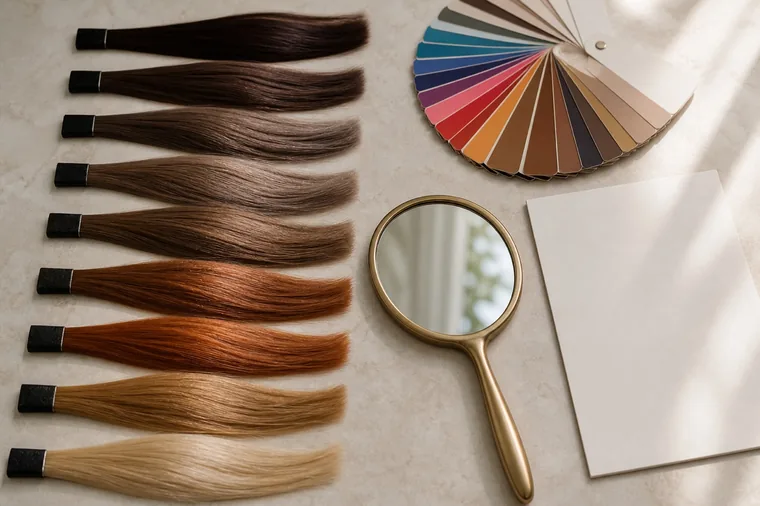
Professional hair swatches from deep brown to blonde with cool neutral and warm tones beside a personal colour palette and client record
Compare depth, visible tone and contrast independently before defining a hair-colour direction

Hair-colour directions for Winter, Summer, Autumn and Spring

Four families are not four compulsory hair colours

Keep natural hair, base, identity and fibre integrity in the decision

Winter

Cool balance, depth or clean contrast

Summer

Cool-neutral, softened transitions

Autumn

Warm-neutral, rich or muted depth

Spring

Warm-neutral, light or clear reflection

Winter does not require black, Summer blonde, Autumn copper or Spring bleaching. Each family provides comparisons, not a dye instruction.

The following are directions to compare, not diagnoses, salon formulas or requirements to change natural hair. Every family contains different dominant dimensions, and the colourist must assess the starting base and safe technical route.

Family

Directions to compare

Contrast idea

Do not assume

Winter

Balanced-cool espresso, cool brown, controlled burgundy or plum

Medium to high, clean or deep according to dominant

Every Winter should dye hair black

Summer

Cool beige, mushroom, taupe, smoky blonde or soft brown

Low to medium with diffused transitions

Every Summer must become blonde or grey

Autumn

Chestnut, warm chocolate, caramel, copper or auburn

Soft, rich or deep according to dominant

Warm means orange everywhere

Spring

Clear gold, warm beige, honey, light copper or luminous brown

Light, lively or defined according to dominant

Every Spring must lighten dramatically

Winter hair: depth and contrast without compulsory black

Winter directions often sustain cooler balance, clear depth or more defined contrast. Compare neutral-cool espresso, dark brown, cooler brunette, deep plum or burgundy only where the person and base support them. Black is one possible very deep result, not the definition of Winter. Applied to a much lighter base, it can flatten dimension, create hard regrowth and make later change difficult.

Deep Winter may prioritise value, Cool Winter temperature and Bright Winter cleaner contrast. That can translate into different briefs at the same starting depth. A softer cool brown with defined face framing may work better than an opaque blue-black. Let the current hair, brows, skin and maintenance determine how strongly the direction appears.

Summer hair: softened relationships without compulsory blonde

Summer directions often support cool-to-balanced tone, moderated chroma and gradual contrast. Compare mushroom brown, cool beige, smoky blonde, taupe and soft brunette at an appropriate depth. Summer does not require blonde hair. A rich soft brown can be more coherent and much healthier than unnecessary high lift.

Light Summer may prioritise value, Soft Summer muted transitions and Cool Summer temperature. Ash is not the only route and can look flat or green on an unsuitable base. The colourist may use balanced beige, dimensional neutral-cool work or fine low-contrast placement rather than a literal grey cast.

Autumn hair: warmth and richness without mandatory copper

Autumn directions often support warm-to-balanced tone, complex richness and soft or deep contrast. Chestnut, warm chocolate, caramel, auburn, copper and rich brunette are families to compare. Copper and red are not requirements, and both can demand substantial maintenance. A natural or cosmetic brown may already express the useful depth and warmth.

Deep Autumn may prioritise depth, Soft Autumn moderated chroma and Warm Autumn clearer warmth. Do not make the whole head orange to prove a warm result. A narrow warm face frame, rich brunette or controlled reflective tone may be enough. On olive skin, inspect whether warmth connects or creates an unrelated cast.

Spring hair: light and clarity without forced bleaching

Spring directions often support warm-to-balanced tone, a sense of light and cleaner chroma. Honey, clear gold, warm beige, strawberry, light copper and luminous brown may be compared at the person’s real depth. Light does not mean pale, and clarity can come from shine and selective dimension rather than several levels of lift.

Light Spring may prioritise value, Bright Spring cleaner contrast and Warm Spring temperature. A brunette Spring can preserve natural depth and add a refined reflection. If lifting would compromise fibre or create maintenance the client does not want, work with shine, placement and surrounding colours instead of forcing the stereotype.

Grey and white hair: transition, tone and contrast

Grey or white hair does not automatically make the palette cool. Loss and distribution of pigment can produce silver, white, charcoal, beige or yellowed appearances in different patterns. The seasonal result still comes from comparison. The transition changes practical contrast and may invite new wardrobe or make-up relationships without proving that age has changed the person’s underlying colour response.

Choose whether the goal is full coverage, blending, brightening, toning, gradual transition or keeping the natural pattern untouched. Discuss where contrast remains strongest and how roots will look between appointments. Purple or blue products are not universal solutions: they target certain unwanted tones and can deposit unevenly on porous white hair. Follow the selected product and colourist’s directions.

Keep autonomy central. Grey is not a defect the consultant is entitled to correct, and continuing colour is not a failure to accept ageing. Show several realistic maintenance paths, their timing and how they relate to the person’s palette and identity.

Highlights, lowlights and face framing: design the distribution

Placement changes the relationship even when the formula stays similar. Fine highlights produce diffuse light; wider ribbons create visible alternation; face framing changes the immediate boundary with skin; lowlights return depth; a root shadow can soften regrowth or increase the root-length difference. Decide whether the brief needs global value change, internal dimension or a local accent.

Assess the design with curl pattern, movement and haircut. A placement that appears linear on straight hair may scatter through curls; shrinkage and parting can reveal different contrast. Avoid using one social-media placement map for every head. The colourist should design sections for the real hair and explain how the effect changes when worn differently.

Small changes near the face can sometimes satisfy the colour brief with less intervention than a full transformation. They still require technical assessment and maintenance. Do not describe a local service as risk-free or universally gentle; product, starting hair and process determine impact.

Maintenance is part of the colour decision

Design day one and the months that follow

Regrowth, fading, home care and appointment capacity belong in the brief

1

Predict root visibility

2

Explain tone movement

3

Plan care and review

4

Offer a conservative alternative

A colour is sustainable only when its intermediate states, cost, time and routine remain acceptable to the client.

A technically beautiful colour can fail if the person cannot maintain its root line, fading or home routine. Before choosing, estimate salon frequency, toner or gloss appointments, product needs, heat and sun exposure, water, swimming, grey coverage, budget and time. Ask how the tone is expected to fade and whether that intermediate state remains acceptable.

Lower-maintenance designs often stay closer to natural depth, avoid a hard root boundary, use more forgiving placement and select a fading direction the client can accept. Lower maintenance does not mean no care. It means growth and tone change are planned rather than treated as a surprise.

Record the review interval and alternative if the desired tone proves unstable. Do not sell a cool or vivid result without explaining that maintenance depends on starting hair, porosity, cleansing, heat, ultraviolet exposure, water and the chosen product system. Personal colour can choose the destination range; it cannot suspend material behaviour.

Maintenance question

Why it matters

Brief response

How visible can regrowth be?

Depth change and grey coverage set the boundary

Choose root proximity and transition deliberately

How much tone change is acceptable?

Warm, cool and vivid reflections fade differently

Plan the intermediate colour, not only day one

What time and budget are realistic?

Multi-session work and toning create ongoing cost

Offer maintenance, moderate and transformative paths

How will the hair be worn?

Parting, curl and styling alter visible placement

Design for actual movement and routine

Safety, preliminary tests and professional boundaries

Hair colour products can cause irritation and allergic reactions. Follow the exact label and manufacturer’s current instructions, warnings, mixing, application area, preliminary allergy alert test and timing for the system used. A person can become sensitised after previous uneventful use, and a negative consumer alert test cannot guarantee that no reaction will occur. It is not a medical patch test or permission to ignore symptoms.

A strand test and an allergy alert test answer different questions. A strand test can help assess colour development, compatibility and fibre response on a small section according to the system. An allergy alert test addresses a stated reaction precaution. Neither turns an unsafe or incompatible service into a safe one. Record product, batch, date, method and result according to the salon’s compliant procedure.

Stop and seek appropriate medical advice for swelling, breathing difficulty, widespread reaction or other concerning symptoms. Do not colour an irritated, sunburned or damaged scalp, and do not continue because the planned shade matches the palette. Disclose previous reactions and black-henna temporary tattoos because they may be relevant to sensitisation. Do not diagnose allergy or prescribe treatment in an image consultation.

The FDA’s current US guidance says to follow package directions and perform the stated skin test before every hair-dye use, and warns never to use scalp hair dye on eyebrows or eyelashes. These statements illustrate one jurisdiction and product category. The selected product instructions and the law of the country where the service is supplied remain controlling. Qualified local training, insurance and salon procedures are essential.

Build a useful brief for the colourist

Bring the personal palette or report, two or three annotated reference images, current and natural-light hair photographs, a full colour and chemical history, maintenance limits and priorities. State whether the priority is depth, tone, contrast, grey strategy, healthier-looking fibre or a lower-maintenance transition. Include what the client does not want.

Annotate references by feature instead of saying ‘exactly this’. One image may show desired face framing, another a useful depth and a third an acceptable warm-cool direction. Ask which elements are possible on the current base, what cannot be reproduced, how many sessions may be needed, what preliminary checks apply and what conservative alternative exists.

Keep personal-colour language accessible. Rather than instructing the colourist to create True Summer hair, describe a soft neutral-cool brunette at similar depth with low face contrast and no obvious golden reflection. The technical professional can then translate the visual brief without being required to share one seasonal nomenclature.

Common personal-colour and hair mistakes

  • Assigning a season from natural hair, grey hair, eye colour or ethnicity.

  • Treating Spring as blonde, Winter as black, Autumn as copper and Summer as ash.

  • Copying a formula from a reference image without assessing the starting base.

  • Using ash, beige, gold or mahogany as though shade names were standard.

  • Confusing depth, tone, chroma and contrast and changing all four at once.

  • Hiding plant colour, direct dye, bleach, relaxer or previous reaction from the colourist.

  • Promising exact colour from a phone simulation or printed swatch.

  • Ignoring curl pattern, haircut, grey distribution, growth and maintenance.

  • Treating an allergy alert test as a medical diagnosis or guarantee.

  • Sacrificing scalp comfort or fibre integrity to obey a palette.

Frequently asked questions about personal colour analysis and hair

Does natural hair colour determine the season?

No. It contributes to visible contrast but cannot assign Winter, Summer, Autumn or Spring. Similar hair colours occur across different palettes, and one seasonal family includes many pigmentations. Controlled drape comparison supports the result.

Must I change my hair after a personal colour consultation?

No. Natural or current colour may already work, feel important to identity or be the healthiest choice. You may change shine, placement or tone slightly, explore a larger transformation or do nothing. The analysis offers options, not an obligation.

Does a cool season always need ash hair?

No. Ash is a variable technical and commercial direction, not a synonym for harmonious coolness. It may appear neutral, dull or greenish on different bases. Balanced-cool brown, beige, pearl, plum and other directions may be more suitable.

Should every Winter dye hair black?

No. Winter can support depth or contrast, but black is only one extreme. On a lighter base it can create hard regrowth, flatten dimension and restrict future changes. Espresso, cool brunette or localised contrast may satisfy the brief more realistically.

Should every Summer become blonde?

No. A soft brunette, mushroom brown or cool-neutral depth can be coherent. Significant lifting is unnecessary when the base and contrast already work and can damage fibre. Value, chroma and transitions matter more than the blonde stereotype.

Does every Autumn need copper or red hair?

No. Chestnut, warm chocolate, caramel, rich brunette or natural hair may fit better. Copper and red can require frequent maintenance and fade differently. Compare warmth, depth and chroma with the person and starting base.

Should every Spring lighten their hair?

No. Shine, clear tone and selective dimension can create light without dramatic lift. A brunette Spring can keep natural depth. The colourist must place fibre integrity, achievable result and maintenance above a seasonal stereotype.

Does grey hair automatically make the palette cool?

No. Grey and white hair show varied silver, charcoal, beige or yellowed appearances and distributions. They change practical contrast but do not assign a palette. Reassess styling needs through controlled comparison rather than age or pigment loss.

How do I know whether a warmer or cooler tone works?

Compare credible swatches at similar depth, shine and size beside the face in stable light. Change one variable at a time and observe the whole relationship. Then ask the colourist which direction is achievable on the actual base.

How much can hair be lightened safely?

There is no universal safe number. History, fibre, scalp, product and technique change the risk. Significant lift generally requires more intervention. A colourist should assess the hair, use appropriate preliminary testing and reduce or stage the goal when needed.

Can highlights change contrast without changing the whole base?

Yes. Width, placement, root distance and value can add or soften contrast around the face and within the hair. Fine highlights, wide panels, lowlights and root shadow create different effects. Design must follow haircut, texture and growth.

Should brows and hair be the same colour?

No. A natural difference can support the face and intended contrast. Evaluate brow depth and temperature as part of the whole. Never use scalp hair dye on eyebrows or eyelashes; only use products intended for the area as directed.

Can a phone simulation predict the final hair colour?

It can explore mass, placement and preference, but it cannot predict underlying pigment, porosity, lift, fading or exact reflection. Camera, software and display transform colour. Use it as a conversation sketch, not a guarantee.

Is an allergy alert test needed after previous trouble-free colour?

Follow the current product instructions every time, including the stated preliminary test. Sensitisation can develop after earlier uneventful exposure and formulas can change. A negative result cannot guarantee no reaction and is not medical diagnosis.

Why disclose a black-henna temporary tattoo?

It may be relevant to sensitisation risk with some hair-dye ingredients. Tell the professional about it and any previous reaction, follow the product warning and seek healthcare advice when symptoms or uncertainty require it. Do not improvise testing.

Can colour be applied to an irritated scalp or very damaged hair?

Do not ignore irritation, lesions, pain or severely compromised fibre to reach a palette target. The professional should postpone, alter or decline the service and refer for healthcare assessment when appropriate. Colour harmony never outranks health.

How can I choose a lower-maintenance colour?

Stay closer to natural depth, avoid a hard root boundary, use forgiving placement and choose a fading direction you can accept. Account for grey, washing, sun, heat, swimming, appointments, budget and how the hair is normally worn.

Will purple shampoo cool every blonde?

No. Neutralising products target particular unwanted tones and can deposit unevenly on porous hair. They do not change the underlying base or correct every warm result. Use the specific product, timing and frequency advised for the service.

Are personal colour analysis and salon colour theory the same?

No. Personal colour analysis compares colours near the face. Professional hair colour theory covers underlying pigment, formulation, lifting, depositing and product behaviour. The two can collaborate, but one qualification does not replace the other.

What should I bring to a colourist after an analysis?

Bring the palette or report, annotated references, full colour and chemical history, current photographs, maintenance limits and priorities. Ask about feasibility, preliminary checks, sessions, expected fading and a conservative alternative. Do not bring an internet formula as an instruction.

Official sources and editorial limits

Safety sections use current US Food and Drug Administration guidance on hair dyes and hair-dye precautions, the American Academy of Dermatology’s colouring and perming guidance, the consolidated English text of the EU Cosmetics Regulation and the European Commission’s current SCCS opinions. These are regional references; product instructions and local law remain controlling.

The personal-colour and seasonal suggestions are visual testing directions, not technical formulas, medical advice or guarantees. Image consultants should work within training and insurance, refer chemical decisions to qualified colourists and never diagnose scalp or allergy conditions.

Continue from palette to a responsible hair brief

Use the guide to reading and applying a personal palette and compare the dedicated Winter, Summer, Autumn and Spring families without phenotype shortcuts. Connect the result with personal colour and make-up. Browse the colour-analysis guide hub, the English course collection and the current complete colour analysis course within the English market.

Apply an established palette to shirts, tailoring, beard, eyewear and accessories with personal colour analysis for men. The guide prioritises face-zone colour, dress code, identity, useful combinations and responsible grooming without creating a separate colour system for men.

To keep favourite clothes without turning a palette into a ban, use the guide to wearing colours outside your personal palette. It turns distance, visible area, face framing, bridge colours, texture and full-outfit testing into a reuse method.

For wedding-specific coordination of dress white, make-up, hair, jewellery and flowers, continue with the bridal colour analysis guide. It turns the personal palette into an inclusive, real-light brief while keeping every specialist within professional scope.

Continue learning