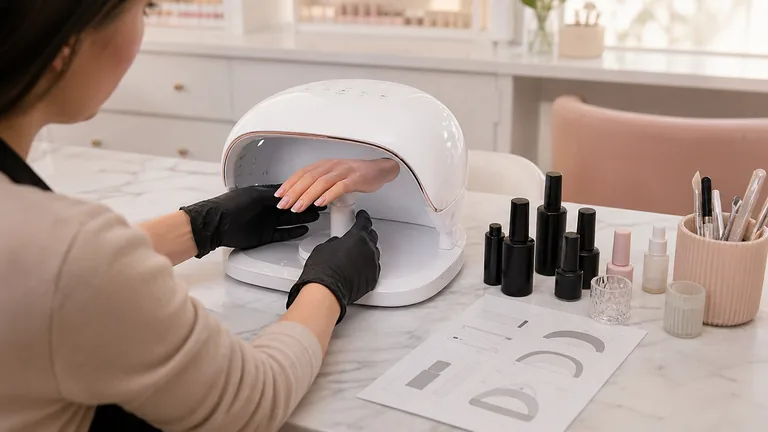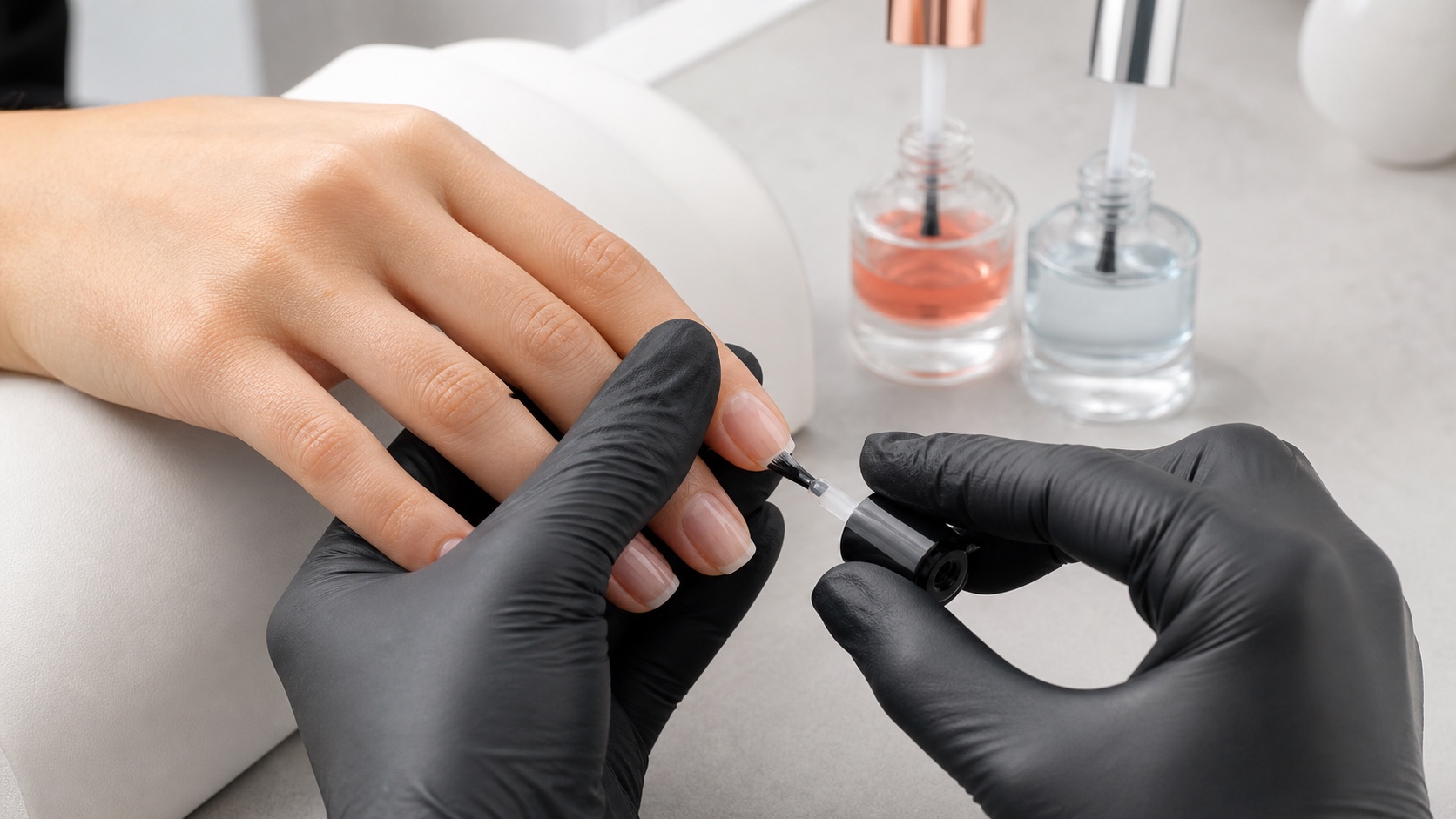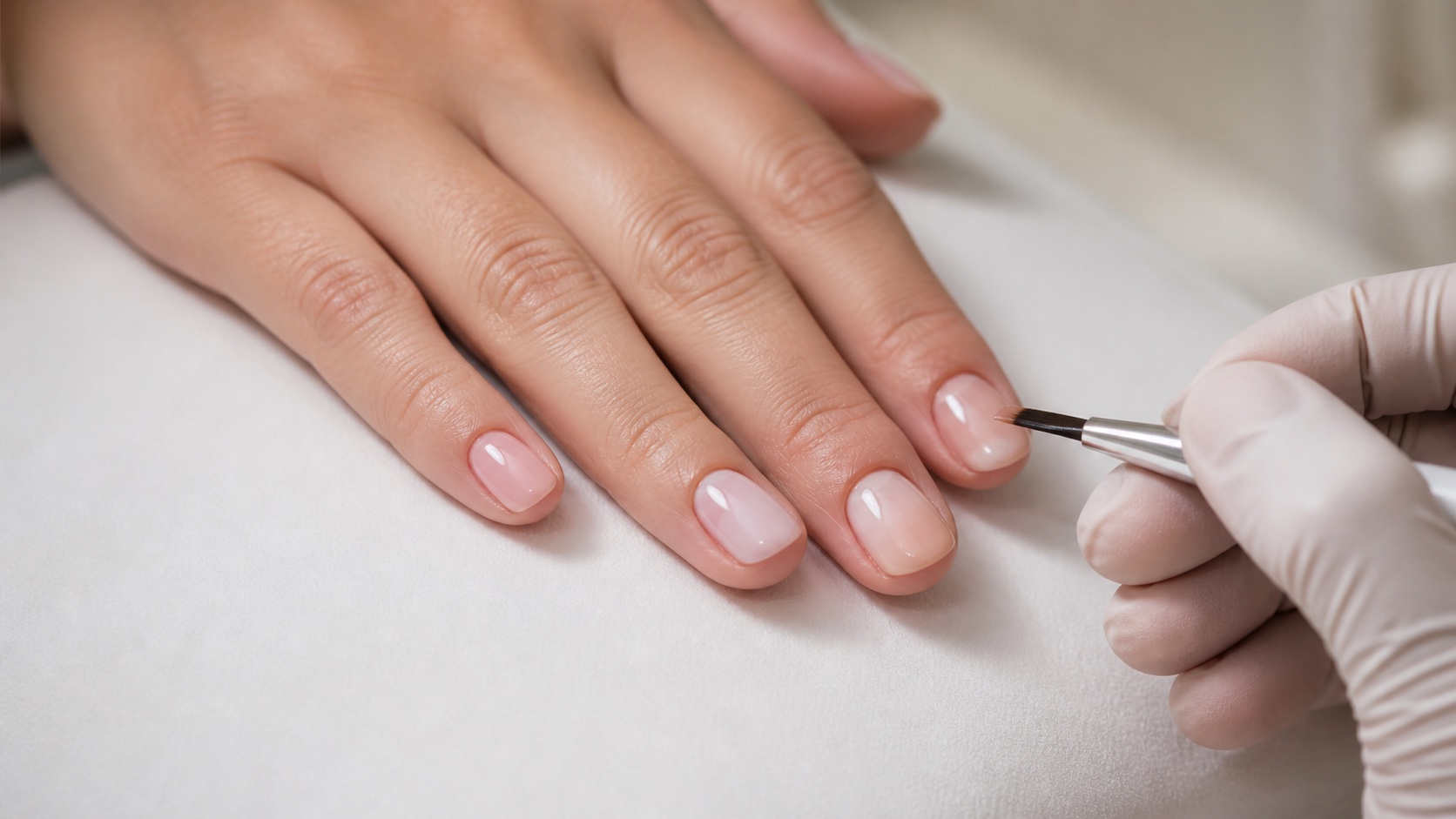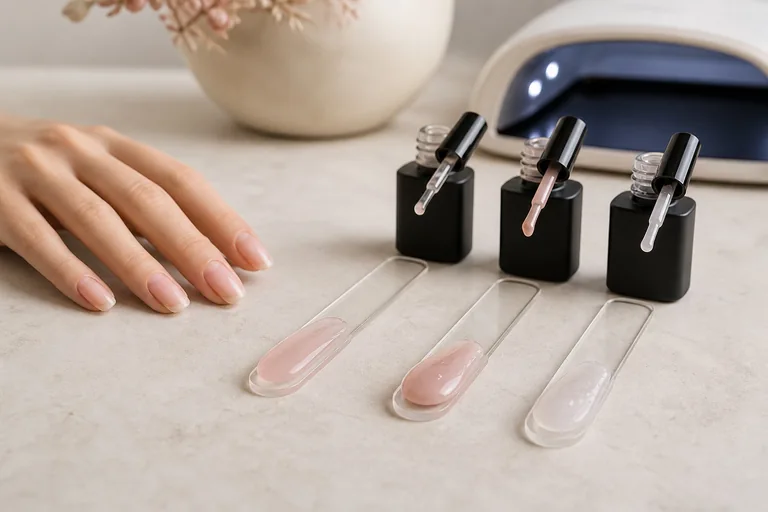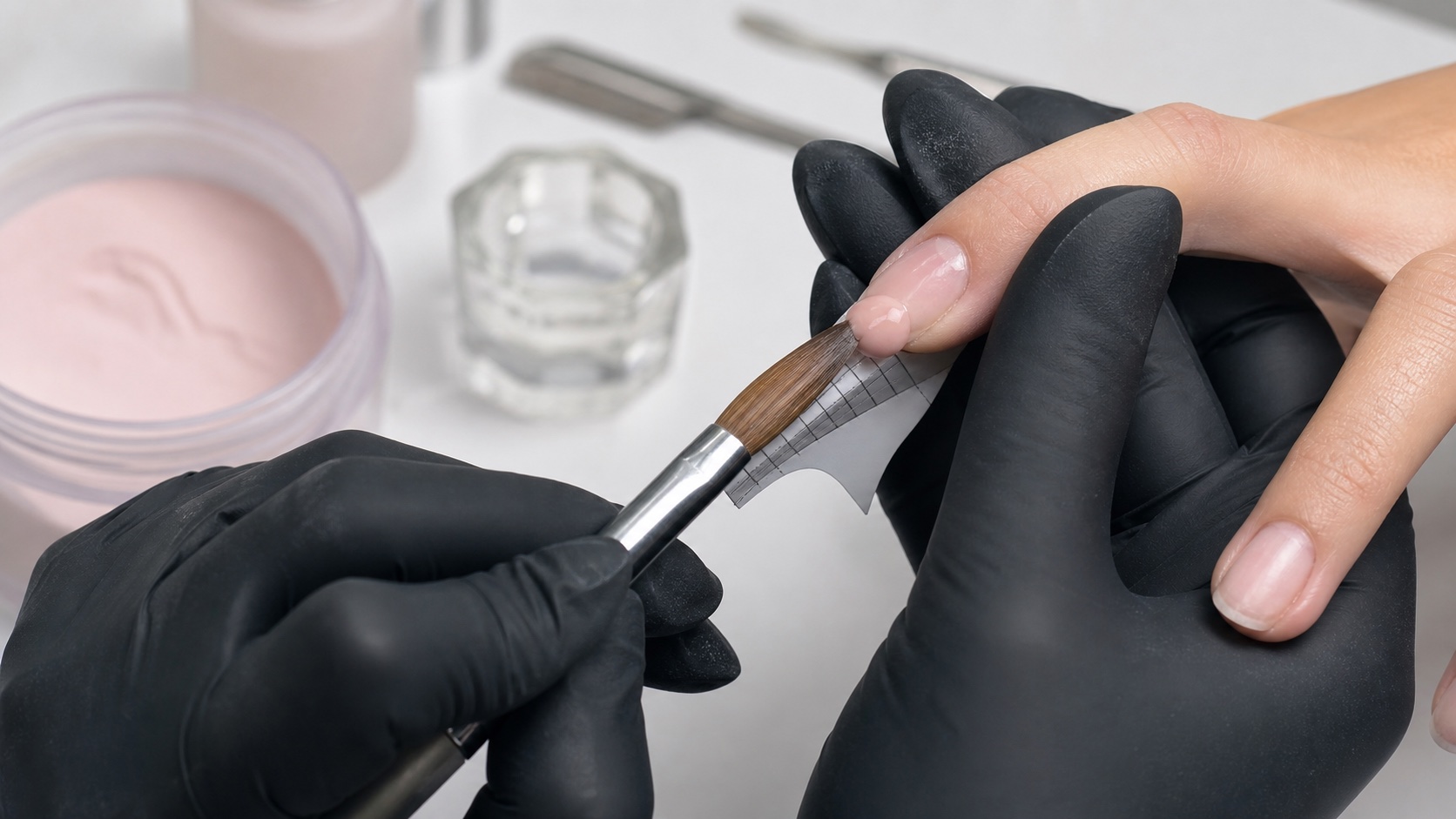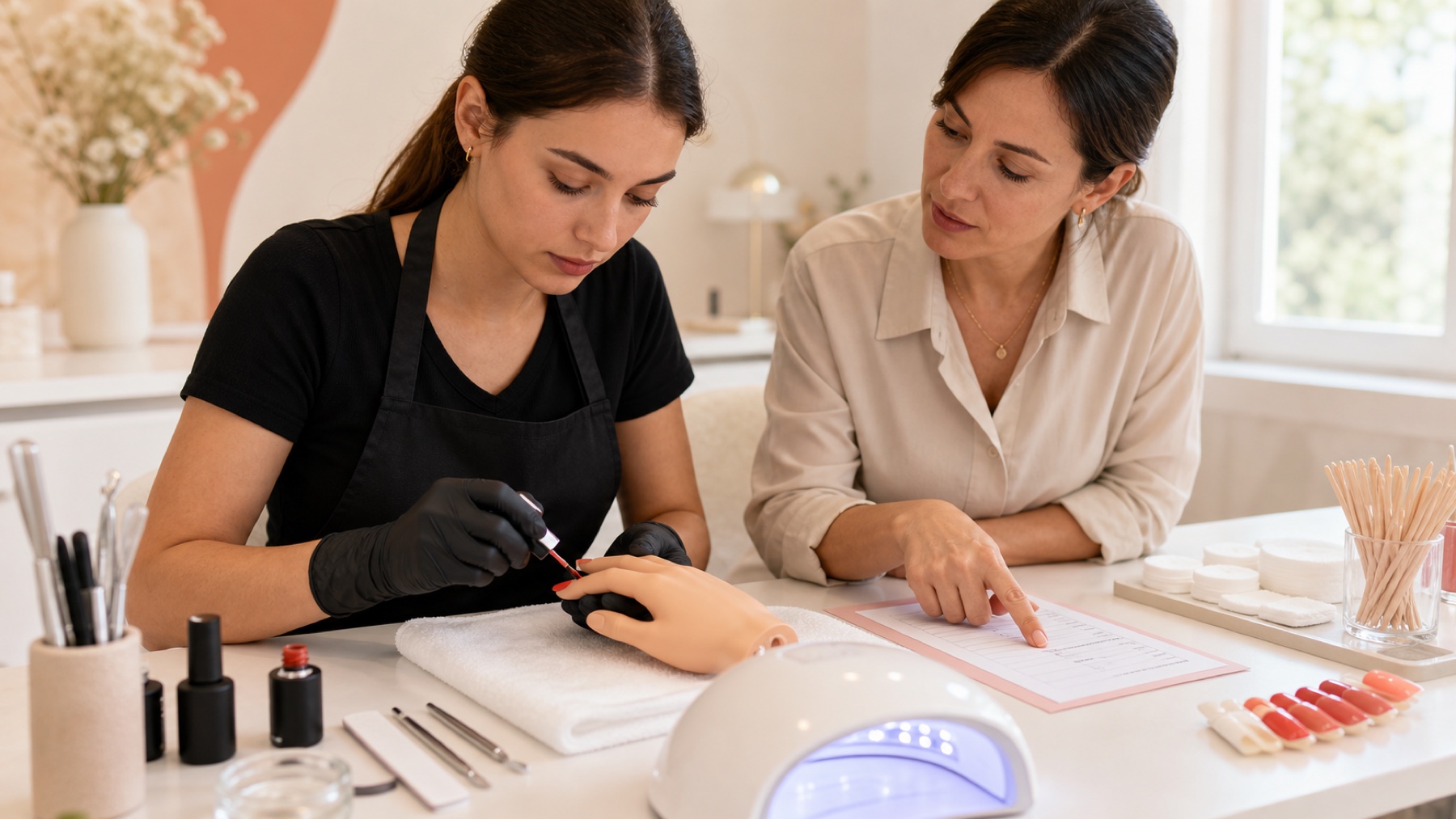
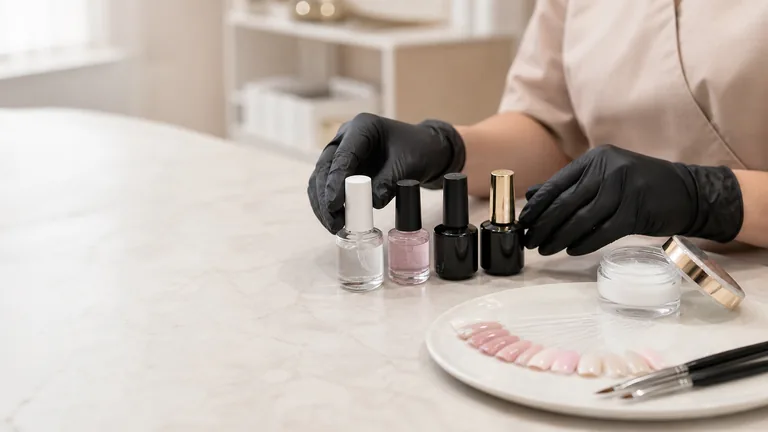
Base, primer, builder, colour and top from different nail brands can only be combined responsibly when compatibility is documented or evaluated within a controlled professional process. One service that looks glossy and remains attached for several weeks does not prove complete cure, chemical compatibility, long-term mechanical balance or safe removal. The strongest default is the complete system and lamp identified in the current manufacturer instructions for the exact products and market.
Do not treat ‘UV/LED’, ‘universal’, ‘HEMA-free’, ‘soak-off’ or ‘professional use’ as proof that two formulas belong together. Verify role, permitted layer, interfaces, lamp, mode, time, removal and written manufacturer position. Never mix formulas inside a bottle or jar.
Compatibility has several dimensions: chemical bonding between layers, mechanical behaviour after cure, cure through the required thickness and pigment, resistance during wear, controlled maintenance and removal, and compliance with each product’s labelled use. Failure in any one dimension can appear later as lifting, cracking, staining, excessive heat, difficult removal or unexpected exposure.
This guide is substantively reviewed on 5 September 2026 and uses regulatory and scientific sources rather than commercial protocols from competing academies. It cannot certify a custom combination. Product manufacturers and responsible persons hold the exact formulation, testing and system evidence. If they do not support a combination, a salon test cannot create the same evidence or transfer responsibility back to them.
What compatibility really means
Compatibility is a chain, not a logo match
Every interface and the complete cure route need evidence
Plate
Preparation, primer and base interface
Structure
Base and builder flexibility
Finish
Colour, top and surface handling
Cure
Lamp, mode, time and thickness
Compatibility is not one yes-or-no property. A primer must leave the interface expected by the base. The base must bond to the prepared plate and move coherently with the builder. Colour must cure through its pigment load and accept the top. The finish must adhere, resist staining and be removable through the planned route. Every photo-curable layer must receive the wavelength distribution, irradiance, time, hand position and thickness validated for it.
Compatibility dimension | Question | A visual result cannot prove |
|---|---|---|
Adhesion | Will the next layer bond to the previous one as instructed? | Reliable long-term interface |
Mechanical | Do cured flexibility, rigidity and structure suit each other? | Balanced stress transfer under wear |
Cure | Does the named lamp cure each layer in the permitted amount? | Adequate conversion below a hard surface |
Removal | Can the whole stack be maintained or removed predictably? | Safe solvent or filing endpoint |
‘Same brand’ is useful but not absolute proof that every line combines with every other. ‘Different brand’ is not automatically failure. Exact line, product code, market version and instructions matter. Read the guide to nail product labels, INCI, batch and PAO before evaluating a system whose identity or instructions are incomplete.
Layering products is not mixing formulas
Layering keeps products in their original packaging and applies them sequentially, each in its declared role. Mixing combines uncured formulas physically in a pot, bottle or improvised palette before cure. Do not mix formulas unless the manufacturer explicitly provides a controlled mixing instruction for those exact products and ratios. Adding cleanser, monomer, primer, top or pigment to change viscosity or colour can alter photoinitiator balance, cure depth, stability and labelled use.
An inhibition layer is a surface affected by oxygen during cure; it is not universal glue and does not prove that any next product will bond. Some systems instruct leaving it, some require cleaning or refinement and some use no-wipe layers. Follow the sequence for each interface. Do not preserve a contaminated dispersion layer because it feels sticky.
Primer from one brand and base from another
Acid primer, acid-free primer, dehydrator and bonder are not synonyms. They change moisture, surface condition or chemical interface in different ways. A base may require no primer, one named primer or a specific amount on selected clients. Adding an unrelated primer ‘for insurance’ can create excess product, brittleness, over-adhesion, skin exposure or an interface the base was not tested to accept.
Begin with the exact base instructions. Ask whether the other primer is authorised by both manufacturers for that substrate and service. Confirm drying or air time, whether residue remains, quantity and areas of application. If the information conflicts or is unavailable, use the documented primer-base pair. The detailed guide to acid and acid-free primer, dehydrator and bonder explains each function without turning stronger adhesion into a universal goal.
Base and builder from different systems
A flexible soak-off base, rubber base and rigid file-off builder can respond differently to bending and impact. A thin compliant layer under a rigid structure may be intended in one tested system and unstable in another. Excess base can create a soft interface; too little may not cover the contact requirement. The jar’s viscosity does not tell you the cured mechanical behaviour.
Verify whether the builder is approved for direct natural-nail use or needs a base, which base, in what amount, and whether the layer is cured before building. Confirm service type and length. The guide to one-, two- and three-phase gel systems separates product roles from marketing names. Cross-brand use adds a new evidence question; it does not change those functions.
Colour and top from different brands
A colour can wrinkle, shrink or retain an unstable surface when it is too thick, heavily pigmented, applied over an unsuitable surface or cured in the wrong lamp. A top can separate, crack, stain or lose gloss because the interface, flexibility, cure or inhibition-layer handling is incompatible. ‘No wipe’ describes a surface outcome in the stated system; it does not mean universal.
Ask whether the top is supported over the exact colour or builder, whether the colour needs a dispersion layer removed, whether refinement is required, and which lamp cures each. Test dark, white and highly pigmented shades at their maximum permitted layer because a clear swatch is not the difficult case. Never extend cure time at random as a substitute for compatibility evidence.
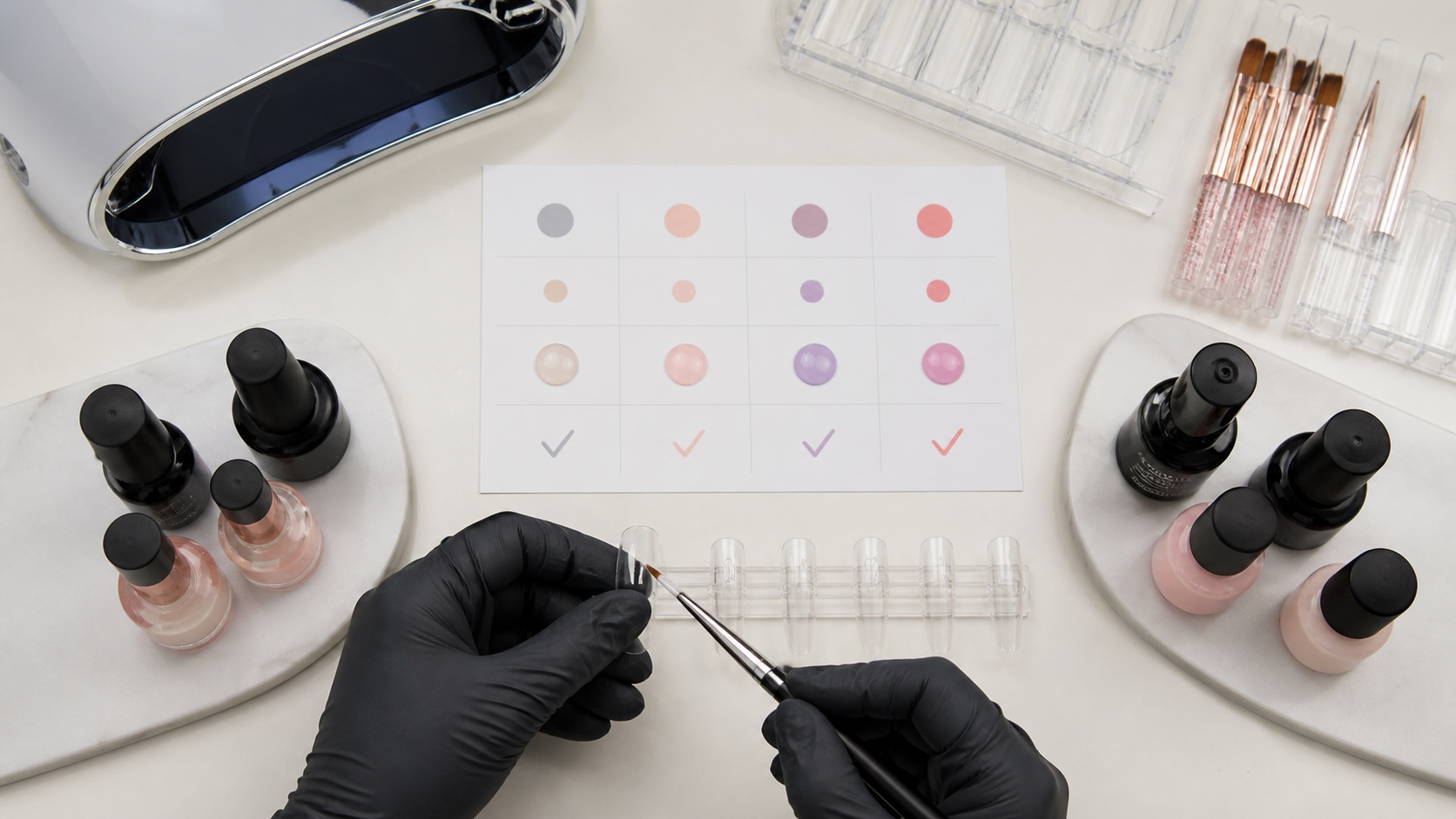
The lamp is the compatibility point you cannot guess
Photo-curable nail products depend on a relationship between photoinitiators, wavelength spectrum, irradiance distribution, exposure time, layer thickness, pigmentation and hand position. Wattage describes electrical power, not the useful light dose reaching every point of every nail. The words UV/LED on two packages do not demonstrate that a generic lamp cures both formulas.
A hard or glossy surface does not prove adequate conversion throughout the layer. Under-cured material can remain beneath it. Do not assess cure by touching, pressing or peeling uncured product. Use the lamp named or technically validated by the product manufacturer, its correct mode and complete time, with clean diodes and the hand positioned as instructed. Review the dedicated guides to UV/LED nail-lamp compatibility and curing gel nails safely.
A controlled protocol for evaluating cross-brand products
Documents first, one variable at a time
A training sample can reveal failure; it cannot certify safety
Verify label, role and instructions
Ask exact written compatibility questions
Test a labelled sample consistently
Observe wear and removal over time
Start with documents, not a client. Capture exact product name, code, market, batch, label, instructions, safety information and named lamp. Ask both manufacturers a precise written question. If either excludes the combination, stop. If both support it, follow the stated protocol. If evidence is absent rather than negative, treat the combination as unverified and decide whether there is any professional reason to investigate instead of staying inside a complete system.
Define one combination and service goal; do not compare several unknown changes together.
Verify label, instructions, product role, permitted layer, lamp and removal for every component.
Request written compatibility information using exact codes and market versions.
Test on labelled training samples without skin contact, recording amount, layer, cure and environment.
Inspect adhesion, wrinkling, shrinkage, surface, staining, flexibility, cracking and removal over time.
Change one variable at a time and preserve failed samples rather than rewriting the result.
Do not promote the custom stack as manufacturer-approved unless that approval is explicit and current.
A practice-tip test can expose obvious failure, but it cannot reproduce natural-nail movement, client activity, water exposure, heat, maintenance or individual sensitivity. It also cannot measure monomer conversion without appropriate laboratory methods. Use it as a screening and technique comparison, not a safety certification.
What to ask the manufacturer
Is product code A supported over or under product code B for this service and market?
Which primer or base, lamp model, mode, time and maximum layer are required?
Must the inhibition layer remain, be cleansed or be refined before the next product?
What cured flexibility, service length and removal route is the combination designed for?
Does cross-brand use affect technical support, warranty or documented complaint investigation?
‘They should be fine’ from a reseller is not the same as a traceable manufacturer answer. Preserve date, contact, exact question and response. Ask again when formulations, packaging, lamp or instructions change. If the answer covers only one colour or base, do not extend it to the entire range.
Change one variable to understand the result
When a service starts lifting after changing primer, base, lamp and preparation at once, there is no interpretable result. Restore the last documented system, then change one controlled variable. Keep application amount, preparation, sample type, lamp, cure and observation interval consistent. Record success and failure by zone instead of relying on a general impression.
The guide to nail lifting causes by area helps distinguish proximal, lateral, free-edge and central patterns. Use the separate guide to bubbles, cracks, breaks and cuticle flooding when the failure is structural or application-related. Neither fault proves cross-brand incompatibility by itself.
Compatibility and sensitisation risk
Sensitisation risk increases with avoidable exposure to uncured nail-product ingredients. Cross-brand uncertainty can contribute when products shrink, flood, remain under-cured or require repeated removal and reapplication. The European Commission SCCS opinion on HEMA and Di-HEMA emphasises application to the nail plate, avoidance of adjacent skin and appropriate curing within an artificial-nail system.
Never perform homemade patch tests with gel on skin. Do not continue through burning, pain, swelling, itching or blistering to finish a cure cycle; stop exposure and follow appropriate first-aid, product and healthcare guidance. A previous successful service does not exclude later sensitisation. Record exact products and batches through the nail client-record protocol.
Decision matrix: supported, excluded or unverified
Name the evidence state before using the stack
Anecdotal wear does not turn an unknown into approval
Supported
Exact products and conditions documented
Excluded
An instruction rejects the interface
Unverified
No adequate answer for the exact stack
Evidence state | Meaning | Professional action |
|---|---|---|
Supported | Exact combination and conditions documented | Follow the complete current protocol |
Excluded | One instruction or manufacturer rejects the interface | Do not combine |
Unverified | No adequate answer for exact products and conditions | Use a complete documented system; do not claim compatibility |
A single good wear result does not move ‘unverified’ into ‘supported’. A failed result can reject a practical combination, but it may still involve technique, cure, sample or contamination. The matrix protects against turning anecdote into manufacturer evidence.
Unknown product at an infill
When the existing product and lamp history are unknown, inspect for lifting, cracks, colour, thickness and natural-nail condition. Do not apply a new system over unstable zones. Remove all compromised product and decide whether a complete removal offers the most controllable reset. Never assume that a sticky surface or rough filing creates chemical compatibility.
If stable residual material remains, the new manufacturer must support application over that type of surface or the salon accepts an unverified interface. Record the unknown and explain the limitation. The guide to nail infills and rebalancing owns structural maintenance and removal decisions.
Warranty, insurance and professional responsibility
A manufacturer warranty or technical-support policy is commercial and technical evidence about the supported system. Cross-brand use does not automatically cancel every legal right, but it can make fault investigation and support harder when the combination falls outside instructions. Ask the insurer whether custom protocols, off-system lamps, imported products and incomplete traceability affect cover or claim handling.
A client signature does not transfer responsibility for an unverified combination. Document product, batch, lamp and service; maintain training, label checks and incident procedures; and describe outcomes accurately. The professional must still stop for contraindications and use products as law and current instructions require.
Inventory for a multi-brand workstation
Maintain a system matrix rather than a shelf grouped only by colour. For each product record exact name, role, market version, batch, opening date, labelled storage, permitted neighbours, required lamp, mode and time, layer limit, inhibition-layer handling and removal. Identify supported combinations clearly and quarantine discontinued, changed or uncertain products.
Limit active systems to those staff can execute and trace reliably. More choice increases training, stock rotation and interface risk. Review the matrix when a label, formulation, bottle, supplier or lamp changes. Do not top up one container from another batch, and never transfer products into anonymous pots.
When a familiar product changes
A familiar name can hide a new technical version
Treat every relevant label or instruction change as a review point
Receive
Capture version and batch
Compare
Check label and current protocol
Confirm
Store dated manufacturer evidence
Pause
Quarantine unresolved discrepancies
Compatibility evidence belongs to an identifiable product version, not just a familiar brand name. A reformulation, new responsible person, altered warning, different market label, revised lamp instruction or replacement shade can change the relevant conditions while the front name remains similar. Treat a new package as a verification event: compare the Ingredients list, directions, product code, batch format, required lamp, cure time, layer limit and removal route with the version already recorded. Do not pour the new product into the old container or rely on bottle colour to preserve identity.
If a manufacturer confirms that the technical protocol remains unchanged, store the dated answer with the system matrix. If instructions conflict with an older answer, the current label and authorised documentation take priority; pause the combination until the discrepancy is resolved. Repeat training-sample observations for the changed interface and update staff notes before client use. A product that behaved well under its previous formula is not a control for an undocumented replacement.
The same rule applies to lamps. A visually similar model, repaired unit or replacement cable does not establish equivalent output. Preserve model and serial details, maintenance history and the manufacturer’s current compatibility statement. When traceability breaks, return to a documented complete system instead of compensating with thicker base, stronger primer or longer improvised cure.
Learn one complete system before testing variants
A learner gains more from repeating one documented system than from combining products to solve every fault. Stable variables make amount, perimeter, architecture, cure and removal teachable. Once results are consistent, compatibility questions can be investigated without hiding technique errors. Compare Gel Nails Level 1 and Gel Nails Level 2 or browse all online nail courses. English course records remain separate from the Italian catalogue.
Frequently asked questions about mixing nail brands
Can I use base, builder and top from different brands?
Only when the exact products, interfaces, lamp, layers and removal route are supported or professionally verified within appropriate limits. A good-looking result or several weeks of wear does not prove complete cure, mechanical compatibility or manufacturer approval.
Can I use one brand's primer with another brand's base?
Check the base instructions first and obtain a specific answer for both products. Dehydrator, acid primer, acid-free primer and bonder have different functions. An unnecessary or incompatible primer can create excess adhesion, brittleness, exposure or failure.
Does a universal base work with every gel?
No marketing term proves universal chemical, mechanical and cure compatibility. Verify which substrates, builders, colours, lamps, services and removal routes the manufacturer actually supports. If the exact combination is not documented, treat it as unverified.
Can I put another brand's top over gel polish?
Only after confirming the interface, inhibition-layer handling, flexibility, lamp and cure for both products. No-wipe does not mean universal. Test pigment, gloss, cracking, staining and removal without using a client as the first experiment.
Can any LED nail lamp cure any gel?
No. Cure depends on photoinitiators, wavelengths, irradiance distribution, time, layer, pigment and hand position. Wattage and UV/LED wording are not validation. Use the named or technically supported lamp, mode and complete exposure.
Does a hard surface prove the gel is fully cured?
No. A surface can feel hard while deeper material remains inadequately converted. Touch and wear tests cannot measure complete cure. Follow validated product-lamp conditions and maximum layer instead of adding arbitrary time or pressing uncured product.
Can I mix two gels inside one pot?
Do not mix formulas unless the manufacturer gives a specific controlled instruction for the exact products and ratio. Improvised blending can change pigment, viscosity, photoinitiator balance, stability, cure, label identity and traceability.
Does the sticky inhibition layer make any products adhere?
No. The inhibition layer is not universal glue. The next product still needs a compatible interface and instructed surface preparation. Some systems retain it, some clean it and some require refinement; contamination can also make it unreliable.
How can I test compatibility without risking a client?
Start with written product evidence, then use labelled training samples without skin contact. Record exact batches, layer, lamp, mode, time and removal, changing one variable at a time. A sample can reveal obvious failure but cannot certify cure or individual safety.
What should I do at an infill when the previous brand is unknown?
Remove all lifting and unstable material, identify what can safely remain and consider complete removal when the system or compatibility cannot be established. Record the unknown. Roughness or a sticky surface does not create proof of compatibility.
Can different cured flexibility cause lifting or cracks?
Yes, mechanical mismatch can concentrate stress at an interface, although lifting and cracks also have preparation, architecture, cure, impact and maintenance causes. Compare the failure pattern and change one controlled variable rather than blaming the brand automatically.
Should I continue curing if the client feels strong heat?
Do not force a client to endure pain. Follow the product’s authorised heat-management and lamp protocol, remove the hand when required and assess amount, plate condition and system before continuing. Never replace the complete cure with an arbitrary shorter cycle.
Does mixing brands always void warranty or insurance?
Not automatically in every contract, but unsupported combinations can limit manufacturer assistance and complicate a claim. Check current warranty, technical-support and insurance terms for the exact operating model; preserve written compatibility evidence and complete records.
Scientific and regulatory references
European Commission SCCS — opinion on HEMA and Di-HEMA Trimethylhexyl Dicarbamate: professional exposure, nail-plate application, skin-contact avoidance and appropriate system cure.
European Union — Commission Regulation (EU) 2020/1682: restrictions and professional-use warnings for HEMA and Di-HEMA TMHDC in nail products.
US Food and Drug Administration — Nail Care Products: labelled directions, warnings and avoiding skin exposure in the US regulatory context.
European Commission — cosmetic product safety and legislation: EU responsible-person and cosmetic-product framework.
Substantively reviewed on 5 September 2026. Formula, label, instructions, lamp specifications, warranty and market conditions can change. Verify current documentation for exact products and do not infer compatibility from a brand name, visual result or this general guide. Independent manufacturer validation for every possible cross-brand combination has not been performed.