
The label on foundation, mascara, lipstick, primer or setting spray is not paperwork to inspect only after something goes wrong. It connects a cosmetic to the Responsible Person who places it on the EU market, identifies its manufacturing batch, communicates durability and precautions and lets a professional compare the physical item with the seller’s claims. In a makeup kit, it is also an inventory record: which product and shade were used, when the pack was opened and which instructions governed the application.
Quick check: before buying or adding a cosmetic to a professional kit, verify the EU Responsible Person’s name and address, nominal content, minimum durability or PAO, precautions, batch reference, product function and Ingredients list. For imports, check country of origin. If the actual pack, shade, ingredient list or batch cannot be read and the seller cannot establish traceability, quarantine the item. An online listing and a familiar brand name do not replace the label on the product received.
This guide explains the operational reading of EU makeup labels. It is educational, is not legal advice and still requires independent regulatory review. The current consolidated law and instructions for the exact product take priority. The general guide on how to read an INCI list owns ingredient-order interpretation; this page owns traceability, durability, Responsible Person, warnings and makeup-kit procedure.
Eight essential checks on an EU makeup label
A professional label check has eight parts
Ingredient names are only one part of traceability
Identity
Responsible Person and origin
Product
Content, function and shade
Time
Minimum durability or PAO
Safety
Warnings, batch and ingredients
Article 19 of Regulation (EC) No 1223/2009 sets the principal label information for cosmetics. It does not require every item to occupy one face of one container. Some information can sit on outer packaging and, where practical constraints apply, precautions and ingredients may be linked to a leaflet, tag, card or enclosed information using the hand-and-book symbol. The complete information must remain accessible, legible and unambiguously tied to the product.
Element | What to verify | Why it matters in a kit |
|---|---|---|
EU Responsible Person | Identifiable name and postal address | Identifies who is responsible for EU compliance |
Nominal content | Mass or volume, subject to applicable exceptions | Supports stock and format comparison |
Durability | Minimum durability date or PAO | Separates unopened life from time after opening |
Precautions | Area, method, limits and warnings | Prevents unintended eye, lip or spray use |
Batch | Number or manufacturing reference | Connects a unit to recall or adverse-event data |
Function | Purpose when not clear from presentation | Prevents use in an unapproved area |
Ingredients | Common ingredient names in the declared list | Helps identify a medically diagnosed allergen |
Origin | Country of origin for imported cosmetics | Completes traceability for non-EU manufacture |
Identify the EU Responsible Person, importer and country of origin
The Responsible Person’s name and address are not simply a general customer-service contact. They identify the natural or legal person established in the EU who carries defined regulatory obligations for the cosmetic placed on that market. When several addresses appear, the address at which the product information file is readily accessible may be highlighted. Imported cosmetics must also state country of origin.
A website, social profile or ‘distributed by’ line does not necessarily establish the EU Responsible Person. Before buying from a non-EU marketplace, request real images of container and outer packaging, verify the EU contact and compare product name, variant and amount with the listing. Delivery to an EU address does not prove lawful EU placement.
Do not search for CE marking as a universal cosmetics seal. Ordinary makeup cosmetics follow the cosmetics regulation and are not validated by adding a CE logo to the pack. Electrical devices or medical devices in a studio belong to different frameworks and should not be used to infer cosmetic compliance.
Separate batch code, barcode, SKU and shade number
The batch reference connects a particular unit to identifiable manufacture and is essential for recalls and adverse-event records. A barcode usually identifies a commercial item, a shade code identifies colour and a seller SKU organises a catalogue. None automatically replaces the batch, even when a manufacturer uses a compact alphanumeric system.
Photograph the batch when a product enters the kit and do not cover it with opening-date labels. If you decant a service quantity onto a clean palette, retain the original pack; decanting for one application must not become anonymous long-term storage. With pans and refills, record the actual refill used as well as the outer case.
A factual client record can include date, service, product, shade and batch without collecting unnecessary personal information. When symptoms occur, follow the separate cosmetic reaction stop protocol for immediate action, documentation and medical referral.
PAO and minimum durability measure different periods
Unopened life and open-product life are different
Record the first opening instead of guessing later
Hourglass
Minimum durability date
Open jar
Period after first opening
Opening record
Month and year in inventory
Condition
Discard earlier if altered
Minimum durability concerns an unopened product stored appropriately and is shown using the hourglass or equivalent wording and date. When minimum durability exceeds 30 months, the label generally uses the period-after-opening symbol where relevant: an open jar with a duration such as 6M, 12M or 24M. PAO describes use after first opening, not a purchase date or a universal expiry system.
Record month and year when the pack is first opened using a label that leaves batch and warnings visible, or use a digital inventory. If the opening date was never recorded, it cannot be reconstructed reliably from memory. Mascara, liquid liner, jars and shared cream products may need earlier removal because hygiene, contamination or storage conditions override the theoretical endpoint.
PAO does not promise that a cosmetic remains suitable until its final day. Assess odour, colour, texture, separation, performance, packaging integrity, heat and sunlight exposure and contamination. Do not dilute dry mascara, add an unapproved solvent or rebuild an altered emulsion. Quarantine the product and ask the Responsible Person or supplier for product-specific guidance.
Read the ingredient list without inventing percentages
Label order is not a formula reconstruction
The 1% threshold and colourant conventions limit inference
>1%
Generally descending when added
≤1%
May follow in any order
±
Possible colourants across shades
CosIng
Informative, not self-authorising

The list is introduced by Ingredients. Ingredients are generally declared in descending order by weight when added; those at 1% or below may be listed in any order after those above that threshold. Many colourants use CI nomenclature. In multi-shade makeup, the ‘may contain’ or plus-or-minus convention can list colourants that may be used across the range.
Position cannot reveal an exact percentage, and a list alone cannot predict coverage, wear, compatibility or individual tolerance. CosIng supports searches for common names and recorded functions, but the Commission explains that it is informative and not a self-standing list of authorised uses. Check the exact name and current regulation rather than drawing conclusions from a fragment.
Parfum and Aroma may represent compositions. Regulation (EU) 2023/1545 expanded individual fragrance-allergen labelling with transitional periods, so packs with different lists can lawfully coexist during transition. Compare the exact formula, variant, batch and market rather than copying an old retailer page. Use the free INCI Analyzer to organise names, then verify the physical pack and primary sources.
Treat eye, lip, spray and professional-use warnings as instructions
Precautions are not promotional copy. They may limit application area, method, ventilation, mucosal contact, heat or flame exposure and use on particular skin conditions. A face pigment is not automatically suitable for the waterline or lips; an adhesive belongs only in the area and method defined by its manufacturer; a spray may require distance and ventilation.
Professional use does not make warnings optional and does not authorise off-label application. It may indicate specific working conditions or competence. Stop and obtain the correct instructions when the pack is ambiguous. Use the false-eyelash guide for temporary adhesive placement and the makeup hygiene guide for decanting and cross-contamination.
Recognise the open jar, hourglass and hand-and-book symbols
The open jar represents period after opening, the hourglass accompanies minimum durability and the hand pointing to a book directs the user to enclosed information. They are not interchangeable decoration. Recycling triangles, packaging-material codes and environmental certifications answer different questions and do not replace ingredients, batch or warnings.
Pencils, miniatures and small containers have limited space, so inspect the box, peel-off label, tag or leaflet before discarding it. For a professional palette, retain the original packaging or a legible linked record, but do not claim that an internal photo becomes the legal label. Traceability must lead back to the exact physical product.
Compare an online listing with the physical pack
Ecommerce pages can be outdated, written for a different market or merge several shades. They are useful for an initial check before ordering; the physical pack must be reviewed on arrival. If online and physical ingredient lists differ, photograph both, keep the batch and ask which formula corresponds to the delivered unit. Do not choose the version that sounds preferable.
Match name, format, shade and code between order, box and container.
Verify the EU Responsible Person and country of origin for imports.
Read the required local-language precautions rather than only seller copy.
Retain invoice, photographs and relevant supplier correspondence.
Quarantine a cosmetic with a missing, erased or incoherent batch reference.
Turn label information into a professional inventory
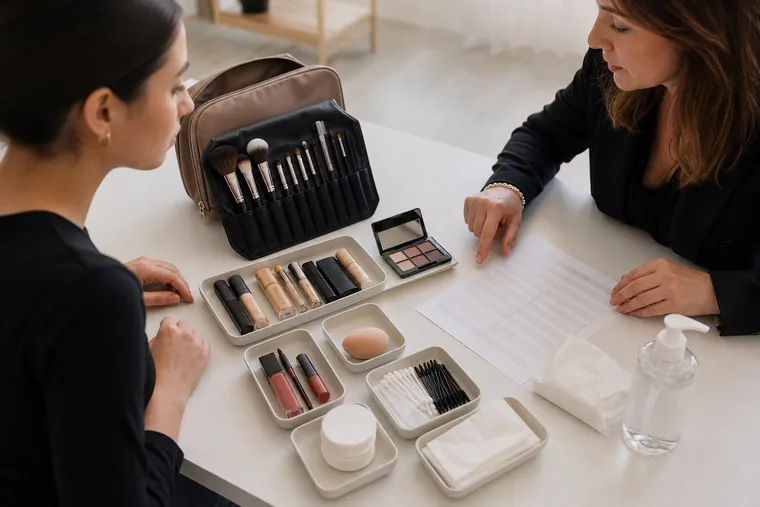
A large kit cannot rely on memory. Record category, brand and line, name, shade, format, batch, EU Responsible Person, supplier, purchase date, opening date, PAO or minimum durability, instruction location, current status and disposal. Palettes and sets need enough detail to identify the actual variant used.
Perform a light monthly check and a fuller review with each order. Separate active, quarantined and disposal products. Rotate stock without confusing oldest purchase with earliest opening. Before a bridal, photographic or multi-person job, verify supplies, applicators and touch-up products. The professional makeup products course connects label reading to formula behaviour and service use.
Use a final pre-service label checklist
Trace the product before it touches a person
Identity, instructions, time and condition come before application
Match product, shade and area
Read warnings and directions
Check batch, PAO and condition
Decant with traceability
Confirm exact product, line, shade and intended application area.
Read current precautions and manufacturer directions in the physical pack.
Verify batch, opening record, PAO or minimum durability and packaging integrity.
Check storage history and quarantine any altered colour, odour or texture.
Confirm relevant diagnosed allergens from the client record without diagnosing from INCI.
Decant hygienically and retain a traceable link to the original pack.
Stop if the label or product status is unclear rather than improvising.
Practise these controls in the beginner makeup course and compare all current paths under online makeup courses. Training explains procedure; it does not replace current law, a regulator or product-specific instructions.
Frequently asked questions about makeup labels
What should appear on an EU cosmetic label?
Article 19 covers Responsible Person, nominal content, durability or PAO, precautions, batch, function where needed and ingredients; imported cosmetics also state origin. Placement can vary between container, box and permitted accompanying material.
What is the difference between PAO and expiry?
Minimum durability concerns the properly stored unopened product. PAO states a period after first opening, such as 12M. Neither permits using a contaminated, altered or recalled cosmetic.
Is the batch number printed beneath the barcode?
Not necessarily. Barcode, SKU and shade codes can identify commercial items, while the batch links one unit to manufacture. Ask the supplier when several compact codes are ambiguous.
Are ingredients always listed from highest to lowest?
They are generally descending by weight when added, but ingredients at 1% or below may appear in any order after those above the threshold. Colourants can follow specific conventions.
What does plus or minus mean beside colourants?
It indicates that shades in a product range may contain some listed colourants. It does not prove that every shade includes every pigment; verify the exact variant when individual avoidance matters.
Does CosIng certify that an ingredient is authorised?
No. CosIng is informative and supports common-name searches. Legal status, limits and conditions come from current legislation and its annexes, not database presence alone.
Is natural or hypoallergenic makeup safe for everyone?
No claim guarantees universal tolerance. Use the full ingredient list, warnings and individual medical information. Stop at burning, itching, swelling or another unexpected symptom.
Can eyeshadow be used on lips?
Only when the product function, intended area and instructions include that use. A cosmetic sold for face or eyes is not automatically suitable for lips or the eye waterline.
Which ingredient list applies when the website and pack differ?
Do not guess. Keep screenshots and photographs of box, container and batch, then ask the Responsible Person or supplier which formula corresponds to that unit. Quarantine it when the difference matters.
Should outer packaging be retained?
Retain it when information is not repeated on the container, or archive a reliable record linked to the exact product and batch. Do not discard the only accessible warnings or ingredient list.
When should makeup be discarded before its PAO?
Quarantine and verify a contaminated, altered, badly stored, damaged, recalled or untraceable product. Abnormal odour, colour, separation or texture is not a reason for home dilution or repair.
What should be kept after a suspected reaction?
Retain package, full name, shade, ingredients, batch, PAO, opening date, application sequence, area and symptom timing. Stop exposure and seek medical or emergency help according to symptoms.
Current regulatory sources and review status
EUR-Lex — current consolidated Regulation (EC) No 1223/2009: Article 19 and the current EU cosmetics framework.
European Commission — CosIng glossary of ingredients: nomenclature and database scope.
European Commission — fragrance-allergen labelling: Regulation (EU) 2023/1545 and transition.
Editorial review: 5 September 2026, checked against the consolidated EU text current on 18 May 2026. Independent regulatory review remains recommended and has not yet been completed. Continue with the English makeup guide library for service technique; current legislation, authorities, the Responsible Person and product instructions prevail for compliance.
Connect product traceability to the service record
Label and batch checks become useful when linked through the makeup client-record guide.
Preserve product evidence for a complaint
Product identity and batch traceability feed the professional liability and complaint guide.
Preserve label and batch information in working containers
Connect product traceability to the professional makeup kit inventory system.
Do not turn non-comedogenic into a guarantee
Read label claims within the acne-prone skin makeup guide.
Read removal directions before using the product
Put label checks into practice with the makeup-removal guide.
Read SPF and reapplication directions before layering
Continue with the sunscreen-and-makeup guide.