
A useful makeup client record is neither a medical-history form nor a universal liability waiver. It prepares the service, records relevant facts reported by the client, preserves product traceability and documents whether the artist proceeded, adapted, stopped or postponed. It also separates the privacy notice, any special-category data, technical photographs, portfolio publication and marketing instead of hiding all purposes under one signature.
Quick framework: collect only information that supports a defined service decision or obligation; do not diagnose; provide the privacy information before collection; separate contract administration, any health-related data, photographs and marketing; record the version and affirmative choice; restrict access, copies and retention; obtain privacy-law and healthcare review before deploying the form.
This guide explains an EU GDPR and Italy-aware operational model. It is educational, is not a ready-to-use form and does not replace legal, data-protection or medical advice. It was editorially checked against official sources available on 5 September 2026 but has not received independent DPO, privacy-lawyer or clinician review. The actual services, systems, providers, territory and risk assessment determine the lawful implementation.
For symptoms and immediate action, follow the separate cosmetic reaction stop protocol. For scope, payments and cancellation, use the Italy-specific makeup agreement guide. This page owns the client-record, privacy, image-permission and retention intent; it does not diagnose allergy or turn a signature into permission to continue an unsuitable service.
Client record, medical history and consent are not interchangeable terms
A clinical history is gathered for healthcare assessment, diagnosis and treatment. A makeup artist does not perform that role. Client record or pre-service questionnaire is more accurate: it captures client-reported facts and non-diagnostic observations that can affect product, application area, hygiene, adaptation or a decision to refer and postpone.
Consent also changes meaning with purpose. A client may acknowledge service information. Where legally appropriate, she may give explicit consent for a defined processing of special-category data. She may separately allow specified photographs or publication channels and separately choose promotional contact. These are not one permission, and a privacy notice is not itself a request for consent.
Design five recognisable modules instead of one signature
One record needs five purpose-specific modules
A signature cannot make unrelated purposes interchangeable
Booking
Identity, contact and appointment
Service
Products, batch, observations and decisions
Privacy
Purposes, legal bases and rights
Images
Technical, portfolio and publication uses
Marketing
Optional contact preference
The modules can appear in one booklet or digital flow, but the client should recognise which information is required to book and deliver the service and which uses are genuinely optional. Purpose, lawful basis, responsible organisation, retention and choice should not be inferred from a heading such as privacy acceptance.
Module | Operational purpose | Common mistake |
|---|---|---|
Booking | Identify client, appointment, place and service | Using marketing consent to justify service administration |
Operational questionnaire | Record relevant reported reactions, areas and decisions | Turning it into a clinical record |
Privacy information | Explain controller, purposes, bases, recipients and retention | Writing only I consent to privacy |
Images | Define technical capture, portfolio, social or advertising | Treating paid service as publication permission |
Marketing | Manage optional promotional messages and profiling | Pre-ticked or service-gated choice |
Include fields only when they lead to a real decision
Every field must change a decision or meet a defined obligation
Need, action, access and deletion form one test
Need: state the specific purpose
Decision: show what the answer changes
Access: limit who can see it
Delete: set a defensible review point
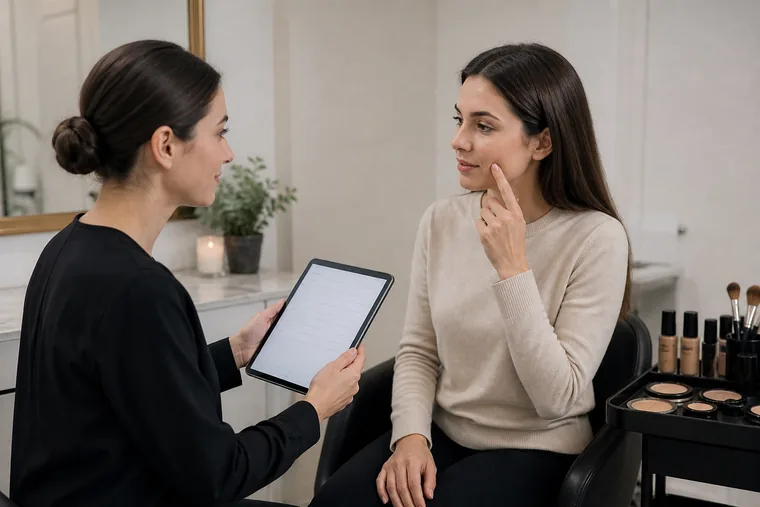
GDPR data minimisation requires personal data to be adequate, relevant and limited to what is necessary for the purpose. For every proposed field, write who uses it, which decision it changes, where it is stored, who receives it and when it is deleted. If the team cannot explain those points, the field is not ready for the form.
Essential identity and contact: name and selected appointment channel, without routinely copying identity documents.
Assignment: date, place, time, occasion, agreed look, service recipients and responsible artist.
Current application area: observable skin integrity, eyes and lips, contact lenses and relevant comfort reported by the client.
Previous event: product or service involved, body area, timing, reported symptoms and any advice the client says she received, without routinely collecting medical reports.
Traceability: products, shades, cleansers, adhesives, lashes and batches needed to reconstruct the service.
Decision: completed, adapted, stopped or postponed, using factual language and recording instructions given.
Version: date, author of the note, client updates and the privacy information and optional choices presented.
Use the makeup label guide to connect product name, shade, INCI, batch, PAO and warnings to the technical record. A client form does not replace a product inventory, manufacturer instructions or the makeup hygiene protocol.
Do not collect broad medical details without demonstrable need
A generic checklist of diagnoses, medicines, operations, pregnancy, disability or treatment can create a highly sensitive archive without improving a makeup decision. Open text boxes invite unexpected disclosures. Ask whether a less intrusive, present-focused question can produce the operational answer.
Instead of requesting a complete dermatology history, ask whether the application area is intact today and whether a cosmetic, adhesive or service on that area previously caused a reaction. Avoid collecting photographs of lesions, prescriptions and clinical reports as routine. If a sign or reported history makes the service inappropriate, stop and refer; do not demand the eventual diagnosis for your records.
Intrusive question | Operational alternative | Decision supported |
|---|---|---|
List every diagnosis | Is the application area intact and comfortable today? | Proceed, adapt or postpone |
List all medication | Has a clinician asked you to avoid products or application here? | Follow a specific reported restriction |
Upload medical evidence | Which product or service was involved and what happened? | Avoid re-exposure and refer |
Free medical notes | Choose from factual service-relevant events plus limited clarification | Reduce unnecessary disclosure |
Ask about reported reactions without diagnosing allergy
Report, observe, decide and record without diagnosis
The service decision is professional; the diagnosis is clinical
Report: use the client's own description
Observe: note the visible service area
Decide: adapt, stop or refer
Record: products, timing and action
The question do you have allergies is too vague on its own. A client may not know an allergy or may use the word for irritation. Ask about events: after foundation, skincare, pigments, false-lash adhesive, latex, fragrance or cleanser, was there persistent burning, itch, swelling, hives, blistering, peeling or breathing difficulty? Where did it occur, how quickly, which product was involved and was healthcare advice obtained?
The answer does not authorise a makeup artist to diagnose contact dermatitis or allergy. A recent, significant or unexplained reaction calls for postponement and medical advice. Do not invent a diagnostic patch test by placing a product or adhesive on the skin. Clinical patch testing uses controlled allergens and scheduled interpretation; a small cosmetic exposure cannot guarantee safety.
During service, stop for significant or increasing burning, pain, swelling, hives, blistering, broken skin or eye symptoms. Breathing difficulty, throat or tongue swelling, collapse or other severe systemic symptoms require the local emergency service. Record reported and observable facts, timing, product and batch without declaring a cause.
Finding | Studio action | Record language |
|---|---|---|
Unresolved prior reaction | Do not re-expose; postpone and refer | Client reported product, area, timing and symptoms |
Broken or actively inflamed area | Do not cover; explain stop and refer | Observable condition without diagnosis |
Symptoms during application | Stop, remove appropriately and assess urgency | Sequence, product, batch, area and action |
Breathing or severe systemic symptoms | Call the local emergency service immediately | Time, observed event and emergency action |
Service acknowledgement cannot waive fundamental rights
An acknowledgement can record that the client received information about preparation, products, duration, removal, ordinary limitations and stop signals. It can preserve questions and preferences. It cannot make an inappropriate procedure safe, validate a non-compliant product, authorise practice outside professional scope or remove responsibility for negligence.
Avoid statements such as I accept every risk or release the artist from all liability. Describe the service, realistic result limits, reasons it may be modified or stopped and how to report a problem. Economic terms and cancellation belong in the separate agreement; a client record should not silently rewrite them.
A privacy notice is not a request to consent to everything
GDPR requires a purpose and an appropriate lawful basis. Identity, appointment, payment and contact details may be processed, depending on the case, for pre-contract steps, performance or legal obligations. Consent is one Article 6 basis, not a universal signature for any future use. The controller should map the basis rather than asking the client to accept privacy.
Information revealing allergy, diagnosis, symptoms or reactions can be data concerning health and fall within Article 9 special categories. Processing is generally prohibited unless a specific condition applies. Ordinary contractual necessity under Article 6 does not replace an Article 9 condition. If explicit consent is assessed as appropriate, it must be informed, specific, demonstrable, freely given and withdrawable, while the collection itself must remain necessary.
A prudent small-business design often minimises rather than accumulates: present-focused operational questions, non-diagnostic wording, strict access and no parallel medical archive. If the service routinely collects allergy or skin-condition information, document purposes, lawful bases or conditions, providers, transfers, retention, security and risks with a privacy professional before launch.
Give Article 13 information before or at collection
The notice should identify the controller and contact route, purposes and legal bases, recipients or categories, relevant transfers, retention period or criteria, applicable rights, complaint route, whether information is required and the consequence of not providing it. It should be clear enough for the real booking flow and name the systems and providers that matter rather than using a generic website template.
Separate booking, service documentation, tax records, complaints, technical images, publication and marketing purposes.
Map booking platform, cloud, email, messaging, payment provider, consultants and collaborators with correct roles.
Assign retention by record category rather than keeping everything indefinitely for safety.
Make access, rectification, erasure, restriction, objection and withdrawal routes understandable where applicable.
Technical photographs, portfolio, social and advertising are different uses
One photograph can move through four different purposes
Permission for one use does not automatically cover the next
Technical
Private service comparison
Portfolio
Professional work sample
Social
Platform publication and sharing
Advertising
Paid promotional use
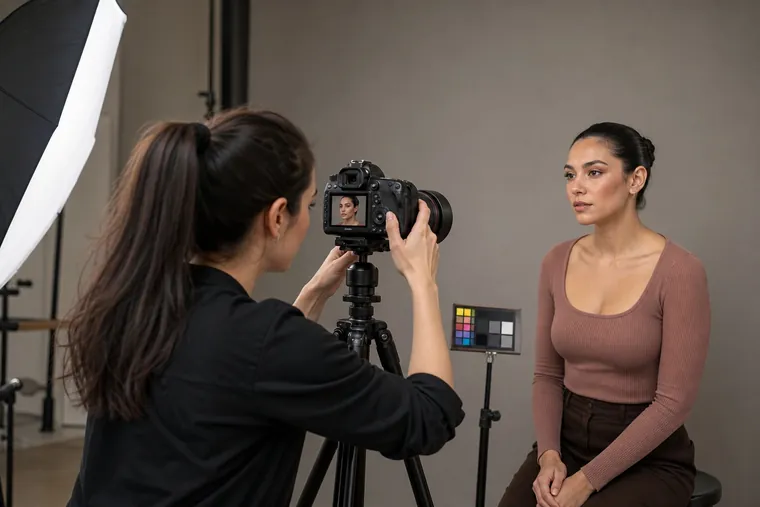
A photograph taken to remember a bridal trial look or compare camera response is not automatically authorised for Instagram. The professional bridal makeup guide explains why private trial references belong to the service workflow. A website, printed portfolio, social feed, temporary story, partner repost, press feature and paid advertisement have different reach and context. Describe intended purposes and channels instead of extending one choice to unknown future use.
A face is readily identifying. Cropping the eyes or omitting a name does not guarantee anonymity when tattoos, clothing, venue, event, metadata or surrounding posts reveal the person. Italian portrait rules and rights in the photograph also matter. The portrayed person's permission does not automatically grant the makeup artist copyright or licence to use a photographer's file.
Make publication choices genuinely optional when images are not necessary for service delivery. State purpose, channels, crop or before-and-after format, paid-media use, retention criteria, withdrawal route and realistic limits once third parties have copied a public post. Use the makeup portfolio guide for ethical selection and presentation, not as a substitute for permissions.
Minors need a separate service and image workflow
Before serving a minor, verify professional scope, product suitability, parental responsibility and who can make decisions. Permission for makeup does not automatically include public photographs. Online publication requires a specific review of authority, the child's interests, recognisability, location data, permanence and platform reach. When authority or appropriateness is unclear, do not publish.
Control storage, access, retention and deletion
Paper sheets should be locked and separated from public work areas. Digital records need individual accounts, strong authentication, device protection, backups, role-based access and a process for removing access when a collaborator leaves. Messaging apps and personal camera rolls can multiply copies across downloads and cloud backups; they should not become an accidental permanent archive.
One retention period rarely fits every record. Tax documents, contract evidence, service notes, special-category data, unpublished technical images, public portfolio files and marketing preferences can follow different justified schedules. Record the rationale, automate reminders where possible and actually delete or anonymise data when the period ends. Withdrawal of consent stops future consent-based processing, subject to a reviewed legal basis for any limited retention already required.
Prepare for reactions, complaints and personal-data breaches
For a reaction, prioritise the person, stop exposure, record facts and product traceability, refer for healthcare and assess cosmetic-vigilance or supplier reporting. For a complaint, preserve the relevant chronology, agreement, service and communications without adding clinical judgments. For loss, unauthorised access or a photograph sent to the wrong person, contain the incident and activate the data-breach process.
The controller must document personal-data breaches and assess risk. The Italian supervisory authority explains that notification is made without undue delay and, where feasible, within 72 hours after awareness unless the breach is unlikely to risk people's rights and freedoms. High risk can also require communication to affected people. Not every incident is notified, but every incident needs prompt, recorded assessment by the responsible person.
Run the record before, during and after the service
Map purposes, fields, bases, Article 9 conditions where relevant, providers, retention and responsibility.
Send the notice and proportionate questionnaire before the client is already in the chair.
Confirm relevant updates and observe skin, eyes and lips without diagnosing.
Proceed, adapt, stop or postpone and record the factual reason.
Record products, shades, batches, application areas and instructions given.
Capture technical-image, publication and marketing choices separately.
Store in the approved system, restrict access and apply the deletion schedule.
Handle correction, withdrawal, reaction, complaint and incident through documented procedures.
Checklist for independent review
Accurate client-record name and non-clinical language.
Every field tied to an actual decision, without routine diagnoses or reports.
Purpose, Article 6 basis and Article 9 condition map where relevant.
Article 13 information delivered before collection with version evidence.
Any consent is granular, affirmative, demonstrable and withdrawable.
Image choices distinguish private record, portfolio, social, advertising and partners.
Specific routes for minors, photographers, assistants and productions.
Security, accounts, transfers, retention, deletion, rights and breach response.
This checklist is not a form to copy. Adapt it to the real services, premises, booking software, cloud, messaging, payment providers and collaborators. Build professional foundations through how to become a makeup artist and review the English makeup course catalogue. Training does not replace independent legal and healthcare review.
Frequently asked questions about makeup client records
Is one standard makeup client form legally mandatory?
There is no single national template for every makeup service. Contract, tax, safety, privacy and professional obligations can still apply. A proportionate record may organise evidence, but it must be designed around the real service and applicable rules.
Should a makeup artist call the form medical history?
Client record or pre-service questionnaire is usually more accurate. Medical history has a clinical meaning. The artist records service-relevant facts and non-diagnostic observations; she does not interpret reports, diagnose or prescribe treatment.
Does the client have to consent to privacy?
There is no generic privacy consent required for every datum. The controller identifies an appropriate lawful basis and provides information. Consent is used only when appropriate and must satisfy its conditions; special-category data, images and marketing should not be bundled under one signature.
Can allergy information be health data?
Yes. Allergy, diagnosis, symptom and reaction information can reveal health status and fall within GDPR Article 9. Collect it only for a defined necessary purpose, minimise detail and verify the applicable condition and safeguards with a privacy professional.
Can a makeup artist perform a diagnostic patch test?
Do not improvise diagnostic testing by applying a cosmetic or adhesive. Medical patch testing follows healthcare protocols, while a small studio exposure cannot rule out a reaction. An unexplained previous event requires postponement and appropriate medical advice.
Does a signed waiver remove all artist responsibility?
No. A record can show what was reported and explained, but cannot make an unsuitable procedure, non-compliant product or ignored stop signal proper. Avoid sweeping waivers and have service acknowledgements and contract terms reviewed independently.
Is separate permission needed for photographs?
Uses should be distinguishable. A private bridal-trial reference is not the same as a website, social story, partner repost or paid advertisement. Explain purpose, channels, duration or criteria, withdrawal and realistic limits after public sharing.
Is a photo anonymous when the name is removed?
Not automatically. Face, tattoos, clothing, venue, event, metadata or surrounding posts can identify a person. Assess recognisability and lawful use rather than relying on omission of a written name.
Does the client's permission include rights to the photographer's file?
No. Permission concerning the portrayed person and rights in the photograph are separate. Check the photographer, production, agency and commissioning agreements. Credit or a social tag is not a substitute for the required licence.
Can a minor's makeup photograph be published?
Use a specific, professionally reviewed process for service authority and image publication. Confirm parental responsibility, the minor's interests, platform reach, recognisability and location data. If authority or appropriateness is uncertain, do not publish.
How long should a makeup client record be kept?
There is no single period for every field. Tax documents, contract evidence, technical notes, special-category data, private images, public portfolio and marketing preferences can require different justified schedules. Define and apply them rather than retaining everything indefinitely.
Can client records and photos stay in WhatsApp?
Messaging, downloads and backups can create uncontrolled copies and access. Assess provider roles, accounts, transfers, device security and deletion. A personal gallery should not become the default permanent archive for health-related details or recognisable images.
How should a postponed service be recorded?
Record date, relevant client report and observable facts in neutral language, such as skin not intact or increasing burning reported. State that the service was postponed and appropriate assessment advised, without adding a diagnosis.
What if a client reports a reaction after makeup?
Advise against further exposure and direct the client to healthcare; severe symptoms require emergency help. Collect only proportionate product, batch, area, sequence and timing facts, do not diagnose from a photograph and follow reviewed complaint and reporting procedures.
What if a record is lost or a photograph is sent to the wrong person?
Contain access, establish data and people affected, document the incident and assess risk promptly. Notify the supervisory authority and affected people when the GDPR criteria are met; involve the responsible privacy adviser immediately.
Can a downloaded client-form template be used unchanged?
A template may reveal topics but cannot prove compliance. It may request excessive data, name the wrong providers, use an invalid basis or bundle images with marketing. Map the actual flow and obtain tailored legal and healthcare review.
Official sources and scope
European Union — Regulation (EU) 2016/679: Articles 5, 6, 7, 9, 13, 32 and 33 on principles, lawful bases, consent, special categories, information, security and breaches.
European Data Protection Board — Guidelines 05/2020 on consent: conditions for informed, specific, demonstrable and freely given consent.
Garante per la protezione dei dati personali — fundamental processing principles and personal-data breach guidance.
Normattiva — Law 22 April 1941 No. 633: Articles 96 and 97 concerning publication of portraits and statutory exceptions.
NHS — anaphylaxis symptoms and emergency action: public-health reference for recognising a potentially severe emergency, not a studio diagnosis.
Editorial review: 5 September 2026. This page does not authorise clinical data collection, diagnose allergy or supply a compliant form for every business. Have the real fields, systems, providers, notices, lawful bases, security, retention, image choices and stop criteria reviewed before use.
Keep the complaint file connected but access-controlled
Service facts, reactions and images may later support the liability and complaint workflow.
Connect image permission to the actual capture workflow
After defining purpose and channel, follow the makeup light, framing and true-colour guide.
Record the agreed visibility and image use
Structure the consultation with the men’s and groom makeup brief.
Record rosacea-related information without diagnosing
Use the rosacea makeup decision guide.
Document identifiable scars and tattoos with specific consent
Use the cosmetic camouflage client-record workflow.