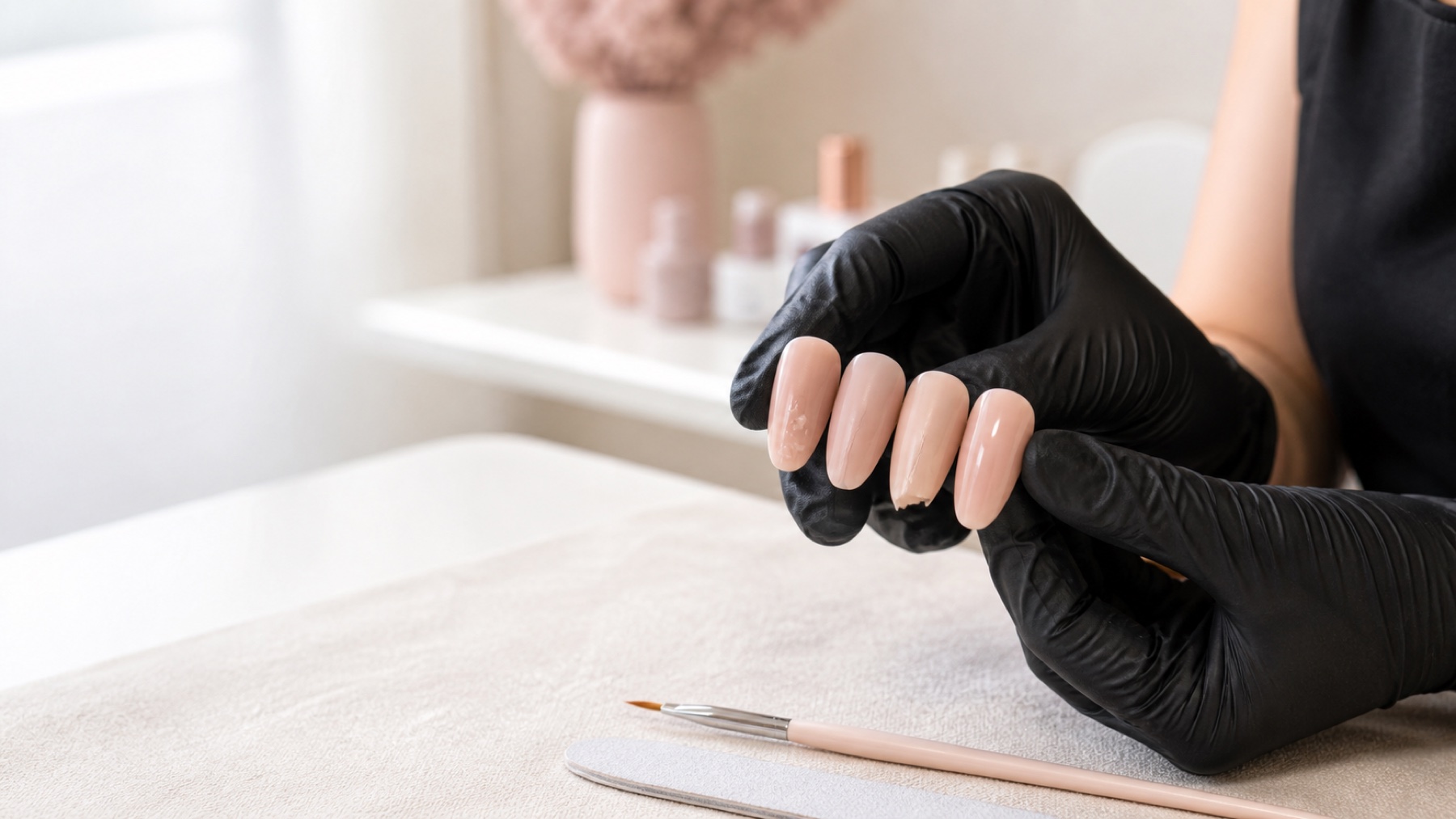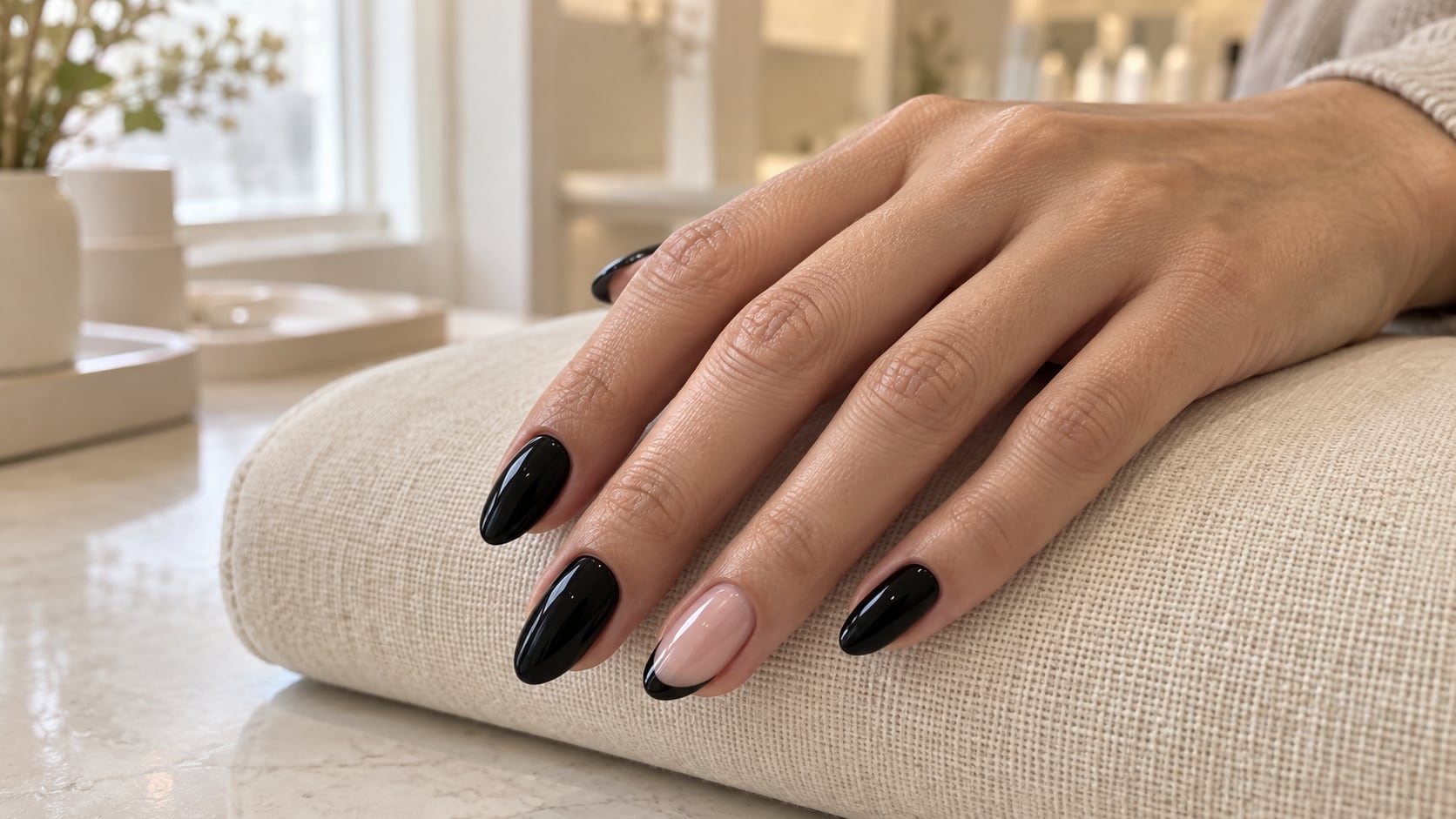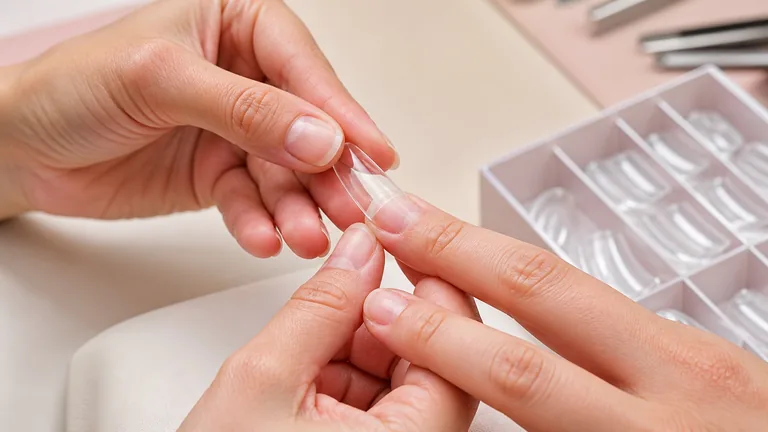
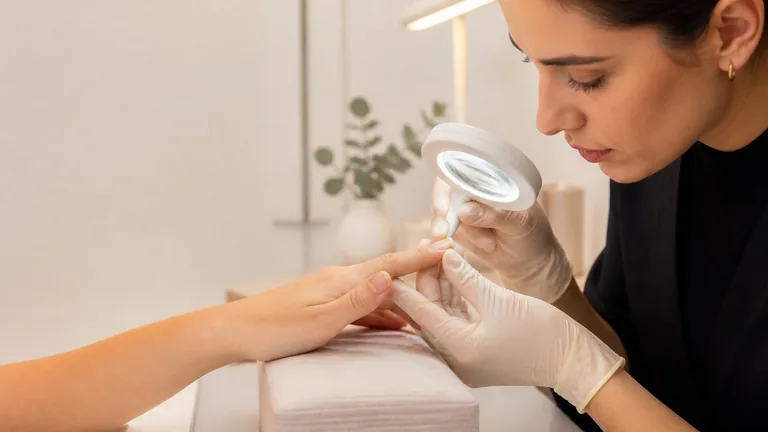
A white or opaque area advancing beneath the nail plate, a free edge that appears to lift, or a green, yellow-green or green-brown colour is not a cosmetic imperfection to hide. Nail separation and discolouration can follow trauma, repeated wet work, irritant exposure, inflammatory skin disease, infection or more than one factor. Appearance alone cannot establish the cause. A nail technician should keep the area visible, stop the cosmetic service and recommend assessment by an appropriate healthcare professional.
Do not apply gel polish, builder gel, acrylic, acrygel, adhesive or a full-cover tip over a detached, green, painful, inflamed or weeping nail. Do not dig beneath the plate or recommend antibiotics, antifungals, bleach, vinegar or essential oils. Describe what you can see, document it with consent and refer the client for medical advice.
This is an educational stop-and-refer guide, not a diagnostic tool. The yellow nail guide covers a wider range of colour changes; the nail-lifting guide deals with artificial product losing adhesion. This page owns the different question of natural-plate separation and unexplained green colour. Beauty training can teach observation, hygiene and professional limits, but it does not qualify a technician to diagnose or treat disease.
What onycholysis is and what a technician may observe
Observe and describe without diagnosing
Visible signs guide a stop decision, not a clinical conclusion
Observe
Colour, border, plate and surrounding skin
Describe
Location, extent and client report
Do not conclude
No diagnosis from colour or a photo
Refer
A clinician assesses cause and care
Onycholysis is separation of the nail plate from the nail bed. It most often begins at the distal free edge, although it may involve a lateral area or, less commonly, begin proximally. Air beneath the no-longer-adherent plate makes the area look white and opaque rather than translucent and pink. The boundary may be sharply visible. Debris, blood, cosmetic pigment or microbial colonisation can alter the colour further.
The detached portion does not simply reattach when it is pressed down or covered. Clinical management aims to identify and address the cause while new plate grows forward in contact with the bed. Fingernails generally take months to replace and toenails take longer. Repeatedly probing beneath the plate with a file, bit or other implement can add trauma, extend the separation and introduce contamination.
What you observe | A safe description | What it does not prove |
|---|---|---|
White or opaque area beneath the edge | The plate appears separated in this area | Why it separated or how it should be treated |
Green or green-brown colour | There is an abnormal colour change | That Pseudomonas or fungus is confirmed |
Pain, heat, swelling or discharge | The service must stop and prompt advice is needed | Which condition or medicine is appropriate |
Why a green nail cannot be diagnosed by colour alone
Green nail syndrome is classically associated with Pseudomonas species. These bacteria can produce green pigments and tend to colonise a moist space created by onycholysis or chronic inflammation around the nail. The colour can range from yellow-green to green-brown or green-black. Repeated water exposure, irritants and an already detached plate can provide conditions in which colonisation is more likely.
That association does not turn a salon observation into a diagnosis. Polish staining, cosmetic pigments, old blood, fungi, foreign material and other nail disorders can change colour, and more than one process can coexist. A clinician may need history, examination and sometimes bacterial or fungal testing. The technician can say ‘I can see a green-brown area and possible separation’; the technician should not say ‘you have Pseudomonas’ or prescribe a treatment.
A new or changing dark band, pigment extending into the nearby skin or a colour change without an obvious explanation also needs medical assessment. Do not assume that every dark area beneath an enhancement is a bruise. The broad nail matrix and growth guide explains why the living structures and causes of abnormal growth sit outside a cosmetic diagnosis.
Why gel, acrylic and tips should not cover a detached or green nail
An opaque or coloured enhancement hides whether the area is spreading, whether the surrounding skin changes and whether discharge develops. Preparation adds abrasion, pressure, primer, adhesive or solvent to a nail whose integrity is already uncertain. A smooth finished surface cannot demonstrate that the underlying condition is stable, harmless or resolved.
Leaving a small window above the colour while coating the rest is not a reliable compromise. The full extent and cause of the separation are unknown, and the enhancement can still alter moisture, leverage and observation. A shorter structure or clear product is not a medical monitor. Cosmetic work resumes only after appropriate assessment and when the nail is demonstrably suitable—not because the client accepts the risk or has an important event.
Do not confuse product lifting with natural-nail onycholysis. In product lifting, cured material has separated from an otherwise intact plate. In onycholysis, the natural plate has separated from the nail bed. They can occur together. If the boundary is not clearly visible, stop rather than filing blindly. Use the artificial-product lifting framework only after confirming that the natural nail itself remains intact.
A salon stop-and-refer protocol
A calm four-step stop protocol
Keep the nail visible and avoid adding trauma
Stop preparation and application
Observe without digging
Document facts with consent
Recommend healthcare assessment
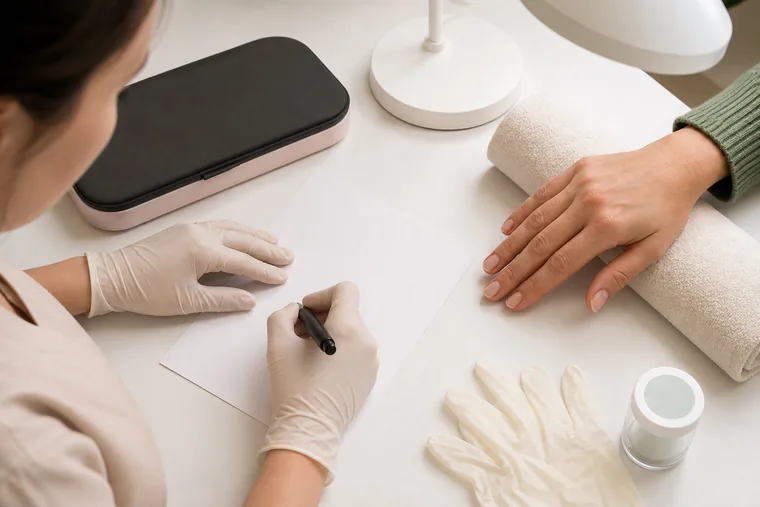
Stop preparation and application. Do not add primer, base, glue, colour, disinfectant or another product to investigate the area.
Observe without probing. Note the location of colour or separation, surrounding skin, any visible discharge and symptoms the client reports.
Photograph only with explicit consent, neutral light and a date reference. Do not use filters, diagnose from the photograph or publish it as content.
Record relevant facts: the existing product, last service, reported trauma, repeated wet work, onset and change over time. Use descriptive language rather than clinical labels.
Recommend contact with a doctor or dermatologist. For a foot problem, a podiatrist may also be involved within the healthcare system and local scope.
Contain used items and reset the workstation under your hygiene procedure without blaming the client or claiming poor sanitation caused the change.
If an enhancement is already present, do not prise it off or file aggressively simply to expose the colour. Removal can worsen pain or trauma and may erase useful evidence. Stop if the margin is unclear, the client is symptomatic, living tissue is exposed or discharge is present. The professional product-removal guide explains material-specific methods for suitable nails; it does not authorise routine removal over a medical concern.
What not to do: covering, drilling and home remedies
Four actions that reduce safety and visibility
A hidden colour is not a resolved condition
Do not cover
Gel, acrylic and tips hide change
Do not probe
Tools may extend detachment
Do not file it away
Pigment is not a surface defect
Do not prescribe
Treatment belongs to healthcare
Avoid | Why | Professional alternative |
|---|---|---|
Seal it with gel polish or builder | Hides change and adds a cosmetic system to an altered nail | Keep visible, document and refer |
Dig under the detached plate | Can extend separation and injure the nail bed | Observe without probing |
File until the green disappears | Pigment may be within or beneath the plate; filing adds trauma | Record the area and stop |
Suggest bleach, vinegar, tea tree or medication | Cause, concentration, skin condition and contraindications are unknown | Let a clinician assess and advise |
A product labelled antibacterial, antifungal or antiseptic is not permission to treat an undiagnosed nail condition. Surface cleaning does not prove that tissue beneath the plate is healthy, and a temporary change in colour is not a cure marker. Never use a salon chemical outside its labelled purpose or a household substance on living tissue as an improvised treatment.
Possible causes are a clinical map, not a salon diagnosis
Repetitive trauma, aggressive manicure, long nails, cleaning beneath the free edge, tight footwear, prolonged water exposure and chemical irritants may contribute to separation. Psoriasis, dermatitis, lichen planus, fungal or bacterial infection, photosensitising medicines, thyroid disorders and other systemic conditions may also be associated. A single nail after an impact and several nails without an obvious cause require different medical histories, yet neither pattern authorises cosmetic cover while detachment is active.
A technician gathers operational facts rather than selecting the most likely diagnosis. If itching, swelling or eczema followed a UV-cured nail service, keep the exact product names, ingredient lists, batch details and dates available for the clinician. The gel allergy and methacrylate guide explains chemical-contact red flags, while the nail preparation guide shows why extra abrasion cannot correct a medical uncertainty.
When to seek medical advice and when it may be urgent
Routine advice or urgent help?
Use red flags to avoid delaying assessment
Arrange advice
New, persistent or unexplained change
Prompt
Pain, pus, heat, swelling or spread
Urgent
Fever, red streaking or rapid worsening
Lower threshold
Diabetes, immunity or circulation concerns
A new colour change, unexplained separation or persistent nail change warrants medical advice even when it is painless. Seek timely assessment when the area spreads, recurs, affects several nails, appears with a skin disorder, follows a medicine or interferes with ordinary activity. Do not wait until the next infill to see whether it disappears beneath the product.
Prompt assessment: increasing pain, warmth, redness, swelling, pus, strong odour or rapidly spreading colour.
Urgent medical help: fever, feeling significantly unwell, red streaking or rapidly worsening inflammation.
Lower threshold for advice: diabetes, reduced immunity, impaired circulation, cancer treatment or another condition that may increase complication risk.
Dermatology assessment without cosmetic cover: a new or changing dark streak, irregular pigment or colour extending into surrounding skin.
Emergency routes and professional titles differ by country. Use local health-service advice and emergency numbers rather than relying on a salon article to grade severity. If symptoms are severe or the person appears systemically unwell, seek urgent local care.
Document the observation without invading privacy
A short client record can support continuity: date, digit, approximate position and size, colour, reported pain, surrounding-skin appearance, existing product, last service and relevant events the client volunteers. Write ‘green-brown area beneath the lateral free edge’ rather than ‘bacterial infection’. Keep fact, client report and action in separate fields so another person can understand the record.
Photographs need informed consent, secure storage, a defined retention period and access limited to the agreed purpose. Do not upload a clinical-looking photograph to a public or professional group to crowdsource a diagnosis. Do not use it in a portfolio. Record only health information needed for the service decision and follow the privacy requirements that apply in the client’s jurisdiction.
Tool and surface hygiene still matter, but they do not explain the diagnosis. Follow the separate guide to cleaning, disinfection and sterilisation for manicure tools so that a stop event does not collapse cleaning, disinfection, sterilisation and waste control into one vague spray step.
When a cosmetic nail service may resume
There is no universal waiting period. Resume only after the relevant healthcare professional has assessed the condition and any recommended management is complete or compatible with the proposed service. The nail should be intact and adherent, without active abnormal colour, pain, inflammation, discharge or broken skin. A dry surface on one appointment is not enough if the underlying plate remains detached.
At the return visit, reassess before opening products. Confirm what advice the client received without collecting unnecessary medical detail, photograph the starting point with consent and choose the most conservative compatible service. Keep length and load appropriate, avoid unnecessary preparation and arrange an observation point. Stop immediately if symptoms, colour or separation return. A client waiver cannot override professional stop criteria.
How to explain the stop without alarming or dismissing the client
Use neutral, specific language: ‘I can see an area where the plate appears detached and the colour has changed. I cannot determine the cause in a nail appointment, so I will not cover it. Please ask a doctor or dermatologist to assess it before we continue.’ This describes the finding, your limit and the next step without announcing an infection or blaming previous work.
Avoid both extremes. ‘It is definitely fungus’ is an unsupported diagnosis; ‘it is only moisture and will grow out’ may falsely reassure. Do not promise a date for reapplication, sell a corrective product or imply that signing a form transfers the risk. Professional confidence means making a calm stop decision and recording it consistently.
A pre-service decision checklist
Is the natural plate visibly attached, intact and a normal colour for this client?
Are the surrounding folds free from unexplained redness, swelling, broken skin or discharge?
Can you distinguish artificial-product lifting from natural-plate separation without probing?
Has any previous concern been medically assessed and is the proposed service compatible with that advice?
Can you complete preparation, application, curing and removal without covering an uncertain area or causing pain?
A ‘no’ or uncertain answer means postpone, document and refer. Build this boundary into consultation forms and practical education rather than improvising when the diary is full. Explore online nail courses that teach natural-nail assessment, chemical safety, hygiene and stop criteria alongside application technique.
Frequently asked questions about onycholysis and green nails
Can gel be applied over a green nail?
No. An unexplained green colour should remain visible and be medically assessed. Gel polish, builder, acrylic, acrygel, adhesive or a tip can hide change and add preparation, moisture or leverage to an already altered nail.
Is every green nail caused by Pseudomonas?
Pseudomonas is the classic cause of green nail syndrome and can produce green pigments, but colour alone does not confirm it. Staining, blood, fungi, foreign material and other disorders can alter appearance or coexist. Diagnosis belongs to a healthcare professional.
What is the difference between onycholysis and gel lifting?
Onycholysis is separation of the natural nail plate from the nail bed. Product lifting is loss of adhesion between an enhancement and an intact natural plate. They may look similar and can coexist, so stop if the boundary is unclear.
Can I disinfect a green mark and then cover it?
No. Applying a disinfectant does not identify or resolve the cause, and misuse can irritate tissue. A colour change after cleaning is not evidence of cure. Keep the nail uncovered and seek appropriate assessment.
Will the detached nail reattach?
The portion already detached does not simply reattach. If the cause is identified and managed, new nail may grow forward attached to the bed. Regrowth takes months and a long-standing separation may recover less completely.
Should a nail technician cut away all detached nail?
Not automatically. The extent, location, pain, skin condition and possible infection need assessment. Do not insert tools under the plate. Ask the healthcare professional what care is appropriate, especially for extensive or proximal separation.
Do vinegar or tea tree oil treat a green nail?
A nail technician should not prescribe a home remedy without diagnosis, concentration, duration and skin assessment. Even familiar substances can irritate or delay appropriate care. A clinician should decide whether testing or treatment is needed.
When is a green nail urgent?
Seek prompt medical help for increasing pain, pus, heat, swelling, spreading redness, rapid colour change, fever or feeling unwell. People with diabetes, reduced immunity, circulation problems or cancer treatment should seek advice at a lower threshold.
When can gel polish or enhancements be applied again?
Only after appropriate assessment and when the nail is intact, adherent and free from active abnormal colour, pain, inflammation, discharge and broken skin. Follow any clinical advice and stop if the change returns.
Can a nail technician tell a client they have an infection?
No. A technician can describe visible signs, stop the service and recommend medical assessment. Identifying the condition or organism, excluding other causes and prescribing treatment are healthcare decisions.
Can a clear product be used so the nail remains visible?
Clear product still requires preparation and creates a cosmetic layer over an altered nail. It can change moisture, leverage and what can be assessed. Transparency does not make an unsuitable nail suitable for service.
Can the client sign a waiver and ask the technician to continue?
A waiver does not convert a contraindicated or uncertain service into good professional practice. The technician retains responsibility for following scope, training, product instructions, local requirements and documented stop criteria.
Dermatology sources and healthcare boundary
DermNet — Onycholysis: definition, causes, clinical features, complications, assessment and regrowth.
Merck Manual Consumer Version — Green Nail Syndrome: association between green pigmentation, Pseudomonas, onycholysis and wet or irritant exposure; reviewed October 2025.
American Academy of Dermatology — 12 nail changes a dermatologist should examine: nail lifting, green-black colour and other changes that need professional assessment.
NHS — Nail problems: general nail care, unexplained colour or shape changes and signs around the nail that need medical advice.
Substantively reviewed on 5 September 2026. This guide provides general education for nail-service stop and referral; it does not diagnose onycholysis, bacterial or fungal infection, prescribe treatment or replace individual medical care. Chiara Daso is a Nail Master and educator, not the reader’s healthcare professional. Apply local professional scope, privacy rules and clinical advice.