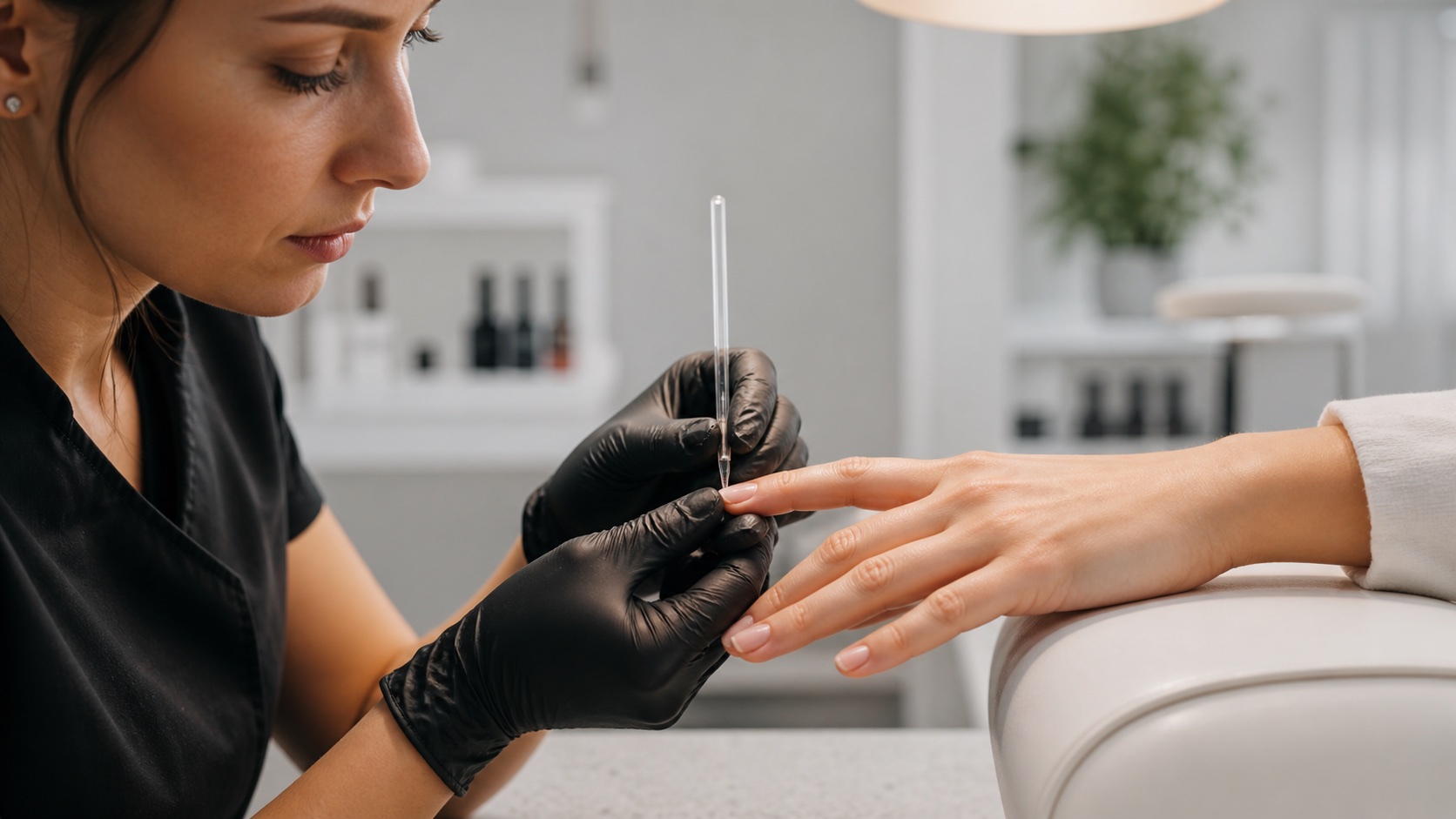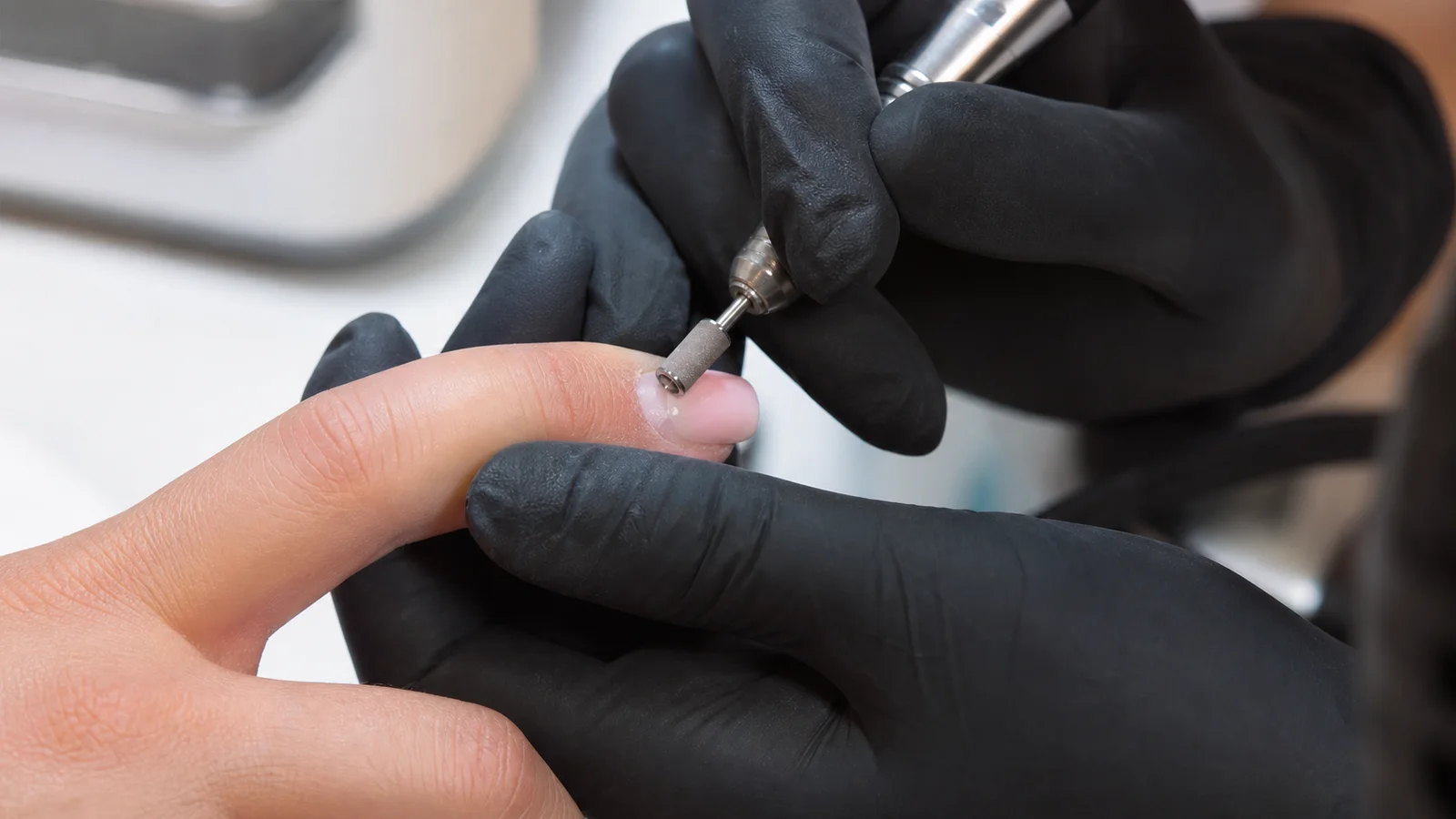
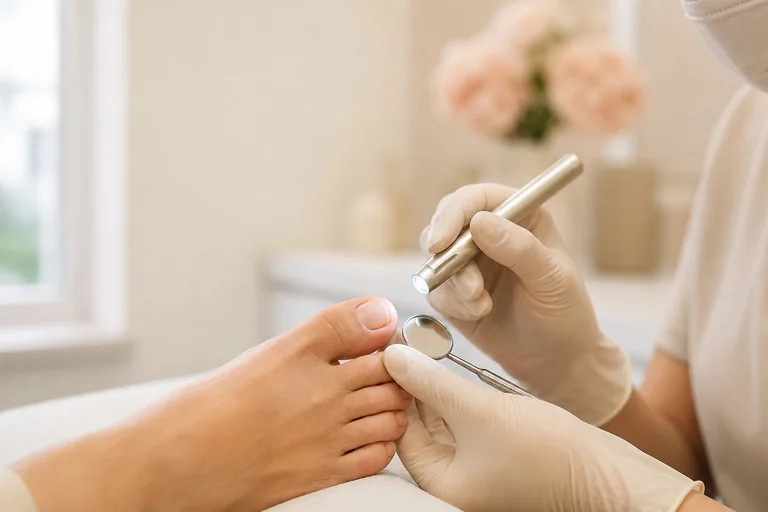
Cosmetic toenail reconstruction can restore a neat visible outline where part of a stable nail remains after an old, fully healed injury. It is not an automatic cover for every short, thick, detached or discoloured toenail. Footwear pressure, moisture, slow growth and nail changes that can look alike make assessment more important than the material chosen.
Short answer: consider cosmetic reconstruction only when skin is intact, the area is stable and the cause of the change has been clarified. Do not cover pain, inflammation, discharge, active nail separation, recent trauma or unexplained colour. Reconstruction does not treat fungal infection or restore the nail matrix. Diabetes, reduced sensation, circulation problems, immunosuppression or previous foot ulcers require individual clinical or podiatric advice before any cosmetic service.
This page owns the cosmetic reconstruction decision and its limits. The guide to gel polish on toenails covers a thin colour service on healthy nails, while onycholysis and green nail changes owns the no-cover decision for a detached or discoloured plate. Substantively reviewed on 5 September 2026, this guide is technical education, not diagnosis, podiatric treatment or medical advice. It has not received independent clinical review.
What cosmetic toenail reconstruction is—and is not
Cosmetic form is not medical treatment
One word can describe services with completely different scope
Cosmetic
Temporary visible form
Gel polish
Thin colour on a suitable nail
Podiatric
Foot-health pathway
Surgical
Medical repair of tissue
In a cosmetic service, reconstruction means creating a controlled artificial portion that completes the visible form of a stable natural toenail. It may replace a small corner, a distal edge or a larger missing area only where the product instructions and remaining nail support permit. The objective is appearance and, in some documented systems, limited protection from minor contact. It does not regenerate the matrix, reattach a lifted nail plate or change the cause of nail dystrophy.
It must not be confused with surgical repair of the nail bed, medical treatment for fungal disease, devices used for an ingrown toenail or a podiatric prosthesis delivered inside a healthcare plan. The word reconstruction is used for very different procedures. Before consent, name the cosmetic product, intended use, expected result, maintenance and professional boundary without claiming therapy or biological regrowth.
Review nail-matrix anatomy and growth before using words such as repair or regrowth. A cosmetic layer sits on available surface; it cannot replace the living structures that produce or support the natural plate.
A hand-enhancement protocol cannot simply be copied onto the foot. The big toe sits inside a shoe, receives front and vertical forces and can spend hours in a warm, humid microenvironment. A long, domed or rigid build may become a pressure point and create new trauma. Appearance at the treatment couch is incomplete evidence until the profile has been checked with the client’s real footwear.
When a cosmetic reconstruction may be considered
Candidacy cannot be decided from one photograph or from the client’s wish to hide a defect. A potentially suitable case has an understandable history, fully intact skin, a stable residual nail and conditions that allow observation and scheduled removal. If the cause is unknown, the change is evolving or the professional cannot see a safe support area, postpone rather than improvise.
Scenario | Consider only if | First professional decision |
|---|---|---|
Old, healed trauma | Cause is known, skin intact and no recent pain or change | Assess stability, footwear space and review date |
Part of the plate is missing | Healthy stable support remains and the system allows that use | Follow the product’s support and skin-contact limits |
Irregular but stable outline | Origin is clarified and no warning sign is present | Create the minimum low-pressure profile |
Temporary appearance goal | Foot and nail are healthy and follow-up is realistic | Explain that the result is temporary and non-therapeutic |
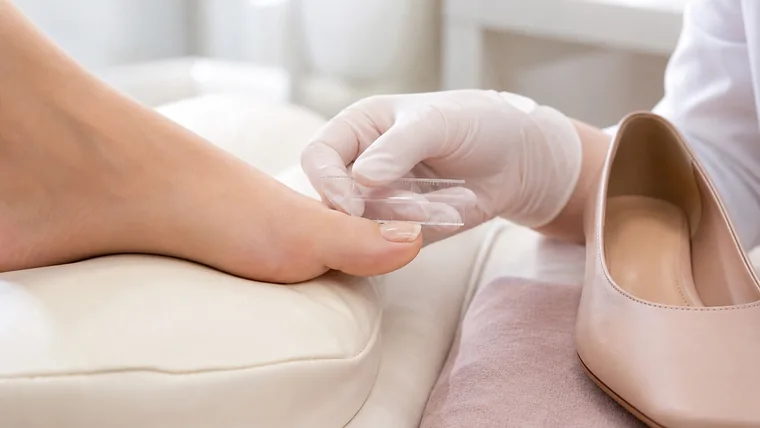
Do not promise one standard wear time even in an apparently suitable case. Remaining nail area, growth, sweating, shoes, activity and product mechanics all affect maintenance. Set a review date, explain early-removal signs and document the starting condition. A longer interval is not proof of a better service if the nail cannot be inspected.
When not to reconstruct: stop signs before aesthetics
Stop signs stay visible
The salon records an observation and refers without diagnosing
Colour
New or unexplained change
Attachment
Plate lifting from the bed
Skin
Red, swollen, broken or weeping
Action
Stop, document and refer
Never reconstruct to hide an unexplained sign. An opaque cover can delay observation, trap debris or moisture, add shoe pressure and postpone appropriate assessment. The cosmetic professional does not need to diagnose in order to stop. Neutral documentation—colour, area, pain reported, swelling seen—is more responsible than naming a disease from appearance.
New, changing or unexplained green, yellow, brown, red or black colour.
Crumbling, marked thickening, subungual debris or another pattern that could require fungal testing.
Extensive or progressing onycholysis—the natural plate separating from the nail bed.
Pain, heat, swelling, redness, bleeding, discharge, malodour or broken periungual skin.
Recent impact, surgery, an inflamed ingrown toenail or an incompletely healed area.
A new or changing dark streak, sudden distortion or a rapidly evolving nail change.
Known allergy or previous reaction to gel, acrylates or methacrylates without an appropriate clinical plan; follow the gel-nail allergy stop guidance rather than trialling another product.
The client cannot return for observation, professional removal or maintenance.
Colour alone cannot identify a cause and a cosmetic professional does not diagnose. Stop, record what is visible without interpretation and recommend assessment by an appropriate podiatrist, dermatologist or medical professional.
The American Academy of Dermatology advises assessment for changes including a new dark streak and nail lifting. Fungal disease can resemble injury or psoriasis and may require examination plus clipping, scraping or laboratory work. Use the guide to yellow nails and warning signs to organise observations without self-diagnosis. Cosmetic reconstruction is never a diagnostic trial.
Diabetes, neuropathy and circulation require a higher threshold
Diabetes can be associated with reduced sensation and blood-flow problems. A client may not feel pressure, friction, heat or a small injury reliably, and a wound can become serious. The US Centers for Disease Control and Prevention advises people with diabetes to inspect their feet daily and seek professional care for changes. A salon check cannot establish circulation, sensation or healing capacity.
Diabetes, neuropathy, vascular disease, immunosuppression or a history of foot ulcer is not an invitation to invent a gentler gel protocol. Postpone and ask the client to obtain individual advice from the clinician or podiatry professional responsible for their foot care. Consent alone cannot replace assessment. If sensation is reduced, ‘tell me if it feels tight’ is not a reliable safety test.
Cosmetic reconstruction, gel polish and clinical care are different services
Service | Primary purpose | Essential boundary |
|---|---|---|
Gel polish on toes | Thin colour film on a suitable healthy plate | Does not replace missing nail or treat disease |
Cosmetic reconstruction | Temporarily completes visible form and surface | Needs stable candidacy, suitable product and review |
Podiatric device or treatment | Part of professional foot-health management | Does not automatically belong in cosmetic scope |
Surgical reconstruction | Repairs injured anatomical structures | A medical procedure, entirely separate |
Clear language protects the client and the professional. Do not advertise cure, matrix correction or fungal treatment when providing a cosmetic coating. Use words such as prosthesis or medical only where they accurately match the regulated product, provider and purpose in the relevant country. Local professional scope takes priority over this general editorial distinction.
A seven-part candidacy assessment
Candidacy is a sequence, not a photograph
History, tissue, footwear and follow-up must agree
History
Known, healed and stable
Tissue
Intact skin and support
Pressure
Toe box, activity and profile
Follow-up
Review, removal and stop signs
History: when did the change appear, is the cause documented, is it stable, painful or evolving?
Skin: proximal and lateral folds, toe pad and surrounding area must be intact, without heat, fissure, inflammation or discharge.
Natural nail: describe colour, thickness, attachment and stable residual area without diagnosing their cause.
Risk context: ask proportionately about diabetes, sensation, circulation, immune status, allergies, medicines and previous foot problems.
Footwear and activity: review toe-box width and height, direct big-toe pressure, sport and hours in closed shoes.
System: confirm that the precise product and lamp cover the proposed use, support area, skin-contact boundary and thickness.
Follow-up: agree the review, professional removal and signs that trigger immediate contact or healthcare assessment.
Use the nail client record and consent guide to trace observations, products, batches, authorised photographs and advice. Collect only information required for a safe service, protect it under applicable privacy law and retain it according to a defined policy. A signed form cannot make an unsuitable service acceptable.
Choose a documented material and the lowest practical profile
Design for the shoe, not only the treatment couch
More thickness can create more pressure and leverage
Low profile
Minimum practical material
Front view
No projecting distal edge
Side view
No excessive dome
Shoe test
No pain or compression
Not every builder gel designed for hands is suitable for a proposed toenail reconstruction or for contact near exposed skin. Use only a system whose documentation covers the intended application. Respect its remaining-nail requirement, preparation, skin clearance, amount, compatible lamp, exposure, minimum profile and contraindications. Do not improvise because a familiar gel happens to be available.
The build should follow a natural low profile rather than reproducing a hand apex. The distal edge should not project into the shoe, and sidewalls must not press against nail folds. Check from the front and side, then with the client standing where appropriate and wearing the actual closed shoe. A beautiful result when barefoot may be mechanically unsuitable during walking.
If a protocol mixes primer, base, builder, top or lamp from different systems, first read the guide to cross-brand nail-product compatibility. Generic claims such as flexible, medical-style or antifungal do not establish intended use. Verify the exact label, technical instructions, batch and responsible supplier; do not use a salon cosmetic as a treatment for an undiagnosed condition.
A conservative professional sequence
Screen first: decide to proceed, postpone or refer before opening or preparing product.
Document the starting condition, history reported, footwear, consent and photograph where separately authorised.
Apply the established hygiene workflow for hands, surfaces, reusable tools and single-use items.
Prepare conservatively without digging beneath the plate, thinning stable nail or touching broken skin.
Create only the form and length needed, keeping the lowest controllable shoe-compatible profile.
Use the documented product–lamp exposure without curing reactive material on skin.
Check every edge, standing comfort where relevant and pressure inside the client’s footwear.
Provide written maintenance and stop signs, and schedule the first review before the client leaves.
The guide to cleaning, disinfecting and sterilising nail tools explains a one-way reprocessing workflow. Use the guide to curing gel nails for layer, lamp and position controls. Neither technique guide expands a provider’s legal or clinical scope.
Maintenance means inspection, not automatic infill
A reconstructed toenail must not be left to grow indefinitely. Toenails grow slowly, but the artificial portion continues to receive shoe pressure, moisture and impact. The review interval depends on product instructions, residual nail, growth, footwear, activity and what is observed. At review, decide whether to maintain, remove or stop; do not treat every appointment as a routine infill.
Check colour, odour, discomfort, pressure, lifting and surrounding skin each day.
Keep feet clean and dry, change socks and never insert tools beneath the reconstruction.
Do not glue, pull or shorten a detached area at home; arrange controlled professional removal.
Avoid footwear that presses directly on the toe; contact the professional promptly if comfort changes.
Remove through the product method without tearing the remaining natural plate.
Remove and seek assessment when the picture changes
The plan needs an immediate stop for pain, throbbing, heat, swelling, redness, discharge, new odour, colour change, broken skin, nail-plate separation or worsening shape. A new or changing dark streak belongs with a dermatologist, not beneath opaque product. Do not file away colour to see whether it returns and do not wait for the scheduled review when symptoms are worsening.
Suspected fungal infection cannot be confirmed visually. Trauma, psoriasis and other disorders can look similar, and the AAD explains that nail sampling may be used to distinguish them. The NHS highlights added concern in people with diabetes or reduced immune function. Diagnosis and any treatment come before a later cosmetic decision, not from the success or failure of a reconstruction.
Build skill without crossing the clinical boundary
The Dry and Russian Manicure Course develops controlled work around the nail and tool handling. The Gel Polish Course builds thin application, margin and cure skills on suitable nails, while the Complete Nail Technician Course connects anatomy, preparation and material control. Training in cosmetics never substitutes for podiatry or medicine; recognising a stop sign and referring is part of professional quality. English course and instructor records remain independent from the Italian market.
Frequently asked questions about cosmetic toenail reconstruction
Can a toenail that has stopped growing be reconstructed?
Only after the absent or altered growth has been assessed and the skin, nail bed and remaining plate are considered suitable for a cosmetic application. Reconstruction does not restart the matrix or promise natural regrowth. An unexplained or changing condition needs clinical assessment first.
Can builder gel be placed directly on skin where the nail is missing?
Not unless the precise system explicitly permits that intended use and the professional is competent and legally able to provide it. Many nail cosmetics are designed for the nail plate, not exposed nail bed or skin. Without stable support and intact tissue, stop rather than adapting a hand gel.
Does cosmetic toenail reconstruction treat fungal infection?
No. It is not an antifungal treatment and can obscure colour, thickness, debris or separation that should remain visible. A suspected fungal nail needs assessment and sometimes testing because injury and other nail disorders can resemble infection. Treatment belongs with an appropriate healthcare professional.
Can a green toenail be reconstructed?
No cosmetic product should cover an unexplained green area or a detached nail. Record what is visible, remove existing unstable material safely where within scope and recommend appropriate assessment. Do not name the organism, prescribe a remedy or seal the colour beneath new gel.
How long after trauma should toenail reconstruction wait?
There is no universal number of days. Healing must be complete, the cause and present stability must be clear, and there should be no wound, bleeding, pain, inflammation or ongoing change. Significant trauma, surgery or altered growth requires individual clinical guidance before cosmetic work.
Can an ingrown toenail be cosmetically reconstructed?
Not when the edge is painful, inflamed, embedded or producing broken skin. Added thickness or length can increase shoe and fold pressure. Ingrown-toenail assessment and corrective devices belong to an appropriate clinical or podiatric pathway, not an improvised cosmetic build.
How long does a big-toe reconstruction last?
Wear depends on the product system, stable support area, footwear, activity, sweating, growth and maintenance. One duration promise is not responsible. Set the inspection and removal interval from instructions and observed conditions, and bring it forward for pain, pressure, lifting or colour change.
Should a toenail reconstruction be thick for strength?
No. Excess thickness can create pressure inside a shoe and add leverage during walking. Use the lowest profile the documented system and case require, then inspect from front and side and check actual footwear. Strength cannot be judged separately from comfort, support and force.
Is toenail reconstruction suitable for someone with diabetes?
The salon should not decide this alone. Diabetes may involve reduced sensation, altered circulation and higher consequences from pressure or small wounds. Ask the client to obtain advice from their diabetes or foot-care professional, especially with neuropathy, vascular disease or previous ulceration.
Can I use the same builder gel used on fingernails?
Only if the manufacturer documents the proposed application and every condition is met. Formula, flexibility, support, skin-contact boundary and cure cannot be transferred by intuition. Choose from intended use and technical instructions, not because a familiar pot is already on the table.
What if the reconstruction hurts inside a shoe?
Stop wearing the compressive shoe and contact the professional promptly for inspection and controlled removal where needed. Do not wait to ‘get used to it’ or file it randomly at home. Pain, redness, swelling, heat or broken skin can require healthcare assessment.
How often should a cosmetic toenail reconstruction be checked?
The interval is product- and case-specific and should be agreed before application. Arrange an earlier check for any change in colour, odour, comfort, attachment or surrounding skin. A review is a decision point to retain, remove or stop—not automatically an appointment to add material.
Clinical sources and editorial limits
American Academy of Dermatology — 12 nail changes a dermatologist should examine
American Academy of Dermatology — Nail fungus: diagnosis and treatment
US Centers for Disease Control and Prevention — Your feet and diabetes
These sources support the stop and referral boundaries for nail separation, changing colour, suspected fungal disease and higher-risk diabetic feet. They do not endorse one cosmetic reconstruction product or universal protocol. No competing academy, salon or product retailer is linked. Apply current local scope, product instructions and individual clinical advice, and continue through the complete English nail guide library without treating education as authorisation to provide healthcare.