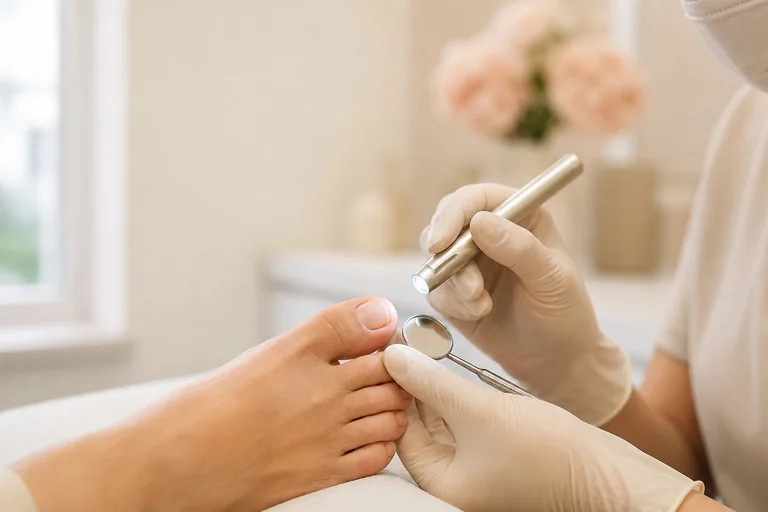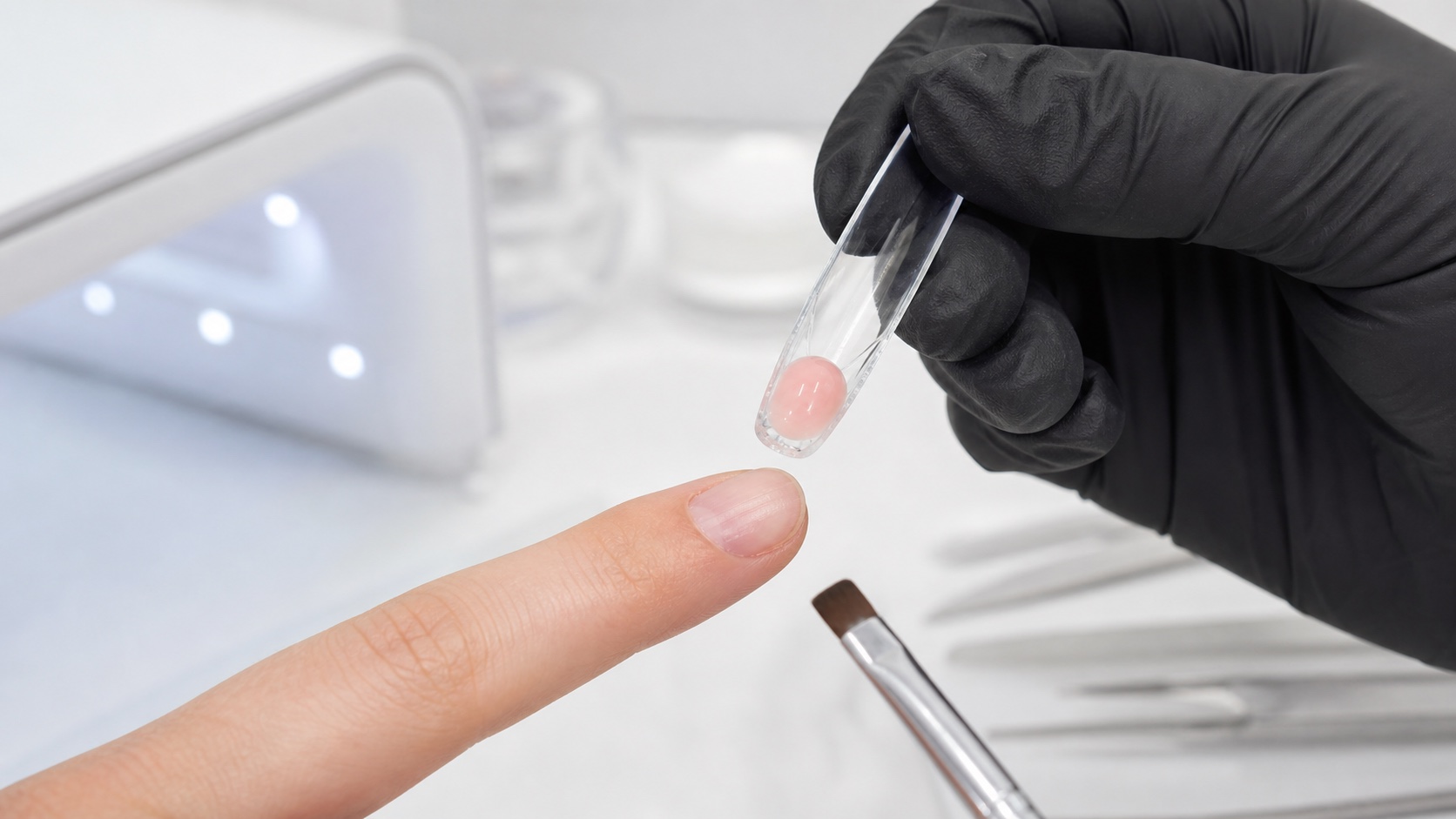
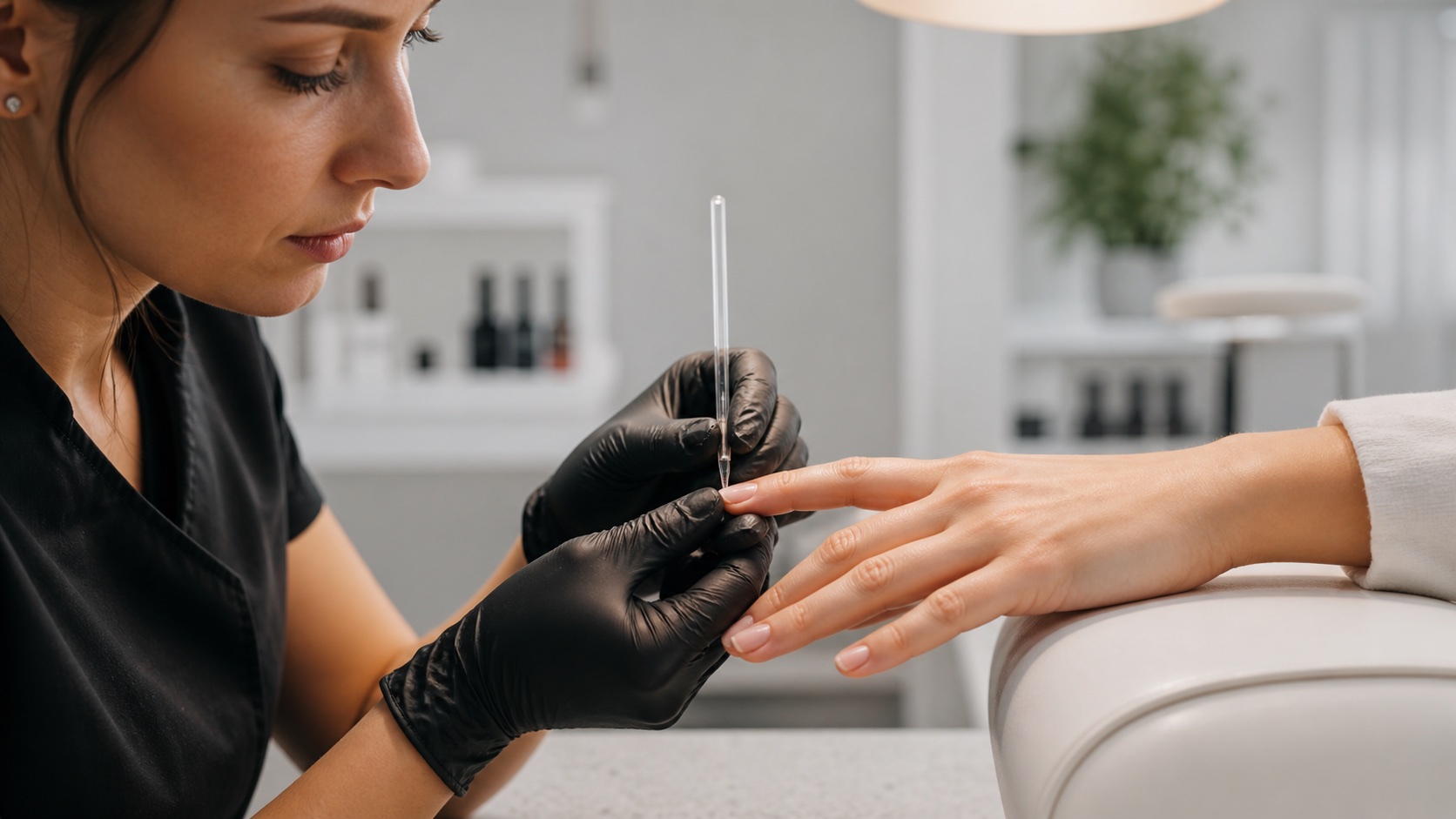
Hooked, ski-jump and sideways-growing nails follow directions that may differ from the visual axis planned for an enhancement. A nail technician’s role is not to force the natural plate into a new path. It is to observe the existing growth, decide whether cosmetic work is appropriate and design temporary artificial structure that remains balanced as the nail grows.
Short answer: artificial product can rebalance the visible profile or axis, but it cannot change how new nail is produced by the matrix. The correction must be reassessed at maintenance and must never depend on aggressively filing the natural plate, forcing the folds or hiding a new unexplained deformity.
This guide owns growth-direction assessment and limited cosmetic compensation on intact nails. The nail morphology guide owns aesthetic shape choice; the nail-form guide owns general form fitting. Symptoms, sudden changes and medical nail deformities remain outside cosmetic scope.
How to recognise downward, upward and lateral nail growth
Three visible patterns need three different plans
A salon description does not identify the cause
Downward
Free edge descends in profile
Upward
Distal plate rises
Lateral
Axis shifts left or right
Scope
Describe; never diagnose
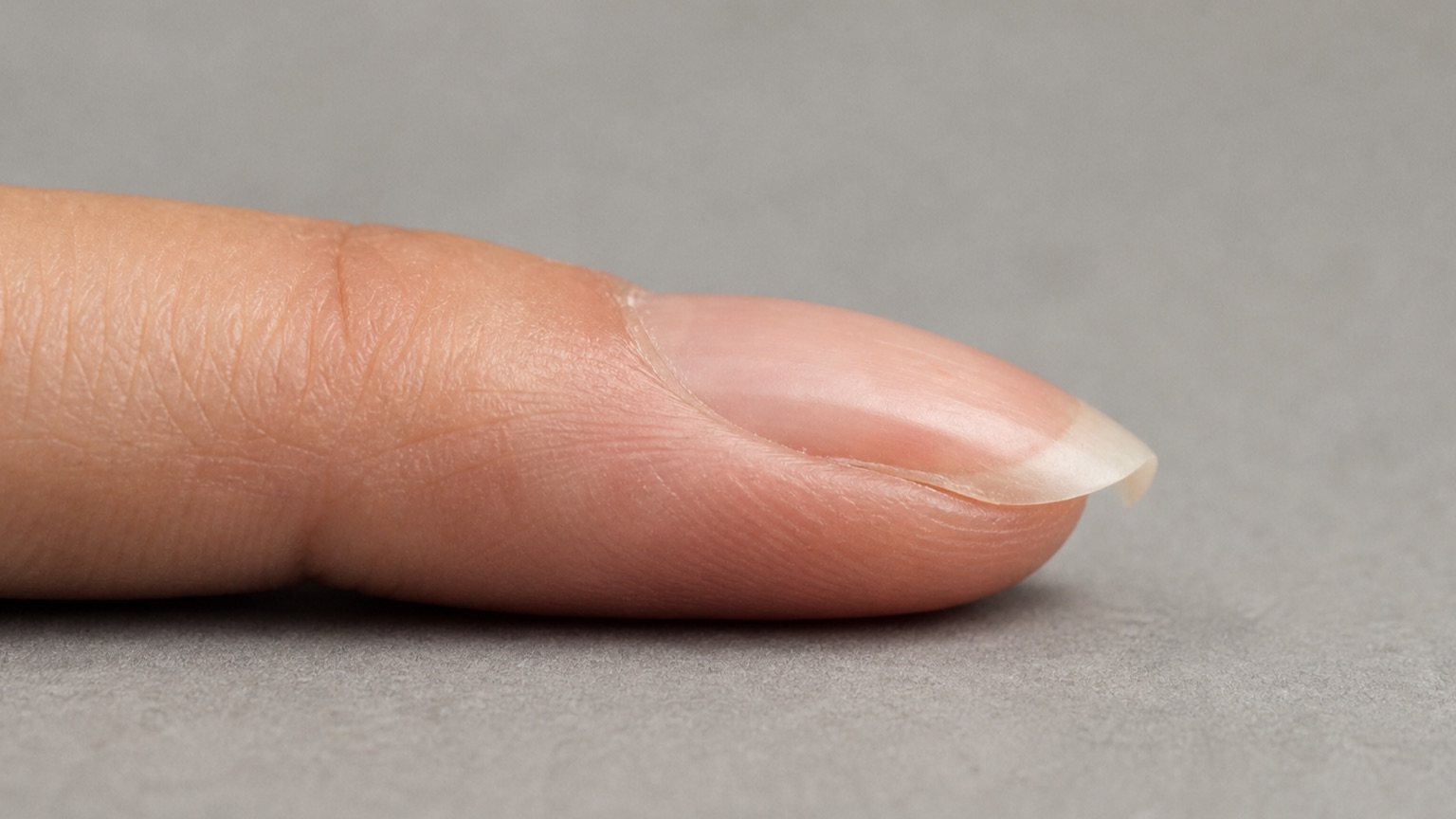
Classification begins with the bare nail, not the desired salon shape. On a hooked or downward-growing nail, the distal plate curves below the intended lower line. A ski-jump or upward-growing nail rises through its profile. With lateral deviation, the plate or sidewalls travel to one side relative to the finger. These are visual descriptions, not diagnoses or explanations of cause.
Visible pattern | Primary clue | Realistic cosmetic aim | Mistake to avoid |
|---|---|---|---|
Hooked or downward | Descending free-edge profile | Build a more supported visual lower line | Following the downward edge with the form |
Ski-jump or upward | Rising distal profile | Moderate the visual rise without a heavy tip | Filling space with bulk instead of redesigning |
Sideways-growing | Plate axis deviates left or right | Create a moderate axis aligned to the finger | Thinning one natural side to fake symmetry |
The nail matrix produces most of the plate, while the nail bed and surrounding structures support its path. Published clinical literature describes how matrix or bed trauma may lead to persistent deformity. That evidence supports an important cosmetic boundary: product placed on top cannot reprogramme the tissue producing the nail.
Natural growth line and designed extension axis are not the same
The growth line is the path the natural plate is already following. The designed axis is the visual direction selected for the artificial extension. An angle may exist between them. Cosmetic correction manages that transition through support, product distribution, length and filing; it does not erase the difference from the natural plate.
A straight-looking top outline can conceal a descending lower line, a twisted form or very unequal sidewalls. Conversely, a modest asymmetry may be safer than forcing a perfectly centred photograph with excessive material or a weak lateral wall. Design must survive ordinary wear, not only a single viewing angle.
Assess every nail from top, side and front views
One view cannot support a three-dimensional correction
Each camera direction answers a different structural question
Top
Finger, plate and sidewall axes
Side
Growth line and profile
Front
Tilt, curve and symmetry
History
Change, trauma and symptoms
Observe and photograph the clean natural nail before surface preparation. The side view reveals rising or descending growth and the available lower line. The top view compares the finger, plate and sidewall axes. The front view reveals transverse curve, tilt and asymmetry. One profile image cannot support a three-dimensional correction.
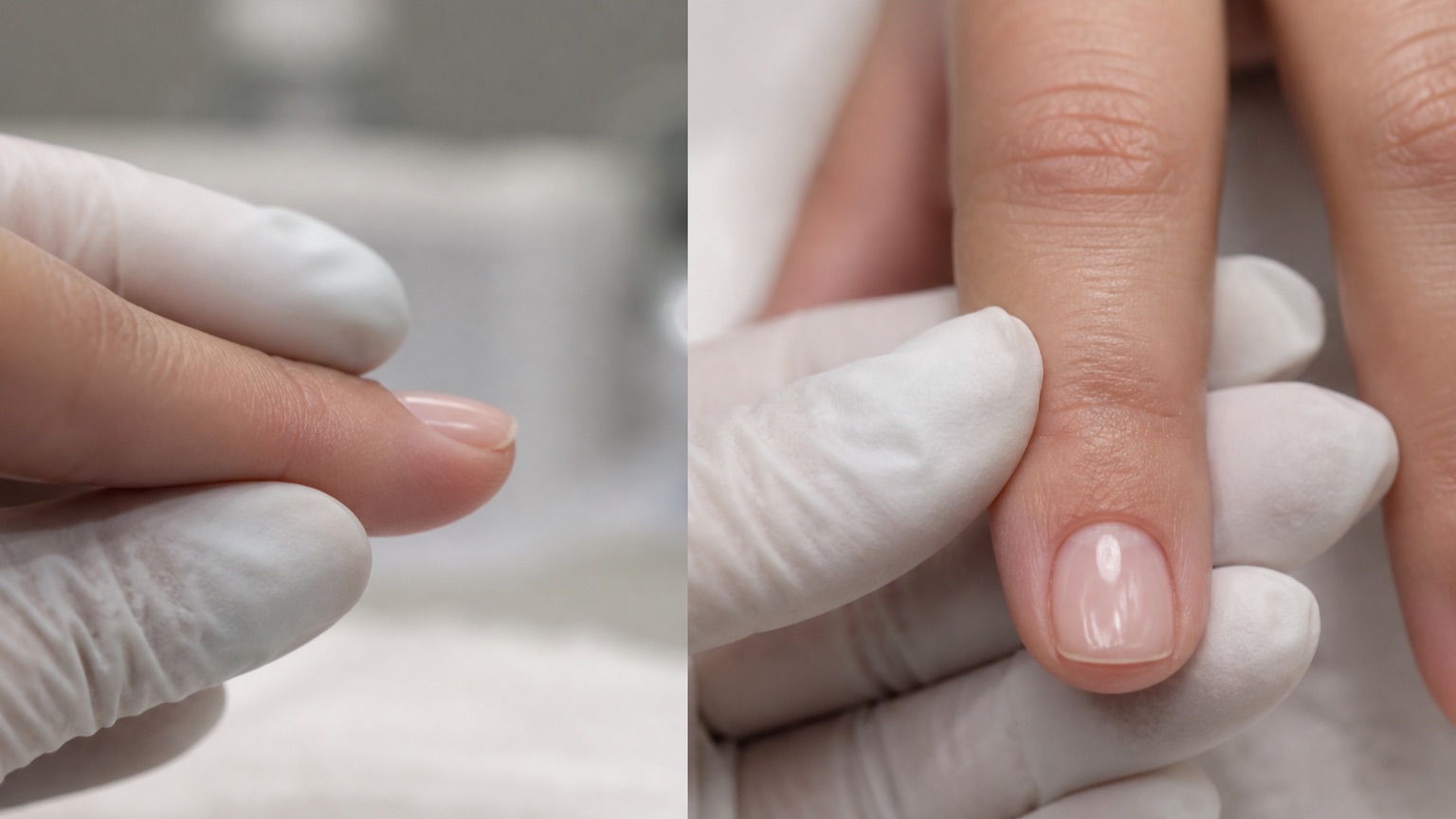
Use the centre of the finger as one reference rather than assuming the plate centre is always the final axis.
Check whether the natural free edge interferes with the proposed support and lower line.
Choose a length that suits adhesion area, deviation, daily load and realistic maintenance.
Compare fingers individually; one form angle or tip size is not automatically correct for the whole hand.
Record recent changes, trauma history and symptoms without attempting to diagnose their cause.
Use the nail matrix guide for living anatomy and the limit between observation and healthcare assessment. The comparison made here is geometric and cosmetic; it does not classify disease.
Correcting a hooked nail with a sculpting form
A common error is placing the form directly against the descending free edge and continuing its path. The extension then lengthens the hook instead of moderating it. When sound natural free edge obstructs the designed plane, reduce only what is safe and necessary for the documented method. Custom-fit the form around the remaining anatomy without gaps or pressure.
The form must support the intended lower line while respecting the hyponychium and living folds. Relief cuts adapt the support; they are not permission to weaken it until it collapses. Check the axis from above, inclination from the side and closure from the front before applying product, as explained in the dedicated nail-form fitting guide.
After cure or set, inspect before refining. The profile may appear straighter, but it should not contain an unsupported step, a hidden void below the free edge or a bulky compensation above it. A successful correction is not necessarily flat. It retains the complete architecture required for its product, length and shape.
Ski-jump nails: reduce visual rise without loading the tip
A uniform overlay on an upward-growing plate usually repeats the rising profile. Adding product above the distal nail without a plan creates a heavy tip; filling beneath it can create thickness, serviceability and hygiene problems. A controlled reconstruction may provide more freedom than following the whole natural edge with a simple overlay.
Plan a coherent upper arch and a clean lower line, then keep the free edge proportionate. Correct artificial material during filing; do not chase the desired silhouette by thinning the natural plate. Recheck the side view after every major stage, because a balanced top view can still hide a rising or dropped profile.
Sideways-growing nails: centre the design without sacrificing a sidewall
When a plate deviates laterally, its visible centre may not coincide with the finger. Project a line from the finger axis towards a realistic future free edge, then use that plan to align the support, sidewalls and filing. Compensating entirely from one side often leaves a weak wall and excessive mass on the opposite side.
Keep the correction moderate. If a perfectly centred extension would require extreme thickness, major natural-plate removal or an unstable lateral, reduce the length and aesthetic ambition. Sound structure with a small visible deviation is preferable to forced symmetry that cannot be maintained.
The corrected structure must still pass complete architecture checks
A straighter silhouette is not enough
Correction remains valid only when the whole structure agrees
Support
Apex and stress area
Lines
Sidewalls and lower arch
Front
Curve and free-edge thickness
Safety
Adhesion, skin contact and cure
Read the final enhancement as one system: apex, stress area, sidewalls, lower arch, C-curve and free edge must agree. The apex is not a decorative bump and does not occupy one fixed percentage on every nail. The nail architecture pillar explains load paths; the apex placement guide connects the high point to length and growth direction; and the C-curve guide owns transverse balance and front-view limits.
Do not let correction disguise basic failures. Product on skin, incomplete cure, a lifted natural edge or very thin sidewall remains a defect even when the silhouette looks straighter. Photograph all three views at a level angle and compare them with the original plan before deciding that the service is complete.
Sculpting form, dual form or overlay: choose by correction range
Method | Potential advantage | Important limit |
|---|---|---|
Adhesive sculpting form | Designs axis and lower line finger by finger | Needs custom cuts, stability and three-view reading |
Dual form | May reproduce a compatible moderate correction efficiently | A standard shell may rock or distort on a deviated plate |
Natural nail overlay | Supports short nails with mild deviation | Follows more of the natural path and offers less correction |
The dual-form guide owns reusable upper-form sizing and pressure control. The natural nail overlay comparison helps define how much support an intact short plate needs. Choose the method that can achieve a moderate stable design without force, not the method promoted as fastest.
Errors that make cosmetic correction unstable
Adding bulk to hide the growth direction instead of redesigning support and load.
Thinning the natural plate or one natural sidewall to create false symmetry.
Using the same form angle or pre-shaped tip on every finger without checking axis.
Choosing excessive length that magnifies leverage and the original deviation.
Judging only from above while the lower line, profile or front view remains unbalanced.
Promising permanent correction even though new plate follows its existing growth source.
Maintenance means redesigning as natural growth returns
The original direction reappears with every growth cycle
Maintenance is reassessment, not proximal filling
Reassess
Axis, profile and symptoms
Reduce
Length, lift and imbalance
Rebuild
Restore support deliberately
Stop
Remove if not safely recoverable
During regrowth, the apex moves, more natural plate becomes visible and the original direction reappears. An infill is not just product added near the proximal fold. Reassess profile, axis, lifting, length and stress area. Remove compromised material and reduce unsafe length before rebuilding useful structure.
There is no universal interval. Growth, length, load and retention determine the return point. Use the nail infill and rebalance guide for the full decision process. If stable architecture cannot be recovered, follow the appropriate product removal route rather than sealing over an old problem.
When cosmetic correction must not proceed
Do not cover a recent unexplained change, a progressive deformity affecting one nail, pain, swelling, redness, bleeding, secretion, marked thickening, major separation or unusual colour. A previous crush, amputation or matrix injury may involve the nail bed, bone and tissue support. The appropriate goal is healthcare assessment, not concealment.
Nail technicians do not diagnose the cause or provide medical correction. Record the appearance and client report only as permitted, explain why the service is paused and recommend an appropriate healthcare professional. Resume cosmetic work only when it is within scope and the nail is suitable for the intended product.
Frequently asked questions
Can gel permanently correct a hooked nail?
No. Gel can change the temporary artificial profile. New nail continues to be produced by the matrix, so the growth direction reappears and needs reassessment.
Is a ski-jump nail a medical diagnosis?
The salon term describes an upward visual profile; it does not identify a cause. New, progressive, painful or otherwise abnormal changes need healthcare assessment.
Can a sideways-growing nail be corrected by filing only?
Artificial material can be refined, but do not thin the natural plate to simulate symmetry. Meaningful deviations are managed mainly through a moderate designed axis and support.
Should a nail form follow the downward natural edge?
Not automatically. Following the hook can extend it. Fit the support to the safe designed lower line while respecting the free edge, hyponychium and folds.
Can a dual form correct every growth direction?
No. The shell must fit width, transverse curve, sidewalls and axis without rocking or pressure. Pronounced deviation may require another method or a more modest result.
Is a long corrective extension stronger?
Not inherently. More length increases leverage. A shorter balanced correction is often more realistic where adhesion area is limited or deviation is pronounced.
How much natural free edge should be removed?
There is no universal amount. Preserve healthy plate and reduce only what the documented method safely requires for support fit and structure.
Does the apex stay in one place on these nails?
No. Its useful position depends on length, shape, growth and maintenance stage. Regrowth moves existing mass distally, so the structure must be rebalanced.
How should the result be photographed?
Use level top, side and front views before and after. Keep distance and orientation consistent so the comparison does not exaggerate a correction.
Is growth-direction correction suitable for beginners?
Pronounced cases require established anatomy, preparation, support fitting, architecture, product and filing skills. Practise three-view planning on suitable training models with feedback first.
When should an existing correction be rebuilt instead of infilled?
Rebuild when the axis, lower line, sidewalls or adhesion cannot be restored safely by reducing and rebalancing stable material. Do not preserve a distorted base to save time.
Which signs require referral rather than covering?
Pain, inflammation, bleeding, secretion, major separation, unusual colour, marked thickening or a recent progressive one-nail change should stop the cosmetic service.
Develop corrective design through guided practice
BeautyLearn's online nail courses connect anatomy, form fitting, product control, architecture and filing in progressive paths. Use the English nail guide library to review each supporting skill and choose a course whose declared level matches your current control.
Sources and scope
Nail-bed anatomy, injury and late deformity: Bharathi and Bajantri, Nail bed injuries and deformities of nail. Primary clinical description of post-amputation hook nail: Kumar and Satku, Treatment and prevention of hook nail deformity. Current review of trauma and secondary nail deformities: Approach to nail trauma for primary care physicians. These clinical sources define anatomy and referral limits; they do not prescribe a universal cosmetic enhancement procedure.
Editorial boundary: this page owns three-view reading and temporary cosmetic compensation of downward, upward and lateral growth. Medical diagnosis and treatment, hand-shape aesthetics, general form fitting, apex theory and product-specific application remain separate intents.