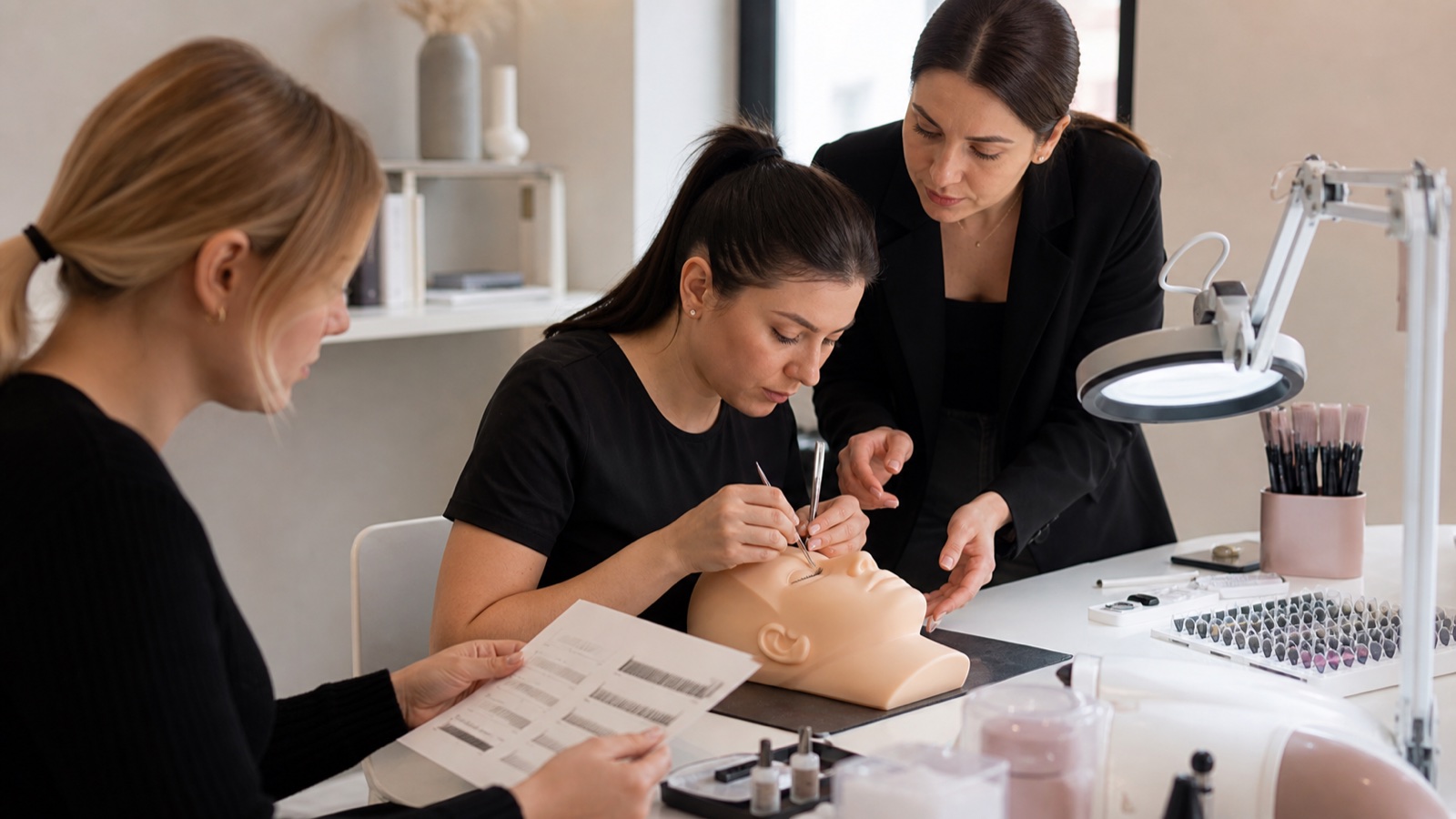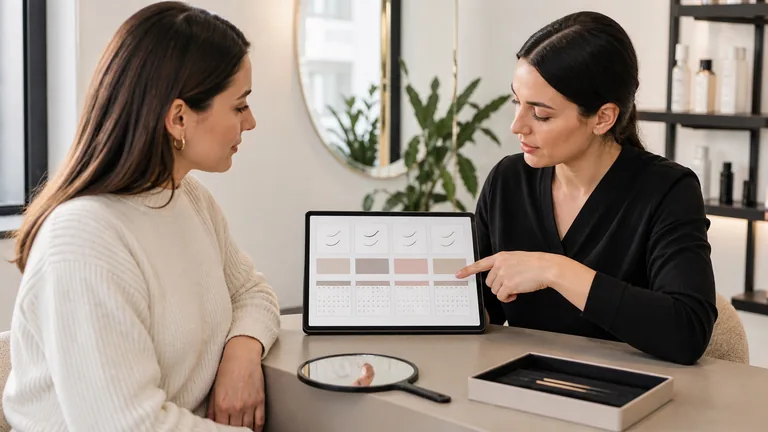

How much does a lash artist earn? A reliable answer cannot come from multiplying the highest menu price by every working hour. Lash professionals may be employees, renters, mobile contractors or studio owners, and their mix of full sets, infills, removals, lash lifts and tint changes appointment length, costs, repeat frequency and capacity. Revenue, business profit and personal take-home pay are different numbers.
This guide owns professional earnings intent. The client guide to eyelash extension and lash lift costs compares service quotes and maintenance. The professional lash service pricing guide builds the unit rate card. Here the task is to measure what an existing or planned business model can produce after time and operating costs, without promising an income.
Reviewed 5 September 2026. All formulas and scenarios are educational and currency-neutral; they are not salary surveys, market averages, recommended prices or forecasts. Tax, social contributions, employment classification, allowable expenses and reporting differ by jurisdiction and personal circumstances. Use current records and a qualified local accountant, tax adviser or employment professional before making financial decisions.
Quick answer: what determines lash artist earnings
Revenue, operating profit and take-home are different numbers
Every claim needs a business model, period, costs and hours
Revenue
Paid services × collected ticket
Contribution
Revenue minus variable cost
Operating profit
After period overhead
Take-home
Entity, tax and owner circumstances
For a self-employed lash artist, begin with paid services multiplied by the average amount actually collected. Subtract service-level variable costs and the period's fixed costs to estimate operating profit before owner tax and personal withdrawals. Then divide by every hour worked—not only client time—to understand the effective hourly return. Replace every assumption with your own location, currency and records.
Five variables usually explain more than a viral income claim: sustainable appointment capacity, occupancy of that capacity, collected average ticket, contribution per service and total working time. A high price cannot compensate for an empty diary; a full diary can still produce weak profit when sessions overrun, discounts are routine, stock expires or rent is disproportionate.
An employee's earnings begin with the employment offer, working hours, pay basis, benefits, tips or commission rules and local employment law. The client's payment belongs to the business and is not the employee's salary. A renter or owner bears more costs and risk, so gross receipts should never be compared directly with an employee's gross or net pay.
There is no credible worldwide average for an English-language audience. Currency, wages, taxes, rent, licensing, technique mix and consumer demand differ between cities and countries. Search data or self-reported social posts often mix salary, revenue and take-home. A transparent personal model is more useful than a precise-looking number with an undefined denominator.
Salary, revenue, contribution, operating profit and take-home pay
Salary or wages apply to employment. Read gross pay, pay period, contracted and expected hours, holiday or leave, pension or retirement, statutory contributions, commission, tips, deductions and benefits. An annual figure becomes comparable only after defining paid hours and the total compensation package under the relevant jurisdiction.
Revenue is what the business earns from services and other sales before expenses, subject to local accounting and tax definitions. It is not profit and not free cash. The bank balance can also differ from reported revenue because deposits, gift cards, tax collected, payment delays, refunds and bills cross reporting periods.
Contribution per service is collected service revenue minus costs that change directly with that service. It shows what remains to cover rent, software, insurance and other fixed costs. Operating profit subtracts those period costs too. Personal take-home then depends on entity, owner compensation, tax, mandatory contributions, debt and withdrawals.
Keep the labels visible in every spreadsheet. Calling revenue profit inflates performance; calling an owner's withdrawal salary can hide whether the business earned it. Ask any income claim: before or after which costs, over what period, for how many total hours, in which jurisdiction, and does it describe one person or the business?
Employee, room renter, mobile artist or studio owner
Model | Primary number | Costs and risk to clarify |
|---|---|---|
Employee | Gross pay and total compensation per paid hour | Contract, unpaid time, commission, benefits and deductions |
Room renter | Contribution after rent or revenue share | Products, booking, clients, insurance, records and licence scope |
Mobile artist | Profit per complete travel-and-service cycle | Travel, setup, mileage, storage, cancellations and geography |
Studio owner | Operating profit, owner compensation and cash | Premises, people, utilities, systems, stock and full business risk |
A lower-overhead model is not automatically lawful or profitable. Home and mobile work can create travel, planning, property, insurance and local licensing obligations. Use the lash certificate and licensing guide to verify the exact service and location. Compare business models only after including the costs of operating them correctly.
Measure the complete service cycle, not client-facing minutes
The treatment timer captures only part of the working hour
Preparation, appointment, turnover and general work form capacity
Confirm and prepare
Consult and perform
Record, pay and reset
Order, message and manage
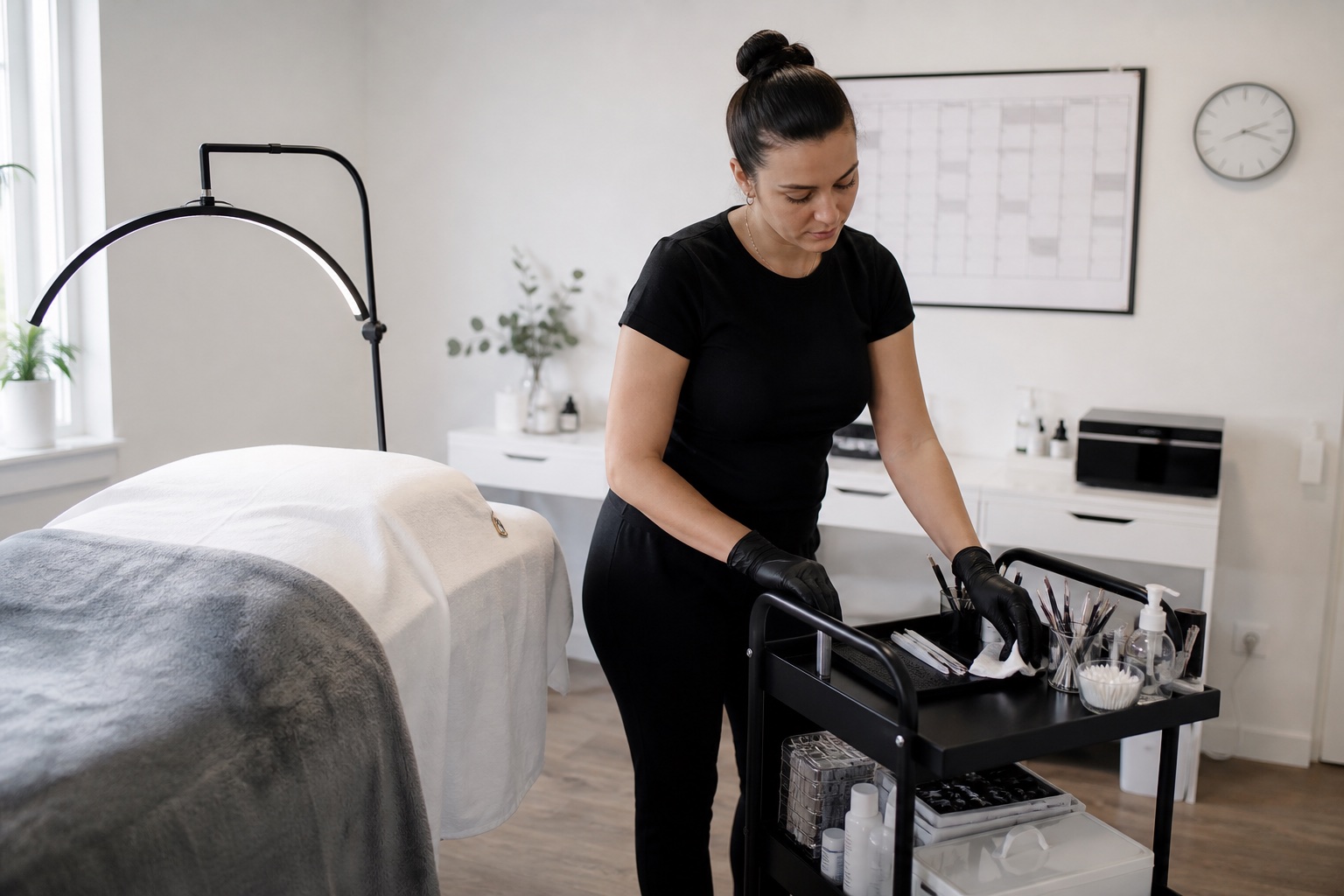
Client-facing time starts when the client arrives and may include consultation, preparation, treatment, checks, aftercare and payment. The complete cycle adds appointment messages, product preparation, delays absorbed, authorised photographs, client records, turnover, stock management and a share of general administration. Capacity should use the complete cycle.
Record at least ten reasonably comparable cycles for each service family. Keep full set, infill bands, removal, lift, tint and combinations separate. Use a cautious median or percentile, not the fastest appointment. Note why an outlier occurred instead of deleting every inconvenient result. The observed distribution tells you how much buffer a sustainable diary needs.
If a treatment occupies 90 client minutes, 15 minutes of preparation, 20 minutes of reset and an allocated 15 minutes of messages and records, its economic cycle is 140 minutes. Four such bookings require more than six visible client hours. Ignoring the surrounding work creates unpaid labour, delay and hygiene pressure.
Efficiency means reducing searching, duplicate entry and avoidable movement, not omitting consultation or shortening manufacturer times. The lash workstation hygiene guide shows why turnover belongs inside the booking model. Posture and breaks will have their own ergonomics guide when that page is published; meanwhile, do not monetise capacity by removing them.
Calculate sustainable appointment capacity
Theoretical capacity equals available service hours divided by the weighted complete-cycle time. Practical capacity subtracts breaks, training, maintenance, stock, finance, marketing and contingency. A booking calendar can display more slots than a professional can complete consistently. Treat overrun as data, not personal failure.
Model capacity by day and service mix. A long full set can block a time window that two shorter services would use differently; a booked infill can become removal plus new set after assessment. Build rules for services that exceed their booked scope and protect the next client from the cost of optimistic timing.
Do not assume every opening hour is sellable. Demand may cluster around evenings or weekends; some hours are needed for new enquiries or documentation. Track offered capacity that a client could genuinely book, not every hour you are awake or in the building. Then compare it with completed, paid services.
Occupancy: available, booked, completed and paid are different
A booked slot is not yet earned revenue
Track movement from real capacity to paid completion
Available
Genuinely sellable capacity
Booked
Reserved but still conditional
Paid
Completed and earned
Lost
Unfilled or unrecovered time
Core occupancy equals completed paid appointments divided by genuinely available slots. Keep enquiries, provisional bookings, cancellations within policy, late cancellations, no-shows and resold slots as separate events. A diary can look full on Monday and produce far fewer paid services by Sunday.
Track value as well as count. Losing one long full set and one short tint is not the same economic event. Estimate the contribution lost after any avoided variable cost, then record whether the slot was resold or the deposit lawfully retained under transparent terms. Local consumer and contract rules govern cancellation policies.
Near-100% occupancy is not always an ideal target. It can eliminate recovery, maintenance and new-client capacity, create lateness and make absence financially severe. Choose a range that supports quality and cash needs. Separate seasonal peaks from a repeatable baseline before accepting higher fixed costs.
A booked slot is not yet earned revenue. Create a simple booking funnel: enquiry received, suitable consultation, reservation confirmed, appointment attended, service completed, payment collected and appropriate rebooking. Count movement between stages by source and service. This reveals whether the constraint is visibility, conversion, unsuitable enquiries, available hours, cancellations or client return rather than treating every empty appointment as the same marketing problem.
Average collected ticket and service mix
Average collected ticket equals service revenue actually earned divided by paid services in the period. Use amounts after promotions, package allocation and refunds under your accounting method, not the highest listed price. Record retail separately when its cost and sales pattern differ from services.
The mix explains the average. Full sets, infills, removals, lift and tint use different time and materials. Compare contribution per complete hour, not price alone: contribution per service divided by full cycle hours. A smaller ticket can support a stronger hourly contribution when it uses proportionately less time and variable cost.
Technique should never be chosen only for margin. Suitability, competence, client demand and honest maintenance come first. Use the guides on retention and infills and extensions versus lash lift to keep the service decision distinct from the spreadsheet.
Variable costs: build a service bill of materials
Variable costs rise with appointments. Include fibres used, adhesive consumed and discarded, pads, tape, applicators, cleansing products, lift or tint doses, remover, single-use protection, payment processing and any laundry or travel that changes per service. Separate optional retail cost from the service itself.
Package price divided by theoretical volume is not real cost per use. Use the number of safe, saleable services actually obtained before expiry, replacement or technical discard. If an adhesive is changed before empty, the unused portion belongs in actual cost. Recalculate when product, supplier, protocol or volume changes.
Create one bill of materials per service family and version it. Do not assign classic-extension consumption to volume or a lift-only dose to lift plus tint. The professional lash kit guide separates durable tools, working stock, backup and unnecessary variety.
Fixed, periodic and replacement costs
Every service supports four layers of cost
Variable, fixed, replacement and cash timing
Variable
Products, single-use items and fees
Fixed
Space, systems and professional support
Replacement
Tools, furniture and education
Cash
Due dates and reserve
Fixed or periodic costs may include room rent, minimum utilities, booking software, accounting, insurance, licences, communications, recurring marketing, cleaning, education and shared services. Some costs are mixed: a base fee plus usage. Split them when practical so that service contribution and period overhead remain interpretable.
Spread annual and irregular costs across months for management analysis while preserving their real cash due dates. A yearly insurance payment may represent one-twelfth per month economically but still requires the full cash amount at renewal. Profit and cash therefore need parallel views.
Tools and furniture need replacement. Estimate useful life and create a reserve for lamp, bed, stool, tweezers, devices and fit-out. This management reserve is not automatically the same as tax depreciation or a deductible expense; the local accountant determines the reporting treatment.
Build three currency-neutral monthly scenarios
Scenarios expose assumptions; they do not predict income
Capacity, occupancy, ticket, cost and time move together
Low
Demand or capacity below plan
Base
Evidence-backed current case
High
Possible, never guaranteed
Stress
Higher cost and longer cycles

Use low, base and high scenarios with the same currency and period. For each, enter practical capacity, occupancy, service mix, average collected ticket, variable cost per service, fixed costs and complete working hours. Keep price and occupancy independent: raising one does not guarantee the other remains unchanged.
A useful model uses indexed currency units instead of pretending to provide a global rate. Example: if a service earns 100 units and uses 12 units of variable cost, its contribution is 88 units. With 1,320 units of monthly fixed cost, fifteen equivalent services reach operating break-even before owner compensation, tax and contingency. Substitute your actual values.
Stress-test each scenario. Reduce occupancy, increase product cost, add ten minutes to the cycle and move a major bill into its due month. If the model works only when every slot sells and nothing changes, it is not a resilient plan. Keep the assumptions beside the result and date the version.
Use the free BeautyLearn beauty service pricing calculator to organise time, materials, overhead and margin for a service. Its report is an educational pre-tax estimate; your earnings model must still include actual demand, occupancy, all services, cash timing and local professional advice.
Break-even, owner target and practical capacity
Break-even becomes a required number of services
Contribution links costs to realistic capacity
Find contribution per service
Add fixed cost and labelled target
Divide and round services up
Compare with practical capacity
Operating break-even services equal fixed costs divided by average contribution per service. Round up because part of an appointment cannot be sold. For multiple services, use a weighted contribution based on a realistic mix, not the most profitable item. Recalculate when price, products, rent or mix changes.
A fuller target adds planned owner compensation, business reserve and other defined objectives to fixed costs before dividing by contribution. Tax and social contributions require separate location-specific treatment. If required services exceed practical capacity, the model must change through scope, price, cost, mix or overhead—not by cutting safety or breaks.
The US Small Business Administration uses the same basic fixed-cost divided by price-minus-variable-cost logic and warns that break-even is an estimate, especially with multiple products or services. Its formula supports the method; it does not set lash prices, validate assumptions or replace local accounting.
Effective hourly return and unpaid work
Effective operating return per hour equals operating profit divided by all business hours in the period. Include treatment, setup, turnover, messages, ordering, finance, marketing, education required for the work and travel. State whether tax and owner compensation are already included; otherwise the number is easy to misread.
Calculate by service and for the whole business. A service can show strong contribution per client hour but weak contribution per total hour if it produces extensive unpaid consultation or rework. Conversely, administrative systems may lower total hours without changing visible treatment quality.
Time tracking should guide redesign, not punish care. Protect consultation, isolation, checks, cleaning and product timing. Look first for repeated questions, searching, duplicate data, stock emergencies and unclear policies. If the service still cannot support the required return, the future rate-card guide will address price construction.
Cash flow is not the same as monthly profit
Profit allocates revenue and costs to a period under an accounting method; cash flow follows when money enters and leaves. Annual insurance, licence renewals, bulk orders, tax payments, deposits and card-settlement delays can create cash pressure in a profitable month. Build a rolling cash forecast alongside the operating model.
Separate money collected on behalf of tax authorities or owed for future services where local rules apply. Gift cards, packages and deposits may not become earned revenue at the payment moment. Ask the accountant how to record them. Keep a business account and evidence appropriate to the jurisdiction.
The US Internal Revenue Service's small-business recordkeeping guidance provides one jurisdictional example: records should clearly show income and expenses and supporting documents should identify payment, date and business purpose. The general lesson is traceability; retention periods and tax categories must come from your own authority.
A 90-day measurement cycle
Days 1–30: observe before changing everything. Record complete cycle, paid services, collected amount, variable cost, cancellations and general hours. Reconcile records and identify the three largest gaps between scheduled and actual activity. Avoid diagnosing every gap as a pricing problem.
Days 31–60: choose one controllable change, such as trolley layout, booking confirmation, product-dose recording or infill triage. Keep other variables stable where possible. Monitor time, quality, client experience and contribution. One unusually busy week is not proof.
Days 61–90: compare median, range and total, then decide whether to keep, refine or reverse the change. Build low, base and high scenarios for the next period and check cash due dates. Take tax, staffing, contract and premises decisions to the appropriate local professional.
Build a monthly dashboard that can be audited
A useful dashboard fits on one page. Show available service capacity, completed paid appointments, occupancy, collected revenue, average ticket, variable costs, contribution, fixed costs, operating profit, complete hours and effective hourly return. Add opening and closing cash plus known payments due. Every headline should lead back to appointments, receipts, invoices, bank or processor records and the accounting system rather than a manually edited total with no source.
Report by service family as well as total. A stable overall ticket can conceal a fall in full-set demand and a rise in discounted infills. A stable revenue total can conceal longer cycles or rising product cost. Separate first visit, returning client, full set, infill band, correction, removal, lift and tint only when the category supports an actual decision; too many labels create admin without insight.
Reconcile before interpreting. Compare appointment system, payments, refunds, deposits and recorded revenue under the local accounting method. Investigate missing or duplicated transactions. Record sales tax or VAT separately where required and do not call money collected for an authority operating income. A dashboard that cannot reconcile to source evidence may produce confident but false margin decisions.
Use a rolling comparison: current month, previous month, same season where available and trailing three-month view. Annotate closures, holidays, promotions, price versions, new service launches, equipment purchases and staff changes. Do not attribute a movement to one cause merely because the dates overlap. Compare a changed process over enough comparable observations and keep client safety outcomes visible beside speed or profit.
Protect the dashboard's data. Limit access to identifiable client and financial records, use the minimum necessary fields, maintain backups and follow local privacy and retention rules. Management analysis usually needs service category, duration, price and cost—not private consultation detail. Keep operational metrics separate from sensitive records and use consistent anonymous identifiers when linking them is genuinely necessary.
End every review with one decision, one owner and one date. Examples include measuring actual adhesive discard, extending a specific infill buffer, clarifying another artist's work policy or obtaining three current quotes for an expiring cost. Avoid changing price, product, schedule and booking policy together; when every variable moves, the next dashboard cannot explain which intervention helped.
Common mistakes when estimating lash artist income
Mistakes 1–5: calling revenue take-home pay; using only client minutes; multiplying list price rather than collected ticket; treating available slots as sold; and omitting discarded product, fees or annual costs. Each inflates the result before any tax issue appears.
Mistakes 6–10: copying another country's salary; applying a universal tax percentage; using a peak month as a normal baseline; counting followers as bookings; and assuming every scheduled infill remains an infill. These collapse different markets and service outcomes into one optimistic number.
Mistakes 11–15: confusing cash and profit; pricing from the most efficient appointment; expanding capacity by removing breaks; taking fixed premises based on a high scenario; and believing a course guarantees income. Training can build competence, but demand and economics remain business variables.
Frequently asked questions
How much does a lash artist make per month?
There is no reliable worldwide amount. For an employee, use the actual offer, hours, benefits and deductions. For self-employment, calculate paid services multiplied by average collected ticket, then subtract variable and fixed costs. Divide operating profit by every hour worked and apply local tax and contribution advice. A currency figure without business model, location and cost boundary is not comparable.
How much can a lash artist make per hour?
Define the hour first. Menu price divided by treatment minutes is not earnings. Use operating profit for the period divided by treatment, preparation, turnover, messages, finance, marketing, stock and travel hours. State whether owner compensation and tax are included. Track several months because a single full day can overstate sustainable demand and understate unpaid work.
Is lash artistry a profitable business?
It can be, but technique alone cannot guarantee it. Profit requires sufficient contribution per service, realistic capacity and occupancy, controlled overhead, repeat demand, cash reserves and lawful operation. Build low, base and high scenarios, then test them against actual bookings. If only the high scenario covers costs, reduce commitment or redesign the model before assuming the business is viable.
What is the formula for lash artist profit?
Service revenue minus service-level variable costs gives contribution. Total contribution minus fixed and periodic business costs gives operating profit before any separately excluded owner compensation, tax and contributions. For multiple services, calculate each then combine the real mix. Label every boundary and reconcile it with accounting records rather than treating a management formula as a tax return.
How many lash clients can I book in a day?
Use complete observed cycles and breaks, not treatment claims. Separate full sets, infills, removals and lifts; add setup, consultation, records and turnover; then fit the mix into working hours with buffer. The right number preserves quality and recovery. If the model needs every appointment to finish at the fastest observed time, it is not a sustainable daily capacity.
What occupancy rate should a lash artist target?
No universal percentage is optimal. Define genuinely sellable capacity and divide completed paid bookings by it. Track cancellations and resold slots separately. Choose a range that covers the financial plan while preserving maintenance, learning, new-client access and illness buffer. Several months of stable data matter more than a social-media target or one seasonal peak.
What costs should a lash artist include?
Include real product use and discard, single-use items, payment fees, laundry or travel where variable, space, utilities, booking systems, insurance, licences, professional advice, marketing, cleaning, education, replacement reserve and every paid or unpaid working hour. Tax categories vary, so a management cost list should be reviewed by the local accountant rather than copied directly into a return.
Are eyelash extension infills more profitable than full sets?
Not automatically. An infill may require less time, but overgrowth, poor remaining work, cleansing and correction can change the cycle. Compare collected price minus actual variable cost, divided by complete time, across comparable bookings. Track infills reclassified as removal or new set. Retention policy and safe assessment should determine service scope before the margin calculation.
Is a lash lift more profitable than extensions?
It depends on collected ticket, full appointment cycle, product-system cost, tint, occupancy and repeat timing. A shorter treatment can have strong hourly contribution but lower frequency or demand. Do not transfer extension assumptions to lift. Use actual service records and keep manufacturer timing and natural-lash suitability outside pressure from a financial target.
How do I calculate break-even appointments?
Divide period fixed costs by average contribution per service and round up. Contribution is collected service revenue minus the variable cost of delivering it. With multiple services, use a realistic weighted mix. Add owner target or reserve only when labelled, and compare the required bookings with practical capacity. Break-even is an estimate, not a guarantee or tax calculation.
Does working from home increase lash artist earnings?
It may reduce some rent, but it can add utilities, fit-out, insurance, planning, licence, privacy, access and household disruption. Allocate the real business share and verify that the work is permitted at that address. A lower visible cost does not make an unauthorised or inadequately insured model sustainable. Compare complete profit and risk, not rent alone.
Is renting a lash room better than revenue share?
It depends on occupancy, included services, client ownership, payment processing, marketing, cancellation risk and contract terms. Fixed rent creates a cost even when demand falls; revenue share rises with sales but may become expensive at high occupancy. Model both across low, base and high scenarios and verify licensing, records and insurance responsibility in writing.
How much should I reserve for tax?
There is no universal percentage. Country, entity, taxable profit, social contributions, sales tax or VAT, other income, allowances, instalments and filing dates change the amount. Ask a qualified local adviser for a projection and payment calendar. Separate collected tax and planned reserves from operating cash, then update the forecast when profit or law changes.
How do cancellations affect lash business profit?
Measure the contribution the slot would have earned, subtract any variable cost avoided and record whether the time was resold or a lawful fee retained. Track timely cancellations, late cancellations and no-shows separately. Clear reminders and proportionate written terms may reduce loss, but consumer and contract rules vary and a deposit is not automatically earned revenue.
Can a lash course guarantee income?
No. A course can teach technique, consultation, hygiene and business measurement, but it cannot guarantee local demand, legal eligibility, speed, occupancy, price, cost or client retention. Compare the syllabus, tutor evidence and assessed practice. Treat fixed income claims as marketing unless their population, period, costs, hours and independent evidence are fully defined.
How long does it take to build a full lash diary?
There is no standard timeline. It depends on local demand, availability, quality, client experience, repeat behaviour, reputation and marketing. Track enquiries, consultations, first bookings, rebooking and paid occupancy by month. Commit fixed costs against a cautious scenario rather than an assumed date. A full diary also needs buffer; speed of filling is not the only success measure.
Which numbers should a lash artist review each month?
Review practical slots, completed paid services, occupancy, collected average ticket, revenue by service, variable cost, contribution, fixed costs, operating profit, total hours, effective hourly return, cancellations and forward cash. Add notes for closures, promotions, price changes and equipment purchases so periods remain comparable. Reconcile the dashboard to source records.
Can I increase profit without raising prices?
First measure product discard, duplicate stock, payment fees, avoidable movement, repeated messages, booking gaps and resold cancellations. Improve systems without shortening consultation, hygiene, product timing or breaks. If contribution remains insufficient after real efficiency changes, revisit service scope, cost, mix and price with evidence. Cutting safety is not an efficiency strategy.
What is the difference between profit and cash flow?
Profit matches revenue and costs to a reporting period under an accounting method. Cash flow records when money enters and leaves. Annual bills, deposits, gift cards, tax payments, stock orders and processor delays can make the two move differently. Maintain both an operating statement and a rolling cash forecast, then confirm accounting treatment locally.
Should I compare my lash income with online salary averages?
Use them only when the source defines country, employment status, period, sample, hours and whether the figure is salary, revenue or profit. Most English-language averages cannot describe every jurisdiction or business model. Your actual offer or reconciled business records provide a stronger baseline. Use external data for context, not as proof of what you will earn.
Official sources and next steps
The US Small Business Administration break-even guidance provides the fixed-cost divided by unit contribution formula and explains that break-even remains an estimate. The IRS business recordkeeping guide illustrates source-document discipline in one jurisdiction. Neither source sets lash prices or applies outside its stated scope.
Continue with the free pricing calculator, browse all English lash guides and compare current BeautyLearn lash courses. This guide does not replace local accounting, tax, employment, legal or financial advice and does not promise revenue, profit or take-home pay.
For a repeatable capture workflow covering permission, lighting, focus, honest before-and-after comparison, colour and editing limits, use the professional lash photography guide. It documents completed work without replacing live technical or safety checks.
To turn real work into a coherent path through evidence, authentic reviews, enquiry, booking, follow-up and appropriate return, use the lash portfolio and client acquisition guide. It measures qualified appointments without promising demand or income.
To adjust the complete lash workstation and plan static-load interruption, reach, light, tools and recovery without prescribing treatment, use the lash artist ergonomics guide. It complements technical and hygiene controls without replacing individual assessment.
For a cautious framework on apparent lash breakage or thinning, serum limits, treatment pauses and clinical referral, read the fragile or thinning eyelashes guide. It supports a stop-or-proceed decision without diagnosing the cause or promising regrowth.