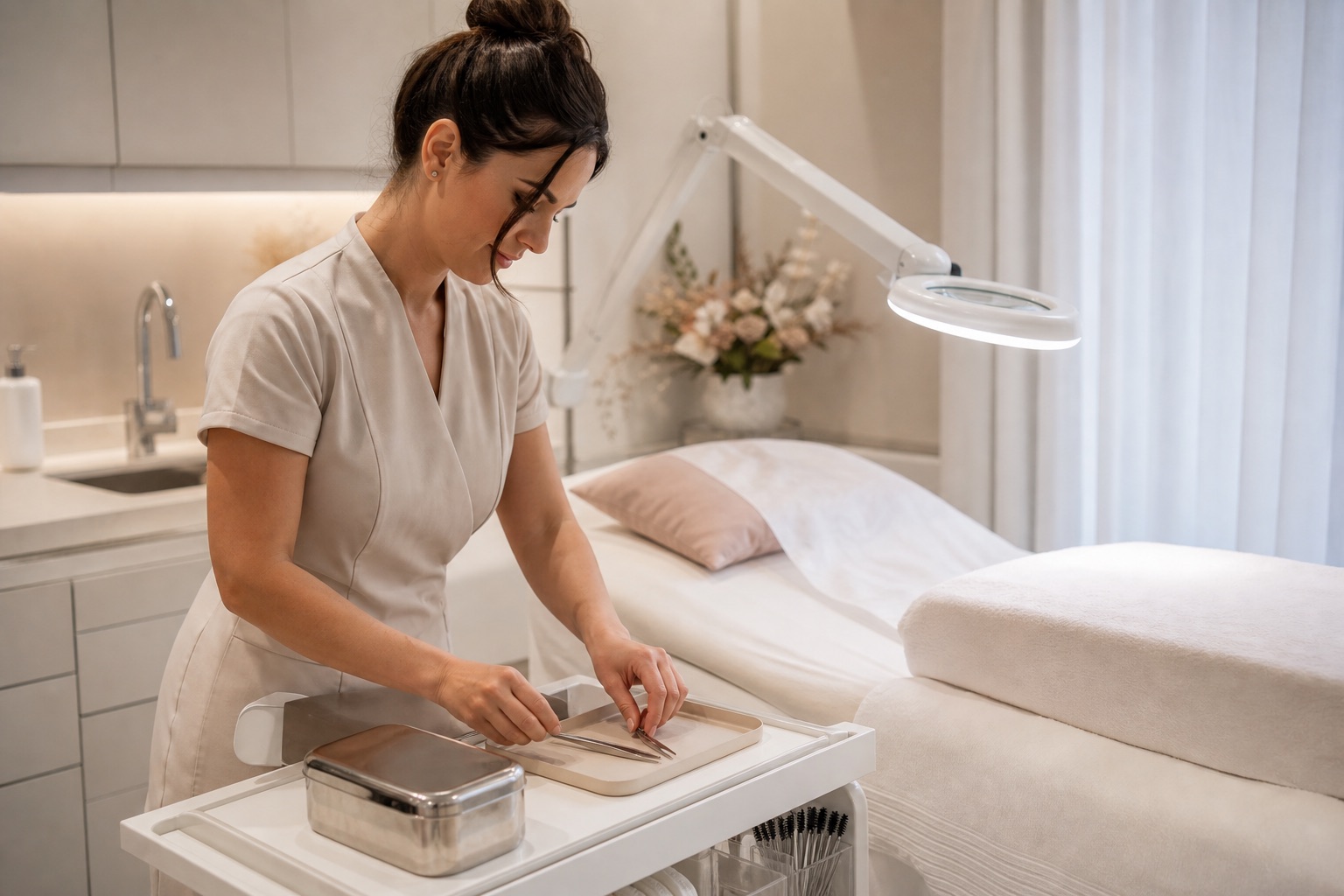

A professional lash artist kit is not a suitcase filled with every tool promoted online. It is a controlled work system. Each item must support a defined service, be compatible with the exact products and technique, enter a clear clean-to-used workflow, remain identifiable and be replaced before it becomes unreliable. Buying breadth before you can explain function creates more open products, expiry risk, duplicated tools and technical variables—not a more professional service.
Start with the services you are trained to perform. Buy the smallest complete system that lets you assess, protect, isolate, apply, remove, clean, document and respond to an incident without improvisation. Test tools in the real hand position, follow each manufacturer's current instructions, record products and batches, and expand only when practice or stock data identifies a genuine missing function.
This guide owns the lash-kit, selection and purchasing intent. The lash workstation hygiene guide owns hand hygiene, cleaning, disinfection, single-use decisions and turnover. The online lash-course guide explains how to assess training and an included student kit. Here the question is what to own, why it belongs, how much to stock and what evidence should delay a purchase. It contains no brand rankings, affiliate lists or links to competing academies.
The essential lash kit in one view
A kit is a controlled system
Every item supports a defined function
See
Stable lighting and support
Control
Tested tools and products
Remove
Approved reversal route
Trace
Batches, openings and records
For eyelash extensions, the functional core normally includes an isolation tweezer, an application tweezer matched to the trained technique, tested backups, stable adjustable lighting, ergonomic client and practitioner support, a controlled fibre range, an identified professional adhesive, environmental measurement when the adhesive instructions depend on it, eye-area protection and isolation materials, single-use applicators, a stable working surface, mirror, timer, approved removal materials, hygiene and waste supplies, a client record and product-batch log. Exact contents still depend on jurisdiction, service, training and product directions.
Lash lift and tint require different systems. Solutions, shields, direction tools, tint, developer, barriers, applicators, timers and aftercare belong to the protocol for those products. An extension kit does not become a lift kit because it contains tape and micro-applicators. Review the professional lash-lift procedure and the separate professional eyelash-tinting guide before combining inventories.
The minimum kit is not necessarily the cheapest bundle. A tweezer that needs excessive force, a lamp that creates glare, a pad that migrates or a large adhesive bottle discarded half-used adds cost through time, waste and loss of control. The most expensive product is not automatically suitable either. Compare performance on the task, documentation, usable life, replacement route and cost per completed service.
The purchasing hierarchy: safety, control, range and comfort
Buy from the foundation upward
Safety before range; evidence before upgrades
1 Safety
Complete compliant service route
2 Control
Backups, timer and measurement
3 Range
Variants supported by real cases
4 Comfort
Upgrades solving measured limits
Level one is the service boundary: compliant identifiable products, readable instructions, required protection, adequate light, intact tools, approved removal route, hygiene supplies, waste control, traceability and incident information. Without these, the appointment does not begin. A decorative tweezer, new curl or premium trolley cannot compensate for an anonymous adhesive, missing batch or unstable light.
Level two creates repeatable control: a verified backup for critical tweezers, dedicated timer, temperature and humidity measurement when relevant, secure strip or drop surfaces, mirror, clean-used separation and a realistic reorder point. Level three adds range after evidence: curls, diameters, lengths, colours, shield sizes or alternative tools that answer recurring cases rather than imagined demand.
Level four improves measured comfort or capacity: a better stool, secondary lamp, more adjustable trolley, specialist photographic equipment or a mobile setup. These can be good investments when they solve a documented bottleneck. If isolation, direction or dose is inconsistent, a faster adhesive or another tweezer may amplify the underlying problem. Training and observed practice come before product escalation.
Define the services before opening a supplier catalogue
Write the services you can currently deliver: classic extensions, a specific volume method, refill, professional removal, lash lift, tint or a documented combination. For each, map assessment, preparation, application, removal, aftercare, cleaning, waste and records. A learner practising isolation and one-to-one placement does not need every mega-volume tweezer, every curl or several chemical lift systems.
Separate durable equipment, reusable tools, single-use consumables, opened cosmetics or chemical mixtures, client take-home items and contingency supplies. Each category has a different replacement trigger. A lamp is maintained; a damaged tweezer is withdrawn; a single-use applicator is discarded after one client; an opened product follows its period and storage instructions; an unopened reserve remains sealed until required.
If you are still defining scope, the guide on becoming a lash artist connects training, supervised practice, local requirements and gradual service launch. A shopping list does not establish competence or legal permission. Do not buy hazardous or eye-area products merely to make a future kit look complete.
Tweezers: choose for function, closure and your working hand
Shape names do not prove control
Test closure, tension, visibility and repetition
Isolation
Clear gap and base visibility
Pickup
Contact zone suits the method
Repeat
Light force remains consistent
Backup
Verified before it is needed
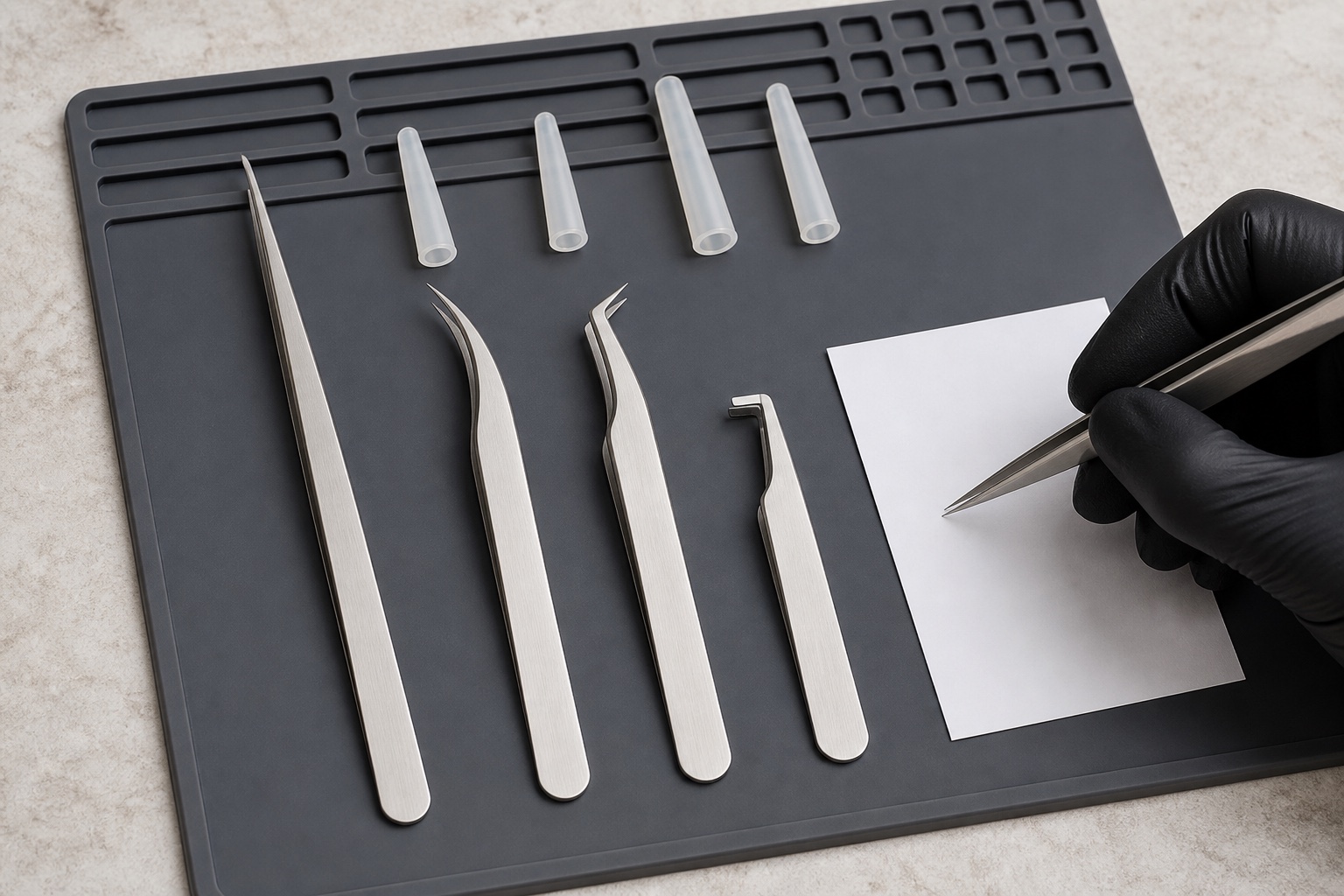
An isolation tweezer must create and hold a clear working gap without forcing the wrist to rotate or compressing neighbouring lashes. Straight, gently curved and angled designs are families, not a ranking. Compare tip visibility, length, tension, balance, edge finish and response in your normal posture. A model that feels precise in one practitioner's hand may cause fatigue or hide the base in another's.
The pickup tweezer must control the fibre or fan for the method you have learned. Closure can be concentrated or distributed along a working zone. Test it with the actual fibre and repeated light pressure, not only by squeezing empty tips together. For volume, pickup geometry must support the taught fan-building method; a product called universal does not prove equal control across classic, handmade volume and premade fans.
Inspect alignment, symmetry, contact zone, spring, weight, surface, sharp damage and lateral play. Test with the gloves and lighting you use, then repeat the gesture for several minutes. A very light tool with poor closure can demand more force than a balanced heavier one. Do not bend tips to create a new geometry unless the manufacturer provides a safe adjustment method and the tool can be reverified.
Keep a known, already-tested backup for each critical function. An unopened spare is not operational until closure and handling are confirmed. If a tweezer falls, leaves the processing flow, develops a burr or stops closing predictably, withdraw it. Protect tips during storage and transport while avoiding a closed damp environment. Label clean, used and inspection-required states clearly.
Lighting and support: visibility without glare or distorted posture
The lamp should illuminate both eyes evenly, reduce shadows from the hands and make isolation, direction, adhesive contact and residue readable. Look for stable height and angle adjustment, controllable intensity, diffusion, secure mounting, cleanable surfaces and dependable power. Colour rendering matters for tint, photography and skin observation, but a high number on the box never replaces a test in the actual room.
Position the source outside the client's direct line of sight and check reflections before work begins. Magnification may help but can narrow the field or pull the neck forward. Assess the lamp together with bed height, stool, head support, elbow freedom and tool position. If you must elevate the shoulders or hold the neck in sustained flexion to see, record and change the setup rather than accepting discomfort as part of the profession.
For electrical equipment, verify an identifiable manufacturer or responsible seller, instructions, correct power supply, applicable conformity information, intact cable and plug, stable base and warranty route. Requirements differ by market and product category. A CE mark is relevant in the European framework but is not a universal global approval, and an online marketplace listing is not technical documentation.
A backup lamp does not need to duplicate every feature, but the business needs a decision for power or equipment failure: safely complete the current controlled step if possible, remove active product where required, or stop. Do not continue precision eye-area work with a phone torch or moving client because only a few lashes remain.
Consumables: buy by contact, task and workflow
Consumables may include micro-applicators, spoolies, pads, tape, lint-free wipes, barriers, gloves where required, drop or strip surfaces, covers and waste bags. Similar appearance does not make products interchangeable. Check intended use, material, size, absorbency, fibre release, adhesive behaviour, compatibility with skin and cosmetics, storage and supplier instructions.
Pads and tape must protect and isolate without entering the lid margin, forcing the eye, lifting skin excessively or migrating during conversation. Keep a small set of meaningfully different options and record which anatomy each solves. Stacking several poorly fitting products does not create a stable fit. The pre-treatment lash consultation determines whether safe protection and comfortable closure are possible.
Prepare a client-specific quantity without leaving bulk packs open in the working field. A single-use applicator does not return to stock, product or another client. Tool size should fit the task: too large can carry excess liquid; too small can multiply friction and passes. Keep clean items dry and protected, and never relabel an item as reusable because stock is low.
Calculate average units per service, confirmed appointments, supplier lead time and a reasonable disruption margin. Stock should absorb a plausible delay without leaving months of material exposed to heat, dust, pressure or ageing. A purchase made only to reach free delivery can cost more when half the contents expire or are never used.
Extension adhesive: match the product to technique and measured conditions
One adhesive, one documented operating route
Identify, measure, use, close, record
Identify
Product, lot and instructions
Measure
Relevant room conditions
Control
Drop, dose and placement
Record
Opening, storage and withdrawal
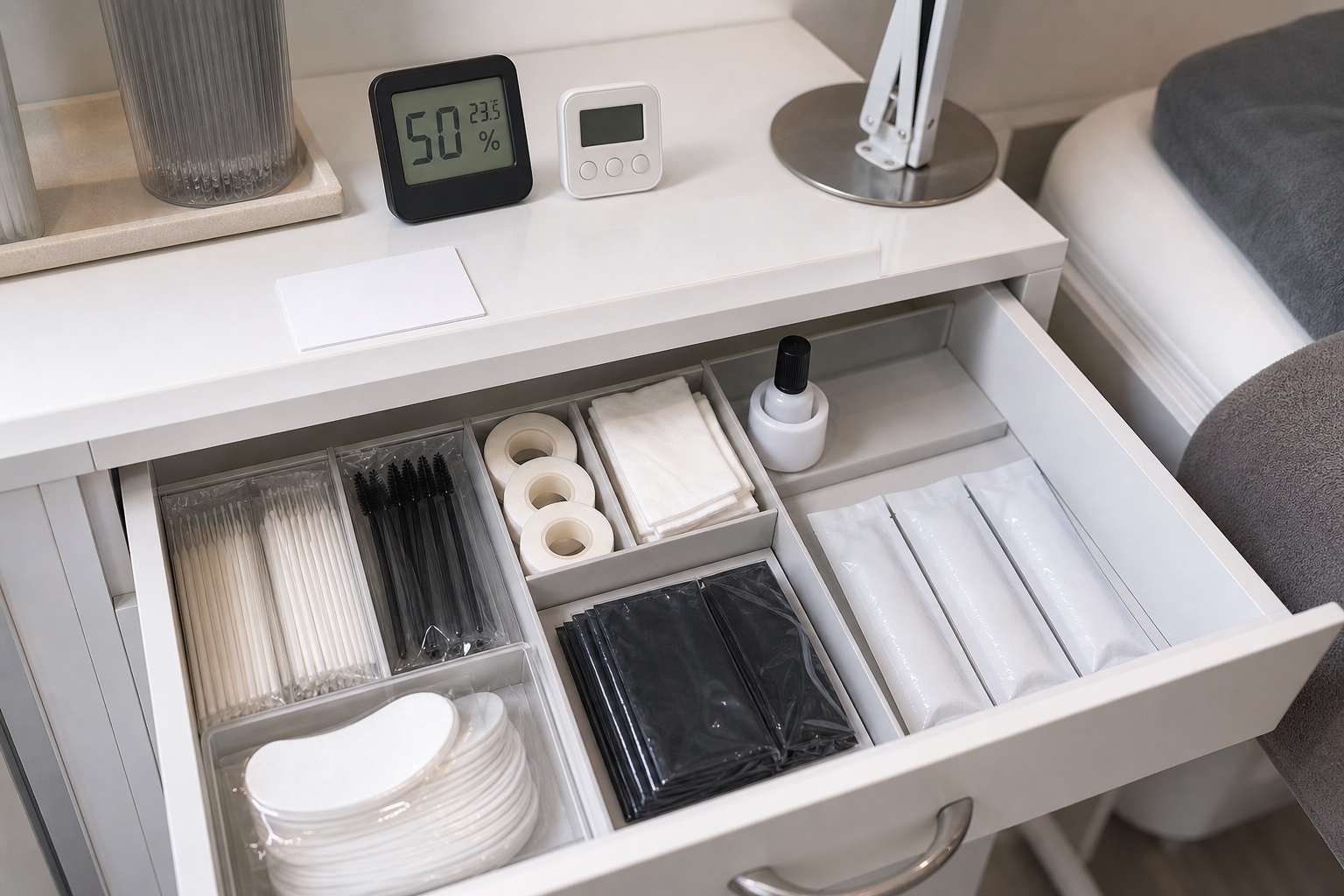
Do not choose adhesive only by advertised speed or retention. Compare professional intended use, chemistry, viscosity, colour, working behaviour within the stated environmental range, storage before and after opening, preparation, drop management, warnings, safety documentation, removal and incident instructions. Your real pace must be observed on training and controlled cases, not selected aspirationally from a product name.
Temperature and humidity belong to the exact adhesive. Measure near the service at the relevant time when the instructions require it; do not borrow the range of another bottle. A hygrometer describes conditions but does not diagnose retention. Airflow, ventilation, drop age, dose, contact area, fibre, preparation, placement and storage can all contribute. The product instructions and applicable safety documents remain primary; a generic timing chart cannot replace them.
Before purchase, require readable identification, supplier, batch or lot, warnings and documentation appropriate to your jurisdiction. Where a safety data sheet is required for a hazardous professional mixture, it communicates classification, handling, exposure controls, first aid, storage, transport and disposal. It does not replace the technical application instructions. Do not transfer adhesive to an anonymous bottle, mix products or improvise solvents around the nozzle.
Choose a size you can use within the manufacturer's post-opening period and storage conditions. Several open bottles create more dates and variables. A sealed reserve can protect continuity only if its storage and stock rotation are controlled. Record arrival, batch, opening, storage change and withdrawal. An altered smell, viscosity, closure or behaviour is a reason to quarantine and verify, not to apply more product.
Fibres, trays and working surfaces: a short usable range
Begin with curls, diameters and lengths that match your training and planned cases. Natural-lash capacity limits extension design; review natural eyelash anatomy and growth before treating a trend-driven length or map as an inventory requirement. More variations do not create better design if weight and direction are not assessed.
Mixed trays help reveal consumption but often empty at the common lengths while extremes remain. Single-length trays reduce interruption for stable high-use rows but require data. Start with enough range for training and realistic clients, mark rows used, and expand where repeated records show demand. Do not decant fibres from different products or batches into anonymous boxes.
Evaluate consistency, release from the strip, strip backing, residues, curl stability, labelling and replacement availability. A palette, tile or strip support should be stable, cleanable where reused, compatible with the material and positioned without wrist deviation. A fashionable accessory that cannot enter the hygiene workflow or hides the product identity does not belong in the kit.
Lash-lift and tint kits are complete systems, not spare extension items
A lash-lift kit may include staged solutions, shields, the permitted fixing or positioning medium, direction tools, protection, timer, applicators and finishing products. A tint kit may include the eye-area tint, compatible developer, permitted shades, measuring and mixing tools, barriers and removal materials. Every component, ratio, order, timing and storage rule comes from the exact system.
Do not buy a large collection of shields or tints before defining actual service needs. Choose genuinely distinct sizes and shapes that can be assessed and processed correctly. Do not mix generations or brands because the containers fit the same organiser. The safest-looking neat drawer can still contain an undocumented chemical combination.
US and EU eye-area rules are not identical, especially for colouring products. An item sold to professionals in one market may be restricted or unsuitable in another. Verify intended use and current local requirements before ordering across borders. The word professional, a foreign certification or an international shipping option does not itself establish permission.
Hygiene, removal, waste and incident readiness belong in the budget
A kit is incomplete without products and containers for hand hygiene, surface turnover, tool processing, single-use separation, clean storage, contaminated or used items and waste. Choose methods that are compatible with the actual tool materials and local requirements. A UV box, bead device or spray bottle must not be described as sterilisation or disinfection without a validated process and applicable evidence.
Professional removal is a core safety route, not an optional retail add-on. Keep the remover or system-directed reversal materials for the service performed, protective materials, applicators, sufficient light and exact instructions. Do not use oil, steam, pulling or another improvised method merely because the approved remover was omitted from the starter bundle.
Prepare incident information before opening a reactive product: product identity, safety data where relevant, manufacturer response, contact route, suitable first-aid provision within your training and local emergency pathway. This is not an invitation to diagnose or treat. It ensures that exposure is stopped, the correct product information is available and healthcare escalation is not delayed while a cupboard is searched.
Documentation and supplier checks before purchasing
For each product, verify legal identity, responsible business, intended area and user, ingredients or composition information where applicable, batch, quantity, warnings, instructions, expiry or post-opening information, storage and traceability. For equipment, verify model, electrical specification, instructions, warranty and applicable conformity information. Save the documents that belong to the exact variant, not a generic family brochure.
Compare suppliers on authenticity, documentation, storage, delivery conditions, damaged-goods process, recall communication and replacement—not only price. Anonymous marketplace listings, relabelled bottles, missing lots, copied instructions or contradictory claims create an information gap. A low price cannot repair a product whose route back to the responsible business is unclear.
On delivery, compare package, seal, lot, quantity, ordered variant and condition before moving stock into service. Do not open every unit unnecessarily. Quarantine leaking, overheated, damaged or mismatched goods, photograph the condition for the supplier and follow the documented return route. Never use a doubtful item to avoid losing a refund window.
Budget in stages: buy now, after evidence, or not yet
Staged buying protects technique and cash
Complete the core, observe use, then expand
Now
Complete safe minimum
Observe
Practice and stock records
Then
Add a proven missing function
Avoid
Anonymous and duplicate stock
Buy now: the complete minimum for the services currently trained and offered—visibility, ergonomic support, primary and backup tweezer functions, an appropriate fibre range, one controllable adhesive route, protection, consumables, professional removal, hygiene, timer, relevant environmental measurement, records, waste and incident readiness. Quantities should prevent foreseeable interruption without creating an ageing warehouse.
Buy after evidence: less common curls or colours, specialist volume tools, premium backup lighting, expanded trolley, travel kit, macro lens, additional chemical system or larger stock. The trigger should be a repeated case, measured time loss, stable consumption or a new trained service. A discount code, trend or fear of appearing under-equipped is not evidence.
Do not buy yet: several fast adhesives to test on clients, duplicate trays without consumption, systems outside your training, anonymous products, counterfeit branding, improvised sterilisers or devices promising to eliminate allergy and exposure risk. Calculate landed price, usable life, training, trial material, hygiene, storage, waste, replacement and management time. Cost per usable service matters more than unit price.
Inventory, opening dates and reorder points
A drawer is not an inventory
Stock, active, quarantine and disposal remain distinct
Receive
Check variant, seal and batch
Open
Date and store as directed
Use
Link the lot to the service
Withdraw
Record why and when
Create one inventory line per identified item: name, function, supplier, lot or serial where available, quantity, arrival, opening, expiry or inspection date, storage location, average use, reorder point and status. Keep unopened stock, active stock, quarantine and disposal physically and digitally distinct. A glance into the drawer does not reveal which bottle was opened first.
First-in-first-out is useful only when actual expiry and condition agree; the earlier valid date takes priority. Set a short recurring check and a deeper periodic stocktake. Compare expected use with actual depletion to find overdosing, waste, missing entries or unrealistic service costing. The lash client record connects each appointment to the products and lots actually used.
A reorder point combines expected units per appointment, bookings before delivery and a modest disruption buffer. It should change when supplier lead time or appointment mix changes. Overstock is not resilience when products age, storage becomes crowded or batches cannot be separated during a recall.
Mobile lash kit: transport is a separate operating system
A mobile kit is not a salon drawer transferred into one bag. Use a closed checklist, protected original containers, rigid tweezer protection, clean-used separation, temperature control where products require it, a safe waste route, stable lighting and power, client positioning, records and an incident plan. Keep chemicals separated from clean consumables and never rely on a host venue to provide unverified products.
Assess the venue before accepting the service: space, ventilation, electrical safety, lighting, privacy, water and hand hygiene access, surface turnover, posture and emergency access. If the documented product conditions or safe eye-area workflow cannot be recreated, postpone or use an appropriate fixed location. Mobility does not widen adhesive ranges or chemical-system tolerances.
After the appointment, used tools and waste do not travel beside clean stock. Apply the full processing route on return and restock only after verification. Record products and lots at the point of use; memory reconstructed at the end of a travel day is not reliable traceability.
Professional lash kit purchasing checklist
Current services and trained techniques are defined before products are selected.
Every tool has a task, handling test, maintenance route, hygiene status and verified backup where critical.
Lamp, bed, stool and supports produce even visibility without sustained awkward posture.
Consumables are suitable for the contact and task, protected in stock and prepared per client.
Adhesive has identified supplier, batch, instructions, safety information, measured conditions and controlled opening.
Fibres cover trained, frequent cases without an unmanageable range.
Lift and tint remain complete compatible systems with local market suitability verified.
Clean, used, quarantine, waste and active stock have separate labelled routes.
Inventory records openings, expiry or inspection, batches, usage and reorder points.
Cost per service includes trials, hygiene, waste, replacement, shipping and management time.
Connect purchasing decisions to demonstrations, supervised practice and feedback through the BeautyLearn lash course collection and the online lash-lift course. A credible course explains function, compatibility, limits and alternatives; it should not pressure a beginner to buy every visible item immediately.
Frequently asked questions about lash artist kits
How much does a professional lash artist kit cost?
There is no useful universal total because services, jurisdiction, equipment quality, training and stock depth vary. Price a complete function rather than comparing bundle totals: lighting and support, tested tool pairs, products, removal, hygiene, records and a small operating reserve. Then calculate usable services before expiry. A cheaper large kit can cost more when unsuitable fibres and open products are discarded.
Which tweezers does a beginner need?
For classic practice, at least one isolation tweezer and one pickup or placement tweezer compatible with the taught method, plus already-tested backups for any client service. Choose closure, tension, visibility and balance through repeated movement in the real posture. Do not purchase a volume shape merely because it appears in a comprehensive bundle before you are trained to use it.
Can one universal tweezer do everything?
One geometry may be versatile for a particular hand, fibre and method, but universal is not a performance standard. Isolation, classic pickup and different fan methods create different contact and visibility needs. Test the claimed range on practice material, keep a second tool for continuity and never continue after damage simply because no alternative was purchased.
Are light or heavy tweezers better?
Weight cannot be judged apart from spring tension, balance, grip and duration. A very light tweezer with a poor contact zone may require more force; a heavier well-balanced tool may feel steadier. Test repeated opening, precise closure and hand comfort in your working posture. Withdraw any tool that causes compensatory force or no longer closes predictably.
What lamp should a lash artist buy?
Choose a stable, adjustable, evenly diffused and cleanable lamp that illuminates both eyes without direct glare. Test shadows from your hands, colour rendering, flicker, reach, clamp or base, power supply and interaction with bed and stool height. Electrical conformity and warranty requirements depend on the market; a product photo and lumen claim are not sufficient evidence.
Is a magnifying lamp essential?
Not automatically. Magnification can improve visibility for some practitioners, but it can also narrow the field, create distortion or pull the head into a rigid position. Trial the working distance and full service sequence. Adequate base lighting, correction prescribed for your own vision and sound posture should not be replaced by a device chosen only for magnification.
Which eyelash extension adhesive is best for beginners?
The appropriate professional product is one matched to the technique, observed pace, measured environment and training, with clear instructions, supplier identity, lot and relevant safety documentation. The fastest cure claim is rarely the best learning choice. Do not experiment across several open bottles on clients; establish control with one documented system and approved removal route.
Are temperature and humidity ranges universal?
No. Use the current range and operating directions for the exact adhesive and measure in the relevant part of the room. Do not transfer numbers between products. Environmental readings are one part of troubleshooting, not proof of cause: preparation, amount, timing, contact, airflow, storage and practitioner technique must also be considered systematically.
How many adhesive bottles should be open?
Keep the minimum number needed for the services you can control. Every open bottle adds a date, storage condition and behaviour to track. A sealed backup can reduce disruption if stored exactly as directed. Do not open it for comparison without a defined reason, and withdraw any bottle whose identity, opening date, storage or performance is uncertain.
Do I need a safety data sheet for lash adhesive?
Where chemical classification and local workplace rules require an SDS, obtain the current document for the exact product and language, read it and integrate handling, storage, exposure, first-aid and disposal controls. An SDS is not an application manual and does not prove an adhesive is suitable for every lash technique or client. Keep technical instructions as a separate controlled document.
Can lash adhesive be kept in a refrigerator?
Only when the manufacturer gives that instruction for the specific sealed or opened state and explains conditioning before use. Do not store professional chemicals with food or use condensation-prone routines copied from another product. Record storage changes and allow the container to reach the required condition before opening if the instructions say so.
Which curls and lengths should I buy first?
Start with the range used in your training and suitable for the realistic natural lashes and designs you will assess. Mixed trays can reveal common lengths; move to single-length stock after usage data is stable. Avoid buying extreme lengths or many near-identical curls simply to display choice. A sustainable set begins with assessment, not inventory breadth.
Are all eye pads and tapes interchangeable?
No. Shape, thickness, material, adhesive, stretch, absorbency and edge stability vary. They must be suitable for the intended contact and protect without entering the lid margin, altering comfortable closure or migrating. Keep a few meaningfully different options, assess them before active product is prepared and never create fit by layering several unstable materials.
Can disposable spoolies or micro-applicators be reused for one client?
Follow the item's stated use and your validated hygiene protocol. In the professional workflow, a single-use applicator does not return to bulk stock or product after contact. If a clean spoolie is given to the client for home care, it leaves the salon circuit. Never preserve an item for the next appointment in a way that creates uncertain storage or identity.
Is a ready-made starter kit a good choice?
It can be useful when every component is identified, documented, compatible with the taught method and supplied in sensible quantities. The word kit does not prove completeness, legal market suitability or value. Compare the contents with your service map and price the missing lighting, removal, hygiene, backups and records before deciding whether the bundle is economical.
Is the kit included with a course enough to work on clients?
A course kit may be designed for exercises, not a complete client service, operational reserve, hygiene cycle or incident response. Check quantities, intended-use labels, expiry, documentation, backup tools and what must be purchased separately. Completion of a kit list also does not replace practice assessment, insurance or local occupational requirements.
How much consumable stock should I keep?
Estimate units per service, multiply by confirmed demand before the next delivery and add a modest delay buffer. Review actual depletion rather than preserving a permanent guess. Too little stock interrupts safe workflow; too much creates ageing, crowded storage and hidden expiry. Keep bulk packaging closed and issue only a client-specific working quantity.
How should tweezers be protected during transport?
Use a rigid holder and tip protection that prevents impact without trapping moisture. Keep verified clean tools separate from used or inspection-required items, and do not let heavy equipment move against them. After a fall or visible impact, withdraw the tweezer and inspect closure and edges before processing and returning it to service.
What must never be missing from a mobile kit?
A closed checklist, stable light and safe power, original protected products, critical backups, hand and surface workflow, clean-used separation, waste route, client and batch records, approved removal and incident information. If the venue cannot provide the conditions required by the product and precision eye-area work, the professional response is to postpone or relocate.
When is it time to expand the kit?
Expand when training, repeated client assessment, consumption records or measured workflow show a missing function. Examples include a consistently exhausted length, a tool geometry needed for a newly trained method or a second lamp after documented capacity risk. Do not expand because a trend, discount or social-media setup makes a controlled compact kit appear incomplete.
Should products be bought from overseas marketplaces?
Country of origin alone is not the decision. Verify that the exact product is lawful and correctly labelled for the market where you work, with a responsible business, traceability, readable instructions, storage and recall route. Cross-border availability does not prove local compliance. Avoid anonymous, relabelled or counterfeit goods and any listing whose technical claims cannot be confirmed.
What should be recorded when a product enters the kit?
Record name, exact variant, function, supplier, batch or serial where available, delivery condition, quantity, storage, expiry or review date and the controlled instruction version. Add opening and withdrawal dates later. This makes stock rotation, incident review and recall response possible without relying on packaging scattered across drawers or supplier order history alone.
Official sources and further reading
For hazardous professional mixtures in the European context, ECHA explains the purpose and content of safety data sheets. General consumer-product duties are set out in the current EU General Product Safety Regulation. Product-specific cosmetics, electrical and workplace requirements must still be checked separately.
For US eye-area context, FDA's Eye Cosmetic Safety and Using Cosmetics Safely stress intended eye-area use, clean instruments, uncontaminated products, label directions and stopping after irritation. These consumer resources do not replace professional product instructions or state licensing rules.
For repeated hand-tool selection, OSHA's ergonomic hand-tool guidance supports evaluating grip, force, posture and repeated use rather than selecting by appearance alone. Explore all BeautyLearn lash guides and the lash course collection to connect equipment with assessment, technique and feedback.
For the complete client-level overview, read the eyelash extensions guide: it connects classic, volume and hybrid principles with design, the appointment, realistic duration, infills, preparation, aftercare, removal and safety boundaries.
Study the classic technique in the one-to-one eyelash extensions guide: it makes natural-lash selection, isolation, off-skin distance, direction, contact, adhesive dose and sticky checks separately verifiable.
Compare every volume-family construction in the volume, hybrid and mega-volume guide: it keeps D labels, total load, fan anatomy, hybrid design, mega-volume prerequisites and troubleshooting inside one non-cannibalising technical intent.
For a complete specification and mapping framework, continue with the guide to extension curls, lengths, diameters and total load. It explains product-label limits, leverage, zone adaptations, grow-out and sustainable set design without splitting every curl or diameter into a competing page.
Connect eye references, visible balance and texture with the complete lash mapping guide. Cat eye, doll/open eye, squirrel and wispy stay together as one non-cannibalising design intent, with no universal map assigned to an eye-shape label.
For product identity, environmental control, storage, exposure and reaction boundaries, use the complete eyelash extension adhesive guide. It also owns irritation, sensitisation and patch-test limits, so no separate competing page is needed for glue allergy.
For duration, natural shedding, early-loss troubleshooting and the choice between maintenance and replacement, use the complete lash retention and infill guide. It also owns the search intent “why eyelash extensions fall out”, avoiding a second competing page.
For product choice, a no-pull sequence, residue inspection, incident response and stop criteria, use the professional eyelash extension removal guide. It also owns DIY removal and cream-versus-gel search intent, avoiding thin competing pages.
For cleanser choice, a complete wash-and-dry method, make-up, sleep, exercise, swimming and stop signs, use the complete eyelash extension aftercare guide. It also owns “when can lashes get wet” and sleeping-with-extensions intent, avoiding thin competing pages.
For natural-lash protection, load, stickies, tension, breakage and warning signs, use the complete eyelash extension safety guide. It owns “do extensions damage natural lashes?” intent without creating a competing fear-based page.
For customer-facing costs, inclusions, maintenance budgets and quote comparison, use the eyelash extension and lash lift cost guide. It avoids misleading international averages and remains separate from professional rate-card calculation.
Before taking paying clients, use the lash artist certificate and licensing guide to verify practitioner, premises, business and insurance requirements in the exact jurisdiction. It keeps legal-entry intent separate from technique and career development.
For a currency-neutral model of paid appointments, full service time, occupancy, costs and operating profit, use the lash artist earnings guide. It keeps professional earnings separate from client price comparison and future rate-card construction.
To build a traceable unit price from complete time, real product use, overhead, labour, fees and margin, use the professional lash service pricing guide. It keeps the rate card distinct from client quote comparison and monthly earnings analysis.
For a repeatable capture workflow covering permission, lighting, focus, honest before-and-after comparison, colour and editing limits, use the professional lash photography guide. It documents completed work without replacing live technical or safety checks.
To turn real work into a coherent path through evidence, authentic reviews, enquiry, booking, follow-up and appropriate return, use the lash portfolio and client acquisition guide. It measures qualified appointments without promising demand or income.
To adjust the complete lash workstation and plan static-load interruption, reach, light, tools and recovery without prescribing treatment, use the lash artist ergonomics guide. It complements technical and hygiene controls without replacing individual assessment.
For a cautious framework on apparent lash breakage or thinning, serum limits, treatment pauses and clinical referral, read the fragile or thinning eyelashes guide. It supports a stop-or-proceed decision without diagnosing the cause or promising regrowth.